ADAPTIVE PSO BASED REAL CODED
ALGORITHM FOR UNIT
COMMITMENT
R. K. SANTHI S. SUBRAMANIAN
Professors of Electrical Engineering,
Annamalai University, Annamalainagar-608002, Tamil Nadu, India *
Abstract
This paper presents an adaptive PSO based technique that involves real number matrix representing generation schedule for unit commitment. The new generation scheme for initial population and the repairing mechanism attempt to reduce the overall computation time. The algorithm adoptively adjusts the inertia weight and the acceleration coefficients in order to enhance the search process. Numerical results on systems up to 100 generating units display the effectiveness of the proposed strategy.
Keywords: Unit commitment; particle swarm optimization.
Nomenclature
ACT Average Computation Time ED Economic Load Dispatch EPM EP based Method
FLAPC Full Load Average Production Cost GAM GA based Method
LRM Lagrangian Relaxation Method LRGAM combined LR and GA based method PSO Particle Swarm Optimization PA Proposed Algorithm UC Unit Commitment
c b
a, , fuel cost coefficients i
CST cold start up cost of unit-i ($)
2 1&c
c acceleration coefficients )
(Pit
F generator fuel cost function ($/hr) G real number matrix
t i
G, real power generation of unit i at hour-t i
HST hot start up cost of unit-i ($)
max
K maximum number of iterations N number of generating units
n number of particles in the population
max min&
i
i P
P minimum and maximum real power generation of unit i respectively t
i
P real power generation of unit-i at hour-t load
t
P load demand at hour-t t
R spinning reserve at hour-t
2 1&r
r uniformly distributed random numbers in the range of [0,1] t
i
ST startup cost of unit-i at hour-t T total number of hours
cold i
down i
T minimum down time of unit-i (hours) off
i
T continuously off time of unit-i (hours) on
i
T continuously on time of unit-i (hours) up
i
T minimum up time of unit-i (hours) t
i
U, on/off status of unit-i at hour-t
) (k
Vi velocity of ith moving particle
max ,
j
V velocity limiter of the jthdimension of the particle )
(k
w inertia weight )
(k
Xi candidate solution of the ith particle
max , min
, , j
j X
X minimum and maximum of the jthdimension of the particle )
(
* k
X particle best )
(
* *
k
X global best
decrement constant smaller than but close to 1 )
, (PU
cost function to be minimized over the scheduling period superscripts ini& fin initial and final values respectively
1. Introduction
Present day power systems have the problem of deciding how best to meet the varying power demand that has a daily and weekly cycle in order to maintain a high degree of economy and reliability. Among the options that are available for an engineer in choosing how to operate the system, unit commitment (UC) is the most significant. UC determines the optimal scheduling of the generating units along with their generation levels at minimum operating costs while satisfying the system and unit constraints. The decision variables include the binary UC variables and real valued economic dispatch (ED) variables. The UC variables describe the ON/OFF status while the ED variables indicate the generation levels of the generators at each hour of the planning period. Thus, the UC problem can be formulated as a non-linear, large-scale, mixed-integer combinatorial optimization problem, which is quite difficult due to its inherent high dimensional, non-convex, discrete and nonlinear nature [1]. Besides, the dimension of the problem increases rapidly with the system size and the scheduling horizon.
Over the years numerous methods with various degrees of near-optimality, efficiency, ability to handle difficult constraints and heuristics, have been suggested in the literature. Specifically they are priority list [2,3] methods, integer programming [4], mixed-integer programming [5], dynamic programming [6,7], branch-and bound [8] and Lagrangian relaxation methods (LRM) [9-11]. Among these, the priority list method is simple and fast but the quality of final solution is not guaranteed to be good. Dynamic programming methods that are based on priority lists are flexible but are computationally expensive. The drawback with the branch and bound method is the exponential growth in the execution time with the increase in the size of the UC problem. The integer and mixed integer methods require major assumptions that limit the search space and adopt linear programming techniques to obtain integer solution. The LRM provides a fast solution but suffers from numerical convergence and solution quality problems. The above techniques come under deterministic search approaches.
The aim of this paper is to develop a PSO based methodology that involves real coded matrix for representing the decision variables besides adjusting adoptively the inertia weight and the acceleration coefficients in order to enhance the search process for UC problem. The proposed algorithm (PA) is tested on systems up to 100 generating units and the results presented to exhibit the performance.
2. Problem Description
The main objective of UC problem is to minimize the overall system production cost over the scheduled time horizon under the spinning reserve and operational constraints of generator units. This constrained optimization problem is formulated as
Minimize
itT t N i t i t i t i
i P ST U U
F U P , 1 1 1 , 1 ) ( ) , (
(1) where
Fi(Pit)aiPit2biPit ci
Subject to
Power balance constraint
0 1 ,
N i t i t i loadt P U
P (2) Spinning reserve constraint:
N i t i i t loadt R P U
P
1
,
max 0 (3)
Generation limit constraints:
t i i t i t i
i U P P U
Pmin , max , (4)
i1,2,,N Minimum up and down time constraints:
otherwise or T T if T T if
U ioff idown up i on i t i 1 0 0 1
, (5)
Startup Cost: down i cold i off i i down i cold i off i down i i i T T T if CST T T T T if HST
ST (6)
3. Adaptive Particle Swarm Optimization
PSO was introduced by Kennedy and Eberhart as a modern heuristic optimizer. It is a population-based stochastic optimization technique modeled on swarm intelligence. Swarm-intelligence, also referred to as collective intelligence, is based on social-psychological principles and provides insights into social behavior, as well as contributing to engineering applications. The PSO system combines a social-only model and a cognition-only model [19].
In this approach, a population of m-individuals, called particlesX(k), is initialized with random guesses in the problem space. Each particle represents a candidate solution to the problem at hand. These particles fly around in a multidimensional search space with a velocity, V(k).
( 1) ( 1)
) 1 ( ) 1 ( ) 1 ( ). ( ) ( * * 2 2 * 1 1 k X k X r c k X k X r c k V t w k V i i i i i n
i1,2,, (7) ) ( ) 1 ( )
(k X k V k
X (8) The inertia weight w(k) is gradually decreased during the iterative process using the relation
) 1 ( )
(k wk
w (9) The iterative process of updating the particle positions and velocities based on the objective function values is continued until the desired conditions are satisfied.
The time varying inertia weight that is linearly reduced during the iterations in order to enhance the computational efficiency is suggested in [20] instead of using Eq. (9).
fin ini
iniw K k K w w k
w
max max )
( (10)
The time-varying acceleration coefficients are introduced in [21] with a view to efficiently control the search process and convergence to the global solution. A large cognitive component and small social component at the beginning allows particles to move around the search space instead of prematurely moving towards the population best. A small cognitive component and a large social component during the latter stage allow the particles to converge to the global optimum.
fin ini
ini fin iniini fin ini ini fin c c c K k c c c c c c K k c c c 2 2 2 max 2 2 2 1 1 1 max 1 1 1 , , (11) In the conventional PSO, a fixed velocity limiter, which prevents particles moving too rapidly from one region in search space to another, for each dimension is usually considered as a proportion of the allowable position range. However selecting a proper velocity limiter is difficult, especially for complex problems. A higher velocity limiter is usually required for initial stages of the search process so that the particles can search different regions of the solution space. On the other hand, a lower velocity limiter is preferred for the final stages of the search process in order to obtain a better convergence. The selection of this value is nontrivial and very important in view of obtaining better overall performance of the algorithm. The following velocity limiter that adaptively sets the maximum allowable velocity [22] offers good exploration capability and convergence behavior.
) ( ,max ,min
max
, j j
j R X X
V (12) where
fin ini ini
fin
ini R R
K k R R R
R
( ) ,
max (13)
In the proposed formulation, the inertia weight, acceleration coefficients and maximum velocity limiter are adaptively changed with a view of enhancing the computational efficiency, improving the search capabilities and obtaining the global optimal solution.
4. Proposed Algorithm
problem is solved for each binary trial solution and cost function evaluated besides checking for constraint violations.
The method proposed in this paper uses a real number matrix to represent the generation schedule and a fixed threshold to obtain discrete variables. The PSO is used to obtain optimal generations and schedules using these variables. An efficient repairing mechanism is used to handle constraints with a goal of enhancing the search process, improving the computational efficiency and obtaining the global solution. The algorithm also adjusts adaptively the time varying inertia weight and acceleration coefficients in order to provide a balance between global and local explorations.
4.1 Representation of PSO variables
The particle that represents generation schedule of the proposed approach is denoted by a real number matrix G as shown in Fig. 1. The part of the particle Gi,t represents real power generation of unit-i at hour-t. In this representation, if Gi,jequals zero, Ui,j is zero; else Ui,j is one.
1 2 3 4 … T
1 G1,1 G1,2 G1,3 G1,4 … G1,T 2 G2,1 G2,2 G2,3 G2,4 … G2,T .
. . .
. .
. .
. .
. .
. . N GN,1 GN,2 GN,3 GN,4 … GN,T
Fig.1 Representation of a particle
4.2 Generating Initial Population
It is difficult to generate feasible solution when initial population is generated at random. The procedure described below, intends to create a good starting solution, is used to form the initial population.
i. Sort the generating units in ascending order of full load average production cost (FLAPC) and commit the groups of identical units with least FLAPC one by one unit until the power balance constraint is satisfied for each interval. Then carry out ED based on the principle of equal incremental cost as the fuel cost is represented by a quadratic cost function [1] at each interval. The generation schedule obtained over the planning period forms particle-1. The generations for decommitted units are set to be zero.
ii. Generate remaining particles one by one by performing the following the steps. a. Set particle i2
b. Set columnj1 of the particle-i
c. Generate a random number in the range (0, N). d. Choose randomly any two particle position in column-j
e. Alter them randomly within their respective limits in such a way to satisfy the power balance constraint, Eq. (2).
f. Repeat steps (d-e) generating units are at least perturbed
g. Check whether all columns in particle-i are considered. If not, choose next column-j and repeat steps (c-f).
h. Check whether the required number of particles are generated. If not, choose the next particle-i and repeat steps (b-g).
iii. Stop
4.3 Repair Algorithm
Spinning reserve, minimum up/down time constraints are important in UC problems. During iterative process, these constraints are often violated and the system may suffer from deficiency in units. At this stage, a repair algorithm can enhance the solution process. The proposed repair algorithm is outlined below.
otherwise
P G P if
P G P if
P G if
P G P
G
i j i i
i j i i
i j i
i j i i j
i max
, min
max ,
min max ,
min , max
,
, 0
, ,
,
where is a constant in the range of (0,1)
2. If spinning reserve constraint is not satisfied, randomly change an off status unit to on and set the corresponding generation to its lower limit.
3. If the net minimum power generation of on status units is greater than the power demand, randomly change an on status unit to off by setting its generation to zero.
4. If minimum up/down time constraint is violated, commit or decommit minimum number of units in order to overcome this violation. If a unit is committed, set the generation to its lower limit.
5. If the power balance constraint is not met at each hour, perturb the generation of the committed units in the respective column till it satisfies the constraint.
6. Repeat steps 1-5 till all the constraints are satisfied. 4.4 Cost Evaluation
The PSO searches for the optimal solution by minimizing a cost function. The net fuel and start-up costs of the generating units, Eq. (1), are considered as the cost function to be minimized in the proposed approach. 4.5 Stopping Criteria
The process of generating new particles can be terminated either after a fixed number of iterations or if there is no further significant improvement in the global best solution.
4.6 Algorithm
The algorithm of the proposed algorithm for UC problem is outlined. 1. Read the input data of the UC problem
2. Choose population size, m, and other PSO parameters 3. Set k0
4. Randomly generate initial population consisting mparticles using the procedure described in section 4.2.
5. Randomly generate m initial velocity values. 6. kk1
7. Repair the particles to satisfy the spinning reserve and minimum up/down constraints by following the procedure in section 4.3.
8. Compute the cost function using Eq. (1).
9. Search for particle best and global best positions and store them. 10.Obtain values for w(k),c1&c2 and Vj,maxusing Eqs. 10, 11 and 12. 11.Update particle velocity and positions using Eqs. 7 and 10.
12.Check for convergence. If converged, stop and print the optimal solution corresponding to the global best position. Otherwise, go to step 6.
5. Simulation Results
The average computation time (ACT) of the PA is compared with that of evolutionary algorithms of GAM, EPM and LRGAM in Table. 2. The computation times given in articles [12] and [15] for GAM, EPM and LRGAM were measured before a decade and hence suitably scaled down using a factor of 0.5 with a view to compare with the computation times of PA executed using the present day fast computers. From this table, it is very clear that the PA is reasonably faster than the other three methods.
Table 1. Comparison of fuel cost
Number of units Best Fuel Cost ($)
LRM [12] EALRM [11] GAM [12] EPM [15] LRGAM [10] PA
10 565825 565508 565825 564551 564800 564245
20 1130660 1126720 1126243 1125494 1122622 1125517
40 2258503 2249790 2251911 2249093 2242178 2249714
60 3394066 3371188 3376625 3371611 3371079 3375064
80 4526022 4494487 4504933 4498479 4501844 4505615
100 5257277 5615893 5627437 5623885 5613127 5626513
Table. 2 Comparison of ACT
GAM [12] EPM [15] LRGAM [10] PA
10 110 50 259 57
20 367 170 574 163
40 1349 588 1083 573
60 2920 1134 1208 1120
80 5018 1792 1692 1613
100 7865 3060 2023 1905
7. Conclusions
A real coded matrix based PSO algorithm has been proposed for unit commitment in this paper. This method has adaptively adjusted the inertia weight and the acceleration coefficients to enhance the search process. The repairing strategy has ensured feasible solution in the population. The method has avoided ED computations during the PSO iterations. The results on various test systems have clearly exhibited the superior performance of the proposed algorithm. This method has been found to be ideally suitable for practical applications.
Acknowledgement
The authors gratefully acknowledge the authorities of Annamalai University for the facilities offered to carryout this work.
Appendix
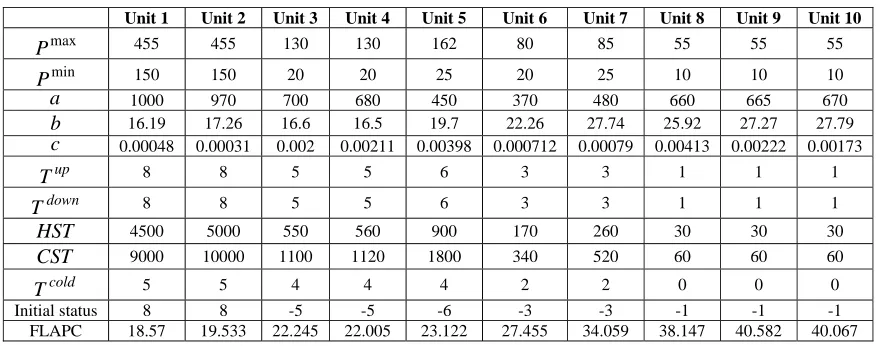
Table A-1. Unit data for the 10 unit system
Unit 1 Unit 2 Unit 3 Unit 4 Unit 5 Unit 6 Unit 7 Unit 8 Unit 9 Unit 10
max
P 455 455 130 130 162 80 85 55 55 55
min
P 150 150 20 20 25 20 25 10 10 10
a 1000 970 700 680 450 370 480 660 665 670
b 16.19 17.26 16.6 16.5 19.7 22.26 27.74 25.92 27.27 27.79
c 0.00048 0.00031 0.002 0.00211 0.00398 0.000712 0.00079 0.00413 0.00222 0.00173
up
T 8 8 5 5 6 3 3 1 1 1
down
T 8 8 5 5 6 3 3 1 1 1
HST 4500 5000 550 560 900 170 260 30 30 30
CST 9000 10000 1100 1120 1800 340 520 60 60 60
cold
T 5 5 4 4 4 2 2 0 0 0
Initial status 8 8 -5 -5 -6 -3 -3 -1 -1 -1
Table A-2. Load demand data
Hour 1 2 3 4 5 6 7 8 9 10 11 12
Load (MW) 700 750 850 950 1000 1100 1150 1200 1300 1400 1450 1500
Hour 13 14 15 16 17 18 19 20 21 22 23 24
Load (MW) 1400 1300 1200 1050 1000 1100 1200 1400 1300 1100 900 800
References
[1] AJ. Wood and BF. Wollenberg. (1996). Power generation, operation and control. John Wiley and sons, New York.
[2] HH. Happ, RC. Johnson and WJ. Wright. (1971). Large Scale Hydrothermal unit Commitment method and results. IEEE Trans. On PAS, PAS – 90: 1373-1383.
[3] CJ. Baldwin, KM. Dale and RF. Dittrich. (1960). A study of econmic shutdown of generating units in daily dispatch. AIEE Tr on PAS, 78: 1272-1284.
[4] TS. Dillon and KW. Edwin. (1978). Integer Programming approach to the problem of optimal unit commitment with probabilistic reserve Determination. IEEE Trans. on PAS, PAS – 97(6): 2154-2166.
[5] JA. Muckstadt and RC. Wilson. (1968). An application of mixed-integer programming duality to scheduling thermal generating systems”, IEEE Trans. Power App. Syst., 1968-1978.
[6] WL. Snyder, HD. Powell Jr and JC. Rayburn. (1987). Dynamic programming Approach to unit commitment. IEEE Trans. Power Syst., PWRS S-2(2): 339-350.
[7] WJ. Hobbs, G. Hermon, S. Warner and GB. Sheble. (1982). An Enhanced Dynamic programming Approach for unit commitment. IEEE Trans. on PAS, PAS-101: 79-86.
[8] AI. Cohen and M.Yoshimura. (1983). A branch and bound algorithm for unit commitment. IEEE Trans. on PAS, PAS-10: 444 – 451. [9] FN. Lee. (1989). A Fuel constrained unit commitment method. IEEE Trans. Power Syst., 4(3): 691-698.
[10] CP. Cheng, CW. Liu and CC. Liu. (2000). Unit commitment by Lagrangian relaxation and genetic algorithem, IEEE Trans. Power Syst., 15: 707-714.
[11] Weerakorn Ongsakul and Nit petcharaks. (2004). Unit commitment by enhanced adaptive Lagrangian Relaxation, IEEE Trans. Power Syst., 19(1): 620-628.
[12] SA. Kazarlis, AG. Bakirtzis and V. Petidis. (1996). A genetic algorithm solution to unit commitment problem, IEEE Trans. Power Syst., 11: 83-92.
[13] T. Senjyu, H. Yamashiro, K. Shimabukuro, K. Uezato and T. Funabashi. (2003). Fast solution for large-scale unit commitment problem using genetic algorithm, IEE Proc.-Gener. Transm. Distrib., 150(6): 753-760.
[14] DN. Simopoulos, SD. Kavatza and CD. Vournas. (2006). Unit commitment by an enhanced simulated annealing algorithm , IEEE Trans. Power Syst., 21(1): 68-76.
[15] K.A. Juste, H. Kita, E. Tanaka and J. Hasegawa. (1999). An evolutionary programming solution to the unit commitment problem, IEEE Trans. Power Syst., (14): 1452-1459.
[16] Yun-Won Jeong and Jong-Bae Park. (2010)A new quantum-inspired binary PSO: Application to unit commitment problems for power systems, , IEEE Trans. Power Syst., (25(3): 1486-1495.
[17] B. Zhao, CX. Guo, BR. Bai and YJ. Cao. (2006). An improved particle swarm optimization algorithm for unit commitment, Elect. Power Energy Syst., 28(7): 482-490.
[18] X. Yuan, H. Nie, A. Su, L. Wang and Y. Yuan. (2009). An improved binary particle swarm optimization for unit commitment problem, Journal of Expert Systems with Applications, 36(4): 8049-8055.
[19] J. Kennady and RC. Eberhart. (1995). Particle swarm optimization, Proc. of IEEE Int. Conf. on Neural Networks, Piscataway, NJ, IV: 1942-48.
[20] KT. Chaturvedi, M.Pandit and L.Srivastava. (2008). Self-organizing hierarchical particle swarm optimiation for nonconvex economic dispatch, IEEE Trans. Power Syst., 23(3): 1079-1089.
[21] Ratnaweera, SK. Halgamuge and HC. Watson. (2004). Self-organizing hierarchical particle swarm optimizer with time-varying acceleration coefficients, IEEE Trans. E Comput., 8(3): 240-255.