R E S E A R C H A R T I C L E
Open Access
Variability of physicians
’
thresholds for
neuroimaging in children with recurrent
headache
Carrie Daymont
1,2*, Patrick J McDonald
1,2,3, Kristy Wittmeier
1,2,4, Martin H Reed
5and Michael Moffatt
1,2,6Abstract
Background:We sought to determine the extent to which physicians agree about the appropriate decision threshold for recommending magnetic resonance imaging in a clinical practice guideline for children with recurrent headache.
Methods:We surveyed attending physicians in Canada practicing in community pediatrics, child neurology, pediatric radiology, and pediatric neurosurgery. For children in each of six risk categories, physicians were asked to determine whether they would recommend for or against routine magnetic resonance imaging of the brain in a clinical practice guideline for children with recurrent headache.
Results:Completed surveys were returned by 114 physicians. The proportion recommending routine neuroimaging for each risk group was 100% (50% risk), 99% (10% risk), 93% (4% risk), 54% (1% risk), 25% (0.4% risk), 4% (0.01% risk). Community pediatricians, physicians in practice >15 years, and physicians who believed they ordered neuroimaging less often than peers were less likely to recommend neuroimaging for the 1% risk group (all p < 0.05).
Conclusions:There is no consensus among pediatric specialists regarding the appropriate decision threshold for neuroimaging in a clinical practice guideline for children with recurrent headache. Because of the impact that individual threshold preferences may have on guidelines, these findings support the need for careful composition of guideline committees and consideration of the role of patient and family preferences. Our findings also support the need for transparency in guidelines regarding how evidence was translated into recommendations and how conflicts were resolved.
Keywords:Risk, Decision threshold, Clinical practice guideline, Medical decision-making, Headache
Background
Variable recommendations for breast cancer screening among countries and organizations demonstrate the complexity of translating evidence into recommendations, even in very well-studied conditions [1-4]. Disagreement can arise over a variety of issues, including which studies provide sufficiently valid evidence to be included in analysis, the relative value of various outcomes, and the degree to which personal preferences of patients and families should be considered [5-9]. Another issue which
may cause disagreement is the decision threshold: the level of risk above which testing or treatment should take place, and below which it is unnecessary [10-12].
Identification of the risk threshold for testing or treatment generally involves subjective judgment [13]. In some situations, decision analysis may help to identify an appropriate threshold. However, valid and reliable input required to obtain a valid and reliable result from decision analysis is unavailable for many conditions. Even when data are available, determining which outcomes should be considered in decision analysis, and how costs should be considered, involves some personal judgment. In practice, identification of a threshold may be entirely dependent on personal judgment, particularly for conditions with a relatively
* Correspondence:[email protected]
1
Department of Pediatrics and Child Health, The University of Manitoba, Winnipeg, MB, Canada
2
The Manitoba Institute of Child Health, 655A-715 McDermot Avenue, Winnipeg, MB R3E 0Z2, Canada
Full list of author information is available at the end of the article
small evidence base regarding the natural history of disease and effects of treatment. This dependence on personal judgment may contribute to variability in the practice of individual physicians as well as variability in recommendations of clinical practice guidelines produced about the same topic.
Thresholds for action are an important part of clinical prediction rules. Clinical prediction rules are sometimes able to identify groups of patients with very high or low levels of risk for which the appropriate recommendation is clear. However, some groups of patients identified by a clinical prediction rule may have a degree of risk for which there is no consensus about the appropriate recommendation. For example, in a recent clinical prediction rule for identifying intracranial pathology in children with minor head trauma, approximately 30% of children in the study were found to have a combined risk of 0.9% for intracranial pathology [14]. The clinical prediction rule publication recommended making decisions based on individual factors for children in this intermediate-risk category.
In this study, we sought to explore the variability among physicians regarding decision thresholds. We performed a survey to identify the degree of consensus among physicians from relevant specialties about the appropriate threshold for neuroimaging in children with recurrent headache when forming a clinical practice guideline based on a clinical prediction rule. We also sought to explore physician characteristics that may be associated with recommendations for or against neuroimaging at a given risk level.
Methods
Survey design
No validated tools were identified to address our questions; therefore, a survey was developed by the research team. The survey was refined through two pilot surveys, administered to twelve physicians each, with three physicians contributing to both pilot surveys. The survey was administered via SurveyMonkey (Palo Alto, California) (Additional file 1).
We aimed to evaluate thresholds using a method that would best approximate decisions made during clinical practice guideline development. Participants were asked to respond as if they were part of a committee developing clinical practice guidelines for children with recurrent headaches based on a hypothetical, well-validated clinical prediction rule. Participants were advised that follow-up would be recommended regardless of the recommendation regarding neuroimaging. Participants were asked to indicate whether they believed magnetic resonance imaging should be recommended or not recommended for children in each of six risk categories: 50% (1/2), 10% (1/10), 4% (1/25), 1% (1/100), 0.4% (1/250)
and 0.01% (1/10,000). The risk categories were chosen based on the pilot surveys, as well as a retrospective study of risk of pathology in children with headache and an associated cost-effectiveness analysis [15,16]. Participants were not provided with any corresponding clinical features for the hypothetical risk levels. An extremely high and an extremely low level of risk at which we expected no disagreement were included. Participants were also asked whether they would be willing to change their recommendation for the 1% risk group to achieve consensus if everyone else on the committee had chosen the opposite recommendation.
The final page of the survey included thirteen statements of beliefs about neuroimaging framed within the Theory of Planned Behavior [17-20]. Participants were asked to rate their level of agreement with the statements using a 7-point Likert scale. We initially identified 51 beliefs related to neuroimaging decisions based on literature and discussions with colleagues. In the interest of keeping the survey brief, we eliminated beliefs for which we anticipated a high degree of agreement, and included 13 belief statements in the final survey. The survey also included questions about advanced epidemiology training, participation in clinical practice guideline development, and the participants’perception of his or her own neuroimaging ordering frequency compared to peers.
Participants
The population of interest was physicians in Canada who are commonly involved in the care of children with recurrent headache or the pathology with which it may be associated. Attending physicians who were in active practice in one of the following four specialties were eligible for inclusion: community pediatricians, child neurologists, pediatric radiologists, and pediatric neurosurgeons.
Some community pediatricians in Canada practice primary care, although most see patients referred from family physicians. Two family physicians were included in the initial pilot, and both indicated that they would generally defer decisions about neuroimaging in children to pediatricians.
Recruitment
child neurologist indicated that we identified the vast majority of attending Canadian child neurologists.
Each participant was contacted by email three times, at varying times and days of the week. The emails were sent 1–2 weeks apart. The tone and length of the emails also varied [21]. No monetary incentive was offered. No identifying personal information was collected except for an option to provide an email address in order to ask questions or request a copy of the results.
Analysis
The primary outcome was the proportion of participants who would recommend neuroimaging for each risk category. The recommendation for the 1% risk category was used for further analysis because the highest level of disagreement was anticipated for this category. Fisher’s exact test was used to evaluate the association of eight physician characteristics and thirteen neuroimaging beliefs with the recommendation for the 1% risk category. Belief answers were converted to binary measures by combining all disagree and neutral answers in one category, and all agree answers in the other category. A p-value of 0.05 was used to determine statistical significance without a correction for multiple comparisons, as these analyses were exploratory and primarily for the purpose of hypothesis generation.
Nonresponders and missing data
In order to evaluate for possible nonresponse bias, responses of physicians who responded to the first notice were compared with physicians who responded to the second or third notice [22]. The characteristics of physicians who did not respond to the primary question were also compared with the characteristics of those who responded fully.
Ethics
Administration of the survey, and pilot surveys, was reviewed and approved by the Health Research Ethics Board at the University of Manitoba. The survey included
a consent disclosure statement on the first electronic page (Additional file 1).
Results
Responses
The survey was administered between October 2011 and February 2012. The overall response rate for the survey was 35% (Table 1). The response rate varied by specialty. Pediatric neurosurgeons had a response rate of 84%. Pediatric neurosurgeons were relatively few in number and were contacted by one of the authors, who is also a colleague.
Recommendations
No respondent had conflicting recommendations, defined as recommending neuroimaging for a group with a lower risk than a group for which they had recommended against neuroimaging.
For children with recurrent headache and a 1% risk of treatable pathology, 54% of surveyed physicians recom-mended routine neuroimaging and 46% recomrecom-mended against routine neuroimaging (Table 2). Forty-five percent of the respondents indicated they would be willing to change their response for the 1% risk group in order to achieve consensus with the guideline committee. Respondents who recommended for neuroimaging in the 1% risk group were less likely to be willing to change their answer than those recommending against neuroimaging (33% v 58%, p = 0.008 using Fisher’s exact test).
For the next-lowest risk category (0.4% risk) 25% of participants recommended routine neuroimaging. A small proportion of respondents (4%) recommended routine neuroimaging for patients in the lowest risk group (0.01% risk).
Most participants (93%) recommended routine neuroim-aging for children with a 4% risk. All but one respondent recommended routine neuroimaging for children with a 10% risk of treatable pathology, and all recommended routine neuroimaging for children with a 50% risk of treatable pathology.
Table 1 Response and question completion rates, overall and by specialty
Overall Pediatric neurosurgeons Child neurologists Pediatric radiologists Community pediatricians
Total # initially contacted 432 31 84 94 223
# (%) responded 152 26 33 25 68
(35%) (84%) (39%) (27%) (30%)
# respondents eligible 132 24 30 18 60
# (%) answered 1% threshold question
114 21 26 11 56
(86%) (88%) (87%) (61%) (93%)
# (%) completed last question 115 22 27 12 54
Association of recommendation with physician characteristics and beliefs
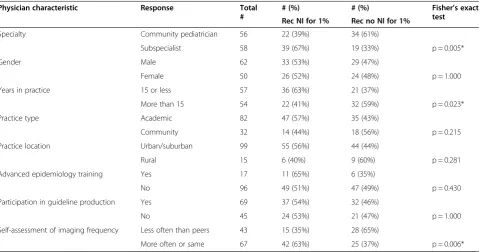
Three of the eight tested characteristics were significantly (p < 0.05) associated with recommendation for the 1% risk group (Table 3). Those in practice more than 15 years were less likely than those in practice fewer than 15 years to recommend neuroimaging (41% v. 63% p = 0.023). Community pediatricians were less likely than subspecial-ists to recommend neuroimaging (39% v. 67%, p = 0.005).
The response of community pediatricians did not vary by type of community practice (primary care versus consultant). Those physicians who believed that they ordered neuroimaging less often than their colleagues were less likely to recommend neuroimaging than those who believed they ordered neuroimaging at least as often as colleagues (35% v. 63%, p = 0.006).
A high degree of variability was seen in the level of agreement for some of the belief statements, particularly
Table 2 Recommendations for neuroimaging for each risk group, overall and by specialty
Risk group Percent and number recommending neuroimaging
Overall Pediatric neurosurgeons Child neurologists Pediatric radiologists Community pediatricians
50% 100% 100% 100% 100% 100%
116/116 23/23 26/26 11/11 56/56
10% 99% 96% 100% 100% 100%
114/115 22/23 26/26 11/11 55/55
4% 93% 95% 96% 100% 89%
107/115 21/22 25/26 11/11 50/56
1%* 54% 67% 65% 73% 39%
61/114 14/21 17/26 8/11 22/56
0.4% 25% 23% 37% 36% 18%
29/116 5/22 10/27 4/11 10/56
0.01% 4% 0% 8% 9% 4%
5/113 0/22 2/24 1/11 2/56
*Denotes association of recommendation with specialty (p < 0.05 using Fisher’s exact test).
Table 3 Association of physician characteristics with recommendation for 1% risk group
Physician characteristic Response Total #
# (%) # (%) Fisher’s exact test
Rec NI for 1% Rec no NI for 1%
Specialty Community pediatrician 56 22 (39%) 34 (61%)
Subspecialist 58 39 (67%) 19 (33%) p = 0.005*
Gender Male 62 33 (53%) 29 (47%)
Female 50 26 (52%) 24 (48%) p = 1.000
Years in practice 15 or less 57 36 (63%) 21 (37%)
More than 15 54 22 (41%) 32 (59%) p = 0.023*
Practice type Academic 82 47 (57%) 35 (43%)
Community 32 14 (44%) 18 (56%) p = 0.215
Practice location Urban/suburban 99 55 (56%) 44 (44%)
Rural 15 6 (40%) 9 (60%) p = 0.281
Advanced epidemiology training Yes 17 11 (65%) 6 (35%)
No 96 49 (51%) 47 (49%) p = 0.430
Participation in guideline production Yes 69 37 (54%) 32 (46%)
No 45 24 (53%) 21 (47%) p = 1.000
Self-assessment of imaging frequency Less often than peers 43 15 (35%) 28 (65%)
More often or same 67 42 (63%) 25 (37%) p = 0.006*
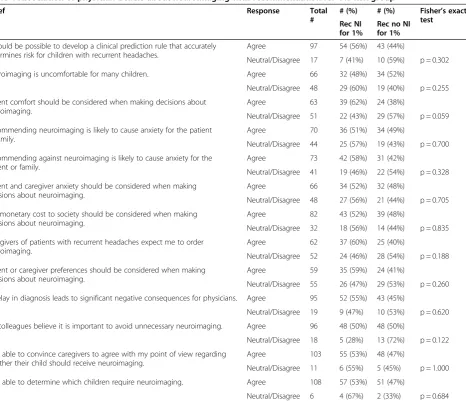
those relating to patient and family comfort, anxiety, and preferences regarding neuroimaging and the degree to which those factors should be taken into account when making decisions about neuroimaging (Table 4). There were no significant associations between agreement with any of the belief statements and recommendation for the 1% risk group. There were also no significant associations between the evaluated physician characteris-tics or beliefs and willingness to change response in order to achieve consensus.
We evaluated the 13 respondents with uncommon recommendations, including 5 who recommended for neuroimaging in the 0.01% risk group and 8 who recommended against neuroimaging in the 4% risk group (including 1 who also recommended against neuroimaging in the 10% risk group). Physicians with
outlying responses of either type did not share any uncommon characteristics or beliefs. All 5 respondents who recommended for neuroimaging in the 0.01% risk group indicated that they did believe it was possible for a clinical prediction rule to accurately predict risk. Ten of 13 (77%) of these respondents with uncommon responses would not have agreed to change their answer for children with a 1% risk in order to achieve consensus.
Late and incomplete responders
Physicians who responded to the first survey invitation were more likely to recommend neuroimaging for children with a 1% risk compared to physicians who responded to subsequent survey invitations (63% v 42%, Fisher’s exact p = 0.04). Physicians who responded to the first versus second or third survey invitations did not
Table 4 Association of physician beliefs about neuroimaging with recommendation for 1% risk group
Belief Response Total
#
# (%) # (%) Fisher’s exact test
Rec NI for 1%
Rec no NI for 1%
It would be possible to develop a clinical prediction rule that accurately determines risk for children with recurrent headaches.
Agree 97 54 (56%) 43 (44%)
Neutral/Disagree 17 7 (41%) 10 (59%) p = 0.302
Neuroimaging is uncomfortable for many children. Agree 66 32 (48%) 34 (52%)
Neutral/Disagree 48 29 (60%) 19 (40%) p = 0.255
Patient comfort should be considered when making decisions about neuroimaging.
Agree 63 39 (62%) 24 (38%)
Neutral/Disagree 51 22 (43%) 29 (57%) p = 0.059
Recommending neuroimaging is likely to cause anxiety for the patient or family.
Agree 70 36 (51%) 34 (49%)
Neutral/Disagree 44 25 (57%) 19 (43%) p = 0.700
Recommending against neuroimaging is likely to cause anxiety for the patient or family.
Agree 73 42 (58%) 31 (42%)
Neutral/Disagree 41 19 (46%) 22 (54%) p = 0.328
Patient and caregiver anxiety should be considered when making decisions about neuroimaging.
Agree 66 34 (52%) 32 (48%)
Neutral/Disagree 48 27 (56%) 21 (44%) p = 0.705
The monetary cost to society should be considered when making decisions about neuroimaging.
Agree 82 43 (52%) 39 (48%)
Neutral/Disagree 32 18 (56%) 14 (44%) p = 0.835
Caregivers of patients with recurrent headaches expect me to order neuroimaging.
Agree 62 37 (60%) 25 (40%)
Neutral/Disagree 52 24 (46%) 28 (54%) p = 0.188
Patient or caregiver preferences should be considered when making decisions about neuroimaging.
Agree 59 35 (59%) 24 (41%)
Neutral/Disagree 55 26 (47%) 29 (53%) p = 0.260
A delay in diagnosis leads to significant negative consequences for physicians. Agree 95 52 (55%) 43 (45%)
Neutral/Disagree 19 9 (47%) 10 (53%) p = 0.620
My colleagues believe it is important to avoid unnecessary neuroimaging. Agree 96 48 (50%) 48 (50%)
Neutral/Disagree 18 5 (28%) 13 (72%) p = 0.122
I am able to convince caregivers to agree with my point of view regarding whether their child should receive neuroimaging.
Agree 103 55 (53%) 48 (47%)
Neutral/Disagree 11 6 (55%) 5 (45%) p = 1.000
I am able to determine which children require neuroimaging. Agree 108 57 (53%) 51 (47%)
Neutral/Disagree 6 4 (67%) 2 (33%) p = 0.684
significantly differ regarding responses to any of the eight characteristics, agreement with belief statements, or willingness to change response in order to achieve consensus.
Eighteen of the 132 eligible respondents did not answer the primary question of interest regarding the recommendation for the 1% risk group. There were two physician characteristics associated with an increased likelihood of providing a response to the primary survey question regarding the recommendation for children with a 1% risk. Community pediatricians were more likely than specialists to answer the 1% question (93% v. 81%, p = 0.03), and those in community settings were more likely to answer the 1% risk question than those in academic settings (97% v 83%, p = 0.03).
Comments
Several respondents mentioned in free text comments that it was difficult to answer some of the belief questions because they were dependent on circumstances. For example, a physician noted that if a child has a very high risk of pathology, parent preferences should not be considered but that in a patient with lower risk, parent preferences should be taken into account.
Discussion
There is substantial disagreement among pediatric specialists regarding the appropriate recommendation for children with recurrent headache and a 0.4% or 1% of treatable pathology. Community pediatric practice, more than 15 years in practice, and self-perception of ordering neuroimaging less often than peers were significantly associated with a decreased likelihood to recommend routine neuroimaging for children with a 1% risk of treatable pathology. Respondents were mixed re-garding their willingness to adjust their recommendations in order to achieve consensus with a guideline committee.
More research regarding the risks and benefits of neuroimaging in this population would potentially improve our ability to identify the best threshold for neuroimaging in children with recurrent headache, but some issues crucial for effective formal decision analysis will likely never be resolved. Most importantly, we will almost certainly never be able to quantify the impact of delayed diagnosis on the long-term outcomes of children with intracranial pathology who present with headache.
Our findings indicate that recommendations for children with intermediate degrees of risk may be strongly influenced by characteristics and beliefs of individual guideline committee members, particularly their beliefs about appropriate decision thresholds and the strengths of these beliefs. These findings provide support for recommendations from the Institute of
Medicine and others for guidelines to include information about the methods for translating evidence into recom-mendations and also to describe how conflicts were resolved [5,23,24].
The findings also support recommendations that guideline development committee members should include a diverse representation of health care professionals in addition to other stakeholders [5,23-25]. Including physicians with variable durations of practice and ensuring representation from both academic and community practice may be factors to consider when evaluating the diversity of a committee. It may also be appropriate to consider identifying members with varied self-perceptions of practice style. Some organizations producing guidelines may even wish to consider more explicit evaluations or discussions regarding the decision threshold preferences of potential committee members. Organizations producing guidelines may want to insure that those with less common views are included on guideline committees. Others may feel that certain views about thresholds do not represent the values of the organization or that physicians with less common views would have a disproportionate impact on the recommendations.
Particularly when there is a lack of consensus among health care professionals regarding the appropriate recom-mendation, universal recommendations in a guideline may not be appropriate [23,26-28]. Our findings support the use of explicit discussions in guidelines regarding the role of patient and family preferences, as demonstrated in clinical practice guidelines recently produced by the American Academy of Pediatrics [29-32].
Our study had limitations, including a response rate of 35%. This low response rate is of particular interest because physicians who responded earlier were more likely to recommend neuroimaging for the 1% group than physicians who responded later, indicating possible nonresponse bias. However, our primary conclusion indicating disagreement among physicians regarding the appropriate recommendation for children with recurrent headache and a 1% risk of treatable pathology would very likely remain true even with a large degree of non-response bias. We identified no other differences in physician characteristics or beliefs between early and late responders, including no difference in the rate of participation in guideline production. It is possible that timing of response may be associated with some important characteristics that we did not evaluate, or for which we did not have the power to detect a difference.
strongly they agree, as recommended by several respon-dents in free-text comments. We only presented the risk of treatable pathology, but many physicians may make decisions based on the risk of any pathology, even if it is not treatable [33]. We presented the risk in two formats simultaneously, and did not evaluate alternate methods of presenting the degree of risk. Physician responses to the survey may or may not reflect decisions they would make in real life. The fact that physicians’self-assessment of their imaging frequency compared to their peers were signifi-cantly associated with their recommendations is one indica-tion that disagreement regarding appropriate thresholds in the survey answers may reflect real-world behavior.
No association was present between recommendations and beliefs based on constructs from the Theory of Planned Behavior. This may have resulted from a lack of power to detect important differences, the way we asked about beliefs, or a true lack of association between these beliefs and decision thresholds in this context. In the interest of keeping the survey brief, we did not explore other factors that may affect decision thresholds, such as physician risk preference or risk tolerance, which have been shown to have variable associations with decision-making [34-40].
Conclusion
There is no consensus among pediatricians and pediatric subspecialists in Canada regarding the appropriate neuroimaging recommendation for children with a 1% risk of intracranial pathology. More evidence regarding the risks of neuroimaging and the benefit of early identification of pathology may help to guide further recommendations, but more evidence is unlikely to resolve the variability completely. Further research into factors that affect physician decision thresholds and other factors that drive variability in guideline production and individual physician decision-making could lead to improvements in the guideline production process and provide information to researchers who hope to develop the evidence that supports guidelines. Organizations planning to produce clinical practice guidelines should anticipate differing opinions regarding the translation of evidence into guide-lines due to variable decision thresholds and should ensure transparency regarding the methods used to select committee members, to determine the content and strength of recommendations, and to resolve conflicts.
Additional file
Additional file 1:Pediatric Neuroimaging Survey.
Competing interests
The authors declare that they have no competing interests.
Authors’contributions
CD contributed to the conception of the study and design of the survey, distributed the survey, analyzed and interpreted the data, drafted the manuscript, and approved the final manuscript as submitted. PM contributed to the design of the survey, recruited pediatric neurosurgeons, edited the manuscript for important content, and approved the final manuscript as submitted. KW interpreted the data, edited the manuscript for important content, and approved the final manuscript as submitted. MR contributed to the design of the survey, assisted with recruitment of pediatric radiologists, edited the manuscript for important content, and approved the final manuscript as submitted. MM contributed to the conception of the study and design of the survey, edited the manuscript for important content, and approved the final manuscript as submitted.
Acknowledgements
We thank Dr. Fran Booth and Dr. Ruth Grimes for their assistance with recruiting physicians. We are very grateful to all of the physicians who took the time to respond to the survey.
We gratefully acknowledge funding from the Manitoba Health Research Council and the Manitoba Institute of Child Health, which paid for Dr. Daymont’s research time. The funders had no involvement or input into the study design, implementation, analysis, or decision to submit for publication. The authors have no conflicts of interest to disclose.
Author details
1Department of Pediatrics and Child Health, The University of Manitoba, Winnipeg, MB, Canada.2The Manitoba Institute of Child Health, 655A-715 McDermot Avenue, Winnipeg, MB R3E 0Z2, Canada.3Section of Neurosurgery, The University of Manitoba, Winnipeg, MB, Canada.4The George and Fay Yee Centre for Healthcare Innovation, Winnipeg, MB, Canada.5Department of Radiology, The University of Manitoba, Winnipeg, MB, Canada.6Department of Community Health Sciences, The University of Manitoba, Winnipeg, MB, Canada.
Received: 29 October 2013 Accepted: 19 June 2014 Published: 23 June 2014
References
1. Screening for breast cancer:U.S. Preventive Services Task Force recommendation statement.Ann Intern Med2009,151(10):716–726. W–236. doi: 10.1059/0003-4819-151-10-200911170-00008. 2. Peres J:Mammography screening: after the storm, calls for more
personalized approaches.J Natl Cancer Inst2009. doi: 10.1093/jnci/djp496. 3. Smith RA, Saslow D, Sawyer KA, Burke W, Costanza M, Evans WP, Foster RS, Hendrick E, Eyre H, Sener S:American Cancer Society guidelines for breast cancer screening: update 2003.CA Cancer J Clin2003,53(3):141–169. 4. The Canadian Task Force on Preventive Health Care:Recommendations on
screening for breast cancer in average-risk women aged 40–74 years. CMAJ2011,183(17):1991–2001. doi: 10.1503/cmaj.110334.
5. Brouwers MC, Kho ME, Browman GP, Burgers JS, Cluzeau F, Feder G, Fervers B, Graham ID, Grimshaw J, Hanna SE, Littlejohns P, Makarski J, Zitzelsberger L: AGREE II: Advancing guideline development, reporting and evaluation in health care.CMAJ2010. doi: 10.1503/cmaj.090449.
6. Barratt A:Evidence based medicine and shared decision making: the challenge of getting both evidence and preferences into health care. Patient Educ Couns2008,73(3):407–412. doi: 10.1016/j.pec.2008.07.054. 7. Veatch RM:Reasons physicians do not follow clinical practice guidelines.
JAMA2000,283(13):1685. author reply 1686.
8. Woolf S, Schünemann HJ, Eccles MP, Grimshaw JM, Shekelle P:Developing clinical practice guidelines: types of evidence and outcomes; values and economics, synthesis, grading, and presentation and deriving recommendations.Implement Sci2012,7:61. doi: 10.1186/1748-5908-7-61. 9. Taylor JA, Opel DJ:Choriophobia: A 1-act play.Pediatrics2012,
130(2):342–346. doi: 10.1542/peds.2012-0106.
10. Ben-Haim Y, Zacksenhouse M, Keren C, Dacso CC:Do we know how to set decision thresholds for diabetes?Med Hypotheses2009,73(2):189–193. doi: 10.1016/j.mehy.2008.12.053.
12. Graham ID, Stiell IG, Laupacis A, O’Connor AM, Wells GA:Emergency physicians’attitudes toward and use of clinical decision rules for radiography.Acad Emerg Med1998,5(2):134–140.
13. Jaeschke R, Guyatt GH, Sackett DL:Users’guides to the medical literature. III. How to use an article about a diagnostic test. B. What are the results and will they help me in caring for my patients? The Evidence-Based Medicine Working Group.JAMA1994,271(9):703–707.
14. Kuppermann N, Holmes JF, Dayan PS, Hoyle JD, Atabaki SM, Holubkov R, Nadel FM, Monroe D, Stanley RM, Borgialli DA, Badawy MK, Schunk JE, Quayle KS, Mahajan P, Lichenstein R, Lillis KA, Tunik MG, Jacobs ES, Callhan JM, Gorelick MH, Glass TF, Lee LK, Bachman MC, Cooper A, Powell EC, Gerardi MJ, Melville KA, Muizelaar JP, Wisner DH, Zuspan SJ,et al:Identification of children at very low risk of clinically-important brain injuries after head trauma: a prospective cohort study.Lancet2009,374(9696):1160–1170. doi: 10.1016/ S0140-6736(09)61558-0.
15. Medina LS, Pinter JD, Zurakowski D, Davis RG, Kuban K, Barnes PD:Children with headache: clinical predictors of surgical space-occupying lesions and the role of neuroimaging.Radiology1997,202(3):819–824. 16. Medina LS, Kuntz KM, Pomeroy S:Children with headache suspected of
having a brain tumor: a cost-effectiveness analysis of diagnostic strat-egies.Pediatrics2001,108(2):255–263.
17. Walker AE, Grimshaw JM, Armstrong EM:Salient beliefs and intentions to prescribe antibiotics for patients with a sore throat.Br J Health Psychol 2001,6(4):347–360. doi: 10.1348/135910701169250.
18. Grimshaw JM, Eccles MP, Steen N, Johnston M, Pitts NB, Glidewell L, Maclennan G, Thomas R, Bonetti D, Walker A:Applying psychological theories to evidence-based clinical practice: identifying factors predictive of lumbar spine x-ray for low back pain in UK primary care practice. Implement Sci2011,6(1):55. doi: 10.1186/1748-5908-6-55.
19. Millstein SG:Utility of the theories of reasoned action and planned behavior for predicting physician behavior: a prospective analysis. Health Psychol1996,15(5):398–402.
20. Glanz K, Rimer BK, Viswanath K:Health Behavior and Health Education: Theory, Research and Practice.San Francisco: Jossey-Bass; 2008. 21. Dillman DA, Dillman DA:Mail and internet surveys: the tailored design
method.New York: Wiley; 2000.
22. Armstrong JS, Overton TS:Estimating nonresponse bias in mail surveys. J Mark Res1977,14(3):396–402. doi: 10.2307/3150783.
23. Clinical Practice Guidelines We Can Trust - Institute of Medicine. In Available at: http://www.iom.edu/Reports/2011/Clinical-Practice-Guidelines-We-Can-Trust.aspx. Accessed May 30, 2012.
24. Eccles MP, Grimshaw JM, Shekelle P, Schünemann HJ, Woolf S:Developing clinical practice guidelines: target audiences, identifying topics for guidelines, guideline group composition and functioning and conflicts of interest.Implement Sci2012,7(1):60. doi: 10.1186/1748-5908-7-60. 25. Carpenter J, Hutchings A, Raine R, Sanderson C:An experimental study of
the influence of individual participant characteristics on formal consensus development.Int J Technol Assess Health Care2007, 23(1):108–115. doi: 10.1017/S0266462307051641.
26. Krahn M, Naglie G:The next step in guideline development: incorporating patient preferences.JAMA2008,300(4):436–438. doi: 10.1001/jama.300.4.436.
27. Keirns CC, Goold SD:Patient-centered care and preference-sensitive decision making.JAMA2009,302(16):1805–1806. doi: 10.1001/jama.2009.1550. 28. Opel DJ, Taylor JA, Phillipi CA, Diekema DS:The intersection of evidence
and values in clinical guidelines: who decides what constitutes acceptable risk in the care of children?Hospital Pediatrics2013,3(2):87–91. doi: 10.1542/hpeds.2012-0090.
29. Kassirer JP:Incorporating patients’preferences into medical decisions. N Engl J Med1994,330(26):1895–1896.
30. Marcus CL, Brooks LJ, Draper KA, Gozal D, Halbower AC, Jones J, Schechter MS, Sheldon SH, Spruyt K, Ward SD, Lehmann C, Shiffman RN:Diagnosis and management of childhood obstructive sleep apnea syndrome.Pediatrics2012, 130(3):576–584. doi: 10.1542/peds.2012-1671.
31. Copeland KC, Silverstein J, Moore KR, Prazar GE, Raymer T, Shiffman RN, Springer SC, Thaker VV, Anderson M, Spann SJ, Flinn SK:Management of newly diagnosed type 2 diabetes mellitus (T2DM) in children and adolescents.Pediatrics2013,131(2):364–382. doi: 10.1542/peds.2012-3494. 32. Subcommittee on Attention-Deficit/Hyperactivity Disorder, Steering
Committee on Quality Improvement and Management:ADHD: clinical practice guideline for the diagnosis, evaluation, and treatment of
attention-deficit/hyperactivity disorder in children and adolescents. Pediatrics2011,128(5):1007–1022. doi: 10.1542/peds.2011-2654. 33. Osmond MH, Klassen TP, Wells GA, Correll R, Jarvis A, Joubert G, Bailey B,
Chauvin-Kimoff L, Pusic M, McConnell D, Nijssen-Jordan C, Silver N, Taylor B, Stiell IG:CATCH: a clinical decision rule for the use of computed tomography in children with minor head injury.CMAJ2010,182(4):341–348. doi: 10.1503/ cmaj.091421.
34. Nightingale SD:Risk preference and laboratory use.Med Decis Making 1987,7(3):168–172.
35. Nightingale SD:Risk preference and laboratory test selection.J Gen Intern Med1987,2(1):25–28.
36. Nightingale SD:Risk preference and admitting rates of emergency room physicians.Med Care1988,26(1):84–87.
37. Nightingale SD, Grant M:Risk preference and decision making in critical care situations.Chest1988,93(4):684–687.
38. Andruchow JE, Raja AS, Prevedello LM, Zane RD, Khorasani R:Variation in head computed tomography use for emergency department trauma patients and physician risk tolerance.Arch Intern Med2012. doi: 10.1001/ archinternmed.2011.2243.
39. Allison JJ, Kiefe CI, Cook EF, Gerrity MS, Orav EJ, Centor R:The association of physician attitudes about uncertainty and risk taking with resource use in a Medicare HMO.Med Decis Making1998,18(3):320–329. 40. Tubbs EP, Elrod JA, Flum DR:Risk taking and tolerance of uncertainty:
implications for surgeons.J Surg Res2006,131(1):1–6. doi: 10.1016/j. jss.2005.06.010.
doi:10.1186/1471-2431-14-162
Cite this article as:Daymontet al.:Variability of physicians’thresholds for neuroimaging in children with recurrent headache.BMC Pediatrics
201414:162.
Submit your next manuscript to BioMed Central and take full advantage of:
• Convenient online submission
• Thorough peer review
• No space constraints or color figure charges
• Immediate publication on acceptance
• Inclusion in PubMed, CAS, Scopus and Google Scholar
• Research which is freely available for redistribution