A method on Step Variable LMS Algorithm
for OFDM Channel Estimation under Fast
Fading Conditions
Raju Manda1, Harikrishna Ette2 and Ashoka Reddy Komalla3
1
Dept. of ECE, Sree Chaitanya College of Engineering, Karimnagar, Telangana, India
2
Dept. of ECE, UCE Kothagudem, Kakatiya University, Warangal, Telangana, India
3
Dept. of ECE, Kakatiya Institute of Technology & Science, Warangal, Telangana, India
Abstract –Orthogonal frequency division multiplexing (OFDM) is a spectrally efficient method that offers an ideal solution to inter-symbol interference (ISI) caused by high data rate wireless communication system under multipath fading environment, which is the key requirement for multimedia signals by maintaining the orthogonality among the subcarriers. The wireless channel impulse response (CIR) for a multi-carrier (MC) communication system varies rapidly under severe channel fading conditions. In general, adaptive filtering (AF) with various weights of self-adjusting algorithms will give a viable solution for channel estimation. In general adaptive filtering with least mean square (LMS) algorithm is applicable for slow fading channels and with recursive least squares (RLS) algorithm for fast fading channels because of its convergence analysis. In this paper, we consider the OFDM channel estimation under fast fading channel environment using various forms of LMS algorithms, leading to a method which yields fast convergence, closely approaching the RLS algorithm. The evaluated parameters which include bit error rate (BER) and mean square error (MSE) establish the efficacy of the proposed step variable LMS (SV-LMS) for OFDM channel estimation under fast fading environments.
Index Terms – OFDM , LMS, RLS, Channel estimation I. INTRODUCTION
Orthogonal Frequency Division Multiplexing (OFDM) is an important technique used in wireless and mobile communication system because it can tolerate the severe effects of different fading channel environment. Channel estimation is a process of characterizing the effect of the channel on the input data stream [1], [2]. Unlike other guided media, the radio channel is highly dynamic. Channel estimation techniques for OFDM based system can be grouped into two main categories: blind and non-blind. The blind channel estimation methods exploit the statistical behavior of the received signals and require a large amount of data. Hence, they suffer severe performance degradation in fast fading channels. On the other hand, in the non-blind channel estimation methods, information of previous channel estimates or some portion of the transmitted signal are available to the receiver to be used for the channel estimation [3]-[14]. DDCE is a common approach to assume the channel to be constant over OFDM symbol duration, for fast fading channels the same assumption leads to ICI, which degrades the channel estimation performance. Hence, the methods employed in data-aided and decision directed channel estimation need to be modified so that the variation of the channel over the OFDM symbol is taken into account for better estimates. External interfering sources also affect the performance of channel estimation. The effect of interfering sources can be mitigated by exploiting their statistical properties [15].
Although most systems treat ICI and external interference as part of the noise, better channel estimation performance can be obtained by more accurate modeling. The specific choice depends on the wireless system specifications and the channel condition. The aspects of each method are presented such that a suitable method can easily be selected for a given wireless system and channel conditions. It can be observed that each method can be approximated to the other methods by using the same set of variables.
(DV-LMS), error variable LMS (EV-LMS), time variable step size LMS (TVS-LMS) and step variable LMS (SV-LMS) algorithms [24]-[29].
In this paper, we present a method based on SV-LMS for the OFDM channel estimation under fast fading channel environment.
II.TYPICAL OFDMSYSTEM MODEL
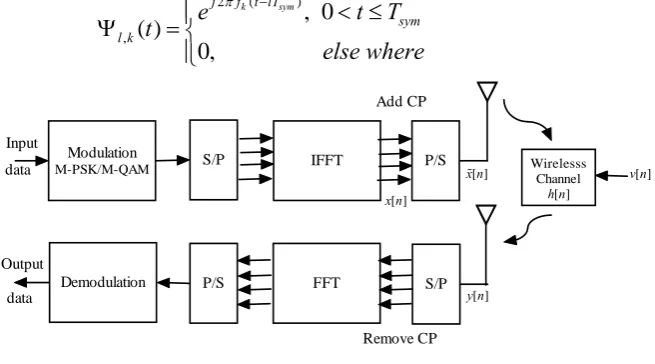
The typical block diagram of the baseband OFDM system is shown in figure.1. OFDM transmitter maps the message bits into a sequence of PSK or QAM symbols which will be subsequently converted into N parallel streams [5]. Each of N symbols from serial-to-parallel (S/P) conversion is carried out by the different
subcarrier. Let
X k
l[ ]
denote the lth transmit symbol at the kthsubcarrier
l
0, 1, 2,
,
,
k
0, 1, 2,
,
N
1
. Due to the S/P conversion, the duration of transmission time for N symbols is extended to NTs, which forms a single OFDM symbol with a length of Tsym (i.e., Tsym= NTs). Let denote the lth OFDM signal at the kthsubcarrier, which is given as
2 ( )
,
, 0
( )
0,
k sym
j f t lT
sym l k
e
t T
t
else where
(1) Modulation M-PSK/M-QAM IFFT FFT S/P Demodulation P/S P/S S/P Input data Output data Add CP Remove CP Wirelesss Channel [ ]x n [ ] x n [ ] v n [ ] y n [ ] h n
Fig 1. OFDM System Model
Then the passband and baseband OFDM signals in the continuous-time domain can be expressed respectively as
1
,
0 0
1
( )
Re
[ ]
( )
N
l l l k
sym l k
x t
X k
t
T
(2) and 12 ( )
0 0
( )
[ ]
k symN
j f t lT
l l
l k
x t
X k e
(3)The continuous-time baseband OFDM signal in Equation (3) can be sampled at
t lT
sym
nT
s with/
s symT
T
N
andl
f
k
k T
/
symto yield the corresponding discrete-time OFDM symbol as
1
2 /
0
[ ]
[ ]
0,1,
,
1
N
j kn N
l l
k
x n
X k e
for n
N
(4)Note that Equation (4) turns out to be the N-point IDFT of PSK or QAM data symbols
X k
l[ ]
kN01 and can be computed efficiently by using the IFFT (Inverse Fast Fourier Transform)algorithm.
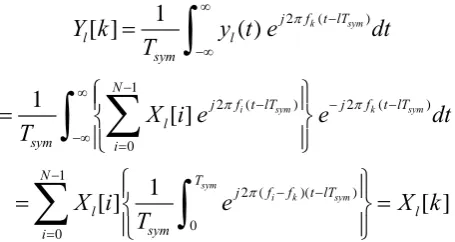
Consider the received baseband OFDM symbol
1
2 ( )
0
( )
N[ ]
j f t lTk syml l
k
y t
X k e
,sym sym s
2 ( )
1
[ ]
( )
j f t lTk syml l
sym
Y k
y t e
dt
T
12 ( ) 2 ( )
0
1
[ ]
i sym k symN
j f t lT j f t lT l
sym i
X i e
e
dt
T
(5)1
2 ( )( )
0 0
1
[ ]
[ ]
sym
i k sym
N T
j f f t lT
l l
sym i
X i
e
X k
T
III.PROPOSED METHOD:MODELING THE COMMUNICATION CHANNEL
There are several basic techniques to estimate the radio channel in OFDM systems [5]-[13]. The estimation techniques can be performed using time or frequency domain samples. These estimators differ in terms of their complexity, performance, practicality in applications to a given standard, and the a priori information they use. The a priori information can be subcarriers correlation in frequency, time and spatial domains. For frequency domain channel estimates, MSE [8] is usually considered as the performance measure of channel estimates, and it is defined by
2
[ , ]
[ , ]
MSE E h n k
h n k
(6)Where [ , ]h n k
is the estimate of equivalent channel at kth subcarrier of nth OFDM symbol. Although MSE is used extensively, the other measures like BER performance are also used. BER performance is mainly used when the performance of OFDM system with the channel estimation error is to be evaluated. The channel estimation performance has an impact on the decoding process of the OFDM receivers [7]. Iterative channel estimation algorithms can be exploited to minimize the channel estimation errors. In these approaches, the channel estimation can be found via any of the methods described in the preceding sections, and the estimates can be improved by re-modulating the detected signals [16]. It is clear that when the number of iterations is one, then the approach is the same as the conventional approaches. However, for more iterations better performance is achieved at the expense of more computation.
An adaptive method based on SV-LMS algorithm for channel estimation is proposed here. The scheme of implementation for the proposed method is shown in figure.2.
Delay Random Noise Source Adaptive Filter Equalizer Random Noise Source Communication Channel h(n) v(n) x(n) a(n) d(n)=a(n-7) e(n) + - Fig 2. Scheme used for implementing the proposed method
Least mean square (LMS) filter is designed using a transversal (tapped delay line) structure. It has two practical features: Simple to design & very effective in performance have made it highly popular in various applications. The least mean square (LMS) algorithm updates the linear filter coefficients such that the mean square error (MSE) cost function to be minimized.
LMS algorithm is given by the following iteration equation [21]:
( ) T( ) ( )
y n W n X n (7)
1 0 ( )
( ) (
)
N i iy n
W n X n i
(8)( ) ( ) ( )
( 1) ( ) ( ) ( )
W n W n C e n X n (10)
where y(n) is the output of adaptive filter, W(n)=[W0(n), W1(n, ………WN-1(n)]T
is the weight coefficient vector of adaptive filter, X(n)=[X(n), X(n-1),…….X(n-N+1)]T is the input vector, n is the time index, N is the order of filter, d(n) is the desired output, e(n) is the error signal, μC is the step-size, superscript T denotes Hermitian transposition. The SV-LMS algorithm is presented below.
Step Variable LMS (SV-LMS) algorithm
In an environment that is not stationary a gradient noise is added to the signal. In such case the value of tap weights change in random fashion instead of terminating on Weiner solution. A fourth step is added to the basic LMS method is that step size of the filter is updated at each step as,
( 1) ( ) ( ) ( ) ( )
T n T n e n n u n
(11)
Here ρ is a small positive constant and γ(n) is defined as the partial derivative of tap weight vector with respect to step size parameter at a sample or iteration.
( ) ( )
( ) n n
W n
(12)
SVLMS attains faster convergence rate since the step size of next iteration depends on the input and error at current iteration, unlike TVSLMS algorithm where step size of present iteration depends on the initial step size.
IV.RESULTS AND DISCUSSION
In the simulation of the OFDM system, the pilot symbols are inserted in the modulated data sequence using pilot duration of 4 symbols. After the pilot insertion data sequence is converted into a time domain sequence using 1024-point IFFT and 4 symbols CP is added. The guard interval or the length of the CP is longer than the maximum delay spread of the channel. AWGN (0, 0.01) is added to the received signal. The CP is removed in the noise corrupted received signal which is then subject to FFT. Now, since the transmitted pilots and received pilots are known, the CSI is estimated.
SIMULATION PARAMETERS CONSIDERED FOR VALIDATION OF PROPOSED WORK
Simulation Parameters Considered values
System bandwidth 7 MHz
Sub carrier spacing 6.83 kHz
Modulation 16-QAM and 32- PSK
N-point IFFT 1024 point IFFT
Length of Cyclic Prefix 16 samples
Doppler Frequency (Hz) 100, 500 and 1000
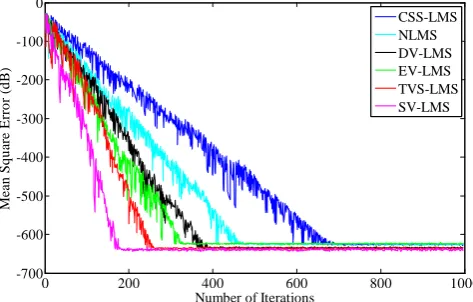
The convergence analysis, presented in figure.3, reveals that the SV-LMS requires less number of iterations to reach the optimum solution i.e. minimum MSE and important observation from plot is that the steady state MSE is also minimum for SV-LMS. Further its performance is also compared with RLS, as shown in figure.4. It can be seen that the SV-LMS closely follows the convergence properties of RLS, thus possessing the advantage of RLS algorithm too.
0 200 400 600 800 1000
-700 -600 -500 -400 -300 -200 -100 0
Number of Iterations
Me
an
Sq
u
are E
rro
r (d
B)
CSS-LMS NLMS DV-LMS EV-LMS TVS-LMS SV-LMS
0 200 400 600 800 1000 -700
-600 -500 -400 -300 -200 -100 0
Number of Iterations
M
ean
aq
u
are
E
rro
r (d
B)
SV-LMS RLS
Fig 4. Comparison of SV-LMS with RLS alogirthm
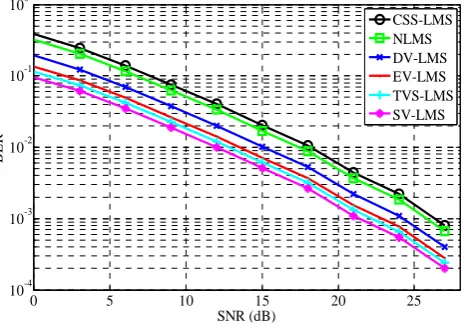
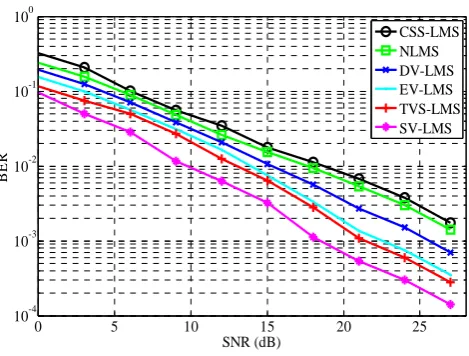
In order to validate the proposed method, different Doppler frequencies of 100 Hz, 500 Hz and 1000 Hz are considered. The bit error (BER) is computed and is compared with methods based on variants of LMS. The fig.5 shows the BER plot for Doppler frequency of 100 Hz. As we move from methods based on CSS-LMS to SV-LMS, the BER performances are improved, but are only closely separated. Hence for the case of low Doppler frequencies the method based on basic CSS-LMS would suffice.
0 5 10 15 20 25
10-4 10-3 10-2 10-1 100
BE
R
SNR (dB)
CSS-LMS NLMS DV-LMS EV-LMS TVS-LMS SV-LMS
Fig 5. BER plot for a doppler frequency of 100 Hz. BERs are computed for different methods using variants of LMS in their algorithms.
Similar plots are shown for Doppler frequencies of 500 Hz and 1000 Hz in figure.6 and figure.7 respectively.
0 5 10 15 20 25
10-4 10-3 10-2 10-1 100
BE
R
SNR (dB)
CSS-LMS NLMS DV-LMS EV-LMS TVS-LMS SV-LMS
0 5 10 15 20 25 10-4
10-3 10-2 10-1 100
BE
R
SNR (dB)
CSS-LMS NLMS DV-LMS EV-LMS TVS-LMS SV-LMS
Fig 6. BER plot for a doppler frequency of 1000 Hz
The proposed SV-LMS based method performed well for large scale fading with Doppler frequency of 1000 Hz.
V. CONCLUSION
We proposed a method based on step-variable LMS algorithm for the OFDM channel estimation problem under fast fading channel environment. The investigation revealed that the step variable LMS resulted in faster convergence yielding a response close to RLS algorithm. The simulation results on BER revealed the efficacy of the proposed SV-LMS based channel estimation method. The efficacy of the proposed method is established by comparing it to the traditional LMS and other variants of LMS for channel estimation. It performed very well under fast fading conditions.
REFERENCES
[1] M. L. Doelz, E. T. Heald, D. L. Martin, “Binary data transmission techniques for linear systems”, Proc. of IRE, Maggio 1957, pp. 656-661.
[2] L. J. Cimini "Analysis and simulation of a digital mobile channel using orthogonal frequency division multiplexing," IEEE Transaction on Communications, vol. 33, no.7, pp. 665 -675, July 1985.
[3] G. Taubock, F. Hlawatsch, and H. Rauhut, "Compressive estimation of doubly selective channels: exploiting channel sparsity to improve spectral efficiency in multicarrier transmission," IEEE J. Select. Topics in Signal Processing, vol. 4, no. 2, pp. 255-271, May 2010.
[4] E. F. Casas and C. Leung, "OFDM for data communication over mobile radio FM channels. II. Performance improvement," IEEE Transaction on Communications, vol. 40, no. 4, pp. 680-683, April 1992.
[5] Liu. Y., Tan, Z., Hu, H., Cimini, L.J., and Ye Li, G., “Channel estimation for OFDM,” IEEE Communications Surveys & Tutorials, vol. pp. 99, May 2014.
[6] O. Edfors, M. Sandell, J. J. van de Beek, S. K. Wilson and P.O. B¨orjesson, “OFDM channel estimation by singular value decomposition”, IEEE Transaction on Communications, vol. 46, no. 7, pp. 931-939, July 1997.
[7] B. Yang, K. B. Letaief, R. Cheng, and Z. Cao, “Channel estimation for OFDM transmission in multipath fading channels based on parametric channel modeling,” IEEE Transaction on Communications, vol. 49, pp. 467–479, March 2001.
[8] Bradaric, I. and Petropulu, A.P. "Performance of training-based OFDM systems in the presence of time varying frequency-selective channels," in proc. of IEEE int. conf. on Acoustics, Speech, and Signal Processing (ICASSP '04), vol. 4, pp. 737-740, 17-21, May 2004.
[9] T. Hwang, Chenyang Yang, Gang Wu, Shaoqian Li, and Li, G.Y. "OFDM and its wireless applications: A Survey," IEEE Transaction on. Vehicular Technology, vol. 58, no. 4, pp. 1673-1694, May 2009.
[10] J.J. van de Beek, Edfors, O. and Sandell, M., “On channel estimation in OFDM systems,” in proc. IEEE Vehicular Technology Conference (VTC), vol. 2, pp. 815–819, July 1995.
[11] Coleri, S., Ergen, M., Puri, A., and Bahai, A., “Channel estimation techniques based on pilot arrangement in OFDM systems,” IEEE Transaction on. Broadcasting, vol. 48, no.3, pp. 223–229, September 2002.
[12] Ye(Geoffrey) Li, “Pilot-symbol-aided channel estimation for OFDM in wireless systems”, IEEE Transaction on Vehicular Technology, vol. 49, no. 4, pp. 1207-1215, 2000.
[13] Lau, H.K. and Cheung, S.W., “A pilot symbol-aided technique used for digital signals in multipath environments,” in proc. of IEEE International conference. on communications, vol. 2, pp. 1126–1130, May 1994.
[14] Hoeher, P. and Tufvesson, F., “Channel estimation with superimposed pilot sequence,” in proc. IEEE Global Telecommunications Conference (GLOBECOM’99), pp. 2162–2166, 5-9, December 1999.
[15] Lyman, R.J. and Edmonson W.W., “Decision-directed tracking of fading channels using linear prediction of the fading envelope,” in proc. of 33rd Asilomar Conference on Signal Processing, Systems, and Computers, vol. 2, pp.1154–1158, 24-27, October 1999, CA, USA.
[16] Temino, L. A. M. R. D., Manchon, C. N. I., Rom, C., Sørensen, T. B., Mogensen, P. “Iterative channel estimation with robust Wiener filtering in LTE downlink,” in Proc. Vehicular Technology Conference, pp. 1-5, September 2008.
[17] Haykin S. , Adaptive Filter Theory, Fourth Edition, Prentice Hall, New York. 2002.
[19] Jerónimo Arenas-García, Luis A. Azpicueta-Ruiz, Magno T.M. Silva, Vítor H. Nascimento, and Ali H. Sayed, "Combinations of Adaptive Filters: Performance and Convergence properties", IEEE Signal Processing Magazine, Vol.33, No.1, pp.120-140, January 2016, Digital Object Identifier 10.1109/MSP.2015.2481746.
[20] V. John Mathews, and Zhenhua Xie, "A Stochastic Gradient Adaptive Filter with Gradient Adaptive Step Size", IEEE Transactions on Signal Processing, Vol. 41, No. 6, pp. 2075-2087, June 1993.
[21] Zhen Zhu, Xiang Gao, Leilei Cao, Daoyuan Pan, Yumeng Cai , Yu Zhu, "Analysis on the adaptive filter based on LMS algorithm", International Journal for Light and Electron Optics, Vol.127, No.11, pp.4698-4704, June 2016.
[22] Yonggang Zhang, Ning Li, Jonathon A. Chambers, and Yanling Hao, "New Gradient-Based Variable Step Size LMS Algorithms", EURASIP Journal on Advances in Signal Processing, Volume 2008, Article ID 529480, 9 pages doi:10.1155/2008/529480.
[23] Wee-Peng Ang Farhang-Boroujeny, B,” A new class of gradient adaptive step size LMS algorithm”, IEEE Transactions on Signal Processing, Vol.49, No. 4, pp: 805 – 810, 2001.
[24] Raymond H. Kwong, and Edward W. Johnston, "A Variable Step Size LMS Algorithm", IEEE Transactions on Signal Processing, Vol 40, No 7, pp. 1633-1642, July 1992.
[25] Saul B. Gelfand, Yongbin Wei, and James V. Krogmeier, “The Stability of Variable Step-Size LMS Algorithms", IEEE Transactions on Signal Processing, vol. 47, no. 12, pp. 3277-3288, , December 1999.
[26] Dirk T.M.Slock, "On the Convergence behavior of the LMS and the Normalized LMS algorithms", IEEE Transactions on Signal Processing, Vol.41. No.9, pp.2811 – 2825, September 1993.
[27] Leonardo Rey Vega, Hernán Rey, Jacob Benesty, and Sara Tressens, "A New Robust Variable Step-Size NLMS Algorithm", IEEE Transactions on Signal Processing, Vol. 56, No. 5, pp1878-1893, May 2008.
[28] Yong-Gang Zhu, Yong-Gui Li, Sheng-Yonig Guan and Qu-Shan Chen, "A Novel Variable Step Size NLMS algorithm and its analysis", Procedia Engineering, Published by Elsevier Ltd., pp.1181-1185, 2012.