Original Research Article.
170 |P a g e Int J Med Res Prof.2018 Jan; 4(1); 170-74. www.ijmrp.com
Quality of Life and Wellbeing of Patients with Celiac Disease in
Aseer Region of Saudi Arabia
Tariq Mohammed Ali Alahmari
1*, Aisha Jaber Al-Amer Asiri
1, Ruqayyah Mohammed Ali Bilali
1,
Asma Saad Al Qahtani
1, Mohammed Abdullah Alqarni
1, Faisal abdullah almalwi
1,
Awad Salem Alrashdi
1, Abdullah Ali Alhassani
1, Javed Iqbal Wani
21MBBS, Internal Medicine Department, College of Medicine, King Khalid University, Abha, Saudi Arabia. 2MD, Associated Professor,
Internal Medicine Department, College of Medicine, King Khalid University, Abha, Saudi Arabia.
ABSTRACT
Background: It is known that people who suffer from celiac can't live natural life, they always have dissatisfaction feeling since most of time they can't enjoy with anything they have so, the aim of the study is to what extend celiac can effect on the life of people who suffer from it.
Method: The researcher will use the analytical descriptive method to achieve the objective of the study. The researcher will depend on descriptive statistics and cross tables, in addition to the most important graphs that will him to show the aim clearly.
Results: In the sample 80% of people who suffered from celiac are men, 45.1% of them are under 23 years, 55% of them are single, 93.7% of them are Saudi, 35.9% of them have a bachelor degree, 40.8% of them doesn't work, 53.5% of them their monthly income less than 3000, 54% of them live in the middle and, 28.2% of them get a good level of wellbeing score.
Conclusions: Quality of life and wellbeing of patients with celiac disease in the sample is moderate level for in average.
Keywords: Quality Of Life; Celiac Disease; Cross-Sectional Studies.
*Correspondence to:
Tariq Mohammed Ali Alahmari, MBBS,
Internal Medicine Department, College of Medicine, King Khalid University, Abha, Saudi Arabia.
Article History:
Received: 06-12-2017, Revised: 03-01-2018, Accepted: 14-01-2018
Access this article online Website:
www.ijmrp.com
Quick Response code
DOI:
10.21276/ijmrp.2018.4.1.033
INTRODUCTION
Celiac disease is the most important cause of malabsorption.
Other conditions include tropical sprue, Whipple’s disease and
giardiasis. Celiac disease is caused by intolerance to storage protein gluten which is found in wheat, barley and rice. Initially it was pediatric disease but according to some studies, it is now being diagnosed more commonly in adults and elderly population. It is defined as an exaggerated immune response to ingested gluten seen in genetically susceptible individuals. It roughly affects
nearly 1% of world’s population but according to new studies its
incidence is increasing in different geographical areas partly owing to better diagnostic tools and public awareness. It is associated with large variety of autoimmune diseases. This correlation is seen more in adult population.
In Europe, the prevalence of celiac disease has been estimated to be 1 in 300 to 1 to 5000 persons, but recent population-based screening studies suggest that the prevalence may be as high as 1 in 100 (and even higher in patients with autoimmune diseases). In the United States, celiac disease remains rare—perhaps because the disease is under diagnosed relative to Europe. European physicians may be more familiar with celiac disease and may have a lower testing thresh- old. Most important, the use
of serologic testing to screen for celiac disease is more common in Europe than in the United States.1 To judge quality of life (QoL)
is to engage in a highly subjective appraisal of the degree to which needs and expectations are fulfilled. Health-related QoL concerns the degree to which needs and expectations are affected by personal health. This includes physical and mental functioning, disability and the experience of symptoms. Whilst difficult to conceptualize, QoL is of critical importance to patients and healthcare professionals and is emerging as a key outcome
measure in today’s 21st century healthcare system.2
As the disease progresses along the intestine, malabsorption of carbohydrate, fat and the fat-soluble vitamins A, D, E and K, and other micronutrients occurs. Secondary lactose intolerance resulting from decreased lactase production by the damaged villi is also common while the symptoms of CD can develop in infancy after the introduction of gluten-containing cereals; it is very common for the disease to manifest itself during adulthood.3
METHOD
measuring subjective well-being. The WHO-5 was derived from the WHO-10, which in turn was derived from a 28-item rating scale used in a WHO multi Centre study in 8 different European countries. The 10 items making up the WHO-10 were selected from among these 28 items based on a non-parametric item response theory analysis, which identified the 10 most valid items from the original 28-item scale. The items for the 28-item scale were selected from the Zung scales for depression, distress and anxiety as well as from the General Health Questionnaire and the Psychological General Well-Being Scale. Therefore, both the 28-item scale and the WHO-10 include 28-items phrased negatively to
reflect symptoms of distress (‘Feeling downhearted and blue’) and
items phrased positively, reflecting well-being (‘waking up feeling
fresh and rested’).4
RESULTS
1. Descriptive statistics
80% of people who suffer from celiac in the sample are females and, 20 % only of them are males. the most suffer from celiac is
category "under 23", it means that adults and children are the most people who suffer from celiac. The least suffer from celiac is category "47 and older".
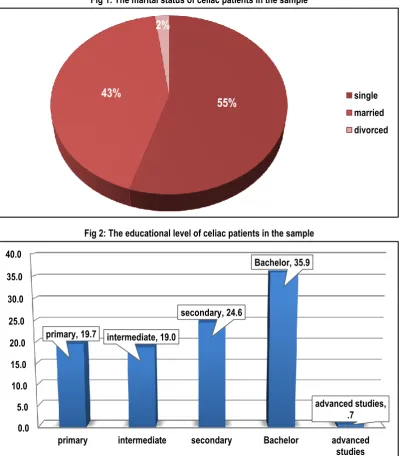
Figure 1 showed that the most suffer from celiac is single people and the least suffer from celiac is divorced people.
Figure 2 showed that the most suffer from celiac is people who have a bachelor degree since they are 35.9% of the sample. The most suffer from celiac is people who don't work since they represent the highest percentage and, the student category also suffers from celiac since they represent 39% of the sample size . 53.5% of people who suffer from celiac have monthly income less than 3000 and, people who have monthly income more than 10000 are the least suffer category from celiac since they are 12% of the sample.
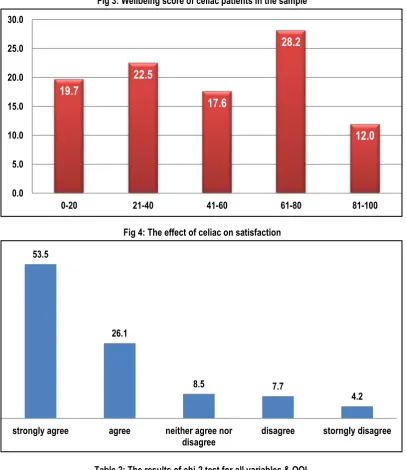
Figure 3 showed that 28.2% of people have a good quality of life and wellbeing of patients with celiac i.e 28.2% of people selected number 4 of the 5 questions and, 19.7 of them have poor quality of life and wellbeing of patients with celiac, it means that they answered with number 1 or 0 of the 5 questions .
Fig 1: The marital status of celiac patients in the sample
Fig 2: The educational level of celiac patients in the sample
55%
43%
2%
single married divorced
0.0 5.0 10.0 15.0 20.0 25.0 30.0 35.0 40.0
primary intermediate secondary Bachelor advanced
studies primary, 19.7 intermediate, 19.0
secondary, 24.6
Bachelor, 35.9
Fig 3: Wellbeing score of celiac patients in the sample
Fig 4: The effect of celiac on satisfaction
Table 2: The results of chi-2 test for all variables & QOL
Variable P-value Decision
Age >0.05 Accept H0
Gender >0.05 Accept H0
Work >0.05 Accept H0
Marital Status >0.05 Accept H0
Educational level >0.05 Accept H0
Monthly income >0.05 Accept H0
The duration of disease <0.05 Reject H0
The duration of GFD >0.05 Accept H0
The hypnosis of chi-2 test: H0: there is no significant relationship between 2 variables;
H1: there is a significant relationship between 2 variables
Table 3: Chi-Square Tests
12 cells (60.0%) have expected count less than 5. The minimum expected count is .38
19.7
22.5
17.6
28.2
12.0
0.0 5.0 10.0 15.0 20.0 25.0 30.0
0-20 21-40 41-60 61-80 81-100
4.2 7.7
8.5 26.1
53.5
storngly disagree disagree
neither agree nor disagree agree
strongly agree
Value df Asymp. Sig. (2-sided)
Pearson Chi-Square 25.294a 12 .013
Likelihood Ratio 25.730 12 .012
Linear-by-Linear Association .366 1 .545
Table 4: The results of chi-2 test between "QOL" and "wellbeing score"
Value df Asymp. Sig. (2-sided)
Pearson Chi-Square 36.030a 12 .000
Likelihood Ratio 35.198 12 .000
Linear-by-Linear Association 18.258 1 .000
N of Valid Cases 142
a. 9 cells (45.0%) have expected count less than 5. The minimum expected count is .72.
H0: there is no significant relationship between "QOL" and "wellbeing score"; H1: there is a significant relationship between "QOL" and "wellbeing score"
50.7% of people suffered from celiac their duration of disease is from year to 6 years, 6.3% of them suffered 19 years and more years from it. 57% of people suffered from celiac their duration of GFD is from year to 6 years, 3.5% of them their duration is 19 years and more years from it. 49.3% of people who suffered from celiac their weight range between48-87K and, 41.5% of people who their weight less than 48K suffered from celiac. According to their height 57.7% of people who suffered from celiac their height 152 and over, 38.8% of people who their height range between119-151 suffered from celiac.
Figure 4 showed that 53.5% of celiac disease are strongly agree and 4.2% of them are strongly disagree.
2.The Relationship Between "QOL" and Each Variable
According to the table 2 and the hypnosis we will accept H0 for all variables except "the duration of disease" we will reject it so, there is a significant relationship between "QOL" & "the duration of disease" at significant level=0.05.
3. The Relationship Between "QOL" and Wellbeing Score
According to the table 4; we will reject Ho because P-value < α
so, there is a significant relationship between "QOL" and "wellbeing score".
4. The General Mean of Wellbeing Score
After calculating the general mean for all cases we found it = 2.515493. It means that there is a moderate wellbeing level for people who suffered from celiac in average.
DISCUSSION
Coeliac disease patients have a reduced QoL and increased likelihood of anxiety and depression in comparison to age and sex-matched controls. The primary purpose of this study was to examine which factors had an impact on QOL in patients with CD. Five hundred seventy-three completed questionnaires were received: 225/503 (44.7%) of invited CD patients (Of whom 26% are male, mean disease duration is 8 years ranging from 6 months
to 51 years) 26/225 (11%); ‘at work’: 61/225 (27%) and, ‘personal
relationships’: 29/225 (13%), the most of people who suffered
from celiac doesn't work "at home".5
A total of 581 celiac patients took part in the study, 410were women (female–male ratio D 2.4:1). The mean age of the entire sample was 31.47 (SD 11.2), the mean ageat diagnosis was 23.21 (SD 14, 8), Feelings of Well-Being. The overall feeling of well-being received a high median score (6.82) on a 20 to 0.6
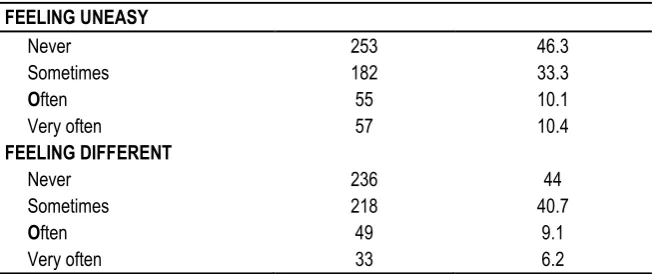
Table 5: Difficulties in Social Life FEELING UNEASY
Never 253 46.3
Sometimes 182 33.3
Often 55 10.1
Very often 57 10.4
FEELING DIFFERENT
Never 236 44
Sometimes 218 40.7
Often 49 9.1
Very often 33 6.2
Table 6: When you felt calm and secure
At no time 3 2.1
some of the time 42 29.6
less than half the time 19 13.4
more than half the time 27 19.0
most of the time 31 21.8
All of the time 20 14.1
By comparing the present study with the previous studies we will find the same results since, 80% of celiac patients are females, 45% of them their ages are under 23, 41% don't work and 38%
CONCLUSION
In general we can say that Celiac disease is more popular among adults, especially adult women. The people who stayed at homes will be the most liable category to celiac disease, since celiac patients have energy at some of the time. Celiac patients have a moderate QOL and wellbeing score.
REFERENCES
1. Shahid Jamal, Rida Iftikhar. Celiac Disease In Adults. Pakistan Armed Forces Medical Journal. 2016; 66(4): 600-605.
2. Mustalahti K, Lohiniemi S, Collin P, Vuolteenaho N, Laippala P, Mäki M. Gluten-free diet and quality of life in patients with screen-detected celiac disease. Eff Clin Pract. 2002 May-Jun;5(3):105-13. 3. Zarkadas M, Cranney A, Case S, Molloy M, Switzer C, Graham ID, Butzner JD, Rashid M, Warren RE, Burrows V. The impact of a gluten-free diet on adults with coeliac disease: results of a national survey. J Hum Nutr Diet. 2006 Feb;19(1):41-9.
4. Christian Winther Topp, Søren Dinesen Østergaard, Susan Søndergaard, Per Bech. The WHO-5 Well-Being Index: A Systematic Review of the Literature; Psychother Psychosom 2015;84:167–176 DOI: 10.1159/000376585
5. Stephen M. Barratt, John S. Leeds, David S. Sanders. Quality of Life in Coeliac Disease is Determined by Perceived Degree of Difficulty Adhering to a Gluten-Free Diet, not the Level of Dietary Adherence Ultimately Achieved. J Gastrointestin Liver Dis September 2011 Vol. 20 No 3, 241-245.
6. Ciacci C, D'Agate C, De Rosa A, Franzese C, Errichiello S, Gasperi V, Pardi A, Quagliata D, Visentini S, Greco L. Self-Rated Quality of Life in Celiac Disease; Dig Dis Sci. 2003 Nov;48(11):2216-20.
[
Source of Support: Nil.
Conflict of Interest: None Declared.
Copyright: © the author(s) and publisher. IJMRP is an official publication of Ibn Sina Academy of Medieval Medicine & Sciences, registered in 2001 under Indian Trusts Act, 1882. This is an open access article distributed under the terms of the Creative Commons Attribution Non-commercial License, which permits unrestricted non-commercial use, distribution, and reproduction in any medium, provided the original work is properly cited.