STRENGTH IMPROVISATION OF M25 GRADE
CONCRETE BY PARTIAL REPLACEMENT OF
COARSE AND FINE AGGREGATE
B.Satyanarayanaraju1, B.Nihith Krishna2 and M.Chiranjeevi3
I. INTRODUCTION
Sustainable construction rather than a fancy idea now is a necessity. Concrete industry which uses 12.6 billion tons of raw materials each year is the largest user of natural resources in the world. As the demand for this natural resource is surpassing the availability has resulted in fast depletion of natural resources. One of the major challenges of our present society is the protection of environment. Some of the important elements in this respect are the
1
Dept. of civil engineering BITS VIZAG, Visakhapatnam (AP)
2
Dept. of civil engineering BITS VIZAG, Visakhapatnam (AP)
3
Dept. of civil engineering BITS VIZAG, Visakhapatnam (AP)
DOI: http://dx.doi.org/10.21172/1.83.029
e-ISSN:2278-621X
Abstract: -Concrete has occupied an important place in construction industry in the past few decades and it is used widely in all types of constructions ranging from small buildings to large infrastructural dams or reservoirs. It is the most widely used man-made construction material in the construction world. Ever since concrete has been accepted as material for construction, civil engineers have been trying to improve its quality, strength etc., against adverse conditions.
Hence in the current study is an attempt made to minimize the cost of aggregates with concrete mix grades M25 by studying the mechanical behavior of these concrete mixes by replacing with advanced mineral admixture such as Robo sand and Recycled coarse aggregates in concrete mixes as partial replacement of sand and gravel. Robo sand is a by-product material produced from the process of crushing the stones and Recycled coarse aggregates are obtained from the debris of the collapsed building. Use of Robo sand and recycled coarse aggregates does not only reduce the cost of construction but also helps to reduce the impact on environment by consuming the material generally considered as waste product.
Therefore an experimental study is conducted to evaluate the workability and strength characteristics of hardened concrete, by partially replacing the sand by 50% of Robo sand and gravel by various percentages of Recycled coarse aggregates for M25 grade of concrete at different ages. The mixes were designed using IS Code method. In this project, properties of concrete have been assessed by partially replacing sand with Robo sand and gravel by Recycled coarse aggregates is separately done in one phase. The fine aggregate has been replaced by Robo sand accordingly in the range of 0% (without Robo sand), and 50% by weight and coarse aggregates has been replaced by Recycled coarse aggregates in the range of 0%, 10%, 20%, and 30% is by weight for M25 mix. Concrete mixtures were produced, tested and compared in terms of compressive strength with the conventional concrete; the tests have been made to study for 3days, 7 days and 28 days.
reduction of the consumption of energy and natural raw materials and consumption of waste materials. These topics are getting considerable attention under sustainable development nowadays. The use of recycled aggregates from construction and demolition wastes is showing prospective application in construction as alternative to primary (natural) aggregates. It conserves natural resources and reduces the space required for the landfill disposal a possible solution to overcome these problems is by using demolished aggregates and robo sand as an alternative.
Recycled coarse aggregate (RCA) is produced by stage crushing of demolished concrete and robo sand is produced by crushing of stones.
As per reports, robo sand is widely used all around the world because of its consistent gradation and zero impurity.
RCA reduces the impact on landfills and can provide cost savings.
In our project, workability of fresh concrete and strength parameters of hardened concrete such as compressive strength were studied.
The presiding properties were studied for three different periods of curing 3, 7 and 28 days.
II. OBJECTIVE
Objectives have been listed as shown below to achieve the aims of this study
1. To determine the suitability of demolished coarse aggregate and robo sand in concrete production.
2. To investigate the strength parameters of concrete with RCA and Robo sand and to compare the performance between conventional concrete and concrete with partial replacement of RCA and robo sand as coarse aggregates and fine aggregates.
III. EXPERIMENTAL WORK 2.1 Materials used:
The materials used for the work are Cement, River Sand, Natural Coarse Aggregates, Recycled Coarse Aggregates (RCA), Robo Sand. The Recycled Coarse Aggregates are obtained from a renovating building near NAD Junction Vizag (AP) and Robo sand is collected from Robo Sand manufacturing plant near Gajuwaka, Vizag (AP).
2.2 Proportioning of materials:
In this stage we will partially replace coarse aggregates and fine aggregates with Recycled Coarse Aggregates and Robo Sand respectively. Five cases are formed with different proportions of materials. Cubes are casted for determining the compressive strength for 3, 7 and 21 days.
Table – 1 Proportion of materials
S.No. Number of cases
Cement %
Fine aggregate
%
Robo sand %
Coarse aggregate
%
Recycled coarse aggregate
%
1 Case – 1 100 100 0 100 0
2 Case – 2 100 50 50 100 0
3 Case – 3 100 50 50 90 10
4 Case – 4 100 50 50 80 20
5 Case – 5 100 50 50 70 30
Nine cubes are casted in each case for determination of compressive strength. Tests are conducted at the age of 3 days, 7 days and 21 days of the specimens. Specimens are placed in the compression testing machine as per IS: 516-1959. Calculations are made by dividing the maximum applied load to the cross sectional area of the cube specimen.
Table – 2 Compressive strength in N/mm2
Number of cases Replacement % of Fine and
Coarse aggregates 3days 7days 28days
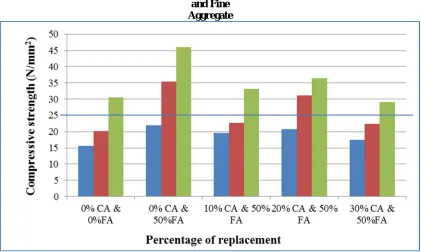
Case – 1 0% CA and 0% FA 15.11 20.14 30.58
Case – 2 0% CA and 50% FA 21.99 35.40 46.07
Case – 3 10% CA and 50% FA 19.55 22.66 33.18
Case – 4 20% CA and 50% FA 20.73 31.10 36.44
Case – 5 30% CA and 50% FA 17.47 22.36 29.07
V. DISCUSSIONS
The following graph shows the compressive strength of different cases for 3 days, 7 days and 28 days curing period of the specimens. The case 2 (50% replacement of fine aggregate with Robo sand and 0% replacement of Coarse aggregate) gives more strength than the conventional concrete. For Case 3 (50% replacement of fine aggregate with Robo sand and 10% replacement of Coarse aggregate with RCA) and Case 4 (50% replacement of fine aggregate with Robo sand and 20% replacement of Coarse aggregate with RCA) gives lesser strength than case 2 but however it attains the target strength. The case 4 (50% replacement of fine aggregate with Robo sand and 30% replacement of Coarse aggregate with RCA) give lesser strength than the target strength.
BAR CHART 7.8 Strength Comparison of Cubes with Different Percentages of Coarse Aggregates and Fine
Graph – 1 Average Compressive Strength Results comparison
VI. CONCLUSIONS
Based on the experimental work the following conclusions were given-
a) Compressive strengths for CASE – 2 (50% replacement of robo sand and 0% recycled coarse aggregates) and CASE – 3 (50% robo sand and 10% replacement of recycled coarse aggregates) was increased by 15.49% and 2.6% respectively when compared with 0% replacement (control specimen). Hence 50% replacement of robo sand and 0% recycled coarse aggregates is effective percentage of replacement in M25 grade concrete.
b) Compressive strength for CASE – 4 (50% replacement of robo sand and 20% recycled coarse aggregate) was increased by 5.86% when compared with 0% replacement (control specimen) c) Compressive strength for CASE – 5 (50% replacement of robo sand and 30% recycled coarse
aggregate) was decreased by 1.5% when compared with 0% replacement (control specimen)
We can conclude that Robo sand can be used as an alternative material to the natural river sand partially up to 50% and can be introduced as a functional construction material. The strength of the concrete is increasing due to better particle packing. However Recycled coarse aggregates can also be used up to 20% replacement. Care should be taken while using Recycled Coarse aggregates, the Recycled Coarse Aggregates should be cleaned well before using it.
REFERENCES
[1]. A.Anbarasan, M.Venkatesan “Effect of robo sand on strength characteristic of recycled aggregate concrete, 2015”, IJRET VOLUME-04 ISSUE: 03 pp : 353 – 357.
[2]. Dr.P.SriChandana, ShaikAhamedMynuddin “Experimental Study on Strength of Concrete by Partial Replacement of Fine Aggregate with Sawdust and Robo sand, 2015” ,IJMETMR VOLUME NO : 2, ISSUE NO: 9 pp : 338 – 346.
[3]. IS: 383:1983 Indian standard institution, Specifications of coarse and fine aggregates from natural sources of concrete, New Delhi
0 5 10 15 20 25 30 35 40 45 50
0% CA & 0% FA
0% CA & 50% FA
10% CA & 50% FA
20% CA & 50% FA
30% CA & 50% FA
[4]. IS: 456:2007 Plain and Reinforced Concrete Code of Practice, Bureau of Indian Standards, New Delhi. [5]. IS: 455-1989 Specification for Portland Slag Cement, Bureau of Indian Standards, New Delhi, Reaffirmed 1995.
[6]. IS: 516-1959 Specification for Method of Tests of Strength of Concrete, Reaffirmed 1999, Edition 1.2, Bureau of Indian Standards, New Delhi.
[7]. IS: 1199:1959 Specification for methods of sampling and analysis of concrete, Bureau of Indian Standards, New Delhi. [8]. IS: 2386 (Part I) – 1963 Specification for methods of test for aggregates for concrete. Part I particle size and shape.
Reaffirmed 1997, Bureau of Indian Standards, New Delhi.
[9]. IS: 2386 (Part II) – 1963 Specification for methods of test for aggregates for concrete. Part II estimation of deleterious materials and organic impurities. Reaffirmed 1990, Bureau of Indian Standards, New Delhi.
[10]. IS: 2386 (Part III) – 1963 Specification for methods of test for aggregates for concrete. Part III specific gravity, density, voids, absorption and bulking Reaffirmed 1997, Bureau of Indian Standards, New Delhi.
[11]. IS: 2386 (Part IV) – 1963 Specification for methods of test for aggregates for concrete. Part IV Mechanical properties. Reaffirmed 1997, Bureau of Indian Standards, New Delhi.
[12]. IS: 2386 (Part V) – 1963 Specification for methods of test for aggregates for concrete. Part V, soundness test. Reaffirmed 1997, Bureau of Indian Standards, New Delhi.
[13]. IS: 4031-1968 Specification for fineness test of cement, Bureau of Indian Standards, New Delhi.
[14]. IS 4031(Part 1):1996 Specification for Methods of physical tests f or hydraulic cement: Part 1 Determination of fineness by dry sieving, Bureau of Indian Standards, New Delhi.
[15]. IS: 4031 (Part-V) - 1988 Specification for initial and final setting time of cement.
[16]. IS: 5816: 1999 Specification for Splitting Tensile Strength of Concrete - Method of Test, first revision, Bureau of Indian Standards, New Delhi.
[17]. IS: 8112-1989. Specification for 43 Grade ordinary Portland cement, Bureau of Indian Standards, New Delhi.
[18]. Manjunath M, Prakash K B, “Effect of replacement of natural aggregates by recycled aggregates derived from demolished concrete on the workability and strength characteristics of concrete, 2015”, INTERNATIONAL JOURNAL OF CIVIL AND STRUCTURAL ENGINEERING VOLUME-06, NO2 pp : 119 - 128.
[19]. M.D.Narendra, G.Gangha “An experimental study on high performance concrete partially replacing cement and fine aggregate with GGBS & ROBO sand, 2015” INTERNATIONAL JOURNAL OF ENGINEERING SCIENCES & EMERGING TECHNOLOGIES VOLUME – 7 ISSUE – 5 pp : 737 – 742.
[20]. N.K.Deshpande, Dr.S.S.Kulkarni and H.Pachpande “Strength characteristics of concrete with Recycled Aggregates And Artificial Sand, 2012” ,IJERA VOLUME-02 ISSUE 5 pp : 038 – 042.
[21]. Prafulla Kumar Tiwari, Dr.RamanNateriya “Replacement of recycled coarse aggregates with natural coarse aggregates in concrete, 2016.” IJSEAS VOLUME-02, ISSUE 7 pp : 174 – 183.
[22]. Rachana M N , E.RameshBabu “Experimental investigation on robosand as replacement material of fine aggregate in normal concrete, 2014”, IJATES VOLUME – 2 ISSUE – 7 pp : 269 – 274.
[23]. S.RukmangadharaRao, G.HimaliKumari, N.VidyaSagarlal “Study on strength of concrete using robosand as a partial replacement of fine aggregate, 2015” , IJERA VOLUME – 5 ISSUE – 12 pp : 84 – 88 .