An Empirical Study about the Impact of Local and
Global functions on Student‘s Behavior
Said Taan El-Hajjar
Arts,sciences&EducationAhliaUniversity,ManamaP.O.Bo x:10878, Kingdom of Bahrain
[email protected] ; [email protected]
Abstract-- This study identifies the generalities on the real functions of a real variable (local study) and generalities on functions (global study). In this study we will see abstract proofs for the notions of limit and continuity. A geometrical study of a polynomial and a rational function is going to be developed through abstract proofs in this study. These abstract proofs are being refused by most students throughout the world. Moreover, they are getting afraid of them. Although mathematicians insist on these proofs to initiate logic and critical thinking among pupils, they are still difficult and complex to be absorbed by the student’s mind. A survey study is done in two universities to explore the reasons behind the pupils’ fears and to develop a model that releases them.
Index Term-- limit , continuity , rational , inversion , composite , functions , interval , monotone , bounded , power , maximum , and minimum .
1. INT RODUCT ION
Nowadays, most mathematical concepts are applied directly in a way that the student has no need to face abstract proofs for significant theorems. This strategy has decreased the creativity thinking process among students and even amo ng mathematicians. From my experience in the field of teaching mathematics, most of the students if not all of them hate to face the notation of epsilon (
).This due to the fact that epsilon represented to many students an abstract no tation for an abstract proof. It put them under a situation of depression. So most of authors and editors in this century avoid to use "
" in their mathematical books. However, the escape of using this symbol in abstract proof had a bad effect on the mentality of students which became flat and limited.To solve this problem, I intended to have some abstract development for important concepts in the field of mathematics which would give significant ideas about the beauty of the pure mathematics, especially in dealing with limits, continuities and functions. I agree that in this century there is a huge attack of technology and software's to describe and express many concepts in mathematics through e-learning and interactive learning, neglecting their pure and theoretical proofs. We are all agreed on the importance of this technology, but we should also be persuaded that the history of mathematical proofs was pure and theoretical which developed significant algorithms used to initiate many software programs that are used in this century. So this history leaded us to develop this new technology and it deserves from
us as mathematicians to keep it up and use it at least once at a time in our mathematical field. However, the use of these abstract concepts in mathematics is becoming a nightmare for students in high schools and universities. The reasons for this fear will be discussed in a survey done at Ahlia University (AU) in Bahrain and at Arts, Sciences & Technology University of Lebanon (AUL). Also some recommendations and contributions will be provided by the end of this study.
2. OVERVIEW
2. 1 Who Gave You the Epsilon?
Deltaepsilon proofs are first found in the works of Augustin -Louis Cauchy (1789–1867) 1 . This is not always recognized, since Cauchy gave a purely verbal definition of limit, which at first glance does not resemble modern definitions:
―When the successively attributed values of the same variable indefinitely approach a fixed value, so that finally they differ from it by as little as desired, the last is called the limit of all the others‘‘ 2
. Cauchy also gave a purely verbal definition of the derivative of as the limit, when it exists, of the quotient of differences when h goes to zero, a statement much like those that had already been made by Newton, Leibniz, d‘Alembert, Maclaurin, and Euler. But what is significant is that Cauchy translated such verbal statements into the precise language of inequalities when he needed them in his proofs. For instance, for the derivative 3 :
Let
,
be two very small numbers; the first is chosen so that for all numerical [i.e., absolute] values of h less than
and for any value of x included [in the interval of definition], the ratioh
x
f
h
x
f
(
)
(
)
will always be greater than f '(x) -
and less than f '(x) +
1Who Gave You the Epsilon? Cauchy and the Origins of
Rigorous Calculus Judith V. Grabiner, 424 West 7th Street, Claremont, California 91711.
2 A.-L. Cauchy, Cours d‘analyse, Paris, 1821; in Oeuvres
complètes d‘Augustin.
3
.This one example will be enough to indicate how Cauchy did the calculus, because the question to be answered in the present paper is not, ―how is a rigorous delta-epsilon proof constructed?‘‘ As Cauchy‘s intellectual heirs we all know this.
2.2. Who did mathematical firsts?
Many scientists wrote articles about ancient scientists who had produced the firsts of mathematics. This production could not be limited in few pages or even in few books. It is an unlimited continuously product that is changed and developed from one century to another. Thus, let's see some of the scientists who did some mathematical firsts.
2.3 The Pythagorean Theorem
The Pythagorean Theorem states that in a right triangle, the sum of the squares of the legs equals the square of the hypotenuse. It would be difficult to overestimate the importance of this result. It is generally acknowledged that this remarkable theorem was known before the time of Pythagoras of Samos (ca. 582–500 B.C.) 4 . Van der Waerden (1983) hypothesized that since the Pythagorean Theorem was known in four ancient civilizations —Babylonia, India, Greece, and China—it is probable that a common origin of the whole theory of right triangles exists. Using both written sources and archeological evidence, he constructed an interesting and compelling argument that led him to the following conclusion (van der Waerden 1983, 29): ―I am convinced that the excellent neolithic mathematician who discovered the Theorem of Pythagoras had a proof of the theorem.‖ 5 He also remarked that the best account of mathematical science in the Neolithic Age is to be found in Chinese texts.
2.4 Euler's polyhedral theorem
One of the most interesting formulas relating to simple polyhedral is F + V – E = 2, where F is the number of faces, V is the number of vertices, and E is the number of edges. The five simple polyhedral are tetrahedron (pyramid), hexahedron (cube), octahedron, dodecahedron, and icosahedrons. For the cube F = 6, V = 8, and E = 12 .Although this formula may have been known to Archimedes (ca. 225 B.C.), René Descartes, the French mathematician and philosopher, was the first to state this concept (ca. 1635). Leonard Euler independently discovered the theorem and announced his finding in Petrograd in 1752. Since Descartes' findings were not generally known until his unpublished mathematical works were made available in 1860, the polyhedral formula became known as Euler‘s theorem rather than Descartes' theorem (Smith 1958, 296)6.
4
The Greek philosopher and mathematician (see, e.g., NCTM [1969], Swetz and Kao [1977],Ang [1978] )
5
van der Waerden, Bartel Leendert. Geometry and Algebra in Ancient Civilizations.
6
―Mathematical Firsts —Who Done It?‖ 7
Struik, Dirk J. ―The Origin of L‘Hôpital‘s Rule.‖
2.5 L’Hôpital’s rule
The first textbook on the calculus was published in Paris in 1696 (Struik 1967, 113).Its author, the Marquis Guillaume François Antoine de L‘Hôpital, included in the text a method for finding the limiting value of a fraction whose numerator and denominator simultaneously approach zero as a limit. This method is now known as L‘Hôpital's rule, even though it was discovered by Johann Bernoulli. Apparently L‘Hôpital paid Bernoulli a regular salary, and under their pact Bernoulli was obliged to send L‘Hôpital his mathematical discoveries (Struik 1963)7.
2.6 Cardan’s formula
The formula for the roots of a cubic equation that appears in textbooks dealing with the theory of equations is called Cardan‘s formula because it first appeared in print in his Ars Magna [The great art] in 1545. Girolamo Cardano (i.e., Jerome Cardan), who was a gambler, a doctor, and a mathematics teacher, wheedled the solution of the cubic from Niccoló Tartaglia under solemn oath to the latter that he would not reveal the secret. Evidence also indicates that Scipione Del Ferro discovered the solution to the cubic even earlier (ca. 1515) than Tartaglia, but he failed to publish his findings (Miller 1932; Smith 1958, 459–61; Feldman 1961)8.
2.7 Cramer's rule
Gabriel Cramer published his Introduction at l‘Analyse des Lignes Courbes Algebriques [Introduction to the analysis of algebraic curves] in 1750. In the appendix he gives a method for solving systems of linear equations using determinants, which is now known as Cramer‘s rule. In 1748, however, the rule appeared in a posthumous publication by Colin Maclaurin, entitled A Treatise of Algebra. Although the rule was first stated by Maclaurin, Cramer‘s superior mathematical notation was probably instrumental in popularizing the method; thus, it has been suggested that the procedure be referred to as the Maclaurin-Cramer rule9.
3. LIMIT AND CONT INUIT Y (LOCAL ST UDY)
3.1 Limits
In this section we will see an abstract description of the limit at a given point. Let f be a function with re values and defined in the neighborhood of a real number x0- may be – at x0. We say that the number k is the limit of f at x0 if f(x) is on the neighborhood of k as x is sufficiently on the neighborhood of
x0, but distinct from x0, that is more explicitly:
If for every
0
, there exists n > 0 such that:8
(D (x, x0) =
x
x
0 < n and x
x0)Implies that D (f(x), k) =
f
(
x
)
k
When such a limit exists, it is unique.
Well, for m
k, we have D (k, m) =
> 0. Since
= D (k , m)
D (k , f(x)) + D ( f(x) , m) then we can not have simultaneouslyD (k, f(x)) <
2
and D (f(x), m) <
2
.
Then m can not be a limit of f at x0 . Then we note that
0 0
)
(
x
x
x
x
x
f
m
i
l
k
or more simply
k = 0
)
(
x
x
x
f
m
i
l
.We also say that f(x) tends to k as x tends to x0 (which is symbolized by the notation x
x0). Notice that we can replace in the definition of a limit the strict inequalities by―large " inequalities, let
k
-f(x)
n
0
x
x
but it is not possible of ―enlarging ―the strict inequalities
> 0 and n > 0. Let us apply the previous abstract definition of limits on the following example:Example 3.1-1
f (x) =
x
x
23
for x
0. We have0
)
(
0 0
x
x
x
x
x
f
m
i
l
___________________________________9 ―Colin Maclaurin and Cramer‘s Rule.‖
Well, for x
0, we haveD (f(x), 0) =
f
(
x
)
3
x
Then
)
0
,
)
(
(
0
3
and
x
D
f
x
x
3.2 Limit to the left and limit to the right
The number
is said to be the limit to the right of f at x0 if, for all
> 0, there exists n > 0 such that:(D (x, x0) < n and x > x0)
D (f(x),
) <
Similarly, the number
is said to be the limit to the left of f at x0 if, for all
> 0, there existsn > 0 such that:
(D (x, x0) < n and x < x0)
D (f(x),
) <
We note these limits by:
0 0)
(
x
x
x
x
x
f
m
i
l
or
0 0)
(
x
x
x
x
x
f
m
i
l
and
0 0)
(
x
x
x
x
x
f
m
i
l
or
0 0)
(
x
x
x
x
x
f
m
i
l
Also, sometimes we write
= f (xNote that for k to be the limit of f at x0 if and only if the limits to the right and to the left of f at x0 must be existed and must be equal:
k =
=
Example 3.2-1
Let f(x) =
x
x
x
2for x
0.For x > 0 , we have
f(x) =
x
x
x
2= 1 + x
then D (f(x), 1) = x and
0
0
1
)
(
x
x
x
f
m
i
l
For x < 0 , we have
f(x) =
x
x
x
2
= - 1 + x
then D (f(x), - 1) =
x
and0
0
1
)
(
x
x
x
f
m
i
l
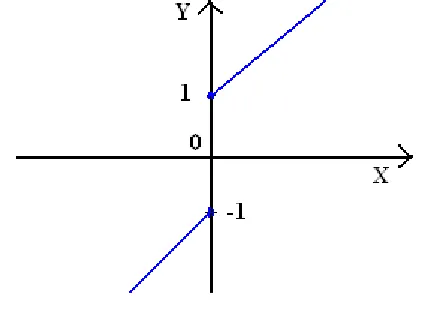
We will say that f has no limit at 0 (fig. 1).
Fig. 1. Limits to the right and to the left of f at 0
3.3 Continuity
Let f be a function defined on the neighborhood of x0 (f is then defined at x0). It is known that f is said to be continuous at x0 if
0
0
)
(
)
(
x
x
x
f
x
f
m
i
l
As an abstract definition, we may say that, if for all
> 0, there exists n > 0 such that(D (x, x0) < n)
(D (f(x), f (x0)) <
)Example 3.3-1
The constant function f (x) = k is continuous for all
values x0 due to the fact that
D (f(x), f (x0)) = 0.
The identical function f(x) = x is continuous for all values x0 due to the fact that
D (f(x), f (x0)) = D (x, x0).
The piece – wise function f defined by
1
)
0
(
0
0
)
(
f
and
x
for
x
f
has a limit k = 0 at x = 0 , but the function f is not continuous at 0 since f ( 0 ) = 1
k .3.4 Infinite limits
Let f be a function defined on the neighborhood of x0 except maybe at x0. We say that f(x) tends to " plus infinity " as x tends to x0 if for all number M there exists n > 0 such that
(D (x, x0) < n and x
x0)
(f(x) > M)this is denoted by
0 0
)
(
x
x
x
x
x
f
m
i
l
We define as previously the relation
0 0
)
(
x
x
x
x
x
f
m
i
l
Example 3.4-1
Let f(x) =
x
1
for x
0. We have
0
0
1
x
x
x
m
i
l
Well, we have
x
1
> M > 0 for x <
M
1
Similarly, we have
0
0
1
x
x
x
m
i
l
3.5 limits at infinity
Let f be a function defined for all large values of x, that is over the interval] a, +
[. We say that the number k is the limit of f as x tends to +
if, for all
> 0, there exists a number M such thatx > M
D (f(x), k) <
This expression is expressed by the relation
x
k
x
f
m
i
l
(
)
In an analogous form we define the relation
x
x
f
m
i
l
(
)
Example 3.5-1
Let f(x) =
x
1
for x
0. We have0
1
x
x
m
i
l
Well, we have
0 <
x
1
<
for x >
1
We have the same for
0
1
x
As we see, the abstract work in mathematics has its own smell, if you understand it, absolutely you will like it .Now, let us use abstract proofs to see how functions are closed under addition and subtraction.
4. OPERAT IONS WIT H FUNCT IONS
4.1 The sum of two functions of Ъ belongs to Ъ
Let
1( h ) and
2( h ) belong to Ъ , then for all number
> 0 , there exists n 1 and n 2 such that(
h
n
1 and h
0)
1(
h
)
<2
(
h
n
2 and h
0)
2(
h
)
<2
Then (
h
Inf
(
n
1n
2)
and h
0)
1(
h
)
2(
h
)
1(
h
)
2(
h
)
4.2 The product of a function of Ъ by a bounded function belongs to Ъ.
A function
defined on the neighborhood , except maybe at 0 , is said to be bounded on the neighborhood of 0 if thereexists a number
> 0 and a number
> 0 such that :(
h
and
h
0
)
(
h
)
Then let
)
(
1
h
Ъ , for all number
> 0 there exists
1 > 0such that :
(
h
1and
h
0
)
1(
h
)
Hence
(
h
Inf
(
,
1)
and
h
0
)
(
h
)
1(
h
)
=
.We often designate by the notation
any function of Ъ i.e. an infinitely small function at the same time as the variable .So the properties ( 5.1 and 5.2 ) will be symbolically written :
and
.
where
is a bounded function on the neighborhood of 0 . In particular we have
(
k
)
and
.
k
because
k
and
are two bounded functions. The set Ъ isthen a field.
4.3 Application
Fig. 2. Vertical asymptotes with respect to f
2) The number a is a root of P. Designate by
the order ofmultiplicity of the root a of P , we can write P = ( x – a ) R (x) where R(x) is a polynomial such that R (a)
0 . Thenf(x) =
(
)
(
)
)
(
)
(
x
T
a
x
x
R
a
x
So two cases are possible:
a)
. The function f is equal to the function)
(
)
(
)
(
x
T
a
x
x
R
Hence we are back to case 1: a is a pole of order
of f.b)
. For all values of x distinct from a, the function f is equal to the functiong (x) =
(
)
)
(
)
(
x
T
x
R
a
x
The function g is also defined for x = a, while the function f
does not (for x = a it takes the form
0
0
). We have then
.
)
(
)
(
x
g
a
f
a
x
m
i
l
As a result from this study, a rational function has a finite limit for all values of x other than a pole , and that if a is a pole , we have :
.
)
(
a
f
x
x
m
i
l
So by studying the limit of the function f as
x
tends to
defined by:f(x) = m
m
n n
b
x
b
a
x
a
x
Q
x
P
...
...
)
(
)
(
0 0
,
with a 0
0 and b 0
0 , the function f is asymptote to thex-axis with four cases of fig. depending on the sign of 0 0
b
a
and the parity of the integer m – n ( fig. 3 ) .
Fig. 3. Horizontal asymptotes with respect to f
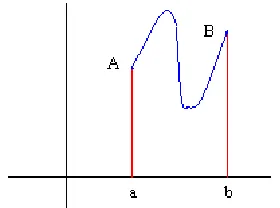
5. CONT INUIT Y OVER AN INT ERVAL (GLOBAL ST UDY) A function is said to be continuous over an open interval] a, b [if it is continuous at all points of] a, b [. It is said to be continuous over the closed interval [a, b] if it is continuous over the open interval] a, b [and it is continuous to the right of the value of a and to the left of the value of b.We note that this definition could be interpret geometrically by saying that the graph of f relate the point A of coordinates a and f(a) to the point B of coordinates b and f(b) a indicated in fig. 4 .
Fig. 4. Continuous functions over an interval
Designate by E (I) the set of continuous functions over an interval I. If f and g belong to E ( I ) then we have f + g
belong to E ( I ) and , for all
,
f
E ( I ) . Also f.g
E (I). The set E (I) is then a sub-ring of the mapping ringsof I in
under addition and subtraction.5.1 Continuity over a closed interval
Let f be a continuous function over the closed interval [a, b].
There exist two numbers
and
that have the following properties:1- If a number
verifies the inequality
, the function f takes at least once the value
over the closed interval [a, b].2- 2- If
>
or
<
, the function f never takes thevalue
in the closed interval [a, b]. These two properties meet with a geometrical intuitive evident property which state that an arc of a defined and continuous curve is lying between two parallels to theFig. 5. Continuous functions between two parallels
So we recognize directly the necessity of these hypotheses:
- The function f (x) =
0
0
0
x
if
x
if
x
x
is not continuous for x = 0. Over the open interval] -1, 1 [, it takes the values -1 and 1, but it never takes the intermediate value
2
1
.
2- The function f (x) =
0
0
0
1
x
if
x
if
x
is not continuous for x = 0. Over the closed interval [-1, 1], it takes values as big as we want.
3- The function f(x) = x2 taken over the open interval] 0, 2 [does not attain the lower and the upper bound which are equal to 0 and 4.
E is a set of numbers so that the function f is defined for all x
E, we call maximum of f over E all number M such thatf(x)
M for all x
E and such that f(x) takes at least once the value of M as x run over E .Such a number necessarily does not exist, but if it exists, then it is unique. In similar manner we define the minimum of f over E.Designate by f (E) the set of numbers of the form f(x) as x run over E , we recognize that if M is the maximum of f over E , the number M is the superior bound Sup ( f(E)) of the set f ( E ) . However, if the set f (E) admits a superior bound M ‗, this number is not necessarily a maximum of f over E as proved in the previous example of the function f(x) = x2 , E represents there the open interval ] 0 , 2 [ : The set f ( E ) is the open interval ] 0 , 4 [ that admits 4 as a superior bound , but f does not take the value 4 over E .We would have similar results for the minimum .
As a result, we can admit that all continuous functions over a closed interval admit a maximum and a minimum over this interval.
5.2 Uniformly continuous functions
Consider a defined and continuous function f(x) over the closed interval [a, b]. If we depend on the definition of the continuity by choosing a value x0 in the interval and
> 0, we can determine a certain number n > 0 such that theinequality
x
x
0 < n leads tof
(
x
)
f
(
x
0)
. This number n depends not only in the choice of
but also in choosing x0 and will vary in general if we choose other values of x0 in the interval. Sometimes it is interesting in replacing n by a number n1 > 0 and less than n but which is convenient to all values x0 of the interval .This is possible because if f(x) is a continuous function over the closed interval [a, b] and
> 0, there exists a number n > 0 such that if two values x 0 and x '0 in the interval verify the inequality0 '
0
x
x
< n, always it results
(
)
(
0)
'0
f
x
x
f
i.e.:
d ( x0 , x '0 ) < n
d ( f (x0 ) , f ( x '0 ) ) <
This result would be expressed by saying that all continuous functions over a closed interval [a, b] are uniformly continuous over this interval.
5.3 Inversion of a function
A function f defined over a subset E of
is said to be increasing over E if the mapping x
f(x) respects the order of real numbers , that is if)
(
)
(
(
)
(
,
2 1 2 1 21
x
E
x
x
f
x
f
x
x
The function f is strictly increasing over E if
)
(
)
(
(
)
(
,
2 1 2 1 21
x
E
x
x
f
x
f
x
x
Similarly , the function f is said to be decreasing over E if the mapping x
f(x) inverses the order , that is if)
(
)
(
(
)
(
,
2 1 2 1 21
x
E
x
x
f
x
f
x
x
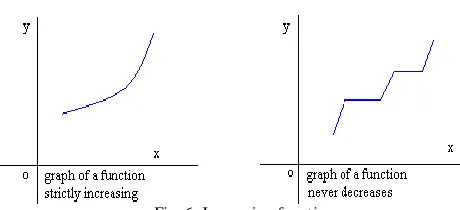
Any strictly increasing function is a function that would never be a decreasing one ; however, a function that is never decreasing may have intervals where it remains constant , which is not the case with a strictly increasing function ( fig. 6 ).
A function which is never decreasing nor is never increasing over E is said to be monotone over E. A function wh ish is strictly increasing or is strictly decreasing over E is said to be strictly monotone over E.
Note that a continuous function over the open interval] a, b [and not strictly monotone is not injective. It does not admit then a reciprocal function.
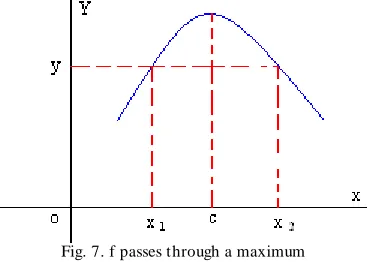
If for example f passes through a maximum at c
]a,b[ , we recognize that for a value y almost less than f( c ) there correspond two possible values x1 and x2 of x (fig. 7 ) .Fig. 7. f passes through a maximum
If f is monotone without being strictly monotone and if f remains constant over an interval ( c , d ) such that c < d , then all values between c and d correspond to y = f ( c ) (fig. 8).
Fig. 8. Monotone function, f remains constant
In contrary , if f is a continuous function and it is strictly monotone over a closed interval [ a , b ] , f has a reciprocal function which is defined, continuous and strictly monotone over the closed interval [ f(a) , f(b) ] . To fix these ideas, suppose that f is strictly increasing over [a, b] with a < b. Let y
[f (a), f (b)]. Then there exists x
[a, b] such that y = f(x).This means that f is an Onto mapping from [ a , b ] to [ f(a) , f(b) ] ; but f is also an injection mapping due to the
inequality:
x
1
x
2, for example, x1 < x2 , leads to f(x2) < f(x2) i.e. f(x1)
f(x2).The function f is then a bijection from [ a , b ] onto [ f(a) , f(b)
] and there exists an inverse or a reciprocal function
= f -1 .This function is a strictly increasing mapping from [ f(a) , f(b)] into [ a , b ] .If y1 < y2 ,we can not have
x1 =
( y1 )
x2 =
( y2 ) due to the following inequality :y1 = f( x1)
y2 = f( x2) . We have then
( y1 ) <
( y2 ).Remains to prove the continuity of
. We can consider itintuitively evident through the fact that the graphs of f(x) and g(x) are symmetric with respect to the first bisector y = x (fig. 9).
Fig. 9. f(x) and
(x) are symmetric w.r.t y = x.An abstract prove for it is as follows : Let x0
] a , b [ , y0 = f(x0) and
> 0 is a sufficiently small number so that a < x0 -
and x0 +
< b .We have equalities of the form : f (x0-
) = y0 -
1 and f (x0 +
) = y0 +
2 with
1 ,
2 > 0. Designate by
the smallest number of
1and
2 and letx =
(y) in a way that y = f(x). The inequalityy
y
0 <
implies that f (x0 -
) < f(x) < f (x0 +
) and then x0 -
< x < x0 +
, which also means that
(
y
)
(
y
0)
, this prove the continuity of
for y0 ( fig. 10 ) .Fig. 10. Continuity of
for y 0.To achieve our work it is sufficient and easy to show that
is continuous to the right for f (a) and continuous to the left for f (b).5.4 Composition of functions
Let f be a function defined over a subset E of
. Designate by f (E) the set (f(x)) x
E of values taken by the function f(x) as x goes over E. If g is a function defined over f (E), then we can define the composite function g
f:
f gE
f
E
(
)
by the equality y = g
f (x) = gNote that if the functions f and g are monotones (respectively strictly monotone), then it is the same for the function g
f. If for example the functions f and g are both of them increasing or both of them decreasing, the function g
f is increasing. If one of the functions is increasing and the other one is decreasing, the function g
f is decreasing. Hence, we can now prove that if a function u = f(x) is continuous for x = x0and if the function
(u) is continuous for u0 = f (x0), then thecomposite function F(x) =
(f(x)) is continuous for x = x0.Let
> 0. We can find
> 0 such that:
u
0implies
(
u
)
(
u
0)
u
And we can find
> 0 such that:
x
0implies
u
u
0x
Then,
x
x
0
implies
F
(
x
)
F
(
x
0)
, which prove our point.5.5 Application Let f(x) = xp for x
0 and g(x) =x
q 1for x
0 where p and q are two none zero positive integers. The functions f and g are continuousbijective mappings, increasing, in the set
of positive numbers under themselves, and the same thing is for thecomposite function g
f (x) = ( xp) q 1, as x , y
, the equality y = ( xp) q1
is equivalent to the equality yq = xp , then , by raising each member to the power k ( k is an integer
1 ) ; ykq = xkp and consequently : y = ( xkp) kq 1. Hence,
the number (xp) q 1
does not depend on other than the ratio
q
p
which justifies the written expression in fractional power:
(xp) q 1
= x q p
.
Now , if
is a rational number strictly positive , assumeq
p
> 0 , the power function : y = x = x q p
defined , for x
0 , as a composition of two continuous strictly increasing functions is then a continuous and strictlyincreasing function . If
' is a rational negative number,assume
q
p
'
< 0, let x q p
=
q p
x
1
for x > 0. The
function y = x
' = q px
1
defined, for x > 0 is then a continuous and strictly decreasing function.
6. SURVEYS
The previous description of the local and global study of functions was tested on 60 sophomore students at Ahlia University in Bahrain (AU) and at Arts; Sciences & Technology University of Lebanon (AUL).This test was about the influence of abstract mathematical concepts on the improvement of students‘ math performance and about the students‘ fear in understanding and using these concepts.
6.1. HYPOTHES IS DESCRIPTION
Based on the comments‘ data collected from students about their fear in understanding and using abstract mathematical concepts, and their effects on the students‘ performance in mathematics, the following hypotheses were formulated: Hypothesis 1a: Students‘ prefer to apply the theorems without knowing the proof of these theorems.
Hypothesis 2a:Students dislike abstract proofs of Local and Global functions .
Hypothesis 3a:It is very difficult for students to understand abstract proof of Local and Global functions.
Hypothesis 1b:Students believe that abstract proofs for Local and Global functions are useless.
Hypothesis 2b:Students believe that abstract proofs have no effect on their performance for solving Local and Global problems.
6.2 Rationale for the Study
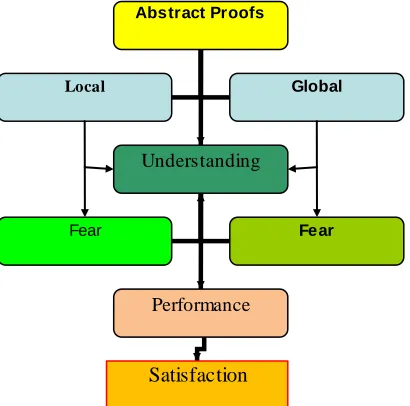
Fig. 1. T he Influence of abstract proofs on Understanding, Performance, and Satisfaction Arrows indicate moderating effects.
7. DAT A ANALYSIS AND INT ERPRET AT ION
The term analysis refers to the computation of certain measures along with searching for patterns of relationship that exists among data groups. Thus in the process of analysis, relationships or differences supporting or conflicting with original or new hypothesis should be subjected to statistical tests of significance to determine with what validity data can be said to indicate any conclusions.
The study is conducted among students at ―Arts, Sciences & Technology University of Lebanon‖ (AUL), and at ―Ahlia University ―a university in the kingdom of Bahrain.
Questionnaire method is used for collecting primary data. 20 questions were included for collecting information on various types of abstract proofs concerning concepts in local and global functions, their influences on students‘ fear of using them, their effect on students‘ understanding, performance and satisfaction. It included questions to clarify their effectiveness on each others. Data is collected from the two mentioned academic institutions, analyzed and interpret.
7.1 Comparati ve Abstract Proofs Bar Chart
The following bar chart describes how sixty query students at AUL and at Ahlia University perceived abstract proofs in local or global functions.
0 5 10 15 20 25 30 35 40
Number of Students
Types of Functions Comparitive Abstract Proofs
Local Global Balance
Local 12 20%
Global 9 15%
Balance 39 65%
Chart 0: Comparati ve abstract proofs Interpretation
The comparison indicates that most of the students (about 65%) in the two universities were perceived abstract proofs about local and global functions (GF) (Balance). About 20% of the students perceived abstract proofs only in Local functions (LF) and 15 % only in global functions (GF). These results indicate that the two institutions were approximately encouraging abstract proofs in the teaching- learning process. Also the analysis of the questionnaire will be significant because an important number of students were perceived abstract proofs about local and global functions.
7.2 Students’ Opinions Who Support Proofs of Abstract Theorems
TABLE I
SUP P ORTING P ROOFS OF ABSTRACT THEOREMS
LF GF BF
Support Local proofs
5 3 11
Support Global proofs
4 3 9
Abstract Proofs
Understanding
Fear Fear
Local Global
Performance
0 2 4 6 8 10 12
Number of Students
LF GF BF
Types of functions Perceived by students
Students Support Abstract Proofs
Local Proofs
Global Proofs
Chart 1: Supporting proofs of abstract theorems Interpretation
The comparison indicates that about 42% of the students who perceived LF supported the abstract proofs for LFs theorems, about 33% of the students who perceived GF supported the abstract proofs for GFs theorems, about 28 % of the students who perceived BF supported the abstract proofs for LFs theorems, and about 23% of the students who perceived BF supported the abstract proofs for GFs theorems.
Chart 1 shows that students who perceived BF supported local proofs more than global proofs.
Notice that in this analysis and in all the coming analysis of data we neglect the results about local proofs and global proofs for responders that they did not perceive the corresponding type of function.
Overall, these results prove that students do not support abstract proof of theorems.
7.3 Students’ Prefer to Apply the Theorems Without Knowing the Proof of these Theorems.
TABLE II
STUDENTS P REFER TO AP P LY THEOREMS WITHOUT P ROVING THEM
LF GF BF
Number of
students who
prefer no proofs
10 8 32
Applying theorems without knowing their proofs
LF GF BF Slice 4
Chart 2: Students prefer to apply theorems without proving them
Interpretation The comparison indicates that about 83% of
the students who perceived LF preferred to apply theorems without knowing their proofs, about 89% of the students who perceived GF preferred to apply theorems without knowing their proofs, and about 82% of the students who perceived GF preferred to apply theorems without knowing their proofs. So the obtained percentages prove that students do not like to deal with the proof of theorems. They prefer direct application of these theorems in solving problems. Hence Hypothesis 1a is satisfied.
7.4 Students Dislike Abstract Proofs of Local and Global Functions.
TABLE III
STUDENTS DISLIKE ABSTRACT P ROOFS
LF GF BF
Dislike Local proofs
11 5 33
Dislike Global proofs
9 8 27
0 5 10 15 20 25 30 35
Number of students
LF GF BF
Types of functions perceived by students
Dislike abstract proofs of local and global functions
Dislike LP Dislike GP
Chart 3: Students dislike abstract proofs Interpretation
89% of the students who perceived GF disliked abstract proof of global theorems, about 85% of the students who perceived LF disliked abstract proof of local theorems, and about 69% of the students who perceived GF disliked abstract proof of global theorems. These results clarify that students dislike abstract proof of local and global proofs of theorems. Hence Hypothesis 2a is satisfied.
Chart 3 shows that students who perceived BF dislike local proofs more than global proofs.
7.5 Difficulties of Local and Global Proof of Theorems T able IV
Difficulties of local and global proof of theorems
Chart 4: Difficulties of local and global proof of theorems Interpretation
The comparison indicates that about 75% of the students who perceived LF found difficulties in understanding abstract proof of local theorems, about 78% of the students who perceived GF found difficulties in understanding abstract proof of global theorems, about 79% of the students who perceived BF found difficulties in understanding abstract proof of local theorems, and about 77% of the students who perceived BF found difficulties in understanding abstract proof of global theorems. These obtained percentages prove that it is very difficult for students understand local and global proof of theorems . Hence Hypothesis 3a is satisfied.
Chart 4 shows that students who perceived BF had difficulties in understanding local proofs more than global proofs.
7.6 Abstract Proofs for Local and Global Functions are Useless
TABLE V
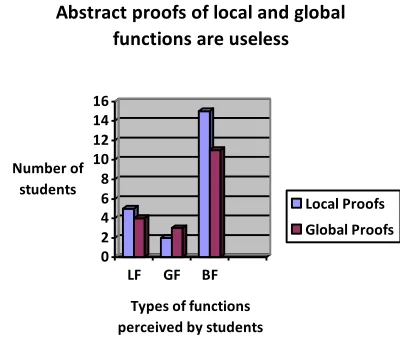
ABSTRACT P ROOFS FOR LOCAL AND GLOBAL FUNCTIONS ARE USELESS
LF GF BF
Local proofs are useless
5 2 15
Global proofs are useless
4 3 11
0 2 4 6 8 10 12 14 16
Number of students
LF GF BF
Types of functions perceived by students
Abstract proofs of local and global functions are useless
Local Proofs Global Proofs
Chart 5: Abstract proofs for local and global functions are useless
Interpretation
The comparison indicates that about 42% of the students who perceived LF found that abstract proof of local theorems are useless, about 33% of the students who perceived GF found that abstract proof of global theorems are useless, about 38% of the students who perceived BF found that abstract proof of local theorems are useless, and about 28% of the students who perceived GF found that abstract proof of global theorems are useless. These obtained results are good evidence to prove that abstract proofs of local and global functions are not us eless. Hence Hypothesis 1b is not satisfied.
Chart 5 shows that students who perceived BF found that abstract proofs for local functions are more useless than the global ones.
7.7 Abstract Proofs Have no Effect on their Performance for Solving Local and Global Problems.
T able VI
T he effect of abstract proofs on students‘ performance in solving problems
LF GF BF
Local proofs
6 5 19
Global proofs
5 4 20
LF GF BF
Local proofs are difficult
9 6 31
Global proofs are difficult
0 2 4 6 8 10 12 14 16 18 20
Number of students
LF GF BF
Types of functions perceived by students
The Effect of Abstract Proofs of Local and Global Theorems on Students
Performance in Solving Problems
Local Proofs Global Proofs
Chart 6: The effect of abstract proofs on students’ performance in solving problems
Interpretation
The comparison indicates that about 50% of the students who perceived LF found that abstract proof of local theorems affect their performance in solving Local problems; about 44% of the students who perceived GF found that abstract proof of global theorems affect their performance in solving global problems, about49% of the students who perceived BF found that abstract proof of local theorems affect their performance in solving Local problems, and about 51% of the stud ents who perceived BF found that abstract proof of global theorems affect their performance in solving global problems. These results are not clear enough to see whether Hypothesis 2b is satisfied or not. Therefore, it reasonable to test the initiated model ( Fig. 1) to realize the effectiveness of the abstract proofs of local and global functions on students performance. Chart 6 shows that students who perceived BF found that abstract proofs for global functions have more effects on students‘ performance in solving problems more than the local ones.
7.8 Students’ Opinions Who Believe That Abstract Proofs of Theorems Are Needed to Understand The Mathematical Concept of These Theorems.
T able VII
Abstract proofs are needed to understand mathematical concepts
LF GF BF
Local proofs 9 7 28
Global proofs 10 7 31
Students Who believe that Abstract Proofs of Theorems Are Needed For
Understanding
0 5 10 15 20 25 30 35
LF GF BF
Types of functions Perceived by Students
Num
be
r of
stude
nt
s
Local proofs Global Proofs
Chart 7: Abstract proofs are needed to understand mathematical concepts
Interpretation
The comparison indicates that about 75% of the students who perceived LF supported the effect of abstract proofs on understanding the mathematical concepts of local proof of theorems, about 78% of the students who perceived GF supported the effect of abstract proofs on understanding the mathematical concepts of global proof of theorems, about 72% of the students who perceived BF supported the effect of abstract proofs on understanding the mathematical concepts of local proof of theorems, and about 79% of the students who perceived BF supported the effect of abstract proofs on understanding the mathematical concepts of global proof of theorems.
Chart 7 shows that students who perceived BF found that abstract proofs for global functions are more needed than the local ones to understand Mathematical concepts.
Overall, these results prove that students do believe that abstract proofs raise the understanding of the mathematical concepts in both local and global functions.
Hence, Students do not support proof of abstract theorems but they believe of their influence on understanding the mathematical concepts of local and global functions. Thus, this would raise the following Hypotheses:
Hypothesis (1): Students have fear of abstract proof of theorems for local and global functions.
Hypothesis (2): Students‘ fear of abstract proof of theorems
will affect negatively their performance in understanding the mathematical concepts of local and global functions.
Hypothesis (3): Students‘ fear of abstract proof of theorems will affect positively their performance in understanding the mathematical concepts of local and global functions.
Hypothesis (4): students whose performance is affected negatively reach satisfaction.
Hypothesis (5): students whose performance is affected positively reach satisfaction.
TABLE VIII
STUDENTS‘ FEAR OF ABSTRACT P ROOFS
Theorems‘ proofs
LF GF BF
Local proofs
10 6 27
Global proofs
8 8 25
Students' Fear of Abstract Proofs
0 5 10 15 20 25 30
LF GF BF
Types of function perceived by students
Num
be
r of
stude
nt
s
Local Proofs Global Proofs
Chart 8: Students’ fear of abstract proofs Interpretation
The comparison indicates that about 83% of the students who perceived LF have fear to deal with abstract proofs of theorems for local functions , about 89% of the students who perceived GF have fear to deal with abstract proofs of theorems for global functions , about 69% of the students who perceived BF have fear to deal with abstract proofs of theorems for local functions , and 64 % of the students who perceived BF have fear to deal with abstract proofs of theorems for global functions. Hence, Hypothesis (1) is satisfied.
Chart 8 shows that students who perceived BF found that abstract local proofs scared students more than the global ones.
7.10 Students’ Fear of Abstract Proofs Affects Negatively the Student Performance in Understanding Mathematical Concepts
TABLE IX
STUDENTS‘ FEAR OF ABSTRACT P ROOFS HAS A NEGATIVE EFFECT ON
STUDENTS‘ P ERFORMANCE
LF GF BF
Local proofs 11 7 30
Global proofs 9 8 29
0 5 10 15 20 25 30
Number of students
LF GF BF
Types of function perceived by
students
Fear From Abstract Proofs Leads to Negative Performance
Local Proofs Global Proofs
Chart 9: Students’ fear of abstract proofs has a negative effect on students’ performance
Interpretation
The comparison indicates that about 92% of the students who perceived LF and are feared from abstract proofs of local theorems have negative performance in understanding local mathematical concepts , about 89% of the students who perceived GF and are feared from abstract proofs of global theorems have negative performance in understanding global mathematical concepts, about 78% of the students who perceived BF and are feared from abstract proofs of local theorems have negative performance in understanding local mathematical concepts, and 74 % of the students who perceived BF and are feared from abstract proofs of global theorems have negative performance in understanding global mathematical concepts. Hence, Hypothesis (2) is satisfied. Chart 9 shows that students who perceived BF found that the students‘ fear of abstract local proofs affects negatively their performance in understanding the mathematical concepts more than the global ones.
7.11 Students’ Fear of Abstract Proofs affects positively the Student Performance in Understanding Mathematical Concepts
TABLE X
STUDENTS‘ FEAR OF ABSTRACT P ROOFS HAS A P OSITIVE EFFECT ON
STUDENTS‘ P ERFORMANCE
LF GF BF
Local proofs 6 5 19
0 2 4 6 8 10 12 14 16 18 20
Number of students
LF GF BF
Types of function perceived by students
Fear From Abstract Proofs leads to Positive Performance
Local Proofs
Global Proofs
Chart 10: Students’ fear of abstract proofs has a positive effect on students’ performance
Interpretation
The comparison indicates that about 50% of the students who perceived LF and are feared from abstract proofs of local theorems have positive performance in understanding local mathematical concepts , about 44% of the students who perceived GF and are feared from abstract proofs of global theorems have positive performance in understanding global mathematical concepts, about 49% of the students who perceived BF and are feared from abstract proofs of local theorems have positive performance in understanding local mathematical concepts, and 51 % of the students who perceived BF and are feared from abstract proofs of global theorems have positive performance in understanding global mathematical concepts. Hence, Hypothesis (3) is almost not satisfied.
Chart 10 shows that students who perceived BF found that the students‘ fear of abstract local proofs affects positively their performance in understanding the mathematical concepts more than the local ones.
Thus, these results with the previous ones show that fear from abstract proofs has a negative influence on the students‘ performance in understanding the mathematical concepts of local and global functions rather than positively.
7.12 Students Whose Performance is Affected Negatively Reach Satisfaction
TABLE XI
STUDENTS‘ WITH NEGATIVE P ERFORMANCE REACH SATISFACTION
LF GF BF
Local proofs 2 5
Global proofs 3 7
0 1 2 3 4 5 6 7 Number
of students
LFGF BF
Types of function perceive
Students whose performance is affected negatively reach satisfaction
Local proofs
Global proofs
Chart 11: Students’ with negative performance reach satisfaction Interpretation
The comparison indicates that about 18% of the students who perceived LF and their performance is affected negatively reach satisfaction in understanding local mathematical concepts, about 38% of the students who perceived GF and their performance is affected negatively reach satisfaction in understanding global mathematical concepts, about 17% of the students who perceived BF and their performance is affected negatively reach satisfaction in understanding local mathematical concepts, and 24 % of the students who perceived BF and their performance is affected negatively reach satisfaction in understanding global mathematical concepts. Hence, Hypothesis (4) is not satisfied.
Chart 11 shows that students who perceived BF found that students‘ whose performance is affected negatively reach satisfaction in understanding global mathematical concepts more than the local ones.
7.13 Students Whose Performance is Affected Positively Reach Satisfaction
TABLE XII
STUDENTS‘ WITH P OSITIVE P ERFORMANCE REACH SATISFACTION
LF GF BF
Local proofs 5 15
0 2 4 6 8 10 12 14 16
Number of students
LF GF BF
Types of function perceived by
students
Students whose performance is affected positively reach satisfaction
Local proofs
Global proofs
Chart 12: Students’ with positive performance reach satisfaction
Interpretation
The comparison indicates that about 83% of the students who perceived LF and their performance is affected positively reach satisfaction in understanding local mathematical concepts, about 75% of the students who perceived GF and their performance is affected positively reach satisfaction in understanding global mathematical concepts, about 79% of the students who perceived BF and their performance is affected positively reach satisfaction in understanding local mathematical concepts, and 70 % of the students who perceived BF and their performance is affected positively reach satisfaction in understanding global mathematical concepts. Hence, Hypothesis (5) is satisfied.
Chart 12 shows that students who perceived BF found that students‘ whose performance is affected negatively reach satisfaction in understanding local mathematical concepts more than the global ones.
Thus, these results with the previous ones show that once the abstract proofs of the theorems for local and global functions are positively understood by students, these students will reach satisfaction; otherwise, they will be far away of it. Also a good remarkable result is that although students disliked the two types of abstract proofs, they somehow prefer abstract global proofs rather than the local ones.
8. CONCLUSION
The concept of limits leads to define and describe continuity and derivative of the function. The continuity of a function has practical as well as theoretical importance. In this paper, we studied some standard functions, their graphs, concept of limits and discuss about the continuity of
the functions. Throughout this paper, we denoted
as the set of real numbers.Continuity of a function at a point is defined and extended to intervals. Several examples were given to illustrate what can go wrong with continuity; for example, "poles", "jumps", "holes", or some type of oscillating behavior. Then properties of continuous functions and one-sided continuity were
discussed. This topic also illustrated how to define a function so that continuity on an interval or at a point can be assured. It was noted that continuity can not be determined by a graph, even though graphing can help for many functions. Continuity can be checked at each point by using the definition of continuity.
Indeed the results in this paper were precisely why we were interested in discussing continuity in the first place. Although some of the results were ``obvious'', they only followed from the continuity property, and indeed we presented counterexamples whenever that fails. So in order to be able to use the following helpful results, we must first be able to check our functions satisfy the hypothesis of continuity. That task was of course what we have just been concentrating on. The results of the survey clarified the students‘ horror in using abstract proofs to prove theorems. Although this fear affected negatively the performance of students in understanding the local and global mathematical concepts, it had little space of positive effect on some students‘ performance. This positive effect allowed students to reach the desired satisfaction which we needed from them in our teaching process. Therefore, we should not neglect the use of abstract proof of theorems. Also this survey proved that students, whose performance was negatively affected by the fear of abstract proofs, did not reach satisfaction. So one might request if these students would reach satisfaction without the use of those abstract proofs of theorems!
At last but not least, limits and continuity are twins' concepts that complete each others. It is true that many professors avoided using the abstract proofs for many problems related to limits and continuities because they were convinced from their experiences that the mentality of this generation could not analyze and accept such proofs. However, mathematics is the sport of the brain, and many sports need hard efforts and exercises to give wonderful results. And we can say that mathematics is one of these hard sports that give valuable brain. So using epsilon and its relatives to solve mathematical problems in the abstract form are needed to initiate and develop new mathematical concepts and ideas. Professors and students should be persuaded the beauty of mathematics is not found only in using simple or hard proofs, but also in using convenient proofs, such as the abstract ones, to improve the critical thinking among students and professors.
REFERENCES
[1] Grabiner,424 West 7th Street, Claremont, California 91711, 1983. Who Gave You the Epsilon? Cauchy and the Origins of Rigorous Calculus Judith V. The Am erican Mathematical Monthly, March, 90(3): 185–194.
[2] A.L.Cauchy,Cours d‘analyse, Paris 1821, 1899. In Oeuvres com plètes d’Augustin Cauchy. Series 2, (3): 19.
[3] A.L.Cauchy, Résumé des leçons données A l‘école royale polytechnique sur le Calcul infinitésimal, Paris, in Oeuvres, 1823. Cauchy used i for the increment; otherwise the notation is his.Series2 (4): 44.
[4] Swetz, Frank J., and T. I. Kao,1967. A Concise History of Mathem atics. 3rd rev. ed. New York: Dover Publications. [5] Pennsylvania State University Press; Reston , Va. 1977. Was