A Research on Mobile Cloud Computing and Future
Trends
Fei
Gu
1,*,
Jianwei
Niu
1,
Zhenxue
He
11State Key Laboratory of Virtual Reality Technology and Systems, School of Computer Science and Engineering,
Beihang University, Beijing 100191, China
Abstract
With an exploding growth of the mobile applications and emerging of cloud computing, mobile cloud computing (MCC) has become a potential technology for mobile services. MCC is the combination of cloud computing, mobile computing and wireless networks to bring rich computational resources to mobile users, network operators, as well as cloud computing providers. Despite increasing usage of mobile computing, exploiting its full potential is difficult due to its inherent problems such as resource scarcity, frequent disconnections and mobility. MCC can address these problems by executing mobile applications on the resource providers’ side. In this paper, we give a definition of mobile cloud computing and provide an overview of state-of-the-art progress, in particular, models of mobile cloud applications. We also highlight research challenges in the area of mobile cloud computing. We conclude that mobile cloud computing can help building more powerful mobile applications.
Keywords: Mobile Cloud Computing (MCC), Offloading, Mobile Services
1. Introduction
The market of mobile devices has expanded rapidly.
According to IDC[24], the premier global market
intelligence firm, the worldwide Smartphone market grew 55.3% year over year in 2015. Mobile devices allow users to run powerful applications that take advantage of the growing availability of built-in sensing and better data exchange capabilities of mobile devices. In recent years, applications targeted at mobile devices have started becoming abundant with applications in various categories such as entertainment, health, games, business, social networking, travel and news. The popularity of these are evident by browsing through mobile app download centers such as Apple’s iTunes or Google’s Play. The reason for this is that mobile computing is able to provide a tool to the user when and where it is needed irrespective of user movement, hence supporting location independence.
However, the mobile devices are facing many challenges in their resources (e.g., battery life, storage, and bandwidth) and communications (e.g., mobility
and security)[39]. The limited resources significantly
impede the improvement of service qualities. Given the abundance of and easy access to public cloud computing resources, the natural question to ask is,
∗Corresponding author. Email:[email protected]
can cloud computing bridge the resource gap of mobile computing?
The answer is definitively yes. Recently, we have witnessed several cases which cloud computing is called in to solve mobile computing problems. Apple’s iCloud stores customers’ music, photos, apps, calendars, documents, etc, and wirelessly pushes them to all their devices automatically. Apple’s iCloud stores are hosted in Amazon Elastic Compute Cloud (EC2) and Microsoft Azure. Amazon has released its new "cloud-accelerated" Web browser Silk. Silk a "split browser" whose software resides both on Kindle Fire and EC2. With each web page request, Silk dynamically determines a division of labor between the mobile hardware and Amazon EC2 (i.e. which browser sub-components run where) that takes into consideration factors like network conditions, page complexity and the location of any cached content. We refer to mobile applications that leverage the public cloud (e.g. Amazon EC2 and Windows Azure) as mobile cloud applications or mCloud apps for short. We refer to the research area of mobile computing that taps in cloud resources as mobile cloud computing or mCloud computing for short. The public cloud today are designed for enterprise applications without any explicit consideration of mobile applications. Mobile computing demand fundamental changes to the public
on
Industrial Networks and Intelligent Systems
Research Article
Copyright © 2016Fei Gu et al., licensed to EAI. This is an open access article distributed under the terms of the
Creative Commons Attribution licence (http://creativecommons.org/licenses/by/3.0/), which permits unlimited use,
distribution and reproduction in any medium so long as the original work is properly cited. doi: 10.4108/eai.21-4-2016.151159
cloud. We refer to a public cloud that supports mobile applications seamlessly as mCloud.
Cloud computing (CC) has been widely recognized as
the next generation computing infrastructure. CC offers
some advantages by allowing users to use infrastructure (e.g., servers, networks, and storages), platforms (e.g., middleware services and operating systems), and softwares (e.g., application programs) provided by cloud providers (e.g., Google, Amazon, and Salesforce) at low cost. In addition, CC enables users to elastically utilize resources in an on-demand fashion. As a result, mobile applications can be rapidly provisioned and
released with the minimal management efforts or
service provider’s interactions. With the explosion of mobile applications and the support of CC for a variety of services for mobile users, MCC is introduced as an integration of CC into the mobile environment. MCC brings new types of services and facilities mobile users to take full advantages of CC.
This paper presents a comprehensive summary on MCC. A brief background of MCC can be shown in Section 2. Section 3 provides a brief overview of MCC including definition, architecture, and its advantages. Then, Section 4 presents several open research issues and Section 5 shows the basic mobile cloud computing services. Finally, the future research Trends and the conclusion are outlined in Section 6.
2. Background
As a development and extension of Cloud Computing and Mobile Computing, Mobile Cloud Computing, as a new phrase, has been devised since 2009. In order to help us grasping better understanding of Mobile Cloud Computing, let’s start from the two previous techniques: Mobile Computing and Cloud Computing.
2.1. Mobile Computing
Mobility has become a very popular word and rapidly increasing part in today’s computing area. An incredible growth has appeared in the development of mobile devices such as, smartphone, PDA, GPS Navigation and laptops with a variety of mobile computing, networking and security technologies. In addition, with the development of wireless technology like WiMax, Ad Hoc Network and WIFI, users may be surfing the Internet much easier but not limited by the cables as before. Thus, those mobile devices have been accepted by more and more people as their first choice of working and entertainment in their daily lives.
So, what is Mobile computing exactly? In Wikipedia, it is described as a form of human-computer interaction by which a computer is expected to be transported
during normal usage[32]. Mobile computing is based on
a collection of three major concepts: hardware, software and communication. The concepts of hardware can
be considered as mobile devices, such as smartphone and laptop, or their mobile components. Software of mobile computing is the numerous mobile applications in the devices, such as the mobile browser, anti-virus software and games. The communication issue includes the infrastructure of mobile networks, protocols and data delivery in their use. They must be transparent to end users.
Compared with the traditional wired network, mobile computing network may face various problems
and challenges in different aspects, such as signal
disturbance, security, hand-off delay, limited power,
low computing ability, and so on, due to the wireless environment and numerous mobile nodes. In addition, the Quality of Service (QoS) in mobile computing
network is much easier to be affected by the landforms,
weather and buildings.
2.2. Cloud Computing
In the era of PC, many users found that the PCs bought 2 years ago cannot keep pace with the development of software nowadays; they need a higher speed CPU, a larger capacity hard disk, and a higher performance Operation System (OS). That is the magic of "Moores Law" which urges user upgrading their PCs constantly, but never ever overtakes the development of techniques. Thus, a term called "Cloud Computing" burst upon our lives.
Cloud Computing has become a popular phrase since 2007. However, there is no consensual definition on what a Cloud Computing or Cloud Computing System is, due to dozens of developers and organizations
described it from different perspectives. C. Hewitt[22]
introduces that the major function of a cloud computing system is storing data on the cloud servers, and uses of cache memory technology in the client to fetch the data. Those clients can be PCs, laptops, smartphones and so
on. R. Buyya[9] gives a definition from the perspective
of marking that cloud computing is a parallel and distributed computing system, which is combined by a group of virtual machines with internal links.
Such systems dynamically offer computing resources
from service providers to customers according to their Service level Agreement (SLA). However, some authors mentioned that cloud computing was not a
completely new concept. L. Youseff[45] from University
of California, Santa Barbara (UCSB) declares that cloud computing is just combined by many existent and few new concepts in many research fields, such as distributed and grid computing, Service-Oriented Architectures (SOA) and in virtualization.
3. Overview of Mobile Cloud Computing
attracting the attentions of entrepreneurs as a profitable business option that reduces the development and running cost of mobile applications, of mobile users as a new technology to achieve rich experience of a variety of mobile services at low cost, and of researchers
as a promising solution for green IT[3]. This section
provides an overview of MCC including definition, architecture, and advantages of MCC.
3.1. Definition
MCC is the combination of cloud computing, mobile computing and wireless networks to bring rich computational resources to mobile users, network
operators, as well as cloud computing providers[1][29].
The ultimate goal of MCC is to enable execution of rich mobile applications on a plethora of mobile
devices, with a rich user experience[2]. MCC provides
business opportunities for mobile network operators
as well as cloud providers[14]. Move comprehensively,
MCC can be defined as a rich mobile computing technology that leverages unified elastic resources of varied clouds and network technologies toward unrestricted functionality, storage, and mobility to serve a multitude of mobile devices anywhere, anytime through the channel of Ethernet or Internet regardless of heterogeneous environments and platforms based on
the pay-as-you-use principle[36].
3.2. Architectures
From the concept of MCC, the general architecture of
MCC can be shown in Figure 1. In Figure 1, mobile
devices are connected to the mobile networks via base stations (e.g., base transceiver station, access point, or satellite) that establish and control the connections (air links) and functional interfaces between the networks and mobile devices. Mobile users’ requests and information (e.g., ID and location) are transmitted to the central processors that are connected to servers providing mobile network services. Here, mobile network operators can provide services to mobile users as authentication, authorization, and accounting based on the home agent and subscribers’ data stored in databases. After that, the subscribers’ requests are delivered to a cloud through the Internet. In the cloud, cloud controllers process the requests to provide mobile users with the corresponding cloud services. These services are developed with the concepts of utility computing, virtualization, and service-oriented architecture (e.g., web, application, and database servers).
The details of cloud architecture could be different
in different contexts. For example, a four-layer
archi-tecture is explained in [18] to compare cloud
com-puting with grid comcom-puting. Alternatively, a service-oriented architecture, called Aneka, is introduced to
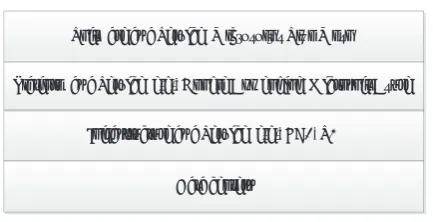
Software as a Service (Microsoft’s Live Mesh)
Infrastructure as a Service (e.g., EC2, S3)
Platform as a Service (e.g., Google App engine, Microsoft Azure)
Data centers
Figure 2. Service-oriented cloud computing architecture
enable developers to build. Microsoft .NET applications with the supports of application programming
inter-faces (APIs) and multiple programming models. [10]
presents an architecture for creating market-oriented
clouds and [23] proposes an architecture for
web-delivered business services. In this paper, we focus on a layered architecture of cloud computing (CC) (Figure
2). This architecture is commonly used to demonstrate
the effectiveness of the CC model in terms of meeting
the user’s requirements[43].
Generally, a CC is a large-scale distributed network system implemented based on a number of servers in data centers. The cloud services are generally classified
based on a layer concept (Figure2). In the upper layers
of this paradigm, Infrastructure as a Service (IaaS), Platform as a Service (PaaS), and Software as a Service (SaaS) are stacked.
• Data centers layer: This layer provides the
hardware facility and infrastructure for clouds. In data center layer, a number of servers are linked with high-speed networks to provide services for customers. Typically, data centers are built in less populated places, with a high power supply stability and a low risk of disaster.
• IaaS:Infrastructure as a Service is built on top of
the data center layer. IaaS enables the provision of storage, hardware, servers, and networking components. The client typically pays on a per-use basis. Thus, clients can save cost as the payment is only based on how much resource they really use. Infrastructure can be expanded or shrunk dynamically as needed. The examples of IaaS are Amazon Elastic Cloud Computing and Simple Storage Service (S3).
• PaaS: Platform as a Service offers an advanced
integrated environment for building, testing, and deploying custom applications. The examples of PaaS are Google App Engine, Microsoft Azure, and Amazon Map Reduce/Simple Storage Service.
• SaaS: Software as a Service supports a software
ccess Point Access Point
atellite Satellite
BTS BTS
Mobile Network A
Centrol Processor
Servers
Databa ase
Database Mobile Network Services
Mobile devices
HA
AAA
ccess Point Access Point
atellite Satellite
BTS BTS
Mobile Network B
Centrol Processor
Servers
Databa ase
Database Mobile Network Services
HA
AAA
Mobile devices
Internet
Cloud controler Data
center
Cloud A
Cloud controler Data
center
Cloud B Cloud Computing Data center owners or
cloud service providers
A
A Appllliiicatiiion
servers Application
servers
Application server providers Internet service
providers (ISPs)
Mobile users Network operators
Figure 1. Architecture of Mobile Cloud Computing
layer, the users can access an application and information remotely via the Internet and pay only for that they use. Salesforce is one of the pioneers in providing this service model. Microsoft’s Live Mesh also allows sharing files and folders across multiple devices simultaneously.
Although the CC architecture can be divided into four
layers as shown in Figure2, it does not mean that the
top layer must be built on the layer directly below it. For example, the SaaS application can be deployed directly on IaaS, instead of PaaS. Also, some services can be considered as a part of more than one layer. For example, data storage service can be viewed as either in IaaS or PaaS. Given this architectural model, the users
can use the services flexibly and efficiently.
3.3. Advantages
Cloud computing is known to be a promising solution for mobile computing (MC) because of many reasons
(e.g., mobility, communication, and portability[17]). In
the following, we describe how the cloud can be used to overcome obstacles in MC, thereby pointing out advantages of MCC.
• Extending battery lifetime. Battery is one of the
main concerns for mobile devices. Several solu-tions have been proposed to enhance the CPU
performance[25][34] and to manage the disk and
screen in an intelligent manner[13][30] to reduce
power consumption. However, these solutions require changes in the structure of mobile devices, or they require a new hardware that results in an increase of cost and may not be feasible for
all mobile devices. Computation offloading
tech-nique is proposed with the objective to migrate the large computations and complex process-ing from resource-limited devices (i.e., mobile devices) to resourceful machines (i.e., servers in clouds). This avoids taking a long application execution time on mobile devices which results in large amount of power consumption.
In [35] and [42], the effectiveness of offloading
techniques were evaluated through several exper-iments. The results demonstrate that the remote application execution can save energy
signifi-cantly. Especially, Rudenko[35] evaluates
large-scale numerical computations and shows that up to 45% of energy consumption can be reduced for large matrix calculation. In addition, many mobile applications take advantages from task migration
and remote processing. For example, offloading
a compiler optimization for image processing[26]
mobile device. What’s more, using memory arith-metic unit and interface (MAUI) to migrate mobile
game components[12] to servers in the cloud can
save 27% of energy consumption for computer games and 45% for the chess game.
• Improving data storage capacity and processing
power. Storage capacity is also a constraint for
mobile devices. MCC is developed to enable mobile users to store/access the large data on the cloud through wireless networks. First example
is the Amazon Simple Storage Service[5] which
supports file storage service. Another example is Image Exchange which utilizes the large storage
space in clouds for mobile users[44]. This mobile
photo sharing service enables mobile users to upload images to the clouds immediately after capturing. Users may access all images from any devices. With the cloud, the users can save considerable amount of energy and storage space on their mobile devices because all images are
sent and processed on the clouds. Flickr[16] and
ShoZu[41] are also the successful mobile photo
sharing applications based on MCC. Facebook[15]
is the most successful social network application today, and it is also a typical example of using cloud in sharing images.
Mobile cloud computing also helps in reducing the running cost for compute-intensive applica-tions that take long time and large amount of energy when performed on the limited-resource
devices. CC can efficiently support various tasks
for data warehousing, managing and synchro-nizing multiple documents online. For example,
clouds can be used for transcoding[19],
play-ing chess[12][27], or broadcasting multimedia
services[28] to mobile devices. In these cases, all
the complex calculations for transcoding or off
er-ing an optimal chess move that take a long time when perform on mobile devices will be processed
efficiently on the cloud. Mobile applications also
are not constrained by storage capacity on the devices because their data now is stored on the cloud.
• Improving reliability: Storing data or running
applications on clouds is an effective way to
improve the reliability because the data and application are stored and backed up on a number of computers. This reduces the chance of data and application lost on the mobile devices. In addition, MCC can be designed as a comprehensive data security model for both service providers and users. For example, the cloud can be used to protect copyrighted digital contents (e.g., video, clip, and music) from
being abused and unauthorized distribution[46].
In addition, the cloud can remotely provide mobile users with security services such as virus scanning, malicious code detection, and
authentication[33]. Such cloud-based security
services also can make efficient use of the
collected record from different users to improve
the effectiveness of the services.
In addition, MCC also inherits some advantages of clouds for mobile services as follows:
• Dynamic provisioning. Dynamic on-demand
provisioning of resources on a fine-grained, self-service basis is a flexible way for self-service providers and mobile users to run their applications without advanced reservation of resources.
• Scalability. The deployment of mobile
appli-cations can be performed and scaled to meet the unpredictable user demands due to flexible resource provisioning. Service providers can eas-ily add and expand an application and service without or with little constraint on the resource usage.
• Multitenancy. Service providers (e.g., network
operator and data center owner) can share the resources and costs to support a variety of applications and largenumber of users.
• Ease of integration. Multiple services from
different service providers can be integrated easily
through the cloud and Internet to meet the user demand.
4. Open Research Issues
4.1. Energy efficiency
Owing to the limited resources such as battery life, available network bandwidth, storage capacity and processor performance, on the mobile devices, researchers are always on the lookout for solutions that result in optimal utilization of available resources.
4.2. Security
The absence of standards poses a serious issue specifically with respect to security and privacy of data being delivered to and from the mobile devices to the cloud.
4.3. Better service
The original motivation behind MCC was to provide PC-like services to mobile devices. However, owing to
the varied differences in features between fixed and
Memcache
Compute nodes
Storage
Databases
CDNs
Bakcup
Data locker for p2p
Basic platform services
Constructed services
Figure 3. Platform services
4.4. Task division
Researchers are always on the lookout for strategies
and algorithms to offload computation tasks from
mobile devices to cloud. However, due to differences in
computational requirement of numerous applications available to the users and the variety of handsets available in the market, an optimal strategy is an area to be explored.
5. Basic Mobile Cloud Computing Services
We envision that cloud computing providers will provide a set of basic services for mobile computing. There are three types of services. The first one is what we refer as platform services, the second is application services, and the third is context-rich support services.
5.1. Platform Services
Platform services include computing, storage, database, memcache, content distribution as shown in Figure
3. Currently all EC2 services accessible from mobile
devices are considered platform services. Some of these basic services can benefit from application sharing. Taking distributed memcache service for an example, we can see that many application may create same or access same data sets. With a shared memcache service, it will be more likely to have a cache hit due to the larger cache size. It will reduce computation demand to re-generate the cached results. Of course, sharing brings several issues, such as security, privacy as well as how much storage each application should have.
Out of the basic platform service, one can already build very useful applications. For example, with storage service, and computing service, one can build file backup service, and file syncing service (keep all registered devices in sync of the user content). One
can also build a data locker service[4]. In essence, the
Moble e-commerce
Location-based applications
Application services
Collaborative Applications
Video streaming
proxy
Presence
Push notification
Speech/image recognition
Platform services
Gaming
Figure 4. Application services
data locker protocol works with p2p protocols closely to service files on behalf of end hosts. It is particularly appealing in the mobile device context as it minimizes the usage of wireless access links.
5.2. Application Services
Public cloud provider can also offer a set of essential
application services, which can be shown in Figure
4. For example, people may not trust each individual
applications and thus, may not reveal their location information. This can hamper the development of location based services. If mobile devices are using the cloud services, then there is prior trusted relationship. For example, Apple iCloud users are comfortable that their private data will be protected from un-authorized use. So it is easier to trust the cloud provider for location privacy. Thus, a presence service can be an essential service so that any application that needs location information can talk to the presence service. The presence service will implement location privacy policies according to what are stipulated by
the mobile subscribers. We recognize that different
people have different levels of privacy requirements.
It is conceivable that some people may not want to sign up with a presence service. However, the presence service will facilitate the development of location-based services. Presence service will save resources as it is not replicated for each location based application.
Given the popularity of video streaming applications,
cloud providers can offer a video transcoding and
Many mobile applications need to send push notification to mobile devices. Because many mobile devices are behind NAT, in order to send push notification, a persistent TCP connection is needed. To maintain such a persistent TCP connection, periodic heartbeat messages have to be sent. Thus, it will be
very inefficient if each application has to maintain a
persistent TCP connection. To avoid such situation,
Android offers a push notification service through an
API so that one TCP connection is maintained between a mobile device and a Google server for the purpose of push notification.
Push notification services typically are used by servers to reach mobile clients. To allow mobile devices to communicate with each other, Microsoft Research
Project Hawaii[21] has developed a relay service. The
Hawaii Relay Service provides a relay point in the cloud that mobile applications can use to communicate. It
provides an endpoint naming scheme and buffering
for messages sent between endpoints. It also allows for messages to be multicast to multiple endpoints.
There are many applications that do speech and image recognition. It makes sense to provide a common service to implement the best algorithm while amortizing the cost. In fact, Google Android have a speech recognition API which enables developers to integrate speech input capabilities into their applications. Developers stream audio to Google’s servers which then convert speech into text and feed
it back to the applications. Project Hawaii[21] also
provides a speech to text service.
5.3. Context-rich Services
We envision that many mobile applications will become more personalized, and more context aware, recognizing not only the location of the user and the time of day, but also a user’s identity and their personal preferences. To support these mCloud services, we believe mCloud providers need to provide a set of context-rich support services. Application developers can use these context-rich support services as building blocks to build a large class of new mCloud services. We envision several context-rich support services such as context extraction service, recommendation service, and group privacy service. Context extraction service provides data mining analysis of mobile data combined with other forms of data, such as social networking data and sensor network data, in order to extract contextual clues relevant to the user. For example, recognizing the user’s activity based on mobile accelerometer and audio data is one such contextual mining service
that is currently being explored[31]. The context
extraction service will be a common service that relieves each context-rich application from replicating context
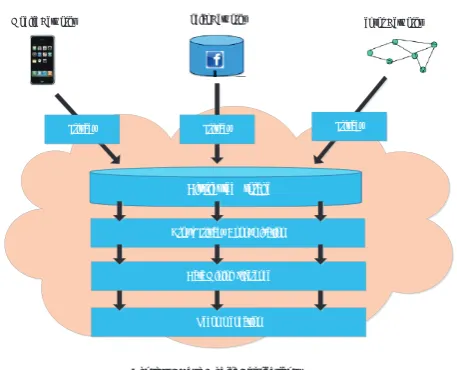
Mobile Networks Social Networks Sensor Networks
Distributed Storage
Privacy Privacy Privacy
Group Privacy/Anonymization
Data Mining/Inference
Recommendation
Context-Aware Mobile Applications
Figure 5. Privacy, Data Mining, and Recommendation Services in the Context-Aware Mobile Social Cloud.
extraction, thus saving energy and reduce computation costs of mobiles.
Based on these contextual clues, a layer of cloud recommendation services can be built that creates output that is tailored to an individual or set of individuals with those contextual characteristics. For example, some applications have begun to combine together mobile location with social networks to generate multimedia content, e.g. a song playlist or a
recommended video[6], that is tailored to the individual
or individuals who are nearby an audio jukebox or video screen that is aware of their presence.
Such contextual mobile applications would be
composed as shown in Figure5. This architecture fuses
together multiple layers of cloud application services, as
described in the SocialFusion architecture[8], wherein
mobile, social, and sensor networks supply streams of data into a distributed storage service. Data mining/inference cloud services then operate on the assembled data to extract contextual clues. Finally, recommendation services in the cloud generate tailored multimedia output, either for the mobile device or for nearby multimedia devices such as LCD displays or loudspeakers.
We imagine that privacy protection services will emerge as a key component of context-aware mobile
cloud services, as there is a fundamental tradeoff
devised to protect and anonymize information released
from social networks[7] and sensor networks[20][37].
Moreover, we believe a new concept of "group privacy" or "collective privacy" will emerge, requiring privacy services that protect groups of individuals from collective inferences on their joint actions, tastes, and preferences.
6. Conclusion and Future Trends
Mobile Cloud Computing, as a development and extension of Cloud Computing and Mobile Computing, is the emerging and well accepted technology with fast growth. The combination of cloud computing, wireless communication infrastructure, portable computing devices, location-based services, mobile Web etc. has laid the foundation for the novel computing model.
We have given an extensive survey of current mobile cloud computing research in this paper. Highlighting the motivation for mobile cloud computing, we have
also presented different definitions of mobile cloud
computing in the literature. We have presented a taxonomy of issues found in this area, and the approaches in which these issues have been tackled, focusing on operational level, end user level, service and application level, security and context-awareness.
These are still early days in mobile cloud computing,
with recent workshops in the area such as MobiSys[38],
MCCTA[40], CMCVR[12], and MCNCS[11]. There are
numerous new mobile applications that a mobile cloud framework can enable, when many more resources can be made available to the mobile device (via the mobile cloud facility). The future could also explore the potential of local mobile clouds formed from collections of computers in ubiquitous devices in shoes, clothing, watches, jewelry, furniture and other everyday objects, as indeed such embedded computers will become more powerful. And so, the infrastructure, platform or application available as services will be of new forms: the infrastructure could be a powerful massively distributed set of cameras on stationary and mobile devices formed ad hoc and metered to cover an event, or a collection of distributed computers formed to compute a job seamlessly from the user’s mobile device while the user is shopping. A car can sell its computational resources and pay for its own parking, or the collection of computers on crowds of people in a busy area forms an "elastic" collective resource for ad hoc use. There is also potential to have context sources or sensors (and sensor networks) in the vicinity of a mobile user sold as services to the mobile user, to support context-aware applications. However, challenges are present in order to "elastically" on-demand form clouds of services and resources
efficiently, seamlessly and in a robust manner.
References
[1] S. Abolfazli, Z. Sanaei, E. Ahmed, A. Gani, and R. Buyya. Cloud-based augmentation for mobile devices: motivation, taxonomies, and open challenges.
Communications Surveys & Tutorials, IEEE, 16(1):337– 368, 2014.
[2] S. Abolfazli, Z. Sanaei, A. Gani, F. Xia, and L. T. Yang. Rich mobile applications: genesis, taxonomy, and open issues. Journal of Network and Computer Applications, 40:345–362, 2014.
[3] M. Ali. Green cloud on the horizon. InCloud Computing, pages 451–459. Springer, 2009.
[4] R. Alimi. Open content distribution using data lockers. Technical report, Technical Report TR1426, Feb. 2010. [5] Amazon simple storage service. http://aws.amazon.
com/s3/.
[6] A. Beach, M. Gartrell, S. Akkala, J. Elston, J. Kelley, K. Nishimoto, B. Ray, S. Razgulin, K. Sundaresan, B. Surendar, et al. Whozthat? evolving an ecosystem for context-aware mobile social networks. Network, IEEE, 22(4):50–55, 2008.
[7] A. Beach, M. Gartrell, and R. Han. q-anon: Rethinking anonymity for social networks. In Social Computing (SocialCom), 2010 IEEE Second International Conference on, pages 185–192. IEEE, 2010.
[8] A. Beach, M. Gartrell, X. Xing, R. Han, Q. Lv, S. Mishra, and K. Seada. Fusing mobile, sensor, and social data to fully enable context-aware computing. InProceedings of the Eleventh Workshop on Mobile Computing Systems & Applications, pages 60–65. ACM, 2010.
[9] R. Buyya, C. S. Yeo, and S. Venugopal. Market-oriented cloud computing: Vision, hype, and reality for delivering it services as computing utilities. In High Performance Computing and Communications, 2008. HPCC’08. 10th IEEE International Conference on, pages 5–13. Ieee, 2008. [10] R. Buyya, C. S. Yeo, S. Venugopal, J. Broberg, and I. Brandic. Cloud computing and emerging it platforms: Vision, hype, and reality for delivering computing as the 5th utility. Future Generation computer systems, 25(6):599–616, 2009.
[11] A. Coronato and G. De Pietro. Mipeg: A middleware infrastructure for pervasive grids. Future Generation Computer Systems, 24(1):17–29, 2008.
[12] E. Cuervo, A. Balasubramanian, D.-k. Cho, A. Wolman, S. Saroiu, R. Chandra, and P. Bahl. Maui: making smartphones last longer with code offload. InProceedings of the 8th international conference on Mobile systems, applications, and services, pages 49–62. ACM, 2010. [13] J. W. Davis. Power benchmark strategy for systems
employing power management. In Electronics and the Environment, 1993., Proceedings of the 1993 IEEE International Symposium on, pages 117–119. IEEE, 1993. [14] H. T. Dinh, C. Lee, D. Niyato, and P. Wang. A survey
of mobile cloud computing: architecture, applications, and approaches. Wireless communications and mobile computing, 13(18):1587–1611, 2013.
[15] Facebook.http://www.facebook.com/. [16] Flickr.http://www.flickr.com/.
[18] I. Foster, Y. Zhao, I. Raicu, and S. Lu. Cloud computing and grid computing 360-degree compared. In Grid Computing Environments Workshop, 2008. GCE’08, pages 1–10. Ieee, 2008.
[19] A. Garcia and H. Kalva. Cloud transcoding for mobile video content delivery. In Proceedings of the IEEE International Conference on Consumer Electronics (ICCE), volume 379, 2011.
[20] P. Gilbert, L. P. Cox, J. Jung, and D. Wetherall. Toward trustworthy mobile sensing. InProceedings of the Eleventh Workshop on Mobile Computing Systems & Applications, pages 31–36. ACM, 2010.
[21] M. R. P. Hawaii. Hardware and software platforms for developing cloud-enabled applications for windows phone 7.http://research.microsoft.com/en-us/um/ redmond/projects/hawaii/students/.
[22] C. Hewitt. Orgs for scalable, robust, privacy-friendly client cloud computing. IEEE internet computing, pages 96–99, 2008.
[23] Y. Huang, H. Su, W. Sun, J. M. Zhang, C. J. Guo, J. M. Xu, Z. B. Jiang, S. X. Yang, and J. Zhu. Framework for building a low-cost, scalable, and secured platform for web-delivered business services.IBM Journal of Research and Development, 54(6):4–1, 2010.
[24] International data corporation.http://www.idc.com/. [25] R. Kakerow. Low power design methodologies for mobile
communication. InComputer Design: VLSI in Computers and Processors, 2002. Proceedings. 2002 IEEE International Conference on, pages 8–13. IEEE, 2002.
[26] U. Kremer, J. Hicks, and J. Rehg. A compilation framework for power and energy management on mobile computers. In Languages and Compilers for Parallel Computing, pages 115–131. Springer, 2003.
[27] K. Kumar and Y.-H. Lu. Cloud computing for mobile users: Can offloading computation save energy?
Computer, pages 51–56, 2010.
[28] L. Li, X. Li, S. Youxia, and L. Wen. Research on mobile multimedia broadcasting service integration based on cloud computing. In Multimedia Technology (ICMT), 2010 International Conference on, pages 1–4. IEEE, 2010. [29] F. Liu, P. Shu, H. Jin, L. Ding, J. Yu, D. Niu,
and B. Li. Gearing resource-poor mobile devices with powerful clouds: architectures, challenges, and applications. Wireless Communications, IEEE, 20(3):14– 22, 2013.
[30] R. N. Mayo and P. Ranganathan. Energy consumption in mobile devices: why future systems need requirements– aware energy scale-down. In Power-Aware Computer Systems, pages 26–40. Springer, 2005.
[31] E. Miluzzo, N. D. Lane, K. Fodor, R. Peterson, H. Lu, M. Musolesi, S. B. Eisenman, X. Zheng, and A. T. Campbell. Sensing meets mobile social networks: the design, implementation and evaluation of the cenceme application. InProceedings of the 6th ACM conference on Embedded network sensor systems, pages 337–350. ACM,
2008.
[32] Mobile cloud computing subscribers to total nearly one billion by 2014. http://www.abiresearch.com/press/ 1484/.
[33] J. Oberheide, K. Veeraraghavan, E. Cooke, J. Flinn, and F. Jahanian. Virtualized in-cloud security services for mobile devices. InProceedings of the First Workshop on Virtualization in Mobile Computing, pages 31–35. ACM, 2008.
[34] L. D. Paulson. Low-power chips for high-powered handhelds.Computer, 36(1):21–23, 2003.
[35] A. Rudenko, P. Reiher, G. J. Popek, and G. H. Kuenning. Saving portable computer battery power through remote process execution. ACM SIGMOBILE Mobile Computing and Communications Review, 2(1):19–26, 1998.
[36] Z. Sanaei, S. Abolfazli, A. Gani, and R. Buyya. Heterogeneity in mobile cloud computing: taxonomy and open challenges. Communications Surveys & Tutorials, IEEE, 16(1):369–392, 2014.
[37] S. Saroiu and A. Wolman. I am a sensor, and i approve this message. InProceedings of the Eleventh Workshop on Mobile Computing Systems & Applications, pages 37–42. ACM, 2010.
[38] Y. Sasaki and Y. Shibata. A disaster information sharing method by the mobile servers in challenged networks. In Advanced Information Networking and Applications Workshops (WAINA), 2012 26th International Conference on, pages 1048–1053. IEEE, 2012.
[39] M. Satyanarayanan. Fundamental challenges in mobile computing. In Proceedings of the fifteenth annual ACM symposium on Principles of distributed computing, pages 1–7. ACM, 1996.
[40] M. Satyanarayanan, P. Bahl, R. Caceres, and N. Davies. The case for vm-based cloudlets in mobile computing.
Pervasive Computing, IEEE, 8(4):14–23, 2009. [41] Shozu.http://www.shozu.com/portal/index.do/. [42] A. Smailagic and M. Ettus. System design and power
optimization for mobile computers. Inisvlsi, page 0015. IEEE, 2002.
[43] W.-T. Tsai, X. Sun, and J. Balasooriya. Service-oriented cloud computing architecture. InInformation Technology: New Generations (ITNG), 2010 Seventh International Conference on, pages 684–689. IEEE, 2010.
[44] E. Vartiainen and K. Väänänen-Vainio-Mattila. User experience of mobile photo sharing in the cloud. In
Proceedings of the 9th International Conference on Mobile and Ubiquitous Multimedia, page 4. ACM, 2010.
[45] L. Youseff, M. Butrico, and D. Da Silva. Toward a unified ontology of cloud computing. InGrid Computing Environments Workshop, 2008. GCE’08, pages 1–10. IEEE, 2008.