on Cloud Systems
Research Article
1
A Counterfeit Solution for Pharma Supply Chain
Soundarya. K.
1, Priyanka Pandey
1and R. Dhanalakshmi
2,*
1Student, Department of Computer Science and Engineering, KCG College of Technology 2Professor, Department of Computer Science and Engineering, KCG College of Technology
Abstract
This paper provides a detailed overview of the blockchain technology and how it can
be used to build a foolproof system in eliminating counterfeit products in
pharmaceutical industries. Study by various reports indicate that counterfeit products
entering the mainstream supply is by far one of the major issue faced by the
pharmaceutical industries. By using blockchain across the whole value chain, various
pitfalls and challenges faced by the stakeholders can be resolved as blockchain, by
design is (i) robust, (ii) improves transparency, (iii) immutable, (iv) authentic, (v)
reliable and (vi) secure. Overall, this paper attempts to provide a roadmap on how
blockchain transactions can help various stakeholders improve the counterfeit
situation, challenges one might face in implementing a blockchain solution and steps
for further research.
Keywords: Blockchain, Pharmaceutical Supply Chain, Smart Contracts, Anti – Counterfeit
Received on 08 March 2018, accepted on 03 April 2018, published on 11 April 2018
Copyright © 2018 Soundarya. K. et al., licensed to EAI. This is an open access article distributed under the terms of the Creative Commons Attribution licence (http://creativecommons.org/licenses/by/3.0/), which permits unlimited use, distribution and reproduction in any medium so long as the original work is properly cited.
doi: 10.4108/eai.11-4-2018.154550
*Corresponding author. Email:[email protected]
1. Introduction
1.1. Blockchain
Blockchain is a tamper-proof, distributed database that stores blocks of transaction bound together cryptographically over a peer to peer network. The blockchain architecture gives participants the ability to share a ledger that is updated, through peer-to-peer replication, every time a transaction occurs. Peer-to-peer replication means that every time a participant (node) in the network performs a transaction then that data is synchronized across the whole network i.e., other nodes receive a copy of that transaction. There is no need of a central authority to validate transactions as any transaction between participating entities are visible to all the participating nodes of the network.
Every transaction is stored in blocks and linked together like a chain, hence, the name blockchain. So, when a transaction happens, the blocks are just added to the network confirming the time and sequence of transactions. Each block has a hash, timestamp and the hash of the previous block. Previous hash prevents from altering blocks in between. Because of this, the network is tamper proof, transparent and immutable.
EAI Endorsed Transactions on
Cloud Systems
2 Figure 1. A centralized network vs blockchain
network
1.2 Smart Contracts
Smart contract is a code that facilitates agreement between parties (i.e., a contract) which is stored on the blockchain and is executed automatically as part of a transaction. It does not need third party involvement and make transactions transparent and irreversible. The purpose of smart contracts is to provide better security and lowering costs and delays related with traditional contracts. It also helps store information about an application and can be used in other contracts. Every smart contract has a contract hash and a contract address which is used for storing and retrieving contracts in a secure manner. Smart Contracts are mostly written in Solidity (a contract-oriented programming language).
Figure 2. Traditional contractual agreement system vs Smart Contract
1.3 Supply Chain
A supply chain contains all the different checkpoints involved in manufacturing and distribution of goods. Now-a-days, a supply chain can potentially involve hundreds of stages and many geographical locations. This makes it very difficult to track events happening in a supply chain and investigate any incidents as there are information losses and barriers in every step. Buyers and sellers need to have a reliable system to validate the true value of a product or service purchased. When an actor in the supply chain conducts illicit activities, investigation becomes very hard and often no one is held accountable.
2. Motivation
2.1 Gartner Hype Cycle
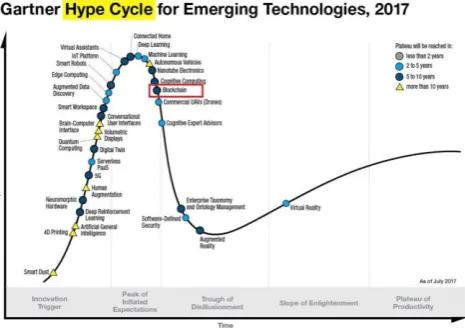
Gartner Hype Cycle provide a graphic representation of the growth and acceptance of technologies and applications, and how they are likely relevant to solving real industry problems and utilise new opportunities. Gartner Hype Cycle methodology gives you a view of
how a technology or application will evolve over time and provides insight to help with specific business goals.
The blockchain technology appears around the Peak of Inflated Expectations in the graph which tells that the technology is at its early stage. Gartner predicts that blockchain will be in large scale by 2025 and companies has to wait till the technology is more robust. However, some companies have started adopting it as an experiment rather than using it on an enterprise scale, so that they can find new outcomes and possibilities.
Figure 3. Blockchain on Gartner Hype Cycle
2.2. Pharmaceutical Industry
Pharmaceutical is considered as a standout amongst the essential need for every one of us. Pharmaceutical companies face many of the same challenges as faced by any other brand owners when it comes to counterfeit products entering the market. Counterfeit product is fake product. Unlike other products, such as clothes, handbags, and shoes, counterfeit medicines contain the wrong active ingredient or the wrong dosage have a serious impact, wherein the use of these can (and often does) lead to severe health issues and even fatalities due to their unregulated and unsupervised manufacturing and distribution process. Since consumers are not aware of what they are buying, they are
exposed to numerous life-threatening dangers. Many companies have emerged to address this profound issue.
As per the latest Equity master report, Indian pharma industry accounts for a fifth of the global volumes and is the thirteenth largest market by value. Being one of the largest exporter of generic drugs, Indian pharma sector enjoys a key position in the global pharmaceutical industry. As a case in point, over 80 percent of the antiretroviral drugs used to combat AIDS is produced by Indian pharma firms. With so much at stake, there is also a rise in counterfeit market that has resulted in contraband entering the mainstream pharma supply chain. Poor regulations, gaps in cold chain infrastructure and a highly
EAI Endorsed Transactions on
Cloud Systems
3
fragmented and unorganized domestic market has resulted in a thriving ecosystem of counterfeit drugs.
3. Literature Review
Bitcoin, the cryptocurrency prodigy soared to a new high by breaching the $19,000/BTC barrier on December 7th, 2017– something that was thought impossible even a decade ago. Bitcoin’s humble origins are based on a research paper by a certain Satoshi Nakamoto who came up with an idea of “a digital peer-to-peer payment system” by completely eliminating a trusted third party to validate transactions. A few months after the paper was published, the first version of a Bitcoin client came into existence and as they say, the rest is history. In this paper, we make an attempt to explore the supply chain of the pharmaceutical industry, the challenges, opportunities and supporting technologies that can enable a transparent and streamlined flow of medicines from the source to the destination. In this pursuit, we investigate the counterfeit industry in Pharmaceuticals and how emerging technologies such as Blockchain, IoT etc. can be harnessed to improve the supply chain as well.
As per a recent world annual report by a market research firm Evaluate Pharma, the pharma industry is set to witness a growth rate of 6.3% CAGR globally through 2022 with a market cap of $1.2 trillion.
One of the biggest challenges in an industry this big is that of counterfeit products entering the consumer market. However, unlike in other industries, counterfeit products not only have a negative economic impact, but also a serious social impact as wrong/fake drugs can easily alter the course of treatment meted to the end consumer. Counterfeit products range from drugs with no active ingredients to those with dangerous levels of adulteration. They are usually copies of branded drugs, generic drugs or over-the-counter drugs.
The counterfeit drugs market is estimated to be worth anywhere between $75B to $200B a year and could add up to half the drugs in circulation in some low-income countries.
A recent study conducted by the European Union Intellectual Property Office (EUIPO) notes that fake medicines results in an annual loss of over 37,000 jobs and cost the EU pharmaceutical sector in excess EUR 10.2 billion each year. This is only the tip of the ice berg as the study does not include downstream counterfeit.
Counterfeiting groups usually originate and thrive in countries where the anti-counterfeiting and IP protection laws are weak and ineffective.
Counterfeit drug has become a global phenomenon spread across higher-income countries such as in the US (reported 10 times more often within the last 5 years in the United States) and Europe (counterfeit products increased by 118% within 1 year (2007 to 2008). In developing countries, counterfeit drugs account for between 10% and 30% of all drugs sold.
The rate of counterfeiting is as high as 20% of all drugs in the countries of the former Soviet Union. According to the World Trade Organization, the United Nations Office on Drugs and Crime (UNODC), and data that are often based on package labels and may be incomplete, India manufactured most of the counterfeit drugs worldwide in 2006, followed by China and Thailand.
On finding out the challenges faced by the pharma industry, the regulatory bodies, the government and most importantly the general public, it is evident that the key to stop counterfeiters and such products was a need to improve information sharing. We are of the opinion that latest technologies such as IoT, Blockchain can help all the stakeholders overcome all the challenges by making information available to all the stakeholder and increasing transparency in the supply chain.
4. Literature Survey on Blockchain
4.1. Bitcoin: A Peer-to-Peer Electronic Cash
System by Satoshi Nakamoto
In this paper the author has proposed a new version of electronic cash which will eliminate the involvement of any third party for online payments. Involvement of third party increases the cost of any transaction and also makes it impossible to do small casual transactions. Using the proposed system, the double-spending problem can be solved. Since in the current system there is no mechanism to make payments over a communication channel without a trusted party, a certain percentage of fraud is accepted as unavoidable. The proposed solution uses a peer-to-peer distributed timestamp server to generate cryptographic proof of all the transactions which does not require the buyer to trust other parties.
The first transaction in a block starts with a new coin owned by the creator of the block. All the transactions are publicly announced by broadcasting to all the nodes. Each node puts new transactions into a block and finds a proof-of-work for it. Other nodes express their acceptance of the block by using the hash of that block as the previous hash. The timestamp server calculates timestamp for each block which includes the previous timestamp in its hash, forming a chain, with each additional timestamp reinforcing the ones before it. When the latest transaction is buried under enough blocks, the spent transactions are discarded to save disk space.
In the proposed system, there is a necessity to announce all transactions publicly hence the level of privacy in traditional banking model cannot be achieved.
4.2. BlockChain Technology: Beyond
Bitcoin by Michael Crosby, Nachiappan,
Pradan Pattanayak, Sanjeev Verma and
Vignesh Kalyanaraman
EAI Endorsed Transactions on
Cloud Systems
4
In this paper the authors study the different challenges and business opportunities in the blockchain technology. The authors believe that the technology will revolutionize our digital world. In 1994, Nick Szabo invented an application called “Smart Contracts” which automatically execute con- tracts between participating parties but it was not used until crypto currencies came into existence. Open source companies like Ethereum and Codius are already enabling Smart Con- tracts using blockchain technology and many companies which operate on bitcoin and blockchain technologies are beginning to support Smart Contracts.
There are many applications of this technology in both financial and non-financial areas. The financial applications include different sectors such as private securities and insurance. Some of the applications in private security sector are NASDAQ Private Equity, Medici, Coinsetter, Augur, Bitshares, etc. In insurance sector, there is a company called ‘Everledger’ which creates diamond certification and the transaction history of the diamond using blockchain. Some of the non-financial applications of the blockchain technology are verifying authenticity of the documents, application in Music Industry, Decentralized proof of existence of documents, Decentralized Storage, Decentralized IoT, Internet Applications, BlockChain based Anti-Counterfeit Solutions, etc.
Although blockchain is a promising and very attractive technology as it can solve many current financial as well as non-financial industry problems, there are still many risks involved in its adoption. For example: Resistance to change, Scaling, Migration of existing documents to new technology, Government Regulations, Need of Quantum Computing, etc.
4.3. Blockchain enabled Trust &
Transparency in supply chains by Anders V.
Hua and Jørgen S. Notland
In this research paper authors investigate if the blockchain technology can increase trust in supply chains. The authors believe that the problem with supply chains today is that it involves different stages and many geographical locations which makes it very difficult to track events happening in a supply chain. They define trust as: “Willingness of a party to be vulnerable to the actions of another party based on the expectation that the other will perform a particular action important to the trustor, irrespective of the ability to monitor or confront that other party.” In a supply chain not, all customers want to purchase the highest quality service, some customers rather want someone whom can be trusted to provide a certain degree of service.
In blockchain technology, trusting in records is very essential and hence concepts of reliability and authenticity comes into picture. Blockchain does not address the reliability of its records. Thus, it’s implementation can face several limitations and might require some trusted
third party. Reliability can also be ensured by using some secured tracking device but again, for example, a GPS tracker used for release a payment upon arrival of the product can be hacked to send a wrong location to a smart contract and trigger the payment without actually delivering it.
Another challenge is that it is not perceived as profitable by many businesses as the reputation of the company could be damaged because the end customers can know the products provenance.
Blockchain is one of the most secure protocols ever de- signed but still it is not completely secure from all attacks.
4.4. A Novel Blockchain-Based Product
Ownership Management System (POMS)
for Anti-Counterfeits in The Post Supply
Chain by Kentaroh Toyoda, P. Takis
Mathiopoulos, Iwao Sasase, Tomoaki
Ohtsuki
This paper produces an implementation of a proof-of- concept experimental system employing an open blockchain application, Ethereum, to avoid the supply of counterfeit products from the cloning of RFID tags and to find out the real owners. The supply chain focuses on the Ethereum accounts that each party manages on their own. For post supply chain, the retailers sell the products to the consumers, who verifies using RFID tags chooses upon purchasing that product or not. In addition to this, the paper provides various algorithms for implementing the same. The main goal of this paper is to reduce the number of counterfeit products in the system and the ability for a customer to reject products if the seller does not possess ownership. From this paper, we infer that the blockchain technology is used to find the ownership details of each product, through the supply chain. So, even if the RFID tags can be cloned but the ownership of each product cannot be changed.
4.5. Blockchains Everywhere - A Use-case
of Blockchains in the Pharma Supply-Chain
by Thomas Bocek, Bruno B. Rodrigues, Tim
Strasser, Burkhard Stiller
In this paper the authors have proposed a system for the implementation of blockchain technology along with IoT being in Pharmaceutical supply chain. It mainly talks about the start-up modum.io which implements this. Also, they talk about how smart contracts adds up to the advantage of the blockchain. Smart contracts that can verify its validity and apply predefined rules and they are self-executing and self-enforcing. In addition to this, they talk about various start-ups whose products are based on the Blockchain technology. The proposed system by the authors is organized into back end, front end and IoT sensor devices. In the back end of the system which
EAI Endorsed Transactions on
Cloud Systems
5
includes the Ethereum blockchain network and server, the smart contracts ensure the supply is in the correct temperature using IoT sensors. The server connects the blockchain network, smart contracts and the clients. The front end involves the client application which is used to register new records or check the details of the product on the supply chain. The goal here is to make sure the data such as temperature etc. is immutable and transparent which would help in reducing operational costs in a supply chain. From this we infer that blockchain technology can be used along with other technologies like IoT to enhance its field of applications other than just financial fields like modum.io AG.
4.6. Corda: An Introduction by Richard
Gendal Brown, James Carlyle, Ian Grigg,
Mike Hearn
This paper provides an introduction about the Corda Blockchain and explains about the design and basic architecture. Corda is an open source blockchain project, designed for business. It allows you to build interoperable blockchain networks that transact in strict privacy. Their smart contract technology allows businesses to transact directly. The authors of this paper explain about the different features of Corda which includes recording and managing of financial agreements and other shared data between two or more parties such that it is supported in existing legal guidelines and conventions, creating workflow between companies without a central authority, supporting agreement between companies at the level of individual agreements, not as a global system, validating transactions exclusively between parties, using industry- standard tools, restricting access to the data only to those who are explicitly authorized. There are three core concepts in their model: State objects which represent an agreement between two or more parties regulated by machine-readable Contract Code (similar to Smart Contracts), Transactions which is the transition between state objects and Transaction Protocols which enables parties to coordinate without a central authority. This paper also provides comparison between Corda Blockchain, Bitcoin and Ethereum network. From this we infer that, Corda was built for recording and implementing business contracts among companies.
5. Blockchain Platforms
Since the emergence of blockchain technology, many enterprises have developed/ are developing blockchain platforms. A blockchain platform can be public, permissioned or hybrid/consortium. The following sub-section gives further details about few blockchain platforms.
5.1. Ethereum
Ethereum is an open and decentralized platform that helps build decentralized applications (DApps) and use them. It runs the smart contracts created for the DApps. It is an open-source project and is flexible as well as adaptable unlike Bitcoin protocol. It is a public blockchain and has repository on GitHub which is actively followed by many users. Ether is the cryptocurrency used for transactions. Python, Go and C++ are the languages supported by Ethereum.
5.2. Hyperledger Fabric
Hyperledger is an open-source collaborative effort by IBM along with The Linux Foundation to promote cross-industry blockchain technologies. Hosted by The Linux Foundation, it is a global collaboration including leaders in finance, banking, Internet of Things, supply chain, manufacturing and technology. Hyperledger Fabric has 8 ongoing projects with 185+ members to create an open, standardized and enterprise-grade distributed ledger framework. Hyperledger can be used as both public and private blockchain and it supports Python language.
5.3. MultiChain
MultiChain helps to build and deploy blockchain applications with speed within or between organizations and is permissioned blockchain. MultiChain platform is known for rapid deployment of blockchains, issue unlimited assets which is tracked and verified on blockchain and provide data streams. Users can control the permissions in this platform and customize it accordingly as well. Python, C#, JavaScript, PHP and Ruby are the languages supported by MultiChain.
5.4. Quorum
Quorum is an enterprise-focused version of Ethereum created by J.P. Morgan. It is ideal for any application requiring high speed and high throughput processing of private transactions within a permissioned network. Quorum addresses the faced by the financial industry. Quorum has two fundamental features to the existing service, privacy of transactions/contracts and a new consensus mechanism. It supports transaction-level privacy and network-wide transparency, institutional transaction volumes and blockchain transactions among a permissioned group of known participants. Quorum is a permissioned blockchain.
5.5. Corda
Corda is an open source blockchain project using which interoperable blockchain networks can be built that
EAI Endorsed Transactions on
Cloud Systems
6
transact in a permissioned network. Their smart contract technology allows businesses to transact directly. The different features of Corda includes recording and managing of financial agreements and other shared data between two or more parties such that it is supported in existing legal guidelines and conventions, creating workflow between companies without a central authority, supporting agreement between companies at the level of individual agreements, not as a global system, validating transactions exclusively between parties, using industry-standard tools, restricting access to the data only to those who are explicitly authorized. Corda was built for recording and implementing business contracts among companies.
6. Proposed System
The idea of the project is to provide a detailed overview of the blockchain technology and how it can be used to build a fool proof system to avoid counterfeit scenario in a pharmaceutical supply chain.
6.1. Overview
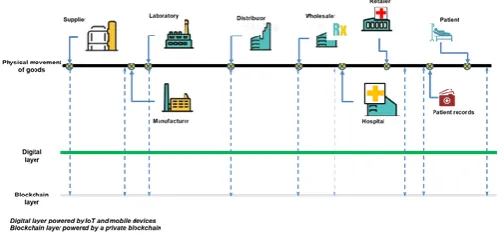
The objective of this project is to develop a Blockchain prototype which can be used in the pharmaceutical supply chain for preventing counterfeit products (Refer Fig. 4). A major advantage of the Blockchain is that it is immutable, transparent and secure, which will help in avoiding many misconducts in the supply chain.
The different participants in the supply chain are cryptographically added into the Blockchain network and can provide or extract information (or records) from the Blockchain. This ensures transparency and security within the network. The end user i.e., the patients can know all the information like the source of the product, various stages of manufacturing, raw materials etc. about their product from the data stored in the Blockchain by scanning a barcode or similar identifiers printed on the product packaging. This will ensure the authenticity of the products being manufactured.
Every participant of the pharmaceutical supply chain will be connected to a common blockchain and can enter data at every checkpoint. Since all the participants are connected, they can get data from every other participant. This will ensure that every participant has a copy of the data so that no individual can manipulate the data.
Figure 4. Implementing blockchain in Pharmaceutical Supply Chain
6.2. Architecture and Components
•Blockchain Platform: to connect the various stakeholders (nodes) of the supply chain network for transacting and deploy smart contracts. There are many open- source Blockchain platforms available like Ethereum, MultiChain, BigChain DB, JP Morgan's Quorum etc.
•Cloud Service: used for creating an environment for running virtual machines and servers which act as different nodes for the blockchain. There are many cloud services that can be used like Microsoft Azure, Amazon Web Services etc.
•Smart Contract: to verify and store the information entered by the stakeholders of the supply chain.
•Database: used to store the data input by the users on the application as well as the hashes and addresses of the transactions occurred and the deployed smart contracts.
•Server: to provide interaction between the blockchain network and front-end users, creating and
deploying smart contracts, as well as storing data in the database.
•Application: to enter the data into smart contracts by the stakeholders and to view the previous information. On the consumer side, the application will be used to verify if the product is original or not.
EAI Endorsed Transactions on
Cloud Systems
7 Figure 5. Architecture diagram of the proposed
system
6.3. Working
The working of the proposed system can be divided into two categories:
(i) Supply chain participant side (ii) Consumer side
Supply Chain Participant Side
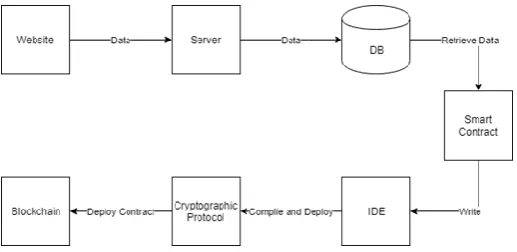
In the supply chain participant side of the system, the participant at every checkpoint uses a website to enter the data relevant to that checkpoint. This data is then stored in a database via a server. A separate smart contract is written for every checkpoint and this contract retrieves the stored data from the database. This smart contract is written in an IDE (integrated development environment) and then compiled and deployed to the blockchain.
Initially when the contract is deployed, a contract hash is generated which is unique to every smart contract. This contract is then mined to obtain a contract address. The contract, then, can be accessed using this address.
Figure 6. Supply chain participant side block diagram for proposed system
Consumer Side
In the consumer side of the system, there is a mobile application available to the users using which they can scan barcode on the medicine. Upon scanning the barcode, the application will retrieve the data from the database via server and display it.
Figure 7. Consumer side block diagram for proposed system
7. Challenges
Although, blockchain gives better solution for the problem defined in this paper, some challenges are encountered. The following sub-sections explain further about few of the challenges faced while using the blockchain.
7.1. Trust and Transparency
In a supply chain, not all customers want to purchase the highest quality service, some customers rather want someone whom can be trusted to provide a certain degree of service. In blockchain technology, trusting in records is very essential and hence concepts of reliability and authenticity come into the picture. Blockchain does not address the reliability of its records. Thus, its implementation can face several limitations and might require some trusted third party. Reliability can also be ensured by using some secured tracking device but again, for example, a GPS tracker used for releasing a payment upon arrival of the product can be hacked to send a wrong location to a smart contract and trigger the payment without actually delivering it. Another challenge is that it is not perceived as profitable by many businesses as the reputation of the company could be damaged because the end customers can know the provenance of the products. The blockchain is one of the most secure protocols ever designed but still, it is not completely secure from all attacks.
7.2. Scalability, Integration and Cost
The computing and data mining power required by a network of blockchain nodes in their race to validate and share transactions is considerable. Because of this, some nodes may find their computing processing efforts to the larger network are not rewarded. There are also substantial integration requirements for a blockchain with traditional enterprise applications such as ERPs, either to generate inputs for the blocks or to further process the blockchain’s outputs. For example, interfaces with supply chain execution applications or accounting ledgers add
EAI Endorsed Transactions on
Cloud Systems
8
additional complexities and costs that need to be addressed.
7.3. 51% Attack
When a group of miners in a blockchain network control more than 50% of the network's computing power, it is known as 51% attack. This attack is only hypothetical, though, it is possible theoretically. As the network is open and free, someone with enough computational power can do it and also there is no central authority controlling them. If it happens, attackers can change or decline transactions and also possibly reverse it. Double-spending is a huge risk in such attacks. Double-spending means to spend the digital currency twice by making the copy of the original token.
8. Conclusion
This paper proposes a scheme for preventing counterfeit medicines in a pharmaceutical supply chain by providing a roadmap on how to use the Blockchain technology to solve the same. Although there are many solutions to the problem, this paper signifies why using blockchain is better. First, the challenges faced by a typical supply chain are discussed and then the different components of the proposed system are explained. There is also a theoretical working of the proposed system to understand the solution.
9. Future Work
The proposed system, besides using for preventing counterfeit products, can be further extended to pharmaceutical cold chain management, supply chain track & trace, inventory visibility across a multi-echelon supply chain and provenance across the whole value chain.
References
[1] Nakamoto, S. (2008) “Bitcoin: A peer-to- peer electronic cash system,” unpublished manuscript, retrieved at: https://bitcoin.org/bitcoin.pdf
[2] M. Crosby, Nachiappan, P. Pattanayak, S. Verma, V. and Kalyanaraman. (2016) “Blockchain technology: Beyond bitcoin,” AIR- Applied Innovation Review (Issue no. 2 June 2016), pp. 6–19.
[3] A. V. Hua and J.ørgen S. Notland, (2016) “Blockchain enabled trust & transparency in supply chains” ntnu school of entrepreneurship tiø4530. (Autumn, 2016).
[4] P. K. Toyoda, T. Mathiopoulus, I. Sasase, T. Ohtsuki, and T. Ohtsuki, (2016) “A novel blockchain-based product ownership management system (poms) for anti-counterfeits in the post supply chain,” DOI 10.1109/ACCESS.2017.2720760, IEEE Access.
[5] T. Bocek, B. B. Rodrigues, T. Strasser, and B. Stiller, (2017) “Blockchains everywhere - a use-case of blockchains in the pharma supply-chain,” in IFIP/IEEE International Symposium on Integrated Network Management (IM2017).
[6] R. G. Brown, J. Carlyle, I. Grigg, and M. Hearn, (2016)
“Corda: An introduction,” Available:
https://docs.corda.net/\_static/corda-introductorywhitepaper.pdf
EAI Endorsed Transactions on
Cloud Systems