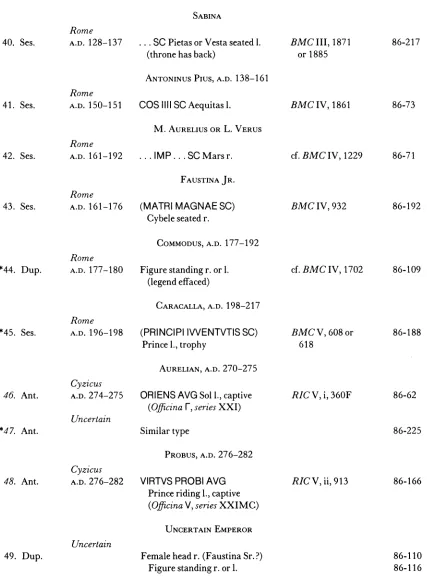
TEMPLE E AND EAST OF THE THEATER
(PLATES 1-8)
EXCAVATION
AT ANCIENT CORINTH was conducted in two distinct and sepa-A rate areas during the spring of 1986. Temple E was one focus of activity, subdivided into three sets of trenches; East Theater District was the second focus.'
AREA OF TEMPLE E
One of the three groups of trenches laid out around Temple E was placed along the un- excavated scarp at the north flank of the temple; a second set of trenches was placed between 13 and 33 meters south-southeast of the southeast corner of the temple; the third set was placed between 52 and 64.5 meters south of the podium of Temple E in an area where an east-west paved road with sidewalks had been discovered in preliminary probes in 1985. This street apparently is a major decumanus of the Roman city (Fig. 1).
Modern ground level over the Roman paved road south of the peribolos of Temple E lies ca. 88.55 m. above sea level. The top 0.75 m. is all unstratified plow soil under which are undisturbed Frankish levels. Here a minimal sequence of eight hard road metals was found overlying the paved Roman road, but eleven such surfaces were distinguished in the
I As in the past I have again this year the honor of thanking the Greek Archaeological Service, for making
the work possible and aiding the activity of the American School of Classical Studies at Corinth, and specif- ically of thanking I. Tzedakis, the Director of the Archaeological Service, and the members of the Greek Archaeological Service in the Corinthia and the Argolid. It has been a pleasure working with Mrs. P. Pa- chygianni, Ephor of Antiquities of the Argolid and Corinthia and with Mrs. Z. Asamantzidou, epimeletria for the Corinthia. I appreciate the continued support of Professor Stephen G. Miller, Director of the School, in things Corinthian and his efforts to facilitate my work at Corinth.
Again this year, Dr. N. Bookidis has proved invaluable in overseeing the correct and efficient operation of the museum. As in the past Mr. A. Arboreres served as foreman for the American School at Corinth, Miss S. Bouzaki as conservator, N. Didaskalou, A. Papaioannou, and G. Arboreres as technicians. Misses I. Ioanni- dou and L. Bartzioti continued to photograph the site and objects. Miss K. D. Hutchinson executed the profile drawings for this report. The trench supervisors for the spring season were Misses Anna Stewart and Ana Abraldes, Mrs. Mary B. Richardson and Messrs. Christopher A. Pfaff, Gideon S. Schor, and Guy Sanders. Thanks and gratitude are due to everyone concerned for their efforts, cooperation, and enthusiasm throughout the season.
Works frequently cited are abbreviated as follows:
Corinth II = R. Stillwell, Corinth II, The Theatre, Princeton 1952
Corinth, VII, iii = G. R. Edwards, Corinth, VII, iii, Corinthian Hellenistic Pottery, Princeton 1975
Corinth X = 0. Broneer, Corinth, X, The Odeum, Cambridge, Mass. 1932
Williams and Zervos, 1983 = C. K. Williams, II and 0. H. Zervos, "Corinth, 1983: The Route to Sikyon," Hesperia 53, 1984, pp. 83-122
Williams and Zervos, 1984 = C. K. Williams, II and 0. H. Zervos, "Corinth, 1984: East of the Theater," Hesperia 54, 1985, pp. 56-96
Williams and Zervos, 1985 = C. K. Williams, II, and 0. H. Zervos, "Corinth, 1985: East of the Theater," Hesperia 55, 1986, pp. 129-175
Hesperia 56, 1
American School of Classical Studies at Athens is collaborating with JSTOR to digitize, preserve, and extend access to Hesperia
So
0~~~~~~~~~~~~~~~~~~~~~~
U6~~~~~~
-
taD>X~~~~~~~~~~~~~~~~~~~~~~~~~~~~~~~~~c
northern part of the trench. The lowest road yet cleared this year in this trench is a Roman paved street uncovered at an elevation of 86.88 to 86.78 m. above sea level (P1. 1:a). It is flanked by sidewalks and made of hard, white limestone, similar to that used in the Lechai- on Road. Green-glazed Byzantine sherds were found in strata that rest upon the north sidewalk of the paved street. In the street itself, below the top of the sidewalk, was found a large amount of debris with tiles and poros rubble, apparently a stratum of Late Roman date.
The street runs slightly south of due west and, apparently, determined the course of all the roads that overlay it. The paved Roman street is ca. 3.80 m. wide; its north sidewalk is 1.71 m. wide. The south sidewalk is ca. 1.76 m. wide, with its curb lying at 86.99 m. above sea level; the road paving here at curbside is at + 86.80 m. Ruts in the street paving attest to a cart path close to the north sidewalk. Rut 1 is wide and has three "ribs" less than 0.70 m. out from the north curb. The center of rut 2 is ca. 1.64 m. out from the curb. A groove in the paving, perhaps not really a rut, lies at 0.60 m. south of rut 2. It is quite shallow. Light wear can be distinguished in rut 3, which lies at 0.75 m. south of the shallow groove, and in another at about 0.87 m. from the south curb. The two northernmost ruts indicate much use: in places they are worn completely through the paving. Within the deepest pockets were found ten coins that suggest possible use of the northern side of the paved road down into the 7th century after Christ (see below, Zervos, Appendix, Coin Units XII and XIII). Rut 3 is much less deeply worn because it was buried in a late alteration and narrowing of the street, apparently in the second half of the 4th century.
Tests to the earlier Roman levels have not yet been made extensively to the north or to the south of the road. One test extends 2.50 m. south of the sidewalk, along which has been exposed a room and one party wall, largely robbed of its poros blocks. A door opens onto the sidewalk from the room. There is no possibility that a colonnade flanked either side of the paved street or that colonnades were ever part of the original design.
The other two trenches south of Temple E produced deep fills of Byzantine and Frank- ish pottery. The pottery from one of these trenches will be published in a separate article.2
EAST OF THE THEATER
The second area of excavation focused on East Theater Street and Buildings 1, 3, 5, and 7 east of the Theater. Investigation this year was expected to be the conclusion of a project started in 1981; exploration now is all but completed through Roman levels. Some Greek levels, however, still appear to have potential, although at the moment, the pre-Roman strata and associated deposits present a wide chronological spread with few special rela- tionships discernible that tie one stratum or deposit to another. The earlier Corinth excava- tion reports now are at variance with the scheme presented in the present report. In certain places only details vary; at other points whole elements have been added or eliminated from the chronological skeleton as it was presented in Hesperia 1984, pp. 85-89.
2 I thank Messrs. C. A. Pfaff and G. Sanders for undertaking the meticulous supervision of these trenches
Six discrete Roman occupational periods, a period of misuse and abandonment, and one period of use in the Byzantine period have been isolated along East Theater Street. The founding of Roman Corinth inaugurates Roman Phase 1, which ends with the earthquake
of A.D. 77. Within this period should be placed the first Roman reconstruction of the Greek
theater and the initial occupation east of East Theater Street, as seen in the construction of Building 1, a structure with reservoir 1984-1 (P1. 2). It is suspected, although there is less evidence, that Building 3 was built at this time also, in some form or other. Phase 2 begins after the earthquake of A.D. 77 with the restoration of the Theater, evidenced along East
Theater Street by the construction of raking buttressing to reinforce the cavea wall. In- cluded in this general activity should be the construction of the Odeum on the west side of East Theater Street and the reconstruction of Building 1, probably on a new plan, along with the erection or re-erection of Building 3 on a plan similar to that of redesigned Build- ing 1. Some evidence suggests that Phase 2 ends with an earthquake. Phase 3 commences with the straightening of the course of East Theater Street, the repair of Buildings 1 and 3 and the erection of Building 5. It now appears that Building 5, as defined in the past ex- cavation reports, should be subdivided into two, hereafter called Buildings 5 and 7.
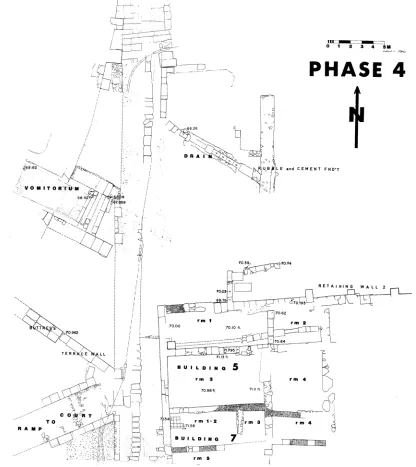
In Phase 3 new structures also appear to be laid out southward along the east side of the street, all sharing party walls; these remains were partially excavated in the 1920's and are still not fully investigated or understood. A columned court on the west side of the street perhaps was planned and built at this time between the Odeum and the Theater. Phase 3 ends with what evidence now shows to be a devastating earthquake, and Phase 4 begins with the repair to the damage thereafter. The east side of the cavea of the Theater receives a replacement for the first set of buttresses erected along East Theater Street. The old T- shaped vomitorium is replaced with one that goes straight from East Theater Street into the upper cavea. The sites previously occupied by Buildings 1 and 3 are abandoned. Now a diagonal drain passes from southeast to northwest through the clay debris of the southern half of Building 1. Buildings 5 and 7, however, are repaired and reoccupied, with some alteration of plan and redecoration. Sometime later in Phase 4 the Odeum is restored by Herodes Atticus. The columned court between the Odeum and the Theater may possibly be contemporary (Fig. 1); even if the court was built in Phase 2, at least its ramped entrance from East Theater -Street is constructed at this time. There is some evidence that activity ends in another earthquake.
end of the 3rd century and may be synchronous with the collapse and destruction of the House of the Opus Sectile Panel, excavated east of the Theater in 1981 and 1982.
Phase 6 is a period of rebuilding, starting with the fashioning of an east-west corridor out of what had been the north range of rooms in Building 5. This corridor may well be built as a public footpath to connect East Theater Street with a road to the east, possibly also with the Roman North Market. The ruins south of this east-west path appear to become an area devoted to dumping, however, as the whole area is slowly made into a high terrace. Part of this filling operation is the dumping of marble debris from the burnt-out Odeum on the other side of East Theater Street. Probably at the end of this phase the lane along the north side of what had been Building 5 is blocked off. An opus africanum wall is constructed along the west side of East Theater Street stopping at the south flanking buttress of the east vomitorium of the Theater. This wall blocks at street level the ramped entrance to the colonnaded court between the Odeum and the Theater; the court appears, therefore, to go out of use in this phase.
Phase 7 starts with the wholehearted robbing out of the fabric of the Theater on the west side of the street and of the terrace wall that had been built over Buildings 5 and 7 on the east side; thereafter follow years of abandonment during which only insubstantial strata and tenuous traces of human activity accumulate. This period extends from the late 5th- early 6th century down to the 12th century after Christ. Phase 8 is 12th-century Byzantine in date; it is represented by heavy, stratified levels of dumped ash. These contain much painted and glazed pottery, some kiln rejects and kiln supports. The only architecture con- structed in Phase 8 is an east-west wall, built low along the side of the slope over the ruins of Building 1 in order to contain the extensive deposit of ash to the south. No architectural elements or occupational levels attest to settlement immediately east of the Theater from the 6th century after Christ to modern times. Indeed, the slope along the east side of the Theater appears to be completely outside the urban complex from the late Christian period to mod- ern times.
The following detailed report of the 1986 excavation east of the Theater is written largely to coordinate the past six excavation reports of the area and to bring the conclusions up to date. Continued study of the finds from the excavation may cause refinements in the dates of the phases here presented; thus it is expected that there will be some movement in the absolute chronology. It is hoped, however, that the phases as outlined in this report, and supported in grosso by the published numismatic evidence, will remain a reliable frame- work in relative terms, upon which the future detailed studies of this area can be hung.
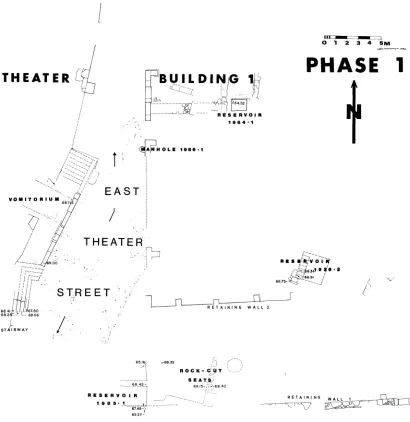
ROMAN PHASE 1 (Figure 2)
0 1 2 3 4 5M
PHASE 1
THEATER BUIL DING I
-RESERVOIR 4
S ;0&. ~~~~~~~~~~19S 8 4 * 1
/ 4~~~~(#ANOLE 1986.1
EAST
VM ITO R II U M
H E
T ATE E RI
.0 , K,s v
00 ' '/ /.' '?.634 R
1I .
. i
S-TR E EET T
68.4 . I1S 780 -- 2c R I W 68.2- -68.06
I/r
STAIRWAY
- . , ~ ~ ~ ~ ~ O K
65.M +6.2j , ,
R O C K - GT -' ---- _--- '-- S E A T,i)
_ 68.42-; 69.15- .-.69.42
RESERVOIR R E T A I N I N G
---- --- - - 1
,s
19 5
67.4S 69.27J
FIG. 2. East of Theater: Roman Phase 1
the Romans initially did with what they found on the site. A T-shaped vomitorium was de- signed and built by them along the east side of the Theater, consisting of a corridor that runs parallel to the cavea wall with stairs at both north and south ends. A right-angled entrance into the cavea from the corridor gives the element its T-shaped form.3
I See the south exit of the Odeum of Corinth in Corinth X, p. 32, pl. 1. Restoration here is from founda-
The corridor is supported by an east wall, 0.33 m. wide, of well-cut poros blocks laid in courses. The trimming of the stone was by both plain and claw chisel. Little of the stairway at the south end of the corridor is preserved; much has been removed owing to later al- terations. Still extant, however, is a flight of four steps, rising from an elevation of + 67.79 m. from the bottom tread to + 68.41 m. at the top tread. The topmost step is preserved for a length of 3.20 m.; at its south end it continues into unexcavated earth. There is much less evidence for a stairway at the north end of the corridor, but the restoration of a flight of steps here seems most suitable. Cuttings for footings that align with the existing fabric of the corridor suggest this possible reconstruction.
The fabric of the first Roman phase of Building 1 still can be seen as it was re-used within the second-phase street facade. It is obvious as large rectangular, cut-poros blocks, all about 0.46-0.48 m. thick, set into place on a cut-block socle; the whole wall was erected without any apparent use of cement. Such a segment exists at the northwest corner of the building, extending southward to end 1.09 m. south of the south door jamb at the street entrance. A window was built into the segment of wall north of the door. The original wall, 1.09 m. south of the door, has been replaced by rubble and cement with troweled joints, a method of construction used in Phase 2.
The segment of the first phase wall that is preserved just south of the doorway spans the mouth of an oval manhole, designated manhole 1986-1 (Fig. 2). The following finds are a representative sample of the material found in its shaft and cistern. Most of it is Hellenistic, probably descending in date to 146 B.C. A scattering of small sherds within the shaft, in-
cluding Arretine and sanded-ware fragments, attests to some filling of the shaft in the 1st century after Christ, perhaps at the time of the construction of the original Building 1.
1. Molded relief krater P1. 1
C-1986-113. H. 0.155, D. of lip 0.209 m. Fine, light pinkish buff clay, local; core ca. 7.5YR 7/5. Glaze unevenly fired orange brown to brown black overall.
Large bowl with flattened bottom and three feet in the form of applique heads of maenads, each with band dipping across forehead. Hemispherical body continuing into tall, slightly flaring rim. Outward thickened lip, flat on top, offset from rim by groove.
Relief decoration on exterior. Bottom medallion: frontal head (gorgoneion) in double ring frame. Co- rolla: ring of tiny fronds that radiate from frame, be- tween which are groups of three tendrils with buds, perhaps enframed by larger leaf. Above, ring of larg- er fronds alternating with large akanthos leaves rises above tendril zone. Above, two rows of running ani- mals: Lower row, boar alternating with hound, oc- casional small animal(?) beneath their legs, moving
1. Upper row, hounds coursing r., alternating with foxes, heads turned back. Band of repeated S's framed by rib top and bottom.
For boar, vertical S pattern, see CP-520, Corinth VII, iii, no. 842, p. 154, note 3, p. 167 (S in reverse); for foot (exact parallel), see Corinth VII, iii, no. 339 (C-31-102), pl. 77.
2. Molded relief bowl P1. 3
C-1986-107. H. 0.082, D. of rim 0.145 m. Pale, light gray-buff clay with rare, minuscule white and brown inclusions. 1OYR 7.5/1.5.
Hemispherical bowl with recessed bottom; slight- ly flaring rim, 0.035 m. high, and slightly outward thickened lip, beveled on outside.
Apollo with kithara, seated r. (used 4 times); frontal- ly standing, semidraped god ("Poseidon") with scepter(?) in left hand (6 times); standing draped fe- male ("trophy girl") in profile to r. with wreath in upraised r. hand (5 times). Figural zone surmounted by row of horizontal S-shaped spirals, framed by rib
along top and bottom. Above frame, row of small up- right fern leaves.
For Apollo, cf. CP-1935; "Poseidon", cf. C-28-59; "trophy girl", cf. C-38-683.
Date: Late 3rd to first half of 2nd century B.C.
One fragmentary mold for a relief bowl, MF-1 986-46 (P1. 4), was found in the shaft of manhole 1986-1. Two more fragments, MF-1986-24 and MF-1986-34, were found south of the manhole. Another two, MF-1985-82 and MF-1985-72, were found in the 1985 sea- son. Each sherd appears to be from a differently decorated mold. With this range of molds recovered from an excavation that has not yet probed extensively into the Hellenistic levels, one might suggest that a Hellenistic potter's shop lies somewhere in the vicinity. One other mold, MF-1986-23 (P1. 4), was found in a 5th-century context in a Classical cistern under- lying Building 1. This mold is designed for the production of rectangular or square plaques with a central motif, possibly of a running gorgon, surrounded by a zone of horses and chariots. A squid and possibly a Triton decorate the one preserved corner.
The following pottery is also from manhole 1986-1 and its cistern:
3. West Slope thorn kantharos
C-1986-127. Two non-joining fragments: p.H. of shoulder fragment 0.067; p.H. of rim fragment 0.053 m. Fine, pale buff clay, local. 10YR 7.5/3. Ovoid body turning in at shoulder to vertical rim with molded lip, only bottom of which is preserved. Decoration: Body divided into three zones, lowest black glazed, second (0.022 m. high) glazed but dec- orated with ivy tendril and leaves in clay slip. Ten- drils reinforced by scratching. Top zone glazed with three rows of pointed barbotine "thorns" on shoul- der, set off below and above by groove wheel-run through glaze. Vertical rim decorated with incised, boxed rectangles, separated by narrow checkerboard of alternate squares and rectangles slip painted; clay slip line below and above, and above preserved lip molding. Interior glazed.
See Corinth VII, iii, pp. 87-88, no. 524 (small fragment), first half of 2nd century B.C.
4. Cruet with clay-slip decoration
C-1986-121. P.H. 0.091 m. Fine, pale buff clay with minuscule white and dark inclusions, local. 7.5YR 7/4 to 7.5YR 6.5/4.
Double conical(?) body, upper half set well in from lower, creating broad horizontal rim above maximum diameter. Upper half conical with convex
profile, tapering at top to narrow stem capped by low, conical knob. Two cylindrical spouts rising at 60? angle from opposite sides of body to above knob; both spouts surrounded by flat, slightly downturned rim, incompletely preserved. Attachment scars against rims of spouts for horizontal strap handle which arched from spout to spout. Body has upper and lower compartment, with dividing floor sloping down from maximum diameter of body to center.
For shape, see C-60-57, from well 1960-4, deposit 38 in Corinth VII, iii, 350-250 B.C.
5. Cooking-ware krater
C-1986-130. H. 0.188-0.19, D. of foot 0.137, re- stored D. of rim 0.46 m. Coarse, cooking fabric, poorly compacted, with many fine to coarser white flinty inclusions, fired brick red. 2.5YR 5/6. Thick, flaring ring foot with thick resting surface, convex undersurface. Body flares at ca. 45-50? and angles to concave neck with juncture between body and rim. Juncture pared. Concave neck curves into outturned, nearly horizontal rim, very slightly over- hanging. Upper surface of rim has slight ridge at top of inside wall, perhaps for lid. Part of one horizontal loop handle attached at pared band between rim and upper body.
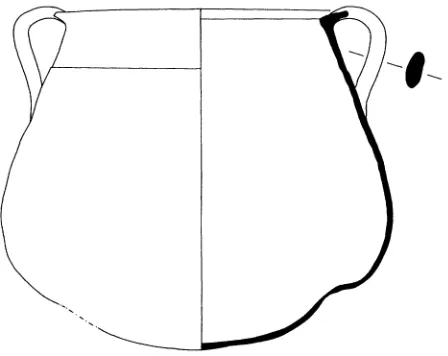
FIG. 3. Two-handled stewpot 6. Scale 1:4
6. Two-handled stewpot Fig. 3
C-1986-120. P.H. 0.225, D. of body 0.277, D. of rim 0.210 m. Thin, hard, cooking fabric with many coarse inclusions, fired brown inside, gray black on outside. Inside surface near 2.5YR 4/6. Cooking pot with round bottom, where preserved, and ovoid body deformed in firing; maximum
diameter just above bottom. Straight upper wall tapers to wide, flaring outturned rim with angled lip. Upper part of body slightly inset from neck just above lower handle attachment. Two vertical strap handles rise from upper body and attach to lip.
Context: Hellenistic.
Inside Building 1, immediately south of the door, one can see incorporated within the second-phase fabric a cut-stone stub of an east-west partition wall belonging to Phase 1 (P1. 2: blocks protruding from face of wall at top of photograph, above diagonal drain).4 The only other place where Phase 1 construction can be distinguished within the complex of Buildings 1 and 3 is at the south door jamb of the main entrance into Building 3, again a stub of partition wall going west, from slightly south of the jamb. On the outside of the wall one can see the original face as it was worked back in Phase 2 (P1. 4:a).
To be associated with the first Roman phase is reservoir 1984-1, which apparently occupies a western room in the original plan of Building 1 (P1. 2). The pottery found within this reservoir gives a pre-Domitian date for the use of Building 1, Phase 1.5 The eastern end
and the east wall of the reservoir were built over in Phase 3, at the latest, by a north-south foundation of rubble and cement that supported the east wall of Buildings 1 and 3 in Phase 3. (See upper right corner, Fig. 2; cf. Fig. 7.)
I For views of the north end of the wall, see Williams and Zervos, 1983, pl. 24; Williams and Zervos, 1985,
pl. 7:b. A back view of the wall is shown in Williams and Zervos, 1983, pls. 25:b, 26:a. The wall was further cleared in 1985 and 1986. For another view of the wall still incompletely excavated, see Williams and Zervos,
1984, pl. 6.
The evidence for the date of construction and first use of Building 3 is tenuous. A test to bedrock was made this year within the southern half of the north room. In this test sieved earth under what must be the first clay floor of Building 3 produced only two coins, 1986- 143 and 1986-144 (Zervos, Appendix, Coin Unit IV). The first is a bronze of the Co- rinthian duovir issue dated A.D. 4; the second is also a duovir coin, dated according to Kent to
A.D. 39. On this evidence one can say only that Building 3 was erected after A.D. 39. A pit
(pottery lot 1986-52) that destroyed a segment of the original clay floor of the north room produced three readable coins, 1986-133, 1986-134, 1986-136 (Zervos, Appendix, Coin Unit IV), the latest of which is dated A.D. 68-69. This pit was either dug in the course of Phase 1 or else is to be associated with the clean-up at the beginning of Phase 2.
ROMAN PHASE 2
Phase 2 started with the reconstruction of the East Theater District after the earth- quake of A.D. 77. On the west side of East Theater Street, evidence indicates that structural alterations were needed along the east cavea wall of the Theater, especially around the vomitorium. The ashlar wall that had supported the corridor entrance to the vomitorium was lengthened toward the south for two meters. A new corridor floor was established at 69.0 m. above sea level. The extension demanded the elimination of much of the first-phase southern stairway to the vomitorium corridor. What is left of these steps was totally buried under a sloping poros-chip floor that served as a ramp. The corridor wall was lengthened to the south at the expense of the stairs in order to make room for two supporting buttresses (P1. 3:a; see lower left quarter of photograph and high rectangular pier in center fore- ground). The northern buttress was built against the original portion of that wall. The buttresses are 3.67 and 3.12 m. long; both are 1.20 m. wide, measured at the innermost plane of their rusticated faces. They are set 2.62 m. apart, measured at the corridor wall. Their foundations are placed against the east face of the corridor wall, with the super- structure rising and then, apparently, arching over the corridor, to meet and support the cavea wall.6 A whole series of similarly constructed buttresses, without doubt all built at this same time, is preserved along the north face of the parodoi of the Theater, at either side of the skene.7
Certain segments of Buildings 1 and 3, on the east side of the street, underwent a radical reconstruction with the introduction of the opus africanum masonry style in certain areas, coursed masonry in others. Cement was used liberally, especially in the rubble-and-cement panels between the uprights in the opus africanum segments. Here, also, trowel work is
6 For the northern buttress see Williams and Zervos, 1983, pls. 25:b, 26:a; Williams and Zervos, 1984,
pls. 6, 16:a, c. The_arched design of the buttresses, as hypothesized here, is better preserved in the raking- buttress system of the east parodos wall of this same theater. There all the parodos traffic into the orchestra passed under the buttresses.
I Corinth II, p. 50, where the author refers to added buttresses of the eastern parados as having "their bedding ... all sloped upward toward the north." For an elevation of this construction, see fig. 65. For similar construction on the western parados, see p. 55, where Stillwell dates the additional buttressing to A.D. 77 (i.e.,
quite clearly part of the surface treatment. On the west wall of the south room of Building 3 one still sees much of a coat of white lime plaster, thin like whitewash, that serves as the only wall enhancement of the room. The floor is covered with a similar white coat.
Although the two buildings were planned as independent structures, each with two rooms along East Theater Street, they appear to have been laid out as a continuous run of four rooms, becoming slightly wider as they proceed to the north. The east-west dimension at the south end appears to have been determined by the buttresses within terrace wall 2 (Fig. 7) against which they abut. Buildings 1 and 3 are divided by a party wall that is no thicker than any of the interior partition walls. The floor of Building 1 is one meter lower than that of Building 3, the lowest part of their east-west party wall serving as the terrace wall between the two. This difference of floor level is the direct result of siting the buildings along a rising slope.
Buildings 1 and 3 resemble each other in plan and, apparently, in function. Of the four street rooms only the northernmost of Building 1 varies from the standard dimensions of 4.42-4.46 m. from north to south by 5.79-5.89 m. from east to west; the corners of the rooms in most cases are either slightly more or slightly less than 900. The variant northernmost room is larger, being 5.79-5.85 m. from north to south. The south wall of the south room of Building 3 is slightly askew because it was built against a cliff face. Each building is entered from East Theater Street by a door in the southwest corner of its north room.
The north room (Room 1) of Building 1 has been identified as a kitchen. It has the remains of an oven at floor level between the main entrance and the window, 1.33 m. wide, in its west wall. Here can be seen in the scarp a lens of charcoal and another of white marl, apparently the remains of a hearth covered by a collapsed dome of white marl. The remains lie immediately below the floor of the northern oven of the Phase 3 room. Because the Phase 3 floor has been removed by excavation only from the northern half of the room, it is not yet possible to determine whether the Phase 2 oven had a second oven immediately south of it, as there was in Phase 3. A pivot stone was found in the first clay floor of this same room, built against the west face of its east wall. Here a doorway gave direct access to the long, narrow space that runs north-south along the east side of Buildings 1 and 3. Unfortunately, most of the evidence for the doorsill and threshold has been eliminated with a subsequent dismantling of the northern portion of the wall.
mortar, tiles, and small rubble laid in such a wide bed used to carry a superstructure. It is suspected that this mortar, tile, and rubble bedding had been laid not as a part of Building 1 or 3 but for a large, more important structure that lies to the east, of which this foundation is only its western limit. This theory cannot be verified at this point, however, because the excavation scarp lies along the east side of the foundation in question.
Evidence for the ending of Phase 2 by a general disaster is slightly tenuous, although it is here suggested that Phase 2 terminated in such a manner, as attested by structural col- lapse in various buildings within the reign of Trajan. Three points support this hypothesis. First, evidence from the earlier excavations of the Theater, as presented by Stillwell, indi- cates that repairs were made to the parodoi or the colonnade of the upper diazoma of the Theater, or both, in the reign of Trajan.8
Second, evidence from within Room 1 of Building 3 suggests a destruction at such a time, even though investigation has been restricted to one stratigraphic test within the southern half of that room. In the course of the 1986 excavation, a zigzag pattern was found stamped into the original white-clay floor of the room; this probably is the impression of blocks fallen from the surrounding walls. The blocks apparently had been removed for re- use before the floor was buried by a debris of broken pottery and earth, 0.40-0.50 m. thick; this layer is now only partially excavated because of the necessity of preserving three third- phase ovens which sit on the floor that seals the debris. Much of the pottery, however, that has been recovered from between the two floors has been mended into whole and nearly whole shapes; the high proportion of joins among the sherds suggests that the assemblage is part of a clean-up operation or dump preparatory to a general repair of the structure. The latest presently identifiable coin from the fill is of Domitian; along with the coins were recovered, among other ceramics, the following pots.9
7. Unglazed, handleless cup P1. 3
C-1986-54. H. 0.113, D. of foot 0.046, D. of rim 0.093 m. Buff, moderately fine clay with a few large, buff inclusions, some sparkling inclusions, and voids. Clay lOYR 7.5/3.
Jar with vertical ring foot, conical undersurface; ovoid body with maximum diameter below median. No articulated shoulder; short, flaring rim; rounded lip. Paring mark on body at maximum diameter with wheel ridging from paring mark to rim.
No exact parallel at Corinth. For same type see C-1976-15, with slight wheel ridging, and C-61-40, with no wheel ridging.
8. Local, unglazed one-handled coarse- P1. 3 ware jar.
C-1986-82. H. 0.253, D. of foot 0.078, max. D. of body 0.174, D. of rim 0.052 m. Buff, moderately fine clay with voids and black inclusions, a few lime particles. Clay lOYR 8/2.5 to 2.5Y 8/2.5 m. Jar with vertical ring foot, conical undersurface, and ovoid body with maximum diameter just below shoulder; high, narrow neck contracting suddenly to a diameter of 0.032 m. just under wide, flaring rim; rim slopes toward inside; rounded lip. Single, ridged strap handle, attached at outer shoulder, rises verti- cally, then turns down to meet neck just below rim
8 Corinth II, pp. 144, 136, a series of blocks, esp. no. 89, figs. 88, 89, a cornice block inscribed TRAIANO
AVG GERMANICO ET COLONIAE LAVD IVL, dated to a time before A.D. 101.
9 Pottery lot 1986-49; the coins include 1986-104, 1986-106, 1986-107, 1986-117, 1986-123, 1986-124,
contraction. Neck slightly wheel ridged; faint cir- cumferential groove at point of attachment with lower and upper terminus of handle. Unglazed.
Second, similar jar from same fill.
For close parallel but with more contracted neck just below the rim, see Williams and Zervos, 1985,
p. 133, pl. 27.
9. Glazed table amphora with mask-appli- P1. 5 qued handles
C-1986-81. H. 0.288, D. of foot 0.096, D. of rim 0.121 m. Fine, pale buff clay with very fine white, black, and red-brown inclusions, voids. Clay 7.5YR 7.5/3-4.
Table amphora with disk foot, undersurface with four concentric grooves. Ovoid body with maximum diameter slightly above median. Concave neck, 0.061 m. high, articulated from body by low plastic collar, with neck to outturning rim and rounded lip in continuous profile. Rim flat on top, sloping slight- ly toward lip. Two vertical handles with flattened oval section, from lower shoulder to mid-neck. Ap- plique theatrical mask rises from midpoint of body against base of each handle; row of horizontal curls over forehead, wide lock of hair at each side behind ears, cut horizontally at bottom. Amphora is rou- letted in wide zone just below maximum diameter; spalled, black to reddish brown glaze on exterior and undersurface, glaze dripping down inside of neck.
Probably not locally made.
10. Local Roman red-slipped, footed amphora with rouletting
C-1986-84. H. 0.427, D. of body 0.303, D. of rim 0.126 m. Moderately fine, buff to pale buff clay with voids and black inclusions, between 7.5YR 7/4-7/6.
Amphora with low ring foot, molded undersur- face, ovoid body and shoulder, maximum diameter just below shoulder. Tall neck, expanding slightly from 0.091 to 0.093 m., set off from convex rim at upper handle level by flange; second, smaller flange sets off top of rim from horizontally outturned lip; two vertical strap handles with four grooves rise from mid-shoulder to flange below convex rim, where handles attach with side spurs.
Red slip (1OR 5/8-2.5YR 5/8) over entire exte- rior surface and on interior of rim; single rouletted band on highest third of shoulder.
11. Local Roman red-slipped amphora P1. 7 with rouletting
C-1986-83. H. 0.528, D. of body 0.254, D. of rim 0.13 m. Moderately fine, reddish yellow clay, with voids and black inclusions, scattered lime, 4YR 6.5/6.
Amphora toe not preserved; ovoid body with max- imum diameter well below median. Sloping shoul- der angled from body. Diameter of neck 0.101 m.; upper neck, rim, and handles similar to 3, but neck and handles shorter, neck vertical.
Red slip (2.5YR 4/8) over exterior and interior of rim; single rouletted band at median of body, double rouletting just below angle between body and shoulder.
12. Large Corinthian one-handled jar Fig. 4 C-1986-125. Max. D. of body 0.32 (restored), D. of rim 0.083 m. Moderately fine, ocher-tan clay, fired more pinkish in places at core; black, minus- cule white, and very few minuscule, sparkling in- clusions. Clay, 7.5YR 7/4-5YR 6/6.
One-handled jar with ovoid body; maximum di- ameter above midpoint. Long, almost straight shoul- der rising in continuous profile at about 420. Nar- row, bulbous neck with outward thickened, quarter- round rim flat on top. Quarter-round grooved at top to give a slight articulation to lip. One double- ridged, vertical strap handle from mid-shoulder to mid-neck.
Similar in type to C-1962-88, from well 1961-3 (found with two others) near South Basilica. Fill probably first half of 2nd century after Christ.
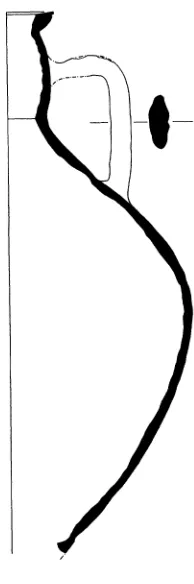
13. Forlimpopoli amphora Fig. 5
C-1986-124. Pres. H. 0.60, D. of rim 0.078 m. Pinkish tan clay, core buff in places, not well com- pacted, containing a few large lime and some sparkling inclusions. Surface around 4YR 7/6; core about 3YR 6/7.
Amphora preserves over one quarter of upper body, one half of shoulder, most of neck, and one and one half handles. Ovoid body, with maximum diam- eter just below shoulder. Tubular neck 0.199 m. tall, contracting to 0.0655 m. under outward thickened, rounded rim. Groove around shoulder at point of at- tachment of handles. Two vertical strap handles with three grooves rise vertically to just below top of neck, turning sharply inward and down to join at neck 0.02 m. below rim.
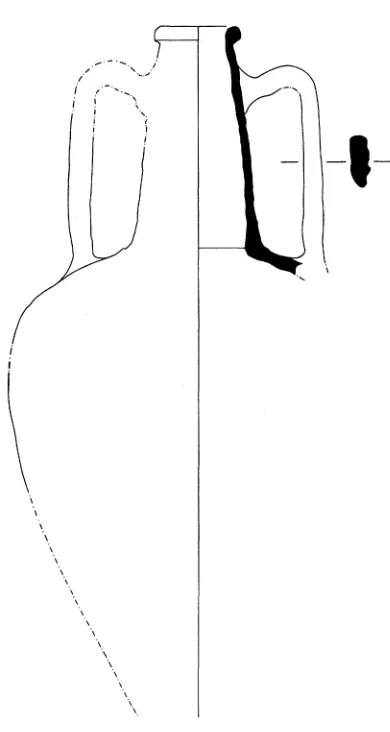
14. Gaulish type of amphora (Ostia Fig. 6 Form LX)
C-1986-123. Pres. H. 0.462, max. D. 0.402, D. of rim 0.122 m. Hard, tan clay, reddish tan at inside wall. Moderate amount of small black and white, sparkling inclusions. Core close to 4YR 6/6, sur- face a little darker than 7YR 7/4.
Amphora preserves one third of upper body, all of neck, handles, and rim. Wide ovoid body curves to low, sloping shoulder in one continuous profile; heavy, folded rim. Interior of rim and upper neck
just below rim.
C. Panella, "Anfore," in A. Carandini and C. Pa- nella, edd., Ostia III, ii (Studi Miscellanei 21), Rome 1973 (pp. 463-633), p. 539, closest to fig. 528, from stratum of beginning of 2nd century after Christ.
15. Roman Coan amphora
FIG. 6. Gaulish amphora 14. Scale 1:5
Tan, medium-coarse clay with pocked, buff sur- face, numerous white and a few black inclusions. Core 5YR 7/4 (at its pinkest); surface 7.5YR 6.5/5 to 5Y 8/3.
Amphora with long, solid, spike toe that flares gently into long cylindrical body. Transition be- tween body wall and shoulder articulated by inset- ting shoulder. Shoulder rises almost vertically to cy- lindrical neck that is slightly contracted, minimum diameter 0.101 m. Rim articulated from thickened neck wall by deep groove 0.014 m. below top of lip. Lip flattened on top, with inward slope to angled in- terior neck wall. Two double-rolled handles attach 0.02 m. above body offset, rising to "horns" just be- low lip, joining neck slightly under rim groove. Two sets of dipinti on one side of neck near top and near shoulder, on opposite side at upper neck.
Cf. C-1982-160, from manhole and cistern com- plex East of Theater,'1982. Slight variations exist in over-all size between the two examples.
16. Glass pillar-molded bowl
MF-1986-16. H. 0.043, D. of rim 0.120 m. Clear glass, spherical bubbles throughout, with larger concentration at rim.
About one eighth of moldmade bowl with wide, flat bottom, relatively thin wall. Vertically ribbed body curves into vertical rim, 0.012 m. tall. Polished rim with groove below lip on interior; two concentric grooves on interior at transition between floor and side wall.
Cf. G. R. Davidson, Corinth, XII, The Minor
The third point supporting the termination of Phase 2 by a general disaster is the strati- graphic evidence obtained from the area between the second-phase raking buttresses, which shows the following sequence along the east face of the corridor wall:10
1. A hard-packed pedestrian surface associated with use in Phase 1.
2. A foundation trench that cuts through the packed surface, within which, in Phase 2, the stones for the addition to the corridor wall of the vomitorium were set.
3. Two distinct, chipped-poros levels or crusts that spread over the foundation trench and abut the corridor wall. The top surface, at least, appears to have been packed by use in Phase 2 and definitely becomes a road surface as it spreads toward the east.
4. Two superimposed fills that cover the poros roadway. Both fills have enough depth so as to exclude any identification of them as gradual build-up, use accumulation, or layers of silt that might accumulate day by day over any roadway. Between the two fills in question is a pit with bones, some of which spread out to the east in a thin lens. These demark the division between the superimposed strata. The bones in question would suggest that the fills may be more garbage than earthquake debris, except for the inclusion within pottery lot 1984-70 of fresco fragments decorated with architectural motifs. These fragments are simi- lar to pieces found in East Theater Street east of Buildings 1, 3, 5, and 7. As a consequence, at least the fill with painted frescoes should be equated to a phase of clean-up, replanning, and rebuilding, in this report coupled with the initial activity within Phase 3.
5. The uppermost of the two superimposed fills is capped by road metal. That surface is the archaeological evidence for life and activity here in Phase 3.
6. A fall of architectural blocks from the superstructure of the Theater overlies the road metal. This debris is equated to similar falls of blocks in Buildings 1 and 3 and is assigned to the reign of Hadrian. The falls are assumed to be the result of the earthquake that brought Roman Phase 3 to an end. This fall should be equated with the tumble of blocks that were found over the last floor of the south room of Building 1 and over both rooms of Building 3.
ROMAN PHASE 3 (Figure 7)
Phase 3 introduced a new spirit of activity in the East Theater District. Apparently it was all part of a unified urban project, starting north of Building 3 and extending south- ward, probably to the east-west street north of the Fountain of Glauke. Not only were Buildings 1 and 3 repaired where needed but the undeveloped land south of Building 3 was now divided into small occupational units, each unit sharing its party walls with its north- ern and southern neighbor. East Theater Street was straightened, and the peristyle court between the Theater and the Odeum was probably planned."1
10 The specific area under scrutiny in the following analysis is that which abuts the south end of the south-
ward extension to the corridor wall of the vomitorium.
II Corinth X, pp. 144-145. Construction of the court is equated to the rebuilding of the Odeum by Herodes Atticus. The mosaic of figure 41 can be paralleled in the House of the Mysteries of Isis, room 3, at Antioch. See D. Levi, Antioch Mosaic Pavements, Princeton 1947, pl. CII:b, dated in Appendix 1, p. 625 within the Seve- ran period, A.D. 193-235, but variants of the pattern of intersecting circles with squares are to be found as
0 1 2 3 4 5m
Li ri
.PHASE
3
ILDINGt 5m 1 m 1 69 9X
' i e 1F~~~~ U I L D i N_ , ,
Ilk-~~~~~~~~~~~~~~~~~~~~~~~~~~~~~~~~~~~~~~~~-
F. 7.East ofTheater: 3.34 f , Roman hs
'~~~~~
;
~~~~~~~~~~~~~~~~~~~~~~:4
XA ~ ~~~~~~~~~~~~~~~~~~~~~~~~ T . 76
9@ ^; t~~~~~~~m 3 rm 4
I 1., 38 ft.
mfiB
__
IL lim 7
g i! l \ A>~~~~~~~~~~~~~WElwL 1925-
T IR Ei,T
A rA-F E A R L I E R E X C _A Y -fAT 0 O 1 S
Debris from the Theater, here associated with the end of Phase 2, was re-used in many places along East Theater Street at the beginning of Phase 3. The debris was found in the trenches of 1983-1986 against the vomitorium corridor wall of the Theater and again far- ther to the southwest close to the cavea wall, as well as along East Theater Street east of Buildings 1 and 3, over reservoir 1985-1, and along the west side of the street in front of Building 7. These different pockets of fill are assumed to be all of one period and the wall plaster all from one monument. They earth is, in all cases, red, probably mud brick, or else reddish, pebbly soil used in pise. Mixed in with the earth is frescoed wall plaster. The red earth appears to be the collapsed wall upon which the frescoes had been executed. In all the debris the frescoes are homogeneous, both in fabric and in pattern. The decorative scale of the different elements, the vocabulary, and the palette are the same. The fragments of fresco are decorated with zones of Lesbian and Doric leaf, under which is a horizontal green band. Beneath this is a maroon zone upon which are painted, in white, Erotes and horses and sometimes Erotes with amphoras and mythological animals, above a horizontal, bright-red line at the bottom of the maroon zone. Other fragments have white columns in which the indication of flutes is done by varying widths of line and a slight ocher shading.
The fresco-bearing debris was dumped against that part of the west facade wall of Building 1 which was built at the beginning of Phase 2. The date for the deposition of the fill here cannot be fixed precisely, but it must have been made after the construction of the Phase 2 segment of facade and before the end of Phase 3.12 The same type of fill with fres- coes rests upon the roadway that seals the foundation trench of the west facade of Building 3, Phase 2. In other words, the fresco fill against Building 3 was deposited upon a road surface that can be associated with the use of that structure in Phase 2. That fill in turn is sealed by another road surface that was compacted in the course of Phase 3. This later road went out of use with the abandonment of Building 3. The frescoes west of Building 5 overlie reservoir 1985-1 (P1. 5) without any intervening road surface. Road metal here has been identified only above the fresco layer.'3 West of Building 7 the fill containing similar fresco fragments rests only on a single hard surface, but that surface apparently never served as a roadway. The fresco-bearing soil associated with Buildings 5 and 7 is sealed by later levels of road metal (pottery lots 1986-122, 1986-124, 1986-144). Finally it should be reiterated that fragments of this type of fresco, but not in mud-brick debris, were found in similar chronological levels between the buttresses of the east cavea wall, over which lies a surface sealed by Theater blocks that fell at the end of Phase 3.
As seen from the above evidence, road surfaces do underlie the fresco fill that was dumped at the beginning of Phase 3 in front of Buildings 1 and 3 but not in front of Build- ings 5 and 7. Thus East Theater Street can be shown to rise southward from the Theater
reverse of colors in the pattern; see also, the House of Porticoes, pl. XCVIII:a, dated to the Severan period. It is possible that the Corinth mosaics were laid as part of a repair of the colonnade rather than during its initial construction. Only systematic excavation of at least some part of the court below floor level can supply a more precise date for the construction of that complex.
12 Williams and Zervos, 1983, pp. 105-106, figs. 8, 9.
straight up the slope toward the Fountain of Glauke only from Phase 3 onward. In Phases 1 and 2 the street veered toward the southwest following the outside edge of the cavea of the Theater, but at some point it branched off or turned back to climb southward past the east side of the Odeum. Apparently the availability at the end of Phase 2 of the great amount of debris, flecked with decorated plaster, made feasible the regrading of the hillside into a slope that allowed easy ascent in a straight run.
A terracotta drain, U-shaped in section and covered by tile fragments, was laid into red earth and fresco debris that had been piled against the lower part of the west facade of Building 5 (P1. 6, foreground, center). The drain took away water from downspouts set into the facade of both Buildings 5 and 7 and runs along the north side of Building 5, passing through the terrace wall on the north side of Building 5 at a point just east of the point where Building 3 abuts that terrace wall. In fact, the southeast room of Building 3 in its rebuilt state appears to be designed in consideration of the outflow from that drain.
This U-shaped drain was eliminated at the end of Phase 3, apparently when a large drain built of stone was laid down East Theater Street to service all the buildings that faced the street (P1. 6: at the right side of the reservoir the photograph shows the drain in section where it is cut away to expose the north wall of reservoir 1985-1). At this time round terra- cotta pipes were installed to connect Buildings 5 and 7 with the new stone drain.
Large, newly planned elements in this quarter of the city did their part to secure the new, straightened street arrangement, or vice versa. The Odeum was built at this time and confirmed the line of the west side of the street.14 The East Theater Street of Phases 1 and 2 which had curved around the east side of the Theater must have gone out of use with the laying out of the new course at the beginning of Phase 3, if for no other reason than that the planning, if not the actual construction, of the peristyle court between Theater and Odeum impinged upon the course of the early road. This course was now overlapped and blocked by the northeast corner of the peristyle court. Thus, even if the court was not constructed at the very beginning of the Flavian period, the area appears to have been reserved at this time for the eventual construction of the peristyle complex.
Buildings 1 and 3 underwent radical repair. It appears that the Phase 2 walls of the south room of Building 3 survived the recent destruction as did much of the west facade wall of Building 1, but almost all the rest of the fabric of the two buildings preserved today is the result of rebuilding at the beginning of Phase 3. The plan of the two buildings remained the same as it had been before, but the new walls were raised in a more casual manner. Large squared blocks from the earlier phase, or perhaps even from other buildings, were re-used in a rather poor opus africanum style. The blocks were set at random intervals on their short ends, the spaces between filled with clay and tiles, not cement and rubble. The clay has in it large pieces of charcoal. Apparently a temporary formwork was laid between the re-erected blocks, and the interstices were then packed with the clay and tiles, perhaps from the debris
14 Broneer (Corinth X, p. 143) states that there is "adequate proof that the building was erected toward the
end of the first century A.D." On pp. 22-23 Broneer states that the packing associated with the foundations of
of the recent earthquake. In a number of cases, but largely in the collapsed wall debris over Buildings 5 and 7, the clay used for the walls has been found to contain an extremely high number of small pre-Roman sherds, an indication that, in those buildings, the clays used for the walls were gathered from much earlier habitation sites or levels.
Other techniques of construction used in this period are worth mentioning. On the north face of the party wall between Buildings 1 and 3 one can still see one device, unpleas- ant for the archaeologist's peace-of-mind, used in the backing for a mud-plaster wall sur- face. Here stands an application of amphora sherds mixed with marl or clay, used to pad out uneven parts of the wall before a final marl coat is applied. This appears to be the cheapest form of wall cover used in Roman storerooms at Corinth. It appears to be satisfactory enough that, sometimes, the surface was then decorated by a coat of lime or cement. This year blue, black(?), and maroon layers were found adhering directly to fragments of fallen mud. Apparently the Romans were willing even to decorate the mud walls if covered only with a more finely prepared clay.15 The problem caused this year arises from the Roman practice of using randomly gathered amphora sherds as wall backing behind mud plaster. Those backing sherds are easiest to find in the debris of the immediately preceding phase, gathered before the material can be cleared away or sealed under a new floor. But once the walls are rebuilt the next earthquake releases in its debris, above the new floor level, sherds which archaeologists find mend with others sealed below the floor. This appears to have happened with two pots that have been recovered over the past two years. Sherds come both from below the latest floor of Room 1 of Building 3 and from destruction debris over the final floor in the room to its south.16
As has been mentioned above, Room 1 of Building 3 was equipped in Phase 3 with three hearths or ovens, all with tile floors.17 The smaller two have baked clay walls, 0.02-0.031 m. thick. A raw marl insulating wall 10-12 cm. thick coats the outside surface of the inner, baked clay wall. The largest oven was fashioned simply of unbaked clay and re- used tile fragments. Its wall is at a minimum 0.23 m. thick. It has developed a thin baked clay crust on its interior face from repeated use.
Until excavation this year cleared a larger part of Building 5, it had been considered to be a single complex of at least four rows of east-west rooms (P1. 5:a).18 Exploration this year shows, however, that the structure is not so large as had been anticipated. In the cur- rent Phase 3 plan one now sees that the area was laid out as a series of parallel east-west
15 A-1984-5, A-1984-6. Two fragments of decorated mud wall with a thin final coat of mud mixed with
marl and sand, overpainted in red lines. Both fragments were found in debris at the south side of the south room of Building 1. The 0.005 m. surface coat is a sandy mixture of clay and marl with black and white grains. The painted red lines on fragment A-1986-6 are from a framing motif of parallel lines, one side doubled. The frame is divided by rectangles crossed by X's. Each resultant triangle is decorated with two superimposed V's with dot on top, a pattern used in walls of the Villa San Marco Castelmare, destroyed A.D. 79.
16 Rim and wall of coarse upper body and rim, perhaps funnel, from lot 1985-129 (no. 1) and lot 1986-48;
fragmentary Tarragonian amphora, from lots 1985-127 and 1985-129 (no. 2) and from lot 1986-48. I thank K. Slane for making these joins and drawing my attention to them.
17 Williams and Zervos, 1985, p. 135, fig. 1 (plan), pls. 28:b, 29:a.
walls with various north-south partition walls between. The northernmost of the east-west walls is founded on the buttressed terrace against which Building 3 stands. The second east-west wall is separated from the first by 3.25 m., the space between serving as an en- trance corridor from East Theater Street. The space between the second and third east-west walls is 4.55-4.60 m. wide and is divided into an eastern and a western room. The south wall of these two rooms now is completely cleared and preserves no evidence for ever having been pierced by a doorway. In addition, in the first phase of this complex the levels are so different between the floors of its second and third line of east-west rooms, counting south from the terrace wall, that normal circulation between the two suites would be extremely difficult and, if achieved, extremely inconvenient. For example, the floor in the second range of rooms is at ca. 70.31-70.50 m. above sea level; that in the third range is at + 71.38-71.46 m. At least one door is preserved at the west end of the next east-west wall to the south, a definite connection between the third and fourth ranges of east-west rooms. Thus it is now considered best to reapportion Building 5 into a complex composed of two suites of rooms running east-west, with the third east-west wall from the north serving as a party wall between buildings. The adjacent unit to the south now is called Building 7. Following this readjustment all the rooms of Building 5 have been numbered, starting at the northwest corner of the structure: Room 1 is what has previously been called the corridor; Room 3 is what has been called the northwest room. For the new designations, see Figure 3. Likewise the rooms of Building 7 have been numbered from left to right, starting at the northwest corner with Room 1.
All the east-west walls of Buildings 5 and 7 are laid on bedrock, as is the west fapade wall facing East Theater Street. The outside or west face of the street wall shows no division between Buildings 5 and 7; in fact the masonry appears to have been laid in a continuous line of coursed ashlar along the street without consideration of articulating individual build-
ing units.
Phase 3 ended in an earthquake, taking with it Buildings 1 and 3. The south room of Building 1 and all of Building 3 are buried in a fall of architectural blocks that can only suggest violent destruction. Building 1 has a fall of large building blocks over the floor of its southwest room.19 Building 3 has fewer fallen blocks within its two western rooms, but between an elevation of 67.985 and about 68.10 m. above sea level was found a fall of fresco, much if not all of which appears to have been applied to a mud-brick or pise wall, rather than to stone.20 Buildings 5 and 7 were also damaged at this time but could be repaired for reoccupation.
Evidence recovered from the west side of East Theater Street shows that the same earthquake probably brought down the raking buttresses of the Theater. This is indicated by the tumble of large blocks fallen from the upper structure around the vomitorium terrace wall and from the two associated raking buttresses on the east side of the Theater.21 The fallen blocks include an unfluted poros column drum, an inscribed poros frieze block,
19 Williams and Zervos, 1985, pp. 131, 133, pl. 27:a. 20 Williams and Zervos, 1985, pp. 139-140, pls. 31:a, 32:a.
buttress blocks, and one corbel or console block. During the excavations of 1981-1986 evidence suggested that damage to the fabric of the Theater should be equated to a general destruction at the end of Phase 3.
Excluding the stratigraphic evidence which suggests a Domitian date for the first occu- pation floor in Room 1 (previously called the north corridor) of Building 5, no floor with associable destruction debris indicates that this building was occupied before the Hadrianic period.22 The lack of evidence for a destruction at the end of Phase 3 seems to suggest that no disaster equal to that which collapsed Buildings 1 and 3 shook Building 5. One of the best places in Building 5 in which to study this apparent inconsistency is in Room 3. Here an undisturbed series of strata start at bedrock and end with terrace fill that buried the struc- ture. Between 1983 and 1986 almost all the strata were removed from Room 3. Only a strip 1.65 m. by 2.50 m. along the south wall of the room remains to be excavated. From bedrock to an elevation of ca. + 70.31-70.45 m. the strata are either pre-Roman or Roman con- struction fills dumped at the time of the erection of Building 5. Two floor levels were distin- guished within the room at the wall height where its fabric changes in quality from un- evenly projecting and casually laid stones to an upper wall with a more finished and gener- ally smoother face. The lower floor slopes up along the walls at this point and does not form an evenly packed surface at the center of the room. This surface was designated in 1984 as a construction floor. The closely superimposed surface ( + 70.31-70.54) is harder and defi- nitely is a level earth floor suitable for a domestic establishment. This is called "floor 1" in the publication. Over this is a deep fill of debris, composed of two strata. Numerous joins were made between the two strata, indicating that the difference in the earths has only to do with textures of tipped fills. The fill contained wall plaster, many pots and artifacts, such as figurines, all placeable by date within Phase 4.23 This year more pottery and coins were recovered that reinforce this date. The latest coin from the fill this season can be dated to the Severan period (coin 1986-75).24 The debris is sealed by a good floor level at an elevation of + 70.79-71.13 m. This is the last use level of the room and here is dated to Phase 5.
The stratigraphy inside Room 3 of Building 5, as now divided into phases, does not relate to the sequence outside Building 5. The stratigraphy in East Theater Street against the west facade of Building 5 demands that the construction of Building 5 be placed within Phase 3. Also, Phase 3 destruction debris has been distinguished in a heavy stratum throughout Building 3, which abuts and is contemporary with Building 5, but no Phase 3 destruction has been found within Room 1 of Building 5. To resolve this apparent contra- diction in the stratigraphic evidence, the following conclusions are made: What originally had been identified as a construction floor in Room 3 of Building 5 is, in reality, evidence of a removed floor. Most likely Building 5 was damaged during the disaster that destroyed Building 3 and terminated Phase 3, but repairs to Room 3 of Building 5 included removal of all its debris after the quake; some of the floor was dug up and removed as well, down to
22 Williams and Zervos, 1984, pp. 67-68; Williams and Zervos, 1985, pp. 152-153.
what had been identified in 1984 as the "construction floor". Thereafter a new earth floor was laid over the cleared-out level. That level, called "floor 1 " in the previous reports, is still preserved and easily identified. In reality it represents the second occupation of the Room 3. It was covered in the next earthquake by debris that can be dated into the early 3rd century after Christ.
ROMAN PHASE 4 (Figure 8)
The disastrous earthquake that brought Phase 3 to its end apparently did extensive damage to the Theater. Whatever still stood of the raking buttresses above the debris was dismantled, and a new set of horizontally coursed buttresses was built to support the cavea wall. The vomitorium was redesigned and put between two of these new buttresses; the access ramp now rose from East Theater Street in a flight of steps 3.55 m. wide to the level of the corridor floor of the earlier vomitorium, with the fifth and last riser being the top of the old corridor wall. To the west of the steps the entrance continued in a straight line as a marble-paved ramp, straight into the upper cavea. The northern flanking buttress of the vomitorium was built upon the trimmed and leveled foundation of a dismantled second- and third-phase buttress. The northern flanking buttress was built upon a new rubble-and- cement and poros-block foundation that is about 1.20 m. wide. Today its superstructure is totally robbed of blocks, but its form is clear from the shape of the foundations. The south face of the buttress can be determined by the line formed by the north edge of the steps where they had abutted that buttress. The construction of the steps is not elegant; in fact, the stairs are made of scavenged blocks. Only marble veneer, of which no remains now are preserved on the flight of steps, can have kept the aesthetics of a theater-goer from being offended by the shoddy step construction. The floor of the ramp definitely had been paved in marble; the outline of veneer plaques can still be seen in the cement bedding of the ramp west of the stairway.
One might include the rebuilding of the stage building as part of a general rehabili- tation of the Theater after this earthquake; whether all the repairs should be considered as, one project or whether they were accomplished only over a more extended period is, at the moment, hard to determine.25
The access ramp into the Odeum-Theater court from East Theater Street should be discussed now, even though the date of its construction cannot yet be fixed firmly by coins or pottery to a precise time within Phase 4. (For ramp, see P1. 5:a, lower right; for its terrace wall see P1. 3:a, diagonal wall at lower right, against rectangular buttress.) One knows that the ramp was not built before the erection of a diagonal wall of poros ashlar blocks which abut a theater buttress of Phase 4, for the ramp is retained upon a homogeneous dumped fill supported by that wall. In turn that wall cannot have been built until after the construction of the theater buttress, for the wall abuts and is later than the buttress. Its west end was also
25 For the most recent examination of the rebuilt stage building in this period, see M. C. Sturgeon, Corinth,
PHASE
4
~U~E and CEMENT FNDOT
VON ITORIIJ M~~~~~~~~~~~~~~~~~~R A GWA
/ H76 /_ =D
/
/'1--s
rm r~~~~~m 2
TT ~~~~~~~~~~~~~70~00 70-101f1
700962 T E RR CE LL
fS,i"J0\4Fl0~~~r 3-
PH
AS
470981 71, f .
TO r
TO rRT 7 4
S
,C
~~~~ ~ ~~~rm 5 W02 $FIG. 8. East of Theater: Roman Phase 4