WESTERN AND ISLAMIC COMMUNICATION MODEL: A COMPARATIVE ANALYSIS ON A THEORY
APPLICATION Sofia Hayati Yusoff1
Universiti Sains Islam Malaysia
Abstract
The theories of communication that have been explored are of western perspectives and origin. There are scholars who argue that communication theories should be developed based on the social, cultural and religious context of the society. Thus, this paper conceptually discusses the issue by comparing and contrast the perspective of communication from Islam and the West. The author has underlined specific arguments for or against the position by citing prominent scholars and specific theories in communication. Finally, a model of Islamic communication is proposed and put into visualization based on the analysis and discussion on fundamental concept of Islamic communication made by a prominent Muslim scholar, Hamid Mowlana.
Keywords: Islamic communication, Communication theory, Communication model
Abstrak
Sebahagian besar teori komunikasi berasal daripada Barat dan mengikut perpektif Barat. Terdapat beberapa pakar berpendapat teori komunikasi seharusnya dikembangkan mengikut konteks sosial, budaya dan agama sesebuah masyarakat. Justeru itu, artikel ini membincangkan secara konseptual beberapa isu berkait teori komunikasi melalui perbandingan dua perspektif iaitu Barat dan Islam. Penulis juga telah menggariskan beberapa pendapat daripada pakar yang menyokong dan membangkang posisi dua perspektif ini berkaitan teori komunikasi. Akhir sekali, model komunikasi Islam telah dicadangkan oleh penulis dan divisualisasikan melalui
gambarajah berpandukan analisa dan perbincangan mengenai konsep asas komunikasi Islam yang dibangkitkan oleh par Muslim terkenal, Hamid Mowlana.
Kata Kunci: Komunikasi Islam, Teori komunikasi, Model komunikasi
INTRODUCTION
Communication theory existed as an outstanding intellectual topic only in the mid-twentieth century. Its term was first used by electrical engineers in the 1940s with reference to signals in the mathematical analysis (Craig, 2007). It grew rapidly into every intellectual tradition that related to communication. Ideas from various fields like psychology, sociology and others were absorbed into a number of so-called communication theories. At present, there are at least seven distinguished major traditions of communication theory with ‘rhetoric’ being the oldest (Littlejohn, 2008). According to Baran and Davis (2009), the term communication theory can be addressed to a single theory or also can be utilized in the design of some collective wisdom available in the entire body of communication related theories.
MODELS OF COMMUNICATION
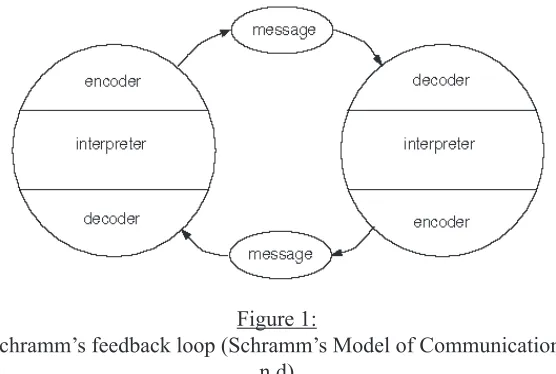
Figure 1:
Schramm’s feedback loop (Schramm’s Model of Communication, n.d)
Following Schramm’s model are Berlo’s Model of Communication and The McCroskey Model of Communication. These two models seem to be the improved version of communication model developed by Schramm. Berlo’s model stresses on source, message, channel and receiver. The source should possess several elements such as skill, attitude, knowledge and others in sending message to the receiver. While the message in this model contains several other elements that makes the message delivered correctly to the right receiver. The channel in this model consists of seeing, hearing, touching, smelling and tasting. Finally, the receiver should also possess the same elements that the sender has as the role is interchangeable (Whitaker, Ramsey & Smith, 2012).
The development of communication models has also witnessed the transition from interpersonal to mediated communication model. In 1957, scholars in the field of journalism Bruce Westley (1915-1990) and Malcolm S. MacLean Jr (1913-2001) proposed new model namely Westley and MacLean’s model of communication. This model that portrays two contexts, interpersonal and mass communication stresses the difference between the two, which is feedback. In interpersonal, the feedback is direct and fast while in the mass, the feedback is indirect and slow. Thus, this model believes that communication does not begin when a person starts to talk, but rather when he/she responds selectively to his/her physical surroundings. It considers a strong relationship between response from surroundings and the process of communication. Communication begins only when a person receives message from surroundings. Each receiver responds to the message he/she receives based on his/her object of orientation (Whitaker, Ramsey & Smith, 2012).
In short, communication models from the western perspective as displayed above pay attention on mostly the communication process itself that goes around between the sender and receiver. Names like Schramm, Berlo, McCroskey, and Westley are very prominent in the development of communication within the sphere of western context.
ISLAMIC COMMUNICATION VS WESTERN COMMUNICATION
of the response to the following five questions: “who says what to
whom through what channel and with what effect?” (Littlejohn, 2008. P: 34). This positivistic and functional Western perspective on communication does not treat communication as an act of social process as comprehensive as drawn by Islamic scholars and most importantly, the absence in the element of tawhid (the concept of Oneness towards God) is obviously undeniable (Ali, 1996).
In the perspective of Islam, communication is in fact a divine concept with humans being the finest creature created by Allah SWT blessed with the brain and all the five senses and a single unifying factor is communication (Ghani, 2009). Communication in Islam does not stress out on individualistic approach per se, yet the societal approach at large is also pinpointed. Thus, Islam proposes a comprehensive model of communication which puts every communicator awares of the existence of Allah SWT as the sole creator of the world and awares of social function of communication at large known as
ummah. Furthermore, with the holy Quran and prophet’s traditions as reference, Islam always stresses on the word akhlak or ethics as a vital element in communication which is distinctively lacking in any western communication models (Mowlana, 2007).
FUNDAMENTAL CONCEPTS OF ISLAMIC COMMUNICATION
There are a number of fundamental concepts in Islamic communication as outlined by Hamid Mowlana (2007) that need to be taken into a serious consideration by Muslim communication scholars and researchers. The first concept is the theory of Tawhid. It implies the unity, coherence and harmony between all parts of universe. It describes the rightness of “exclusive servitude” to Allah SWT and rejects any other forms of sovereignty except Allah SWT. Hamid Mowlana (2007) further argued that should this concept is applied in human communication, it will give the principal guide in “drawing the boundaries of political, social, and cultural legitimation by a given communication system”. This concept of Tawhid is much needed to be practiced by all Muslim communicators as it functions against the material foundations such as a desire for wealth which must not be stressed by communication practitioners but Tawhid
teaches us to work for Allah SWT alone.
The second concept proposed by Hamid Mowlana (2007) is the doctrine of responsibility, guidance and action. It is the doctrine of
al-amr bi al-ma’ruf wa al-nayh ‘anil munkar or the commanding to the right and prohibiting for the wrongdoings. It gives the notion of individual and group responsibility for preparing the succeeding generation to accept the Islamic precepts and make us use of them. This is because Muslims have the responsibility of guiding one another and each generation has the responsibility of guiding the next. In short, Islamic communication as opposed to western approach, places communication in a bigger and greater position in which it is not merely a communication, but within the act of communication, there is a responsibility carried out by both Muslim individual and community at large as obligation in communication.
Both the first and second concepts are obviously missing in any of communication models proposed by Western communication scholars. Western communication models never place tawhidic
Islam stresses the significant of Tawhid as the major element in either human or mass communications (Hamid Mowlana, 2007).
The next concept highlighted by Hamid Mowlana (2007) in Islamic communication is the concept of community. It refers to the ummah, that is the larger Islamic community that goes beyond national borders and political boundaries as well as racism. An Islamic community in a real sense exists only when it is nourished and governed by Islam. Moral values follow piety and the social system of Islam is based on justice, equality, and people’s rights. Referring this to communication context, the community that follows closely the Islamic principles would lead to a good community.
The fourth concept is the principle of Taqwa or fear of Allah SWT. It is basically translated as piety, referring to individual’s fear of Allah SWT. It is the individual, spiritual, moral, ethical and psychological capacity to raise oneself to that higher level, which makes a person almost immune from the excessive material desires of the world. According to Hasim (2009), it is a virtue and as important element in the ethical framework of Islamic communication both at the individual and community levels. For example, in the context of journalism, if one journalist does not posses taqwa, he tends to provide false news to the public and this is what we can see nowadays in the world of journalism where not all news are covered based on reliable and valid source, in fact some are merely false coverage.
the group or among other groups. It may also be noted that rights and obligations are interdependent. Another example, if we want to apply this concept into media context, serving the public interest, therefore becomes one of the principal ethical duties of the media (Basir, Haron, & Musa, 2009).
ISLAMIC COMMUNICATION MODEL
Based on the above analysis and discussion on fundamental concepts of Islamic communication as outlined by Mowlana (2007) and supported by a number of researchers, the concept of Islamic communication can be visualized into an Islamic communication model as opposed to the ones developed by western communication scholars:
TAWHID RESPONSIBILITY
GUIDANCE BROTHERHOOD
TAQWA AMANAH MESSAGE
GOOD WORDS RELIABLE
NEWS GIVING GUIDANCE
KEEPING SECRETS
MESSAGE
GOOD WORDS RELIABLE
NEWS GIVING GUIDANCE
KEEPING SECRETS
RECEIVER SENDER
Figure 2:
Visualization of Islamic Communication Model¾based on the fundamental concepts of Islamic communication proposed by
Referring to the model in figure 2 above, it is very obvious that there is a distinct difference from the models developed by western communication scholars like Wilber Schramm, James McCroskey and others (Whitaker, Ramsey & Smith, 2012) in terms of the elements of message as well as the personality of the sender and receiver. The western models do not emphasize on ‘what’ kind of message but only on ‘how’ to encode and decode the message (Littlejohn, 2008). While in Islamic perspective, the message that is delivered or received must be well monitored in terms of its reliability and choice of words. The message should not possess elements that are misleading in human’s judgment and it should be kept within the sender’s and receiver’s own secrets (Khiabany, 2007). While unlike the western models that highlight only on the ability of both sender and receiver in interpreting the message or decoding process, the Islamic model stresses on the personality of both the sender and the receiver who should follow the right teachings of Islam based on the holy Quran and prophet’s traditions as the reference in life. They are expected to be a person with good qualities as described in the model (Mowlana, 2007).
Furthermore, Islamic communication model as proposed by Mowlana (2007) has shown the existence of Tawhidic element in which every individual is aware of the existence and the Oneness of Allah SWT. This awareness has led an individual to a situation whereby he or she will be conscious of every word uttered as to ensure no actions that lead them to be sinful. This results to the existence of other elements such as responsibility of what is going to be uttered, fear of Allah
(Taqwa) and honesty.
WESTERN COMMUNICATION THEORIES VS ISLAMIC COMMUNICATION THEORIES
usage need much attention in adaptation with Islamic perspectives for the application within Muslim society worldwide. Thus, the writer’s following arguments will only put a focus on western media theories as comparison to Islam.
Media theories play a big role in developing a society. They act as socializing agent in society and this role is significantly important. This is due to the fact that media contribute to various impact in the process of changing social lifestyle (Basir et. al, 2009). The media messages are able to influence individuals and shape social behaviour which leads to major attention paid by the media authorities in developing certain expected perceptions in society. Some scholars claim that media are able to produce either positive or negative impact as they wish to the society (Barran & Davis, 2009; Littlejohn, 2008; Ghani, 2000) For example, research done on media and youths show big impact that the media have in influencing the youths (Barran & Davis, 2009; Littlejohn, 2008; Hopkinson, 2003;Bahari, 1998).
This discussion will put a focus on one media theory developed by Western media theorists like Mellvin De Fleur and Sandra Ball-Rokeach (1975) who described on Media System Dependency Theory. They argue that in this theory, the more “a person depends on having needs gratified by media use, the more important the media’s role will be in person’s life” (p: 273). Thus, this clearly signifies that media, regardless of which type, have a very strong influence on individual’s life. Since the media’s coverage is seen able to influence audience or readers, Basir et.al (2009) argued that the media are then believed to have a power in shaping public opinion on certain issues and to some extent, the media are seen to have a big impact in making the public to rely and trust on news portrayed.
theory is that the theorists themselves fail to provide both the society and media practitioners with proper guidelines on how to avoid from disseminating and receiving negative message as an addition to the theory. Therefore, to counter with such issue in media usage among Muslim users, the adaptation of Islamic perspective into the western media theories is needed.
Haron (2009) argued that the media usage must be based on the Islamic principle of al-amru bi al-ma’ruf wa al-nahy ‘an al-munkar
(the commanding to the right and prohibiting for the wrongdoings). This principle is a benchmark towards the role of media in ensuring the conservation of five major elements in syariat al Islamiyyah
(Islamic principles) which are the conservation towards Islam, mind, generation, soul and wealth. To clarify further, it means that the role of media from Islamic perspective should be parallel to the context of Islamic principles. In other words, the role should be seen from the approach of not only social development, but also social responsibility which covers responsibility of media practitioners in providing only valid and reliable news, avoiding message dissemination that is misleading, giving opportunity to public expressing their views and many others which obviously not in the practice of western media culture (Basir et.al, 2009).
CONCLUSION
In conclusion, media and communication theories are not only important in conducting research for social change, but also very significant in providing transparent guidelines for authorities, practitioners and organisations in developing a harmonious society. Within the Islamic and Muslim context, the theories need to be adapted following the Islamic teachings as to prepare the society with proper guidance in facing the challenging world that already set by the West which full with biases against Islamic culture.
It is then argued by Yousif (2002) that one of the best means to counter against this bias is for Muslims to develop their own independent communication and media capacity based on their own communication and media theories as to reduce their dependence on western theories which open to various doubts and lead to many drawbacks, especially with regards to social spiritual development.
The application of Islamic principles in the modern communication theories would lead to the development of another field of subject, that is, principles of Islamic tolerance. As Islamic communication model highlights on the concepts of responsibility, this would produce an individual with good moral values having sense of tolerance in communication aspects (Syed & Faisal, 1996). The lacking that exists in western communication model should be substituted by islamic communication model
REFERENCES
Ali, S. (1996). Foundation to communication in the Quran and Sunnah. American Journal of Islamic Social Sciences , 13 (2), 223-245.
Bahari, A. (1998). Modenisasi: Implikasi dan cabaran kepada belia. In A. Hamzah, & T. Suandi, Pengukuhan Sinergi Belia dan Negara. Kuala Lumpur: Aslita Sdn Bhd.
Baran, S. J., & Davis, D. K. (2009). Mass Communication Theory
(5th ed.). California,CA: Wadsworth.
Craig, R. (2007). Pragmatism in the field of communication theory.
Communication theory, 17 (2), 125-145.
DeFleur, M.L., & Rokeach,S.B (1989). Theories of Mass Communication, 5th ed. New York,NY: David McKay.
Ghani, Z. A. (2009). Dasar komunikasi negara dalam konteks pendekatan Islam Hadhari. In M. S. Hasim, & Z. Abd Ghani (Eds.), Komunikasi Di Malaysia: Suatu Penelitian Awal Pendekatan Islam Hadhari. Bangi: Universiti Kebangsaan Malaysia.
Ghani, Z. A. (2000). Imperatif multimedia dalam pembangunan ummah. In A. B. Majeed, & S. F. Abdul Rahman(Eds.),
Multimedia dan Islam. Kuala Lumpur: IKIM.
Haron, M. S. (2009). Konsep dan falsafah Islam dalam media. In M. S. Hasim, & Z. Abd Ghaani (Eds.), Komunikasi di Malaysia: Suatu Penelitian Awal Pendekatan Islam Hadhari. Bangi: Universiti Kebangsaan Malaysia.
Hasim, M. S. (2009). Islam sebagai asas falsafah komunikasi. In M. S. Hasim, & Z. Abd Ghani (Eds.), Komunikasi Di Malaysia: Suatu Penelitian Awal Pendekatan Islam Hadhari. Bangi: Universiti Kebangsaan Malaysia.
Hopkinson, N. (2003, October 29). Youngsters awash in high-tech media. Providence Journal , A3.
Khiabany, G. (2007) Is there an Islamic Communication? The persistence of ‘tradition’ and the lure of modernity. Retrieved on September 28, 2011 from: http://www. highbeam.com/doc/ IGI-175525371.html
Khiabany, G. (2003). De-westernizing media theory, or reverse orientalism; ‘Islamic communication’ as theorized by Hamid Mowlana. Media Culture & Society, 25, 415-422.
Littlejohn, S. (2008). Theories of Human Communication (9th ed.). Singapore: Wadsworth.
Mowlana, H. (2007). Theoretical perspectives on Islam and communication. China Media Research, 3 (4), 23-33.
Schramm’s Model of Communication (n.d). Retrieved from: http:// www.uri.edu/personal/carson/kulveted/wlsmodel/html
Whitaker, W.R., Ramsey, J.E., & Smith, R.D. (2012). Media Writing; Print, Broadcast and Public Relations (4th ed.). New York: Routledge.
Yousif, A. (2002). Strategies for enhancing the understanding of Islam in the media. In A. A. Razak, & A. B. Abdul Majeed (Eds.), Enhancing the Understanding of Islam for the Media.