86
INSTRUCTION BUILT ON LEARNERS’
PREVIOUS KNOWLEDgE By
USINg THE VARIATION THEORy
Mona Holmqvist, Gunilla Lindgren, Jane Mattisson, teresa svarvell Kristianstad University, Sweden E-mail: [email protected]; [email protected]; [email protected]
abstract
This chapter discusses teaching based upon pupils’ previous knowledge. As the world becomes more and more globalised, it is harder and harder for a teacher to form a picture of the pupils’ knowledge when planning instruction. However, without this information about pupils, it is impossible to know if the created learning situations are conducive to learning or if the pupils had already acquired knowledge about the learning object before the learning situation. In this study pupils’ previous knowledge is investigated in relation to how English as a Second Language1 is learnt when pupils have different mother tongues. In a phenomenographic study we found that pupils with three different mother tongues, when placed in the same learning situation, made errors which could be traced back to the structure of their mother tongue. This observation led to a learning study, in which variation theory was the theoretical point of departure, and in which three different research lessons with three different groups of pupils were carried out. The learning object was dependent possessives, and the pupils’ mother tongue was Swedish. As there is no differentiation between independent and depend-ent possessives in Swedish, the pupils could not discern the difference between these two forms. As Swedish has a differentiation between t- and n-gender, the puils wrongly assumed that the difference between my and mine was not connected to dependent and independent possessives but to gender. The results of our study show how teachers who are familiar with the pupils’ previous knowledge (mother tongue) can become aware of what mistakes they might make as ESL learners; this knowledge has a profound effect on instruction. In this way, teachers can also predict and plan what information is needed to develop learning situations which provide maximum opportunity to learn. They also understand what kinds of critical aspects are necessary to enable pupils to discern. As a result, teachers are more effective, which is reflected in better pupil results in the classroom.
Key words: contrastive linguistic, English as second language, instruction, variation theory, phenomenog-raphy.
Introduction
One problem, or possibility, of education in the 21st century is pupils’ previous knowledge. How is it possible to take their knowledge into account in today’s highly globalised world? The pupils acquire information from all over the world by listening to the radio, watching the television and using the internet. It seems almost impossible for a teacher to assess the pupils’ previous knowledge without the use of a design which allows teachers to examine exactly what the pupils have discerned about a learning object. This chapter discusses if a theory of learning, known as the variation theory,
87
IN THE 21 CENTURY Volume 6, 2008
can be used to enable teachers to design lessons which capitalize on learners’ previous knowledge in order to increase the learning outcome. The present study is part of the ‘Pedagogy of Learning’ project, a joint three-year project (2003-2005) between Kristianstad University and Gothenburg University. The project is funded by the Swedish Research Council. One of the subjects studied in the project was ‘English as a Second Language’3. The mistakes pupils make as ESL learners are strongly connected to the structure of the learners’ mother tongue. When pupils learn a second lan -guage the learning is based on the pattern of structure of their mother tongue, which makes it more difficult to discern the target language’s structure (Svarvell, 2003). As a consequence, learning a second language differs from learning mother tongue as there are no contrasting patterns to consider in the learning situation.
In this study the phenomenographic approach has been used to analyse the pupils’ ways of experiencing ESL. If and how the pupils’ mistakes arise because of the structures between their mother tongue and English is also investigated. Following the publication of Marton et al’s (1977) research on learning, a number of educational institutions both within and outside Sweden have initiated phenomenographic research projects. Phenomenography was originally a descriptive and analytical methodological approach of the type presented in Uljens (1989). Today, phenomenography is explanatory rather than descriptive (see, for example, Marton & Booth, 1997). However, even if the phenomenographic approach does explain different ways of experiencing phenomena, it offers no indications of how to use this knowledge in a learning situation. Using the phenomenographic approach, a theory of learning was developed to cover such interests – the variation theory. Its basic tenet is that all learning requires variation in some form. At critical moments we notice a change in our understanding of the world and learn something new. Where there is no variety in the learning objects presented the learner is denied the opportunity of discovering differences and identifying the critical aspects of a particular learning object. On the other hand, and somewhat paradoxically, too great a variation counteracts the positive effects of the variations which are preconditions for differentiation.
Variation theory is based upon the premise that all learning is dependent on variation in the environment (Holmqvist, 2004; Holmqvist, Gustavsson & Wernberg, in press; 2007). It identifies three factors which constitute preconditions for learning: discernment, simultaneity and variation (see the previous chapter in the present book - Holmqvist & Mattisson, 2008). The method used in the study is learning study.
Of particular interest for the present discussion is Svarvell’s study on ‘The Pedagogy of Learn -ing’ (2003). Svarvell describes how the same tasks which form the basis of the present study were carried out by ESL students whose mother tongue was not Swedish. The study incorporated Ben -gali (7 students), Lithuanian (3 students) and Portuguese (5 students). All live in Great Britain, and attend a comprehensive school2 in East London. Svarvell asked the students to translate sentences
which were almost identical to those in the present study (only colors, names and nouns differed) (see figure 2).
Svarvell’s results demonstrate that there is a strong connection between how students experience the target language, and the structure of their mother tongue. Nouns denoting number, for example, are not declined in Bengali, i.e. the same noun is often used for both singular and plural. Thus, there is no difference between book and books. An adjective such as many is often used to indicate plural. As in English, the Bengali language has personal and possessive pronouns for 1st, 2nd and 3rd person
singular and plural; the same pronoun, however, is used for the 3rd person singular pronouns he and
she. The same applies to the possessive pronouns his and her. Bengali does not distinguish between possessive pronouns referring to a noun, e.g. my book, and those that function independently, e.g. the book is mine. Finally, verbs have a weak position and often come at the end of the sentence. Since verbs are always conjugated in the 1st, 2nd or 3rd person, the subject may be deleted. There is
no auxiliary verb in Bengali (Beena 2000, Greenbaum 1996).
In the group translations, the Bengali group made errors which can be traced back to influence from the mother tongue, i.e. Bengali. Such errors included deletion of the copular verb and erroneous choice of pronoun, both of which are ambiguous in the Bengali language. The pupils also confused
88 the personal pronoun they and the possessive pronoun her, which look and sound similar in Bengali. They used a non-English sentence structure based upon Bengali patterns. Other errors appeared in the individually translated sentences. Copular verb deletion was common among the Bengali students.
In Lithuanian, nouns and adjectives are declined according to gender (masculine or feminine), number (singular or plural) and case (nominative, genitive, dative, accusative, instrumental and locative). Pronouns can be labelled ‘personal’ and ‘possessive’, although possessive pronouns in all persons except 1st and 2nd person singular are identical with the genitive form of the corresponding
personal pronoun. Personal pronouns vary according to person, number and gender, as in English. The copular verb of the 3rd person can be deleted in the present tense, e.g. Jo kate (yra) maza. =
His cat (is) little. There is agreement between subject and predicate (Mathiassen 1996, Ramoniene 1996). The Lithuanian group also made errors in the choice and use of pronouns, e.g. they confused the elliptical form you’re with his and her, and the personal pronoun your with their.
In all three groups, students confused personal pronouns with possessive pronouns. The Bengali and Portuguese pupils also confused personal pronouns with other possessive pronouns. Learners of English as a Second Language frequently misspell their and there. The Portuguese pupils did not make this mistake as they found an alternative to their. However, the Portuguese pupils confused different personal pronouns. In one case, the definite article was also confused with a possessive pronoun.
Singular and plural are also problematical, at least for Bengali and Portuguese pupils. Nouns are either masculine or feminine. Adjectives are declined according to number and gender. Pronouns are labelled personal (in nominative, accusative and dative) and possessive. The possessive pronouns are declined according to the possessed object and are often used with an indefinite article. The same possessive pronoun, seu/sua/seus/suas (depending on the gender and number of the possessed object), is used for his, hers, its, their as well as the polite formof your. To express your politely, all four forms seu/sua/seus/suas are used, depending on the gender and number of people addressed. Since verbs are declined according to person and number, the subject is often omitted (Cardoso 1998), as in gosto, which can mean both like and I like. The Portuguese sentence structure in Svarvell’s study is translated word-for-word into English in order to compare the language structures (Cardoso, 1998, and Bjellerup, 1990).
Svarell’s study demonstrates that the mother tongue has a profound effect on ESL-student per -formance. How can a teacher create a learning situation that capitalises on pupils’ previous language learning experience? And how is it possible to predict what kinds of mistakes pupils will make as a result of previous language experience? Variation theory enables the teacher to analyse what the students already know about the target language. What are described are variations they have dis -cerned simultaneously as contrasts between their mother tongue and ESL. Using Svarvell’s results as a basis, a study of how teachers can create learning situations based on pupils’ previous language learning experiences was carried out. With the aid of the method known as ‘Learning Study’ the teachers involved in the present project have been able to ascertain what pupils have learned and how to present the learning object in order to better faciliate learning. The pupils’ mother tongue is in this study Swedish.
Methodology of Research
A Learning study is both a research method and an in-service teacher-training model (Holmqvist, 2006). It is developed as a fusion of lesson study, an in-service teacher-training model used for over twenty years by teachers in Japan (see Stiegler & Hiebert, 1999), and design experiment (Kelly & Lesh, 2000). Lesson study is thought to be one of the reasons why Japanese pupils have attained bet -ter learning results than other nationalities included in the TIMSS (Third In-ternational Mathematics and Science Study)evaluations. The method requires that groups of teachers observe one anothers’ lessons. These are subsequently analysed from the perspective of how the pupils’ knowledge is de -veloped. The fundamental assumption is that understanding rather than reproduction or recall is the goal. The focus is on teaching methods as well as methods promoting teacher reflection.
89
IN THE 21 CENTURY Volume 6, 2008
which are critical for understanding. The actual method of presentation is less important. Learning goals might include a pupil learning about how to calculate the time interval between two strokes of the clock, developing the technique of free writing, or understanding possessive pronouns when learning ESL.
If, for example, a teacher aims to teach a pupil how to distinguish between ‘am’ and ‘are’, s/he must decide if each form is to be presented separately or simultaneously. In either case, it is possible to employ a variety of methods. The critical difference, however, is the way in which the pupils are presented with the various aspects of the learning object. Before giving a lesson to be observed, a survey is made of the pupils’ knowledge. Pupils may be asked to write in their mother tongue, they may write a letter in English, they can be interviewed by the teacher, or they may be given a con -ventional test. Pupils are informed that the latter is for knowledge ascertainment purposes only, and that it will not affect their grades. The results are not given to the pupils: they are purely a measure of the effectiveness of previous teaching.
A learning study cycle comprises a minimum of eleven stages arranged in a specific order. Be -low is a description of one such cycle which included three research lessons (Holmqvist & Nilsson, 2005). A learning study can consist of more than three research lessons.
Selection of what is to be learned
1. .
Analysis of the critical aspects
2. of what is to be learned. Together, the teachers and research
-ers identify the necessary preconditions for achieving their goal. Joint lesson planning
3. .
Research lesson A.
4. One of the teachers gives the lesson in class A. The lesson is recorded on
video. It is planned together, but considerable scope is given to individual pupils’ responses. The teacher is also permitted a degree of flexibility as to how the lesson is taught, though s/he must keep within the agreed field of knowledge to be taught. How this knowledge is presented is determined by the pupils’ responses.
Analysis of lesson A.
5. The teachers carry out a new survey of the pupils’ knowledge after
lesson A; the video recording is also reviewed. The results determine the planning of a new lesson to be given to pupils in group B. The teaching situation is adapted to maximize pupils’ chances of acquiring the desired knowledge. The post-lesson analysis also provides teachers with greater insight into how pupils learn. It should allow for the planning of a learning situation which enables the teacher to take into consideration the new insight(s). Research lesson B; pupil group B.
6. As with lesson A, a survey is made of the pupils’ knowl
-edge before the lesson is given. Either a new teacher is chosen or the original teacher is re-selected to give the lesson. The latter is recorded in the same way as lesson A.
Analysis of lesson B
7. (see no. 5 above).
Research lesson C; pupil group C
8. (see nos. 5 and 7 above).
Analysis of lesson C.
9. The results of the previous lessons are also studied in order to ascertain which factors are of decisive importance for pupils’ ability to achieve the desired goal. Post-test
10. . A post-test may be carried out to establish if the knowledge gained is based upon a real and increased understanding of the chosen feature.
Summary and written documentation
11. of the learning study cycle.
The data on which the present analysis is based comprises documentation of three lessons, recorded dialogues between the teachers and researchers both before and after each lesson, and three different tests for the pupils. The lessons were recorded with the aid of a tape recorder and two video cameras. A wireless microphone was attached to the teacher and connected to a digital video camera. Transcriptions were made from the sound tracks.
90
Figure 1. Pupil groups in the research lessons (Holmqvist et. al., 2006).
The focus of the analysis in the first part of the learning study is, as already explained, to dem -onstrate how the targeted knowledge is constructed, identify the teacher’s goal(s), and ascertain what the pupils have learned. It is also designed to illustrate the relationship between what pupils demonstrate that they have learned, and what they were given the opportunity to learn. In order to demonstrate the difference between the pupils’ knowledge before and after the lesson they were asked to complete a test without prior warning: no previous instruction had been given on the subject. The learning object in this study was dependent possessive pronouns (Taylor, 1996). After a four-week interval, the pupils were asked to fill in a post-test, which was identical to the original one, though the sentence order was changed and all names replaced by new ones. The pupils were asked to translate the following Swedish sentences into English (figure 2).
Translate into English, please.
Tycker du om din syster [Do you like your sister]? Jag tycker om min cykel [I like my bicycle]. Deras skola är blå [Their school is blue]. Hans T-shirt är ny [His T-shirt is new]. Hennes katter är svarta [Her cats are black].
Figure 2. Pre-test, post-test and delayed post-test.
In addition to the test described above, and in conjunction with the delayed post-test, the pupils were given an assignment in which they were presented with an English text and asked to identify all the words denoting possession.
Put a ring around ALL the words denoting possession [authors’ comment: i.e. possessive pronouns such as my, your, hers, his, our] in the text below:
My sister and I have a cat. It is ours. His name is Simon. He’s two years old. I also have a rabbit. It is mine. Her name is Sarah. She’s four years old and lives in my cousins’ house. Their house is in the country. A friend of mine also lives in the country. My friend’s house isn’t far from here.
Write down each word you have put a ring around using one word per line below. Explain what each word means in Swedish. (N.B. There are more rows than words in the text).
91
IN THE 21 CENTURY Volume 6, 2008
Data Analyses
The study is quasi-experimental. There are assessments before, immediately after and four weeks later. The statistical computer program SPSS 14.0 (Statistical Package for the Social Sciences) has been used to compare means on the data gathered. Beside this, a qualitative analysis of the identi -fying test (figure 3) has been made to scrutinize the pupils’ abilities to; a. identify words denoting possessives and b. ignore words not denoting possessives. Only respondents who have taken all the tests are included in the data sample.
Results of Research
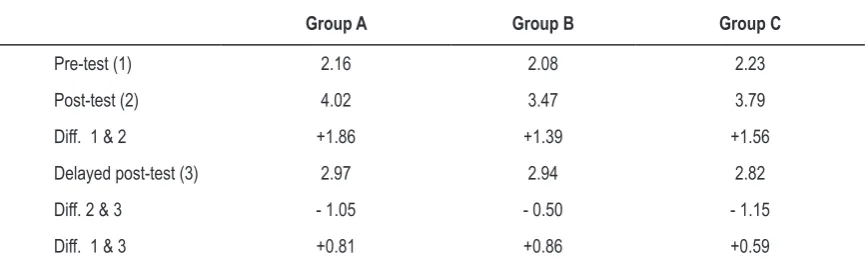
The present study followed the learning study procedure described above: a pre-test was given before the lesson; after each lesson, an almost identical post-test was given. At the end of the first lesson, the teachers collectively analysed the results of the pre- and post-tests; they also analysed the video recording of the lesson. Four weeks later, the pupils did a second post-test, and they were also given at the same time an additional new text in which they were asked to identify the possessive pronouns (figure 3). The first lesson, in the first group of pupils, was structured in a traditional man -ner and dealt with each dependent possessive pronoun in turn. The contrasts on which the teacher focused related to different possessive pronouns and how these differed in the pupils’ native language (Swedish). In the second lesson, with the second group of pupils, the teacher used as a starting point the pupils’ existing knowledge. This was determined by asking the pupils which words denote possession. In this way, pronouns and possessive pronouns were identified. The results of the first post-test in group B (see below) were poorer than those of group A. The third lesson, with pupils in group C, was thus a mixture of the first two lessons: the dependent and independent possessive pronouns were focused upon simultaneously but within a clear framework.
The first post-test immediately after the research lesson, showed that group A had made the greatest progress, and group B, the least. However, the results of the delayed post-test four weeks after the research lesson (table 1) were somewhat surprising. The difference in results between the post-test and the delayed post-test demonstrated that the pupils in group B had retained their knowl -edge of pronouns to a greater degree than in group A. In lesson B, the teacher asked the pupils to identify minor qualitative differences; this may have resulted in the pupils developing an ability to identify these differences in contexts other than those presented in the lesson.
table 1. Results of learning study on possessive pronouns (average scores).
Group A Group B Group C
Pre-test (1) 2.16 2.08 2.23
Post-test (2) 4.02 3.47 3.79
Diff. 1 & 2 +1.86 +1.39 +1.56
Delayed post-test (3) 2.97 2.94 2.82
Diff. 2 & 3 - 1.05 - 0.50 - 1.15
Diff. 1 & 3 +0.81 +0.86 +0.59
92 Table 2. Results of identified possessive pronouns in a text (pupils).
No. of possessive pronouns distinguished (max. 6)
Group A
points PupilsNo. of Group Bpoints pupilsNo. of Group Cpoints pupilsNo. of
6 18 3 24 4 30 5
5 10 2 20 4 25 5
4 28 7 16 4 28 7
3 12 4 15 5 0
2 6 3 4 2 2 1
1 1 1 0 1 1
0 0 0 0
75 (3.75) 20 79 (4.16) 19 86 (4.53) 19
Of the six possessive pronouns in the text, identification of mine was particularly problematical for Group A because mine was not identified in the research lesson. For the pupils in group C, it was their which presented the greatest problem. Pupils in group B found both pronouns difficult:
table 3. Possessive pronouns found in the text.
A (N=20) B (N=19) C (N=19)
My 19 18 17
Mine 5 9 14
His 14 16 18
Her 16 16 17
Our 8 11 12
Their 13 9 8
Total 75 MV: 3.75 79 MV: 4.16 86 MV: 4.53
If one only takes into consideration the number of identified words, those pupils who marked all words would gain the highest scores. As a result, we decided to analyse incorrect answers in each of the groups. In so doing, we have been able to determine that the pupils in group B made the few -est mistakes. This sugg-ests that this lesson achieved the b-est balance between variant and invariant factors, with the result that the pupils were able to identify critical features. In group C, the lowest number of mistakes was made with respect to the contracted form, which pupils often perceived as the genitive form. However, the pupils in group C most frequently marked such words as here and have as possessive pronouns: they saw these words as denoting some form of possession; her was mixed with here and have indicates that someone owns something.
Table 4. Words incorrectly identified as possessive pronouns.
A (N=20) B (N=19) C (N=19)
He’s 12 11 9
She’s 13 9 8
Here 0 2 3
Have 3 1 6
93
IN THE 21 CENTURY Volume 6, 2008
conclusions and discussion
The teacher in the first lesson (A) concentrated on dependent possessive pronouns because the teacher/research group felt it might be confusing for pupils to compare (1) their mother tongue and (2) the English possessive pronouns with (3) the independent possessive pronouns. In order to restrict variation, teacher A refrained from focusing on the independent possessive pronouns, even when the pupils’ answers indicated that they were aware of the distinctions. The teacher gave the pupils the opportunity to discern differences between their mother tongue and English. At the time the lesson was given, the teacher was not aware of any pattern of variation since she focused on one aspect at a time and presented this in the order normally adopted in grammar books. In lesson B, the teacher used as his starting point the pupils’ knowledge of the grammatical feature to be taught. As a result, there was no pre-determined order of presentation. All aspects were presented at the same time and contrasts made apparent. Pupils observed, for example, that both my and mine could be translated as min in Swedish. There is no distinction between independent and dependent possessive pronouns in Swedish. The pupils were thus curious about when the different words should be used. Their first explanation was that the two words must correspond to min (possessive connected to a substantive in utrum – n-gender) and mitt (connected to a substantive in neutrum – t-gender) in Swedish, a distinction not made in English.
table 5. the different structures in swedish and english.
Dependent possessive pronouns Independent possessive pronouns
T-gender in following substantive my - mittyour - ditt mine – mittyours – ditt
N-gender in following substantive your – dinmy - min mine – minyours – din
Gradually, they were able to discern a pattern of pronouns and possessive pronouns. The pupils in group A were not able to discern this pattern (between dependent and independent possessives) in the first lesson and were by that gradually forced to renounce their original explanation.
94 what mistakes they might make as ESL learners. In this way, teachers can also predict and plan what information is needed to develop learning situations which provide maximum opportunity to learn. They also understand what kinds of critical aspects are necessary to enable pupils to discern.
acknowledgements
This chapter draws on a research project funded by the Swedish Research Council, ‘The Pedagogy of Learning’. We would like to thank the researchers at Kristianstad University, Göte -borg University and the teachers and pupils who participated in the learning study presented here. Above all, we thank Professor Emeritus Ference Marton for his valuable comments on the present chapter.
References
Beena, K. (2000). Modern textbook in Bengali as foreign language. Göteborg: Bengaliska magasinet: Rabeya Publishers: Internationella kojan.
Bjellerup, S. (1990). Portugisisk språklära. [Portuguese languagebook] Lund: Studentlitteratur. Cardoso, J. (1998). Português para todos: Portugisiska för nybörjare: texter, ordlistor,
grammatik, övningar, facit. [Portuguese for beginners: texts, vocabulary lists, grammar, exercises, key] 2 uppl. Örebro: Palavra.
Greenbaum, S. (1996). The Oxford English grammar. Oxford: Oxford University Press. Holmqvist, M. (Ed) (2004.) En främmande värld. [A strange world] Lund: Studentlitteratur.
Holmqvist, M., Gustavsson, L. & Wernberg, A. (in press). Variation Theory - A tool to improve educa-tion. In Kelly, A.E., & Lesh, R. (in press) Handbook of design research methods in education. Mahwah, NJ: Erlbaum
Holmqvist, Mona, Gustavsson, Laila & Wernberg, Anna. Generative learning. Learning beyond the learn-ingsituation. Educational Action Research, vol 15, no 2, June 2007, pp 181-208.
Holmqvist, M. & Mattisson, J. (2008). Variation Theory as o tool to analyze and develop learning at school. In Eds namn Problems of Education in the 21th Century. Lithuania: Scientific Methodical Centre ‘Scientific Educologica’.
Holmqvist, M. & Nilsson, J. (2005). Hur kan lärare utveckla ett livslångt lärande? [In what ways can teachers develop lifelong learning?] Lindelöf & Gisby (Eds): Lärande hela livet. [Lifelong learning] Lund: Studentlitteratur.
Holmqvist, Mona (Ed) (2006). Lärande i skolan – Learning study som skolutvecklingsmodell. [Learning at school. Learning study as a tool in school development] Lund: Studentlitteratur.
Kelly, A., & Lesh, R. (2000). Handbook of research design in mathematics and science education. Ma-hwah, NJ: Erlbaum.
Marton, F., Dahlgren, L-O., Svensson, L., Säljö, R., (1977). Inlärning och omvärldsuppfattning [Learning and experiences], Stockholm: Almqvist & Wiksell.
Marton, F. & Booth, S. (1997). Learning and awareness. New Jersey: Lawrence Erlbaum Associates, Publishers.
95
IN THE 21 CENTURY Volume 6, 2008
Ramoniene, M. (1996). Colloquial Lithuanian: the complete course for beginners. London: Routledge.
Stigler, J. & Hiebert, J. (1999). The teaching gap. New York: The Free Press.
Svarvell, T. (2003). Translation and variation. A pedagogical-linguistic study at an English secondary school. Kristianstad: Kristianstad University.
Taylor, J. (1996). Possessives in English. An Exploration in Cognitive Grammar. Oxford: Clarendon Press.
Uljens, M. (1989). Fenomenografi. 8Phenomenography]. Lund: Studentlitteratur.
Adviced by Ference Marton, Goteborg University, Sweden
Mona Holmqvist Associate Professor, Kristianstad University, SE-291 88 Kristianstad, Sweden. Phone: +44203241.
E-mail: [email protected]
Website: http://www.hkr.se/bet-mona-holmqvist
Gunilla Lindgren PhD, Kristianstad University, SE-291 88 Kristianstad, Sweden Phone: +44203000.
E-mail: [email protected] Website: http://www.hkr.se
Jane Mattisson PhD, Kristianstad University, SE-291 88 Kristianstad, Sweden Phone: +44203000
E-mail: [email protected] Website: http://www.hkr.se
Teresa Svarvell ME, Kristianstad University, SE-291 88 Kristianstad, Sweden Phone: +46143521