_____________________________________________________________________________________________________
*Corresponding author: E-mail: [email protected];
Kinetics Properties and Thermal Behavior of Pine
Sawdust and Municipal Solid Waste
Arthur M. Omari
1*, Baraka Kichonge
2and Zephania A. Chaula
11
College of Engineering and Technology, Mbeya University of Science and Technology, P.O. Box 131, Mbeya, Tanzania. 2
Department of Mechanical Engineering, Arusha Technical College, P.O. Box 296, Arusha, Tanzania.
Authors’ contributions
This work was carried out in collaboration among all authors. All authors designed the study, performed the statistical analysis, wrote the protocol and wrote the first draft of the manuscript. All authors read and approved the final manuscript.
Article Information
DOI: 10.9734/JENRR/2019/v3i230091
Editor(s):
(1) Dr. Nyoman Puspa Asri, Department of Chemical Engineering, W. R. Supratman University, Indonesia.
Reviewers:
(1) P. Saravana Kumara, Rathnavel Subramaniam College of Arts and Science, India. (2) Ghassan Tashtoush, Jordan University of Science and Technology, Jordan. Complete Peer review History:http://www.sdiarticle3.com/review-history/49896
Received 22 April 2019 Accepted 01 July 2019 Published 08 July 2019
ABSTRACT
Waste resulting from economic activities has been an integral part of every human society. Effective waste management is considered to be consistent with improved quality of life through removal of potential hazards of uncontrolled disposal. Recent years has witnessed a number of sustainable energy recovery technologies developed to divert solid waste destined for landfills. Waste management is a global problem and therefore development of energy recovery technologies and at the same time serving dual purpose in its reduction has become a priority in recent years. The present study reports kinetics properties and thermal behavior of pine sawdust and municipal solid waste (MSW) using thermogravimetric analysis (TGA) and thus providing theoretical basis for development of energy recovery technologies. Results of this study have shown that the activation energy of both MSW and pine sawdust varies with temperature. The analysis of pine sawdust shows that it has activation energy (Ea) values of 26.19 kJ/mol., 87.46 kJ/mol. and 54.46 kJ/mol. At respective temperature ranges between 350 – 400K, 550 – 650K and 700 800K. MSW has activation energy between 72.91 kJ/mol. and 139.1 kJ/mol. at temperature ranges between 700 – 900 K and 500 – 600 K respectively. The estimated value of pre-exponential factor for pine sawdust was determined to have the values of 2.46 x 10⁴, 1.6 x 10¹⁰ and 5.32 x 10¹⁶ (s-1) with temperature
ranges between 350 – 400 K, 550 – 650 K and 700 800 K respectively. Municipal solid waste has the values of 3.01 x 10¹² and 7.31 x 10³ (s-1) with a temperature range of 500 – 600 K and 700 – 900 K respectively. From these findings, it has been determined that MSW and pine sawdust available in Arusha and Kilimanjaro possess energy recovery potentials.
Keywords: Municipal Solid Waste (MSW); pine sawdust; Thermogravimetry (TG); Differential Thermogravimetry (DTG); Differential Scanning Calorimetry (DSC).
1. INTRODUCTION
The sustainable economic development of any country is usually accompanied with energy demand increases and environment degradation challenges [1-3]. As economic sectors grows the energy demand and waste generation in cities rises primarily influenced by population growth, changing life styles and thus rapid urbanization [4-7]. Inappropriate waste management strategies and insufficient energy supply contributes to poor life quality in cities [8-10] as a result of uncontrolled greenhouse gases (GHGs) emission to the atmosphere among others [11]. Municipal solid waste (MSW) uncontrolled burning results in emissions of gases such as methane and carbon dioxide and therefore considered as among major climate change contributors [6,12,13]. Then again, the emissions of GHGs such as carbon dioxide, methane and nitrous oxide from uncontrolled agricultural activities are considered to be among climate change contributors [14,15].
The primary sources of energy for many years has been from fossil fuels, which are fast depleted and contributed to the global warming [16,17]. There is a need for a sustainable source of renewable energy to replace fossil fuels as global energy demand is continuously increasing in parallel with population increase and industrial development. The biogenic fraction of municipal solid waste and forest waste are renewable in nature and therefore they can be used to mitigate energy and environmental challenges [18,19]. Conversion of waste to energy is one among methods in waste management while mitigating energy challenges [20]. Renewable waste materials from MSW and agriculture activities such as pine sawdust are convertible to useful energy forms through waste to energy routes for sustainable development. Compared to fossil fuels pine sawdust and MSW due to their nature can reduces equivalent CO2, SO2 and NOX emissions [17,21].
The abundant pine sawdust and municipal solid wastes and their renewable nature are
encouraging their utilization as the source of sustainable renewable energy [19,22,23]. Pine sawdust and municipal solid wastes need to be processed so as to upgrade its fuel quality for energy recovery [24]. There are many ways of energy recovery from pine sawdust and municipal wastes, but the common one being physical treatment such as making pellets, thermal treatment such as combustion, pyrolysis, and gasification [25]. Biological treatment such as fermentation and anaerobic digestion [26]. The municipal solid waste contains a big portion of biomass materials such as food, wood, and paper [27]. The knowledge of thermal degradation is essential for predicting the pyrolysis behavior of municipal solid waste and pine sawdust materials [8]. The characterization makes easier to optimize their utilization and gives essential information in designing the suitable energy recovery technologies for their disposal [28,29]. Thermal degradation of pine sawdust and municipal solid waste pose a big challenge due to their nature and composition [30]. The chemical reactions that take place during their degradation and chemical kinetics used to estimate the potentiality for energy recovery [31]. Thermal degradation values such as activation energy, frequency factor, rate of reaction, calorific values, differential scanning calorimetry and differential thermal gravimetric can be determined by using thermogravimetric analysis (TGA) [32-34]. TGA is considered as the simplest and the most effective method to analyze the burning profile of a fuel as compared to others [35,36]. The purpose of this study was therefore to determine and analyze the kinetics properties and thermal behavior of pine sawdust and MSW available in Arusha and Kilimanjaro using TGA and therefore to provide a theoretical basis for making use of their properties and characteristics as sustainable energy resources.
2. MATERIALS AND METHODS
2.1 Material Sampling and Collection
Kilimanjaro were used. Different equipment and standard test methods were adopted in order to determine and analyze thermal degradation. The airtight polythine bags were used for quality assurance and safety of samples transport from source to laboratory for analysis.
2.2 Municipal Waste Collection
The sampling of municipal solid waste material was based on ASTM D5231-03. The method for random sampling for determination of the composition of unprocessed municipal solid waste [37,38]. The waste was randomly collected and categorized to plastic, paper, food, and non-combustibles. The combustible components were collected for laboratory analysis.
2.3 Pine Sawdust Collection
The pine sawdust samples obtained from sawmills were natural dried and collected for laboratory analysis.
2.4 Thermal Degradation Analysis Study
The experiments for the pyrolysis of wastes were performed by using thermo-gravimetric analyzer type NETZSCH STA 409 PC Luxx. Then samples collected as per municipal waste and pine sawdust sampling paragraphs above were grounded to small particles of 1mm and oven dried at 378K to constant weight. Then a sample of 30±0.1 mg of wastes with an average particle size less than 1mm was loaded to the crucible and subjected into the furnace and heated. These samples mass are small and therefore it is assumed that the thermal degradation within the sample is negligible [39].
The thermal gravimetric analyzer connected to PC installed with proteus software for data acquisition, storage and analysis. The thermal gravimetric analyzer is used to measure the quantity of mass change due to physical and chemical reactions; it is combined the heat flux differential scanning calorimetry which determines the physical and chemical reactions associated with thermal effect. The profile curves of thermogravimetry (TG), differential thermogravimetry (DTG) and differential scanning calorimetry (DSC) were obtained from Proteus software [40].
2.4.1 Municipal solid wastes thermal degradation analysis
The municipal solid waste samples and subjected to heat at temperature ranges vary
from 308 to 1273K and heating rate of 10K/min. The calculated thermo-gravimetric from Proteus software was obtained and recorded.
2.4.2 Thermal degradation analysis of pine sawdust
The pine sawdust samples were subjected to heat at temperature ranges from 308 to 973K with a heating rate of 10K/min. The calculated thermo-gravimetric output from Proteus software was obtained and recorded.
2.5 Kinetic Parameters Analysis
The method deployed to determine Kinetic parameter was Coasts-Red fern methods equation (1). It is used as a standard method for studying the thermal degradation of pine sawdust and municipal solid waste under non-isothermal condition [41,42]. The Coasts-Red fern method used to calculate the kinetic parameters of first-order reaction [4,43].
(1)
Using the known heating rate, the line graph of versus 1/T understudied material will be a straight-line graph. The slope and intercept of the line graphs were used to calculate the kinetic parameters [44,45].
Since the value of that can be
neglected, the interception on the vertical axis is
and the slope line is can be used
to determine the values of and
The constant heating rate is expressed as shown in Equation 2.
(2)
The rate constant for the process is expressed by Arrhenius Equation 3.
(3)
where: k is the rate constant which depends on the temperature. RT E E RT E AR T x a a a
2
1 ) 1 ln( ln 2
ln
1
/
2
ln
T
1
2
aE
RT
a E AR R Ea aE
A
.
)
(
dT dt
RT E AA is the pre-exponential factor
Ea is the activation energy
R is the universal gas constant and T is the
temperature
(4)
Algebraic function depending on reaction mechanism
(5)
Degree of conversion
(6)
where:
Initial mass
The mass remaining at time
The final mass remaining
3. RESULTS AND DISCUSSION
3.1 TG Analysis of Municipal Solid Waste and Pine Sawdust
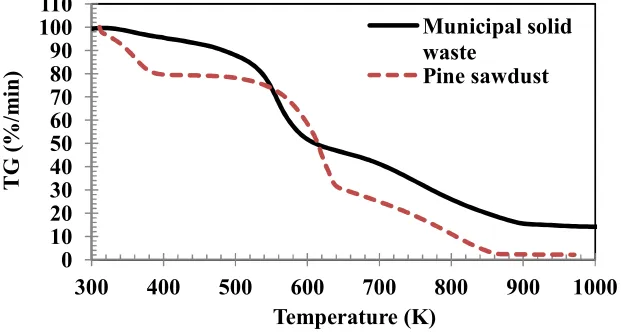
The thermo-gravimetric analysis results were shown in Fig. 1 and Table 1. The value of ash
remaining in pine sawdust is much less compared to municipal solid waste. The big amount of moisture released at 378K from pine sawdust (18%) shows that there are much moisture contents in pine sawdust than in municipal solid waste. There are also slightly more volatiles in municipal solid waste than in pine sawdust. The value of ash remaining is higher in municipal solid waste than in pine sawdust shows that there are many mineral components in municipal solid waste than in pine sawdust [46].
3.2 DTG Analysis of Municipal Solid Waste and Pine Sawdust
Fig. 2 shows the derivative of thermo-gravimetric analysis (DTG), for municipal solid waste and pine sawdust. The municipal solid waste curve shows that the degradation derived in four shoulders. The first shoulder is the degradation of moisture, this is ranging from 303K to 423K, and the second shoulder is the lignocellulose degradation which ranges between 423 and 643K. The third shoulder ranges between 643 and 913K shows the degradation of plastics and hemicellulose materials (Quina et al., 2018).
There is very small char pyrolysis in pine sawdust curve since it has a very little char
remaining in the reaction, Figs. 1 and 2 [44]. The degradation of plastic and hemicellulose materials are overlapping in municipal solid waste degradation while the degradation of
hemicellulose in pine sawdust is clearly defined in Fig. 2. The char pyrolysis
falls in 4th shoulder ranges between 913 and 1273K.
Fig. 1. TG Curves of municipal solid waste and pine sawdust
)
(
S
1)
/
(
kJ
mol
)
3142
.
8
(
kJmol
1K
1)
(
K
) (x f k dt dx
)
x
(
f
RT E exp ) x ( Af dt
dx a
x
w
w
/
w
w
x
0 t 0o
w
t
w
t
w
0
10
20
30
40
50
60
70
80
90
100
110
300
400
500
600
700
800
900
1000
T
G
(
%
/m
in
)
Temperature (K)
Municipal solid
waste
Table 1. TG results of municipal solid waste and pine sawdust
S/N Material Moisture release Volatile release Remaining char & ash
1 Municipal solid waste 3.6 80.8 15.6
2 Pine sawdust 18.9 77.5 3.6
3.3 DSC Analysis of Municipal Solid Waste and Pine Sawdust
Fig. 3 shows the differential scanning calorimetry curves. All curves show that there are endothermic reactions during its initial stage of degradation. The temperature range between 300 and 370K, this is due to the release of moisture. The pine sawdust curve is higher than a municipal solid waste curve. The value of this moisture is clearly seen in the TG and DTG curves (Fig. 1 and Fig. 2). The energy used to release moisture from pine sawdust is higher than that used in municipal solid waste. The structure of pine sawdust is so that the moisture is entrained in its cell walls and for that case, it requires more energy to remove moisture from pine sawdust than in municipal solid waste [40]. An energy release result due to differential scanning calorimetry (DSC) of municipal solid waste has energy quantity ranging from 7.6 to 8.5 MJ/kg. Compared to the energy found from bomb calorimetry about 12MJ/kg. The energy amount found in DSC is low. The energy found during bomb calorimetry is the energy determined from dry MSW pellets. The energy found during DSC is the energy remaining after drying MSW. The energy to dry MSW that make the difference between the two. The energy
released due to DSC of pine sawdust has the energy value of 15.1 MJ/kg.
3.4 Kinetic Parameters of Municipal Solid Waste
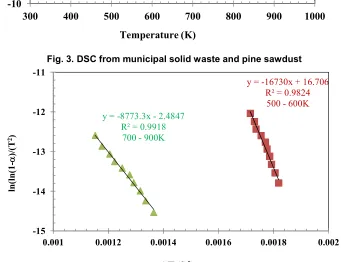
The value from the TGA curve of MSW obtained and put into coats Red-fern method give the value as shown in Fig. 4.
The kinetic parameters of municipal solid waste are shown in two curves. The kinetic parameter at high-temperature peak and at the low-temperature peak as shown in Fig. 4 and Table 2. The kinetic parameter graphs show the values of Pre-exponential factor (A) for municipal solid waste as 3.01 x 10¹² and 7.31 x 10³ (S-1) for low and high temperature respectively. The value of Ea for municipal solid waste is 72.91 and 139.1 kJ/mol. for low and high temperature respectively.
3.5 Kinetic Parameters of Pine Sawdust
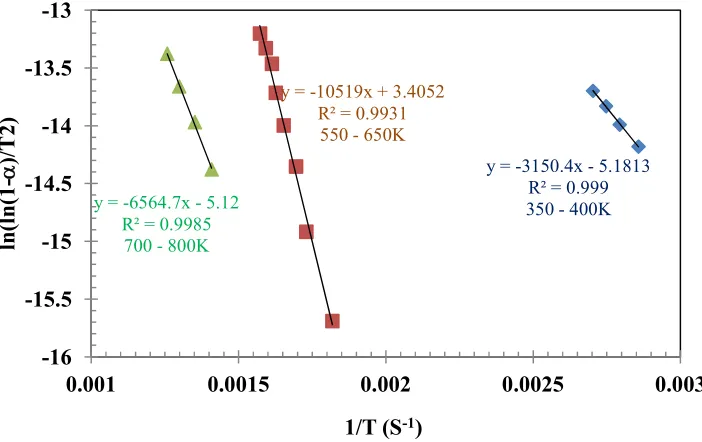
The value from the TGA curve of pine sawdust obtained and insert into Coats Redfern method gives the value as shown in Fig. 5.
Fig. 2. DTG of municipal solid waste and pine sawdust
-8 -6 -4 -2 0
300 400 500 600 700 800 900 1000
D
T
G
/
(
%
/m
in
)
Temperature (K)
Municipal solid waste
Fig. 3. DSC from municipal solid waste and pine sawdust
Fig. 4. Determination of kinetic parameter of municipal solid waste
Table 2. Activation energy and pre-exponential factor of municipal solid waste and pine sawdust
Type of waste Temperature (K) Activation energy (kJ/mole) Pre-exponential factor (s-1) Municipal solid
waste
500 – 600 139.1 3.01 x 10¹²
700 – 900 72.91 7.31 x 10³
Pine sawdust 350 – 400 26.19 2.46 x 10⁴
550 – 600 87.46 1.6 x 10¹⁰
700 – 800 54.58 5.32 x 10¹⁶
The pine sawdust kinetic parameters as shown in Fig. 5 in three curves, the degradation of hemicellulose at low-temperature peak and of cellulose at high-temperature peak. The results tabulated in Table 2 show that the activation energy Ea ranging from
26.19 to 87.46 kJ/mol. The value of pre-exponential factor increases from 2.46 x 10⁴,
1.6 x 10¹⁰ and 5.32 x 10¹⁶ (S-1) with a respective increase in the temperature range of 350 – 400K, 550 – 600K and 700 – 800K.
-10 -8 -6 -4 -2 0 2
300 400 500 600 700 800 900 1000
D
S
C
/
(m
W
/m
g
)
Temperature (K)
Municipal Solid waste
Pine sawdust
y = -16730x + 16.706 R² = 0.9824
500 - 600K
y = -8773.3x - 2.4847 R² = 0.9918
700 - 900K
-15 -14 -13 -12 -11
0.001 0.0012 0.0014 0.0016 0.0018 0.002
ln
(l
n
(1
-
)/
(T
2)
Fig. 5. Determination of the kinetic parameter of pine sawdust
4. CONCLUSION
From the results obtained in this study, it can be concluded that the activation energy of both MSW and pine sawdust varies with temperature. The determined energy recovery from dry MSW was 10.6 MJ/kg while energy recovery from dry pine sawdust was 15.1 MJ/kg. Differential scanning calorimetry (DSC) shows that at the beginning the reactions are endothermic due to the release of moisture from the samples and thereafter moisture released the reactions undergo exothermic reaction. The analysis of pine sawdust shows that it has activation energy (Ea) values of 26.19 kJ/mol., 87.46 kJ/mol. and 54.46 kJ/mol. with respective temperature ranges between 350 – 400K, 550 – 650K and 700 800K while MSW activation energy was determined in between 72.91 kJ/mol. and 139.1 kJ/mol. with temperature ranges between 700 – 900K and 500 – 600K respectively. The estimated value of pre-exponential factor for pine sawdust was 2.46 x 10⁴, 1.6 x 10¹⁰ and 5.32 x 10¹⁶ (s-1) at temperature ranges between 350 – 400K, 550 – 650K and 700 800K respectively while that for MSW was 3.01 x 10¹² and 7.31 x 10³ (s-1) at a temperature ranges of 500 – 600K and 700 – 900K respectively. The conclusion drawn from this study show promising potential for energy recovery from both MSW and pine sawdust available in Arusha and Kilimanjaro.
COMPETING INTERESTS
Authors have declared that no competing interests exist.
REFERENCES
1. Ahmed K, Rehman MU, Ozturk I. What drives carbon dioxide emissions in the long-run? Evidence from selected South Asian Countries. Renewable and Sustainable Energy Reviews. 2017;70(1):1142-1153.
2. Wolfram C, Shelef O, Gertler P. How will energy demand develop in the developing world? Journal of Economic Perspectives. 2012;26(1):119-38.
3. Kichonge B, et al. Modelling of future energy demand for Tanzania. Journal of Energy Technologies and Policy. 2014;4(7):16-31.
4. Tsamba AJ, Yang W, Blasiak W. Pyrolysis characteristics and global kinetics of coconut and cashew nut shells. Fuel Processing Technology. 2006;87(6):523-530.
5. Gentil E, Clavreul J, Christensen TH. Global warming factor of municipal solid waste management in Europe. Waste Management & Research. 2009;27(9):850-860.
y = -3150.4x - 5.1813 R² = 0.999 350 - 400K
y = -10519x + 3.4052 R² = 0.9931 550 - 650K
y = -6564.7x - 5.12 R² = 0.9985 700 - 800K
-16
-15.5
-15
-14.5
-14
-13.5
-13
0.001
0.0015
0.002
0.0025
0.003
ln
(l
n
(1
-
)/
T
2
)
6. Chiemchaisri C, Visvanathan C. Greenhouse gas emission potential of the municipal solid waste disposal sites in Thailand. Journal of the Air & Waste Management Association. 2008; 58(5):629-635.
7. Omari AM, et al. Potential of municipal solid waste, as renewable energy source - A case study of Arusha, Tanzania. Sustainable Development. 2014;3:4. 8. Johari A, et al. Generalization, formulation
and heat contents of simulated MSW with high moisture content. Journal of Engineering Science and Technology. 2012;7(6):701-710.
9. Kuo JH, et al. The prospect and development of incinerators for municipal solid waste treatment and characteristics of their pollutants in Taiwan. Applied Thermal Engineering. 2008;28(17): 2305-2314.
10. Kichonge B, John GR, Mkilaha IS. Modelling energy supply options for electricity generations in Tanzania. Journal of Energy in Southern Africa. 2015;26(3):41-57.
11. Noor ZZ, et al. An overview for energy recovery from municipal solid wastes in Malaysia scenario. Renewable and Sustainable Energy Reviews. 2013;20(1):378-384.
12. Kothari R, Tyagi V, Pathak A. Waste-to-energy: A way from renewable energy sources to sustainable development. Renewable and Sustainable Energy Reviews. 2010;14(9):3164-3170.
13. Udomsri S, et al. Clean energy conversion from municipal solid waste and climate change mitigation in Thailand: Waste management and thermodynamic evaluation. Energy for Sustainable Development. 2011;15(4):355-364.
14. Cole C, et al. Global estimates of potential mitigation of greenhouse gas emissions by agriculture. Nutrient Cycling in Agroecosystems. 1997;49(1-3):221-228. 15. Smith P, et al. Greenhouse gas mitigation
in agriculture. Philosophical Transactions of the Royal Society B: Biological Sciences. 2007;363(1492):789-813.
16. Ryu C. Potential of municipal solid waste for renewable energy production and reduction of greenhouse gas emissions in South Korea. Journal of the Air & Waste Management Association. 2010;60(2):176-183.
17. Shahsavari A, Akbari M. Potential of solar energy in developing countries for reducing energy-related emissions. Renewable and Sustainable Energy Reviews. 2018;90(1):275-291.
18. Mohammed Y, Mustafa M, Bashir N. Status of renewable energy consumption and developmental challenges in Sub-Sahara Africa. Renewable and Sustainable Energy Reviews. 2013;27(1):453-463. 19. Varol M, et al. Investigation of
co-combustion characteristics of low quality lignite coals and biomass with
thermogravimetric analysis.
Thermochimica Acta. 2010;510(1-2):195-201.
20. Barbieri L, et al. Waste Management and Valorization Alternative Technologies, E.C. Rada, Editor. Apple Academic Press: Waretown, New Jersey 08758 USA; 2016. 21. Baxter L. Biomass-coal co-combustion:
Opportunity for affordable renewable energy. Fuel. 2005;84(10):1295-1302. 22. Pandey BK, et al. Municipal solid waste to
energy conversion methodology as physical, thermal, and biological methods. Curr. Sci. Perspect. 2016;2(1):39-46. 23. Hossain HZ, et al. Municipal solid waste
(MSW) as a source of renewable energy in Bangladesh: Revisited. Renewable and Sustainable Energy Reviews. 2014;39:35-41.
24. Chaula Z, et al. Modelling the suitability of pine sawdust for energy production via biomass steam explosion. Smart Grid and Renewable Energy. 2014;5(1):1-7.
25. Chen P, et al. Utilization of municipal solid and liquid wastes for bioenergy and bioproducts production. Bioresource Technology. 2016;215(1):163-172.
26. Sharholy M, et al. Municipal solid waste management in Indian cities–A review. Waste Management. 2008;28(2):459-467. 27. Pandey BK, et al. Characterisation of
municipal solid waste generated from Bhopal, India. Curr. Sci. Perspect. 2016;2(1):52-56.
28. Sonobe T, Worasuwannarak N. Kinetic analyses of biomass pyrolysis using the distributed activation energy model. Fuel. 2008;87(3):414-421.
29. Clarke S, Preto F. Biomass burn characteristics. Ministry of Agriculture, Food and Rural Affairs; 2011.
31. Chaula Z, Said M, John G. Thermal Characterization of pine sawdust as energy source feedstock. Journal of Energy Technologies and Policy. 2014;4(4):57-64.
32. Mhilu CF. Analysis of energy characteristics of rice and coffee husks blends. International Scholarly Research Notices in Chemical Engineering. 2014(1);1-6.
33. Mishra RK, Mohanty K. Pyrolysis kinetics and thermal behavior of waste sawdust biomass using thermogravimetric analysis. Bioresource Technology. 2018;251(1):63-74.
34. Chen D, Zhou J, Zhang Q. Effects of heating rate on slow pyrolysis behavior, kinetic parameters and products properties of moso bamboo. Bioresource Technology. 2014;169(1):313-319.
35. Yorulmaz SY, Atimtay AT. Investigation of combustion kinetics of treated and untreated waste wood samples with thermogravimetric analysis. Fuel Processing Technology. 2009;90(7-8): 939-946.
36. Sanchez M, et al. Thermogravimetric kinetic analysis of the combustion of biowastes. Renewable Energy. 2009;34(6):1622-1627.
37. ASTM, ASTM D5231-92, Standard test method for the determination of the composition of unprocessed municipal solid waste. ASTM International: West Conshohocken, PA; 2003.
38. Gidarakos E, Havas G, Ntzamilis P. Municipal solid waste composition
determination supporting the integrated solid waste management system in the island of Crete. Waste Management. 2006;26(6):668-679.
39. Dirion JL, Reverte C, Cabassud M. Kinetic parameter estimation from TGA: Optimal design of TGA experiments. Chemical Engineering Research and Design. 2008;86(6):618-625.
40. Wilson L, et al. Thermal characterization of tropical biomass feedstocks. Energy
Conversion and Management.
2011;52(1):191-198.
41. Amutio M, et al. Kinetic study of lignocellulosic biomass oxidative pyrolysis. Fuel. 2012;95(1): 305-311.
42. Farrokh NT, et al. A thermogravimetric analysis of lignin char combustion. Energy Procedia. 2019;158(1):1241-1248.
43. Coats A, Redfern J. Kinetic parameters from thermogravimetric data. Nature. 1964;201(4914): 68-69.
44. Lai Z, et al. A study on municipal solid waste (MSW) combustion in N2/O2 and CO2/O2 atmosphere from the perspective of TGA. Energy. 2011;36(2):819-824.
45. Tan YL, et al. Kinetics of pyrolysis of durian (Durio zibethinus L.) shell using thermogravimetric analysis. Journal of Physical Science. 2019;30(1).
46. Quina MJ, et al. Technologies for the management of MSW incineration ashes from gas cleaning: new perspectives on recovery of secondary raw materials and circular economy. Science of the Total Environment. 2018;635(1):526-542. _________________________________________________________________________________
© 2019 Omari et al.; This is an Open Access article distributed under the terms of the Creative Commons Attribution License (http://creativecommons.org/licenses/by/4.0), which permits unrestricted use, distribution, and reproduction in any medium, provided the original work is properly cited.
Peer-review history: