~ 295 ~ WWJMRD 2017; 3(7): 295-309
www.wwjmrd.com Impact Factor MJIF: 4.25 e-ISSN: 2454-6615
Safarov Ismail Ibrahimovich
DepartmentHigher mathematics, Tashkent chemistry –technological Institute, Tashkent , Republic of Uzbekistan
Akhmedov Maqsud Sharipovich
DepartmentHigher mathematics, Bukhara Technological Institute of Engineering, Bukhara, Republic of Uzbekistan
Rajabov Ozod Isroilovich
DepartmentHigher mathematics, Bukhara Technological Institute of Engineering, Bukhara, Republic of Uzbekistan
Correspondence:
Safarov Ismail Ibrahimovich
DepartmentHigher mathematics, Tashkent chemistry –technological Institute, Tashkent, Republic of Uzbekistan
About the Natural Oscillations Viscoelastic Toroidal
Shell with the Flowing Fluid
Safarov Ismail Ibrahimovich, Akhmedov Maqsud Sharipovich,
Rajabov Ozod Isroilovich
Abstract
It is given to the study of natural oscillations of a viscoelastic toroidal shell with a flowing liquid, based on the theory of shells. On the basis of a geometrically nonlinear version of the semimuscular theory of shells, the equations of motion of the toroidal shell are obtained with all inertial forces components included, including tangential forces, and also taking into account the working internal hydrostatic and dynamic pressures. Based on the developed methods, the intrinsic oscillations of the toroidal shell with a flowing liquid.
Keywords: toroidal shell, pressure, fluid oscillations, viscoelasticity.
Introduction
Studies of natural oscillations of curvilinear sections of pipelines with a constant flow of liquid within the framework of the core theory began to develop in the second half of the last century. One of the first works in this area is the article by V.S. Ushakov [1], where the equation of motion of the circular section of the pipeline was obtained and its natural oscillations were studied at a constant flow velocity and internal pressure. The flow velocity was considered to be small, which made it possible to discard some small terms of the equation and reduce the solution to the investigation of the oscillations of the circular rod. Further studies in this area began to develop quite intensively in the works of T. Anni [2], I. Hill and S. Davis [3], S.S. Zhenya [4] and M.P. Paidussis [5]. The same problem within the framework of the core theory was solved in the works: P.D. Dotsenko [6-8], VA Svetlitsky [9,10], V.F. Ovchinnikov [11], V.A. Svetlitsky [12], etc., which gives the equations of motion of a curvilinear planar or spatial pipeline, the solutions of which and their analysis are presented in the form of graphs of the dependence of the frequencies of natural oscillations on various factors (pipeline curvature, fluid flow rate, pressure, etc.). Acceptable for practical calculations. Experimental studies of curved sections of pipelines with a liquid flow are described in detail in [13]. The results of investigations of this problem within the framework of the core theory can be briefly formulated as follows:
The eigenfrequencies of the curved sections of the pipeline decrease with increasing flow velocity and increase with increasing curvature of the longitudinal axis of the pipeline. In this paper, the curvilinear pipeline with a flowing liquid is considered as a toroidal shell. The equations of motion of flexural oscillations of the toroidal shell are derived on the basis of general relations of the geometrically nonlinear theory of shells. Mushtari and K.Z. Galimov [14]. This theory considers such a bending of shells, in which the maximum deflection (in this case, the radial displacement of the points of the middle surface
w
) Is of the same order of magnitude as the wall thickness, or even exceeds it, but small in comparison with other linear dimensions of the shell.Statement of the problem
~ 296 ~
investigate the frequencies and forms of intrinsic bending vibrations in the plane of curvature of a given section of the pipeline as a thin toroidal shell, taking into account the dynamic influence of the flowing fluid, internal pressure, and deformation of the middle surface of the shell with considerable displacements.
The pipeline section in question is represented as a section of a toroidal shell with a radius
R
the longitudinal axis passing through the centers of gravity of its cross-sections.Cross sections are circular with a radius of the mean line of the section
r
, shell thickness -h
. The value of theratio
r
h
considered to be small, so you can use the ratio
of the theory of shells based on Kirchhoff-Love.
Fig.1: Curvilinear pipeline section in toroidal coordinates.
The end sections of the shell are assumed to be hinged (or rigid). Inside the shell at a speed of
U
const
proceeds ideal incompressible fluid with a density
0
conts
.The geometry of the curved section of the pipeline is shown in Fig. 1 as a toroidal shell with a median surface in toroidal curvilinear coordinates
,
, where
meansthe central angle of the torus, and
- angle in the cross-section of the shell
0
2
. If the longitudinal axis of the shell is half the circumference of the radiusR
, as shown in Fig. 1, the angle
varies within
0
. When considering the middle surface of a shell in curvilinear coordinates
,
differentials of segments of arcs of coordinate linesds
1 andds
2 are connected with the differentials of the coordinates themselves through the parameters of LameA
1 andA
2:
cos
,
2,
1
R
r
d
ds
rd
ds
therefore
r
A
r
R
A
1
cos
,
2
Curvatures of normal sections of the middle surface of the
shell in the undeformed state with
cos
1
R
andr
R
2
according to Fig. 1 are defined by expressions:,
cos
cos
1
1
r
R
R
R
r
1
1
2
.Components of point displacement
A
the middle surface into positionA
*, referred to the radiusr
(I.e. Dimensionless) and directed along the coordinatesy
,
,
and along the outer normal to the middle surface, are denoted respectivelyu
,
,
W
y,
w
. The angle of rotation of the tangent to the midline of the contour of the cross-section is denoted by
.Differential equations and basic relations
In accordance with this theory, the equations of equilibrium of the moment forces for the toroidal shell element in the deformed state have the form (indices 1 and 2 refer to toroidal coordinates
and
respectively) [20] :R
1=
/
cos
O1
O
h
Z
R
=
R
+
rcos
Z1
ds
2=rd
W
YA*
r
d
O2
A
Y
~ 297 ~
0
,
,
0
,
0
0
,
0
2 2 1 1 1 2 2 1 2 2 1 1 2 1 2 2 1 1 2 1 1 2 3 2 1 * 2 2 * 1 1 2 1 2 1 1 2 2 1 * 2 2 2 1 1 1 2 2 1 2 2 1 1 2 * 1 1 2 1 2 2 1 1 2 1 1 2
Q
A
A
A
M
A
H
H
A
M
A
Q
A
A
A
M
A
H
H
A
M
A
X
S
S
R
T
R
T
A
A
Q
A
Q
A
X
Q
R
Q
A
A
A
T
A
S
S
A
T
A
X
Q
R
Q
A
A
A
T
A
S
S
A
T
A
(1)Where
X
1,
X
2,
X
3- Components of external force vectors.The first two equations (1) are the equations of equilibrium of forces, the last two are the equations of equilibrium of moments.
Differential equilibrium equations for the shell element (1) are nonlinear, since They contain works of effort and deformation. In addition, they are obtained for a shell in a deformed state. Therefore, these equations include radii of
curvature
R
1* andR
2* deformed middle surface of the shell. Their connection with the curvature of the initial state is expressed in accordance with [14] by the following relations:.
1
1
1
,
cos
1
1
* 2 2 2 * 1
r
R
w
R
r
R
R
(2)Change in curvature of the midline of the cross section of
the shell
2 and torsion
are expressed in terms of the angle of rotation
the following relations:
R
r
1
,
1
2 , (3)
In accordance with the assumptions (2) - (3) of the half-shell theory of V.Vlasov's half-shells [15], in the first three equilibrium equations (1) we neglect the transverse force
1
Q
, and in the last two - torqueH
. As a result, in accordance with the d'Alembert principle, we obtain a system of equations for the motion of the shell in the effort:0
,
0
,
0
2
,
0
sin
,
0
2 2 1 1 * 3 2 2 * 2 1 * 1 * 2 2 * 2 1 2 * 1 2 1
rQ
M
rQ
H
M
R
r
rX
Q
S
r
T
R
r
T
R
r
rX
Q
R
r
T
R
r
T
S
R
r
rX
Q
r
S
T
R
r
(4)where
X
1,
X
2,
X
3 - components of inertia forces in coordinates
,
and along the normal to the middle surface, respectively. Eliminating all the forces andmoments from equations (4) except
T
1 andM
2, we arrive at a single equation of motion in the effort:
0
1
sin
1
* 3 * 2 2 2 * 2 * 1 2 2 * 2 1 2 2 2 * 2 2 2 2 1 * 1 * 2 2 2 2 2 1 2 2 2
X
R
X
r
X
R
r
M
R
T
R
r
M
R
r
T
R
R
M
R
r
T
R
r
(5)To solve the dynamic problems of the pipeline section in question, it is necessary to obtain the equation of motion of the toroidal shell in displacements. Therefore, we
transform equation (5), expressing efforts
T
1 andM
2and deformation
1 and
in displacements, using the relationships between the forces, deformations and displacements of the semimuscular theory of shells:
(
)
(
)
,
cos
sin
,
~ 298 ~
where
R
0(
t
)
- Relaxation core material;E
0 - instantaneous modulus; h- shell thickness;
0- Poisson's ratio;u
,
v
,
w
- referred to the radiusr
dimensionless displacement components;W
y - projection onto the axisy
the point А the middle surface of the shell in position*
A
as a result of deformation of its contour,v
- the angle of rotation of the tangent to the midline of the section of the shell as a result of deformation of the cross section. We assume the integral terms in (6) to be small, then applying the freezing procedure [29], we note that the relations (6) are approximate of the form
,
1
,
1
12
,
2 0 3 2
0 1
R S R С
y
i
E
v
Е
r
Е
h
M
W
u
R
r
h
Е
E
T
where
R- Real constant;
0
cos
RR
Rd
C
,
0
sin
RR
Rd
S
, respectively, the cosine
and sine Fourier images of the relaxation core of the material. As an example of a viscoelastic material, we take
three parametric relaxation nuclei
R
t
Ae
t/
t
1 On the influence function the usual requirementsof integrability, continuity (except for ), sign-definiteness and monotony:
Substituting relations (6) into equation (5), neglecting here small nonlinear terms, we obtain the resolving equation of motion of the toroidal shell, expressed in displacements
,
1
12
sin
cos
sin
cos
* 3 *
3 2 2
0 * 2 0 * 1 0
2
2 2 3 3 2 2
2 2
2
2 2 3
3 2
2 3 3 3
3 2
3 2
2
X
X
h
Е
r
X
h
Е
r
X
hR
Е
r
v
v
r
h
Е
W
W
R
r
Е
W
R
r
Е
u
R
r
Е
u
R
r
Е
u
R
r
Е
(7)
Where
* i
X
- components of inertia forces:-tangential components in coordinates
and
;
,
2 2 *
2 2 2 *
1
t
rh
X
t
u
rh
X
the normal component (along the normal to the middle
surface of the shell) 2
,
2 *
3
p
t
w
rh
X
wherep
- internal pressure, including hydrodynamic pressure, which occurs when the fluid moves,
- density of the shell material.The equation of motion of the toroidal shell (7) is a differential inhomogeneous partial differential equation
with four unknown quantities
u
,
v
,
w
,
. Adding to it three relations on the membrane theory of shells:,
0
w
v
0
,
u
v
R
r
v
w
(8)we obtain a complete system of equations with four unknowns. For a stationary fluid flow, the solution of Eqs. (7), (8) allows us to determine the frequencies and shapes of the eigenoscillations of the curved pipeline section.
Determination of hydrodynamic pressure caused by a fluid flow.
The region bounded by a toroidal cavity filled with a
liquid is considered in toroidal coordinates
,
,
,where
0
r
- radial coordinate in the plane of the cross section of the torus (see Fig. 1),0
0 and
. Lame coefficients of the coordinate surface at
const
have the form [16]:,
cos
ch
c
H
H
,
cos
ch
csh
H
(9)where
c
- scale factor.The velocity field of an ideal incompressible fluid in the process of shell oscillation is an irrotational potential field
with a potential
,
,
,
t
. The system of basic equations of the potential flow of an ideal incompressible fluid includes [17]:equality of continuity (Laplace)
2
0
, (10) equation of motion (Euler)
0
,
p
Q
t
(11)
equation of state
p
0
const
,
(12)where
Q
p
- uniform pressure function in the fluid flow.
1
0
,
0p
p
p
p
Q
(13)where
p
andp
0 - full and hydrostatic pressure. Here, in~ 299 ~ *
3
X
according to (7), the internal pressure on the pipewall is represented as the sum
2 22 2 2 2
0 0
0
w r R U t w r p p p
p ж n , (14)
where
0- fluid density,p
0
const
- Constanthydrostatic pressure;
p
ж- the hydrodynamic pressure of the fluid flow in the curvilinear pipeline section, determined through Legendre functions
1 2 1 ' 2 12
1
r
ch
P
r
ch
P
n n n
(15)where
P
n
ch
r
2 1
and
P
n
ch
r
'2 1
- Legendre function of
the first kind and its first derivative.
Considering the velocity vector of the fluid flow
U
in toroidal coordinates, we write down the expressions for itscomponents by
,
,
:
H
U
H
U
H
U
1
,
1
,
1
. (16)For the component of the velocity vector
U
, directed along the normal to the deformed surface of the shell, the smooth flow around this surface by the liquid flow must be satisfied [18]:,
1
2 2 2 2 R a R a Rw
H
U
t
w
r
H
U
(17)
where
w
- The dimensionless component of displacement of the points of the middle surface of the shell, referred to the radius R.Thus, the problem of determining the hydrodynamic pressure of a liquid on the pipe wall reduces to finding the potential
, satisfying the Laplace equation (10) andconditions (15), (16) for
R
.Solution of the system of differential equations of motion of a toroidal shell. The differential equation of motion (7) of a curved section of a pipeline with a stationary flow of liquid, recorded in displacements
,
,
,
,
v
w
W
yu
in toroidal coordinates
,
after thesubstitution of the values by the component of inertia
forces
* i
X
it takes the form:
ж E u h p er
t
w
r
r
t
v
r
t
u
R
Е
r
h
Е
W
Е
W
Е
R
r
u
R
r
Е
u
R
r
Е
u
Е
R
r
u
Е
R
r
W
Е
R
r
2 2 2 3 3 2 3 2 3 0 3 2 2 2 3 2 2 2 3 2 2 2 2 3 3 3 3 2 3 2 2 2 2 3 3sin
cos
sin
cos
cos
(18)where
u
,
V
,
w
,
W
,
- moving the shell in a toroidal coordinate;
; ; ; ; .1
12 0 0
2 0 0 0 2 2 2 2 2 h E r r E r r p h E r r E r r r h
hp
p
h
EThe last term on the right-hand side of equation (18)
contains the derivative of
of a work 2 3* 2Х
. Afterdifferentiation, taking into account (18) and discarding small nonlinear terms, the following terms remain in the
equation (the last three terms on the right-hand side)
p
жh
E
r
t
w
E
r
p
h
E
r
2 2 0 2 2 4 0 2 3 3 00
(19)Adding to the equation of motion (18) the relation of the semimuscular theory of shells and using the formula for
the hydrodynamic pressure
p
ж, we obtain a complete system of equations for the problem in the displacements~ 300 ~
The relationship between displacements and deformations in the sex of membrane theory of shells
sin
cos
,
,
0
,
0
v
w
W
v
w
u
v
R
r
w
v
y
(21)It should be noted that the displacement components
w
u
,
,
dimensional, therefore all terms of the system ofequations (20), (21) are also dimensionless. To solve the system of equations (20), (21), we represent the normal component of the displacement arising during bending
vibrations of the toroidal shell
w
,
,
t
in the form satisfying the boundary conditions at the edges of the shell (see Fig. 1):0
,
0
2 02
0
w
w
(22)And also
w
,
,
t
satisfying circularity conditions along the circumferential coordinate
:
t
f
t
a
m
n
w
,
,
mcos
sin
, (23)where
f
t
- time functiont
,
a
m
const
,
m
,
n
- wave numbers that determine the shape of the shell oscillations in the circumferential and longitudinal directions, respectively. From the relations (21) between the components of displacement at a valuew
(23) we obtain expressions for the remaining components of the displacement and the angle of rotation:
cos
sin
.
1
2
1
2
2
1
,
sin
sin
1
,
sin
sin
1
,
cos
cos
1 1 2 2
m
n
m
m
a
m
m
a
W
n
m
a
t
f
m
m
n
m
a
t
f
m
n
m
a
t
f
m
n
R
r
u
m m m m m
(24)Substituting expressions (23), (24) for the displacement components and the rotation angle into the equation of motion of the shell (20) and calculating the partial
derivatives with respect to
and
, we obtain a resolving equation with respect to unknown amplitudevalues
b
m, containing a function of timef
t
and its second time derivativef
t
, taking into account the relationship between displacements and deformations in the sex of membrane theory of shells:
m
m
n
Rr
U
a
h
E
E
r
m
p
h
E
E
r
m
m
m
r
h
m
m
m
m
m
m
a
m
m
a
R
r
m
m
m
a
m
m
a
m
n
R
r
m
m
a
m
n
R
r
m
a
m
n
R
r
t
f
m
a
Е
E
r
m
m
а
Е
E
r
m
m
n
pа
R
Е
E
r
t
f
n m m m m m m m m n m msin
sin
)
1
12
1
(
1
)
1
(
12
1
sin
4
2
1
sin
4
2
1
2
1
2
sin
1
2
1
2
2
1
sin
1
sin
2
sin
sin
sin
1
sin
2 2 0 0 3 0 3 0 2 3 2 2 2 2 2 1 1 2 2 1 1 2 3 3 2 3 3 3 4 4 4 0 0 2 0 2 3 2 2 0 4
(25)
To simplify the form of equation (25) we introduce the
dimensionless parameter of shell thickness
h
:
1
,
12
,
2
c
rc
h
h
(26)where
- Poisson's ratio. We divide each term ofequation (25) by
2
~ 301 ~
1
sin
0
.
sin
sin
1
1
1
sin
2
1
sin
2
1
2
1
2
2
sin
1
2
1
2
1
sin
1
sin
2
sin
0 2 0 2 3 2 2 2 2 0 2 2 0 2 0 0 2 0 2 2 1 1 2 2 2 1 1 2 2 3 3 3 4 2 4 4
m
а
m
hh
Е
E
r
r
m
m
m
n
R
r
hh
Е
E
r
t
f
m
а
mn
U
hh
Е
E
r
R
r
m
а
p
hh
Е
E
r
m
m
m
m
m
m
m
m
m
а
m
m
а
h
R
r
m
m
m
а
m
m
а
m
m
a
m
n
h
R
r
m
а
m
n
h
R
r
t
f
m n m n m m m m m m m (27)We shall further simplify the form of the resolving equation by introducing in (27) the following parameters
of the density of the shell material
p
*, fluid density* 0
p
and internal hydrostatic pressure
p
0*:0 2 0 * 0 0 2 0 * 0 2 0 * , , p hh E r p hh E r hh Е r
. (28)In addition, we transform equation (27) using the
curvature parameter of the toroidal shell
, accepted in the theory of shells [14,15,19], which characterizes not only the geometry of the shell, but also its material, since it includes the Poisson's ratio:
2
2 2
1
12
,
c
c
Rh
r
(29)
We assume that the intrinsic flexural oscillations of the toroidal shell occur according to a harmonic law with a circular frequency
, i.е.
t
d
sin
t
,
f
t
2d
sin
t
,
f
m
m
(30)Here it is taken into account that in the penultimate term
of equation (27) the quantity 2 2
R
r
, small in comparison
with wave number
m
1
,
2
,
3
....
and equating the factors for the same trigonometric functionssin
t
, ve finally get
.
0
sin
1
sin
sin
1
1
1
sin
2
1
sin
2
1
2
1
2
2
sin
1
2
1
2
1
sin
1
sin
2
sin
0 2 0 2 3 2 2 2 2 0 2 2 2 0 2 0 0 2 0 2 2 1 1 2 2 2 1 1 2 2 3 3 3 4 2 4 4
m
а
m
hh
Е
E
r
r
m
m
m
n
R
r
hh
Е
E
r
m
а
mn
U
hh
Е
E
r
R
r
m
а
p
hh
Е
E
r
m
m
m
m
m
m
m
m
m
а
m
m
а
h
R
r
m
m
m
а
m
m
а
m
m
a
m
n
h
R
r
m
а
m
n
h
R
r
m n m n m m m m m m m (31)The equation of motion of a toroidal shell with a stationary fluid flow (31), obtained on the basis of a geometrically nonlinear version of the semimuscular theory of shells and the theory of the potential flow of an ideal incompressible fluid, is a homogeneous equation describing its deformation of the transverse cross sections of the envelope under bending vibrations. All terms of which are
multipliers with trigonometric functions
...
3
,
2
,
1
,
sin
m
m
. Thus, whenm
1
the shellvibrations occur without deformation of the contour of the cross sections are displaced during the oscillation process as rigid ones. Therefore, the internal pressure does not
affect the shape of the oscillations
p
0 , since the term ofequation (31) containing the pressure vanishes when
1
m
. All other forms of vibration (m
2
,
3
,
4
...
),connected with the deformation of the contour of the cross section and the pressure, as can be seen from equation (31), has an effect. To solve the problem posed by the determined frequencies of the natural oscillations of the curvilinear pipeline section over all shell oscillations, we equate the coefficients for the same trigonometric
functions
sin
m
atm
1
,
2
,
3
...
from equation (31), after some transformations, we obtain an infinite system of homogeneous linear algebraic equations with respect to~ 302 ~
homogeneous linear algebraic equations obtained from
(31) with
m
1
,
2
,
3
...
the truncation of an infinite system of linear algebraic equations does not significantly affect the accuracy of the solution of the problem, since this system is regular [20]. A study conducted in accordance with the procedure of [20] showed that the sum of the moduli of the coefficients of the minor terms of each rowof the matrix
A
, divided by the coefficient modulus for the principal diagonal term, is less than unity for any parameter
.Investigation of the natural oscillations of toroidal shells with a fluid flow. Here, the results of determining
the real parts (
Rmn) complex eigenfrequencies(
mn
Rmn
i
Imn) bending vibrations of toroidal shells with a flowing liquid in three first shell modes
m
,
n
1
,
2
,
3
. As the relaxation nucleus of a viscoelastic material, we take a three-parameter core
1t
Ae
t
R
t
Rizhanitena-Koltunova [30], which has a
weak singularity, where
A
,
,
- parameters materials[30]. We take the following parameters:
1
,
0
;
05
,
0
;
048
,
0
A
. The complexroots of the frequency equation are determined by the Mueller method, at each iteration of the Muller method is applied by the Gauss method with the separation of the principal element [20]. Investigation of the frequencies of proper flexural vibrations of curvilinear sections of steel pipelines with a longitudinal axis in the form of a half
circle
0
with a stationary flow of liquid(water) at values of its velocity u from 0 to
c
м
50
. It waspossible to estimate the influence of the flow velocity on
the frequency of the first four modes (
m
1
,
2
,
3
,
4
at3
,
2
,
1
n
). Calculations were carried out for toroidalshells with relative magnitudes
70
1
,
35
1
r
h
different
curvature
20
1
,
10
1
R
r
, which corresponded to the
parameters of curvature
5
,
8
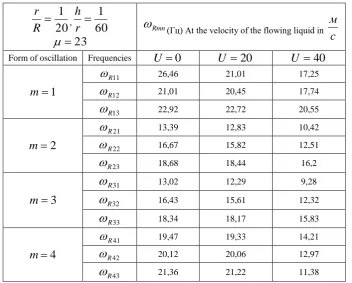
; 11,6 and 23,1.Table 1: Real parts of the natural frequencies as a function of the velocity of the flowing liquid
20
1
R
r
,
60
1
r
h
23
Rmn
(Гц) At the velocity of the flowing liquid inс
м
Form of oscillation Frequencies
U
0
U
20
U
40
1
m
11 R
26,46 21,01 17,2512 R
21,01 20,45 17,7413 R
22,92 22,72 20,552
m
21 R
13,39 12,83 10,4222 R
16,67 15,82 12,5123 R
18,68 18,44 16,23
m
31 R
13,02 12,29 9,2832 R
16,43 15,61 12,3233 R
18,34 18,17 15,834
m
41 R
19,47 19,33 14,2142 R
20,12 20,06 12,9743 R
21,36 21,22 11,38These parameters, in turn, corresponded to the following values of the curvature of the bends and bends of pipelines
according to SNiP [21]:
0
,
57
;
0
,
28
and 0,14. The instant modulus of elasticity of the steel from which the pipes are made is assumed to be equal toMПП
E
0
2
10
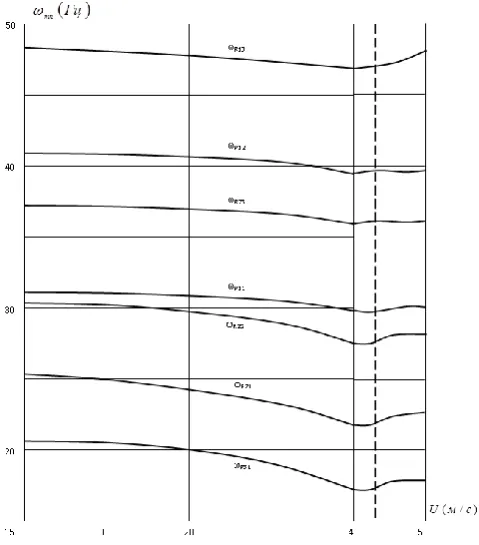
5 , Poisson's ratio .The results of the calculations are presented in Table. 1-6 and in the graphs of Fig. 2 - 5, which shows the change in real parts of the natural frequencies of bending vibrations
Rmn
curvilinear sections of the steel pipeline as afunction of the velocity of the flowing liquid for different
values of the shell thickness. Figure 2a shows a
monotonically increasing frequency dependence
R21 bythe shape of the oscillations at
m
2
the curvatureparameter of the pipeline section
and hisr
h
. And
conversely, the more it affects the natural frequencies of oscillations. Less curvature of the tube and the thinner its walls, the lower its frequencies of natural oscillations
Rmn
practically in all forms.~ 303 ~
Table 2: Real parts of the natural frequencies as a function of the velocity of the flowing liquid
20
1
R
r
,
60
1
r
h
5
,
11
Rmn
( Hz) at the velocity of the flowing liquid in
с
м
Form of oscillation Frequencies
U
0
U
20
U
40
1
m
11 R
55,34 53,47 51,1312 R
56,05 55,27 52,3913 R
60,56 59,99 57,182
m
21 R
36,26 34,09 28,5722 R
44,60 43,78 40,3523 R
51,67 50,52 47,063
m
31 R
35,02 33,01 26,5132 R
43,11 43,50 39,2233 R
50,03 49,63 46,584
m
41 R
53,01 50,31 47,4442 R
54,95 52,05 48,5043 R
55,82 53,92 49,99Thus, the lowest oscillation frequencies from the investigated sections of the pipeline were found near the
pipe with ratios
20
1
R
r
and
70
1
r
h
(Fig. 2,).
Oscillation frequencies
Rmn for this pipe were more than 5 times less than the frequencies for the pipe with10
1
R
r
and
35
1
r
h
(fig. 2b and fig. 3). Figures 2, d
show the results of calculating the natural frequencies of
the fluid flow velocity at h=0.05. Low frequencies of natural oscillations are considered to be the most dangerous in connection with the occurrence of resonance situations in the operation of pipelines and the possibility of loss of stability when one of the frequencies of bending
vibrations
Rmn
0
. Pressure pipelines made of polyethylene pipes are now widely used in the transportation of gas, oil, oil products.Table 3: Real parts of the natural frequencies as a function of the velocity of the flowing liquid
20
1
R
r
,
60
1
r
h
5
,
11
Rmn
( Hz) at the velocity of the flowing liquid in
с
м
Form of oscillation Frequencies
U
0
U
20
U
40
1
m
11 R
8,61 8,01 7,4212 R
10,52 10,23 9,2213 R
12,25 12,03 11,932
m
21 R
8,30 7,83 7,1222 R
10,23 9,84 9,0123 R
11,84 11,75 11,523
m
31 R
7,13 6,70 6,3232 R
8,82 8,42 7,8233 R
10,12 9,91 9,724
m
41 R
11,13 11,05 10,1142 R
12,42 12,72 12,9243 R
~ 304 ~ Fig.2, a. The change in real parts of the natural frequencies of
bending vibrations at different velocities of a flowing liquid h=0,001.
Fig.2, b. The change in real parts of the natural frequencies of bending vibrations at different velocities of a flowing liquid
h=0,005.
Fig. 2, c. The change in real parts of the natural frequencies of bending vibrations at different velocities of a flowing liquid
h=0.001.
Literature sources contain data on the operation of such pipelines with information from (GOST 18599) "Pressure pipes from polyethylene. Technical conditions »with a range of pipes manufactured by the industry. Pipes made of polyethylene with a module of elasticity of the material
МПа
E
500
and Poisson's ratio
0
,
3
, haveouter diameters up to 1200 mm with a ratio of the wall thickness of the pipe to the radius of the middle surface
12
1
8
1
r
h
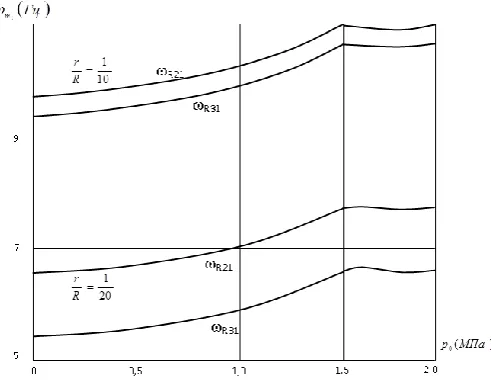
and are designed for internal hydrostatic pressure up to 0.8 MPa (Fig. 4). Curved sections of pipelines made of polyethylene pipes are made of sections with an external diameter of up to 630 mm and are thin-walled toroidal shells. Dynamic calculation of such areas should be carried out on the basis of shell theory. Therefore, the determination of the frequencies of natural oscillations of curvilinear pipeline sections from polyethylene pipes is carried out.
Fig. 2, d. The change in real parts of the natural frequencies of bending vibrations at different velocities of a flowing liquid
~ 305 ~ Fig.3. The change in real parts of the natural frequencies of
bending vibrations from the velocity of the flowing liquid at
2
m
.Frequency study
Rmn by the first three forms of naturaloscillations
m
1
,
2
,
3
curvilinear sections of polyethylene pipelines with a much smaller modulus of elasticity than in steel pipes made it possible to reveal a significant dependence of the values of the vibration frequencies on the flow velocity of the liquid. In accordance with the assortment for polyethylene pipes [22], frequency calculations were carried out for curved sections of pipelines with an external diameter of 630 mmand with a relative wall thickness
4
,
12
1
r
h
. It can be
seen that the frequencies of tubes with a large curvature
(
10
1
R
r
) much higher than the frequencies of tubes of
lesser curvature (
10
1
R
r
). The main conclusion from the
analysis of the results of the study of the frequencies of the own bending vibrations of polyethylene pipes with a liquid flow is that, unlike steel pipelines, the natural oscillation frequencies of these pipelines depend very much on the flow rate of the liquid. Here, the decrease in the oscillation
frequencies
Rmn when the flow rate changes from 0 toс
м
20
reaches 18%, which must be taken into account inthe dynamic calculations of pipelines.
Table 4. Real parts of the natural frequencies as a function of the velocity of the flowing liquid
20
1
R
r
,
30
1
r
h
5
,
5
Rmn
(Гц) at the velocity of theflowing liquid in
с
м
Form of
oscillation Frequencies
U
0
U
20
U
50
1
m
11 R
31,21 30,52 29,0912 R
40,02 39,31 38,0513 R
47,02 46,64 46,182
m
21 R
24,24 53,02 20,3922 R
30,56 29,26 26,5523 R
36,44 35,91 35,273
m
31 R
20,83 19,51 16,1732 R
24,91 24,01 23,3433 R
28,61 28,39 28,354
m
41 R
29,02 28,92 28,9842 R
30,17 29,15 29,0143 R
31,36 30,97 30,05As well as in pipelines, the largest natural frequencies are
frequencies according to the first form of oscillations
1n atm
1
, where there is no deformation of the contour of the cross sections of the pipe. These frequencies correspond to the calculation of pipeline sections according to the bar theory. The lowest frequency of the self-bending oscillations of the curvilinear section isrealized by shell vibration forms (at
m
2
and 3), corresponding to the deformed contour of cross sections and with the formation of one longitudinal half-wave of asinusoid (at
n
1
) . The study of the natural oscillations of curvilinear sections of polyethylene pipelines has shown that, in connection with the small cured elastic modulus of polyethylene (almost 400 times less than that of steel), the oscillation frequencies for all the shell forms studied3
,
2
,
1
,
n
m
) and practically for all real geometricalsizes of the sites is much less than for the corresponding in size steel pipelines (Fig. 4).
Table 5: Real parts of natural frequencies depending on the velocity of the flowing liquid
20
1
R
r
,
35
1
r
h
1
,
4
Rmn(Гц) at the velocity of the flowing liquid inс
м
Form of oscillation Frequencies