KTA FROM CORINTH
*
(PLATES
1141116)
XT is both a privilege and a pleasure to acknowledge liere a friendship of forty
11 years since I first met and began to work with Oscar Broneer, a friendship and
cooperation from which I have derived so much. Under his guidance several genera-
tions of.archaeologists received their first training in the field, as well as in. scholarly
research and publication. His, and our, years at Corinth have seen a vast development
of the site through major excavations. But much has been learned, as well, through
chance finds in and around Corinth, which these excavators have tried to record as
faithfully as possible, in a special notebook entitled Ka
ra'
Xotr6a,
and to publish. Two
such finds are presented here.as a tribute to the person who, more than any other,
personifies the Corinth Excavations.
In late 1943 and early .1944, while Greece was under heavy oppression during
the Second. World War, severe rains caused a portion of the south scarp of the Temple
.Hill at Corinth to fall away, carrying with it. many pieces of early Neolithic pottery
and revealing a pit in hardpan, just south of the middle column of the south side of
the Temple of Apollo.' The site of the collapse and the material from the pit thus
revealed were shown to me by George Kachros, the Head Guard at Corinth, when
we. returned to Greece in 1946; at that time the chance finds of the war years were
recorded in KTA and inventoried.
The pit yielded four hemispherical bowls of fine variegated ware, two biconical
bowls of a somewhat heavier and coarser fabric and one large, deep bowl of a much
coarser fabric, as well as a painted loomweight of fairly fine fabric; all these are
catalogued below.
* The study of the two groups from Corinth is made with the kind permission of the Director of the Corinth Excavations, Mr. Charles K. Williams, II. Dr. Nancy Bookidis, Secretary to the Corinth Excavations, has provided the catalogue descriptions for Nos. 4 and 9-16, has had a new set of photos made of all the objects and has had profiles of the vases made by Sarah l-. Rutter; to Dr. Bookidis and Mrs. Rutter I owe many thanks. The drawings of No. 16 were made in 1952 by Marian Holland, now McAllister, at the instigation of Professor John L. Caskey, theen Director of the American School of Classical Studies at Athens; I express herewith my thanks to them both.
I See S. S. Weinberg, " Remains from Prehistoric Corinth," Hesperia, VI, 1937, p. 490, fig. 1. The pit was south of the eastern end of Trench II of 1937, in which another pit in hardpan had been found (op. cit., p. 491), containing a deposit of similar Early Neolithic pottery which likewise mended into fairly complete bowls (op. cit., figs. 4 and 6).
American School of Classical Studies at Athens is collaborating with JSTOR to digitize, preserve, and extend access to
Hesperia
C)
524 SAUL S. WEINBERG
1. Hemispherical bowl. Fig. 1, P1. 114.
CP-1916. H. 0.117, max. D. 0.176, D. lip 0.171, D. base 0.046m.
Clay buff to gray at core, well levigated. Surface smoothed and polished. Upper third of exterior buff, grading to dark gray at bottom; interior all buff.
Nearly complete, several body fragments missing.
Small, very low foot, slightly hollow under- neath; hemispherical body with hiigh sides, slight contraction to lip. Handmade.
2. Hemispherical bowl. Fig. 1, P1. 114.
CP-1917. H. 0.115, max. D. 0.19, D. lip 0.187, D. base 0.056 m.
Clay buff above and gray below, well levi- gated. Surface smoothed and polished. Ex- terior and interior buff upper third to dark gray below.
Nearly complete, few large body fragments missing.
Small, very low foot, slightly hollow under- neath; hemispherical bowl with high sides, sliglht contraction at lip. Handmade.
3. Hemispherical bowl. Fig. 1, P1. 114.
CP-1918. H. 0.159, max. D. 0.245, D. lip 0.238, D. base 0.075 m.
Clay buff to gray, well levigated. Surface smoothed and polished. Exterior buff above to gray below; interior buff.
Nearly complete, few large body fragments missing.
Low ring base, slightly splayed; hemispheri- cal bowl with high sides, slight contraction at lip; walls thin slightly to top and lip rounded. Handmade.
4. Hemispherical bowl. Fig. 1, P1. 114.
CP-1919. PH. 0.158, max. D. 0.25, D. lip 0.238 m.
Clay buff, well levigated. Surface smoothed and polished. Exterior and interior buff at top to gray below.
Large part of one side of bowl preserved; base mlsslng.
Hemispherical bowl with high sides, slight contraction at lip. Handmade.
The bowls from the pit, three nearly complete and one fragmentary, are typical
examples of the Early Neolithic Variegated ware already well known from Corinth,2
as well as many other Peloponnesian sites. While round-bottomed examples do not
occur in this group, the rudimentary base of Nos. 1 and 2 and the higher ring base
of No. 3 illustrate the development of the footed shape that occurs early in the Early
Neolithic period.
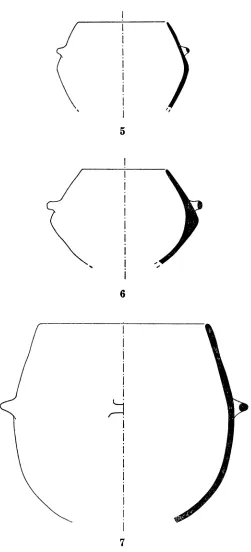
5. Biconical bowl. Fig. 2, P1. 114.
CP-1920. PH. 0.087, PW. 0.122 m.
Clay gray to buff at surfaces, well levigated. Surface smoothed and polished. Surface colo- buff to reddish buff.
One large section of bowl, including lip and la handle, preserved.
Biconical shape with rounded carination, upper part ending in simple thin lip; horizontal
pierced lug a little above carination, probably four in all. Handmade.
6. Biconical bowl. Fig. 2, P1. 114.
CP-1921. PH. 0.10, PW. 0.15m.
Clay buff to gray, slight impurities. Exterior surface smoothed and polished, but slightly rough; interior rough smoothed. Surface color buff on interior and exterior.
5
6
7
526 SAUL S. WEINBERG
One large section of bowl, including lip and a handle, preserved.
Biconical shape with rounded carination,
upper part ending in simple thin lip; horizontal pierced lug a little above carination, probably four in all. Handmade.
The biconical shape is here reported from Corinth for the first time and I have
not found mention of it at other Peloponnesian sites.3 Among the Early Neolithic
shapes found at Elateia in Phocis, there are bowls with " a slight but definite angle,
usually rather near the base, tending thus toward a biconical form."
4These seem
similar to the keeled bowls found in the lowest Early Neolithic layer at Otzaki Magula
in Thessaly,' but not reported elsewhere in Thessaly, to my knowledge. The lugs,
which appear on both of the biconical bowls from Corinth, are not known elsewhere.
If, as is generally supposed, they were used to hold cords by which the bowl was
suspended, four lugs would be desirable, as on a round-bottomed bowl from Corinth.'
In a ware which has thus far been known in only two shapes-the hemispherical bowl
and a globular collared jar-the addition of a third shape, and particularly one which
is carinated and thus seems more advanced than the others, is important. It indicates,
too, that there is probably much more to learn about the Corinthian Early Neolithic
pottery through further excavation.
7. Large coarse bowl. Fig. 2, P1. 114.
CP-1922. PH. 0.21, max. D. 0.232, D. lip 0.185 m.
Clay reddish brown at surfaces to gray at core, quite gritty. Interior and exterior sur- faces pared smooth with visible paring marks. About one-half circumference preserved, from near base to lip; two lugs preserved.
Full-bodied shape, contracting slowly to wide mouth with rounded lip; base missing. Four horizontal pierced lugs placed above belly, where there is very slight carination. Handmade. While the coarse monochrome ware of the Corinthian Early Neolithic period was already set apart in the first publication, this bowl dif- fers in both surface treatment and shape froin
the usual coarse ware found there. The greater contraction towards the lip makes this bowl verge on the hole-mouthed jar type. The four lugs again suggest that the bowl was suspended. The coarse, and very visible, burnishing of the surfaces is unparalleled at Corinth in this period.
8. Painted loomweight. P1. 114.
MF 9036. H. 0.07, D. base 0.055 m. Clay buff, slightly gritty.
Slightly chipped at lower edge, otherwise intact.
Truncated, high conical shape, flat top and bottom; slightly beveled at top and bottom. Suspension hole pierced near top.
We have, thus far, only preliminary reports from the two major sites which have recently produced large quantities of Early Neolithic pottery-Lerna and the Franchthi Cave-and in these little of the early material is published.
4 S. S. Weinberg, " Excavations at Prehistoric Elateia, 1959," Hesperia, XXXI, 1962, p. 170.
5 Johanna Milojcic-v. Zumbusch and Vladimir Milojcic, Die deutschen Ausgrabungen acuf der
Otzaki-Mctgula in Thessalien, I. Das frilhe Neolithikum, Bonn, 1971, pp. 24-25, 54, pl. VI, 21-24, 1). VII, 10-13.
6 Kosmopoulos, op. cit. (note 2), pl. Ia.
Horizontal stripes of red-brown paint from top to near bottom; crossed lines of same paint on top and bottom.
Previously published in Gladys R. Davidson, Corinth, XII, The Minor Objects, Princeton, 1952, pp. 147-148, pl. 146, c.
While this loomweight is unique at Corinth, two painted loomweights from Phthiotic Thebes, one conical and one pyramidal, are published by Christian Zervos in Naissance de la civilisa- tion en Grace, II, Paris, 1963, p. 344, figs. 476-
477,8 They are dated to the Late Neolithic by Zervos, but they are probably without context and an examination of the fabric would be necessary to date them more accurately. Fur- ther confirmation'of the use of loomweights at least by the Middle Neolithic period comes from the Franchthi Cave, in the most recent publication of which there is mention of " spheri- cal weights," ca. 110 grams in weight, which Miss Carrington Smith is inclined to regard as loomweights.9
Thus a pit revealed by accident has added to the Early Neolithic repertory a new
pottery shape (the biconical bowl), a new type of coarse ware and a somewhat dif-
ferent shape in this ware, and a loomweight unique at Corinth, as well as a good group
of hemispherical bowls of a type already well known. It is indicative of the important
contribution which numerous chance finds have made to the total picture of ancient
Corinth, built up during almost eighty years of American work at the site.
In January, 1951, a child's grave was revealed when rain caused earth to fall
away from a scarp and disclosed the corner of a stone sarcophagus. The grave was
found in. the first large ravine to the northwest of the excavation house on the way
to the church of the Haghioi Anargyroi, at the village of Anaploga; it was on the
west side of the ravine, some 200 m. north of the bridge in the road over this ravine
and at a point where the cliff forms an angle with the first east-west ravine that joins
it on the west side below the bridge.'0 The burial was in a small sarcophagus, said
to be about 0.90 m. long and 0.40 m. wide, which was destroyed by the finders; no
cover was reported. The orientation of the sarcophagus was northwest-southeast;
around it were packed large cobbles or field stones. Along the southwest side of the
exterior of the sarcophagus, and at about its center, were found six small kotylai
of the Protocorinthian-Geometric type; the four with geometric linear decoration were
found stacked and the two black-glazed kotylai were separate, apparently also one
within the other. An unusual feeding bottle, also with linear geometric decoration,
and a handmade oinochoe were the first objects brought to the Corinth Museum,
apparently having been found inside the sarcophagus when the grave was first dis-
covered and before it was destroyed.
8 These are now published again in Hans-Giinter Buchholz and Vassos Karageorghis, Prehis-
toric Greece and Cyprus. An Archaeological Handbook, London, 1972, p. 48, figure on p. 255. 9 Thomas W. Jacobsen, " Excavations in the Franchthi Cave, 1969-1971. Part II," Hesperia, XLII, 1973, p. 277.
I
i
10J
I
11 12
13 14
9. Kotyle. Fig. 3, P1. 115.
CP-2060. H. 0.048, D. base 0.028, D. rim 0.067 m.
Complete, but broken.
Clay buff, glaze red to red-brown.
Shape: small ring foot, flaring convex body, two horizontal handles set well below rim.
Decoration: underside plain, exterior lower half of body glazed with one narrow reserved line, narrow lines to handle zone; handle zone: hatched diamonds in central panel between flanking panels of vertical strokes. One hori- zontal line on back of handle, two lines below rim. Interior glazed, two reserved bands near rim.
10. Kotyle. Fig. 3, P1. 115.
CP-2061. H. 0.049, D. base 0.03, D. rim 0.07 m.
Complete except for fragments of rim. Clay and shape: same as No. 9.
Decoration: underside glazed, exterior of foot brown glazed, two broad bands on lower body, fine lines to handle zone; handle zone: six crosshatched diamonds in central panel flanked by vertical lines. Two horizontal stripes across handles. Interior glazed; reserved band below rim.
11. Kotyle. Fig. 3, P1. 115.
CP-2062. H. 0.053, D. base 0.03, D. rim 0.07 m.
Complete profile; part of body and one handle missing.
Clay buff, glaze red-brown. Shape as above.
Decoration: reserved underside; lower half of body glazed, with one reserved line, narrow lines to handle zone; handle zone: central panel dotted diamonds, vertical strokes to sides. In- terior glazed with two reserved lines at rim.
12. Kotyle. Fig. 3, P1. 115.
CP-2063. H. 0.05, D. base 0.029, D. rim 0.068 mn.
Complete, except for chips in rim. Clay and shape as above.
Decoration: underside glazed with single reserved circle. Exterior of foot glazed, single glazed band above foot, above which zone of rays; horizontal lines to handle zone. Handle zone; central hatched diamonds set off by hour- glass panel either side. Interior glazed with two reserved lines below rim.
13. Kotyle. Fig. 3, P1. 115.
CP-2064. H. 0.048, D. base 0.024, D. rim 0.056 m.
Intact; rim slightly chipped. Clay buff; glaze brown-black. Shape as above.
Decoration: underside and exterior glazed to rim, with reserved hourglass at center of han- dle panel, single white painted line on body near foot; handle zone bordered above andl below and delimited at handles by stripes of white paint, all largely gone in this example. Interior glazed, one reserved line just below rim.
14. Kotyle. Fig. 3, P1. 115.
CP-2065. H. 0.037-0.04, D. base 0.027, D. rim 0.057 m.
Small body fragments and one handle missing. Clay buff, glaze streaky black.
Shape: small ring base, wide-flaring convex sides, slight contraction to lip; two horizontal handles set well below lip.
Decoration: underside reserved, exterior glazed except for reserved hourglass at center of handle panel. Interior glazed; two reserved bands at rim.
The early history of the kotyle, its relation to the aryballos and the importance
of the developmental sequence of the two shapes for dating in the late eighth and
seventh centuries
B.C.have been much discussed. The most recent summation of the
530 SAUL S. WEINBERG
Dating of the Protocorinthian Kotyle." " Of the six kotylai found alongside this
grave, only one (No. 14) has the rather squat, wide-mouthed shape that is thought
to be the earliest, going back to late Geometric predecessors of the second half of the
eighth century
B.C.But the taller shape, represented by Nos. 9-13, was already in
existence by 725
B.C.and continued into the early seventh century. In most respects,
the decoration of these six kotylai, as well as the shapes, is consistent with groups
from Corinth that have been dated in the last quarter of the eighth century and the
closing years of that century.'2 The use of crosshatched
ordot-filled lozenges rather
than birds, or the s-curves that are a degenerate representation of them, while some-
what rare, is not unknown on late eighth-century kotylai," though it becomes much
more common after the turn of the century."4 So, too, the use of white paint on
Nos. 13 and 14, and the appearance of the first short rays at the base of No. 12, are
features which appear in the last quarter of the eighth century, but become common
only in the next quarter century.'5 The criteria of shape and decoration of the six
kotylai thus point to a date around 700
B.C.for them, and for the burial with which
they are so clearly associated.
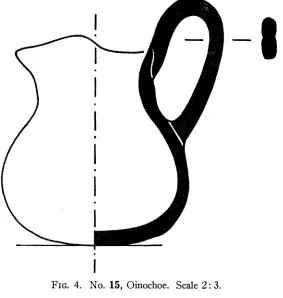
15. Plain oinochoe. Fig. 4, P1. 116.
CP-2066. H. 0.089, max. D. 0.069 m. Intact.
Clay buff, unglazed.
Shape: rounded bottom, squat globular body, short neck to flaring trefoil mouth; high-swung vertical double-band handle from rim to mid- body. Handmade.
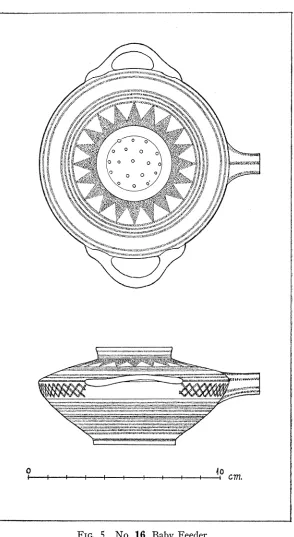
16. Baby feeder. Fig. 5, PI. 116.
CP-2067. H. 0.051, max. D. 0.098, max. W. with handles 0.128m.
Complete but for chips at rim, one handle broken and mended.
Clay very light buff.
Shape: low ring base, wide-splaying body with sides lightly convex, sharp carination to wide shoulder; mouth filled with sieve, low rim about it; horizontal handles set just below cari- nation. Short spout projecting from one side midway between handles.
Decoration: all decoration in black glaze, much worn. Horizontal stripes at top of base and around body up to handle zone, which is filled between handles, and between handles and spout, with motif of three interlocking zigzag lines forming double row of lozenges. Two stripes around outer edge of shoulder, three more at middle of shoulder, then zone of rays radiating from rim, around which are three more stripes.
11Essays in Memory of Karl Lehmann, Locust Valley (New York), 1964, pp. 49-54.
12 S. S. Weinberg, Corinth, VII, i, The Geometric and Orientalizing Pottery, Cambridge (Mass.), 1943, nos. 103-115 and 116-134 respectively.
13 S. S. Weinberg, "What is Protocorinthian Geometric Ware?" A.J.A., XLV, 1941, p. 36, fig. 8.
14Ibid., p. 37, figs. 19-20.
Of the two vases found within the sarcophagus, the plain handmade oinochoe
is a common type that occurs as early as the first half of the eighth century
B.C.in
Grave 18 of the North Cemetery at Corinth." It was still being made with little
change in shape in the Middle Corinthian period, the first quarter of the sixth century
B.C."
The baby feeder, on the other hand, while part of a long series of such vessels
FIG. 4, No. 15, Oinochoe. Scale 2: 3.
that begins at least in Mycenaean times and continues throughout antiquity, is unique
in the exact form in which we have it here. The highly angular profile suggests that
it is an adaptation of an early covered vessel, such as a pyxis or a lekane, here with
cover and bowl in one piece.18 The knob handle usual on the cover of such vessels has
here given place to a sieve with a rim about it; the reflex handles are like those of the
suggested prototype."9 The decoration of the baby feeder is completely in the tradition
1I
Carl W. Blegen, Hazel Palmer, Rodney S. Young, Corinth, XIII, The North Cemetery, Princeton, 1964, p. 27, nos. 18-3 to 18-5, pl. 8.
7 Ibid., p. 192, nos. 174-3,-4, pl. 28; Weinberg, Corinth, VII, i, p. 79, no. 357, pl. 43.
18 Ibid., p. 45, no. 153, pl. 22 is a pyxis dating to about 700 B.C., the exact date indicated for
this burial by the six kotylai.
532 SAUL S. WEINBERG
of the early Protocorinthian-Geometric style, similar to that of the four kotylai, Nos.
9-12. Thus, it too is consistent with a date of about 700
B.C.for the child burial
from which the eight vases derive.
Though the baby feeder is apparently the earliest of Corinthian production, and
while it introduces a new form for this purpose, it is in many ways the inheritor of
a well-established tradition. The feeding bottle starts in Late Helladic III, according
to Jakovides, who has forty examples from graves in the Perati cemetery.20 The
typical shape is a globular jug with a rather high neck, small mouth, basket handle
and a spout rising at about a
450angle from the shoulder (P1.
116).21The same type
of globular jug continued to serve as a baby feeder in the Protogeometric period,
witness a spouted trefoil oinochoe from a child burial at Tiryns,22 or one from the
Athenian Agora.23 But in this samq period a one-handled cup on a high conical foot
was adapted to use as a baby feeder by the addition of a spout attached to the shoulder.24
While the globular jug with basket handle and spout was still in use as a baby feeder
in the Geometric period, a sieve is added in the mouth of one such jug from Eleusis.25
A sieve also fills the wide mouth of a kantharos from Tiryns, which has a spout placed
horizontally on one side between the handles;
26its late Geometric decoration, two-
handled shape and position of the spout bring it rather close to the first Corinthian
baby feeder. Another Late Geometric kantharos made into a baby feeder, but without
a sieve, is in Munich.27 Thus, for seven centuries baby feeders had been made by
adding a spout, and only in the Geometric period a sieve, to existing shapes. The
Protocorinthian-Geometric baby feeder from the child's grave published here is the
first one specifically made as such by inventing a new form. Unfortunately, its suc-
cessors cannot be traced at Corinth during the seventh and early sixth centuries
B.C.;it is only with the appearance of a common type of Late Corinthian II baby feeder
that the history of the shape resumes at Corinth,28
after the middle of the sixth century.
This is the earliest type that appears in the North Cemetery at Corinth, where very
few baby feeders were found.29 The shape, with a spout just below the shoulder and
20 Sp. E. Iakovides, Perati: The Cemetery, II, Athens, 1970, pp. 241-244. While most of these
"thylastra" are of LH IIIA-B date, a few may go into LH IIIC.
21 The example shown here is from the collections of the Museum of Art and Archaeology,
University of Missouri-Columbia (Acc. No. 68.104).
22 V. R. d'A. Desborough, Protogeometric Pottery, Oxford, 1952, p. 209, pl. 28, 10, which is
the same as Tiryns, I, pl. XVI, 10.
23 Hesperia, VI, 1937, p. 367, fig. 30.
24
W. Kraiker, Aigina: Die Vasen des 10. bis 7. Jahrhunderts v. Chr., Berlin, 1951, pl. 1, no. 10.
25
C.V.A., Greece 1, Athens 1, III H d, pl. 3(3), 3.
26 Tiryns, I, pl. XVIII, 9.
27 C.V.A., Deutschland 9, Miinchen 3,
pl. 119 (401), 3-5.
28 H. Payne, Necrocorinthia, Oxford, 1931, p. 335, nos. 1527-1528A.
--
*o . l-x -;. . j;, ,.,
t
~ ~
~ ~ ~ ~ ~ ~ ~ ~ ~ ~
.._ j
0 ~~~~~~~~~~~~40
534 SAUL S. WEINBERG
usually a vertical loop handle at right angles to it, is then taken over in the black-
glazed examples that are made throughout the Classical period.30
One of the most important aspects of the child's grave of about 700
B.C.is that
it is the only grave of this period found thus far at Corinth, for the North Cemetery
produced no graves of the earliest Protocorinthian period, the latter part of the eighth
century
B.C.3CIt is only in the Middle Protocorinthian that burials were again made
in the North Cemetery. The grave reported here may be the first indication of the
location of the cemetery of the Early Protocorinthian period.
SAUL S. WEINBERG
UNIVERSITY OF MISSOURI-COLUMBIA
30 Brian A. Sparkes and Lucy Talcott, The Athenian Agora, XII, The Black and Plain Pottery of the 6th, 5th, and 4th Centuries B. C., Princeton, 1970, p. 161, with footnotes on pertinent literature.
I
_I
I
I
I
2
I
~
~
~
~
I
~
_
_ ~~1 2_
I
eI
3 ~~~~~~~~~~~~4
oW
,1
4~~~~~
5
- 1 ~~~~~~~~~~~~~~~~~6
I 1
7 8
PLATE 115
9 ~~~~~~~~~~~~~~~10
_
~~E
11 ~~~~~~~~~~~~~~~12
13 14
*f* 16, side view
15
..
_~~~~~4c.
Late Helladic, III baby feeder 16, top view