~ 20 ~ WWJMRD 2017; 3(6): 20-24
www.wwjmrd.com Impact Factor MJIF: 4.25 e-ISSN: 2454-6615
Mahato Rabindra Kumar Department of ETP, OTR Paper Mill, Sikandrabad, Bulandsahar, U.P, India
Haffij Nafij
Department of ETP, OTR Paper Mill, Sikandrabad, Bulandsahar, U.P, India
Awasthi Shashank Codon Biotech Pvt. Ltd., Noida, India
Bhatnagar Tripti Codon Biotech Pvt. Ltd., Noida, India
Correspondence: Mahato Rabindra Kumar Department of ETP, OTR Paper Mill, Sikandrabad, Bulandsahar, U.P, India
A study on the effect of paper mill effluent on seed
germination of vegetables
Mahato Rabindra Kumar, Haffij Nafij, Awasthi Shashank, Bhatnagar
Tripti
Abstract
In the present study an attempt has been made to access the effect of Paper Mill effluent treated as well as untreated on germination of various crops, to ensure the safe landing of such effluent for irrigational purpose. The effluent treatment plant of OTR Paper Mill consists of primary clarifier effluent (untreated), Aeration tank effluent(having biomass), secondary clarifier effluent(treated). The germination of various seed was determined on the basis of growth with respect to different effluent, keeping all other factors constant. Maximum rate of germination occur in Secondry clarifier treated effluent. Level of germination in different effluent was determined on the basis of simple pot experiment and basis of measurement of growth was only apical shoot growth. The primary clarifier water showed the reduced growth due to addition of various chemical added during pulping. The high germination in Aeration tank effluent and Secondary clarifier effluent supports that frequent addition of Urea, DAP and Carbon source(N,P) provide food sources for biomass as well as act as residual nutrients or as fertilizer in effluent. The previous research reveals that physicochemical properties of paper mill waste water don’t permit its disposal directly into land for irrigation however after using the treatment methodologies the treated effluent can be used safely and good for crops in coming future. The result obtained supports the beneficial effect of Paper mill effluent on the growth behaviour of crops.
Keywords: Paper Mill effluent, treated, untreated, germination of crops, Effluent Treatment Plant
Introduction
India has an average of 700 pulp and paper mills. It is one of the highest polluting industries in India and is highly water intensive. The most important problem which the pulp and paper industry is facing today is the disposal of tremendous volumes of waste water. This waste water is rich in dissolved solids such as chlorides and sulphates of Na, Ca and varying amounts of suspended organic materials. In addition to these constituents, effluents also contain some trace metals like Hg, Pb, and Cr etc. The dark colour of waste water exhibits the toxic effects on the biota and inhibits the photosynthetic activity by reducing the sunlight (Kesalkar et al.,2012). Reports have suggested that the effluent have an inhibitory effect on seed germination and growth performance of wheat cultivars, pulses like green gram, red gram and other crops like onion and tomato.(Rohit K.C et al.). In regions of water scarcity, effluent is the single permanent water source for irrigation.
The paper industry uses a variety of effluent treatment systems. The preferred process combination for each individual case depends on the grade -specific quality of the effluent that is going to be treated.
Polluted water, in addition to other effects, directly affects soil not only in industrial areas but also in agricultural fields and river beds, thereby creating secondary source of pollution. Various industries have been continuously adding lot of waste water containing high level of nutrients, heavy metals and hazardous substances to the cultivable land. These effluents not only increase the nutrient level, but also excess tolerance limits and cause toxicity (Kamlesh et al., 2006).
Experiments conducted by Dutta and Boissya (1999) for studying the effect of low concentration of paper mill effluent on growth and field NPK contents in rice showed increase in growth and yield of crop. Black liquor effluent from pulp and paper mill is a complex colloidal solution of various inorganic compound and organic polymeric substances like lignin, carbohydrate and their complexes (Sangeeta et al., 2012). According to
Mehta and Bharadwaj (2012), untreated industrial effluent sample being a potential sources of pollution load are toxic to plants. Baruah and Das reported that there is delay, retardtion and decline of germination of rice seeds and seedling growth with paper mill effluent in comparison to control. Ranjannan and Oblisma reported that paper mill effluent affected the germination of rice, black gram and tomato seeds however the diluted form of effluent did enhance their growth.
Materials and Methods
Effluent collection: - The samples for the studying the effect of different effluents were collected from the Effluent Treatment Plant of recycled Paper industry. The wastewater samples were collected from the inlet/primary clarifier (raw wastewater), outlet/ secondary clarifier (final treated wastewater) and aeration tank (having biomass). Normal tap water was taken as control water. These effluent samples of the paper mill were used without dilution for the experimental purpose. Germination and shoot length was measured by simple scale method on apical parts.
Selection of seed/shoot: - The seed and shoot bud of fast germinating crops were selected randomly. The major selected crops which were used for simple pot experiments. 1.Brassica compestris (yellow and black Mustard)
2. Beta vulgaricus (Palak) 3. Allium cepa (Onion) 4. Allium sativum (Lahsun) 5.Raphanus sativus (Muli)
6. Brassica rapa rapa (Shalgam) 7. Coriandrum sativum (Dhaniya)
Soil selection: - All factors were kept constant except for type of water for irrigation. Two types of soil was selected one from secondary sludge bed, other from ETP garden for 1st set expt. and 2nd set expt. respectively.
Planting Procedure: - 4 to 5 seeds of respective plant were planted 3cm apart and 2cm deep in each of 8 planting pot containing 2 kg of soil. The experiment was divided in to two set planted in 1 day gap. Irrigation was done on the basis of moisture in soil.
Growth analysis: - Morphological parameters of planted seed were recorded in situ condition. The seed germination was recorded after 5 to 6 days from planting. The growth was analysed only on the basis of shoot length.
Result and Discussion
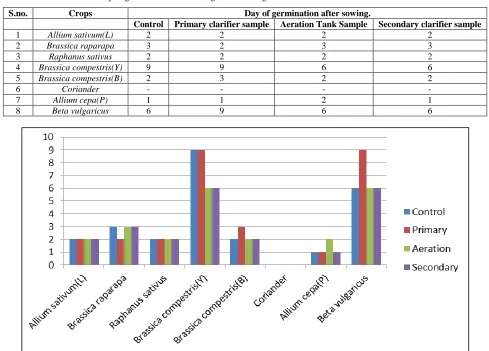
The seeds were sowed in pots and the effluent of Primary, aeration, secondary and control water were added equally in to the respective pots and the day of germination was noted and the height of plant after germination was evaluated on day to day basis and observation. The germination starts after 2th day of sowing in most of the cases. The results of germination date show difference in
case of Allium cepa and Brassica campestris ( both yellow
and black). Coriander seeds did not show any germination by control or test samples.
Table 1: Day of germination after sowing seed and irrigation with treated and untreated waste water
S.no. Crops Day of germination after sowing.
Control Primary clarifier sample Aeration Tank Sample Secondary clarifier sample
1 Allium sativum(L) 2 2 2 2
2 Brassica raparapa 3 2 3 3
3 Raphanus sativus 2 2 2 2
4 Brassica compestris(Y) 9 9 6 6
5 Brassica compestris(B) 2 3 2 2
6 Coriander - - - -
7 Allium cepa(P) 1 1 2 1
8 Beta vulgaricus 6 9 6 6
~ 22 ~
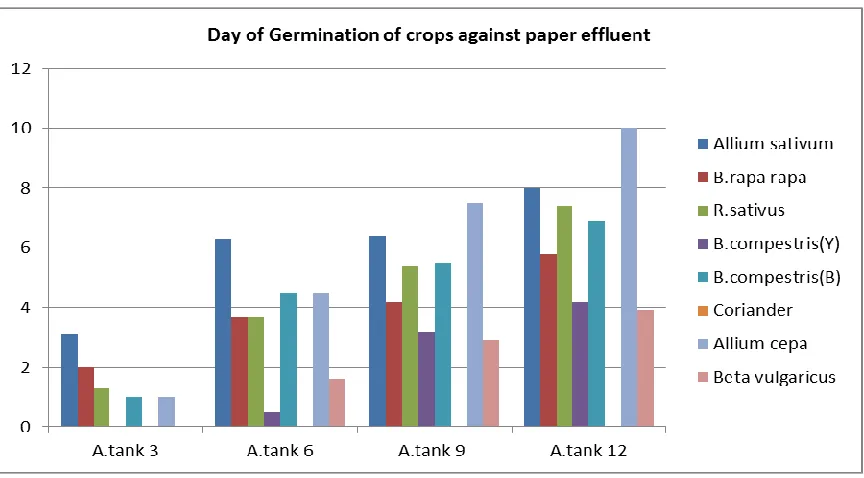
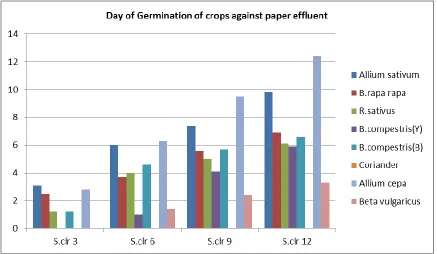
Table 2: Length of seedling after germination and irrigation with treated and untreated waste water.
Sno Name of
Plants Control Primary clarifier Aeration Tank Secondary clarifier
1 Allium
sativum(L)
3day
6
day
9th
day 12th
day 3th day
6th
day 9th
day 12th
day 3rd
day 6th
day 9th
day 12th
day 3
rd
day 6
th
day 9th
day 12th
day
3.5 5.7 7.3 8.2 3 5.2 7.5 8.9 3.1 6.3 6.4 8 3.1 6 7.4 9.8
2 Brassica
raparapa 1.5 3.5 4.5 6 1.7 2.5 3.1 4.8 2 3.7 4.2 5.8 2.5 3.7 5.6 6.9
3 Raphanus
sativus 1.5 3.5 4.5 5.7 1.7 4 4.5 6.7 1.3 3.7 5.4 7.4 1.2 4 5 6.1
4 Brassica
compestris(Y) - - 1.4 4.4 - - 1.0 2.5 - 0.5 3.2 4.2 - 1.0 4.1 5.9
5 Brassica
compestris(B) - 3.5 4.5 5.3 - 3 4.3 5.5 - 4.5 5.5 6.9 - 4.6 5.7 6.6
6 Coriander - - - -
7 Allium cepa(P) 4.3 5.1 6.9 9.9 4 5.6 9.2 11.5 1 4.5 7.5 10 2.8 6.3 9.5 12.4
8 Beta
vulgaricus - 1.7 2.2 3 - - 1.4 2.2 - 1.6 2.9 3.9 - 1.4 2.4 3.3
Fig 2: Length of seedling at 3 days after sowing and irrigation with treated and untreated waste water
Fig 4: Length of seedling at 12 days after sowing using Tap water as source of irrigation
Fig 5: Length of seedling at 12 days after sowing using Primary clarifier water as source of irrigation
~ 24 ~
Fig. 7: Length of seedling at 12 days after sowing using Secondary clarifier water as source of irrigation.
The results reveal that when untreated effluent water or primary clarifier waste water is used it shows decrease in both the days taken for germination as well as length of seedling after germination with respect to treated effluent. i.e Secondary clarifier water. The rate of germination of different crops were analyzed on the basis of 1st day,3rd day,6th day 9th day and 12th day after germination. The
plants Allium cepa and Allium sativum shows maximum
rate of germination, in the pot having secondary clarifier
effluent with respect to other plants on 12th day. Coriander
shows no germination in any set of the experiment. The germination of different 8 crops against different Paper Mill effluent treated and untreated was found to be in decreasing order as, Allium cepa > Allium sativum > Brassica raparapa > Brassica compestris(B) > Raphanus sativus >Brassica compestris(Y) > Beta vulgaricus. ( When analysed on the basis of last day of result on 12th day after sowing germination). The decrease in the untreated effluent might be due to high amount of dissolved solid which cause high osmotic pressure in soil solution. From the above result it can be concluded that the crops and vegetable can be irrigated with treated effluent. The treated Paper Mill Effluent can be used for irrigation purpose instead of throwing in to river or canal. Most of the Effluent Treatment Plants of Indian paper industry are having similar type of treated effluent and they are not reusing the treated water. Thus, in the scenario of water scarcity, usage of treated waste water would be highly useful to agriculturist and farmers for irrigation of the crops and agricultural fields.
References
1. Baruah, B.K. and M. Das (1997). Effect of paper mill
effluent on seed germination of crop plant Oryza(ESP) was found to be higher in comparison to initial sativa L. Environ. Ecol., 15: 904-906.
2. Dutta, S.K. and C.I. Boissya (1999) Effect of paper
mill effluent on growth yield andN, P, K contents of transplanted rice (Oryza sativa L var. Mahsuri). J.Environ. Biol., 20, 29-32 (1999).
3. G.R. Parvathi, N.K. Hemanth Kumar and Shobha
Jagannath (2014) Efficacy Of Distillery Effluent On Seed Germination And Biochemical Parameters Of Chickpea (Cicerarietinum L.)International Journal of Science, Environment and Technology, Vol. 3, No 4, 1393 – 1401.
4. H.M. Patel, A.M. Bafna and R.C. Gami (2013) Impact
of Paper Mill Treated Effluent on the Yield of Certain Agricultural Crops American-Eurasian J. Agric. & Environ. Sci., 13 (8): 1160-1167, 2013
5. KamleshNath, Dharam Singh and Yogesh Kumar
Sharma (2007) Combinatorial effects of distillery and sugar factory effluents in crop plants, Journal of Environmental Biology, 28(3) 577-582
6. Rohit.K. C.,PPonmurugan (2013) Seed Germination
Study Of Vigna Radiate Using Treated And Untreated Industrial Effluents, International Journal of Latest
Research in Science and Technology ISSN
(Online):2278-5299 Volume 2,Issue 2 :Page No.103-104.
7. P.K Chhonkar, S.P Datta, H.C Joshi and H. Pathak
(2000) Impact of Industrial effluent on Soil, Health and Agriculture-Indian experience: Part-II-Tannery and Textile industrial Effluent, Journal of scientific and Industrial Research, Vol -59, 446-454.
8. Sangeeta Madan and Pratibha (2012) Morphological
response of Cicer arietinum exposed to paper mill effluent, Journal of Environmental Biology, 2012. ISSN: 0254-8704
9. Surabhi Yadav, Nidhi Yadav (2014) Physicochemical
study of Paper Mill Effluent: To asses pollutant release
to Environment. International Journal Of