Developing Normative Commitment as a Consequence of
Receiving Help - The Moderated Mediating Roles of
Team-Member Exchange and Individualism/Collectivism: A
Multi-level Model
Katelin Barron∗ Shih Yung Chou†
Abstract: With increased market competition, organizations have devoted much effort to re-taining talented employees. As a consequence, a considerable amount of research attention has been paid to investigating an employee’s willingness to remain within a particular working en-vironment through the lens of the three-dimensional organizational commitment framework (i.e. affective, continuance, and normative commitment). Unfortunately, little is known about factors contributing to the formation of employee normative commitment. Thus, we seek to develop a theoretical model describing how employees’ normative commitment may be affected by receipt of helping behavior, the norm of reciprocity, team-member exchange, and individualism/collectivism. In particular, we propose that the degree of helping behavior received by an employee increases the employee’s normative commitment through the norm of reciprocity. Additionally, we posit that team-member exchange and individual/collectivism moderate the relationship between the degree of helping behavior that an employee receives and normative commitment formed by the employee. By exploring these relationships, our theoretical model provides important insights into effective management of normative commitment.
Keywords: Normative commitment, helping behavior, the norm of reciprocity; team-member exchange, individualism, collectivism.
Introduction
Competition among industry participants has steadily increased over the past few decades. The increased competition has contrived organizations to employ in exceptional organi-zational practices, such as efficient structure, competitive pricing, and effective customer orientation that help obtain and maintain competitive advantage (Porter,1985). Although various organizational practices have been linked with effective organizational functioning, practices that enhance employee commitment help contribute to not only the develop-ment of organizational core competencies, but also the attaindevelop-ment of strategic competitive
∗The University of Texas of the Permian Basin 4901 E. University, Odessa, TX 79762, United States. Email: barron [email protected]
advantage. Indeed, empirical evidence from prior studies has shown that employees’ com-mitment to remain with the organization helps improve organizational competitiveness (Beck & Walmsley,2012;Wang, Hinrichs, Prieto, & Howell,2013).
Because of the impact of employees’ commitment to the organization on organizational performance, a considerable body of research in the literature has investigated factors affecting employee commitment. In particular, research in employee organizational com-mitment has largely drawn upon (Meyer & Allen, 1991) three-component organizational commitment model, which highlights that an employee’s intention to remain with the or-ganization can be classified into three distinct components: affective (emotions-based), normative (obligation-based), and continuance commitment (cost-based). Although each of these three organizational commitment components has been shown to be associated with employees’ intention to remain with the organization (Meyer & Allen,1991;Payne & Huffman,2005;Suliman & Al-Junaibi,2010;Tsai & Huang,2008), normative commitment is one of the most important predictors of job-changing behaviors (Bergman,2006;Gamble & Tian,2015;Iverson & Buttigieg, 1999;Yao & Wang, 2006).
Despite what we have known about employee normative commitment, we believe that the literature can be extended in the following directions. First, when examining norma-tive commitment, scholars have pointed out that an employee’s normanorma-tive commitment may be a product of organizational socialization processes that the employee experiences (Iverson & Buttigieg, 1999). This, therefore, implies that normative commitment may be strengthened when the employee receives helpful behaviors from his or her co-workers. To our best knowledge, however, little is known about how an employee’s normative commit-ment is influenced by the degree of helping behavior that the employee receives from other organizational members. Consequently, the first principal goal of this study is to explore the impact of the degree of helping behavior received by an employee on the employee’s normative commitment.
Second, in his effort to understand human cooperation and social norms, (Gouldner,
1960) has noted that the norm of reciprocity is one of the societal norms that can be found in almost all societies. Gouldner has further claimed that the norm of reciprocity prescribes that individuals should provide assistance to those who previously assisted them, which has been supported by a number of empirical studies (Gallucci & Perugini,2000;Schindler, Reinhard, & Stahlberg,2012). In other words, the norm of reciprocity elicits an individual’s sense of obligation to reciprocate a certain supportive and/or cooperative behavior that the individual received from members within the organization. As such, we suspect that an employee’s perceived norm of reciprocity in a given helping relations could determine his or her normative commitment because of the perceived obligation to return favor to organizational members who have helped him or her before. Accordingly, the second principal goal of this study is to analyze the mediating role that an employee’s perceived norm of reciprocity plays in the relationship between the degree of helping behavior the employee receives and normative commitment of the employee.
the quality of social exchange relationship can be used as a means to encourage the return of helping behavior that was received from others before. Thus, the third principal goal of this study is to explore the moderating role that an employee’s perceived quality of social exchange relationships with other organizational members (i.e., perceived team-member exchange) plays in determining the relationship between the degree of helping behavior that the employee receives and the employee’s normative commitment.
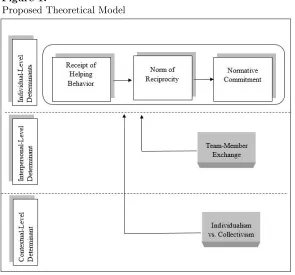
Finally, evidence from cross-cultural studies has revealed that individuals with collec-tivistic values emphasize attaining group interests, conforming group rules, and fulfilling obligations to the group (Markus & Kitayama, 1991). In contrast, individuals with indi-vidualistic values place their focus on the pursuit of personal goals, individual advance-ment, and personal freedoms (Triandis & Suh, 2002). Given the impact of individual-ism/collectivism on individual behaviors, scholars have shown that normative commitment, which describes an individual’s sense of internal obligation, may be culturally driven (Singh & Mohanty, 2011; Yao & Wang, 2006). While our understanding of normative commit-ment in the context of cultural differences has been broaden, we still lack knowledge on the extent of individualism/collectivism affects the development of an employee’s normative commitment resulting from receipt of helping behavior. Accordingly, the fourth principal goal of this study is to examine how individualism/collectivism moderates the relation-ship between the degree of helping behavior that an employee receives and the employee’s normative commitment. Figure 1 depicts the proposed theoretical model.
The remainder to this study unfolds as follows. In the second section, we provide a brief review on the literature with the emphasis placed on antecedents of normative commitment. Next, we present our theoretical arguments and specify our research propositions. This is followed by the discussion on theoretical and managerial implications, as well as limitations of this study and suggested future research directions. The final section provides a brief summary of this study.
Literature Review
According to Mathieu and Zajac (1990) organizational commitment describes an em-ployee’s attitude toward his or her employment organization. Although organizational commitment can vary across employees, a number of prior studies have revealed that an employee’s organizational commitment was associated with reduced absenteeism (Somers,
1995) increased citizenship behavior (Organ & Ryan, 1995) and improved employee well-being (Begley & Czajka,1993). Given the significant impact of organizational commitment on organizational outcomes, various models describing types of organizational commitment have been developed. Among various models, the most widely known model has been
commitment (Meyer & Allen,1991). Finally, an employee can demonstrate his or her con-tinuance commitment when he or she needs to stay with the employing organization due to the costs of leaving the organization and/or the investments made in the organization (Meyer & Allen,1991).
Even though each of these three components of organizational commitment has been shown to be predictive of employees’ intentions to stay in the organization (Meyer, Stanley, Herscovitch, & Topolnytsky,2002; Payne & Huffman,2005; Suliman & Al-Junaibi,2010;
Tsai & Huang,2008) affective commitment has been consistently demonstrated to be a best predictor for employee work attitudes and behaviors (Feather & Rauter,2004;Wong, Wong, & Ngo,2002) Nonetheless, normative commitment seems to be the strongest determinant, among the three components of organizational commitment, of job-changing behaviors (Bergman, 2006; Gamble & Tian, 2015; Iverson & Buttigieg, 1999; Yao & Wang, 2006). Unfortunately, little is known antecedents of normative commitment (Iverson & Buttigieg,
1999;Meyer & Parfyonova, 2010).
Figure 1:
Proposed Theoretical Model
normative commitment as an employee’s sense of obligation to stay with an organization. However, this sense of obligation does not include any specific reference to social pressures regarding loyalty (Bergman, 2006). Later, (Meyer et al., 2002) included the concept of reciprocity of benefits between the employee and organization in their view of normative commitment. (Meyer & Parfyonova, 2010) work suggested that the manifestation of nor-mative commitment is dependent upon the strength of other components of organizational commitment, and that normative commitment can be triggered when a moral duty or a sense of indebtedness is experienced. Although various elements have been included in the conceptualization of normative commitment across different studies, the central focus of normative commitment rests upon the employee’s sense of obligation (Bergman,2006).
While the conceptualization of normative commitment remains one of the scholarly debates in the literature, a particular scholarly stream in the literature has sought to identify antecedents of normative commitment. For instance, Malhotra, Budhwar, and Prowse (2007) showed that normative commitment is positively determined by extrinsic organizational rewards (i.e., pay satisfaction and satisfaction with benefits) and intrinsic rewards (i.e., autonomy, feedback, and training). InSimosi and Xenikou (2010) study, it was demonstrated that constructive organizational culture orientations (i.e., humanistic, affiliative, achievement and self-actualizing cultures) are predictive of normative commit-ment. He, Lai, and Lu (2011) discovered that affective commitment predicts normative commitment, that role ambiguity negatively affects normative commitment, and that man-agerial support positively influences normative commitment. The study conducted by
Yucel, McMillan, and Richard (2014) revealed that high levels of normative commitment are exhibited when low or high levels of transformational leadership style are demonstrated.
Yamao and Sekiguchi (2015) found that HR practices that help promote learning a for-eign language have a positive impact on normative commitment. In a more recent study,
Mory, Wirtz, and G¨ottel(2016) discovered that an organization’s internal corporate social responsibility affects employees’ normative commitment.
In sum, evidence from prior research on normative commitment has provided us with a greater understanding of normative commitment among employees. However, little is known about the extent of normative commitment is affected by the employee’s receipt of helping behavior from co-workers, as well as the roles of the norm of reciprocity, TMX, and individualism/collectivism play in this particular relationship. Thus, in the next section, we present our theoretical arguments and specify our research propositions.
Theoretical Model and Research Propositions
Helping Behavior Received and Normative Commitment
com-mitment is developed when the employee perceives that remaining with the organization, as an internal obligation, is the right thing to do. Meanwhile, when attempting to exploring antecedents of employee helping behavior, a stream of research has shown that employees who engage in helping behavior believe that they will receive help from co-workers in an unspecified future date (Deckop, Cirka, & Andersson,2003;Jiang & Law,2013;Stamper & Dyne,2001). That is, this particular research stream extendsBlau(1964) social exchange theory and suggests that the engagement in helping behavior is triggered by the helper’s belief that such helpful behavior can create an obligation perceived by the recipient con-cerning the need for returning favor to the helper in the future. Thus, we suspect that when an employee receives higher degrees of helping behavior from other organizational mem-bers, he or she is likely to develop greater degrees of internalized obligation that reinforces the employee’s commitment to remain with the organization in order to reciprocate the help that he or she previously received from other organizational members. Accordingly, we propose the following:
P1: The greater degrees of helping behavior that an employee receives from other orga-nizational members, the higher levels of normative commitment that an employee develops.
Mediating Effect of the Norm of Reciprocity
According to (Gouldner, 1960) one of the fundamental principles in most societies is the norm of reciprocity. Generally speaking, the norm of reciprocity indicates that people should provide support, and not injure, those who provided support to them previously (Gouldner,1960;Uehara, 1995). Extending the concept of the norm of reciprocity, it can be argued that when receiving higher levels of helping behavior from other organizational members, an employee is likely to perceive greater degrees of reciprocity norm reinforcing his or her future return of help. Indeed, evidence from prior research has supported this view by demonstrating that the engagement in helping behavior is governed by the norm of reciprocity (Deckop et al., 2003; Edlund, Sagarin, & Johnson, 2007; Iyer & Kanekar,
1991). More importantly, because the reciprocity norm enhances an individual’s sense of indebtedness and obligation to return the favor to others who previously supported the individual Goldstein, Griskevicius, and Cialdini (2011) we expect that the norm of reci-procity created by receipt of helping behavior from organizational members can result in an employee’s internalized normative pressures to remain with the organization in order to reciprocate the help to those who helped him or her before. Given the relationships among receiving helping behavior, perceived norm of reciprocity, and normative commitment, we propose the following mediating effect:
Moderating Effect of Perceived Team-Member Exchange
In this study, team-member exchange (TMX) refers to an employee’s perceived quality of lateral exchange relationships with other members (Seers,1989). That is, TMX describes an employee’s perception of the quality of the reciprocity between him- or herself and other members of the organization. Additionally, high-quality TMX generally results in high levels of exchange in resources, support, and assistance for the completion of tasks among organizational members (Liden, Wayne, & Sparrowe,2000; Scott & Bruce,1994). Organizational members perceiving high-quality TMX tend to engage in the exchange of organizational resources through collaboration in order achieve high performance collec-tively (Banks et al., 2014; Hoegl & Wagner, 2005). Extending the concept of TMX, it is plausible that when an employee perceives higher quality of TMX, he or she is likely to develop a stronger sense of internalized obligation that reinforces his or her continuous engagement in providing support and assistance to other organizational members. The sense of internalized obligation to continuously provide support and assistance to other or-ganizational members can tend foster an employee’s perceived obligation to remain in the organization where the members are. Indeed, it has been noted that the quality of TMX between two parties can determine the level of perceived personal obligation to reciprocate (Clark,1984;Clark, Mills, & Corcoran,1989). Taken together, we expect that the quality of perceived TMX will moderate the positive relationship between the degree of helping behavior received and normative commitment. Moreover, given the mediating relationship among the degree of helping behavior received, norm of reciprocity, and normative com-mitment, we expect that TMX will moderate this mediating relationship (i.e., mediated moderating effect). Accordingly, we propose the following moderating and mediated mod-erating effects:
P3a (moderating effect): The relationship between the degree of helping behavior that an employee receives and normative commitment of the employee will be moderated by team-member exchange, such that the positive relationship is stronger when higher quality of team-member exchange is present.
P3b (moderated mediating effect): The norm of reciprocity will mediate the interac-tive effects of the degree of helping behavior that an employee receives and team-member exchange on the employee’s normative commitment.
Moderating Effect of Individualism/Collectivism
well-being, interests, and concerns (Triandis,1995). Said differently, collectivistic cultures emphasize the attainment of group goals rather than personal goals (Leung,1997;Morris et al., 1998). Furthermore, it has been noted that collectivistic cultures reinforce strong social bonds where individuals remain tightly integrated with one another (“Maslow’s hi-erarchy of needs: Does it apply in a collectivist culture, author=Gambrel, Patrick A and Cianci, Rebecca”,2003) and concentrate on achieving in-group outcomes (Schwartz,1990). Extending the cultural dimension of individualism/collectivism, one can expect that the heavy group orientation emphasized in collectivistic societies can result in an em-ployee’s loyalty and obligation to the organization, personal sacrifices, and attention to expectations of the group, which, in turn, can enhance the employee’s internalized nor-mative obligation to stay with the group and organization. Unsurprisingly, findings of prior research (Moorman & Blakely,1995; Wagner, 1995) have demonstrated that collec-tivistic values are associated with high levels of reciprocation and normative commitment (Hofstede, 1984;Singh & Mohanty,2011; Wang et al.,2013;Yao & Wang,2006). Conse-quently, it is plausible that the cultural dimension of individualism/collectivism moderates the positive relationship between the degree of helping behavior received and normative commitment. Additionally, given the mediating relationship among the degree of helping behavior received, norm of reciprocity, and normative commitment, we expect that individ-ualism/collectivism will moderate this mediating relationship (i.e., mediated moderating effect). Altogether, we propose the following moderating and mediated moderating effects:
P4a (moderating effect): The relationship between the degree of helping behavior that an employee receives and the employee’s normative commitment will be moderated by in-dividualism/collectivism, such that the positive relationship is stronger when the employee possesses collectivistic values.
P4b (moderated mediating effect): Norm of reciprocity will mediate the interactive ef-fects of the degree of helping behavior that an employee receives and individualism/collectivism on the employee’s normative commitment.
Discussion
Theoretical Implications
Although the conceptualization of normative commitment has been offered in various ways, a common element of these conceptualizations is a sense of obligation (Bergman, 2006). That is, normative commitment emphasizes an individual’s belief about his or her respon-sibility to the organization (Allen & Meyer, 1996). Given this, scholarly attention has been paid to identifying antecedents resulting in the development of a sense of obligation (He et al.,2011;Neubert, Wu, & Roberts,2013). Although ample evidence demonstrating the antecedents of normative commitment has been identified, a strong emphasis has been placed upon organizational characteristics such as organizational support (He et al.,2011), leadership (Neubert et al.,2013), organizational justice (Ehrhardt, Shaffer, Chiu, & Luk,
majority of research on antecedents of normative commitment has focused on a single-level approach: the organizational-level analysis. This has resulted in the lack of understanding of how employees’ normative commitment may be affected by multi-level factors. In this study, we theoretically address how normative commitment of a focal employee can be influenced by receipt of helping behavior from organizational members at the interpersonal level. Additionally, we conceptually highlight how normative commitment of a focal em-ployee affected by receipt of helping behavior from organizational members can be further influenced by individualism/collectivism at the contextual level. By doing so, our theoreti-cal model provides a basis for future research attempting to examine employees’ normative commitment utilizing multi-level approaches. Most importantly, due to the lack of schol-arly attention paid to normative commitment, this study provides important insights into understanding the formation of normative commitment through receipt of helping behavior from organization members.
Employee helping behavior, an important dimension of organizational citizenship be-havior (OCB), has been suggested to be critical to effective organizational functioning (Podsakoff, MacKenzie, Paine, & Bachrach, 2000). As such, much research attention has been devoted to exploring factors contributing to employee helping behavior. In particular, a stream of research using social exchange theory (Blau,1964) claims that an employee’s helping behavior is a product of the employee’s belief of whether he or she will receive help from co-workers in an unspecified future date if he or she offers help to the co-workers now (Stamper & Dyne, 2001). That is, the social exchange perspective provides impor-tant insights into the behavioral exchange of employee helping behavior, which may fall short of explaining how the behavioral exchange is psychologically reinforced through the development of a sense of obligation (i.e., normative commitment). Thus, this study theo-retically connects the behavioral exchange process with the psychological exchange process of employee helping behavior. More importantly, because the vast majority of previous studies have focused on the helper’s perspective when investigating consequences of em-ployee helping behavior (Chou & Stauffer,2016), we still lack knowledge on consequences of employee helping behavior from the recipient’s perspective. As a result, this study may help provide a holistic view of employee helping behavior in organizations.
Finally, compared to our knowledge of other types of organizational commitment, our understanding of normative commitment has been limited, especially the antecedents of normative commitment (Ehrhardt et al., 2012). Additionally, because there is a growing interest in understanding normative commitment in cross-cultural settings (Yao & Wang,
2006), this study provides new knowledge to the literature exploring the interaction be-tween cultural dimensions and antecedents of normative commitment. Consequently, our theoretical model helps guide future research focusing on cross-cultural and comparative analysis of employee normative commitment.
Managerial Implications
though the perception of obligation resulting from internalized normative pressures has been used to describe the core of normative commitment (Bergman,2006;Meyer & Allen,
1991), normative commitment can also be viewed as an employee’s belief about his or her responsibility to the organization (Allen & Meyer, 1996). Consequently, our theo-retical study of normative commitment may provide important managerial insights into approaches for enhancing employees’ sense of responsibility to the organization (i.e., nor-mative commitment).
To facilitate the development of a sense of responsibility, managers could pay attention to the organizational culture. Specifically, because a strong organizational culture can fa-cilitate and maintain a positive working environment for all contributing employees who support the attainment of overall organizational goals, high levels of organizational commit-ment can be experienced when an employee embraces the founding organizational cultural values. This implies that it is important for managers to develop an organizational culture that emphasizes the importance of reciprocity among employees. One particular way to achieve this is through leading by example. For instance, a manager can offer help to an employee who has high levels of workload in a team-based setting. This leading-by-example approach may create awareness of mutual support and assistance in the team, which, in turn, can enhance employees’ sense of responsibility and commitment to co-workers and the organization.
In our theoretical discussion, we have also posited that norm of reciprocity mediates the relationship between the degree of helping behavior that an employee receives from co-workers and his or her normative commitment. This determination can be attributed to the likelihood of employees who receive higher levels of helping behavior from co-workers are more likely to perceive greater degrees of obligation to reciprocate, which, in turn, reinforce his or her internalized normative pressures to remain with the organization in order to return help in an unspecified future. Given the role of norm of reciprocity, it is essential for organizations and managers to establish and assist employees with the comprehension of the valuable benefits that could occur consequently from engaging in helping behavior. Accordingly, organizations and managers are advised to implement sufficient educational approaches that help eliminate negative perceptions of reciprocity. For instance, managers may want to consider using the incentive-by-proxy approach, which is considered an indirect form of a negotiated exchange (Goldstein et al.,2011).
exhibited by the employees may be heightened.
Additionally, we have argued that the degree of helping behavior that an employee receives and normative commitment of the employee will be moderated by TMX. That is, the positive relationship between the degree of helping behavior received and normative commitment of an employee is further strengthened when high-quality TMX is present. One particular area of concern when regarding TMX is referred to as group norms. Group norms are known as informal groups that develop and adhere to a certain group behav-ior. Generally, these norms do not exist within a formal acknowledgment system and are not written down. Group norms maintain the capabilities of influencing group member behavior (Hackman, 1976). Norms are accepted and enforced based upon what is most important to group members. It has been noted that group member’s behavior that ac-tively contribute to group survival and facilitate task accomplishment are typically brought under control by the group (Feldman, 1984). Further, the infliction or cooperative norms within a group setting have been known to influence individual-level helping behaviors (Gonzalez-Mul´e, DeGeest, McCormick, Seong, & Brown,2014). Consequently, we recom-mend organizations and managers to implement proper mechanisms that help facilitate and encourage helping behavior by creating high-quality of TMX throughout the organization. For instance, managers may consider increasing the degree of employee interdependence necessary to attain overall organizational goals. High levels of interdependence among em-ployees may, in turn, promote increased employee interaction as well as employee helping. Additionally, managers are encouraged to seek to increase the quality of employee interac-tions. This can be done by, for instance, implementing a monthly or quarterly luncheon for employees and their family members. Moreover, managers can hold a brief meeting before the luncheon to discuss organizational matters, and designate some break time that allows employees and their families to socialize in an informal environment. By doing so, man-agers may be able to allow employees to place high value on their intergroup relationships, which has been suggested to be essential to the development of high-quality TMX rela-tionships (Farmer, Van Dyne, & Kamdar,2015). More importantly, because relationships characterized as high-quality TMX relations are notorious for ongoing exchange of personal resources and support needed for task completion (Liden et al.,2000), the creation and im-provement of interpersonal relations will likely increase reciprocity norm among employees as well as enhancing normative commitment.
Future Research
By exploring the effects of receiving helping behavior from co-workers, norm of reciprocity, TMX, individualism/collectivism on normative commitment, this study provides a new perspective for understanding normative commitment in organizations. While our theo-retical model offers important theotheo-retical and managerial implications, it is not presented without limitations.
2002;Lin & Joe,2012;Tsai & Huang,2008), scales for measuring helping behavior demon-stration have been developed extensively. However, because there is a distinction between how the helper and recipient view helping behavior, there is a need for understanding and measuring helping behavior from the recipient’s perspective, especially in various cultural settings. For instance, it is particularly encouraged that future exploratory research seeks to identify constituents of receiving helping behavior using in-depth data obtained from expert interviews and/or focus groups involving the manager and the recipient given that most managers directly oversee and/or observe the helper’s and recipient’s performance outcomes, and that the recipient is the main target individual of the help. Additionally, because an employee’s help received from other organizational members can vary across different time and situations, we strongly encourage future research to empirically vali-date our theoretical model using longitudinal research designs. This can be done by, for instance, using a laboratory design where employees are encourage to provide and receive help to one another in an extended period of time.
Second, prior research has suggested that newcomers may experience higher levels of organizational commitment within the first six months of their employment versus the months after (Vandenberg & Self,1993). This particular research finding implies that an employee’s experiences after entering the organization greatly affect his or her subsequent organizational commitment. Extending this, one can expect that a newcomer’s normative commitment is likely to be higher than that of an existing organizational member. While this study attempts to explore factors affecting an employee normative commitment, it does not consider the employee’s tenure in the organization. As such, future research may expand our theoretical model by examining if newcomers develop higher levels of normative commitment than do existing organizational members when receiving help from coworkers. When investigating the relationship between gender and work-related behaviors, schol-ars have shown that gender plays a significant role in determining prosocial behaviors (Eagly & Wood, 1991). For instance, existing research evidence has revealed that being helpful is central to female gender stereotype perceptions, whereas being independent is essential to male gender stereotype perceptions (Heilman & Chen,2005). Similarly,Farrell and Finkelstein (2007) study reports that women are more likely to engage in helping behavior than men. The research finding of gender difference in helping behavior could imply that women are likely to develop higher levels of internalized obligation to recip-rocate when receiving help than men. Consequently, future research may be needed to examine the impact of gender on the subjective perceptions of receiving helping behavior such as perceived obligation to reciprocate.
not address the potential perceptual gap between how the helper and the recipient define helping behavior. Consequently, we recommend future research on normative commitment to consider this potential perceptual gap.
Finally, when presenting our theoretical model and arguments concerning how an em-ployee’s normative commitment can be affected by receipt of helping behavior from co-workers, we assume that the employee is merely the recipient of helping behavior. Nonethe-less, it is plausible that an employee not only receives helping behavior from co-workers, but also provides help to the co-workers. In such a case, it can be argued that an employee’s normative commitment level will be lower when the employee engages in and receives helping behavior than when the employee only receives helping behavior. Accordingly, we encourage future research to explore employees’ perceptions and behavioral responses when they are involved in both of the demonstrating and receiving aspect of helping behavior.
Conclusion
References
Allen, N. J., & Meyer, J. P. (1996). Affective, continuance, and normative commitment to the organization: An examination of construct validity. Journal of vocational behavior,49(3), 252–276.
Banks, G. C., Batchelor, J. H., Seers, A., O’Boyle, E. H., Pollack, J. M., & Gower, K. (2014). What does team–member exchange bring to the party? A meta-analytic review of team and leader social exchange. Journal of Organizational Behavior,
35(2), 273–295.
Beck, J. W., & Walmsley, P. T. (2012). Selection ratio and employee retention as an-tecedents of competitive advantage. Industrial and Organizational Psychology,5(1), 92–95.
Begley, T. M., & Czajka, J. M. (1993). Panel analysis of the moderating effects of commit-ment on job satisfaction, intent to quit, and health following organizational change.
Journal of Applied Psychology,78(4), 552-571.
Bergman, M. E. (2006). The relationship between affective and normative commitment: Review and research agenda. Journal of Organizational Behavior,27(5), 645–663. Blau, P. M. (1964). Exchange and power in social life. Transaction Publishers, United
States.
Chou, S. Y., & Stauffer, J. M. (2016). A theoretical classification of helping behavior and helping motives. Personnel Review,45(5), 871–888.
Clark, M. S. (1984). Record keeping in two types of relationships. Journal of Personality and Social Psychology,47(3), 549-562.
Clark, M. S., Mills, J. R., & Corcoran, D. M. (1989). Keeping track of needs and inputs of friends and strangers. Personality and Social Psychology Bulletin, 15(4), 533–542. Deckop, J. R., Cirka, C. C., & Andersson, L. M. (2003). Doing unto others: The reciprocity
of helping behavior in organizations. Journal of Business Ethics,47(2), 101–113. Eagly, A. H., & Wood, W. (1991). Explaining sex differences in social behavior: A
meta-analytic perspective. Personality and Social Psychology Bulletin,17(3), 306–315. Edlund, J. E., Sagarin, B. J., & Johnson, B. S. (2007). Reciprocity and the belief in a just
world. Personality and Individual Differences,43(3), 589–596.
Ehrhardt, K., Shaffer, M., Chiu, W. C., & Luk, D. M. (2012). ‘National’identity, perceived fairness and organizational commitment in a Hong Kong context: A test of mediation effects. The International Journal of Human Resource Management,23(19), 4166– 4191.
Farmer, S. M., Van Dyne, L., & Kamdar, D. (2015). The contextualized self: How team–member exchange leads to coworker identification and helping OCB. Journal of Applied Psychology,100(2), 583-593.
Farrell, S. K., & Finkelstein, L. M. (2007). Organizational citizenship behavior and gen-der: Expectations and attributions for performance. North American Journal of Psychology,9(1), 81-96.
satisfaction and work values. Journal of occupational and organizational psychology,
77(1), 81–94.
Feldman, D. C. (1984). The development and enforcement of group norms. Academy of Management Review,9(1), 47–53.
Gallucci, M., & Perugini, M. (2000). An experimental test of a game-theoretical model of reciprocity. Journal of Behavioral Decision Making,13(4), 367-379.
Gamble, J., & Tian, A. W. (2015). Intra-national variation in organizational commitment: Evidence from the Chinese context. The International Journal of Human Resource Management,26(7), 948–970.
Gillet, N., & Vandenberghe, C. (2014). Transformational leadership and organizational commitment: The mediating role of job characteristics. Human Resource Develop-ment Quarterly,25(3), 321–347.
Goldstein, N. J., Griskevicius, V., & Cialdini, R. B. (2011). Reciprocity by proxy: A novel influence strategy for stimulating cooperation. Administrative Science Quarterly,
56(3), 441–473. doi: 10.1177/0001839211435904
Gonzalez-Mul´e, E., DeGeest, D. S., McCormick, B. W., Seong, J. Y., & Brown, K. G. (2014). Can we get some cooperation around here? the mediating role of group norms on the relationship between team personality and individual helping behaviors.
Journal of Applied Psychology,99(5), 988-1014.
Gouldner, A. W. (1960). The norm of reciprocity: A preliminary statement. American Sociological Review,25(2), 161–178.
Hackman, J. R. (1976). Group influences on individuals in organizations. Consulting Psychologists Press, United States.
He, Y., Lai, K. K., & Lu, Y. (2011). Linking organizational support to employee commit-ment: Evidence from hotel industry of China. The International Journal of Human Resource Management,22(01), 197–217.
Heilman, M. E., & Chen, J. J. (2005). Same behavior, different consequences: Reactions to men’s and women’s altruistic citizenship behavior. Journal of Applied Psychology,
90(3), 431.
Hoegl, M., & Wagner, S. M. (2005). Buyer-supplier collaboration in product development projects. Journal of Management, 31(4), 530–548.
Hofstede, G. (1984). Culture’s consequences: International differences in work-related values (Vol. 5). Sage, London.
Iverson, R. D., & Buttigieg, D. M. (1999). Affective, normative and continuance com-mitment: can the ‘right kind’of commitment be managed? Journal of management studies,36(3), 307–333.
Iyer, N., & Kanekar, S. (1991). Predicted and recommended helping as a function of help-seeking context and cost of helping. The Journal of Social Psychology,131(1), 135–138.
Jiang, J. Y., & Law, K. S. (2013). Two parallel mechanisms of the relationship between justice perceptions and employees’ citizenship behaviour: A comparison of the orga-nizational identification and social exchange perspective. European Journal of Work and Organizational Psychology,22(4), 423–435.
M. Erez (Eds.),New perspectives on international industrial/organizational psychol-ogy (p. 640-675). Jossey-Bass, San Francisco.
Liden, R. C., Wayne, S. J., & Sparrowe, R. T. (2000). An examination of the mediating role of psychological empowerment on the relations between the job, interpersonal relationships, and work outcomes. Journal of Applied Psychology,85(3), 407. Lin, C.-P., & Joe, S.-W. (2012). To share or not to share: Assessing knowledge
shar-ing, interemployee helpshar-ing, and their antecedents among online knowledge workers.
Journal of business ethics,108(4), 439–449.
Malhotra, N., Budhwar, P., & Prowse, P. (2007). Linking rewards to commitment: An empirical investigation of four UK call centres. The International Journal of Human Resource Management,18(12), 2095–2128.
Markus, H. R., & Kitayama, S. (1991). Culture and the self: Implications for cognition, emotion, and motivation. Psychological Review, 98(2), 224-236.
Maslow’s hierarchy of needs: Does it apply in a collectivist culture, author=Gambrel, Patrick A and Cianci, Rebecca. (2003). Journal of Applied Management and En-trepreneurship,8(2), 143-161.
Mathieu, J. E., & Zajac, D. M. (1990). A review and meta-analysis of the antecedents, correlates, and consequences of organizational commitment. Psychological Bulletin,
108(2), 171-194.
Meyer, J. P., & Allen, N. J. (1991). A three-component conceptualization of organizational commitment. Human resource management review, 1(1), 61–89.
Meyer, J. P., & Parfyonova, N. M. (2010). Normative commitment in the workplace: A theoretical analysis and re-conceptualization. Human resource management review,
20(4), 283–294.
Meyer, J. P., Stanley, D. J., Herscovitch, L., & Topolnytsky, L. (2002). Affective, con-tinuance, and normative commitment to the organization: A meta-analysis of an-tecedents, correlates, and consequences. Journal of Vocational Behavior,61(1), 20– 52.
Moorman, R. H., & Blakely, G. L. (1995). Individualism-collectivism as an individual difference predictor of organizational citizenship behavior. Journal of Organizational Behavior,16(2), 127–142.
Morris, M. W., Williams, K. Y., Leung, K., Larrick, R., Mendoza, M. T., Bhatnagar, D., . . . Hu, J.-C. (1998). Conflict management style: Accounting for cross-national differences. Journal of International Business Studies,29(4), 729–747.
Mory, L., Wirtz, B. W., & G¨ottel, V. (2016). Corporate social responsibility strategies and their impact on employees’ commitment. Journal of Strategy and Management,
9(2), 172–201.
Neubert, M. J., Wu, C., & Roberts, J. A. (2013). The influence of ethical leadership and regulatory focus on employee outcomes. Business Ethics Quarterly,23(2), 269–296. Organ, D. W., & Ryan, K. (1995). A meta-analytic review of attitudinal and dispositional
predictors of organizational citizenship behavior. Personnel Psychology,48(4), 775– 802.
142(1), 120–132.
Payne, S. C., & Huffman, A. H. (2005). A longitudinal examination of the influence of mentoring on organizational commitment and turnover. Academy of Management Journal,48(1), 158–168.
Podsakoff, P. M., MacKenzie, S. B., Paine, J. B., & Bachrach, D. G. (2000). Organizational citizenship behaviors: A critical review of the theoretical and empirical literature and suggestions for future research. Journal of Management,26(3), 513–563.
Porter, M. E. (1985). Competitive advantage: Creating and sustaining superior perfor-mance. New York: FreePress.
Schindler, S., Reinhard, M.-A., & Stahlberg, D. (2012). Mortality salience increases personal relevance of the norm of reciprocity. Psychological reports,111(2), 57-74. Schwartz, S. H. (1990). Individualism-collectivism critique and proposed refinements.
Journal of Cross-cultural Psychology,21(2), 139–157.
Scott, S. G., & Bruce, R. A. (1994). Determinants of innovative behavior: A path model of individual innovation in the workplace. Academy of Management Journal,37(3), 580–607.
Seers, A. (1989). Team-member exchange quality: A new construct for role-making re-search. Organizational Behavior and Human Decision Processes,43(1), 118–135. Shepherd, D. A., Patzelt, H., & Wolfe, M. (2011). Moving forward from project failure:
Negative emotions, affective commitment, and learning from the experience.Academy of Management Journal,54(6), 1229–1259.
Simosi, M., & Xenikou, A. (2010). The role of organizational culture in the relationship between leadership and organizational commitment: An empirical study in a Greek organization. The International Journal of Human Resource Management, 21(10), 1598–1616.
Singh, R., & Mohanty, R. (2011). Participation satisfaction and organizational commit-ment: Moderating role of employee’s cultural values. Human Resource Development International,14(5), 583–603.
Somers, M. J. (1995). Organizational commitment, turnover and absenteeism: An exam-ination of direct and interaction effects. Journal of Organizational Behavior,16(1), 49–58.
Stamper, C. L., & Dyne, L. V. (2001). Work status and organizational citizenship behavior: A field study of restaurant employees. Journal of Organizational Behavior, 22(5), 517–536.
Suliman, A. A., & Al-Junaibi, Y. (2010). Commitment and turnover intention in the UAE oil industry. The International Journal of Human Resource Management, 21(9), 1472–1489.
Triandis, H. C. (1995). Individualism & collectivism. Westview press, United States. Triandis, H. C., & Suh, E. M. (2002). Cultural influences on personality. Annual Review
of Psychology,53(1), 133–160.
Uehara, E. S. (1995). Reciprocity reconsidered: Gouldner’smoral norm of reciprocity’and social support. Journal of Social and Personal Relationships, 12(4), 483–502. Vandenberg, R. J., & Self, R. M. (1993). Assessing newcomers’ changing commitments to
the organization during the first 6 months of work. Journal of Applied Psychology,
78(4), 557-572.
Van Dyne, L., Graham, J. W., & Dienesch, R. M. (1994). Organizational citizenship behav-ior: Construct redefinition, measurement, and validation. Academy of Management Journal,37(4), 765–802.
Wagner, J. A. (1995). Studies of individualism-collectivism: Effects on cooperation in groups. Academy of Management Journal,38(1), 152–173.
Wagner, J. A., Humphrey, S. E., Meyer, C. J., & Hollenbeck, J. R. (2012). Individualism– collectivism and team member performance: Another look.Journal of Organizational Behavior,33(7), 946–963.
Wang, L., Hinrichs, K. T., Prieto, L., & Howell, J. P. (2013). Five dimensions of orga-nizational citizenship behavior: Comparing antecedents and levels of engagement in China and the US. Asia Pacific Journal of Management,30(1), 115–147.
Whiting, S. W., Podsakoff, P. M., & Pierce, J. R. (2008). Effects of task performance, helping, voice, and organizational loyalty on performance appraisal ratings. Journal of Applied Psychology,93(1), 125-133.
Wiener, Y. (1982). Commitment in organizations: A normative view. Academy of Man-agement Review, 7(3), 418–428.
Wong, Y.-T., Wong, C.-S., & Ngo, H.-Y. (2002). Loyalty to supervisor and trust in supervisor of workers in Chinese joint ventures: A test of two competing models.
International Journal of Human Resource Management,13(6), 883–900.
Yamao, S., & Sekiguchi, T. (2015). Employee commitment to corporate globalization: The role of English language proficiency and human resource practices. Journal of World Business,50(1), 168–179.
Yao, X., & Wang, L. (2006). The predictability of normative organizational commitment for turnover in Chinese companies: A cultural perspective.The International Journal of Human Resource Management,17(6), 1058–1075.
Yucel, I., McMillan, A., & Richard, O. C. (2014). Does CEO transformational leader-ship influence top executive normative commitment? Journal of Business Research,
67(6), 1170–1177.