Volume 2008, Article ID 237459,14pages doi:10.1155/2008/237459
Research Article
New Structured Illumination Technique for the Inspection
of High-Reflective Surfaces: Application for the Detection of
Structural Defects without any Calibration Procedures
Yannick Caulier,1Klaus Spinnler,1Salah Bourennane,2and Thomas Wittenberg1
1Fraunhofer-Institut f¨ur Integrierte Schaltungen IIS, Am Wolfsmantel 33, 91058 Erlangen, Germany
2GSM, Institut Fresnel, CNRS-UMR 6133, ´Ecole Centrale Marseille, Universit´e Aix-Marseille III, D.U. de Saint-J´erˆome,
Marseille Cedex 20, France
Correspondence should be addressed to Yannick Caulier,[email protected]
Received 31 January 2007; Accepted 29 November 2007
Recommended by Gerard Medioni
We present a novel solution for automatic surface inspection of metallic tubes by applying a structured illumination. The strength of the proposed approach is that both structural and textural surface defects can be visually enhanced, detected, and well sepa-rated from acceptable surfaces. We propose a machine vision approach and we demonstrate that this technique is applicable in an industrial setting. We show that recording artefacts drastically increases the complexity of the inspection task. The algorithm implemented in the industrial application and which permits the segmentation and classification of surface defects is briefly de-scribed. The suggested method uses “perturbations from the stripe illumination” to detect, segment, and classify any defects. We emphasize the robustness of the algorithm against recording artefacts. Furthermore, this method is applied in 24 h/7 day real-time industrial surface inspection system.
Copyright © 2008 Yannick Caulier et al. This is an open access article distributed under the Creative Commons Attribution License, which permits unrestricted use, distribution, and reproduction in any medium, provided the original work is properly cited.
1. INTRODUCTION
One essential part of nondestructive surface inspection tech-niques working in the visible light domain is the choice of the appropriate illumination. Such an illumination allows to in-crease the visibility of defective surfaces without amplifying nondefective surface regions. In general, revealing more than one type of defect necessitates at least two complementary illumination technologies. As far as structural or textural de-fective surfaces have to be inspected, adirectedillumination to enhance the visibility ofstructuraldefects or adiffuse il-lumination to revealtexturaldefects [1] is required. Hence, the primary goal of this work is to propose a new structured illumination technology that reveals both the two types of defective parts onspecularsurfaces.
In general, the application of structured illumination techniques serves two major purposes: the first deals with the retrieval of thedepth informationof a scene yielding an exact three-dimensional reconstruction. The second deals with
re-covering the shapeof an observed object. The most common
way is the projection of certain pattern of a structured light
in such a way that the knowledge of the projected pattern combined with the observed deformation of the structure on the object surface permits the retrieval of accurate depth in-formation of the scene [2]. This method can be improved by using more complex patterns, such asencoded light[3], color-coded light[4], orMoire projection[5]. The principle of all these methods is the combination of three-dimensional information obtained by one or more of calibrated cameras with information depicted in disturbances of the projected light pattern. In contrast to these solutions, Winkelbach and Wahl [6] proposed a reconstruction method of shapes in the scene with only one stripe pattern and one camera by com-puting the normal surface.
inspection of food articles [9] or wood surface inspection im-ages depends on the application task.
In an industrial inspection and quality assurance work-flows, the main task of a human inspector is to visually clas-sify object surfaces as nondefective or as defective. Since such visual inspection tasks are tedious and time consuming, ma-chine vision systems are more and more applied for auto-matic inspection. The two major constraints imposed by an industrial inspection process are the high quality and the high throughput of the objects to analyze.
The choice of an illumination technique is strongly mo-tivated by the inspection task. An appropriate lighting is all the more important as it represents the first element of a machine vision workflow. The inspection systems of metallic surfaces for industrial purpose involve manifold illumination techniques. We found two different quantitative approaches to reveal both textural and structural defects on metallic sur-faces. In this context, quantitative means that the defective surfaces are detected and not measured, as it is the case for qualitative applications.
The first use retroreflective screens [10] as initially pro-posed by Marguerre [11] to reveal deflections of reflective surfaces. This technique has the advantage to reveal both kinds of defective surfaces (textural and structural) but with one inconvenient that both have similar appearances in the images so that they cannot be discriminated afterwards.
The second necessitates at least two different illumina-tion techniques. The Parsytec company [12] has developed a dual sensor for recording object surface’s with a diffuse and a direct light at the same time. Le ´on and Beyerer [8] proposed a technique where more than two images of the same object recorded with different lighting techniques can be fused in only one image. The major disadvantage of those approaches is of course that they necessitate more than one illumination. The direct consequence is that their integration in the indus-trial process is more complex and that the data processing chain is more extensive.
In contrast to conventional computing techniques based on a structured illumination, we propose a 2.5D approach using structured light for the purpose of specular cylindri-cal surfaces inspection. Thedeflectionof the light rays is used
without measuringthe deformation of the projected rays in
the recording sensor, as this is achieved by deflectometric methods [13].
We propose an algorithmic approach for the automatic discrimination of defective surfaces with structural and tex-tural defects and nondefective surfaces under the constrains of recording artefacts. We demonstrate that it is possible to obtain a high inspection quality, so that the requirements of the automatic classification system of metallic surfaces are fulfilled.
We further emphasize the robustness and the simplicity of the proposed solution as no part of the recording setup (cameras, light projector, object) has to be calibrated. Hence, the aim of this work is
(i) to propose an adapted illumination technique for ma-chine vision applications and so to demonstrate that this lighting is specially adapted to the detection of
defects of micrometer depth on specular surfaces of cylinders;
(ii) to show that based on this illumination both struc-tureandtexture information can be retrieved in one camera recordingwithout calibrationof the recording hardware;
(iii) to compare the proposed illumination with two other lighting techniques;
(iv) to demonstrate that excellent classification results are obtained using images of surface illuminated with the proposed illumination technique;
(v) to describe and discuss the robustness of the proposed method with respect to artefacts arising from noncon-stant recording conditions such as the change of illu-mination or variations of object positions.
This paper is organized as follows. We first introduce the surface inspection and the corresponding classification problem in Section 2. The recording situation of metallic surfaces under structured stripe illumination is described in
Section 3. We compare the proposed illumination technique with a diffuse and a retroreflector approaches inSection 4. The proposed pattern recognition algorithm is described in
Section 6, and, inSection 7, based on a large and annotated reference image dataset, we show the results, and discuss our work inSection 8.
2. PROBLEM FORMULATION AND TASK DESCRIPTION
Our goal is to automatically discriminate between different metallic object surfaces, for example, as “nondefective” and “defective” while classifying digital images of these surfaces acquired using structured lightinto predefined classes. Defect types are on metallic surfaces manifold as they can be textural defects, structural defects, or a combination of both. In the considered industrial inspection,long cylindricalobject sur-faces such as tubes or round rots ofdifferent diametershave to be inspected. The automatic inspection should be done at the end of the production line where the objects are moving with a constant speed.
The requirements from the inspection task are twofold. The first aim is to detectallthe defective surfaces and in the same time to have alowfalse alarm rate. As we consider two kinds of defective surfaces, the structural 3D and the textural 2D, the inspection task considers differentmisclassifications rates of 3D in 2D and vice versa.
Considering the first requirement, the most important condition, as this is the case in most of the automatic in-spection systems, is that 100% of the surface defects must be detected. Defects considered within this work are surface ab-normalities which can appear during the production. A false positive, (false defect, i.e., a nondefective surface wrongly de-tected as defect surface), may be tolerated within an accept-able range, expressed in the percentage of the production capacities. Typically, up to 10% of the nondefective surfaces can be classified as defect surfaces. This value has been calcu-lated according to the costs of the manual reinspection of all false-classified objects.
Table1: Influence of the surface type on the reflection angle α and the reflection coefficientρ.αs,OKand ρs,OK are the reflection angle and reflection coefficient for nondefective surfaces. (a) Non-defective surface,ρs =ρs,OKandαs = αs,OK; (b) structural defect. ρs =ρs,OKis the same as for nondefective surfaces but the surface deformation induces a change of the reflection angleαs=/αs,OK. (c) Textural defect.αs =αs,OKis the same as for nondefective surfaces but the surface is less reflective which influences the reflection coef-ficientρs< ρs,OK.
Surface types
Nondefective surface Structural defect Textural defect
(a) (b) (c)
αs=αs,OK
ρs=ρs,OK
αs=αs,OK
ρs=ρs,OK
αs=αs,OK
ρs< ρs,OK
correctly with a 100% accuracy, no misclassifications as tex-tural defects are allowed. The reason is that, a distorted sur-face geometry signifies a change in the functionality of the in-spected object. Fortexturaldefects the situation is different, because they are not a synonym of a functionality change of the inspected object, but correspond to an unclean surface. This is a cosmetic criterium and thus misclassifications as structural defects are not so critical. False classification rates of 2D in 3D defects up to 10% are allowed.
Those conditions define the inspection constraints of the whole inspection system as well as of every element of the processing chain.
The primary information source is the illumination. A great attention should be given in its capability to reveal all the necessary information from the recorded scene. Last ele-ment of this chain is the classification result (Ωκ∈ {ΩA,ΩR,S
andΩR,T}), whereΩAis the class of nondefective surfaces,
ΩR,S is the class of structural defects andΩR,T the class of
textural defects. The image classification procedure is part of the pattern recognition field. The readers can find more de-tails on the description of this field in Niemann [14].
3. PROPOSED ILLUMINATION TECHNIQUE
This section describes the adapted structured illumination technique which is based on the ray deflection on specular surfaces. After a short description of the principle of ray de-flection and starting from the exposed problem (see prece-dent section), we describe step by step the major compo-nents of the proposed illumination. We conclude this section by giving some examples of recorded specular surfaces and show that a good enhancement of the visibility of textural and structural defects can be achieved.
3.1. Specular lighting principle
Object inspection using a specular lighting technique is ap-plied for high reflective surfaces with a high value of re-flectance coefficientρ.ρexpresses the percentage of the
re-flected to the projected flux of light. This coefficient is null for diffuse surfaces which reflect the light in any direction, that is, as Lambertian sources. For a specular reflection the angleαof the reflected component is equal to the angle of the incident beam with respect to the surface normal. Com-pared to defective regions, we consider slowly varying values ofαfor all inspected surfaces without structural defects.
The disturbances of the projected light pattern are there-fore directly linked with the illuminated object surface types. We call (s) an elementary surface element of object surface (S) to inspect.ρsandαsare the reflectance coefficient and the
reflection angle of surface element (s).Table 1uses three ex-amples illustrating ideal reflection conditions of a reflected ray on a surface element (s).
3.2. Adapted specular lighting for the inspection task
As discussed in the introduction, the use of an adapted struc-tured illumination within this work is motivated by the vi-sual inspection process of the human inspector. He turns and moves the high-reflective metallic surface of the object under various and varying illuminations to detect all possible two-and three-dimensional defects. Doing so, he or she is able to recognize surface abnormalities by observing the reflection of a structured illumination onto the surface to inspect.
To emulate this process for machine vision, a specially designed technique for structured illumination has been de-veloped and applied for cylindrical metallic objects. This technique is used in an industrial process as described in
Section 2. The image generation process for the proposed structured light depends on three components: the camera sensor (C), the illumination (L), and the physical character-istics (reflectivity and geometry) of the surface (S) to inspect. In case of the inspection task of high-reflective metallic cylindrical objects, the use ofline-scan sensorswas naturally imposed as the surface of long, constant moving objects has to be inspected. In fact, thescanningof the surface, contrary to the pure perspective projection as for matrix-sensors, al-lows to record the whole surface without a perspective dis-tortion along the longitudinal axis of the objects. Hence, the images recorded with one scanning sensor can directly be stitched together. No preprocessing step for distortion re-moval is necessary. Each object portion is projected onto the recording sensor along the scanning planeΠscan. The relative
position of the recording sensor (C) and the moving direc-tion −→V has a direct influence on the recording distortions. These are negligible when the direction of the line-scan sen-sor (C) andΠscanare perpendicular to−→V and when the
op-tical axis of the sensor passes through the central axis of the cylindrical object.
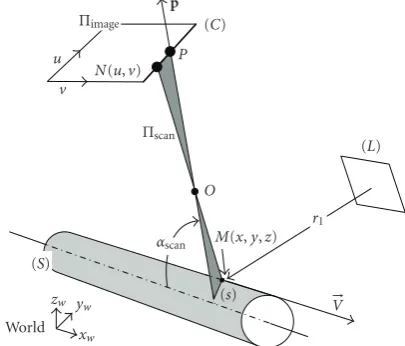
in image coordinate system (u,v). The positions of the ma-jor setup components (C), (L), and (S) are schematically de-picted inFigure 1.
The object to be inspected is moving along thexw axis,
the sensor (C) is placed so that the line-scan sensor (C) is parallel to the axisywand the optical axispOpasses through
the central axis of the object.αscanis the angle between planes
ΠscanandΠxw,yw. We choose anαscannearπ/2 to reduce at as
far as possible the recording distortions.
Let us now define more precisely the light source (L) which reveals both three- and two-dimensional surface de-fects. The imperatives are here afast moving of the surface(S) to inspect and afast detection and discriminationof the two-and three-dimensional defects on it. We define LPprojectedas
the projected light pattern onto the surface (S) and LPreflected
as the reflected pattern by (S). LPreflected which is disturbed
by the object geometryandthe two- and three-dimensional defects is then projected onto the sensor (C).
Measurement methods of high-reflective surfaces use the deformations of a projected fringe pattern, to retrieve the shape of the surface or detect the defective surface parts.
As specular surfaces reflect the incoming light only in one direction, the size and the geometry of the illumination de-pend on the shape of the inspected surfaces. In case of free-form specular surfaces with low varying surface vectors, a planar illumination with a reasonable size can be used to in-spect the whole object. Knauer et al. [13] use such a system with a flat illumination for the inspection of optical lenses. When the variations of the surface to be inspected are more pronounced, an adapted geometry of the illumination facil-itates the recording of the complete surface. Hence, in case of free-form shapes as car doors [15,16] or the coverage of headlights [17], a parabolic illumination allows to restrain the dimensions of the lighting screen to reasonable values. Different methods using adapted patterns and illumination source shapes are described by P´erard [18].
The structure of the observed fringe patterns in the im-ages is nonregular and depends on the shape of the illumi-nated surface. Hence, a preliminary calibration step retriev-ing the geometry of the recordretriev-ing setup is necessary. Ref-erences [15,16] compute the mapping between the cam-era points and the corresponding point on the illumination screen. Knauer et al. [13] use a precalibration procedure to retrieve the position of the camera and the geometry of the structured lighting in the world coordinate system.
Our approach is different. The common part with the ex-isting techniques is that we also adapted the geometry of the lighting to the cylindrical shape of the object under inspec-tion. But, the primary reason was to influence the aspect of the reflected light pattern LPreflectedin the camera image. Due
to the constant shape of the inspected surfaces, if the geom-etry of the reflected light pattern is known, the deformations of the fringe pattern induced by a defective object part are sufficient information to automatically detect this surface ab-normality. Hence, contrariwise to the above-cited methods, a precalibration step of the recording camera or the structured illumination is not necessary.
Therefore, the structure of the observed pattern is an im-portant aspect concerning the image processing algorithms.
p
P
N(u,v)
u
v Πimage
Πscan (C)
(L)
O
(s) (S)
αscan M(x,y,z)
r1
−→ V
World x w
yw
zw
Figure1: Position of the camera line-scan sensor (C), the illumina-tion (L), and the high-reflective cylindrical surface (S). The object is moving with a constant speedValong thexwaxis, the scanning planeΠscanhas an angleαscanwith theΠxw,ywplane. The elementary surface element (s) is characterized by a pointMof world coordi-nate (x,y,z).Mis illuminated by a light rayr1which is reflected on (s) and projected onto the camera sensor (C) so that the cor-responding image pointNof image coordinates (u,v) is obtained. The sensor (C) is characterized by the optical center of projection Oand the optical axisp. Vectorppasses through the pointOand is directed to the pointPat the central position of the sensor.
In fact, their complexity and so their processing time may increase with the complexity of the projected light pattern in the recording sensor. Thus, it is preferable to observe a reg-ular pattern in the camera image and so to simplify the im-age processing procedure. In our case, this reflected observed pattern in the images consists of a vertical, that is, parallel to the image axisv, periodical structure.
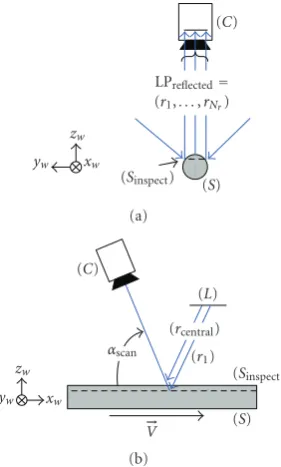
Figure 2shows the arrangement of theNrprojected light
rays forming the illumination (L) (which is adapted to the geometry of (S)) and the recording line-scan camera (C). The figure depicts (a) the front view and (b) the side view of the recording setup which consists in the scanning camera (C), the surface to inspect (S), and the illumination (L).
The depicted recording setup shows that with one line-scan sensor (C) and an adapted illumination (L) a large part of the surface (Sinspect) of the whole surface (S) can be
in-spected, (Sinspect) ∈ (S). The cylindrical metallic object is
moving with a constant speed−→V perpendicular to the line-scan sensor (C). The camera focuses near to the object sur-face. The depth of field is chosen to be sufficient to cover the whole curved surface (Sinspect). The numberNr of necessary
light rays depends on the lateral size (along theywaxis) of the
inspected surfaceSinspectand the minimal size of the defects
to be detected.
Figure 2(a)shows that the arrangement of the projected light pattern LPprojectedis calculated according to the
cylindri-cal geometry of the object surface, so that the reflected light pattern LPreflectedon the surfaceSinspectis projected onto the
LPreflected=
(r1,. . .,rNr)
(C)
(S) (Sinspect)
xw
yw
zw
(a)
(C)
(L)
(S) (Sinspect) (rcentral)
(r1)
αscan
− → V
xw
yw
zw
(b)
Figure2: Principle of adapted structured illumination for the in-spection of high-reflective surfaces of cylindrical objects, (a) front view and (b) side view. The cylindrical object is scanned during its movement with constant speedVby a line-scan sensor (C). (Sinspect) is the part of the surface of (S) that is inspected with one camera and one illumination.Nrlight rays (r1,. . .,rNr) are necessary to cover the whole surface (Sinspect).
Figure 2(b)depicts the reflection of two rays reflected by the object surface (Sinspect) and projected onto the camera
sensor (C): the central light rayrcentraland one extreme ray
r1. We clearly see that the Nr projected rays onto (Sinspect)
are not coplanar because we have chosen a scanning angle
αscan< π/2.
After describing how theNrrays forming the
illumina-tion are to be projected onto the surface, we detail more pre-cisely the different parts forming this adapted structured il-lumination (L).Figure 3shows the Lambertian light (D), the light aperture (AL), and the ray aperture (AR).
The adapted illumination for the structured light itself is composed of three parts: a Lambertian light source (D), a light aperture (AL), and a ray (AR) aperture.
Aim of the Lambertian light (D) surrounding the surface to inspect (S) is to create a smooth diffuse illumination to re-duce disturbing glares on the metallic surface due to its high reflectivity.
A part of the light rays emitted by (D) is passing theNr
slits of the ray aperture (AR). We assume that all the slits
have the same lengthLs and the same widthws. A certain
lengthLsis necessary as we know that the emitted rays which
are then projected into the sensor (C) are not coplanar; see
Figure 2(b). This length depends on the scanning angleαscan
and the diameter of the cylindrical object to inspectDO. The
widthwsdepends on the necessary lateral resolution along
theywaxis which is given by the projected pattern LPreflected
into the camera sensor (C). As this pattern has a sinusoidal structure of perioddP,mm, the widthws=dP,mm/2.
The light aperture (AL) is placed behind (D) to retain all
light, except the light rays needed to form the fringe pattern. The depicted illumination in Figure 3 is one possible method to project a periodical stripe pattern onto the sen-sor. Similar images could have been obtained with a screen projecting a sinusoidal pattern. In that case, an intermedi-ate reflecting element would have been necessary to adapt the planar light structure to the geometry of the cylindrical surfaces. The proposed solution has the advantage to be easy to manufacture, to be cheap, and to have reasonable dimen-sions.
As the whole surface (S) cannot be recorded with one camera, (Sinspect) < S, several cameras and corresponding
adapted structural illuminations must be used for covering the complete circumference of a metallic cylinder. The num-berNCof needed cameras depends not only on the diameter
of the objectDO, the width of the ray aperture’s slitswSbut
also on the distance between the surface to inspect and the recording sensor.Figure 4illustrates this statement by show-ing the reflection of the extreme light rayr1 and the cental
light rayrcentralonto the sensor (C).
This example shows that the lateral size of the inspected surface using the adapted structure illumination depends on the following parameters:DO,wS, and distance between
(Sinspect) and (C). From the lateral size of the surface (Sinspect),
the numberNCof needed cameras to record the whole
sur-face (S) can be deduced.
3.3. Image examples of recorded nondefective surfaces
The recording setup is operable if the image of the projected light pattern LPreflectedis characterized by a succession of
ver-tical parallel and periodical bright and dark verver-tical regions. This vertical pattern has to have a constant perioddP,px (in
pixel) in theudirection of the image. The ratio ofdP,pxwith
the perioddP,mm(in millimeter) of the pattern LPreflectedgives
the image resolution inudirection of the image coordinate system.
An image example of a cylindrical tube surface section illuminated with the proposed structured lighting is shown inFigure 5.
Here,Nr =21 rays are necessary to illuminate the
com-plete cross section of the surface (Sinspect). In this image, one
single horizontal image line corresponds directly to the scan line of the line-scan sensor at a certain point of timet. Thus, the depicted image is obtained by concatenating a certain number of single line scans, where the vertical resolutionv
corresponds directly to the number of line scans over a cer-tain period of time. All theNr bright stripes in the imagef
are vertical (along thevaxis) and parallel to the moving di-rection of the cylindrical object; seeFigure 2.
(C) (L)
(D)
(D) (Sinspect)
(AL)
(AR)
(AR) ws Nrslits
Ls
(a)
(b)
(c)
Figure3: Detailed principle of the adapted structured illumination for the inspection of high-reflective surfaces of cylindrical objects. The adapted structured illumination is composed of a ray aperture (AR), a Lambertian diffuse light (D), and a light aperture (AL). (a) Side view of the whole illumination, (b) front and side views of the ray aperture (AR), and (c) front and side views of the Lambertian diffuse light (D).
(C)
DO
(rcentral)
(Sinspect) (r1)
ws
Figure4: Projection of the extreme light rayr1and the cental light rayrcentralonto the sensor (C) using the adapted structured illumi-nation. As each slit of the ray apertureARhas the same widthws, the reflected rays on the surface are more or less spread, depending on the diameter of the objectDOand the distance between the surface to inspect and the recording sensor. Here is the example of the pro-jected extreme light rayr1and cental light rayrcentralonto the sensor (C).
noise categories. The first is the unavoidable but uncritical camera noise due the electronic devices of the camera. The second is due to the geometry of the object and the illumi-nation as stated according toFigure 4. The second kind of recording noise can clearly be seen with a close look at the stripe image ofFigure 5where we observed a decrease of the contrast for the left and right vertical stripes.
To summarize, for every illuminated elementary surface (s) of the nondefective surface (Sinspect), we have ideal
re-flection coefficientsρs = ρs,OK and ideal reflection angles
αs=αs,OK; see the left image ofTable 1. We fix the ideal
re-flection coefficient to be maximal, that is,ρs,OK=100%. This
u
v
Nr=21
(Sinspect)
DO=9.5 mm
dP,px
Figure5: Typical image of a specularnondefectivecylindrical sur-face of diameterDO=9.5 mm obtained with the adapted structured illumination.dP,pxis the period in pixel of the depicted stripe pat-tern in the image.
corresponds to the maximal value in the images, the inten-sity value of the vertical bright stripes therefore always equals 255, which is the maximal possible value as the depth of all the considered images is of 8 bits.
As defined inFigure 5, for the recording of the surface we need at leastNc =6 adapted illuminations and cameras to
record and inspect the complete surface (S) of the cylindrical object.
3.4. Revealing textural and structural defects
The goal of the described recording setup is to emulate the inspection process of a human visual inspector, to accentuate both two- and three-dimensional defects on the object sur-face at the same time. We saw inFigure 5how nondefective surfaces are depicted, let us now have a look on depicted tex-tural and structex-tural defects on cylindrical metallic surfaces recorded under the proposed illumination; seeFigure 6.
Considering these height image examples, we observed that different types of defects (textural and structural) in-duce a different kind of stripe disturbances. For textural de-fects, mainly the intensity of the adapted stripe illumination decreases. This can even lead to the effect that neighboring dark and light regions are melted; see Figures 6(a1)–6(c1). However, for structural defects, the parallel structure of the stripes is deformed or vanished; seeFigure 6(d2).
In our four textural defects examples, we see that the cor-responding image disturbances are due to a decrease of the reflected intensity. This means that the reflection coefficients of all the elementary surfaces (S) characterizing those two-dimensional defects are lower than the reflection coefficients of nondefective surfacesρs < ρs,OK. This is therefore a suffi
-cient condition to reveal this kind of defects in the images. Concerning the four structural defects examples, the sit-uation is slightly different. We observe naturally a deforma-tion of the projected vertical stripes in the image which is due to a change in the reflection angle,αs=/αs,OK. However,
we also observed a decrease in the intensity of the projected stripes. First, when the texture of the surface is damaged, we have the same conditions as for textural defects, that is,
ρs < ρs,OK; see the inner part of the “3D wear” and “3D
(a1) (b1) (c1) (d1) “2D grease” “2D scratch” “2D rough” “2D mark”
(a2) (b2) (c2) (d2)
“3D hit” ∼20μdepth
“3D wear” ∼20μdepth
“3D cavity” ∼20μdepth
“3D abrasion” ∼10μdepth
Figure6: Image examples of different surface defects recorded with the adapted structured illumination. (a1) the “2D grease” figure shows a grease mark on the surface; (b1) the “2D scratch” depicts a lightly scratched surface; (c1) “2D rough” is due to an abrasion of object surface during surface finishing process; (d1) a typical marking on the surface is depicted in image “2D mark.” Four image examples of different depth defects. (a2) “3D hit” reveals a strong damaged surface, (b2) “3D wear” is due to the mold of an external particle on object surface, (c2) “3D cavity” is due to the pressing of an external object on the surface, and (d2) “3D abrasion” shows a strongly locally polished surface.
(a1) (b1) (c1) (d1)
“2D grease” “2D scratch” “2D rough” “2D mark”
(a2) (b2) (c2) (d2)
“3D hit” ∼20μdepth
“3D wear” ∼20μdepth
“3D cavity” ∼20μdepth
“3D abrasion” ∼10μdepth
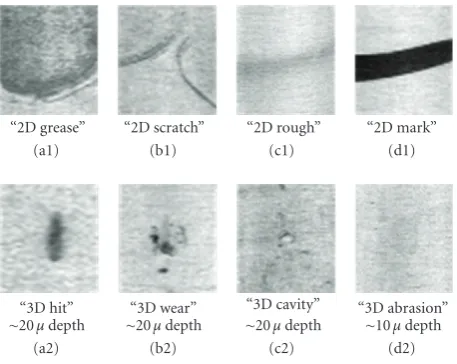
Figure7: Image examples of different surface defects recorded with a diffuse illumination. Same textural “2D grease,” “2D scratch,” “2D rough,” “2D rough” and structural “3D hit,” “3D wear,” “3D cavity” “3D abrasion” images as shown inFigure 6.
disturbed stripes at the borders of the “3D hit” and “3D abra-sion” defects. We observe that those bright stripes follow the contours of the defects where the angle of the surface nor-mal changes in the lateral yw direction (seeFigure 2(a)). If
the angle of the surface normal changes in the longitudinal (xw;zw) direction (seeFigure 2(b)) less light flux is projected
onto (C) so that the intensity of the bright stripes in the im-age decreases.
Hence, a variation of the surface normal without a change of the reflection coefficient, which is characteristic to a structural defect, can lead to similar disturbances in the stripe image than a textural defect would induce. See, for ex-ample, the inner parts of the “3D abrasion” image and the “2D rough” image of Figures6(d2),6(c1). The direct con-sequence is that, if allthe variations of the surface normal of a structural defectonlyoccur in the plane (xw;zw), then
this defective structural surface would not be distinguishable from a textural defective part.
This particular case of structural defect structure has a very low probability to occur as in case of the inspection task, all structural defects to detect have an irregular and random structure. This illumination technique is therefore totally ad-equate for the visual enhancement and discrimination of tex-tural and structex-tural defective parts of cylindrical surfaces as it will be demonstrated in the next sections.
4. COMPARISON OF THE PROPOSED METHOD WITH TWO DIFFERENT ILLUMINATION PRINCIPLES
The described recording setup is one possible illumination technique among several others, used in industrial image processing and machine vision systems.
To demonstrate that the proposed adapted stripe illumi-nation integrates two different illumination techniques (dif-fuse and directed) for the detection of textural and struc-tural defects, we performed further recordings of the high-reflective surfaces described inSection 3. We use adiffuseand aretroreflectorillumination technique. We show that the for-mer does not increase the visibility of all the structural de-fects whereas the latter is too sensible to the nondefective sur-face structures.
4.1. Use of a diffuse illumination technique
First recordings with the involved high-reflective surfaces were made using a smooth diffuse illumination. The purpose was to increase the visibility of textural changes of the surface and to evaluate the enhancement possibilities for structural defects.
A concrete idea of the surface texture enhancement pos-sibilities using a diffuse technique is given inFigure 7where the same eight metallic surfaces as showed inFigure 6with the adapted structured illumination are depicted. Figures
7(a1)–7(d1) depict textural defects whereas Figures7(a2)–
7(d2) depict structural defects.
Obviously, the surfaces exhibiting textural defects dem-onstrate that a smooth illumination is fully appropriate for revealing defective object textures whose reflectivity is less than nondefective surfaces textures. Interestingly, the figures depicting textural defects show that also depth structures can be revealed with this kind of illumination technique. The necessary condition is that the surface reflectivity of the defect differs from the reflectivity of good surface. But the major drawback of this illumination is that some struc-tural defects, in particular those with a small depth (see
(a1) (b1) (c1) (d1) “2D grease” “2D scratch” “2D rough” “2D mark”
(a2) (b2) (c2) (d2)
“3D hit” ∼20μdepth
“3D wear” ∼20μdepth
“3D cavity” ∼20μdepth
“3D abrasion” ∼10μdepth
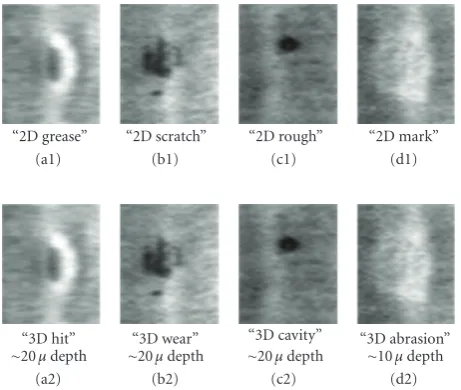
Figure 8: Image examples of different surface defects recorded with a retroreflector. Same textural “2D grease,” “2D scratch,” “2D rough,” “2D rough” and structural “3D hit,” “3D wear,” “3D cavity” “3D abrasion” images as shown inFigure 7.
The eight images examples (Figure 7) illustrate the im-portance of a smooth illumination when textural defects have to be detected on high-reflective surfaces, and also demon-strate the limits of a diffuse illumination when depth struc-tures have to be revealed. In fact, when the texture of the defect has a similar reflectivity as a nondefective surface, as in Figures7(c2) or7(d2) the defect is quasi-revealed not re-vealed in the images.
Therefore, this illumination approach is not suitable to the inspection task as defined inSection 2.
4.2. Use of a retroreflector illumination
One of the first applications of the retroreflector technique for the quality inspection of specular surfaces was proposed by Marguerre [11]. He showed that this technique is partic-ulary adapted for the enhancement of small surface defor-mations and presents his method as a good possibility to enhance three-dimensional surface structures or surface re-gions with different specular properties.
We tested this approach to evaluate how far this method is suited for the inspection of our high-reflective surfaces. We record the same textural and structural defects as depicted in Figures6and7. The results are shown inFigure 8.
At first sight, the two major defect types which are the textural and the structural are well enhanced. The images of the former are similar to the results obtained with the diffuse technique whereas the latter are also well enhanced, which was not the case using the “smooth” illumination. So, this approach seems to give satisfying results concerning the in-crease of nondefective surfaces as for the proposed structured lighting technique; seeFigure 6.
In fact, the obtained images using this technique are sim-ilar to the conclusions of Marguerre [11]. He says that plac-ing a retroreflector in the optical setup is equivalent to
high-(a1) (b1) (a2) (b2)
Figure9: Image examples of two different nondefective surfaces. (a1) and (b1) depict the same nondefective surface recorded with a structured and a retroreflector lighting, (a2) and (b2) depict an-other nondefective surface recorded with a structured and a retrore-flector lightings.
(a) (b1) (b2)
Figure10: Image examples with typical recording artefacts due to bad-positioned objects. (a) ideal depiction of a nondefective sur-face, the stripe pattern in the image is not disturbed; (b1) change of object position in they-direction during surface recording, (b2) bad-positioned object corresponding to a rotation around the y -axis.
pass filtering the resulting images without retroreflector. To be sure if this method is suitable for our inspection purpose, we made further tests by recording nondefective surfaces; see
Figure 9.
We highlighted that the retroreflector technique is a highly sensitive method. Even in the case of nondefective sur-faces, high grey level variations can be observed in the im-ages. Contrariwise, the images of the same surfaces obtained using the proposed illumination do not show these pertur-bations.
The textural defects seem to be well visually enhanced with the retro technique, a discrimination with textural de-fect is not possible. Figures8(b2) and8(c2) clearly demon-strate that textural defects can be depicted with similar grey values than textural surfaces.
5. DIRECT APPLICATION IN AN INDUSTRIAL ENVIRONMENT
We proposed a new lighting technique for specular surfaces inspection by visually enhancing the textural and structural defects without revealing nondefective surfaces in the same time. We compared our results with a diffuse and a retrore-flector lighting technique and showed that for both tech-niques the results are not as good as for the proposed adapted stripe illumination.
i=15
j
=
30
x
y
fj
(
x
)
x
146 201
255 255 255 210
152
i−3 i−2 i−1 i i+ 1 i+ 2 i+ 3
fi j,max=255
x
y
j−3
j−2
j−1
j
j+ 1
j+ 2
j+ 3
35.9 35.7 36.3 36.1 35.8 35.9 36.1
· · · · · · 0.1 0.2 0.2 · · · · · ·
xi j∗,maxs∗i j,max
θ(s)=5
s∗i j,max=0.2
=|35.7–35.9|
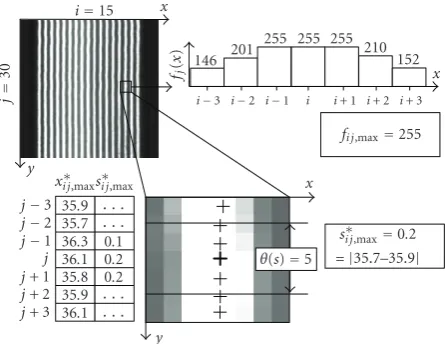
Figure 11: Determination of the shape s∗i j,max and the intensity fi j,maxvalues at maximum positionx∗i j,maxfor a stripe image. The determination of those three parameters is done for maxima at po-sitionsi=5 and j=30. The shapes∗i j,max=0.02 and the intensity fi j,max values correspond to optimal recording conditions, that is, when nearly no bright stripe disturbance occurs.
constraint is not only to achieve a high inspection’s quality but alsoto reach a high productivity. It is therefore quasi-not possible under those conditions to obtain a constant image quality of the recorded surfaces. We show two typical exam-ples of artefacts arising when the recording conditions are not optimal.
We briefly introduce the involved algorithm for the auto-matic segmentation and classification of structural and tex-tural surface defects illuminated with this specular lighting. We show that the proposed method is robust against record-ing artefacts and that a good discrimination between non-defective surfaces, textural defects, and structural defects is possible.
5.1. The problem of specular lighting’s artefacts
The images shown in Section 3 clearly demonstrated the strength of the proposed illumination for surface character-ization. Up to here, we only consider the stripe disturbances caused by critical surfaces, we did take into account possi-ble image artefacts arising when specular surfaces are illumi-nated with directional light.
When the recording conditions of object surface are opti-mal, the quality of the stripe pattern is similar to the depicted surface inFigure 10(a). If not, that is, when recording arte-facts occur, the bright lines are disturbed, as it can be seen in Figures10(b1)-10(b2).
Each of those two artefacts identify one consequence of nonoptimal positioned object surface. Stripe pattern of
Figure 10(b1) shows similar properties to the disturbances caused by structural defects, when αs=/αs,OK, whereas the
disturbances induced by textural defects, whenρs=/ ρs,OK, are
close to those observed inFigure 10(b2).
Causes for such types of disturbances are usually in-evitable uncorrect or imperfect recording conditions.
Typi-cal disturbances are short lateral deviations iny-direction of the inspection object with respect to a fixed geometry be-tween object, sensor, and illumination, leading to a short-term horizontal distortion in the depicted stripe pattern. See
Figure 10(b1) where the complete bundle of reflected rays (R) is displaced in the image. Also, a bad-positioned or de-justified object with respect to the image sensor can yield to inhomogeneous illuminated surfaces and thus wrong condi-tioned images. InFigure 10(b2), the plane defined by the re-flected ray bundle (R) does not correspond to the projection plane of the recording sensor.
5.2. Quantifying image quality
The ideal recording conditions as defined inSection 3.3 can-not be fulfilled at 100% in an industrial context. The record-ing artefacts characterized by a shape distortion and/or an intensity decreasing of bright lines are quasi-unavoidable. To evaluate the influence of such artefacts on the discrimina-tion process of nondefective and defective surfaces, we must quantify thequalityof the depicted stripe pattern in an im-age. Two criteria are here important: theshapeand the inten-sityof the bright lines.
The question is “how far can recording artefacts disturb the projected stripe pattern, so that the surface inspection process is still acceptable?”.
To answer this question, we must quantify the shapes and the intensities of the depicted bright lines in an image f. Those values, both calculated from the picture elements of the images, will help us to evaluate the degree of bright lines disturbance.
Each imagefof sizeNx×Nyis characterized byNl
ver-tical bright lines depicted with a periodd(P). The function
f(x,y) is the two-dimensional discrete representation of f and is represented in a cartesian coordinate system whosex -axis is horizontal with ascendant value from left to right and
y-axis is vertical with ascendant values from top to bottom. Upper-left image point at pixel position (0, 0) of f(x,y) cor-responds to the origin of the coordinate system.
At first, we estimate theNy×Nlpositions of allNlbright
lines. We call those positions the maximax∗i j,maxof the
im-age f, i = 1,. . .,Nl defines the bright line number and
j =1,. . .,Nythe position along image’sy-axis. All maxima
xi j∗,maxare estimated with a high accuracy inx-direction.
One major problem concerning the detection of the max-ima is that most of the brightest points are mapped to a value of 255. This clipping is unavoidable, as high-reflective sur-faces are involved. Hence, for the detection of the maxima at subpixel levelx∗i j,max, we implemented and compared two
dif-ferent methods: the center-of-mass and the Blais-and-Rioux operators. The first uses the distribution of the grey level to retrieve the positions of the maxima, whereas the second ap-plies a local linear interpolation at the zero-crossing of the first derivative. Both methods are detailed described in Fisher and Naidu [19].
Concerning the synthetic images, the evaluation criterion was the detection error between the estimated and the known maxima positions. For the real images, we used the classifica-tion rates as evaluaclassifica-tion criterion. Both series of tests showed that the grey level distribution center-of-mass method out-performs the zero-crossing Blais-and-Rioux approach.
Once the maximaxi j∗,maxare computed, we calculate the
corresponding shapes∗i j,max∈Rand intensity values fi j,max∈ Z.Figure 11shows the computing principle for image func-tion f(x,y) ∈ Z64×64 of shapes∗
i j,max and intensity fi j,max
values of maximaxi j∗,maxfori= 5 and j =30 (fy(x) is the
one-dimensional discrete representation of a horizontal im-age line of lengthNx).
The computation of theNy×Nlshape valuess∗i j,maxfor
eachx∗i j,maxcan be stated as follows:
s∗i j,max= ⎧ ⎪ ⎪ ⎪ ⎪ ⎪ ⎪ ⎪ ⎪ ⎪ ⎪ ⎨ ⎪ ⎪ ⎪ ⎪ ⎪ ⎪ ⎪ ⎪ ⎪ ⎪ ⎩
a1−a2 ifa1−a2< θ(), a1−a2=2θ(s) + 1,
a1=x∗i(j+θ(s)),max,
a2=x∗i(j−θ(s)),max,
0 otherwise,
(1)
θ(s) and θ() are threshold values depending on bright stripe’s shape and period d(P). The shape value s∗i j,max is
computed using two subpixel positions xi∗(j−θ(s)) max and
xi∗(j+θ(s)),max of a bright stripe so that |xi∗(j+θ(s)) max −
xi∗(j−θ(s)),max|< θ()< d(P). Shape value is minimal when no bright stripe disturbances occur,s∗i j,max=0.2 for the example
given inFigure 11.
Bright line’s intensities fi j,max at maximax∗i j,maxare the
corresponding value of image function f(x,y). Figure 11
represents the ideal case when fi j,max=255.
The bright stripe disturbances of a complete image or an image region are characterized withSandI, the mean values of maxima’s shapes∗i j,maxand intensity fi j∗,maxof this image or
this image region. Both expressions are written as follows:
S= 1
Nl×Ny Nl
s=1 Ny
j=1
s∗i j,max,
I= 1
Nl×Ny Nl
i=1 Ny
j=1
i∗i j,max.
(2)
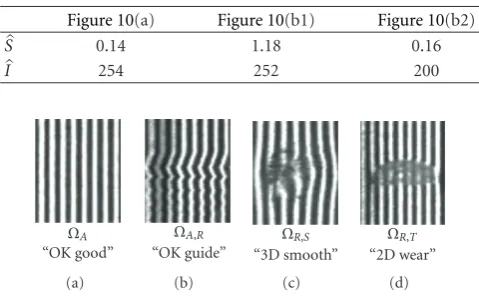
The average shape Sand average intensity Ivalues of bright lines give us an estimation of their disturbance degree. As an example,Table 2lists the values ofSandIof the three stripe image examples depicted in Figures10(a),10(b1), and
10(b2).
5.3. Influence of artefacts on classification performances
We know that recording artefacts are quasi-unavoidable for the target industrial context. Therefore, the classification
Table2: Values of average shapeSand intensityIfor the three im-ages depicted in Figures10(a),10(b1), and10(b2).
Figure 10(a) Figure 10(b1) Figure 10(b2)
S 0.14 1.18 0.16
I 254 252 200
ΩA “OK good”
(a)
ΩA,R “OK guide”
(b)
ΩR,S “3D smooth”
(c)
ΩR,T “2D wear”
(d)
Figure12: Four stripe images of dimension 64×64 pixels. Those images are part of setwte and were recorded by the visual inspec-tion system. The two first images depict nondefective surfaces: (a) image with good quality without any artefact, (b) disturbed stripes corresponding to mechanical, that is, recording artefacts. The two last images depict (c) a superficial structural defect∼10μm and (d) a textural defect corresponding to a “wear” of the surface.
method used for discriminating defective from nondefec-tive surfaces must not be perturbed by nonoptimal record-ing conditions. How far artefacts can influence the inspection performances and how far they may represent an additional difficulty for the discrimination task will be discussed in this section.
We consider a test image samplewte made of 188
im-ages depicting typical surfaces recorded by the industrial sys-tem. All reference images have been used for the qualifica-tion of the system and were classified by a visual inspector in four main image sets. We have 40 nondefective surfaces with-out artefactswAand 62 nondefective surfaces with recording
artefacts wA,RA, 51 nonefective surfaces with structural
de-fectswR,S, and 35 nondefective surfaces with textural defects
wR,T.
Figure 12gives an example of some typical object sur-faces. All images correspond to an object surface of 2 mm width and 6 mm height and are part of the test setwte.
Reso-lution inxdirection is three times greater than the resolution in ydirection, so that all images have square dimensions of 64×64 pixels.
The depicted stripe images give an example of typical object surfaces to inspect. For each of the four considered defect sets{wA,wA,R,wR,S,wR,T}, one example is shown.
Fig-ures12(a)and12(b)show nondefective surfaces. In the for-mer, no disturbances occur and in the latter typical guid-ing disturbances are depicted. A structural defect is shown in
Figure 12(c), the depth is about 10μm and is due to a crush-ing of the object. Size of “3D deep” defect is relatively big with ∼7 disturbed periods inxdirection.Figure 12(d)depicts one textural defect due to the grating of the tube surface with an object.
253 233
213 193
173 153
Average intensity valueI
0 2 4 6 8 10 12
N
u
mb
er
of
images
of
se
t
wte
Distribution of average intensity valueI
wA
wA,R
wR,S
wR,T
(a)
1.5 1
0.5 0
Average shape valueS
0 2 4 6 8 10 12 14 16 18 20
N
u
mb
er
of
images
of
se
t
wte
Distribution of average shape valueS
wA
wA,R
wR,S
wR,T
(b)
Figure13: Distribution of average shapeSand intensityIvalues for all images of subsetswAand for the disturbed image regions of subsets wA,R,wR,S, andwR,T, wherewte= {wA,wR,S,wR,S}.
if (d2(ρc;c)≤d2(jc;c)), (jc∈Ω
κ), then (c∈Ωκ),
ρc∈RNtr, jc∈ RNtr, c∈RNte,
∀κ∈ {1,. . ., 3},
∀ρ∈ {1,. . .,j−1,j+ 1,. . .,Ntr},
∀j∈ {1,. . .,Ntr}.
Algorithm1:i
disturbed image regions of subsetswA,R,wR,S, andwR,T. The
values ofSandIare reported inFigure 13.
Those two Graphes clearly illustrates two items. First, the average valuesSandIof defect surfaces, setswR,SandwR,T,
and nondefective surface without artefacts, setwA, are nearly
disjoint. Second, the distribution of shape and intensity val-uesSandIfor the nondefective surface with recording arte-facts setwA,Rcovers the whole range of values, a clear
thresh-old separating nondefective from defective surfaces here is not obvious. The fact is that recording artefacts dramatically complicate the classification task consisting in discriminating nondefective and defective surfaces. Bright lines shape and intensity seem to represent good but not sufficient character-istics to solve this discrimination task.
We illustrate the classification difficulty by introducing a shapeγS = 0, 18 and an intensityγI = 246 threshold. We
consider an image as depicting a nondefective surface if its average shape valueSis bellowγSor if its average intensity
valueIis aboveγI. In this case, we classify all 20 images of
set wte,A as non-defective surfaces and only 1 image of set
wte,R,S as a nondefective surface also. But in the same time
we would falsely classify nearly all images of set wte,A,RA as
defective surfaces. In the same way, we classify most of the images of set wte,A as nondefective. The major problem in
this case is that images of setww,RAhave similar values ofIas
images of setsww,3Dandww,2D.
This concrete example demonstrates that other charac-teristic stripe features have to be defined, which brings us to the proposed classification algorithm.
6. THE PROPOSED PATTERN RECOGNITION ALGORITHM
If the proposed specular lighting technique shows good re-sults in visually enhancing critical surfaces, its application in an industrial environment induced nonoptimal recording conditions. This leads to image disturbances similar to those induce by surface defects so that the discrimination task be-comes more difficult.
To overcome this problem, an adaptive algorithm was de-veloped for the automatic inspection of structured illumi-nated surfaces. This method shows its robustness as it is part of a widely used real-time industrial application.
The core component of the algorithm is the selection and the extraction of the features best describing the image con-tents. The first step of the algorithm consists in building the feature vectorc ∈ RNc for all stripe image patternf. This
process filters the most irrelevant information, transforming an image of sizeNx·Nyinto its signaturecof dimensionNc,
whereNc Nx·Ny. The feature vector building process is
made of different steps, each one corresponding to a dimen-sionality reduction.
Then, only imageregionscorresponding to characteristic shape, distance, and intensity values of bright and dark lines are retained in setsMR,maxandMR,min.
Finally, further image regions englobs the regions defined byMR,maxandMR,minare built. Those segmented image
re-gions define the relevant information and so the feature vec-torc.
For the classification procedure, we consider three classes: the class of nondefective surfaces ΩA grouping the
nondefective surfaces recorded with and without artefacts, the class of structural defects ΩR,T, and the class of
textu-ral defectsΩR,T. The task then consists in assigning a class
Ω= {ΩA,ΩR,T,ΩR,S}to each patternfaccording to feature
vectorc. In addition to the test setwtedefined earlier, we
con-sider atraining setwtrmade of 116 images,wtr wte=∅.
The classification scheme we used is a supervised learning one, the class of each patternf⊂wtrandf⊂wteis known.
From the possible statistical learning approaches ordecision
ruleswe decide to chose one of the most popular approachs
and easy to implement methods: the nearest-neighbor clas-sification (k-NN) (Yang and Liu [20] refers to thek-NN rule as one of the most efficient methods). This is a reasonable approach as our aim is to compare different feature extrac-tion methods for stripes images and not to test and to op-timize different classifiers. Thek-nearest neighbor (k-NN) technique assigns a feature vectorc∈RNte from test setw
te
to the classΩκof the majority of itsk-nearest-neighboring
image patterns from training setwtr. We consideronenearest
neighbork =1 and use the euclidian distanced2as metric
space for feature vectors pairs. Mathematical expression of
k-NN can be stated as shown inAlgorithm 1.
The classification algorithm consists of an initial training phase using images of setwtrto define the optimal
param-eters adjustment. Then classification performance is mea-sured with the test setwtewhile comparing the true state with
the detected state.
7. CLASSIFICATION RESULTS
The classification is done using the images of setwtewith the
optimized parameters of the algorithm. We would like to un-derline that we have tried to make this test set as represen-tative as possible. The number of images of setswA,wA,R,
wR,S, andwR,T is proportional to the number of images that
are classified by the industrial system and the proportion of badly depicted stripes, that is, with a low quality, corresponds to real recording condition.
The parameters of the algorithm were adjusted in such a way that the inspection conditions defined by the indus-trial process are fulfilled: 100% detection of all defects, 100% classification of all structural defects as structural ones, and
<10% false classified nondefective surfaces, see Section 2. The classification results are depicted inTable 3.
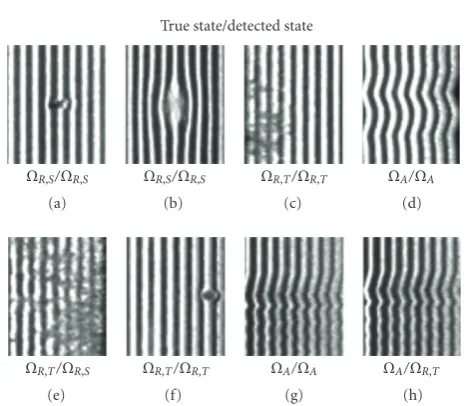
We observed that these classification results are conform with the constrains defined in the industrial requirements. Some image examples with corresponding classification re-sults are shown inFigure 14.
The first group of images (Figures14(a)–14(d)) shows examples of typical surfaces. Figures 14(a)-14(b) depicts
Table3: Classification of image set wte ∈ R188 recorded under industrial real time conditions using the proposed algorithm. The classification task consists in assigning each image of setwteto one of the three distinct classesΩA,ΩR,S, andΩR,T.
True state
ΩA ΩR,S ΩR,T
Detected state
ΩA 94 0 0
ΩR,S 8 51 6
ΩR,T 0 0 29
(a) (b) (c) (d)
ΩR,S/ΩR,S ΩR,S/ΩR,S ΩR,T/ΩR,T ΩA/ΩA True state/detected state
(e) (f) (g) (h)
ΩR,T/ΩR,S ΩR,T/ΩR,T ΩA/ΩA ΩA/ΩR,T
Figure14: Examples of classified imagesf of set wte. Images (a) and (b) show two good classified textural defects. The former has a size of∼0.3 mm and the latter of∼1.5 mm. Images (c) and (d) show two good classified images representing a structural and a recording artefacts. Images (e) and (f) depict a textural defect (classified as structural) and a good classified textural surface. Images (g) and (h) are nearly the same recording artefact, but the former was classified whereas the latter was wrongly classified as a textural surface.
structural defects of different sizes, a textural defect is shown in Figure 14(c) and a recording artefact can be seen in
Figure 14(d).
The second image group gives a good impression of the difficulty of the discrimination task.Figure 14(e) expresses a wrongly classified textural defect as a structural one. Using this image and the image shown inFigure 14(f), we observed that the size of bright stripes deviation is approximately the same, namely of half a periodd(P). But, the former was clas-sified as textural whereas the latter as structural by the visual inspector. Maybe because the human vision also integrates the size of the defect in his judgement, the real depth of a de-fect is certainly more difficult to appreciate when the struc-tural disturbances are small and cover a huge surface region. Our last remark concerns the two last images, Figures
correspond to structural and textural values; seeFigure 13. Another important factor explaining the bad discrimination is the “contrast” of the bright lines, which is much less steep than in Figures14(a) or14(b) for example.
8. CONCLUSION
In this paper, we presented an original usage of adapted structural illumination. This lighting technique integrates a Lambertian diffuse part for the inspection of specular sur-facesanda light aperture to project a structured light on the inspected surface. The geometries of both are adapted to the shape of the inspected objects, so that a simple periodical pattern is observed in the images.
We demonstrated that a good enhancement of structural and textural defects (without revealing nondefective surfaces in the same time) is achieved. All the necessary information is contained in one camera image, no stereo vision is needed to discriminate the different nondefective surface types.
We also compared the proposed approach with diffuse and retroreflector lighting techniques. This shows some diffi -culties in enhancing all structural defects, whereas the second tends to be too sensitive as a noncritical surface structure.
We validated the proposed lighting technique using the images recorded by a daily used industrial application inte-grating such an adapted structured illumination. These im-ages are classified using a segmentation and classification al-gorithms. No calibration of the recording setup elements, which are the sensor, the illumination, and the specular sur-face is needed. We show that a good discrimination of tex-tural, structex-tural, and nondefective surfaces with nonoptimal recording conditions, that is with recording artefacts, is pos-sible.
The next step will be to consider 2.5D rather than 3D technique to measure the depth of the defects with only one camera and one adapted illumination. Based on a simple cal-ibration procedure, we want to propose a new deflectometric approach with an adapted structured illumination.
LIST OF SYMBOLS OF THE MAIN COMPONENTS
(C): Recording camera sensor
(L): Light source/illumination
(S): Whole surface to inspect
(Sinspect): Surface inspected with one camera
(s): Elementary inspected surface
ρ: Specular reflectance coefficient, %
α: Specular reflectance angle, rad
Πscan: Recording plane of a line-scan camera
(LPprojected): Projected illumination pattern on (S)
(LPreflected): Reflected illumination pattern by (S)
Nr: Number of projected rays by (L)
(dP,mm): Illumination pattern period, mm
(dP,px): Illumination pattern period, pixel
f: Image pattern
(xw,yw,zw): World coordinate system
(u,v): Image coordinate system.
ACKNOWLEDGMENTS
The authors are grateful to Mr. Marco Flachman, a colleague of the Fraunhofer IIS in Erlangen, for his help in compar-ing different illumination techniques. They would like to thank the Bavarian Research Foundation BFS (Bayerische Forschungsstiftung) for its financial help, which helped them to fulfil their research activities. They also would like to thank the reviewers for their helpful comments which contributed to improve the quality of the manuscript.
REFERENCES
[1] S. Schuetz, Gewinnung von 3-d-Information durch Strukturi-erte Beleuchtung, 200.
[2] P. Lang, “ Multisensorielle Pruefung von Freiformflaechen, Ph.D. thesis,” Fraunhofer, Stuttgart, Germany, 1999.
[3] O. Hall-Holt and S. Rusinkiewicz, “Stripe boundary codes for real-time structured-light range scanning of moving objects,” in Proceedings of the 8th International Conference on Com-puter Vision (ICCV ’01), vol. 2, pp. 359–366, Vancouver, BC, Canada, July 2001.
[4] T. P. Monks, J. N. Carter, and C. H. Shadle, “Colour encoded structured light for digitisation of real-time 3-d data,” in ceedings of the IEE 4th International Conference on Image Pro-cessing, pp. 327–330, Maastricht, The Netherlands, April 1992. [5] H. Ortiz and M. Paterson, “Location and shape measurement using a portable fringe projection system,” Experimental Me-chanics , vol. 45, no. 3, pp. 197–204, 2005.
[6] S. Winkelbach and F. Wahl, “Shape from single stripe pattern illumination,” inProceedings of the 24th DAGM Symposium on Pattern Recognition, vol. 2449 ofLecture Notes in Computer Sci-ence, pp. 240–247, Zurich, Switzerland, September 2002. [7] Isra, “A fast paper inspection system,” Tech. Rep., Isra Vision
System AG, Darmstadt, Germany, 2005.
[8] F. P. Le ´on and J. Beyerer, “Active vision and sensor fusion for inspection of metallic surfaces,” inProceedings of the Intelligent Robots and Computer Vision XVI: Algorithms, Techniques, Ac-tive Vision, and Materials Handling, vol. 3208 ofProceedings of SPIE, pp. 394–405, Pittsburg, Pa, USA, September 1997. [9] CLK: Beetanalyser, Industry product informationhttp://www
.clkgmbh.de/geschaeftsfelder-produkte/food-packing/. [10] R. L. Reynolds, F. Karpaia, D. A. Claarke, and O. L. Hageniers,
“Theory and applications of a surface inspection technique us-ing double-pass retroreflection,” Optical Engineerus-ing , vol. 32, no. 9, pp. 2122–2129, 1993.
[11] H. Marguerre, “Kontrastierverfahren fuer Kruemmungen und Welligkeiten an Oberflaechen zur Qualitaetspruefung,” z. b. von Lackoberflaechen. Feinwerktechnik und Messtechnik 9, 1985.
[12] A. Jordan, F. Kahmann, and F. Luecking, “Dual solution for high-end stripe inspection,” Material Testing , vol. 26, no. 4, pp. 66–71, 2003.
[13] M. C. Knauer, J. Kaminski, and G. Haeusler, “Phase measur-ing deflectometry: a new approach to measure specular free-from surfaces,” Optical Metrology in Production Engineering, vol. 5457, pp. 366–376, 2004.
[14] H. Niemann, Pattern Analysis and Understanding , Springer Series in Information Sciences, Springer, Berlin, Germany, 2nd edition, 1990.
ofProceedings of SPIE, pp. 254–264, Orlando, Fla, USA, April 2003.
[16] S. Kammel and F. P. Le ´on, “Deflektometrie zur qualit¨ats-pr¨ufung spiegelnd reflektierender oberfl¨achen,” Technisches Messen , vol. 70, no. 4, pp. 193–198, 2003.
[17] S. Kammel, “Deflektometrische untersuchung spiegelnd reflek-tierender freiformflchen, Ph.D. thesis,” University of Karlsruhe (TH), Karlsruhe, Germany, 2004.
[18] D. P´erard, “Automated visual inspection of specular surfaces with structured-lighting reflection techniques, no. 869, Ph.D. thesis,” VDI Verlag, ¨usseldorf, Germany, 2001.
[19] R. B. Fisher and D. K. Naidu, “A comparison of algorithms for subpixel peak detection,” in Advances in Image Processing, Multimedia and Machine Vision , J. Sanz, Ed., pp. 385–404, Springer, Heidelberg, Germany, 1996.