Volume 2007, Article ID 56365,13pages doi:10.1155/2007/56365
Research Article
Efficient and Syntax-Compliant JPEG 2000 Encryption
Preserving Original Fine Granularity of Scalability
Yang Yang,1Bin B. Zhu,2Shipeng Li,2and Nenghai Yu1
1Department of Electrical Engineering and Information Science, University of Science and Technology of China,
Hefei, Anhui 230027, China
2Microsoft Research Asia, Beijing 100080, China
Correspondence should be addressed to Bin B. Zhu,[email protected]
Received 29 June 2007; Revised 29 October 2007; Accepted 23 November 2007
Recommended by E. Magli
A novel syntax-compliant encryption primitive and an efficient syntax-compliant JPEG 2000 encryption scheme are presented in this paper. The syntax-compliant encryption primitive takes, as input, syntax-compliant plaintext and produces syntax-compliant ciphertext. It is faster than all the other syntax-compliant encryption primitives we know. Our JPEG 2000 encryption scheme en-crypts independently either each codeblock segment (normal mode) or each intersection of a codeblock segment and a codeblock contribution to a packet (in situ mode). Truncation-invariant parameters uniquely identifying each independently encrypted data block are combined with a global initialization vector to generate on the fly an initialization vector (IV) used to encrypt the data block. These IVs can be correctly regenerated even when the encrypted codestream is truncated. Encrypted codestreams are syntax-compliant. The original granularity of scalability is fully preserved after encryption so that an encrypted codestream can be truncated to adapt to different representations without decryption. Our JPEG 2000 encryption scheme is fast, error-resilient, and has negligible file-size overhead.
Copyright © 2007 Yang Yang et al. This is an open access article distributed under the Creative Commons Attribution License, which permits unrestricted use, distribution, and reproduction in any medium, provided the original work is properly cited.
1. INTRODUCTION
JPEG 2000 [1,2] is the state-of-the-art international stan-dard for still-image compression. A key improvement over its predecessor JPEG is that JPEG 2000 provides highly flex-ible fine granularity scalability, enabling progressive trans-mission or refinement by quality, resolution, component, or spatial locality. This scalability makes it possible todirectly truncate a single JPEG 2000 codestream into a large varia-tion of “downscaled” yet valid and near rate-distorvaria-tion-(RD- rate-distortion-(RD-) optimal JPEG 2000 codestreams. As a comparison, to get a downscaled representation of a JPEG-compressed image, transcoding is needed: the codestream is first decoded, pro-cessed, and then re-encoded. The resulting codestream is no longer RD-optimal in general. This “encode once decode many ways” feature is very useful in many applications. For example, a single JPEG 2000 codestream can be stored on a downloading server for users with different display devices and network bandwidths to download from. A user with PC and speed bandwidth can download the original, high-resolution codestream. Another user with a mobile phone
and slow network can download a version of properly re-duced resolution.
In response to the growing need for protection of copy-righted images, Part 8 of the JPEG 2000 standard, commonly known as the secure JPEG 2000 or JPSEC [3], defines a stan-dardized framework that different image protection tools can be applied to provide a number of security services such as confidentiality, integrity verification, source authentication. An overview of JPSEC can be found in [4].
tools. For JPEG 2000, it means that a JPSEC encrypted code-stream can be correctly decoded by an image viewer con-formed only to Part 1, the core coding system, although the resulting display is likely garbled. Without syntax compli-ance, an old image viewer may not be able to process a JPSEC encrypted codestream or may even get crashed.
Early encryption schemes did not take into considera-tion either scalability or syntax compliance. Dang and Chau [7] proposed to apply the Data Encryption Standard (DES) [8] to encrypt the payload of each packet after packaging the codestream generated by the embedded zero-tree wavelet compression with the asynchronous transfer mode. The re-sult is not syntax-compliant. Scalability is also lost after en-cryption. Later encryption schemes tried to preserve certain levels of scalability after encryption. Grosbois et al. [9] pro-posed two encryption schemes for JPEG 2000 to allow ac-cesses to resolutions or layers without decryption, but the two access types cannot be supported with a single encrypted codestream. Another drawback is that the seed used to en-crypt a codeblock is inserted after the codeblock’s termi-nation marker in order to be syntax-compliant. The seed may be lost during transmission or scheme-unaware trun-cation, resulting in an entire undecryptable codeblock. Wee and Apostolopoulos [10] proposed a secure scalable stream-ing (SSS) scheme which groups JPEG 2000 packets into SSS packets, and the payload of each SSS packet is independently encrypted with a block cipher in the cipher-block chain-ing (CBC) mode. The initialization vector (IV) used in en-crypting the payload of a packet is inserted into the plain-text packet header. A major disadvantage of this scheme is that the scalability granularity is raised to the progressive SSS packet level. To reduce the encryption overhead introduced by inserted IVs in SSS packet headers, an SSS packet typically contains quite a few JPEG 2000 packets, resulting in a very coarse granularity of scalability after encryption.
Recent encryption schemes for JPEG 2000 ensure syn-tax compliance after encryption in addition to preserving scalability. This means an encrypted codestream is still a valid JPEG 2000 codestream that an encryption-unaware standard-compliant decoder can still decode, although the rendered result may be unintelligible. For JPEG 2000, syntax-compliant encryption requires that the ciphertext do not em-ulate any JPEG 2000 markers. In JPEG 2000, a bitstream produced by arithmetic coding does not contain any byte-aligned value between 0xFF90 and 0xFFFF, and a code-block contribution to a packet (CCP) cannot end with a byte 0xFF. Syntax-compliant encryption must ensure that the cipher-text does not contain any of those prohibited patterns. Wu and Ma [11] proposed a packet-level syntax-compliant en-cryption scheme which generates a pseudorandom sequence with bytes of value 0xFF discarded, and then encrypts each byte of the payload in a packet whose value is not 0xFF and whose preceding byte is not 0xFF by adding it with the cor-responding byte from the pseudorandom sequence modulo 0xFF. As a result, the ciphertext will never contain a byte 0xFF, and thus is syntax-compliant. Wu and Deng [12] pro-posed to encrypt each code-block contribution to a packet (CCP) with a modular addition or a block cipher repeatedly until the ciphertext is syntax-compliant. Watanabe et al. [13]
proposed another syntax-compliant encryption algorithm. The payload in each packet is divided equally into blocks. A single byte is selected from each block by a pseudoran-dom generator, and is checked for encryption. If the byte is below 0xF0, its lower half is selected; otherwise this byte is skipped. All selected half bytes are collected into a buffer, encrypted with a conventional cipher, and put back to the original locations. The resulting payload does not contain a byte 0xFF, and is therefore syntax-compliant. Recently, Fang and Sun [14] proposed a compliant encryption primitive to encrypt CCPs for JPEG 2000. In their primitive, plaintext and keystream are added bytewise modulo 0x100, 0x90, or 0x70, depending on the context and a running parameter. This compliant encryption primitive is designed for arith-metic coding pass bitstreams. It does not work directly for raw pass bitstreams where the arithmetic coder is bypassed (seeSection 2for details).
In [15], we have proposed a codeblock-based scheme which encrypts each codeblock independently. The scheme produces a small, about 1.0%, file-size overhead, and is not syntax-compliant. The scheme is further improved and made syntax-compliant. A short version of the improved scheme is published in a conference paper [16]. In this paper, we ex-tend our conference paper [16] to a full paper with detailed description of a novel syntax-compliant encryption prim-itive and an efficient syntax-compliant encryption scheme for JPEG 2000 as well as more experimental results. Our syntax-compliant encryption primitive described briefly in [16] is called the Ciphertext Switching Encryption (CSE). CSE works for a general specification of syntax such as JPEG 2000 arithmetic coding pass bitstream syntax and raw pass bitstream syntax as well as MPEG-4 FGS syntax [17]. It gen-erates syntax-compliant ciphertext of the same size as the plaintext, decryptable without any additional information except the decryption key. As we will see inSection 5, CSE is the fastest among all the existing syntax-compliant encryp-tion primitives for JPEG 2000. The JPEG 2000 encrypencryp-tion scheme described in this paper is an improved version of that reported in the conference paper [16]. Our JPEG 2000 en-cryption scheme applies CSE to encrypt independently each codeword segment (normal mode) or each intersection of a codeword segment and a CCP (in situ mode). The scheme is syntax-compliant and preserves the original fine granular-ity of scalabilgranular-ity of JPEG 2000. The scheme has two opera-tion modes. In the first mode (i.e., the normal mode), each codeword segment is independently encrypted with CSE. In the second mode (i.e., the in site mode), the intersection of a codeword segment with a CCP is independently encrypted with CSE. An initialization vector (IV) is used for each inde-pendent encryption. A single global IV is inserted into the main header of JPEG 2000 codestream. The IV associated with an independent encryption is generated on the fly from the global IV and the unique index to the data block to be encrypted, resulting in a negligible file-size overhead. These indices are invariant when an encrypted codestream is trun-cated. As a result, a truncated codestream can still be cor-rectly decrypted.
Adaptive binary arithmetic coder Uniform deadzone quantizer
Pre-processing
Bitstream formation Source
image
JPEG 2000 image
DWT
Core encoder
Figure1: JPEG 2000 encoding process.
about JPEG 2000 and JPSEC. The ciphertext switching en-cryption primitive is described inSection 3, and our syntax-compliant JPEG 2000 encryption scheme is presented in
Section 4. Experimental results are given and discussed in
Section 5. We conclude the paper withSection 6.
2. INTRODUCTION TO JPEG 2000 AND JPSEC
JPEG 2000 is an image compression standard based on the discrete wavelet transform (DWT) and arithmetic coding. JPEG 2000 encoding can be roughly divided into 3 phases, preprocessing, encoding, and bitstream formation, as shown inFigure 1.
In the first phase, image pixels are preprocessed before sent into the core encoder. A source image is partitioned into nonoverlapping rectangular pixel blocks of arbitrary yet equal (except for those on the boundaries) sizes, known as tiles. A tile is the basic JPEG 2000 coding unit—each of them is encoded independently. Dividing image spatially into tiles reduces coding memory requirement and enables any part in the final codestream to be accessed and processed indepen-dently. An optional multicomponent transform is performed on each tile to decorrelate RGB color components into YCbCr or YUV components. Each color component is fed into the core encoder.
In the core encoder, anL-level DWT is applied to each color component of a tile to obtainL+ 1 different resolu-tion levels ranging from level 0 to levelL, with the lowest frequency subband referred to as resolution level 0. Each res-olution level contains three subbands except the resres-olution level 0 which contains only one subband. Resolution level 0 is referred to as resolution 0 of the component. The tile-component at resolutionl>0 is the collection of the com-ponent at resolutionl−1 and the three subbands at resolu-tion levell. The original tile-component is at resolutionL. In the lossy encoding mode, all subband coefficients are then passed into a uniform dead-zone quantizer to reduce the data precision. Finally indices of the quantized coefficients of each subband are passed into the embedded block cod-ing with optimized truncation (EBCOT) arithmetic entropy encoder, where each subband is divided into small rectangu-lar blocks, called codeblocks, and each codeblock is indepen-dently encoded in a bitplane manner from the most signifi-cant to the least signifisignifi-cant. Each bitplane is encoded in three sub-bitplane passes with the provision of truncating the bit-stream at the end of each coding pass. The raw bits emitted
from a coding pass are encoded with a context-adaptive bi-nary arithmetic coder, namely, the bibi-nary MQ-coder, unless the lazy coding mode is used. In the lazy mode, the MQ-coder is entirely bypassed and the raw bits are emitted for certain coding passes. Details of the EBCOT arithmetic en-coder can be found in [18].
A codeword produced by the above encoding process ends with codeword termination, which is essentially equiv-alent to stopping and restarting the encoder without neces-sarily resetting the states of its probability contexts. The stan-dard requires that three specific termination patterns be sup-ported [1,2]. The default is to generate a single codeword segment for the entire codeblock, that is, terminating at the end of the last bitplane encoding of the codeblock. The sec-ond is to terminate at the end of every sub-bitplane coding pass so that the bitstream generated from each coding pass forms a codeword segment. The states of the probability con-texts of the arithmetic encoder can be reset at the end of each coding pass to enable independent decoding of the bitstream of each coding pass. The last termination method is for the lazy coding mode that the boundary between the arithmetic coding passes and the raw passes must be terminated.
In the last phase, the outputs from encoding individual codeblocks are packed into a JPEG 2000 codestream whose structure is shown in Figure 2. A JPEG 2000 codestream starts with a main header, comprised of markers and marker segments, to provide the image parameters and coding pa-rameters that can apply to every tile and tile-component. A marker segment is a marker and the associated set of param-eters, used to indicate characteristics of the image. A tile-part header is inserted at the beginning of each tile-part code-stream to provide the tile-part coding parameters. Six types of markers are defined in the JPEG 2000 standard Part 1 [1]. Each marker is two bytes long: the first byte is always 0xFF, and the second may have any value between 0x01 and 0xFE. An arithmetic codeword segment does not contain any byte-aligned value between 0xFF90 and 0xFFFF. A byte of 0xFF followed by any byte of value larger that 0x8F is recognized as a legitimate termination marker. A JPEG 2000 standard-compliant arithmetic decoder stops reading bytes when it en-counters a termination marker, and all the data in a segment after the termination marker are therefore ignored. In a raw segment when arithmetic coding bypass is enabled, if a byte-aligned value is 0xFF, a single zero bit is stuffed into the most significant bit of the next byte. As a result, a byte of value 0xFF is never followed by a bit of 1 in a raw segment.
Image
Tile
Precinct
Codeblock
H
H
H
Codestream
Tile
Packet
Codeblock bitstream
Figure2: The structure of a JPEG 2000 image codestream.
(Px,Py)
(0, 0)
ax bx
ay
by
Canvas
Image
Ty
Tx
Figure3: Canvas coordinates and tile partition in the high resolu-tion grid.
(CCP) is indicated in the header of a packet. In the case of a CCP containing multiple codeword segments, the length of each codeword segment is indicated in the packet header. A CCP in JPEG 2000 never terminates in a byte of value 0xFF. The packets in a JPEG 2000 codestream can be arranged in different ways, called progression orders. The interleaving of the packets can progress along the four axes: layer, compo-nent, resolution, and precinct. Five progression orders are supported by JPEG 2000.
Errors may occur during transmission and storage. For example, random and burst bit errors may occur in wireless communications due to wireless characteristics, and pack-ets may be lost in Internet communications due to traffic congestion. Arithmetic encoding in JPEG 2000 is a variable length coding which is susceptible to error propagation: a
single bit of error in the compressed data may corrupt the decoding of the remaining bits, resulting in much more sig-nificant distortion in the decoded image. To confine error propagation and improve the quality of the decoded images under error-prone environments, JPEG 2000 provides error resilience bitstream syntax and tools [1]. The error resilience tools are defined on both the entropy encoding level and the packet level. On the former level, arithmetic encoding of the quantized coefficients is performed independently for each codeblock. As a result, bit errors are contained within the codeblocks where errors occur. In addition, termination of the arithmetic encoder and reset of the contexts are allowed after every coding pass. This enables the arithmetic decoder to continue decoding the coding passes after the coding pass containing errors. In the optional lazy mode, certain coding passes are not encoded by the arithmetic coder, and there-fore are not susceptible to error propagation. A segmenta-tion symbol can be encoded at the end of each bitplane to detect decoding errors. Correct decoding of this symbol con-firms the correctness of the decoding of the corresponding bitplane. On the packet level, a resynchronization marker start-of-packet (SOP) together with a sequence number can be placed in front of every packet in a tile, allowing spatial partition and resynchronization of the codestream. Packets in a JPEG 2000 codestream can also be organized in the short packet format in which the packet headers are packed into ei-ther the main header or the tile-part header.
In JPEG 2000, an image is referenced from a canvas co-ordinate system [1, 2, 19]. As shown in Figure 3, the up-per left-hand corner of the canvas is always located at the origin (0, 0) of the coordinate system. The right and lower boundaries of the canvas coincide with those of the image. An image is bounded by its upper left-hand corner of coor-dinates (ax,ay), and its bottom right-hand corner of coordi-nates (bx,by). All tiles have exactly the same sizeTx× Tyat the high resolution grid. Tiles on the boundaries may par-tially overlap with the image. Tiles are indexed incrementally from the first row to the last row and from the left to the right, starting from 0. Let (Px,Py) be the coordinates of the top left corner of the first tile on the high resolution grid. The JPEG 2000 standard mandates that
(1) Px,Py≥0;
(2) Px≤ax andPy≤ay;
(3) Px+Tx> ax andPy+Ty> ay.
Once the coordinates of the first tile is known, the co-ordinates of the remaining tiles can be derived. The coordi-nates of precincts are similarly defined. In addition, the co-ordinates of lower resolution grids can also be derived.
JPSEC introduces two new marker segments. One is SEC (of value 0xFF94) in the main header used to carry overall information about the security tools and parameters applied to the image. The other is INSEC (of value 0xFF95) in the bitstream to provide information of localized security tools and parameters.
3. CIPHERTEXT SWITCHING ENCRYPTION
In this section, we present our novel syntax-compliant en-cryption scheme, the ciphertext switching enen-cryption (CSE), which is used to encrypt JPEG 2000 codestreams syntax-compliantly. Like the iterative encryption scheme proposed by Wu and Deng [12], CSE can be applied to ensure cipher-text compliant to a general specification of syntax, such as JPEG 2000’s arithmetic coding pass bitstream syntax and raw pass bitstream syntax presented in this paper and MPEG-4 FGS syntax presented in [17]. On the contrary, the syntax-compliant encryption schemes described in [11,13,14] are applied only for a specific syntax, that is, the JPEG 2000’s arithmetic coding pass bitstream syntax.
CSE works with a stream cipher. Postprocessing opera-tions are added to a conventional stream cipher encryption to ensure syntax compliance. More specifically, illegal bit-strings in the intermediary ciphertext generated by the con-ventional stream cipher are replaced by the corresponding bitstrings from the plaintext to force the ciphertext syntax-compliant. A bitstring is defined in this paper as a minimum number of consecutive bits starting at the boundary of a byte (i.e., byte-aligned) that are checked for compliance. In JPEG 2000, an arithmetic codeword segment does not allow any two consecutive bytes of value between 0xFF90 and 0xFFFF. To check syntax compliance against this requirement, a bit-string is two consecutive bytes. A raw segment, on the other hand, does not allow a byte 0xFF followed by a bit 1. A bit-string in this case is a byte plus the following bit, 9 bits in total. JPEG 2000 does not allow ao CCP ending with a byte 0xFF. A bitstring in this case is therefore one byte. The ef-fective result after postprocessing is that some ciphertext bits are “switched” back to the plaintext bits. The tricky part in switching operations is to ensure that the decryptor can lo-cate the switched bitstrings and correctly decrypt the cipher-text without any additional information other than the ci-phertext and the decryption key. Our experimental results to be reported inSection 5will show that only a very small per-centage of ciphertext bits are required to switch back to the plaintext bits.
In describing CSE, an uppercase letter without subscript indicates a string of bytes, and a lowercase letter with a sub-script index indicates the byte specified by the index in the string denoted by the corresponding uppercase letter. An uppercase letter with a subscript index indicates a bitstring or the remaining bits if there are not enough bits to con-struct a bitstring, starting at the byte specified by the in-dex. Note that the ending index of a bitstring is not indi-cated in this representation since different syntaxes may have different numbers of bits in a bitstring, and a bitstring may end with a partial byte, although it always starts at a byte boundary. For example, an internal bitstring in the JPEG 2000 raw segment syntax consists of one byte plus the follow-ing bit, that is, 9 bits in total. LetM =m0m1 · · · mn−1 be a syntax-compliant plaintext of n bytes, where mi de-notes one plaintext byte andmeans concatenation. LetC= c0c1 · · · cn−1be the corresponding syntax-compliant ci-phertext of exactly the same length as the plaintext, whereci
denotes one ciphertext byte. CSE works as follows.
(1) Generate a keystreamS=s0s1 · · · sn−1ofnbytes. (2) LetR=r0r1 · · · rn−1. CalculateR=M⊕S, that is,
ri=mi⊕si, 0≤i < n, where “⊕” is the bitwise XOR operation.
(3) Initialize the current byte indexcurrIdxto 0:currIdx =0, and indexlastModIdxof the rightmost switched bitstring to−1:lastModIdx=−1.
(4) RuncurrIdxfrom the current byte to the last byten−1 to search for illegal bitstrings inR. If an illegal bitstring is found atcurrIdx, go to step (5). Otherwise, go to step (9).
(5) Replace the illegal bitstring RcurrIdx = rcurrIdx · · · starting at currIdx with the corresponding plaintext bitstringMcurrIdx=mcurrIdx · · ·,RcurrIdx←McurrIdx. Set the indexjustModIdxof the first byte of the just switched bitstringRjustModIdxto becurrIdx: justModIdx
= currIdx.
(6) Check the decrypted bitstrings backward as follows:
(i) forbackIdx=justModIdx−1 :−1 :lastModIdx+1 with the bitstring RbackIdx overlapping with the bitstringRjustModIdx;
(ii) setDbackIdx =RbackIdx⊕SbackIdx, and switch the bits inDbackIdxback to those in Mif those bits were switched previously and their locations do not overlap with any bits inRjustModIdx;
(iii) if DbackIdx is an illegal bitstring, replace all the bits fromRbackIdx to RjustModIdx with the corre-sponding plaintext bits:ri ←mi,backIdx≤i <
justModIdx, setjustModIdx = backIdx, and go back to step 6(i).
(7) Check the ciphertext backward as follows:
(i) forbackIdx=justModIdx−1 :−1 :lastModIdx+1 with the bitstring RbackIdx overlapping with the bitstringRjustModIdx;
(ii) if RbackIdx is an illegal bitstring, replace all the bits fromRbackIdx to RjustModIdx with the corre-sponding plaintext bits:ri ←mi,backIdx≤i <
justModIdx, setjustModIdx = backIdx, and go back to step 7(i).
(8) If no bitstring is replaced in both steps (6) and (7), set
lastModIdx = currIdxandcurrIdx = currIdx+ 1, and go
back to step (4). Otherwise, go back to step (6). (9) OutputRas the syntax-compliant ciphertextC :C =
R.
than the ciphertext. Once an illegal bitstring is found in the intermediary ciphertext Rand switched with the plaintext bitstring in step (5), backward checking is applied in both steps (6) and (7) to ensure that preceding ciphertext strings are still syntax-compliant and the just switched bit-string can be located in decryption. In step (6), the preced-ing ciphertext bitstrpreced-ings are decrypted and checked to make sure that the just switched bitstring can be correctly identi-fied and switched, and no spurious switching would occur during the decryption process. This decryption is done by XORing the intermediary ciphertext with the keystream, and then switching the bits that have been switched during the previous encryption operations except those bits with loca-tions overlapping with the just switched bitstring. Switching a bitstring may make preceding ciphertext bitstrings illegal. Step (7) checks preceding ciphertext bitstrings to ensure that they are syntax-compliant. Switching operations may be ap-plied when needed. In both steps (6) and (7), only the bit-strings overlapping with the just switched bitstring need to be checked since other preceding bitstrings are not affected by the bitstring just switched. steps (6) and (7) are iteratively applied until there is no more switching in both steps. Step (8) checks this condition. If no switching occurs in both steps (6) and (7), it goes back to step (4) to check the remaining bytes.
To facilitate understanding of CSE, an example of CSE encryption is given here. Suppose thatn=8 and the plain-text isM = m0m1 · · · m7 = 0x 00 11 FF 66 FF 66 99 22, which is compliant with JPEG 2000 syntax. Let the keystream be S = s0s1 · · · s7 = 0x 33 44 66 99 99 99 00 55. The intermediary ciphertext after step (2) is R = M ⊕S =
0x 33 55 99 FF 66 FF 99 77. In step (4), the first illegal bitstring is found atcurrIdx=5 :R5=0x FF 99≥0x FF 90. In step (5), the illegal bitstringR5 is switched to the plaintext bitstring:
R5 =M5 = 0x 66 99. Backward checking is then conducted in steps (6) and (7). In step 6(ii), a preceding bitstringD4is decrypted to be illegal:D4 = 0x FF FF. Step 6(iii) switches
R4 back to the plaintext bitstring: R4 = M4 = 0x FF 66. In the subsequent backward checking of ciphertext, the ci-phertext bitstring R3 = 0x FF FF is no longer legal. Step 7(ii) switches the bitstring to the corresponding bitstring:
R3 = M3 = 0x 66 FF. In step (8), since switching has oc-curred in both steps (6) and (7), CSE goes back to step (6) to check backward the decrypted bitstrings again starting fromD2. In step 6(ii),D2 =0x 99 66⊕0x 66 99=0x FF FF is calculated. No bits in the bitstring need to be switched. This decrypted bitstring D2 = 0x FF FF is illegal. In step 6(iii), R2 is therefore switched to the plaintext bitstring:
R2 = M2 = 0x FF 66, resulting in the intermediary cipher-text as R = 0x 33 55 FF 66 FF 66 99 77. No more switching occurs when steps (6) and (7) are applied. In step (8), CSE
setslastModIdx=5 andcurrIdx=6, and goes back to step
(4) to continue processing the remaining bytes. No more il-legal bitstrings are found. The final ciphertext is therefore:
C = 0x 33 55 FF 66 FF 66 99 77, which is syntax compliant. The same procedure can be applied to the ciphertext C to recover the plaintext. Interested readers can apply the pro-cedure toC to confirm that the decrypted plaintext is in-deed identical to original plaintext. More details of CSE can
be found from a C++ implementation available online [21]. That implementation is for easy understanding. A faster C++ implementation of CSE for JPEG 2000 was used in our exper-iments reported inSection 5.
Theoretical analysis of CSE’s security is complex and out of the scope of this paper. Only a discussion is given here. Like other syntax-compliant encryption schemes such as those re-ported in [11, 13,14], CSE does not meet indistinguisha-bility under a chosen-plaintext attack (IND-CPA) security [22]. For an IND-CPA security encryption scheme, an ad-versary cannot tell which of two chosen messages with the same length is encrypted, that is, the ciphertext does not leak any information about any chosen plaintext. For the schemes reported in [11,13,14] as well as CSE, different operations
are applied to a group of data, depending on its context in plaintext and/or ciphertext domain, resulting in possibly dif-ferent distributions which can be used to tell which chosen message is encrypted. Fortunately, IND-CPA security is not normally necessary in practical multimedia encryption. In CSE, the intermediary ciphertext after the first two steps, that is, encryption by a conventional stream cipher, is random if the stream cipher is secure. This implies that the locations of switched bitstrings are random and cannot be predicted even if the plaintext is known. Under known plaintext at-tacks, there is a possibility that an adversary may identify the switched bitstrings by comparing the plaintext and ci-phertext and exploiting the fact that a switched bitstring has a higher probability than a random bitstring to match that in the plaintext, but the adversary would not be able to de-duce the encryption key if the underlying stream cipher is secure. From the experimental results reported inSection 5, for plaintext of 5000 bytes, about 16 bytes, that is, 0.32% of the ciphertext is switched to the plaintext. Each sequence of switched bits is about 2 bytes long. Since encryption is applied to compressed bitstreams in our applications, and compression removes most redundancy in a multimedia sig-nal, CSE leaks very little information about the encrypted content. Even if an adversary could successfully identify the switched bitstrings, he could only gain some information about the restrictions on the neighboring bitstrings overlap-ping the switched bitstrings, without being able to deduce the neighboring plaintext bytes or other nonswitched plain-text bytes, or the encryption key. In conclusion, CSE is suffi-ciently secure for the targeted applications.
4. SYNTAX-COMPLIANT JPEG 2000 ENCRYPTION SCHEME
4.1. Overview of our scheme
Replacement in backward checking?
Backward checking and
replacement
Keystream generator
XOR
KeystreamS
InputM(nbytes) R
Yes
No
Rk=Mk
No
No
Yes Yes
Fork=0 ton−1, isRklegal?
Key, (IV)
k >=n?
Output
k=k+ 1
Figure4: The operations of the ciphertext switching encryption primitive.
goal in our design is to minimize the perceptual degrada-tion attributed to encrypdegrada-tion’s error propagadegrada-tion as well as the file-size overhead.
To ensure syntax-compliant, our scheme applies CSE to encrypt only the compressed data in each packet while leaves the main, tile-part, and packet headers untouched. Since the encryption process is applied after the compression pro-cess, the compression efficiency is not affected. To minimize the perceptual degradation attributed to encryption’s error propagation, the data affected by the error propagation at-tributed to encryption should overlap as much as possible with the data affected by the error propagation attributed to the JPEG 2000 compression. In other words, the boundary of independent encryption should coincide with the termina-tion of the arithmetic coding for error resilience. Recall that in JPEG 2000, each codeblock is independently encoded in a bitplane manner from the most significant to the least signif-icant, and there are three termination patterns for encoding a codeblock. The arithmetic decoding terminates at the end of an arithmetic codeword segment. When a bit error occurs, arithmetic decoding of the remaining bits in the same code-word segment will be incorrect, but decoding of the com-pressed data in other codeword segments is not affected. (For the subsequent codeword segments of the same codeblock, the states of the probability contexts of the arithmetic en-coder should be reset at the end of a codeword segment to enable independent decoding of the compressed data in these subsequent codeword segments.) As a result, encrypting each codeword segment independently would minimize the per-ceptual degradation attributed to encryption’s error propa-gation. This is exactly what we have adopted in our scheme. As discussed in detail in Section 4.4, such encryption also preserves the finest granularity of scalability of a JPEG 2000 codestream, enabling the most flexible truncation of an en-crypted JPEG 2000 codestream without decryption.
Each independent encryption requires some encryp-tion parameters such as an initializaencryp-tion vector (IV) in our
scheme. Insertion of IVs into an encrypted codestream would increase the file-size overhead. To reduce the adverse impact on the file-size, we need to generate those IVs on the fly so that we do not need to store them in an encrypted code-stream. A major challenge to achieve this goal is that gener-ation of IVs has to be invariant when a codestream is trun-cated in an arbitrary yet allowed manner. Otherwise wrong IVs may be generated when truncation of an encrypted code-stream occurs. In our design, a set of truncation-invariant parameters uniquely identifying a codeword segment is used to generate the IV used to encrypt the codeword segment.
An alternative approach is to encrypt the intersection of a CCP and a codeword segment independently so that each CCP can be encrypted or decrypted in situ, a desirable fea-ture when the encryption or decryption process interleaves with the encoding or decoding process. The two approaches are taken as two operation modes in our JPEG 2000 encryp-tion scheme. They are referred to as the normal mode and the in situ mode, respectively, in this paper.
4.2. Generation of truncation-invariant IVs
(0, 0)
(Px,P y)
(Px,Py)
(ax,a
y) (ax,ay)
Ty
Tx
A 0
1 2
3
4
5
0 1 2 3 4 5
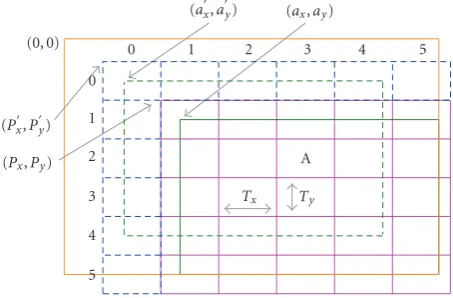
Figure5: The extended JPEG 2000 canvas coordinates. Solid line rectangles represent the canvas, the image area, and the tiling grid. Dashed line rectangles represent the padded tiles.
codestream undergoes an arbitrary yet allowed truncation. To identify a codeblock, we need to identify the tile that the codeblock belongs to. Unfortunately, the tile index used in a JPEG 2000 codestream to identify a tile is not truncation-invariant. When some tiles are truncated from a JPEG 2000 codestream, such as truncating a JPEG 2000 codestream to crop the image from aspect ratio 16 : 9 to 4 : 3, the sur-viving tiles are reindexed starting from 0, resulting in indices inconsistent with the original ones. We exploit in our scheme the property that the canvas coordinates are invariant un-der allowed truncations to define a unique and truncation-invariant identifier for a tile.
To achieve this goal, the image and its tiles are extended upwards and leftwards by padding towards the origin a mul-tiple number of tiles. More precisely, the extended image is first initialized to be the original image: (ax,ay) = (ax,ay) and (Px,Py)=(Px,Py). Then the following iterative moves are applied to extend the image: in each move, the coordi-nates (ax,ay) of top left corner of the extended image and the coordinates (Px,Py) of the top left corner of the extended first tile are reduced by subtractingTxand theTyinx- and
y-directions, respectively, whereTx×Tyis the size of a tile at the high resolution grid, until the following conditions are satisfied:
(1) Px,Py≥0 andax,ay≥0;
(2) Px< Tx,Py< Ty, andPx+Tx> ax,Py+Ty> ay; (3) Px≤ax,Py≤ay.
Figure 5shows an example of the actual image and its tiles (solid lines) as well as the extended image and the extended tiles (dotted lines).
After the above extension of the image and its tiles, each tile is indexed, with both the actual and the extended (or virtual) tiles counted, starting from 0 along bothx- andy -directions, from top to bottom and from left to right. These indices are also shown inFigure 5. Such a tile coordinate sys-tem is used in our scheme to identify each tile uniquely for an image. For example, tile “A” shown inFigure 5is uniquely identified by its coordinates (3, 2), that is, its index along the x-direction is 3, and alongy-direction is 2. It is easy to check
that the resulting indices of a tile in the proposed tile index-ing system do not change even if an arbitrary combination of tiles are cropped from a JPEG 2000 codestream. Therefore, they are invariant for allowed truncations to a JPEG 2000 codestream.
A precinct can also be uniquely identified by the can-vas coordinates of their top left-hand corners, which are truncation-invariant. With these truncation-invariant tile and precinct identifiers, a codeblock can be uniquely iden-tified by the tile, component, resolution level, precinct, and the subband it belongs to, and the coordinates of codeblock’s top left-hand corner on the canvas grid. Such a codeblock identifier is truncation-invariant.
The IV for each independent encryption is generated as follows. In the normal encryption mode, the global IV, the unique codeblock identifier defined above, and the index of the first coding-pass in a codeword segment are concatenated and hashed, truncated if necessary, to generate the IV used to encrypt the codeword segment. In the in situ mode, the global IV, the unique codeblock identifier defined above, and the index of the first coding-pass in an intersection of a code-word segment and a CCP are concatenated and hashed, trun-cated if necessary, to generate the IV used to encrypt the in-tersection. Apparently, the IVs generated in this way do not change when an encrypted codestream is truncated. In typ-ical cases, the concatenation of a codeblock identifier and a coding pass index can be fit into the length of an IV. In this case, the concatenation is XORed with the global IV in gen-erating the IV, and no hashing operation is needed.
In our scheme, a single global IV in the SEC header is the only information needed to be added to an encrypted JPEG 2000 codestream. Since encryption is applied after compres-sion and the ciphertext has the same length as the plaintext with CSE, we can expect that the file-size overhead of our scheme is negligible. This is confirmed by our experiments reported inSection 5.
4.3. Encryption, partition, and CSE’s file-size overhead
With the IVs generated by the method described in
Section 4.2, each codeword segment or intersection of a codeword segment and a CCP is encrypted syntax-compliantly with CSE in the normal or the in situ mode. Note that the output has the same length as the input for CSE. In JPEG 2000, a codeword segment contains a num-ber of complete coding passes, that is, a coding pass will not split into two codeword segments. By using the coding pass length calculation algorithm given in Annex D of the JPEG 2000 standard Part 1, no coding pass will ever be considered as terminating with an byte 0xFF [1]. A CCP does not end with a byte 0xFF either. As a result, no matter which encryp-tion mode is used, the ciphertext will not end with a byte 0xFF in our scheme.
other two termination patterns, the two modes may operate differently. If a CCP contains multiple codeword segments, the two modes still operate in the same way: each codeword segment is encrypted independently. When a CCP contains a single codeword, such as when the default termination pat-tern is used, the two encryption modes operate differently. The in situ mode encrypts the CCP independently in this case, while an encrypted codeword segment may split into two or more CCPs in the normal mode encryption. Although a coding pass will not end with a byte 0xFF, a nonending cod-ing pass in a codeword segment may end with 0xFF after CSE encryption. In addition, some ciphertext bits are switched with the corresponding plaintext bits in CSE. As a result, a partition method is needed to distribute the ciphertext from an encrypted codeword segment into different packets such that each CCP of the codeblock terminates at a right position so that decryption can be executed correctly even if the code-word is truncated at the boundary of a CCP. This requires that a sequence of switched bits could not be split into two CCPs. They have to stay in a single CCP. It also implies that CCP cannot end with a byte 0xFF for an encrypted bitstream either.
Since CSE is basically an XOR-based stream cipher with some ciphertext bits switched with the corresponding plain-text bits when needed, each byte in the cipherplain-text corre-sponds to the byte at the same position in the plaintext. Our partition method for an encrypted codeword segment is based on the original partition method used in JPEG 2000. When the original partition method is applied to the plain-text, if a corresponding partition position in the ciphertext does not end with a byte 0xFF or in the middle of a se-quence of switched bits, then the partition position is also applied to the ciphertext, resulting in no file-size overhead for this partition position. Otherwise, the partition position is moved to the following byte or bytes such that the cur-rent CCP does not end with a byte 0xFF and a sequence of switched bits is not split into two CCPs, resulting in file-size overhead since when truncated at the boundary of the cur-rent CCP, the encrypted codestream contains more bytes (the additional bytes are dropped in decompression if truncated at the current CCP) than the case without encryption for the same rendered image.
A sequence of switched bits is typically two bytes long for CSE encryption of an arithmetic codeword, as indicated by the experiments inSection 5. This means that when adjust-ment to a partition position is needed, the CCP boundary is typically moved to the next byte, resulting in one byte over-head for the CCP. Since the chance that an encrypted CCP ends with a byte of value 0xFF or in the middle of switched bits is slim, the incurred file-size overhead for CSE is almost negligible. The CSE encryption in the normal mode does not incur any file-size overhead under other cases. As a compar-ison, the CSE encryption in the in situ mode does not incur any file-size overhead.
In the in situ encryption mode, each CCP can be read into a buffer, partitioned into codeword segments if it con-tains more than one codeword segment, and then CSE is ap-plied to each codeword segment or the CCP. The encryption result, which has exactly the same length as the CCP, is then
placed back to the original position. The process does not affect other data. Therefore, the encryption and decryption in this mode can be applied in situ to the CCP buffer. As a comparison, in the normal mode, the size of a CCP may be changed, for example, when the CCP of ciphertext ends with a byte 0xFF or in the middle of a sequence of switched bits, resulting in a modified packet header and packet size. The in situ property might be desirable in some applications.
4.4. Scalability and error resilience
Our JPEG 2000 encryption scheme produces an encrypted, syntax-compliant codestream, and preserves the original granularity of scalability. It is obvious that the original gran-ularity of the five types of scalabilities in JPEG 2000, that is, tile, component, resolution, precinct, and layer, is fully pre-served in an encrypted codestream with our scheme. An en-crypted codestream can also be truncated to the smaller level of a codeword segment and a CCP, the same level as sup-ported by JPEG 2000.
In addition to the scalability to allow truncations, a JPEG 2000 codestream can be repackaged by splitting or combin-ing packets. A CCP may contain multiple codeword seg-ments. A packet containing CCPs with multiple codeword segments can be split into multiple packets since the size for each codeword segment can be derived from the packet header. After encryption with our scheme, such a packet can still be split into multiple packages without decryption since our scheme encrypts independently each codeword segment or each intersection of a codeword segment and a CCP. When our scheme runs in the normal mode, combining two or more packets into one packet is still allowed after encryption since each codeword segment is independently encrypted. This is not true when our scheme runs in the in situ mode since the ciphertext in a CCP appended to another CCP after combining will not be correctly decrypted: a wrong IV is used in decryption. Therefore, the original repackaging capability is preserved when our JPEG 2000 encryption scheme runs in the normal mode but only package splitting is preserved when in the in situ mode.
The syntax-compliance and preservation of the origi-nal granularity of scalability allow an encryption-unaware processor to process, for example, to truncate an encrypted codestream in the same way as a nonencrypted codestream without decryption. There is no need to use any decryption secrets in the process. As a result, the processor does not need to be trusted.
As a comparison, Dang and Chau encryption scheme [7], Wu and Ma scheme [11], and Watanabe’s scheme [13] raise the granularity of scalability to the packet level, and Wu and Deng scheme [12] and Fang and Sun scheme [14] to the CCP level, resulting in a granularity of scalability coarser than that offered by JPEG 2000 after encryption. Note that a CCP may contain multiple codeword segments. Our scheme has finer granularity of scalability than those JPEG 2000 encryption schemes.
are rendered undecodable. In our scheme, each codeword segment or each intersection of a codeword segment and a CCP is encrypted independently, and a syntax-compliant stream cipher is used as the encryption primitive. If the bit error removes or generates spurious ciphertext switching in-cidences, our encryption does incur error propagation: the error expands to the whole sequence of switched bits, typ-ically 2 bytes. Fortunately, switching occurs infrequently, as shown from the experimental results reported inSection 5. As a result, our encryption scheme has a very small if not negligible adverse impact on the perceptual quality when er-ror or loss of data occurs, which is confirmed by our exper-iments also reported inSection 5. In other words, our en-cryption scheme is error-resilient. This has been confirmed by our experiments reported inSection 5.
As a comparison, a bit error may cause a wrong selec-tion of bytes to be encrypted in Watanabe’s scheme [13], re-sulting in wrong decryption of a whole packet. A bit error may cause a wrong iteration of decryption in Wu and Deng scheme [12], resulting in wrong decryption of a whole CCP. These schemes have worse error resilience performance than ours. In Wu and Ma scheme [11], a bit error affects the byte
where the error bit resides and possibly the next byte too. Similarly, a bit error affects locally for Fang and Sun scheme [14]. If a CCP contains multiple codeword segments and if the error bit is close to the boundary of two codeword seg-ments and the error expansion due to encryption extends to the neighboring codeword segment, then the two schemes reported in [11,14] have worse error resilience performance than ours. Otherwise, they have a similar error resilience per-formance as ours.
5. EXPERIMENTAL RESULTS
Our JPEG 2000 encryption scheme has been implemented on top of the open source JPEG 2000 C implementation JasPer [23] with the public domain C++ cryptographic li-brary Crypto++ [24]. SEAL [25] was used as the stream ci-pher in CSE in our experiments. The default setting of JasPer was used in JPEG 2000 encoding unless stated otherwise. In the CSE experiments, that is, the experiments for Figures6–
8, the JPEG 2000 arithmetic codeword segment syntax was used, that is, any two consecutive bytes cannot be in the range from 0xFF90 to 0xFFFF, and the ending byte cannot be 0xFF.
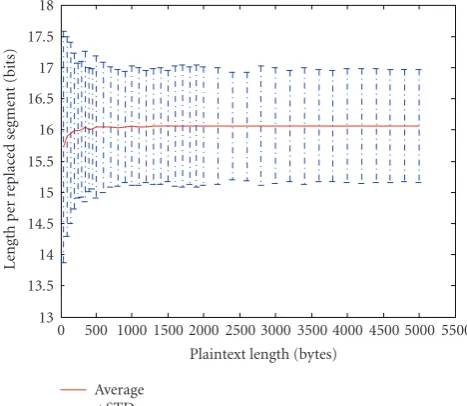
Figure 6shows the average number of bits for each dis-joint sequence of switched bits, andFigure 7shows the av-erage number of disjoint sequences of switched bits for dif-ferent lengths of plaintext with random syntax-compliant plaintexts as input to CSE. The average was over 15 000 runs. From Figures6and7, we can see that ciphertext switching occurs about 8 times on the average for a plaintext of 5000 bytes and about 16 bits are switched back to the plaintext bits for each occurrence. That implies that there about 0.32% of the ciphertext bits is switched to the plaintext. Wu and Ma scheme [11] has more unencrypted bits than CSE on the av-erage, and the locations of unencrypted bits are known. On the contrary, the locations of unencrypted bits in CSE are unknown and hard to locate if the JPEG 2000 bitstream is
13 13.5 14 14.5 15 15.5 16 16.5 17 17.5 18
L
ength
per
replac
ed
seg
ment
(bits)
0 500 1000 1500 2000 2500 3000 3500 4000 4500 5000 5500 Plaintext length (bytes)
Average ±STD
Figure 6: Average number of bits for each disjoint sequence of switched bits for JPEG 2000 arithmetic codeword segment syntax.
0 2 4 6 8 10 12
N
u
mb
er
of
re
pla
ce
d
se
gm
ents
0 500 1000 1500 2000 2500 3000 3500 4000 4500 5000 5500 Plaintext length (bytes)
Average ±STD
Figure7: Average number of disjoint sequences of switched bits for different lengths of plaintext.
unknown. For both Wu and Deng scheme [12] and Fang and Sun scheme [14], all the plaintext bits are encrypted.
0 0.5 1 1.5 2 2.5×10
8
A
ver
age
run
sp
eed
(b
yt
es/s)
0 500 1000 1500 2000 2500 3000 3500 4000 Plaintext length (bytes)
1
2 3 4
5 6
7
Figure8: Encryption and decryption speeds averaged over 10 000 runs. (1) CSE. (2 and 3) Decryption and encryption of Fang and Sun scheme [14]. (4 and 5) Encryption and decryption of Wu and Ma scheme [11]. (6 and 7) Encryption and decryption of Wu and Deng scheme (using modular addition and subtraction) [12].
Figure9: Syntax-compliant encryption that preserves full scalabil-ity of JPEG 2000.
is only a single speed curve for CSE inFigure 8. As shown in the figure, CSE is indeed faster than other schemes, espe-cially when the plaintext length is larger than 500 bytes. The low speeds for small plaintext lengths are mainly due to the time spent on resetting IVs for SEAL, which accounts for a majority of the encryption time.
InFigure 9, we show that the original JPEG 2000 com-pressed image “Lena” is encrypted with the full scalabil-ity preserved. With our syntax-compliant encryption algo-rithm, the encrypted codestream can still be displayed by an encryption-unaware JPEG 2000 image viewer. The en-crypted codestream is then truncated to lower resolutions. These truncated codestreams are still syntax-compliant and can be displayed by an encryption-unaware JPEG 2000 im-age viewer. They are then decrypted to recover the lower-resolution images.
Table1: Speed overhead of our JPEG 2000 encryption scheme in the normal mode over Jasper’s compression for different settings of layers and resolutions.
Resolutions
Layers (%) 5 4 3 2
10 0.7569 0.8959 1.213 1.033
8 0.3796 0.4411 0.5645 0.6193
6 0.2180 0.6315 0.5261 0.8368
4 0.5994 0.5778 1.214 0.6066
2 0.4190 0.4227 0.6189 0.6098
(a)
(b)
Figure10: Rendered images for unencrypted (a) and encrypted (b) “Lena” for bit error rates of 0.00005, 0.0001, 0.001, and 0.01.
We have tested the file-size overhead of our encryption scheme. For all the testing images, our scheme has always 11 bytes more than the original JPEG 2000 compressed code-stream, no matter how large the codestream is. These 11 ad-ditional bytes are in fact the SEC header we added to a code-stream encrypted with our scheme. We conclude that our scheme has negligible file-size overhead.
We have also tested the speed overhead of our encryp-tion in the normal mode over Jasper’s compression with the standard color image “Mandrill” of size 512×512 on a Dell Inspiron 640 m laptop with a 1.6 GHz Intel CPU and 1.50 GB memory running Windows XP Professional SP2. A compres-sion rate of 0.1 BPP was used. Our timing consists of the in-memory encoding and encryption part, with disk I/O ex-cluded. The speed overhead for different settings of layers and resolutions are shown inTable 1. The maximum over-head is about 1.2%. We conclude that our JPEG 2000 encryp-tion scheme has a negligible impact on the encoding speed.
Table2: Blind perceptual test for error resilience.
Test image Original better (%) Encrypted better (%)
Barbara 63 57
Cameraman 52 68
House 62 58
Lake 54 66
Lena 55 65
Mandrill 63 57
Peppers 62 58
Walkbridge 53 67
Figure11: Cropping an encrypted JPEG 2000 image from aspect ratio 16 : 9 to 4 : 3 (e.g., 1280×720 to 792×594).
the blind perceptual test. Four bit error rates, that is, 0.01, 0.001, 0.0001, and 0.00005, were used. The rendered images for both encrypted and unencrypted “Lena” are shown in
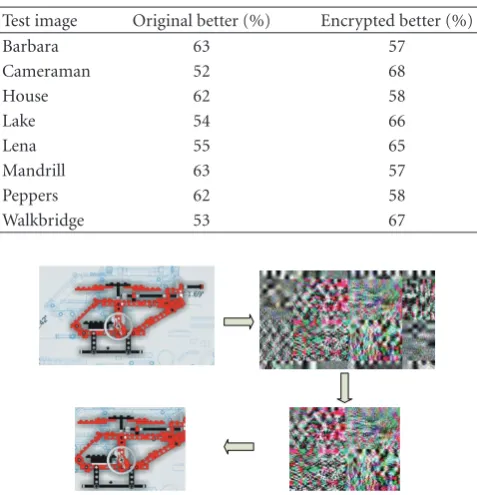
Figure 10for the four bit error rates. Thirty volunteers, half with expertise in image processing and the other half does not, were asked to choose the one perceptually better from the two images displayed side by side. The testing result is summarized inTable 2. The difference is statistically insignif-icant. We conclude that our encryption does not degrade the perceptual quality as compared with the unencrypted case, and therefore our encryption scheme is error-resilient.
Figure 11shows an encrypted JPEG 2000 image of aspect ratio 16 : 9 adapted to 4 : 3 by truncating some boundary tiles. Such aspect ratio adaption is widely used when DVD movie is displayed on a traditional TV. The original image size is 1280×720, the tile size is 396×234, the tile grid origin on the coordinate canvas is (0, 0), and the image origin is at (152, 234). With the above carefully chosen parameters, the encoded JPEG 2000 image has four tiles at the center, form-ing an area of aspect ratio 4 : 3. Adaptation from aspect ratio 16 : 9 to 4 : 3 is simply to truncate all the tiles except the four tiles at the center.
6. CONCLUSION
We have presented a novel syntax-compliant encryption primitive and an efficient syntax-compliant JPEG 2000 en-cryption scheme. The syntax-compliant enen-cryption primi-tive, that is, the ciphertext switching encryption (CSE), pro-duces syntax-compliant ciphertext with exactly the same length as the input. It is faster than all the other
syntax-compliant encryption primitives. Our JPEG 2000 encryption scheme has two encryption modes. In the normal mode, each codeblock segment is independently encrypted. In the in situ mode, each intersection of a codeword segment and a code-block contribution to a packet (CCP) is independently en-crypted. A set of truncation-invariant parameters is used to uniquely identify each independently encrypted data block. These parameters are combined with a global initialization vector (IV) to generate on the fly the IV used to encrypt the data block these parameters refer to. A codestream encrypted with our scheme is syntax-compliant. The original granular-ity of scalabilgranular-ity is fully preserved after encryption so that an encrypted codestream can be truncated to adapt to different representations without decryption. Our JPEG 2000 encryp-tion scheme is fast, error-resilient, and has negligible file-size overhead.
REFERENCES
[1] ISO/IEC, “Information Technology—JPEG 2000 Image Cod-ing System, Part 1: Core CodCod-ing System,” ISO/IEC 15444-1:2000 (ISO/IEC JTC/SC 29/WG 1 N1646R), March 2000. [2] ISO/IEC, “JPEG2000 verification model 8.5 (technical
de-scription),” ISO/IEC JTC 1/SC 29/WG 1 N1878, September 2000.
[3] ISO/IEC, “JPSEC commission draft 2.0,” ISO/IEC/JTC 1/SC29/WG 1, N3397, 2004.
[4] F. Dufaux, S. Wee, J. Apostolopoulos, and T. Ebrahimi, “JPSEC for secure imaging in JPEG 2000,” inApplications of Digital Image Processing XXVII, vol. 5558 ofProceedings of SPIE, pp. 319–330, Denver, Colo, USA, August 2004.
[5] B. B. Zhu, M. D. Swanson, and S. Li, “Encryption and au-thentication for scalable multimedia: current state of the art and challenges,” inInternet Multimedia Management Systems V, vol. 5601 ofProceedings of SPIE, pp. 157–170, Philadelphia, Pa, USA, October 2004.
[6] B. B. Zhu, “Multimedia encryption,” inMultimedia Security Technologies for Digital Rights Management, W. Zeng, H. Yu, and C.-Y. Lin, Eds., chapter 4, pp. 75–109, Elsevier, London, UK, 2006.
[7] P. P. Dang and P. M. Chau, “Image encryption for secure Inter-net multimedia applications,”IEEE Transactions on Consumer Electronics, vol. 46, no. 3, pp. 395–403, 2000.
[8] National Bureau of Standards, “Data Encryption Standard,” NBS FIPS Pub. 46, January 1977.
[9] R. Grosbois, P. Gerbelot, and T. Ebrahimi, “Authentication and access control in the JPEG 2000 compressed domain,” in Ap-plications of Digital Image Processing XXIV, vol. 4472 of Pro-ceedings of SPIE, pp. 95–104, San Diego, Calif, USA, July 2001. [10] S. Wee and J. Apostolopoulos, “Secure scalable streaming and secure transcoding with JPEG-2000,” inProceedings of IEEE In-ternational Conference on Image Processing (ICIP ’03), vol. 1, pp. 205–208, Barcelona, Spain, September 2003.
[11] H. Wu and D. Ma, “Efficient and secure encryption schemes for JPEG2000,” inProceedings of IEEE International Conference on Acoustics, Speech and Signal Processing (ICASSP ’04), vol. 5, pp. 869–872, Montreal, Quebec, Canada, May 2004.
[13] O. Watanabe, A. Nakazaki, and H. Kiya, “A scalable encryp-tion method allowing backward compatibility with JPEG2000 images,” inProceedings of IEEE International Symposium on Circuits and Systems (ISCAS ’05), vol. 6, pp. 6324–6327, Kobe, Japan, May 2005.
[14] J. Fang and J. Sun, “Compliant encryption scheme for JPEG 2000 image code streams,” Journal of Electronic Imaging, vol. 15, no. 4, Article ID 043013, 4 pages, 2006.
[15] B. B. Zhu, Y. Yang, and S. Li, “JPEG 2000 encryption enabling fine granularity scalability without decryption,” in Proceed-ings of IEEE International Symposium on Circuits and Systems (ISCAS ’05), vol. 6, pp. 6304–6307, Kobe, Japan, May 2005. [16] B. B. Zhu, Y. Yang, and S. Li, “JPEG 2000 syntax-compliant
encryption preserving full scalability,” inProceedings of IEEE International Conference on Image Processing (ICIP ’05), vol. 3, pp. 636–639, Genova, Italy, September 2005.
[17] B. B. Zhu, Y. Yang, C. W. Chen, and S. Li, “Fine granular-ity scalabilgranular-ity encryption of MPEG-4 FGS bitstreams,” in Pro-ceedings of 7th IEEE Workshop on Multimedia Signal Processing (MMSP ’05), pp. 1–4, Shanghai, China, October 2005. [18] D. S. Taubman, “High performance scalable image
compres-sion with EBCOT,” inProceedings of International Conference on Image Processing (ICIP ’99), vol. 3, pp. 344–348, Kobe, Japan, October 1999.
[19] D. S. Taubman, JPEG2000 Image Compression: Fundamen-tals, Standards and Practice, Kluwer Academic, Dordrecht, The Netherlands, 2001.
[20] T. Acharya and P. S. Tsai,JPEG2000 Standard for Image Com-pression: Concepts, Algorithms and VLSI Architectures, John Wiley & Sons, New York, NY, USA, 2005.
[21] A C++ implementation of the Ciphertext Switching Encryp-tion (CSE), http://research.microsoft.com/∼binzhu/codes/ CSE/.
[22] M. Bellare and P. Rogaway, “Introduction to Modern Cryp-tography,” chapter 4, Symmetric Encryption,http://www.cse .ucsd.edu/∼mihir/cse207/classnotes.html.
[23] JasPer,http://www.ece.uvic.ca/∼mdadams/jasper/. [24] Crypto++,http://www.eskimo.com/∼weidai/cryptlib.html. [25] B. Schneier,Applied Cryptography: Protocols, Algorithms, and