R E S E A R C H
Open Access
Ectopic expression of
OsMADS45
activates the
upstream genes
Hd3a
and
RFT1
at an early
development stage causing early flowering in rice
Jiun-Da Wang
1, Shuen-Fang Lo
2,4, Yan-Suan Li
2, Po-Ju Chen
2, Shih-Yun Lin
1,5, Teh-Yuan Ho
2, Jenq-Horng Lin
1*and Liang-Jwu Chen
2,3*Abstract
Background:The rice gene,OsMADS45, which belongs to the MADS-box E class gene, participates in the
regulation of floral development. Previous studies have revealed that ectopic expression ofOsMADS45induces early flowering and influences reduced plant height under short-day (SD) conditions. However, the regulation
mechanism ofOsMADS45overexpression remains unknown. We introduce anOsMADS45overexpression construct Ubi:OsMADS45into TNG67 plants (anHd1(Heading date 1) andEhd1(Early heading date 1) defective rice cultivar grown in Taiwan), and we analyzed the expression patterns of various floral regulators to understand the regulation pathways affected byOsMADS45expression.
Results:The transgenic rice exhibit a heading date approximately 40 days earlier than that observed in TNG67 plants, and transgenic rice display small plant size and low grain yield.OsMADS45overexpression did not alter the oscillating rhythm of the examined floral regulatory genes but advanced (by approximately 20 days) the up-regulate of two florigens,Hd3a(Heading Date 3a) andRFT1(RICE FLOWERING LOCUS T1) and suppressed the expression ofHd1at the juvenile stage. The expression levels ofOsMADS14andOsMADS18, which are two well-known reproductive phase transition markers, were also increased at early developmental stages and are believed to be the major regulators responsible for early flowering inOsMADS45-overexpressing transgenic rice.OsMADS45overexpression did not influence other floral regulator genes upstream ofHd1andEhd1, such asOsGI (OsGIGANTEA),Ehd2/Osld1/RID1and OsMADS50.
Conclusion:These results indicate that in transgenic rice,OsMADS45overexpressing ectopically activates the upstream genesHd3aandRFT1at early development stage and up-regulates the expression ofOsMADS14andOsMADS18, which induces early flowering.
Keywords:Floral regulatory genes;Hd1;Hd3a;OsMADS45;RFT1; Rice
Background
The plant developmental transition from vegetative to reproductive growth is regulated by multiple genes and environmental factors, such as temperature and photo-period (Koornneef et al. 1998; Wilczek et al. 2010). In rice, this transition influences the time of floral heading.
The heading date is an important agronomic trait of cul-tivated rice for adaption to variable growth season and photoperiod changes and is also associated with bio-mass, plant size and grain productivity (Xue et al. 2008; Endo-Higashi and Izawa 2011). Rice are cultivated within a wide range of latitudes ranging from 55°N to 36°S; therefore, a wide range of heading varieties are re-quired for efficient and sustainable agriculture practices in these various geographic regions (Khush 1997). In rice, the flowering time or heading date is primarily con-trolled by the two florigens, Hd3a and RFT1 (Kojima et al. 2002; Komiya et al. 2008). Hd3a, an ortholog of * Correspondence:[email protected];[email protected]
1
Department of Life Sciences, National Chung Hsing University, Taichung 402, Taiwan
2
Institute of Molecular Biology, National Chung Hsing University, Taichung 402, Taiwan
Full list of author information is available at the end of the article
Arabidopsis FT, interacts with 14-3-3 proteins in the ap-ical cells of shoots, thereby yielding a complex that translocates to the nucleus and binds to OsFD1, which is a rice transcription factor homologue of Arabidopsis FD, to induce floral initiation (Taoka et al. 2011; Tsuji et al. 2013). RFT1, another ortholog of Arabidopsis FT, is a major floral activator under long-day (LD) condi-tions. The defective expression of RFT1 increases the heading date to more than 200 days, while, RFT1 overexpression reduces the heading date (Komiya et al. 2008; Komiya et al. 2009). During flower development, Hd3a and RFT1 translocate from the leaf to the apical meristem, thereby activating the expression of
down-stream genes, such as OsMADS14, OsMADS15 and
OsMADS18,which regulate flower development (Tamaki et al. 2007; Komiya et al. 2008; Komiya et al. 2009; Kobayashi et al. 2012).
The regulation of Hd3a and RFT1 transcriptions in-volving multiple flowering pathways under SD and LD conditions have been reported (Greenup et al. 2009). In the OsGI-Hd1-Hd3a pathway, OsGI, similar to the Arabidopsis flowering time gene GIGANTA (GI), acts as a positive regulator upstream of Hd1 under both LD and SD conditions (Hayama et al. 2003). Hd1, which is orthologous to Arabidopsis CONSTANS (CO), regulates the expression of Hd3a. Hd1 stimulates the expression of Hd3a under SD conditions but represses Hd3a ex-pression under LD conditions (Hayama and Coupland 2004). In the Ehd2-OsMADS50-Ehd1-RFT1 flowering pathway, Ehd1 represents another important expression regulator ofHd3aandRFT1. Ehd1 not only up-regulates the expression ofHd3aunder SD conditions but also ac-tivates the expression ofHd3aandRFT1under LD con-ditions (Doi et al. 2004; Komiya et al. 2009). Ehd1
expression is regulated by multiple floral regulators, such as OsMADS50, OsMADS51, OsMADS56 and Ehd2/ Osld1/RID1. Under SD conditions, the floral signal of OsGI is transmitted by OsMADS51, which is a MADS-box gene downstream of OsGI, to induce the expression ofEhd1(Kim et al. 2007). Under LD conditions,Ehd1is also up-regulated by OsMADS50 and Ehd2/Osld1/RID1, which is a Cys-2/His-2-type zinc finger transcription fac-tor, while Ehd1 expression is repressed by OsMADS56 (Matsubara et al. 2008; Park et al. 2008; Wu et al. 2008; Ryu et al. 2009). Thus, the expression of Hd3a and
RFT1 is regulated by multiple regulatory networks that govern flower initiation.
Rice MADS-box genes, which are required for floral organ differentiation and flowering time regulation, are grouped into the classes A, B, C, D and E based on the sequences homology and functional similarities to Arabidopsis homologues (Yamaguchi and Hirano 2006; Ciaffi et al. 2011). The MADS-box class A genes,
OsMADS 14, 15 and 18, are downstream in the
flowering signaling pathway and are regulated by Hd3a and RFT1 under SD and LD conditions (Komiya et al. 2009; Kobayashi et al. 2012). Low expression levels of
OsMADS14, OsMADS15and OsMADS18have been ob-served in the leaves at early developmental stages, while the expression of these genes increases when the plants reach the reproductive stage (Lee et al. 2004; Komiya et al. 2008; Kim et al. 2008). OsMADS14 and OsMADS15, which are homologous to Arabidopsis APETALA (AP1), which share a 72% amino acid sequence identity, inter-act with the E class protein, OsMADS1, during flower development regulation (Lim et al. 2000). OsMADS14
overexpression significantly reduces flowering time and causes flower bud development as early as transgenic rice cultured in regeneration medium (Jeon et al. 2000a). An
OsMADS14ortholog mutant,maintained vegetative phase
(mvp), displayed no transition from vegetative to repro-ductive phase in einkorn wheat (Triticum monococcum) (Shitsukawa et al. 2007; Tsuji et al. 2008). Additionally, the overexpression of OsMADS18 revealed a short heading date in transgenic rice, while the heading date did not change in the knockout mutant (Fornara et al. 2004). For
OsMADS15, a similar functional assay has not yet been reported. Therefore, the expression of OsMADS14 and
OsMADS18 are closely associated with the reproductive phase transition. The expression analysis of these genes may elucidate the mechanism of the reproductive stage transition.
Rice OsMADS45 (also known as OsMADS7), which belongs to class E, is specifically expressed in the sta-men, pistil, and carpel, but not in the leaves and other vegetative tissues (Greco et al. 1997; Arora et al. 2007; Bai et al. 2008). E-functional genes are required for spe-cifying organ identity of the inner three whorls of the floral organs in combination with A-, B-, C- and D-functional genes (Pelaz et al. 2000; Honma and Goto 2001). Many studies have indicated that OsMADS45 in-teracts with other MADS proteins to co-regulate the de-termination of floral organ identities (Seok et al. 2010). OsMADS13, which is a D class gene, interacts with OsMADS45 at the protein level to control ovule devel-opment during flower growth (Favaro et al. 2002; Dreni et al. 2007). OsMADS45 also associates with the B class proteins, OsMADS16 and OsMADS4, to form an
OsMADS16-OsMADS4-OsMADS45 ternary complex
and regulate the development of the lodicule and other floral organs (Moon et al. 1999a; Lopez-Dee et al. 1999; Seok et al. 2010). In addition to floral identity determin-ation, the overexpression or deletion of E genes has been shown to alter the flowering time (Jeon et al. 2000a; Jeon et al. 2000b; Cui et al. 2010). For example, the
flowering and affected other agricultural characteristics in transgenic rice (Jeon et al. 2000a). Similarly, a T-DNA activation-tagged mutant that has OsMADS45 activated and expressed in leaves and other tissues revealed early flowering and the same early flowering phenotype was ob-served by overexpressing OsMADS45 in a Taiwan rice variety TNG67. TNG67 is known as a photoperiod in-sensitive cultivar containing defective Hd1 and Ehd1 se-quences as those of T65 (Doi et al. 2004), and malfunction of these two genesHd1andEhd1delayed heading date up to 6.8 days and 17.4 days, respectively (Chen et al. 2010; Chien et al. 2011). However, the regulation mechanism causing early flowering in theseOsMADS45overexpression transgenic rice remains unknown. Thus, we expressed the
OsMADS45 gene ectopically in TNG67 with the hd1and
ehd1genetic background to analyze the early flowering en-hancing mechanism and to demonstrate the probable ef-fects ofOsMADS45in regulating the flowering time when it was overexpressed. The overexpression of OsMADS45
not only induced the early expression of Hd3a andRFT1
but also reduced the expression of Hd1at early develop-mental stages. Based on these data, we propose a model that explains the mechanism by which the ectopic expres-sion ofOsMADS45causes early flowering in rice.
Methods
Plant material and growth conditions
The rice cultivar, Oryza sativa L. cv. TNG67, was ana-lyzed in this study. The plants used for agronomic trait measurements were grown in an experimental field in Taichung, Taiwan (24° 4′ 40.2″ N; 120° 43′ 0.61″ E). The plants used for the study of diurnal gene oscillations were grown in a growth chamber under a 14 h light/ 10 h dark cycle condition using fluorescent white light tubes (400 to 700 nm, 100μmol m-2s-1) at 28°C.
Measurement of photosynthesis rate
The fully expanded upper three leaves of 60 DAI (days after imbibition) plants were used to measure the photo-synthetic rate. The rate of photophoto-synthetic CO2 assimila-tion was measured with a portable Plu-LCi ultra compact photosynthesis system (ADC BioScientific Ltd., Hertfordshire, UK). The measurements were performed from 9 AM to 3 PM with an external constant light source (Ess Capsule G4, Royal Philips Electronics, Amsterdam, Dutch). During the measurement proced-ure, the leaf temperature was 37°C, the reference CO2 was 390 ppm, the relative air humidity was 60%, and the flow rate to the leaf chamber was 300 mL min-1.
Plasmid construction and rice transformation
The full-length OsMADS45 cDNA was cloned by PCR
amplification with the primer pair, BamOsMADS45, which containing aBamHI digesting site (Additional file 1:
Table S1) and introduced into a pGEM-T easy vector
(Promega, http://www.promega.com/). TheOsMADS45
cDNA was sub-cloned into a PLN vector containing the maize ubiquitin promoter (Ubi) and thenos termin-ator (Sun and Gubler 2004). The full-length construct (Ubi:OsMADS45) was fused with the pCAMBIA1301
vector, and the Agrobacterium tumefaciens strain,
EHA105, was used for the rice transformations. Calli in-duced from seeds were co-cultured with A. tumefaciens, and the putative transgenic rice was regenerated from calli as described previously (Chen et al. 2002).
Genomic DNA extraction and genes sequencing
Total genomic DNA extraction was performed as de-scribed previously (Lin et al. 2009). The Hd1 and Ehd1
gene fragments were amplified by PCR with Promega Taq DNA polymerase. Two primer pairs (Hd1-1 and Hd1-2) were used to sequence the Hd1 gene. The pri-mer pair Ehd1-1 was used to sequence the Ehd1 gene (Additional file 1: Table S1).
Southern blot analysis
Fifteen microgram of genomic DNA was digested with
NcoI and separated on a 1% agarose gel. A GUS DNA fragment was amplified via PCR with the primer pair, GUS (Additional file 1: Table S1), and was used as probe. The GUS fragment was labeled with (α-P32) dCTP using the Rediprime™ II DNA Labeling System (GE, http:// www.gelifesciences.com/). Southern blot analysis was performed as described previously (Ho et al. 2000).
RNA isolation and semi-quantitative RT-PCR
Total cellular RNA was extracted using TRIzol reagent (Invitrogen, http://www.invitrogen.com/), and the re-sidual DNA was digested with RQ1 RNase-Free DNase (Promega) to minimize the contamination. For semi-quantitative RT-PCR, first-strand cDNA was synthesized from 2μg of total RNA using M-MLV reverse transcript-ase (Promega) in a 25 μL reaction mixture containing 0.5μg of dT18 primer and 20 units of recombinant RNase inhibitor (TaKaRa, http://www.takara-bio.com/) according to the manufacturer’s instructions. For the quantification of cDNA, rice Actin1 (Act1, Os03g0718100; Lin et al. 2009) was used to normalize the expression levels. The gene-specific primer pairs are listed in Additional file 1: Table S1. The PCR reactions involved 5 min of denatur-ation at 95°C, followed by 95°C for 30 sec, 62°C (54°C forEhd1andHd3a) for 30 sec and 72°C for 45 sec. The PCR cycles used for each amplification are as follows:
Act1, 28 cycles; Ehd1, 34 cycles; Ehd2, 34 cycles; Hd1, 34 cycles; Hd3a, 34 cycles;OsGI, 34 cycles; OsMADS7, 26 cycles;OsMADS14, 34 cycles;OsMADS18, 34 cycles;
Results
Ectopic expression ofOsMADS45causes early flowering in the TNG67 rice variety
To analyze the early flowering enhancing mechanism of
OsMADS45 and to demonstrate the probable effects of
OsMADS45in regulating the flowering time when it was overexpressed, we ectopically overexpressedOsMADS45
in the rice variety, TNG67, by transforming the Ubi:
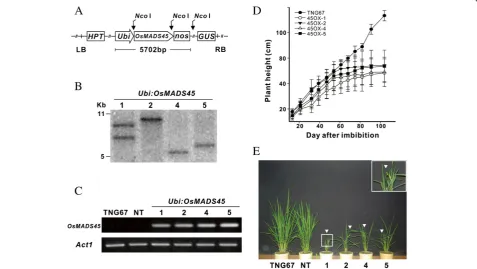
OsMADS45 construct containing the OsMADS45 gene driven by the maize ubiquitin promoter (Figure 1A) into the plant. After the transformation, more than 10 trans-genic lines displayed early flowering and stunted growth, and this early flowering phenotype associated with
OsMADS45 expression observed in the progenies of various transgenic lines was analyzed and verified for more than three generations. Four independent trans-genic lines confirmed by Southern blot assay (Figure 1B) were selected for further investigation. RT-PCR analysis using RNA extracted from 20 DAI leaves revealed the overexpression of the OsMADS45 gene in all four Ubi:
OsMADS45 transgenic lines (designated as 45OX1, 45OX2, 45OX4 and 45OX5), while no expression was
detected in the wild-type (TNG67) and non-transgenic (NT) lines (Figure 1C). Although the RNA expression levels ofOsMADS45for these four transgenic lines were similar, the plant heights varied slightly (Figure 1D and E and Table 1).
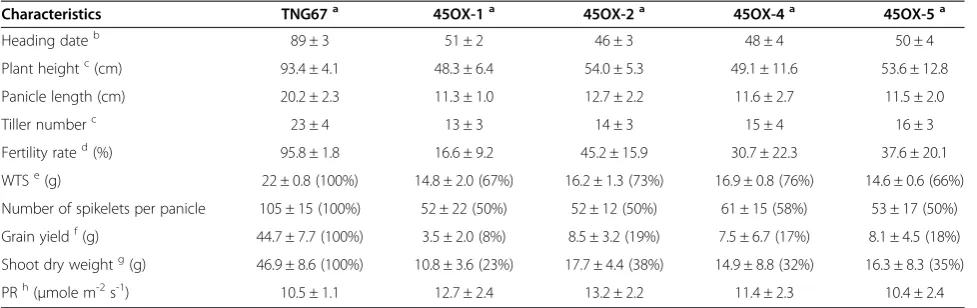
The progenies of these four transgenic lines were grown in an isolated field for two crop seasons, and their agronomic traits, including heading date, plant height, panicle length, tiller number, fertility rate, grain size, number of spikelets per panicle, grain yield, shoot dry weight and photosynthetic rate, were measured and col-lected (Figure 1D and Table 1). The heading dates of the transgenic lines ranged from 46 to 51 DAI, which is ap-proximately 40 days earlier than that of TNG67 plants (heading at 89 DAI) (Table 1). The difference in plant height between TNG67 and the transgenic lines was not significant until approximately 50 DAI, when the transgenic lines started heading (Figure 1D). The plant height of transgenic lines was retarded after 50 DAI, and the plants essentially stopped growing after 60 DAI (Figure 1D). The final plant height of the transgenic lines (48-54 cm) was approximately 40 cm shorter than
that of the TNG67 plants (93 cm). The transgenic plants measured approximately 50% of the TNG67 panicle length and reduced tiller number (13-15 vs. 23 tillers) and lower fertility rates (17-45% vs. 96%) (Table 1). Additionally, we found that the transgenic plants per grain weight measured 66-76% of that of the TNG67 plants, the number of spikelets per panicle for the transgenic plants was 50-58% of that observed with the TNG67 plants, and the grain yield for the trans-genic plants was 8-19% of that observed with the TNG67 plants (Table 1). In terms of biomass produc-tion, the shoot dry weight of the transgenic plants was approximately 23-38% of that measured with the TNG67 plants; however, no difference in the photosyn-thetic rate was observed between the TNG67 plants and the transgenic lines.
Ectopic expression ofOsMADS45does not alter the oscillation rhythm of flowering time regulators
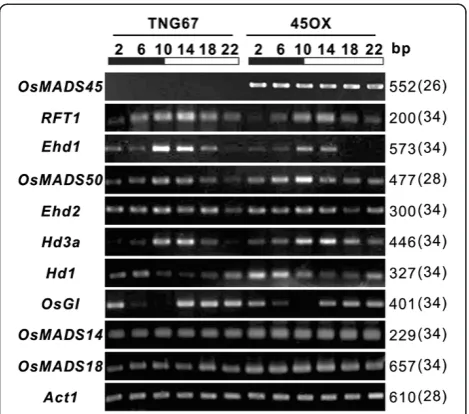
Flowering in many plants (including rice) is dependent on the day length. LD and SD photoperiod-sensitive rice initiate flowering dependent on a critical threshold asso-ciated with the proportion of diurnal hours. The light signals intercepted by photoreceptors and the length of photoperiod determined by the circadian clock regula-tors are integrated and lead to either the induction or sup-pression of flowering (Izawa, 2007). The floral regulators expressed in OsGI-Hd1-Hd3a and Ehd2-OsMADS50 -Ehd1-RFT1 flowering pathways are involved in the oscil-lation rhythm and controlled the flowering time (Ryu et al. 2009; Komiya et al. 2009). To study the oscillatory patterns of these floral regulators in 45OX-5 transgenic rice, leaf RNA samples were analyzed at each 4-hour
interval under 14 h light/10 h dark cycle condition. The results showed that the diurnal oscillations of the floral regulators, including the light-induced Hd3a, RFT1 and
Ehd1 regulators and the dark-induced Hd1 regulators, remained constant in 45OX transgenic lines (Figure 2). This result suggests that ectopic expression ofOsMADS45
does not alter the diurnal oscillations of the examined floral regulators in 45OX transgenic rice on a TNG67 gen-etic background.
Expression analysis of various floral regulatory genes in 45OX transgenic rice
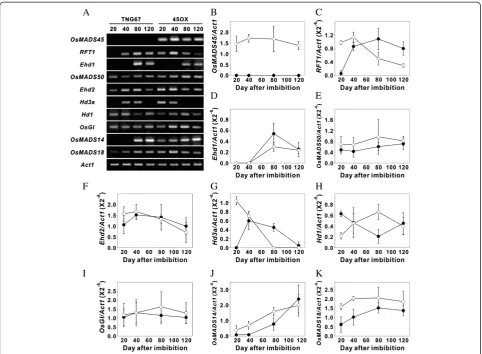
In rice, two independent photoperiod pathways, involv-ing the floral regulators, Hd1 and Ehd1, control flowering time via the regulation of Hd3a (Komiya et al. 2009).Hd1expression is predominantly regulated by the circadian clock through OsGI signaling (Hayama et al. 2003), which regulatesEhd1expression under SD condi-tions (Kim et al. 2007). Hd1, Ehd1 and Hd3a, are known to play a key role in photoperiod-controlled heading. Additionally, the OsMADS50-Ehd1-RFT1 pathway is in-volved in floral activation under LD conditions (Komiya et al. 2009). To understand the mechanism by which these floral regulators promote early flowering of the 45OX transgenic rice, we isolated RNA from the leaves at various growth stages, including 20, 40, 80, and 120 DAI, and compared the expression levels with those of the wild-type TNG67. The results showed the expression
patterns of the RFT1, Hd3a, Hd1, OsMADS14 and
OsMADS18 genes in the 45OX transgenic rice varied from those observed with the TNG67 rice (Figure 3A), thereby suggesting that these genes may be involved in the process of early flowering in the 45OX transgenic
Table 1 Agronomic traits of TNG67 andUbi:OsMADS45transgenic rice plants
Characteristics TNG67a 45OX-1a 45OX-2a 45OX-4a 45OX-5a
Heading dateb 89 ± 3 51 ± 2 46 ± 3 48 ± 4 50 ± 4
Plant heightc(cm) 93.4 ± 4.1 48.3 ± 6.4 54.0 ± 5.3 49.1 ± 11.6 53.6 ± 12.8
Panicle length (cm) 20.2 ± 2.3 11.3 ± 1.0 12.7 ± 2.2 11.6 ± 2.7 11.5 ± 2.0
Tiller numberc 23 ± 4 13 ± 3 14 ± 3 15 ± 4 16 ± 3
Fertility rated(%) 95.8 ± 1.8 16.6 ± 9.2 45.2 ± 15.9 30.7 ± 22.3 37.6 ± 20.1
WTSe(g) 22 ± 0.8 (100%) 14.8 ± 2.0 (67%) 16.2 ± 1.3 (73%) 16.9 ± 0.8 (76%) 14.6 ± 0.6 (66%)
Number of spikelets per panicle 105 ± 15 (100%) 52 ± 22 (50%) 52 ± 12 (50%) 61 ± 15 (58%) 53 ± 17 (50%)
Grain yieldf(g) 44.7 ± 7.7 (100%) 3.5 ± 2.0 (8%) 8.5 ± 3.2 (19%) 7.5 ± 6.7 (17%) 8.1 ± 4.5 (18%)
Shoot dry weightg(g) 46.9 ± 8.6 (100%) 10.8 ± 3.6 (23%) 17.7 ± 4.4 (38%) 14.9 ± 8.8 (32%) 16.3 ± 8.3 (35%)
PRh(μmole m-2s-1) 10.5 ± 1.1 12.7 ± 2.4 13.2 ± 2.2 11.4 ± 2.3 10.4 ± 2.4
a
The plant number of TNG67 was 27, 45OX-1 was 15, 45OX-2 was 13, 45OX-4 was 20, and 45OX-5 was 20.
b
Heading date was the date when the panicles protruding from the flag leaf sheath.
c
Plant height and total tiller number were measured on 104 DAI.
d
Fertility rate was the percentage of spikelets that set fertile seeds.
e
Weight of one thousand seeds (WTS) was the weight counted with 50 seeds and multiplied by 20.
f
Grain yield was the total weight of grains produced from one plant.
g
Shoot dry weight was the weight of the up-ground part of rice without the grains.
h
rice. The expression levels of the floral regulatory genes observed for the two flowering pathways are detailed in the following sections.
The expression ofRFT1is activated at early developmental stages in 45OX transgenic rice
The expression of the Ehd2, MADS50, Ehd1, and RFT1
genes of the Ehd2-OsMADS50-Ehd1-RFT1 flowering pathway were analyzed.RFT1 is a major floral activator under LD conditions, and its defective expression in-creases the heading date to above 200 days (Komiya et al. 2009), while, RFT1 overexpression reduces the heading date (Komiya et al. 2008). In the present study, the ex-pression levels of RFT1 in 45OX transgenic rice were significantly higher than that observed in the TNG67 rice on 20 DAI. On 40 DAI, the RFT1 transcript levels observed in the TNG67 rice increased and reached the same levels of those observed in the 45OX transgenic rice. However, after 40 DAI, RFT1 expression levels de-creased in the 45OX transgenic rice and inde-creased in the TNG67 rice (Figure 3A and C).
Ehd1, a B-type response regulator, is an upstream posi-tive regulator of RFT1 under LD conditions (Komiya et al. 2009), which showed no expression on 20 and 40 DAI and increased expression after 80 DAI (Figure 3A and D). Its expression pattern in 45OX transgenic rice was similar to that observed in the TNG67 plants
(Figure 3A and D). OsMADS50, a MICK-type
MADS-box gene, is an epistatic active regulator of Ehd1 that was expressed throughout all development stages and displayed the same expression pattern in 45OX trans-genic rice and the TNG67 plants (Figure 3A and E).
Ehd2/Osld1/RID1, a zinc finger transcription factor orthologous with maizeIndeterminate1(ID1), is another upstream positive regulator of Ehd1 under LD condi-tions, which was expressed in all stages and failed to show different expression patterns between the 45OX transgenic rice and TNG67 rice (Figure 3A and F).
These results indicate that the overexpression of
OsMADS45activates the expression ofRFT1at early de-velopment stages, but fails to affect the expression of the upstream genes. As the heading of 45OX transgenic rice and TNG67 plants were detected soon after the high ac-cumulation of theRFT1transcript, we hypothesized that the activation and accumulation of RFT1 during the early development stages induces early flowering in 45OX transgenic rice.
The up-regulation ofHd3aand down-regulation ofHd1at early development stages were observed in 45OX transgenic rice
The expression of theOsGI, Hd1 andHd3agenes of the OsGI-Hd1-Hd3a flowering pathway were analyzed.
Hd3a, which is a rice florigen, has been shown to bind several proteins to induce flowering (Kojima et al. 2002) and was significantly expressed in the 45OX transgenic rice on 20 DAI, while the expression was decreased slightly on 40 DAI and then vanished after 80 DAI (Figure 3A and G). In contrast, Hd3a expression was not detected in the TNG67 plants on 20 DAI, showed increased expression from 40 to 80 DAI, and then disappeared on 120 DAI after flowering.
Hd1, another floral regulator orthologous with
Arabidopsis CO, is an upstream repressor ofHd3aunder LD conditions.Hd1mRNA was approximately three-fold lower in the 45OX transgenic rice compared with the TNG67 rice on 20 DAI (Figure 3A and H). Nonetheless, no difference was observed on 40 DAI between the 45OX transgenic and TNG67 rice, the expression of Hd1 in-creased slightly on 80 DAI and then dein-creased in the 45OX transgenic rice, while decreased after 40 DAI and on 80 DAI for in the TNG67 rice (Figure 3A and H).
OsGI, a rice ortholog of Arabidopsis GI, is a positive regulator upstream ofHd1that was expressed at all stages and failed to reveal different expression patterns between 45OX transgenic and TNG67 rice (Figure 3A and I). Our results indicate that OsMADS45 overexpression potenti-ates its effects on the OsGI-Hd1-Hd3a flowering signaling pathway downstream of OsGI and upstream of the Hd1
andHd3agenes. The observations also reveal that the up-regulation ofHd3aat early development stages may play a Figure 2The diurnal expression patterns of the floral
role in the induction of early flowering in 45OX trans-genic rice.
The expression ofOsMADS14andOsMADS18is up-regulated in 45OX transgenic rice
To gain insight into the mechanism underlying the in-crease in RFT1 in 45OX transgenic rice, we assessed the
gene expression levels of OsMADS14 and OsMADS18.
OsMADS14andOsMADS18, which are two Arabidopsis AP1-like MADS-box class A genes, are expressed in the leaves and inflorescences. Expressions of OsMADS14
and OsMADS18 was detectable during the vegetative stages and surged when the plants reach the reproduct-ive stages (Lee et al. 2004; Komiya et al. 2008; Kim et al. 2008). These genes are recognized as the most
down-stream genes regulated by Hd3a and RFT1 under SD
and LD conditions in both flowering-signaling pathways (Komiya et al. 2009). Although the apex-expressed but
not the leaf-expressedOsMADS14 and OsMADS18may
directly participate in floral regulation, due to positive correlation between the leaf-expressed and apex- or
floral-expressed OsMADS14/18 has been confirmed
(Komiya et al. 2009; Sato et al. 2011), the leaf-expressed
OsMADS14/18were used in this study. Moreover, many previous studies used leaf-expressed OsMADS14/18 to analyze the reproductive phase transition and floral regulation as well (Lee et al. 2004; Doi et al. 2004; Kim et al. 2007; Komiya et al. 2008; Kim et al. 2008; Tanaka et al. 2011).
transgenic rice, similar expression levels were observed throughout all stages, while OsMADS18 expression in-creased slowly from 20 to 120 DAI in TNG67 (Figure 3A and K). When comparing the expression levels of
OsMADS14 and OsMADS18 in the 45OX transgenic and TNG 67 rice, we found that both genes were expressed at relatively higher levels in 45OX transgenic rice compared with the TNG67 rice throughout all stages with increasingly significant differences observed during the early stages (Figure 3A, J, and K). As no
OsMADS14 mRNA and relatively low levels of
OsMADS18 were detected at the early development stages (20 to 40 DAI) in the wild-type TNG67 rice, the
increased expression of OsMADS14 and OsMADS18 in
45OX transgenic rice may play a critical role in promot-ing the early transition from the vegetative stage to the reproductive stage, thereby resulting in early flowering.
GenesHd1andEhd1are defective and an alternative splicedHd1mRNA was identified in TNG67 rice
The Hd1 gene is highly variable in the cultivated rice
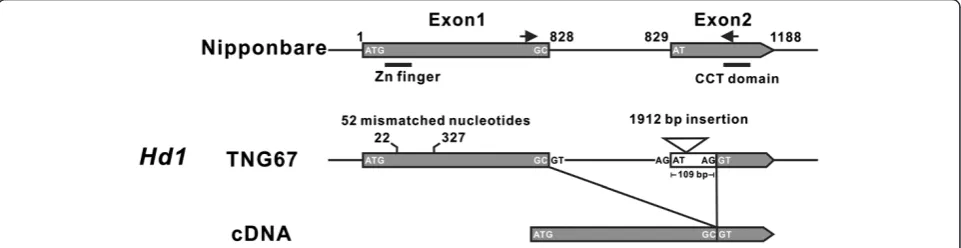
Oryza sativa. The various alleles ofHd1identified in the rice are believed to be selected by humans to adapt to the variable growing photoperiods (Izawa 2007; Takahashi and Shimamoto 2011). Hd1 and Ehd1 are key flowering time regulatory genes in rice; however, both genes have been identified to be non-functional in a Taiwan rice culti-var, Taichung 65 (T65), which shows little or no sensitivity to photoperiods (Doi et al. 2004). TNG67 is a hybrid culti-var descended from T65 plants and had decreased sensi-tivity to photoperiods. To verify Hd1 and Ehd1 gene integrity, both genes were sequenced in TNG67 rice. A total of 52 insertions or deletions and mismatched bases scattered between the 22ndand 327thbases near theHd1
zinc finger domain in exon 1 and a 1912-bp insertion adjacent to the CCT domain in exon 2 were identified (Figure 4 and Additional file 2: Figure S1). The same substitution (a functional glycine replaced by a
non-functional arginine) in the 219th amino acid of Ehd1 found in T65 rice was also detected (Additional file 3: Figure S2). Although sequence variations in the Hd1
and Ehd1 genes were detected, the corresponding
mRNAs were still regulated and expressed in TNG67 rice (Figures 2 and 3). We also found that the cDNA sequence of the Hd1 gene is 109 nucleotides shorter than that found in Nipponbare (Figure 4 and Additional file 2: Figure S1). Based on this cDNA sequence data obtained from the analysis of TNG67 rice, we con-cluded that thisHd1 transcript was generated by an al-ternative splice site (another AG inside the white box) located in exon 2 as indicated in Figure 4. These results suggest that the lack of function of Hd1 and Ehd1 in TNG67 rice (Chen et al. 2010; Chien et al. 2011) does not resulted from inhibited gene expressions but in-stead was caused either by alternative splicing and a DNA insertion into the Hd1 gene or by an amino acid substitution in theEhd1gene.
Discussion
The expression of the OsMADS45 gene is not only in-volved in the determinations of floral organ identity (Favaro et al. 2002; Dreni et al. 2007; Seok et al. 2010) but also involved in the regulation of flower initiation that affects the heading date of rice (Jeon et al. 2000a; Cui et al. 2010). The heading date ofOsMADS45 RNAi knockout mutants was delayed by approximately 2 weeks (Cui et al. 2010). In contrast, the heading date of the
OsMADS45overexpressing transgenic rice instead of be-ing delayed was reduced from the 50 days observed in the wild-type Nakdong rice to 41-48 days in a controlled growth room with 10 h of light per day (Jeon et al. 2000a). For further comparison, the heading date ob-served in our 45OX transgenic rice was approximately 40 days (50 vs. 90 days) earlier than that of the wild-type rice (TNG67) under field conditions of 11.5-13.5 h of light per day. The discrepancy in the shortening the
heading date between the Jeon et al. study and our study may be due to the different rice cultivars,
Nakdong and TNG67, with different Hd1 and Ehd1
genetic background (Figure 4, Additional file 2: Figure S1 and Additional file 3: Figure S2).
The Hd1 and Ehd1 genes are involved in photoperi-odic regulation during floral initiation (Doi et al. 2004; Izawa 2007; Endo-Higashi and Izawa 2011). As in T65 (Doi et al. 2004) and TK8 (Lin et al. 2011) cultivars, both the Hd1 and Ehd1 genes are defective in TNG67 (Figure 4, Additional file 2: Figure S1 and Additional file 3: Figure S2). However, the RNA expressions of the
defective Hd1 and Ehd1 genes can be detected in
TNG67 and 45OX transgenic rice (Figure 3); this find-ing deviates from the results of the T65 study that showed no detection of theHd1 RNA (Doi et al. 2004). While the transcript levels ofHd1(a CO-likegene) was altered in the 45OX transgenic rice, the expression of
the Ehd1 gene did not vary from that in the TNG67
(Figure 3A, D and H). In the Nakdong rice, both the
Hd1 and Ehd1genes were functionally expressed (Kim et al. 2008) and displayed photoperiod sensitivity (Jeon et al. 2000a). Therefore, we hypothesize that the varying effects in the shortening of the heading dates between the 45OX transgenic TNG67 and Nakdong rice may be a result of the regulation and expression of the Hd1
gene. Our results showed that theHd1 gene was down-regulated during the juvenile stage in 45OX transgenic plants (Figure 3H), and when this phenomenon was ob-served in the Nakdong rice, which expressed a func-tional Hd1 gene, would reduce the expression ofHd3a
under SD conditions and abate the early flowering ef-fect in transgenic Nakdong rice (Jeon et al. 2000a). However, additional analysis with our construct to transform Nakdong rice and grown in the same photo-periodic conditions would be required to address this discrepancy.
The floral time regulators in both the
Ehd2-OsMADS50-Ehd1-RFT1 LD activation pathway and the OsGI-Hd1-Hd3a LD suppression pathway exhibit diur-nal oscillation patterns (Matsubara et al. 2008; Ryu et al. 2009). We assessed the daily expression levels of these genes at each 4-hour interval, and the results showed that the expression patterns of the floral regulatory
genes, such as RFT1, Ehd1, OsMADS50, Ehd2, Hd3a,
Hd1 and OsG1 did not vary between the 45OX
trans-genic rice and the host plant TNG67 (Figure 2), thereby indicating that the ectopic expression of OsMADS45
does not alter the diurnal oscillations of these genes. These observations suggest that the diurnal oscillations of these genes are not involved in reducing the flowering time in 45OX transgenic rice, and the normal diurnal oscillations ofRFT1andHd3aobserved in thehd1/ehd1
null cultivar, TNG67, imply that there are additional
signal pathways other than those involving Hd1 and
Ehd1 involved in the day/night rhythm of theRFT1and
Hd3agenes.
Although the diurnal oscillations of the examined floral time regulators were not altered, the RNA
expres-sion levels of RFT1 and Hd3a, which are two rice
orthologs of the Arabidopsis FT-like gene, were up-regulated at a very early growth stages (20 DAI) in the 45OX transgenic rice (Figure 3). The up-regulation of theFTgene during different growth stages has been ob-served in transgenic Arabidopsis ectopically expressing MADS-box genes. For example, ectopic expression of orchid MADS1 in Arabidopsis enhances the expression of FT and results in early flowering (Hsu et al. 2003), and the overexpression of AGAMOUS-LIKE6 (AGL6, also a MADS-box gene) causes the precocious flowering phenotype by enhancing the expression of FT and the downstream gene AP1 (Koo et al. 2010). Similarly, the expression of RFT1 and Hd3a were up-regulated in the 45OX transgenic rice (Figure 3), thereby suggesting that the up-regulation of theRFT1andHd3agenes at a very early growth stage (20 DAI) may contribute to the early flowering phenomenon observed in the 45OX trans-genic rice.
OsMADS14 and OsMADS18are downstream of Hd3a
and RFT1 and regulate the identity of floral meristem development (Ciaffi et al. 2011; Kobayashi et al. 2012). In the floral tissue, OsMADS45 directly interacts with OsMADS6 and OsMADS18; OsMADS6 may further interact with OsMADS14 and OsMADS18 (Moon et al. 1999b) and OsMADS6 and OsMADS18 may form a ternary complex with the histone fold protein, OsNF-YB1 (Masiero et al. 2002). These interactions suggest that OsMADS45, OsMADS6, OsMADS14, and OsMADS18 co-regulate floral development. A number of studies indi-cated that the expression of the OsMADS14/15/18 were increased during the transition from the vegetative phase to the reproductive phase, thus, OsMADS14/15/18 have been considered as reproductive phase transition markers (Lee et al. 2004; Komiya et al. 2008; Kim et al. 2008; Gao et al. 2013). A recent study revealed that a null mutant of
OsMADS6(Osmads6-5)would down-regulate the expres-sion ofOsMADS7/45, but did not affect the expression of
OsMADS14/15/18, therefore no flowering time change was observed (Duan et al. 2012). The same report showed over-expression ofOsMADS6resulted in over production of various flower organs, but has little influence on vegeta-tive traits or the heading date (Duan et al. 2012). However,
in the present study, over-expression of OsMADS45
resulted in an increased expression of OsMADS14 and
expression ofOsMADS14/18andHd3a/RFT1and caused early flowering, a study using MADS14/15/18i-pap2-1
quadruple knockdown mutant reduced the expression of
Hd3a/RFT1and resulted in delayed flowering (Kobayashi et al. 2012). Accordingly, they proposed that PAP2 and
AP1-like genes, such as MADS14/15/18, function up-stream of Hd3a and RFT1 in leaves (Kobayashi et al. 2012). In summary, these observations suggested that 1) although OsMADS45 and OsMADS6 interact with OsMADS14 and OsMADS18 in regulating flower devel-opment, their effect on flowering time were different in overexpressing plants, 2) the downstream genes, such as
OsMADS14 and OsMADS45 would regulate the expres-sion of upstream genes (Hd3a/RFT1) in either knockdown or over-expression transgenic rice, and 3) the early
expres-sion of the OsMADS14 and OsMADS18in 45OX
trans-genic rice shortened the vegetative growth period which resulted in a flowering transition much earlier than that observed in TNG67 rice.
It is interesting to point out that the expression levels of RFT1 and Hd3a were dramatically decreased after heading at 50 DAI in 45OX transgenic rice or after heading at 90 DAI in TNG67 (Table 1; Figure 3C, G), and the expression ofRFT1andHd3awere not well cor-related with the constitutively expression ofOsMADS45
in 45OX transgenic rice after heading (Figure 3B, C, G). The increased expression of RFT1and Hd3aat a higher level before heading and then at a significantly reduced level after heading were observed (Matsubara et al. 2008; Komiya et al. 2008; Kim et al. 2008; Ryu et al. 2009). These observations suggested that both the expression of RFT1 and Hd3a were developmentally regulated by
factors that could override the overexpression effect of
OsMADS45 after heading in 45OX transgenic rice.
Al-though OsMADS14 and OsMADS18 are downstream of
Hd3a and RFT1, the expression of OsMADS14 and
OsMADS18 were not positively correlated with the ex-pression of Hd3a and RFT1 after heading (Kim et al. 2008). While the expression levels of OsMADS14 and
OsMADS18increased throughout the entire growth sea-son, the expression ofHd3aand RFT1was reduced after heading and this pattern was also observed in TNG67 and in 45OX transgenic rice. This observation suggested
that the increased expression of OsMADS14 and
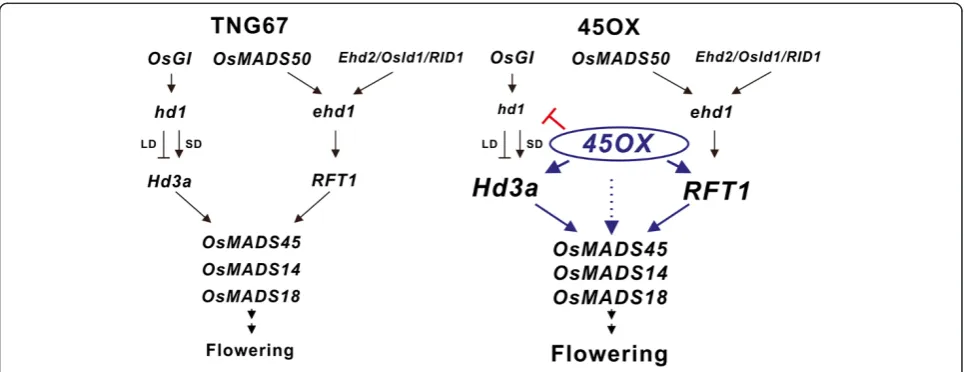
OsMADS18 after heading was controlled by factors in addition toHd3aandRFT1. Based on the understanding of these flower development regulation pathways, we hypothesize that the early increased expression of the
OsMADS14 and OsMADS18 genes in the 45OX trans-genic rice may be caused by either the up-regulation of
Hd3a and RFT1 or directly induced by the constitutive expression ofOsMADS45(Figure 5).
In the present study, we over-expressed the
OsMADS45 gene in TNG67 rice and showed that not only was the heading date reduced but also revealed that many other characteristics, such as plant height, shoot dry weight and the number of spikelets per panicle, were dramatically suppressed (Figure 1E and Table 1). A pre-vious study, which involved the introducing of functional
Hd1 and/or Ehd1 genes into T65 rice under different photoperiodic conditions, revealed that the combination ofHd1andEhd1expression reduced the number of pri-mary branches in a panicle, thereby resulting in smaller spiketlet numbers per panicle independent of the control
of flowering time (Endo-Higashi and Izawa 2011). How-ever, as observed in the T65 rice, TNG67 rice are
defect-ive in both the Hd1 and Ehd1 genes (Figure 4 and
Additional file 3: Figure S2); therefore, the reduction in spikelet numbers per panicle and other characteristics observed in our 45OX transgenic rice could not have been affected by the function of Hd1 and Ehd1. Add-itionally, no reduction in the photosynthetic rate was ob-served in 45OX transgenic rice (Table 1); this finding
suggests that overexpression of OsMADS45 does not
affect the photosynthetic system and the reduction in shoot dry weight in 45OX transgenic rice was not caused by a reduction in photosynthesis. Furthermore, plant height and grain productivity associated with the flowering time regulators, Ghd7 and Ghd8, have been previously reported (Xue et al. 2008; Yan et al. 2010). The report has shown that the enhanced expression of
Ghd7under LD conditions could delay heading and in-crease both plant height and panicle size (Xue et al. 2008). Similarly,Ghd8plays a pleiotropic role in regulat-ing grain productivity and headregulat-ing date dependregulat-ing on its genetic background, which reveals a positive correlation between flowering time and grain productivity (Yan et al. 2010). Accordingly, we propose that many of the agronomic traits, such as shorter plant height, shorter panicle length, less tiller, less shoot dry weight and less grain yield in this 45OX transgenic rice might be the re-sult of the effects of early flowering that reduced the vegetative growth periods from 89 days in TNG67 rice to 50 days.
Conclusions
Based on our results, we propose a model to explain the signaling cascade in the early flowering phenotype of 45OX transgenic rice (Figure 5). The ectopic expres-sion ofOsMADS45 activates the upstream genes,RFT1
andHd3a, at early development stages and up-regulates the expression ofOsMADS14 andOsMADS18 via either the up-regulation of Hd3aand RFT1or direct induction via the constitutive expression of OsMADS45, thereby promoting early flowering. Additionally, the regulation and function of the variousHd1 alleles may be involved in the different shortened effects on the heading dates observed between the 45OX transgenic TNG67 rice and Nakdong rice under the SD condition. In summary, our study illustrates the overexpression function of
OsMADS45 in initiating a possible bottom-up activa-tion of the MADS-box genes signaling pathway that en-hances early flower initiation, and the study using TNG67 rice may also represent another useful ap-proach to study the flowering mechanism of other floral regulators to bypass the complex photoperiodic re-sponses that are regulated by theHd1andEhd1 signal-ing pathways.
Additional files
Additional file 1: Table S1.The primer pairs used in this study.
Additional file 2: Figure S1.The genomic DNA sequence of theHd1 gene of TNG67 rice. TwoHd1exons are marked with boxes, and the intron junctions GT…AG are underlined and marked red. A total of 52 in/del and mismatched nucleotides in exon 1 (black boxed) compare with Nipponbare rice are marked with black (different bases) or grey shadings (additional bases in TNG67) or a dashed line to indicate the deleted bases. The red bases of exon 1 represent the zinc finger domain. A 1912-bp insertion is shaded grey within exon2 (red box), and the green bases represent the CCT domain. The proposed alternative splice site in exon 2 is underlined, in bold text and marked in orange.
Additional file 3: Figure S2.A schematic diagram showing the location of sequence variation and the detailed cDNA sequences ofEhd1of TNG67 rice. (A) The functional glycine (G) in Nipponbare rice replaced by a non-functional arginine (R) in the 219thamino acid of Ehd1 as observed with T65 (Doi et al. 2004) and TK8 plants (Lin et al. 2011) is shown. (B) The cDNA sequences ofEhd1of TNG67 rice with the replaced DNA (underlined) and amino acid sequences (G to R). Five exons are marked with different colors, and the GARP domain is highlighted in yellow.
Competing interests
The authors declare that they have no competing interests.
Authors’contributions
JDW carried out the laboratory studies and made interpretation of data and drafted the manuscript. SFL carried out the mutant selections and identified the genes. YSL identified the function of genes. PJC generated the transgenic plants and carried out the initial assays. SYL carried out the field works. TYH drafted and revised the manuscript. JHL designed the
experiments and supply facilities. LJC designed the experiments, drafted and finalized the manuscript. All authors read and approved the final manuscript.
Acknowledgements
We thank Show-Ya Yang, I-Wen Wang and Wen-Bin Tseng for their technical assistance with the transgenic rice plants, thank Dr. Yann-Rong Lin for the critical suggesting in revising this manuscript. This work was supported by grants from the National Science Council (97-2317-B-005-002 and NSC-98-2628-B-005-018 to L-J.C.) of Taiwan and in part by the Ministry of Education, Taiwan under the ATU plan.
Author details
1Department of Life Sciences, National Chung Hsing University, Taichung
402, Taiwan.2Institute of Molecular Biology, National Chung Hsing University,
Taichung 402, Taiwan.3Agricultural Biotechnology Center, National Chung
Hsing University, Taichung 402, Taiwan.4Present address: Institute of
Molecular Biology, Academia Sinica, Taipei 115, Taiwan.5Present address:
Institute of Plant and Microbiology, Academia Sinica, Taipei 115, Taiwan.
Received: 11 October 2012 Accepted: 20 March 2013 Published: 21 August 2013
References
Arora R, Agarwal P, Ray S, Singh AK, Singh VP, Tyagi AK, Kapoor S (2007) MADS-box gene family in rice: genome-wide identification, organization and expression profiling during reproductive development and stress. BMC Genomics 8:242
Bai X, Wang Q, Chu C (2008) Excision of a selective marker in transgenic rice using a novel Cre/loxPsystem controlled by a floral specific promoter. Transgenic Res 17:1035–1043
Chen PW, Lu CA, Yu TS, Tseng TH, Wang CS, Yu SM (2002) Riceα-amylase transcriptional enhancers direct multiple mode regulation of promoters in transgenic rice. J Biol Chem 277:13641–13649
Chen CS, Chen RK, Chin HH, Lin YR (2010) Introgression of three heading date gene,hd1,Hd6, andehd1, toOryza sativaL.japonicacv. Koshihikari by marker-assisted selection. Crop, Environ. & Bioinformatics 7:1–20
Ciaffi M, Paolacci AR, Tanzarella OA, Porceddu E (2011) Molecular aspects of flower development in grasses. Sex Plant Reprod 24:247–282
Cui RF, Han JK, Zhao SH, Su KM, Wu F, Du XQ, Xu QJ, Chong K, Theißen G, Meng Z (2010) Functional conservation and diversification of class E floral homeotic genes in rice (Oryza sativa). Plant J 61:767–781
Doi K, Izawa T, Fuse T, Yamanouchi U, Kubo T, Shimatani Z, Yano M, Yoshimura A (2004)Ehd1, a B-type response regulator in rice, confers short-day promotion of flowering and controlsFT-likegene expression independently ofHd1. Genes Dev 18:926–936
Dreni L, Jacchia S, Fornara F, Fornari M, Ouwerkerk PBF, An G, Colombo L, Kater MM (2007) The D-lineage MADS-box gene OsMADS13 controls ovule identity in rice. Plant J 52:690–699
Duan Y, Xing Z, Diao Z, Xu W, Li S, Du X, Wu G, Wang C, Lan T, Meng Z, Liu H, Wang F, Wu W, Xue Y (2012) Characterization ofOsmads6-5, a null allele, reveals thatOsMADS6is a critical regulator for early flower development in rice (Oryza sativa L.). Plant Mol Biol 80:429–442
Endo-Higashi N, Izawa T (2011) Flowering time genesHeading date 1andEarly heading date 1together control panicle development in rice. Plant Cell Physiol 52:1083–1094
Favaro R, Immink RGH, Ferioli V, Bernasconi B, Byzova M, Angenent GC, Kater M, Colombo L (2002) Ovule-specific MADS-box proteins have conserved protein-protein interactions in monocot and dicot plants. Mol Genet Genomics 268:152–159
Fornara F, Parˇenicova’L, Falasca G, Pelucchi N, Masiero S, Ciannamea S, Lopez-Dee Z, Altamura MM, Colombo L, Kater MM (2004) Functional
Characterization ofOsMADS18, a Member of theAP1/SQUASubfamily of MADS-box Genes. Plant Physiol 135:2207–2219
Gao H, Zheng XM, Fei G, Chen J, Jin M, Ren Y, Wu W, Zhou K, Sheng P, Zhou F, Jiang L, Wang J, Zhang X, Guo X, Wang JL, Cheng Z, Wu C, Wang H, Wan JM (2013) Ehd4 encodes a novel and oryza-genus-specific regulator of photoperiodic flowering in rice. PLoS Genet 9:e1003281
Greco R, Stagi L, Colombo L, Angenent GC, Sari-Gorla M, Pè ME (1997) MADS-box genes expressed in developing inflorescences of rice and sorghum. Mol Gen Genet 253:615–623
Greenup A, Peacock WJ, Dennis ES, Trevaskis B (2009) The molecular biology of seasonal flowering-responses in Arabidopsis and the cereals. Ann Bot 103:1165–1172
Hayama R, Coupland G (2004) The molecular basis of diversity in thephotoperiodic flowering responses of Arabidopsis and rice. Plant Physiol 135:677–684 Hayama R, Yokoi S, Tamaki S, Yano M, Shimamoto K (2003) Adaptation of
photoperiodic control pathways produces short-day flowering in rice. Nature 422:719–722
Ho SL, Tong WF, Yu SM (2000) Multiple mode regulation of a cysteine proteinase gene expression in rice. Plant Physiol 122:57–66
Honma T, Goto K (2001) Complexes of MADS-box proteins are sufficient to convert leaves into floral organs. Nature 409:525–529
Hsu HF, Huang CH, Chou LT, Yang CH (2003) Ectopic expression of an orchid (OncidiumGower Ramsey)AGL6-like gene promotes flowering by activating flowering time genes inArabidopsis thaliana. Plant Cell Physiol 44:783–794 Izawa T (2007) Adaptation of flowering-time by natural and artificial selection in
Arabidopsis and rice. J Exp Bot 58:3091–3097
Jeon JS, Lee S, Jung KH, Yang WS, Yi GH, Oh BG, An G (2000a) Production of transgenic rice plants showing reduced heading date and plant height by ectopic expression of rice MADS-box genes. Mol Breed 6:581–592 Jeon JS, Jang S, Lee S, Nam J, Kim C, Lee SH, Chung YY, Kim SR, Lee YH, Cho YG,
An G (2000b)leafy hull sterile1is a homeotic mutation in a rice MADS-box gene affecting rice flower development. Plant Cell 12:871–884
Khush GS (1997) Origin, dispersal, cultivation and variation of rice. Plant Mol Biol 35:25–34
Kim SL, Lee S, Kim HJ, Nam HG, An G (2007)OsMADS51is a short-day flowering promoter that functions upstream ofEhd1,OsMADS14, andHd3a. Plant Physiol 145:1484–1494
Kim SK, Yun CH, Lee JH, Jang YH, Park HY, Kim JK (2008)OsCO3, aCONSTANS-LIKE gene, controls flowering by negatively regulating the expression ofFT-like genes under SD conditions in rice. Planta 228:355–365
Kobayashi K, Yasuno N, Sato Y, Yoda M, Yamazaki R, Kimizu M, Yoshida H, Nagamura Y, Kyozuka J (2012) Inflorescence meristem identity in rice is specified by overlapping functions of threeAP1/FUL-Like MADS-box genes andPAP2, aSEPALLATAMADS-box gene. Plant Cell 24:1848–1859 Kojima S, Takahashi Y, Kobayashi Y, Monna L, Sasaki T, Araki T, Yano M (2002)
Hd3a, a rice ortholog of the ArabidopsisFTGene, promotes transition to
flowering downstream ofHd1under short-day conditions. Plant Cell Physiol 43:1096–1105
Komiya R, Ikegami A, Tamaki S, Yokoi S, Shimamoto K (2008)Hd3aandRFT1are essential for flowering in rice. Development 135:767–774
Komiya R, Yokoi S, Shimamoto K (2009) A gene network for long-day flowering activatesRFT1encoding a mobile flowering signal in rice. Development 136:3443–3450
Koo SC, Bracko O, Park MS, Schwab R, Chun HJ, Park KM, Seo JS, Grbic V, Balasubramanian S, Schmid M, Godard F, Yun DJ, Lee SY, Cho MJ, Weigel D, Kim MC (2010) Control of lateral organ development and flowering time by theArabidopsis thalianaMADS-box geneAGAMOUS-LIKE6. Plant J 62:807–816 Koornneef M, Alonso-Blanco C, Peeters AJM, Soppe W (1998) Genetic control of
flowering time in Arabidopsis. Annu Rev Plant Physiol Plant Mol Biol 49:345–370 Lee S, Kim J, Han JJ, Han MJ, An G (2004) Functional analyses of the flowering
time geneOsMADS50, the putativeSUPPRESSOR OF OVEREXPRESSION OF CO 1/AGAMOUS-LIKE 20(SOC1/AGL20) ortholog in rice. Plant J 38:754–764 Lim J, Moon YH, An G, Jang SK (2000) Two rice MADS domain proteins interact
with OsMADS1. Plant Mol Biol 44:513–527
Lin SY, Wang JD, Lin JH (2009) Expression of Trigonopsis variabilis D-amino acid oxidase in transgenic rice for cephalosporin production. Bot Stud 50:181–192 Lin YR, Wu SC, Chen SE, Tseng TH, Chen CS, Kuo SC, Wu HP, Hsing YIC (2011)
Mapping of quantitative trait loci for plant height and heading date in two inter-subspecific crosses of rice and comparison acrossOryzagenus. Bot Stud 52:1–14
Lopez-Dee ZP, Wittich P, Enrico Pè M, Rigola D, Del Buono I, Gorla MS, Kater MM, Colombo L (1999)OsMADS13, a novel rice MADS-box gene expressed during ovule development. Dev Genet 25:237–244
Masiero S, Imbriano C, Ravasio F, Favaro R, Pelucchi N, Gorla MS, Mantovani R, Colombo L, Kater MM (2002) Ternary complex formation between MADS-box transcription factors and the histone fold protein NF-YB. J Biol Chem 277:26429–26435
Matsubara K, Yamanouchi U, Wang ZX, Minobe Y, Izawa T, Yano M (2008)Ehd2, a rice ortholog of the maizeINDETERMINATE1Gene, promotes flowering by up-regulatingEhd1. Plant Physiol 148:1425–1435
Moon YH, Jung JY, Kang HG, An G (1999a) Identification of a riceAPETALA3 homologue by yeast two-hybrid screening. Plant Mol Biol 40:167–177 Moon YH, Kang HG, Jung JY, Jeon JS, Sung SK, An G (1999b) Determination of the
motif responsible for interaction between the rice APETALA1 AGAMOUS-LIKE9 family proteins using a yeast Two-hybrid system. Plant Physiol 120:1193–1203 Park SJ, Kim SL, Lee S, Je BI, Piao HL, Park SH, Kim CM, Ryu CH, Park SH, Xuan YH,
Colasanti J, An G, Han CD (2008) RiceIndeterminate 1(OsId1) is necessary for the expression ofEhd1(Early heading date 1) regardless of photoperiod. Plant J 56:1018–1029
Pelaz S, Ditta GS, Baumann E, Wisman E, Yanofsky MF (2000) B and C floral organ identity functions requireSEPALLATAMADS-box genes. Nature 405:200–203 Ryu CH, Lee S, Cho LH, Kim SL, Lee YS, Choi SC, Jeong HJ, Yi J, Park SJ, Han CD,
An G (2009)OsMADS50andOsMADS56function antagonistically in regulating long day (LD)-dependent flowering in rice. Plant Cell Environ 32:1412–1427
Sato Y, Antonio BA, Namiki N, Takehisa H, Minami H, Kamatsuki K, Sugimoto K, Shimizu Y, Hirochika H, Nagamura Y (2011) RiceXPro: a platform for monitoring gene expression in japonica rice grown under natural field conditions. Nucleic Acids Res 39:D1141–D1148
Seok HY, Park HY, Park JI, Lee YM, Lee SY, An G, Moon YH (2010) Rice ternary MADS protein complexes containing class B MADS heterodimer. Biochem Biophys Res Commun 401:598–604
Shitsukawa N, Ikari C, Shimada S, Kitagawa S, Sakamoto K, Saito H, Ryuto H, Fukunishi N, Abe T, Takumi S, Nasuda S, Murai K (2007) The einkorn wheat (Triticum monococcum) mutant,maintained vegetative phase, is caused by a deletion in theVRN1gene. Genes Genet Syst 82:167–170
Sun TP, Gubler F (2004) Molecular mechanism of gibberellin signaling in plants. Annu Rev Plant Biol 55:197–223
Takahashi Y, Shimamoto K (2011)Heading date 1(Hd1), an ortholog of ArabidopsisCONSTANS, is a possible target of human selection during domestication to diversify flowering times of cultivated rice. Genes Genet Syst 86:175–182
Tamaki S, Matsuo S, Wong HL, Yokoi S, Shimamoto K (2007) Hd3a protein is a mobile flowering signal in rice. Science 316:1033–1036
Taoka KI, Ohki I, Tsuji H, Furuita K, Hayashi K, Yanase T, Yamaguchi M, Nakashima C, Purwestri YA, Tamaki S, Ogaki Y, Shimada C, Nakagawa A, Kojima C, Shimamoto K (2011) 14-3-3 proteins act as intracellular receptors for rice Hd3a florigen. Nature 476:332–335
Tsuji H, Tamaki S, Komiya R, Shimamoto K (2008) Florigen and the photoperiodic control of flowering in rice. Rice 1:25–35
Tsuji H, Nakamura H, Taoka K, Shimamoto K (2013) Functional diversification of FD transcription factors in rice, components of florigen activation complexes. Plant Cell Physiol 54:385–397
Wilczek AM, Burghardt LT, Cobb AR, Cooper MD, Welch SM, Schmitt J (2010) Genetic and physiological bases for phenological responses to current and predicted climates. Philos Trans R Soc Lond B Biol Sci 365:3129–3147 Wu C, You C, Li C, Long T, Chen G, Byrne ME, Zhang Q (2008)RID1, encoding a
Cys2/His2-type zinc finger transcription factor, acts as a master switch from vegetative to floral development in rice. Proc Natl Acad Sci U S A 105:12915–12920
Xue W, Xing Y, Weng X, Zhao Y, Tang W, Wang L, Zhou H, Yu S, Xu C, Li X, Zhang Q (2008) Natural variation inGhd7is an important regulator of heading date and yield potential in rice. Nat Genet 40:761–767
Yamaguchi T, Hirano HY (2006) Function and diversification of MADS-box genes in rice. ScientificWorldJournal 6:1923–1932
Yan WH, Wang P, Chen HX, Zhou HJ, Li QP, Wang CR, Ding ZH, Zhang YS, Yu SB, Xing YZ, Zhang QF (2010) A major QTL,Ghd8, plays pleiotropic roles in regulating grain productivity, plant height, and heading date in rice. Mol Plant 4:319–330
doi:10.1186/1999-3110-54-12
Cite this article as:Wanget al.:Ectopic expression ofOsMADS45
activates the upstream genesHd3aandRFT1at an early development stage causing early flowering in rice.Botanical Studies201354:12.
Submit your manuscript to a
journal and benefi t from:
7 Convenient online submission 7 Rigorous peer review
7 Immediate publication on acceptance 7 Open access: articles freely available online 7 High visibility within the fi eld
7 Retaining the copyright to your article