283 | P a g e
OBJECT ORIENTED MODELING OF RSA DIGITAL
SIGNATURE FOR SECURITY IN E-LEARNING
Dr. Sunil Karforma
1,
Soumendu Banerjee
21
Associate Professor, Dept. of Computer Science, The University of Burdwan
2
Research Scholar, Dept. of Computer Science, The University of Burdwan
ABSTRACT
One of the most recent trends of learning is E-learning. The main thing to concern about an E-learning system is
that, this is fully controlled through online. It is being a public network; security always plays an important role. In
this system teachers send their materials, for various purposes, to the administrator, through online. While sending
these materials, hackers can change or destroy those. Digital signature can be used to detect whether the material is
changed or not. In this paper, we have wrapped RSA Digital Signature algorithm in an object oriented model for
implementation of authenticity of these study materials utilizing the benefits of object oriented analysis and design.
Keywords
:
Class Diagram, DFD, E-Learning, RSA Digital Signature, Use Case Diagram
.
I INTRODUCTION
Like the other learning systems, teachers and administrators are the main components of e-learning system. All the
communications, between teachers and administrators is mainly done through the Internet. Now-a-days, e-learning
is also becoming a part of this competitive world. In e-learning system, teachers prepare study materials, question
papers, mark sheets and they have to upload it securely to the administrator. While sending these confidential
materials, digital signature can be used to detect whether the materials are modified by the hacker or not.
We have made an attempt to object oriented[1] implementation of RSA Digital Signature algorithm[2] for secure
transmission[4,5,6,8] of study materials from teacher to administrator. In this context, teacher will send their materials
with a signature, which will be also verified at the administrator end. If anyone tries to hack the message, the sign
will be changed and the administrator can track it. We have utilized the benefits of object oriented analysis and
design during our implementation.
In the section II, we have analyzed the system with the help of Data Flow Diagram[7] (DFD) and Use case diagram.
Section III covers the proposed class diagram and code segment written in C++ language. Section IV contains all the
284 | P a g e
II. DATA FLOW DIAGRAM (DFD)
The data flow diagram[7] is a graphical representation of a system, which contains the input data to the system,
processes which has been carried out on these data and also the output data generated by the system. The data flow
diagram of material sending from the Teacher to Administrator is shown in the fig: 1, in section IV. Here teacher is
sending the material and compute the hash value from the material using hash() function. The public key and the
teacher’s private keys are stored in the data store. Using the private key teacher is generating the signature and sends
it along with the study material and public key to the administrator. Admin then again computes the hash value from
the public key of Teacher and compare the hash values with the given hash value. If there is no change, then it is
accepted otherwise take the required action.
USE CASE MODEL
In the use case model, we take two types of objects like, Teacher and Administrator. Here Teacher is generating the
signed material and sending this material along with the signature to the administrator. The administrator compares
the hash values and verifies if the material is hacked or not. Here we use two use case models.
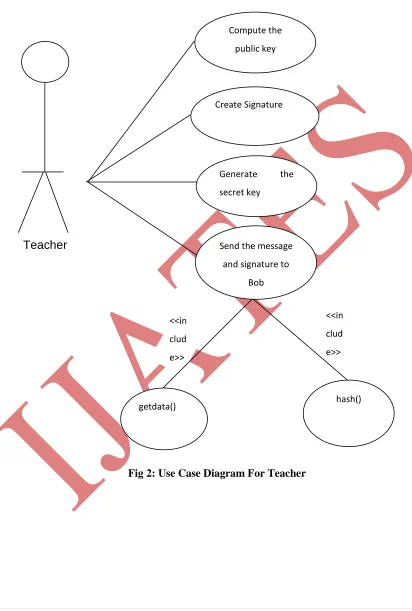
In the first use case model, shown in fig. 2, in section IV, we discuss about the signature generation. Here teacher
generates the signature, computes the private key, secret key and ultimately sends the material along with the
signature to the administrator. The last step also include two other functions getdata() and hash().
In the second use case model, shown in fig: 3, in section IV, we discus about the signature verification, that means
the administrator checks that the signature, sent by the teacher, and the signature, received by him/her, is same or
not. Here the administrator gets the public key of teacher, receive the message and signature from the teacher and
compare the two hash values. This last step includes two other processes, one is the first hash value sent by the
teacher and the other hash value, generated by the administrator himself/herself.
III. CLASS DIAGRAM OF RSA DIGITAL SIGNATURE
The class diagram[3] for RSA digital signature consisting of classes RSA1, RSA2, Tchr (sender) and Admn
(receiver) is shown in fig 4, in section IV:.
The descriptions of individual classes are given below:
Class RSA1{
Public:
//these are the public member functions of the class RSA1
285 | P a g e
long int Ntchr; //it is the product of two prime numbers
long int sign; //sign represents digital signature
};
Class RSA2{
Public:
//these are the public member functions of the class RSA2
int hash(char[]);//this function is used to create a hash value
int GCD(int, int);//this is used to determine the GCD value of two numbers
};
Detail implementation of Class Admn, a multiple inheritance of RSA1 and RSA2 derived both publicly as follows:
Class Admn: public RSA2, public RSA1
{
long int Ptechr;//this is the public key of Tchr
int check();//this is used to verify the digital signature of an object of class Tchr
};
Detail implementation of the class Tchr derived publicly from RSA2 and privately from RSA1 is given below:
Class Tchr: public RSA2, private RSA1
{
Private:
//following data members are private of the class Tchr
long int U,V;//U and V are two random numbers
long int h;//h is storing hash value
286 | P a g e
Public:
// following data members are public of the class Tchr
long int Ptchr;//this is the public key of tchr
void getData();//this function is used to get message and signature from Tchr
/* An object of class Tchr use following function to send his message and digital signature to an object of class
Admn*/
admn send();
};
The objective of the Driver program segment is given below:
The program execution starts from the function main(). Here t is an object of class Tchr and a is an object of class
Admn. t.send() sends a digitally signed message to a and a.check() verifies the signature and detects whether the
received message is unaltered or modified by a third party i.e., intruder. Hence message integrity is checked by this
check() function.
Void main()
{
Tchr t;//t is an object of class Tchr (sender)
Admn a;//a is an object of class Admn (receiver)
Int x; /*x is storing the result after comparison between computed signature on received message and the received
signature*/
a=t.send();//t is sending signed message to a
x=a.check();//a is verifying the digital signature of t
if (x==1)
cout<<”\nMessage is Ok”;//message is not modified after transmission
else
287 | P a g e
}//end of main()
IV. FIGURES:
Fig: 1. DFD for RSA digital signature (from teacher to administrator)
TeacherMaterial
Public key
Compute
hash value
Teach
er’s
privat
e key Generate
signature using
private key of
teacher Send public key and
signature to
Administrator Receive the
hash value and
signature
Compare the hash value
of received signature and
recomputed hash value Administrator
Material Signat
288 | P a g e
Teacher
Fig 2: Use Case Diagram For Teacher
<<in
clud
e>> <<in
clud
e>>
Compute the
public key
Create Signature
Generate the
secret key
Send the message
and signature to
Bob
289 | P a g e
Administrator
Fig 3: Use case diagram for Administrator
Get the public keyof teacher
Get the message and
signature
from
teacher
Re-compute the
hash value
Verify if the incoming
signature is equal to
the recomputed signature Public: RSA2 Private: RSA1 Public: RSA1 Public: RSA2 Class RSA1 Public: Char *msg;
Long int Ntchr, sign;
Class RSA2 Public:
Int hash (char[]); Int GCD (int, int);
Class Tchr
{
Private:
Long int U, V;
Long int h;
Long int Stchr;
Public:
Long int Ptchr;
Void getData(); Admn send(); }; Class Admn { Public:
Long int Ptchr;;
Int check();
290 | P a g e
Fig 4: Class Diagram for RSA Digital Signature
V. CONCLUSION
Proposed Object Oriented Model of RSA algorithm may be applied in case of authentication of transacting parties
involved in E-learning as well as E-commerce and E-governance. The proposed Object Oriented analysis and design
can be done further with the help of sequence diagram, activity diagram etc. Moreover, the security of proposed
model may be improved further by selecting large prime numbers, which are used for key selection. The level of
security of proposed model may be improved further by using MD5 or SHA algorithm as hash function.
REFERENCES
[1] Balagurusamy, E (2006), Object Oriented Programming with C++, Tata McGraw Hill, New Delhi
[2] Behrouz, A Forouzan (2006), Data Communication and Networking, Tata McGraw Hill
[3] Karforma Sunil and Mukhopadhyay Sripati (July, 2005), A Study on the application of Cryptography in
E-Commerce, The university of Burdwan, W.B, India.
[4] Karforma Sunil and Nikhilesh Barik (January, 2012), Risks and Remedies in E-learning System, International
Journal of Network Security & Its Applications (IJNSA), Vol.4, No.1, pp 51-59.
[5] Karforma Sunil and Nikhilesh Barik (August, 2012), Object Oriented Modeling of Secured E-Assessment
System, International Journal of Scientific & Engineering Research Volume 3, Issue 8.
[6] Kumar Gupta Sapan and K. Kuriachan Juneesh, Issues and Solutions in E-learning System, International Journal
in Multidisciplinary and Academic Research (SSIJMAR), Vol. 2, No. 2
[7] Rajib Mall (June, 2006), Fundamentals of Software Engineering, Prentice Hall of India, New Delhi