INTERNATIONAL RESEARCH JOURNAL OF PHARMACY
www.irjponline.com
ISSN 2230 – 8407
Research Article
EVALUATION OF ANTIMICROBIAL, ANTIOXIDANT AND ANTICANCER ACTIVITIES OF
FEW MACROLICHENS COLLECTED FROM EASTERN GHATS OF TAMIL NADU, INDIA
Poornima Shanmugam
1, Ponmurugan Ponnusamy
2*, Mythili Gnanamangai Balasubramanian
1, Nagarjun Nagarajan
1,
Ayyappadasan Ganesan
11
Department of Biotechnology, K.S. Rangasamy College of Technology, Tiruchengode, Namakkal District,
Tamil Nadu, India
2
Department of Botany, Bharathiar University, Coimbatore, Tamil Nadu, India
*Corresponding Author Email: [email protected]
Article Received on: 16/01/17 Approved for publication: 28/02/17
DOI: 10.7897/2230-8407.080334
ABSTRACT
The aim of the present study is to investigate the bioactivities of various solvent extracts of lichens collected from Eastern Ghats of Tamil Nadu, India. The lichen samples were identified based on color tests, chemical profiling and morphological and anatomical characteristic features. Lichens such as
P.grayanum, P.tinctorum, P.reticulatum and P.austrosinense were selected and analyzed for their biological activities. Among the tested lichen samples, methanol extract of P.tinctorum and P.austrosinense showed a strong antibacterial activity with the inhibition rate of 15.13±0.76 and 13.9±0.1mm respectively. P.reticulatum indicated a strong antifungal activity with the inhibition zone of 10.17±0.96mm followed by P.austrosinense and
P.tinctorum. Antioxidant study revealed that IC50 value of acetone extracts of P. tinctorum showed higher antioxidant activity with IC50 of 17.52 µg/ml
than P.austrosinense exhibited IC50 value of 26.39 µg/ml. These activities were confirmed through in vitro cytotoxic studies in which P. austrosinense
registered the maximum control over HeLa cell lines with the IC50 value of 39.06µg/ml.
Key words: Lichens, antimicrobial, antioxidant, lichen compounds, macrolichens, anticancer activities.
INTRODUCTION
Long-term use of synthetic drugs causes numerous side effects
and sometimes resistancesto the drugs. Lichens have economic
benefits to human beings which has antibiotic properties that are valuable commercially for biomedical applications. Lichens and their metabolites yield significant bioactive substances for the treatment of various human diseases caused by different pathogenic microorganisms. There are about 2040 species of lichens present in India1 in which around 10 lichen species are
being used for food, more than 15 lichens used for biomedical applications and few are employed for environmental monitoring and natural dye extraction purposes. Lichens can be efficiently used for monitoring the level of pollution in the atmosphere and analysis of lichen samples can be used to estimate the extent and pollutant emissions around an industry or a particular locality2.
Lichens provide warning signal before severe damages occur on ecosystem and health.
It has been observed that the majority of lichen populations are
unexplored for commercial exploitation3. Lichens can produce a
wide array of both intracellular and extracellular compounds. These lichen compounds are called secondary metabolites which are extracellular in nature often called lichen acids. These are unique to lichens. Since lichens are composed of mycobionts and phycobionts, the former are playing pivotal role for the
production of secondary metabolites4. The quantities of these
secondary metabolites may vary up to 30% of the dry weight of the lichen thalli. So far number of lichen compounds have been extracted for various investigations. Lichen secondary metabolites comprise of amino acid derivatives, aromatic
compounds, dibenzofurans, depsides and depsidones etc. which exhibited manifold biological activities such as antibiotic, anti-inflammatory, analgesic, antipyretic and cytotoxic activities5,6.
The aim of the present study is to evaluate the antimicrobial, antioxidant and anticancer activities of the acetone and methanol extracts of few lichens collected from Eastern Ghats of Tamil Nadu, India.
MATERIALS AND METHODS
Collection and identification of lichen samples
Lichen samples were collected from Yercaud and Kolli hills belonging to Eastern Ghats of Tamil Nadu for the present study. The collected lichen samples were dried and preserved for further
study7. Moreover, lichen samples were identified by spot tests and
chemical profiling along with morphological and anatomical characters. The spot test was carried out by direct application of the reagents such as aqueous solution (5%) of potassium hydroxide (K), 2% calcium hypochlorite (C) and solution of KC (application of K, quickly followed by C).
Preparation of lichen extracts and phytochemical analysis
constituents such as tannins, glycosides, alkaloids, saponins, flavonoids, terpenoids, phenols, carbohydrates and proteins by standard methods.
Antimicrobial activity of lichen extracts
The extracted compounds were then analyzed for the
antimicrobial activity. The test microorganisms such as E.coli,
B.subtilis, S.aureus, A.flavus and A.niger were maintained on
Muller-Hinton agar and potato dextrose agar (PDA); respectively for bacterial and fungal cultures. Antimicrobial ability of the
lichen extracts were carried out by well-diffusion method8. The
plates were inoculated with 50 µl (1 mg/ml) of lichen extracts and 30mg of tetracycline were added to the respectively labelled wells. The plates are allowed to stand for 30 minutes and were incubated at 37°C for 24 hours and the zone of inhibition was
recorded9. For fungal isolates, the spore suspension of test fungi
was swab inoculated aseptically on the sterile PDA plates. Nystatin was used as standard antifungal agent. Antimicrobial activity was evaluated by measuring the zone of inhibition against the test organisms. Experiment was carried in triplicates and average values were recorded.
Minimum inhibitory concentration (MIC) was determined by Micro well dilution method10, all the lichen species including
P.grayanum, P.tinctorum, P.reticulatum and P.austrosinense
against E.coli, B.subtilis, S.aureus, A.flavus and A.niger. The test samples were dissolved in 10% DMSO and the selected bacterial and fungal cultures were prepared using nutrient broth and PD broth and incubated for 24h and 72h respectively. A series of dilutions with concentrations ranging from 10 to 50 µg/ml of was used against selected bacterial and fungal cultures. The 96 well plates were prepared by adding 100 µl of bacterial and fungal culture with various concentrations of extracts (acetone and methanol) and kept for incubation for 12 h. The absorbance was measured at 600 nm.
Antioxidant activity DPPH assay
Free radical scavenging effect of lichen samples were determined
by 1,1-diphenyl-2-picryl-hydrazil (DPPH) method 11. 50µL of
various concentrations of the extracts in methanol was added to 5 ml of a 0.004% methanol solution of DPPH. The mixture was shaken vigorously and allowed to stand for 30 min at room temperature. After that the absorbance was measured at 517 nm using spectrophotometrically. The percentage of inhibition was calculated by
% Inhibition = (Acontrol – Asample / Acontrol) *100
The inhibition concentration (IC50) was calculated to compare the
radical scavenging activity.
Reducing power12
Reducing power of lichen extracts were determined. One milliliter of extract (1 mg/mL) was mixed with 2.5 mL of phosphate buffer (2.5 mL, 0.2 M, pH 6.6) and potassium ferricyanide [K3Fe(CN)6] (2.5 mL, 1%). The mixture was
incubated for 20 min at 500 C. Then, trichloroacetic acid (10%,
2.5 mL) was added and the mixture centrifuged. Finally the upper layer was removed and mixed with distilled water (2.5 mL) and
Cytotoxicity assay
HeLa (cervix adenocarcinoma) cell lines were obtained from National Centre for Cell and Science, Pune, India for the present study. The cell lines were sub-cultured and maintained at CO2
Incubator at 37oC. Then it was subjected to treat with various
concentrations of crude extracts at various concentrations to
analyze the cytotoxicity using MTT assay13. The inhibitory
concentration (IC50) was calculated for the various solvent
extracts against the cancer cells. Cell count and viability was done using hemocytometer and trypan blue assay12. Cell death and
viability was calculated by the following formulae:
Cell death = [(C – T) /C] * 100
RESULTS AND DISCUSSION Phytochemical analysis
The preliminary phytochemical screening revealed that methanolic and acetone extracts showed the presence of most of the phytochemical constituents present in lichen thallus including alkaloids, glycosides, flavonoids, carbohydrates, proteins and saponins (Table 1). The results were coincided with the report of
Rashmi et al. (2014)14. Methanolic extract of P.tinctorum and P.
austrosinense and acetone extract of P.tinctorum were confirmed
the presence of phenols.
Antimicrobial activity
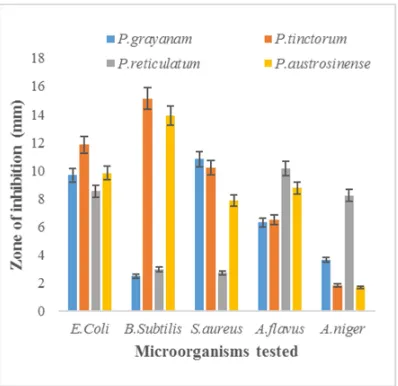
Antimicrobial activity of lichen extracts against bacterial and fungal strains were presented in the Table 2. Methanolic and acetone extracts of lichen species revealed significant
antibacterial effect against the tested organisms. P.grayanam and
P.tinctorum showed significant antibacterial activity against
P.aureus15,it was evident from the zone of inhibition values of
10.83±1.26 mm and 10.23±0.75mm respectively. The antibacterial activity of P.tinctorum is due to the presence of
atronorin and lecanoric acid. P.austrosinense was found to be
active against B.subtilis with the inhibition zone of 13.9±0.1mm;
P.tinctorum showed positive response against B.subtilis and
A.flavus with the inhibition of 15.13±0.76 mm and 6.5±0.87 mm;
respectively. P.reticulatum showed significant activity against
A.flavus. P.tinctorum was found to beeffective against E.coli16.
No activity was recorded for P.austrosinense and P.tinctorum
against A.niger. Hence, it is evident that Parmatrema lichens are
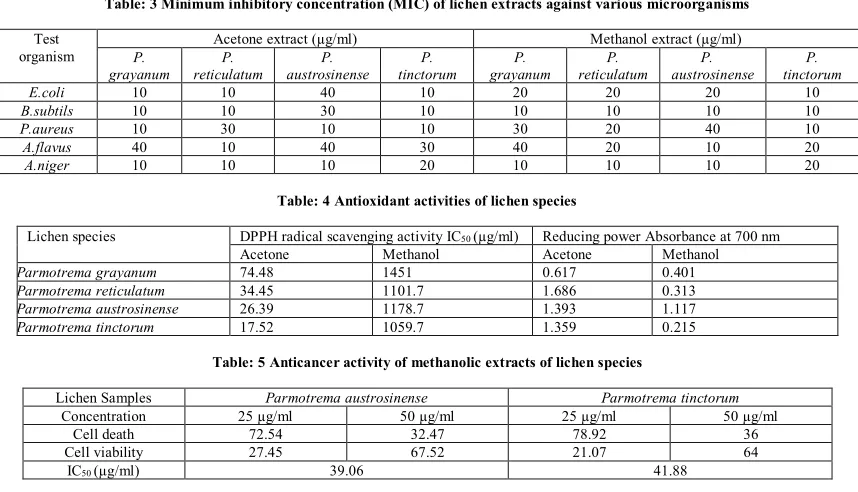
promising microbial agents. The MIC values of tested lichen species were showed in the Table 3 which indicated almost all the selected lichen species shown antimicrobial activity against the tested organisms.
Antioxidant activity
Antioxidant activities determined by DPPH radical scavenging power and ferric ion reducing power were presented in the Table 4. Antioxidant activity of lichens are evidenced by the presence of phenols17. A decrease in absorbance of the reaction mixture
indicated a higher free radical scavenging activity. From the value of inhibitory concentration at 50% inhibition, methanol extract of
P.tinctorum and P.austrosinense showed greater radical
scavenging activity with IC50 value of 17.52 µg/ml and 26.39
µg/ml respectively. The increasing absorbance showed the increasing reducing power. The results of reducing power assay
to confirm the phenolic contents in order to justify their
contribution to antioxidant activity20. The antioxidant property of
lichens were already confirmed by several studies21.
Cytotoxicity assay
The cytotoxicity effect of the methanolic lichen extracts of
P.austrosinense and P.tinctorum was shown in the Table 5. These
two extracts were selected based on their result of free radical scavenging activity. Better cytotoxicity activity was exhibited by
P.austrosinense over HeLa cell lines with the IC50 value of 39.06
µg/ml. Lichen compounds are responsible for anticancer activities in which the growth of cells are inhibited significantly22,23. Bogo et al (2010)24 reported that P.tinctorum
had good anticancer activity against HEp-2 larynx carcinoma, MCF7, 786-0 and B16-F10 cell lines. It has been reported that lichen compounds are having inherent properties towards growth inhibition of tumor cells25.
Table 1: Phytochemical analysis of lichen species
Phytochemical tests Parmotrema grayanum Parmotrema reticulatum
Parmotrema austrosinense
Parmotrema tinctorum
T M W B C A T M W B C A T M W B C A T M W B C A
Tannins - - - - - - - - - - - - - + - - - + - - - - - +
Alkaloids + + - - - - + + + + + + + + + + + + + + + + + +
Phenols - - - - - + - - - - - + - + - - - - - - - - - +
Terpenoids - + - - - + - + - - - - - + - + + + - + - - + +
Glycosides - + + + - + - - + - + + + - - - + + - - + - + +
Carbohydrates + + - - + - + + - + + - - + - - + + + + - - + -
Flavonoids - + - + + - - + - - + - - - - - + - - + - - + -
Proteins - - - - - - + + - + + + - + - - - - - + - + + +
Saponins - - - + + - - - - + + - + - - + + - - - - + + -
Table 2: Zone of inhibition by lichen species extracts through agar well diffusion method against various microorganisms
Test organisms Zone of inhibition (mm)
Parmotrema grayanum
Parmotrema tinctorum
Parmotrema reticulatum
Parmotrema austrosinense
E.coli 9.67±1.53 11.83±1.04 8.53±0.5 9.83±0.15
B.subtilis 2.50±0.50 15.13±0.76 2.97±0.25 13.90±0.10
S.aureus 10.83±1.26 10.23±0.75 2.73±0.70 7.87±0.23
A.flavus 6.33±1.53 6.50±0.87 10.17±0.96 8.77±0.21
A.niger 3.67±1.53 ND 8.23±1.08 ND
ND - Not detected
Table: 3 Minimum inhibitory concentration (MIC) of lichen extracts against various microorganisms
Test organism
Acetone extract (µg/ml) Methanol extract (µg/ml)
P. grayanum
P. reticulatum
P. austrosinense
P. tinctorum
P. grayanum
P. reticulatum
P. austrosinense
P. tinctorum
E.coli 10 10 40 10 20 20 20 10
B.subtils 10 10 30 10 10 10 10 10
P.aureus 10 30 10 10 30 20 40 10
A.flavus 40 10 40 30 40 20 10 20
A.niger 10 10 10 20 10 10 10 20
Table: 4 Antioxidant activities of lichen species
Lichen species DPPH radical scavenging activity IC50 (µg/ml) Reducing power Absorbance at 700 nm
Acetone Methanol Acetone Methanol
Parmotrema grayanum 74.48 1451 0.617 0.401
Parmotrema reticulatum 34.45 1101.7 1.686 0.313
Parmotrema austrosinense 26.39 1178.7 1.393 1.117
Parmotrema tinctorum 17.52 1059.7 1.359 0.215
Table: 5 Anticancer activity of methanolic extracts of lichen species
Lichen Samples Parmotrema austrosinense Parmotrema tinctorum
Concentration 25 µg/ml 50 µg/ml 25 µg/ml 50 µg/ml
Cell death 72.54 32.47 78.92 36
Cell viability 27.45 67.52 21.07 64
Figure 1: Zone of inhibition for lichen extracts against tested organisms
Figure 2: Percentage inhibition of various lichen extracts
CONCLUSION
Even though synthetic drugs have been widely used to treat various diseases, continuous and prolonged usage of these drugs cause undesired side effects which in turn leads to the need for discovering formulations of natural origin. Hence lichens become the potential source to get promising drugs molecules to prevent various life threatening diseases. The present study revealed that salazinic acid and chloroatronorin, lecanoric acid and atronorin are the compounds responsible for the biological activities of lichen species. Further studies on isolation of bioactive lichen compounds without depleting the natural resource becomes the promising sector of lichen research.
ACKNOWLEDGEMENT
The authors are thankful to K.S.Rangasamy College of Technology, Tiruchengode, Namakkal District, Tamil Nadu, India and Bharathiar University, Coimbatore, Tamil Nadu, India for their technical support and constant encouragement.
REFERENCES
1. Awasthi DD, Bishen Singh, Mahendra Pal Singh A.
Compendium of the Macrolichens from India, Nepal and Sri Lanka. The Bryologist 2007; 1-580.
2. Negi HR. Lichens A Valuable Bioresource for Environmental
monitoring and sustainable development, Resonance2003; 1:51-58.
3. Ayyappadasan G, Madhu Preetha T, Ponmurugan P, Jeya
Prakash S, Nayaka S. Antioxidant and antibacterial activity of Parmeliod lichens from Shevaroy hills of Eastern Ghats,
India. International Journal of Pharm Tech Research 2015; 8
(9): 13-23.
4. Ponmurugan P, Ayyappadasan G, Verma RS Nayaka S.
Survey, distribution pattern and elemental composition of lichens in Yercaud hills of Eastern Ghats in southern India.
Journal of Environmental Biology2016; 37: 407-412.
5. Kosanic M, Rankovic B, Stanojkovic T. Antioxidant,
Laurera benguelensis growing in Thailand. Biological
Research2010;43: 169-176.
7. Nayaka S. Methods and techniques in collection, preservation
and identification of lichens. In plant Taxonomy and Biosystematics–Classical and Modern Methods (Eds T.S. Rana, K.N. Nair and D.K. Upreti). New India Publishing Agency, New Delhi 2014; 101-128.
8. Kaur S, Mondal P. Study of Total phenolic and flavonoid
content, antioxidant activity and antimicrobial properties of
medicinal plants. Journal of Microbiology &
Experimentation 2014; 1(1): 00005
9. Bauer AW, Kirby WMM, Sherris JC, Turck M. Antibiotic
susceptibility testing by a standardized single disc method. American Journal of Clinical Pathology 2015; 45: 493 -496.
10.Sahin F, Karaman I, Gulluce M, Ogutcu H, Sengul M,,
Adiguzel a, Azturk S, Kotan R. Evaluation of antimicrobial
activities Satureja hortensis L. Journal of
Ethnopharmacology 2002; 87: 61-65.
11.Dorman HJ, Bachmayer O, Kosar M, Hiltunen R, Antioxidant
properties of aqueous extracts from selected Lamiaceae species grown in Turkey. Journal of Agricultural and Food Chemistry 2004; 52:762–770.
12.Oyaizu, M. Studies on products of browning reaction:
antioxidative activities of products of browning reaction prepared from glucosamine. Japanese Journal of Nutrition 1986; 44: 307-315.
13.Mosmann T. Rapid colorimetric assay for cellular growth and
survival; application to proliferation and cytotoxicity assays
Journal of Immunological methods1983; 65:55-63.
14.Rashmi S, Rajkumar HG. Preliminary phytochemical
screening of different solvent extracts of lichens from Kodagu district, Karnataka. Journal of Pharmacognosy and Phytochemistry 2014; 3 (4): 209-212.
15.Ramya K, Thirunalasundari T. Pharmaceutically relevant
metabolites from Lichens of Kodaikanal, India. International Journal of Current Microbiology and Applied Sciences 2011; 3(11):779-788.
16.Ayyappadasan Ganesan, Madhu Preetha Thangapandian,
17.Behra BC, Verma N, Sonone A, Makhjia U. Evaluation of antioxidant potential of the cultured mycobionts of a lichen
Usnea ghattensis. Phytotherapy Research 2005; 19: 58-64.
18.Subhash Gaikwad, Neeraj Verma, Sharma BO, Behra BC.
Growth promoting effects of some lichen metabolites on probiotic bacteria. Journal of Food Science and Technology 2012; 51(10):2624-2631.
19.Sharma BC, Kalikoty S. Screening of antioxidant activity of
lichens Parmotrema reticulatum and Usnea sp. from Darjeeling hills, India. IOSR Journal of Pharmacy 2012; 2(6): 54-60.
20.Choi Y, Jeong H, Lee J. Antioxidant activity of methanolic
extracts from some grains consumed in Korea. Food Chemistry 2007; 103: 130-138.
21.Ayyappadasan Ganesan, Deepak Kumar Purusothaman,
Uthira Muralidharan, Rubavathy Subbaiyan. Metabolite
profiling and in vitro assessment of antimicrobial and
antioxidant activities of lichen Ramalina inflate. International
Research Journal of Pharmacy2016; 7(12):132-138
22.Bucar F, Schneider I, Ogmundsdottir H, Ingolfsdottir K.
Anti-proliferative lichen compounds with inhibitory activity on
12(S)-HETE production in human platelets. Phytomedicine 2004; 11(7-8): 602-606.
23.Burlando B, Ranzato E, Volante A, Appendino G, Pollastro
F, Verotta L. Anti-proliferative effects on tumor cells and promotion of keratinocyte wound healing by different lichen compounds. Planta Medica 2009; 75:607–613.
24.Bogo D, Matos MFC, Honda NK, Pontes EC, Oguma PM,
Santos ECS, De Carvalho JE, Nomizo A. in vitro antitumor
activity of orsellinates. Journal of Biosciences.2015; 65: 43–
48.
25.Jayaprakasha GK, Rao LJ. Phenolic constituents from the
lichen Parmotrema stuppeum (Nyl.) Hale and their
antioxidant activity. A Journal of Biosciences 2000; 55:
1018-1022.
Cite this article as:
Poornima Shanmugam. Evaluation of antimicrobial, antioxidant and anticancer activities of few macrolichens collected from Eastern ghats of Tamil Nadu, India. Int. Res. J. Pharm. 2017;8(3):39-43 http://dx.doi.org/10.7897/2230-8407.080334
Source of support: Nil, Conflict of interest: None Declared