382
Optimal Management Of Renewable-Based Mgs:
An Intelligent Approach Through The Evolutionary
Algorithm
Mehdi Nafar, Zahra Kazemi, Aliasghar Baziar, Mohammad-Reza Akbari-Zade
Abstract- This article proposes a probabilistic frame built on Scenario fabrication to considerate the uncertainties in the finest action managing of Micro Grids (MGs). The MG contains different recoverable energy resources such as Wind Turbine (WT), Micro Turbine (MT), Photovoltaic (PV), Fuel Cell (FC) and one battery as the storing device. The advised frame is based on scenario generation and Roulette wheel mechanism to produce different circumstances for handling the uncertainties of altered factors. It habits typical spreading role as a probability scattering function of random factors. The uncertainties which are measured in this paper are grid bid alterations, cargo request calculating error and PV and WT yield power productions. It is well-intentioned to asset that solving the MG difficult for 24 hours of a day by considering diverse uncertainties and different constraints needs one powerful optimization method that can converge fast when it doesn‘t fall in local optimal topic. Simultaneously, single Group Search Optimization (GSO) system is presented to vision the total search space globally. The GSO algorithm is instigated from group active of beasts. Also the GSO procedure, one change is similarly planned for this algorithm. The planned context and way is applied o one test grid-connected MG as a typical grid.
Keywords: Uncertainty, Scenario Based Method, Group Search Optimization (GSO), Modified Group Search Optimization (MGSO), Renewable Energy Recourses, Battery.
————————————————————
1- Nomenclatures:
Is referred to last page of this paper.2. Introduction
In recent times by raising the energy rate, lessening the fossil fuel resources the nations and companies effort to catch a result to improve the energy fee moreover dipping the environment litter of fossil fuel energy. Taking concern around this matter, using Renewable Energy Sources (RESs) in place of fossil fuel resources develop prevalent and affordable [1-4]. So the renewable energy sources play the important role in power grid and maybe the cost of energy in near future [5-6]. From the process and organization feature, likewise the RESs managing and application types the MG problem multipart since the Micro-Grids actually are the gathering of diverse RESs and distribution grid [7]. In recent scholarships, cracking MG problem has developed one of the significant difficulties that are value of courtesy [8]. One renewable MG is pretend by Khodr et al to familiarize one novel procedure for the best action in a deterministic agenda [9]. A new methodology based on mix-integer lined programming has been calculated for MG problem by Morais et al. in [10]. In [11] Hafez et al. advises single ideal sizing, preparation and organization of one MG by diminishing the development fee.
The rate of a mixture wind-solar MG is being diminished by the custom of the method which is proposed in [12]. Using linear programming as a influential solution the MG problem in [13] has been cracked and also the role of the storing devices has been planned. In [14], D.uk-pa et al. projected one method to explore the MG tricky which contains WT and battery. One factual coded heritable procedure is existing in [15] to novelty the top theme of the MG unruly. Also all the earlier everything has considered the MG problematic from dissimilar features but not seeing the worries touch that suggestively sort the MG problem compound, is one of their absence. In fact taking account all worries have impact on the optimum procedure idea. Theoretically, diverse stochastic software design methods which ponder the doubts can be secret into three chief methods as follows [16-17]: Mont Carlo Simulation tactic is one of the influential tactics to get the effect of uncertainties of chance variables; nonetheless it is not an reasonable tactic. The logical means are too so compound since of abundant computational load [18]. Estimated methods such as Point Estimation Method (PEM) and adapt sequence increase way can compensate both flaws of MCS and analytical methods [19]. Likewise, scenario founded means are branded in the lesson of influential tactics that can pretend the doubts by making a amount of likely scenarios, each of them attitudes for one chance variable [20-24]. Rendering to the overhead deliberations, in this paper, the stochastic conduct of the chance variables is demonstrated by consuming one scenario based process. In fact, each random adjustable is replicated by one setup. The foremost usage of the future practice is lessening the rate. The practice is tried on one archetypal MG covering dissimilar renewable energy resources such as MT, FC, WT and PV and the battery as storing expedient. The battery can be exciting at great price hours to be castoff in low price hours' time. MG optimization problematic, also want one influential key to bargain the best topic, so one Group Search Optimization (GSO) procedure is recommended and one alteration is also new to create the procedure improved occupied. The main aids of this paper in judgment with other works of the MG can be abridged as follows:
_____________________________
* Mehdi Nafar, Zahra Kazemi, Aliasghar Baziar,
Mohammad-Reza Akbari-Zade
1) Presenting a novel optimization framework based on GSO procedure to resolve the best process organization of MG for the first period.
2) Outline of a new modification method for GSO algorithm to allow its skill for the optimization claims. 3) Scheming a scenario-bases stochastic frame to arrest
the doubts of electronic piles, WT production power, PV production power and market value. The paper is split as surveys: unit 3 suggestions the impartial purpose and its restrictions. In unit 4, the scenario based method is clarified. The planned GSO and MGSO are also deliberated in unit 5, the reproduction grades is offered in unit 6 and at last, the last assumptions are debated in unit 7.
3.
Problem Formulation:
The MG problem formulation by all its' limitations and constraints are presented in this unit:
3.1. Objective Function: Total Operating Cost
Minimizing the MG operational cost is the main purpose of the optimal energy operation. This purpose can be resulted by controlling the RESs productions. The Micro Grid supply its local customers, but if the energy that the distributed renewable generators produce is expensive or not enough, then the grid should supply energy for consumers or the energy should be stored in battery or other storage devices. The cost function can be written as a mathematical formula as follows [7]:
1 1 1
1
( ) ( ) ( ) ( ) ( 1) ]
( ) ( ) ( ) ( ) ( 1) ( ) ( )
( ) { [
[ ] }
Gi i i sj j j
N g T t T
i Gi Gi
t t i
N s
j sj sj Grid Grid
j
t t t S u t u t
t p t t S u t u t t t
Min f X Cost u p B
u B p B
(1)
In the above equation, the cost of the MG includes the fuel cost for RESs and distributed generations (first term), the stat up/ shut down cost of the power generators (second term), the cost of buying power from the battery (the third term), the stat up/ shut down cost of storages (the forth term) and the cost of power exchange between the grid and MG (the last term). In (1), X is standing for the control vector contains each unit power making cost and their grade as below:
1 2
,1 ,2 , ,1 ,2 ,
, , , ,
, , , ,
[ , ] ; [ , ] ; 1
[ , ,..., ] ; [ , ,..., ]
[ (1), (2),..., ( )]; 1, 2,.., 1
[ (1), (2),..., ( )]; 1,
g s
g g nT g G s g s
G G G G N s s s s N
G i G i G i G i g
s j s j s j s j
X P U P P P n N N
P P P P P P P P
P P P P T i N
P P P P T j
1 2
2,..,
[ , ,.., ], 0,1
[ (1), (2),..., ( )]; 1, 2,...,
s
g n k
k k k k
N
U u u u u
u u u u T k n
(2)
The ONN or OFF grade of each units is exposed by uk.(t)=0
& uk.(t)=1.
3.2- Restraints
The restrictions which are measured in MG tricky are described as surveys:
- Capacity
Every power makers can yield energy merely in its minor range as under:
,min ,max
,min ,max
,min ,max
( ) ( ) ( )
( ) ( ) ( )
( ) ( ) ( )
Gi Gi Gi
grid Grid grid
sj sj sj
P t P t P t
P t P t P t
P t P t P t
(3)
-Ingestion and Generation Stability
The summary of the vigor which is made by DG.S, storing plans such as battery and the grid must be equivalent to the entire load request.
, , ,
1 1 1
( ) ( ) ( ) ( )
Ng NS NL
G i s j Grid L l
i j l
P t P t
P
t P t
(4)-Battery restriction
The vigor which is stowed in battery also takes a restriction. The following restraint is showing this limitation which must be pleased at each time intermission:
arg arg arg
arg
1
( ) ( 1)
ess ess ch e ch e disch e
disch e
W t W t P t P t
(5)
,min ,max
arg arg ,max
arg arg ,max
( )
( )
( )
ess ess ess
ch e ch e
disch e disch e
W W t W
P t P
P t P
(6)
4.
Scenario Built Process for Probabilistic
Study
4.1. Stochastic & Doubt Related:
In this paper a novel Scenario Founded technique is rummage-sale to shelter all the doubts by making number of states using Roulette Wheel (RW) as clarified as trails:
4.2. Scenario generation:
Aimed at making a sum of scenarios as [25_26] explain, a chance amount in the range of [0,1] is made for every of the contribution variables. By the Probability Distribution Function (P.D.F) the doubts of the effort variables can be pretend. In this technique, actually the stochastic conduct of every random variable is replicated by one scenario so that a amount of scenarios are created to shelter wholly doubts. A likelihood of occurrence is also presented for each of the scenarios. In this paper as said before the doubts comprise cargo demand, marketplace value and WT and PV production power generation as follows:
;
, , , , ,
1,..., N ; 1,..., N ; 1,..., N forecast P
PW T t s PW T t W T t s
W T W T t T s s
(7)
;
, , , , ,
1,..., N ; 1,..., N ; 1,..., N forecast P
PPV t s PPV t PV t s
PV PV t T s s
(8)
; D, ld, , , , , ,
1,..., N , 1,..., N ; 1,..., N forecast P P t s PD ld t d ld t
ld D t T s s
(9)
Pr ;
Pr , , Pr , utility, ,
1,..., N ; 1,..., N
forecast ice iceutility t s iceutility t t s
t T s s
384
are the PV production power generation, WT production power generation, the value of the market and lth load demand at time t and
scenario s. the predicted ones are
, and the, errors
are similarly exposed by
.
, are also the Figure of WT units,
PV units, load level, time intervals and the number of scenarios. The whole complete scenario founded technique is clarified in [25]. R.W.M can be a valuable process to produce scenarios [25] as clarified underneath: The spreading role becomes to seven distinct intervals although every of intervals announces one typical deviation error (σ) wide [25]. Then after Discretization, R.W.M [20] method is used because of unalike seven intervals and the likelihood which is derived by the P.D.F, and the scenarios for every hour are formed. In Figureure.1 the regularized collected likelihood of each interval can be realized.
Figure.1. Collected regularized likelihoods of the prediction error intervals
Every of the doubts that stated before can be demonstrated by one scenario that is a path of double parameters which comprises all the uncertainties as shadows:
(11)
Pr Pr
{ 1, ,L , ...., 7, ,L , 1, ,WT , ...., WT7, , , 1, ,PV , ..., 7, ,PV , 1, ,ice, ...., 7, ,ice} 1, ..., Senarios W t s W t sW t s W t sW t s W t sW t s W t s t T
, and in this preparation stands for the PVth photovoltaic power production, the WTth breeze power interval ,the lth cargo interval, and the prith market value interval in the sth situation. The number of wanted scenarios can be produced by devious the regularized probability for every scenario by the following mathematical formulation:
, 1
, 1
, 1 1
Pr
Pr NU
i s NS
i
i NS NU i s
s
i s
s i
f f
(12)
4.3. Scenario reduction:
Once the high number of the scenarios will make the classical better working but it is not reasonable. So that to spread to the well goal and perfect while considering all uncertainties concurrently, a scenario decrease process is wanted. This paper uses a method by one synchronous backward method to overlook the fewer important scenarios. At first (s=1… ) is definite for scenarios. Each scenario takes a probability equal to . Similarly the space of each couple scenarios are revealed by D the below steps are applied to decrease the scenarios to the greatest important and likely scenarios [25]:
Step-1: Compute the reserve among the scenarios: the entire amount of the scenarios beforehand discount is shown by S, and DS is the numbers of the scenarios which
should be erased. The space among all scenario couple is intended as surveys:
( , ),s,s 1,..., ,
DTs sDT s s N s
:
(13)
' 2
1( )
,
s s d
i i i
DTs s v v
Step-2: Aimed at all k scenarios,DTk,r min DTk s,',s k', Sand '
s k. Likewise r is the directory of the scenario that its'
space is lowest from the scenario k.
Step-3: Hunt for the d which PDd minPD kk, S and
'
, , min , ,
k r k k r k s
PD DT DT kS
Step-4: Overlook the selected scenario = + , S=S-{d}, DS=DS+ {d}
Step-5: Recurrence steps 2 to 4 until the suitable number of unlike and likely scenarios are stayed.
The overhead process is a rational scenario discount procedure meanwhile it will neglect the scenarios with tiny likelihood when overlooking the alike scenarios too. As the result, the greatest likely scenarios with tiny resemblance would be kept for the tricky. Each of these scenarios would be a deterministic outline for the unruly in finger.
5.
Solution Process
In this part, the planned Group Search Optimization (GSO) procedure and the changed GSO is clarified.
5.1. GSO procedure:
The Group Search Optimization algorithm is one powerful optimization method which is founded on the animal attitude toward penetrating their location and the theory of group-living of them. Similarly the key impression is originated from the producer–scrounger (P.S) typical. In proposed method, all animals‘ exploration the situation to either "join" or "find" choices. The beasts, in fact try to find one enhanced searching procedure to bargain the best solution for optimization tricky [27]. As of all the brainy algorithms, this algorithm is founded on a populace which is called a group. Each of the GSO populace is also called member.
The
i
th member of the GSO at thek
th recapitulation hasa running place k n
i
X R and
ik(
ik1,...
i nk( 1))
R
n1
isalso as a head angle. R is screening the real numbers and
m
is also stand-up for glacial angle of thei
thassociate national to the measurement of n. Also, each of the populace has a way for its' hunt too, and by using the
ik and altering the polar to Cartesian organize, the search direction of the ith member k( k)i i
D can be computed by
1
( ) ( ,..., )
1
1
1 {
( 1)
1
( 1)
cos(
) j 1
sin(
)
cos(
) j 2,...,n 1
sin(
)
k k k k n
i i i in
k ij
D d d R
n
k iq q
n
d k k
i j iq
q
k
i j
j n
(15)
The GSO group is secret to three courses: wardens, borrowers and creator. The guards make chance actions, beggars adjoin to the chances and creator notices the diverse chances. A creator is selected based on a collection associate who its suitability is the finest. The collection associate which has a healthier aptitude to hunt for the healthier areas in hunt space is selected as a creator. In other words, the creator pursues for three opinions close its location at the repetition k, the conduct of them is proposed as underneath:
1 max ( )
k k k
z p p
X X r l D (16)
1 max ( r2 max/ 2)
k k k
r p p
X X r l D (17)
1 max ( r2 max/ 2)
k k k
l p p
X X r l D (18)
Similarly, in this formula
X
p displays the creator position,1
r and r2 are two random numbers in the variety of [0,1]. max
l And
maxare the supreme following aloofness andangle correspondingly.
2) Afterward discovery the top location by the creator, if it has a well worth that it‘s present ones, and then the creator incomes the worth of the new location. If not, the present place will develop as a catch by using the following formulation:
1
2 max
k k
r a
(19)
1 max
a
R
Also is the worth of the extreme turning angle. 3) If after repetitions a creator finds a well position, then the preceding worth of the head develops zero as below:The scroungers obligation is assembly to the places which are spotted by creators. At each repetition k, the ith
beggars can be exactly enthused near to the creator by the Eq. (20):
1
3
(
)
k k k k i i p i
X
X
r X
X
(20)Guards in this procedure are the collection associates which are blowout all ended the pursuit galaxy and can pace free and randomly in the pursuit area. A protector can yield a head angle
i randomly, at the repetition of k by the Eq. (21) as shadows and then afterward that again, it takes one chance position by the use of Eq. (22):1 max
i
l ar l (21)
1
(
1)
k k k k i i i i
X
X
l D
(22)5.2. Adjustment of GSO parameters:
GSO procedure is one fresh powerful optimization algorithm which treasures the best optimal answer in a run time. In judgment with other well-known evolutionary algorithms such as TLA[28], C.S.A [29] and H.B.M.O [30]; the key goal for choosing GSO as the optimization procedure origins in its physiognomies such as modest notion, easy application, no essential to byproducts, fast junction and good stability among the native and worldwide pursuits. However, in instruction to style this procedure better working and more controlling a alteration is planned in this unit. As supposed before in fact for every repetition the best place is credited to the creator, so that the places close the creator may be the universal ideals more likely than other facts. So that chance points are made as applicant points. Of course, this event should be done after flattering certain about not variable the value of the suitability. The following methods display the course of this exhibiting:
If
X
piter
X
piter10
(23)max max
4
max
(
p)(
)
r iter ptest p
X
X
iter
iter
X
X
r
X
iter
(24)
max max
4
max
(
p)(
)
l iter ptest p
X
X
iter
iter
X
X
r
X
iter
(25)
4
r
in Eq. (25) is a chance amount in the array of [0,1] , andmax
X
displays the cost of the adjustable at supreme point. Alsoiter
max is screening the supreme number of repetitions and
is a small price. The beggar‘s path and applicant facts are revealed in Figure. 2.Figure.2. Scroungers path and Candidate points.
Dissimilar applicant opinions are shaped by expending Equation. (23-25) then after that, all of the candidate points should be inspected by spending evaluations, 15to17Also,
,
,
z r l
X
X
X
are designated as the first to third creators, correspondingly as under:1
p z
X
X
(26)2
p r
X
X
(27)3
p l
X
X
(28)1
,
2,
3p p p
X
X
X
As stated are the standards of the creators. Then, four dissimilar collections for beggars are created and all the novel three creators and preceding key creator are chosen to every of the shaped collections correspondingly. In order
k a k
386
that, the planned alteration on scroungers at repetition k is applied as shadows:
1
5
(
)
k k k k
i i p i
X
X
r X
X
(29)' ' '
1
1
6
(
)
k k k k
p
i i i
X
X
r X
X
(30)" " "
2
1
7
(
)
k k k k
p
i i i
X
X
r X
X
(31)''' '''
1
8
(
3 ''')
k k k k
p i
i i
X
X
r X
X
(32)5
, , ,
6 7 8r r r r
Are the facts generated casually in the array of [0,1] an
' '' '''
1 1 1 1
,
,
,
k k k k
i i i i
X
X
X
X
are the memberships of diverseclassification of the scroungers.
6.
Simulation results
In this unit the future technique is verified on the characteristic MG which contains of dissimilar RESs such as WT, PV, MT, FC units and a NiMH-Battery for storing energy. Also, the MG load embraces a workspace as a manufacturing cargo, a housing area and a bright salable customer. The solitary line Figurers for one typical MG is offered in Figure.3 [7]. The reproduction is applied for the 24 hours' time break to see the efficacy of planned likelihood agenda and also see the recital of all DGs clearly. All of the DGs are hypothetical to yield energy at unit control factor and also the marketplace should purchase entirely the production power production which shaped by WT and PV units. The info about the marketplace power offer, the hourly lively energy production of PV and WT units and also the hourly load request predicted can be initiate in [7].
Figure.3. Solitary line diagram of the MG exam structure
It is expected that all the loads features to electrical category. The entire bid records info of DGs are exposed in Table 1. While as, the PV and WT units are more luxurious as it can be seen in table 1. But it appears to be inexpensive to use them since they don't want any energy and moreover very of this, these power units can cause energy at any time in day and the grid can purchase all of the energy which formed by them. Both deterministic and probabilistic outlines are debated for the replications in this paper to see the efficacy of the optional policy better. Also, two dissimilar scenarios are presented to implement the simulations in these dual behaviors and realize the contrast
between the new approaches with the projected methods in situation [7]. At the first scenario all the DGs hypothetical to be ON for all whiles and also the original charge for the battery is expected to be infinitive but at the additional scenario all the DGs can be also ON or OFF and the initial charge of the battery is expected to be zero.
Table 1
The limitations and Bids of the RESs & the utility
Type
Min Power
(kW)
Max Power
(kW)
Bid (€ct /kWh)
Start-up/Shut-down cost
(€ct)
MT 6 30 0.457 0.96
PAFC 3 30 0.294 1.65
PV 0 25 2.584 0
WT 0 15 1.073 0
Bat -30 30 0.38 0
Utility -30 30 -
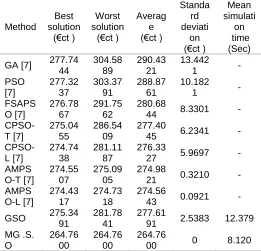
-By way, deterministic study is applied to show the adequate consequences of future MG .S.O method in contrast to all other previous methods. Table.2 displays the effects of the simulation of the firs scenario. Equally it is exposed; the proposed method has better effects than others. In other words, the whole charge is bargain by the planned process. Also, 20 tracks are made-up to expression the steadiness of all optimization algorithms. In this table as it can be realized the finest and nastiest answer and the CPU run time are offered too. Also it can be exposed that the planned alteration on GSO algorithm advances the algorithm efficacy.
Table 2
Deterministic contrast of price job for 20 tracks (First scenario)
Method
Best solution
(€ct )
Worst solution
(€ct )
Averag e (€ct )
Standa rd deviati
on (€ct )
Mean simulati on time (Sec)
GA [7] 277.74
44
304.58 89
290.43 21
13.442
1 -
PSO [7]
277.32 37
303.37 91
288.87 61
10.182
1 -
FSAPS O [7]
276.78 67
291.75 62
280.68
44 8.3301 -
CPSO-T [7]
275.04 55
286.54 09
277.40
45 6.2341 -
CPSO-L [7]
274.74 38
281.11 87
276.33
27 5.9697 -
AMPS O-T [7]
274.55 07
275.09 05
274.98
21 0.3210 -
AMPS O-L [7]
274.43 17
274.73 18
274.56
43 0.0921 -
GSO 275.34
91
281.78 41
277.61
91 2.5383 12.379
MG .S. O
264.76 00
264.76 00
264.76
00 0 8.120
Table 3
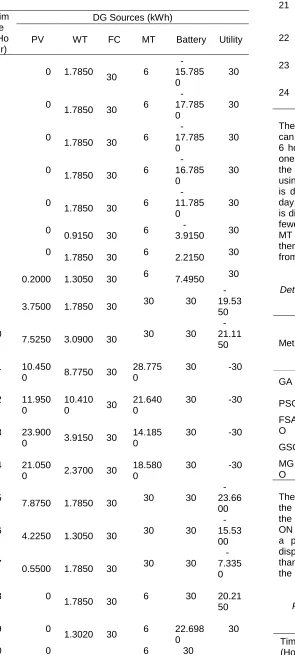
Best solutions obtained for deterministic framework using MG .S.O (First Scenario)
Tim e (Ho
ur)
DG Sources (kWh)
PV WT FC MT Battery Utility
1 0 1.7850
30 6 -15.785 0
30
2 0 1.7850
30 6 -17.785 0
30
3 0 1.7850
30 6 -17.785 0
30
4 0 1.7850
30 6 -16.785 0
30
5 0 1.7850
30 6 -11.785 0
30
6 0 0.9150
30 6
-3.9150 30
7 0 1.7850
30 6
2.2150 30
8
0.2000 1.3050
30 6
7.4950 30
9
3.7500 1.7850
30 30 30 -19.53 50
10
7.5250 3.0900
30 30 30 -21.11 50
11 10.450 0
8.7750
30
28.775 0
30 -30
12 11.950 0
10.410 0
30
21.640 0
30 -30
13 23.900 0
3.9150
30
14.185 0
30 -30
14 21.050 0
2.3700
30
18.580 0
30 -30
15
7.8750 1.7850
30 30 30 -23.66 00
16
4.2250 1.3050
30 30 30 -15.53 00
17
0.5500 1.7850
30 30 30 -7.335 0
18 0 1.7850
30 6 30
20.21 50
19 0 1.3020
30 6 22.698 0
30
20 0 6 30
1.7850 30 19.21
51
21 0 1.3005
30 30 30 -13.30 05
22 0 1.3005
30 30 30 -20.30 05
23 0 0.9150
30 6
-1.9150 30
24 0 0.6150
30 6 -10.615 0
30
The usefulness bid at the head 9 hours of a day is little as it can be realized in the table 3 too, so the battery is charging 6 hours of a day. Likewise the MT units are the luxurious ones, so that the operator ought to accomplish the process the mode that usefulness creation is decreased whereas using these units. The quantity of the energy formed by MT is decreased whereas charging battery at first hours of a day. At substantial load time from hour 9 to 17, the battery is discharged to it's over volume to aid the utility to produce fewer energy. In addition to all overhead explanations, while MT units are luxurious it is reasonable to supply energy by them than of the utility, in fact the utility purchase energy from this units to decrease to total price.
Table 4
Deterministic contrast of price purpose for 20 trails (Second scenario)
Method
Best solution
(€ct )
Worst solution
(€ct )
Averag e (€ct )
Standa rd deviati
on (€ct )
Mean simulati on time
(Sec)
GA 334.86
94
345.02 11
336.29 12
17.631
0 14.291
PSO 327.72
11
340.31 23
331.21 02
13.124
4 14.283
FSAPS O
326.42 91
335.49 31
331.43 01
10.662
1 13.281
GSO 318.64
01
332.90 12
322.91
02 5.1471 13.428
MG .S. O
299.41 24
299.41 24
299.41
24 0 8.839
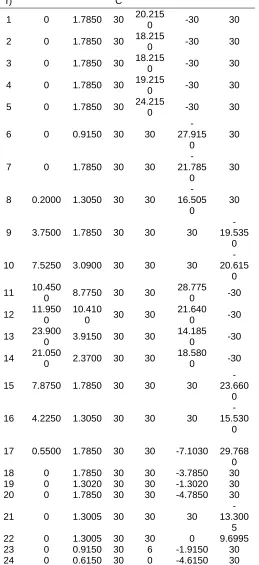
The outcomes for the additional scenario are revealed in the Table 4. In current scenario one constraint is more to the problem; nevertheless the DGs can be whichever off or ON however the battery first charge is nothing and this sort a problem a slight complex. In current table similarly displays the healthier routine of the suggested technique than other procedures. Table 5 is too accessible to express the act of effective points of dissimilar DGs.
Table 5
Finest explanations found for deterministic basis using MG .S.O (Second Scenario)
Time (Hou
DG Sources (KWh)
388
r) C
1 0 1.7850 30 20.215
0 -30 30
2 0 1.7850 30 18.215
0 -30 30
3 0 1.7850 30 18.215
0 -30 30
4 0 1.7850 30 19.215
0 -30 30
5 0 1.7850 30 24.215
0 -30 30
6 0 0.9150 30 30
-27.915
0
30
7 0 1.7850 30 30
-21.785
0
30
8 0.2000 1.3050 30 30
-16.505
0
30
9 3.7500 1.7850 30 30 30
-19.535
0
10 7.5250 3.0900 30 30 30
-20.615
0
11 10.450
0 8.7750 30 30
28.775
0 -30
12 11.950
0
10.410
0 30 30
21.640
0 -30
13 23.900
0 3.9150 30 30
14.185
0 -30
14 21.050
0 2.3700 30 30
18.580
0 -30
15 7.8750 1.7850 30 30 30
-23.660
0
16 4.2250 1.3050 30 30 30
-15.530
0
17 0.5500 1.7850 30 30 -7.1030 29.768
0
18 0 1.7850 30 30 -3.7850 30
19 0 1.3020 30 30 -1.3020 30
20 0 1.7850 30 30 -4.7850 30
21 0 1.3005 30 30 30
-13.300
5
22 0 1.3005 30 30 0 9.6995
23 0 0.9150 30 6 -1.9150 30
24 0 0.6150 30 0 -4.6150 30
Equally it can be exposed at current table at the first 8 hours of a daytime the battery is charging even by providing vigor from MT units. This wonder is more reasonable, since at coming times it can decrease the usefulness making by satisfying battery and procurement energy from this storing hardware. The MT units are also off at periods 23-24 and it aids to lessen the entire price. At the following slice the probabilistic examination based on situation founded technique is also debated. To attain improved outcomes and deliberate the doubt effect, the probabilistic agenda is
functional by the similar two earlier situations. As expressed beforehand, the technique is enclosed altogether the doubt contain of the usefulness bid changes, the PV/WT production power changes and the cargo request estimate fault. The indecision is presented through the condition created method which is elucidated in preceding meetings. By way of it can be understood at Table.6 seeing the uncertainty result can upsurge the total cost. The result can be connected to difficulty of the difficult which is due to the seeing the hesitation effect. Likewise, by the probabilistic plan the working views are delightful close to the corporeal ideals and the operative is assessing more accurate results for the MG problem.
Table 6
Anticipated assessment of entire charge assessed by the anticipated probabilistic technique for 20 trails
The Algorith m
Best solution
(€ct )
Worst solution (€ct )
Averag e (€ct )
Standa rd deviati
on (€ct )
1th Scenar io
GSO 276.21
28
283.01 19
278.58
31 3.76
MG .S. O
265.80 42
265.98 21
265.83
02 0. 07
2th Scenar
io
GSO 321.69
32
333.76 15
324.40
14 6.42
MG .S. O
301.50 44
302.39 12
301.89
83 0.10
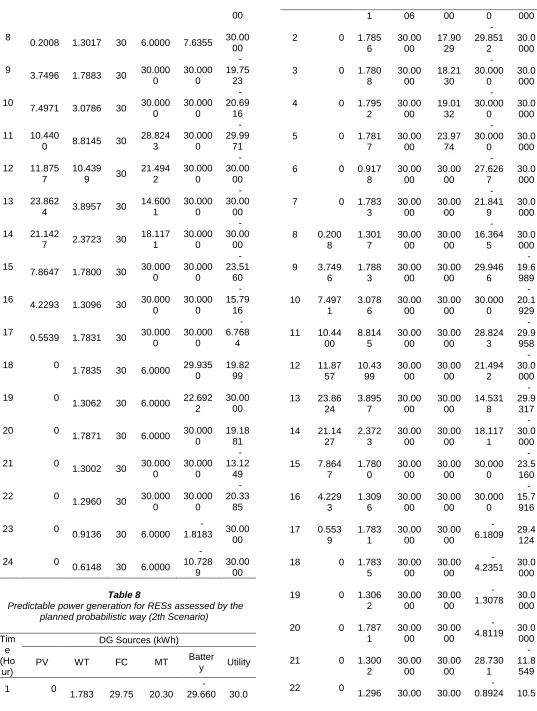
The similar impression as Tables 3 besides 5 is available likewise for the probabilistic outline as revealed at Table 8 and 7.
Table 7
Probable power generation for RESs appraised by the planned probabilistic technique (1th Scenario)
Tim e (Ho
ur)
DG Sources (kWh)
PV WT FC MT Battery Utility
1 0 1.7831
30
6.0000
-15.609
4
30.00
00
2 0 1.7856
30
6.0000
-17.948
3
30.00
00
3 0 1.7808
30
6.0000
-17.787
0
30.00
00
4 0 1.7952
30
6.0000
-16.986
8
30.00
00
5 0 1.7817
30
6.0000
-12.022
6
30.00
00
6 0 0.9178
30
6.0000
-3.6267
30.00
00
7 0 1.7833
30
6.0000
2.1581
00 8 0.2008 1.3017 30 6.0000 7.6355 30.00 00 9 3.7496 1.7883 30 30.000 0 30.000 0 -19.75 23 10 7.4971 3.0786 30 30.000 0 30.000 0 -20.69 16 11 10.440 0 8.8145 30 28.824 3 30.000 0 -29.99 71 12 11.875 7 10.439 9 30 21.494 2 30.000 0 -30.00 00 13 23.862 4 3.8957 30 14.600 1 30.000 0 -30.00 00 14 21.142 7 2.3723 30 18.117 1 30.000 0 -30.00 00 15 7.8647 1.7800 30 30.000 0 30.000 0 -23.51 60 16 4.2293 1.3096 30 30.000 0 30.000 0 -15.79 16 17 0.5539 1.7831 30 30.000 0 30.000 0 -6.768 4
18 0 1.7835 30 6.0000 29.935 0 19.82 99
19 0 1.3062 30 6.0000 22.692 2 30.00 00
20 0 1.7871 30 6.0000 30.000 0 19.18 81
21 0 1.3002 30 30.000 0 30.000 0 -13.12 49
22 0 1.2960 30 30.000 0 30.000 0 -20.33 85
23 0 0.9136 30 6.0000 -1.8183 30.00 00
24 0 0.6148 30 6.0000 -10.728 9 30.00 00 Table 8
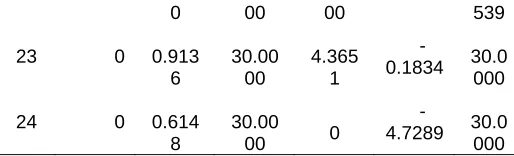
Predictable power generation for RESs assessed by the planned probabilistic way (2th Scenario)
Tim e (Ho
ur)
DG Sources (kWh)
PV WT FC MT Batter
y Utility
1 0 1.783 29.75 20.30 -29.660 30.0
1 06 00 0 000
2 0 1.785 6 30.00 00 17.90 29 -29.851 2 30.0 000
3 0 1.780 8 30.00 00 18.21 30 -30.000 0 30.0 000
4 0 1.795 2 30.00 00 19.01 32 -30.000 0 30.0 000
5 0 1.781 7 30.00 00 23.97 74 -30.000 0 30.0 000
6 0 0.917 8 30.00 00 30.00 00 -27.626 7 30.0 000
7 0 1.783 3 30.00 00 30.00 00 -21.841 9 30.0 000 8 0.200 8 1.301 7 30.00 00 30.00 00 -16.364 5 30.0 000 9 3.749 6 1.788 3 30.00 00 30.00 00 29.946 6 -19.6 989 10 7.497 1 3.078 6 30.00 00 30.00 00 30.000 0 -20.1 929 11 10.44 00 8.814 5 30.00 00 30.00 00 28.824 3 -29.9 958 12 11.87 57 10.43 99 30.00 00 30.00 00 21.494 2 -30.0 000 13 23.86 24 3.895 7 30.00 00 30.00 00 14.531 8 -29.9 317 14 21.14 27 2.372 3 30.00 00 30.00 00 18.117 1 -30.0 000 15 7.864 7 1.780 0 30.00 00 30.00 00 30.000 0 -23.5 160 16 4.229 3 1.309 6 30.00 00 30.00 00 30.000 0 -15.7 916 17 0.553 9 1.783 1 30.00 00 30.00 00 -6.1809 29.4 124
18 0 1.783 5 30.00 00 30.00 00 -4.2351 30.0 000
19 0 1.306 2 30.00 00 30.00 00 -1.3078 30.0 000
20 0 1.787 1 30.00 00 30.00 00 -4.8119 30.0 000
21 0 1.300 2 30.00 00 30.00 00 28.730 1 -11.8 549
390
0 00 00 539
23 0 0.913 6
30.00
00
4.365 1
-0.1834
30.0 000
24 0 0.614 8
30.00
00
0
-4.7289
30.0 000
Equally it can be realized, the working facts, the yield power fabrication of the DGs, the usefulness power and likewise the storage device charge and discharging vigor is altered in the probabilistic investigation. Someway, the descriptions and thoughts for table 8-7 is alike to deterministic bases, the alteration as a point of view is seeing the uncertainty result that sort the worker achieve to actual working points of the RESs. During the table 9, the ideal deviancy values for the cost objective function for mutually tow bases are offered.
Table 9
The standard deviancy importance of the cost objective purpose assessed by the future probabilistic method
The Framework 1th Scenario 2th Scenario
Deterministic Analysis 7.2320 7.8931
Probabilistic Analysis 6.4261 6.9507
7.
Conclusion
This paper considered the optimum organization of MG which contains dissimilar types of replaceable energy sources such as MT, PV, WT and FC units and single battery as a storage device. The reproduction outcomes display that the planned process is better working than all the former systems. The normal deviancy of the cost function is similarly compact for the probabilistic bases as it can be realized and by considering the qualms the ending answer is extra dependable. The central thoughts of this work can be obtainable as follows:
1) Resolve the MG problem in both deterministic and stochastic contexts.
2) Familiarize one new influential optimization instrument called GSO for solving the problem and also present an alteration for it.
3) Measuring the operational points of dissimilar DGs for both deterministic and stochastic position.
4) Familiarizing GSO algorithm for the first time to attain one answer for MG problem.
Nomenclature
BGi(t) The bid of i
th
DG at time t
X State variables vector
BSj(t) The j
th
storage device bid at time t
SSj(t)
Start-up/Shut down cost of jth storage device at time t
SGi(t)
Start-up/Shut down cost of ith DG at time t
PGrid(t)
Active power bought (sold) from (to) the utility at time t
BGrid(t) Utility bid at time t
u i (t)
State of the ith unit denoting ON/OFF statuses
n Number of the state variables
Ng Number of generating units
NS Number of storage devices
Pg
Vector including the power generation of all power units
Ug
Vector including ONN/OFF statuses of all power units
T Number of time intervals
PG,i(t)
Active power production of ith power unit
PG,i,min(t)
Minimum active power production of ith power unit at t
PG,i,max(t)
Maximum active power production of ith power unit at t
Ps,j,min(t)
Minimum active power production of jth storage device at t
Ps,j,max(t)
Maximum active power production of jth storage device
PGrid,min(t)
Minimum active power production of the grid at t
PGrid,max(t)
Maximum active power production of the grid at t
PL,i(t)
The amount of lth load value at time t
NL Total number of load levels
Wess(t)
Amount of stored energy inside the battery at time t
Wess,max/ Wess,min
Maximum/Minimum stored energy inside the battery
Pcharge/Pdischarge
Permitted rate of charge/discharge during a finite time period (∆t) 𝜂charge/𝜂discharge
Battery efficiency during charge/discharge period
S Output vector of the investigated
problem
m Number of uncertain variables
σ Standard deviation error
A normalized probability of each scenario
Photovoltaic power output of unit PV
ldth load demand
market price
Forecasted wind power output of
WT
Forecasted power output of PV unit
ldth forecasted load demand
Forecasted market price
Forecasted wind power output error
Probability of intervals
rand Mathematical operator for random
value in the range [0,1]
Head angle value
Pcharge,max/Pdischarge,max
Maximum permitted rate of charge/discharge during a finite each time period (∆t)
Z Input vector of the investigated problem
Xmax/Xmin
Maximum/Minimum values of the control vector X
TF
A random constant value equal to 1 or 2
Iter Number of iterations passed
Nsw
Log Logarithm mathematic operator
Mod
N Number of bees which have
chosen θth
modification method
5, , ,6 7 8
r r r r Numbers in the range of [0, 1]
' '' '''
1 1 1 1
, , ,
k k k k
i i i i
X X X X Scroungers
max
l Distance
max
Angle
1 max
a R Maximum turning angle
1 max
a R Maximum turning angle
8.
References
[1] A. Kavousi-Fard, M. A. Rostami, and T. Niknam, Reliability-Oriented Reconfiguration of Vehicle-to-Grid Networks, IEEE Trans. on Industrial Informatics 11(3) (2015) 682 - 691
[2] A. Kavousi-Fard, A. Khosravi, S. Nahavadi, A New Fuzzy Based Combined Prediction Interval for Wind Power Forecasting, IEEE Trans. on Power System (2015) (99) 1-9
[3] Dalton G.J, Lockington D.A and Baldock T.E, Feasibility analysis of renewable energy supply options for a grid-connected large hotel, Renewable Energy 34 (2009) 955–964.
[4] A. Kavousi-Fard, T. Niknam, Optimal Distribution Feeder Reconfiguration for Reliability Improvement Considering Uncertainty, IEEE Trans. On Power Delivery, 29(3) (2014) 1344 - 1353
[5] A. Kavousi-Fard, T. Niknam, H. Taherpoor, A.
Abbasi, Multi-objective Probabilistic
Reconfiguration Considering Uncertainty and Multi-Level Load Model, IET SMT, vol 9 (1), 2015, pp.44-55
[6] A. Kavousi-Fard, T. Niknam, M. Khooban, An Intelligent Stochastic Framework to Solve the Reconfiguration Problem from the Reliability view, IET SMT, 8(5), 2014, p. 245 – 259
[7] A. Anvari Moghaddam, A. Seifi, T. Niknam, M. R. Alizadeh Pahlavani, Multi-objective operation management of a renewable MG (micro-grid) with back-up micro-turbine/fuel cell/battery hybrid power source, J. Energy 36 (2011) 6490-6507
[8] A. Kavousi-Fard, A.Abunasri, A. Zare, R. Hoseinzadeh, Impact of Plug-in Hybrid Electric Vehicles Charging Demand on the Optimal Energy
Management of Renewable Micro-Grids,78
Energy, 2014, 904-915.
[9] T. Niknam, R. Azizipanah-Abarghooee, R.
Sedaghati, A. Kavousi-Fard, An Enhanced hybrid particle swarm optimization and simulated annealing for practical economic dispatch, Energy
Education Science and Technology Part A: Energy Science and Research 2012, 30(1): 397-408.
[10]H. Morais, P. Kádár, P. Faria, Z. A. Vale, H.M. Khodr, Optimal scheduling of a renewable micro-grid in an isolated load area using mixed-integer linear programming, J. Renew Energ, 35(1) (2010)1 51–156
[11]A. Kavousi-Fard, and T. Niknam, M. Fotuhi-Firuzabad, Stochastic Reconfiguration and Optimal Coordination of V2G Plug-in Electric Vehicles Considering Correlated Wind Power Generation, IEEE Trans. on Sustainable Energy 6(3)(2015) 822-830
[12]R. Chedid, S. Raiman, Unit sizing and control of hybrid wind solar power systems, IEEE Trans. Energy Convers, 12(1), (1997) 79–85.
[13]A. Kavousi-Fard, T. Niknam, M.R. Akbari-Zadeh, B. Dehghan, Stochastic framework for reliability
enhancement using optimal feeder recon
figuration, IEEE Journal of Systems Engineering and Electronics 25(5), (2014) 901–910.
[14]A. Dukpa, I. Dugga, B. Venkatesh, L. Chang, Optimal participation and risk mitigation of wind generators in an electricity market, IET Renew Power Gener, 4 (2010) 165-175,.
[15]C. Chen, S. Duan, T. Cai, B. Liu, G. Hu, Smart energy management system for optimal microgrid economic operation, IET Renew. Power Gener, 5(3) (2011) 258–267.
[16]A. Kavousi-Fard, T. Niknam, Optimal Stochastic Capacitor Placement Problem from the Reliability and Cost Views using Firefly Algorithm, IET SMT, vol. 8(5), pp. 260 – 269, 2014
[17]A. Kavousi-Fard, T. Niknam, M.R. Akbari-Zadeh, B. Dehghan, Stochastic framework for reliability
enhancement using optimal feeder recon
figuration, IEEE Journal of Systems Engineering and Electronics Vol. 25, No. 5, August 2014, pp.901–910
[18]A. Kavousi-Fard, T. Niknam, A. Khosravi, Multi-Objective Probabilistic Distribution Feeder Reconfiguration Considering Wind Power Plants, International Journal of Electrical Power and Energy Systems, 2014 (55) 680-691
[19]A. Kavousi-Fard, H. Samet, F. Marzban, A New Hybrid Modified Firefly Algorithm and Support Vector Regression Model for Accurate Short Term
Load Forecasting, Expert Systems with
Applications, 41(13) (2014) 6047–6056.
392
Stochastic DFR Strategy, International
Transactions on Electrical Energy Systems, 2014. DOI: 10.1002/etep.1881
[21]R. Sedaghati, A. Kavousi-Fard, A hybrid fuzzy-PEM stochastic framework to solve the optimal operation management of distribution feeder reconfiguration considering wind turbines, Journal of Intelligent and Fuzzy Systems 26 (2014) 1711-1721
[22]A. Baziar and A. Kavousi-Fard, An intelligent multi-objective stochastic framework to solve the distribution feeder Reconfiguration considering uncertainty, Journal of Intelligent & Fuzzy Systems, 26 (2014) pp. 2215–2227
[23]H. Taherpoor, T. Niknam, A. Kavousi-Fard, A
Novel Stochastic Framework for Energy
Management in Renewable Micro-Grids
Considering Uncertainty of Measurement and Forecasting, Journal of Intelligent and Fuzzy systems, 2015 28(3) 999-1008
[24]A. Baziar, A. Kavoosi-Fard, Jafar Zare, A novel self adaptive modification approach based on bat algorithm for optimal management of renewable MG, Journal of Intelligent Learning Systems and Applications, 5 (2013) 11-18
[25]Lei, W., Shahidehpour, M., Tao, L., ―Stochastic security-constrained unit commitment,‖ IEEE Transanctions on Power Systems,(22)(2) (2007) 800-811.
[26]A. Kavousi-Fard, T. Niknam, M. Golmaryami, Short Term Load Forecasting of Distribution Systems by a New Hybrid Modified FA-Backpropagation Method, Journal of Intelligent and Fuzzy systems, 2014 (26) 517-522
[27]He, S., Wu, Q.H., Saunders, J.R.: ‗A group search optimizer: an optimization algorithm inspired by animal searching behavior‘, IEEE Transactions on evolutionary computation, 2009, 13, (5), pp. 973– 990.
[28]A. Kavousi-Fard, A new fuzzy-based feature selection and hybrid TLA–ANN modeling for short-term load forecasting, Journal of Experimental & Theoretical Artificial Intelligence, 25(4) 2013, 543-557
[29]A. Kavousi-Fard, F. Kavousi-Fard, A New Hybrid
Correction Method for Short Term Load
Forecasting Based on ARIMA, SVR and CSA, Journal of Experimental & Theoretical Artificial Intelligence, 25(4) 2013, 559-574.
[30]A. Kavousi-Fard and M.R. Akbari-Zadeh, A hybrid method based on wavelet, ANN and ARIMA model for short-term load forecasting, Journal of