Research article
Available online
www.ijsrr.org
ISSN: 2279–0543
International Journal of Scientific Research and Reviews
Design and Analysis of Low Power Full Adder Using Adiabatic
Technique
A.Konda Gurava Reddy*
and
CH. Adi babu
Department of E.C.E, IITS, Markapur, Prakasam (Dist), A.P, INDIA.
ABSTRACT
–The energy stored at the output can be retrieved by the reversing the current source direction discharging process instead of dissipation in NMOS network. Hence adiabatic switching offers the less energy dissipation in PMOS network and reuse the stored energy in the output capacitance by reversing the current source direction. There are the many adiabatic logic design technique are given in Literature but here two of them are chosen ECRL and PFAL, which shows the good improvement in energy dissipation and are mostly used as reference in new logic families for less energy dissipation reduction of area & power factors the simulations were done using micro wind & DSCH results
KEYWORDS
— Adiabatic switching, energy dissipation, power clock, equivalent modeCorresponding Author-
A.Konda Gurava Reddy
Department of E.C.E, IITS,
Markapur, Prakasam (Dist), A.P, INDIA.
1.
INTRODUCTION :
The main objective of this thesis is to provide new low power solutions for Very Large Scale
Integration (VLSI) designers. Especially, this work focuses on the reduction of the power dissipation,
which is showing an ever-increasing growth with the scaling down of the technologies. Various
techniques at the different levels of the design process have been implemented to reduce the power
dissipation at the circuit, architectural and system level. Furthermore, the number of gates per chip area
is constantly increasing, while the gate switching energy does not decrease at the same rate, so the
power dissipation rises and heat removal becomes more difficult and expensive. Then, to limit the
power dissipation, Alternative solutions at each level of abstraction are proposed. The dynamic power
requirement of CMOS circuits is rapidly becoming a major concern in the design of personal
information systems and large computers. In this thesis work, a new CMOS logic family called
ADIABATIC LOGIC, based on the adiabatic switching principle is presented.
The term adiabatic comes from thermodynamics, used to describe a process in which there is no
exchange of heat with the environment. The adiabatic logic structure dramatically reduces the power
dissipation. The Adiabatic switching technique can achieve very low power Dissipation, but at the
expense of circuit complexity. Adiabatic logic offers a way to reuse the energy stored in the load
capacitors rather than the traditional way of discharging the load capacitors to the ground and wasting
this energy. This thesis work demonstrates the low power dissipation of Adiabatic Logic by presenting
the results of designing various design/ cell units employing Adiabatic Logic circuit techniques. A
family of full-custom conventional CMOS Logic and an Adiabatic Logic units for example, an inverter,
a two-input NAND gate, a two-input NOR gate, a two-input XOR gate, a two-to-one multiplexer and a
one-bit Full Adder were designed in Mentor Graphics IC Design Architect using standard TSMC 0.35
µm technology, laid out in Microwind IC Station. All the circuit simulations has been done using
various schematics of the structures and post-layout simulations are also being done after they all have
been laid-out by considering all the basic design rules and by running the LVS program. Finally, the
analysis of the average dynamic power dissipation with respect to the frequency and the load
capacitance was done to show the amount of power dissipated by the two logic families.
II. MOTIVATION:
spurt in growth, thanks to the use of integrated circuits in computing, telecommunications and
consumer electronics.We have come a long way from the single transistor era in 1958 to the present
day ULSI (Ultra Large Scale Integration) systems with more than 50 million transistors in a single chip
1
.The ever-growing number of transistors integrated on a chip and the increasing transistor switching
speed in recent decades has enabled great performance improvement in computer systems by several
orders of magnitude. Unfortunately, such phenomenal performance improvements have been
accompanied by an increase in power and energy dissipation of the systems. Higher power and energy
dissipation in high performance systems require more expensive packaging and cooling technologies,
increase cost, and decrease system reliability. Nonetheless, the level of on-chip integration and clock
frequency will continue to grow with increasing performance demands, and the power and energy
dissipation of high-performance systems will be a critical design constraint.
For example, high-end microprocessors in 2010 are predicted to employ billions of transistors at
clock rates over 30GHz to achieve TIPS (Tera Instructions per seconds) performance 1. With this rate,
high-end microprocessor’s power dissipation is projected to reach thousands of Watts. This thesis
investigates one of the major sources of the power/energy dissipation and proposes and evaluates the
techniques to reduce the dissipation.
Digital CMOS integrated circuits have been the driving force behind VLSI for high performance
computing and other applications, related to science and technology. The demand for digital CMOS
integrated circuits will continue to increase in the near future, due to its important salient features like
low power, reliable performance and improvements in the processing technology.
The word ADIABATIC comes from a Greek word that is used to describe thermodynamic
processes that exchange no energy with the environment and therefore, no energy loss in the form of
dissipated heat. In real-life computing, such ideal process cannot be achieved because of the presence of
dissipative elements like resistances in a circuit. However, one can achieve very low energy dissipation
by slowing down the speed of operation and only switching transistors under certain conditions. The
signal energies stored in the circuit capacitances are recycled instead, of being dissipated as heat. The
adiabatic logic is also known as ENERGY RECOVERY CMOS .
It should be noted that the fully adiabatic operation of the circuit is an ideal condition which may
only be approached asymptotically as the switching process is slowed down. In most practical cases, the
energy dissipation associated with a charge transfer event is usually composed of an adiabatic
possible, regardless of the switching speed. With the adiabatic switching approach, the circuit energies
are conserved rather than dissipated as heat. Depending on the application and the system requirements,
this approach can sometimes be used to reduce the power dissipation of the digital systems. Here, the
load capacitance is charged by a constant-current source (instead of the constant-voltage source as in the
conventional CMOS circuits).Here, R is the resistance of the PMOS network. A constant charging
current corresponds to a linear voltage ramp. Assume, the capacitor voltage VC is zero initially3.
III. ADIABATIC LOGIC GATE:
In the following, we will examine simple circuit configurations which can be used for adiabatic
switching. Figure 3.2 shows a general circuit topology for the conventional CMOS gates and adiabatic
counterparts. To convert a conventional CMOS logic gate into an adiabatic gate, the pull-up and the
pull-down networks must be replaced with complementary transmission-gate (gate) networks. The
T-gate network implementing the pull-up function is used to drive the true output of the adiabatic T-gate,
while the T-gate network implementing the pull-down function drives the complementary output node.
Note that all the inputs should also be available in complementary form. Both the networks in the
adiabatic logic circuit are used to charge-up as well as charge-down the output capacitance, which
ensures that the energy stored at the output node can be retrieved by the power supply, at the end of each
cycle. To allow adiabatic operation, the DC voltage source of the original circuit must be replaced by a
pulsed-power supply with the ramped voltage output.
IV. ADIABATIC LOGIC TYPES:
Practical adiabatic families can be classified as either PARTIALLY ADIABATIC or FULLY
ADIABATIC3.In a PARTIALLY ADIABATIC CIRCUIT, some charge is allowed to be transferred to
the ground, while in a FULLY DIABATIC CIRCUIT, all the charge on the load capacitance is
recovered by the power supply. Fully adiabatic circuits face a lot of problems with respect to the
operating speed and the inputs power clock synchronization.
A) ECERL-Efficient Charge Recovery Logic:
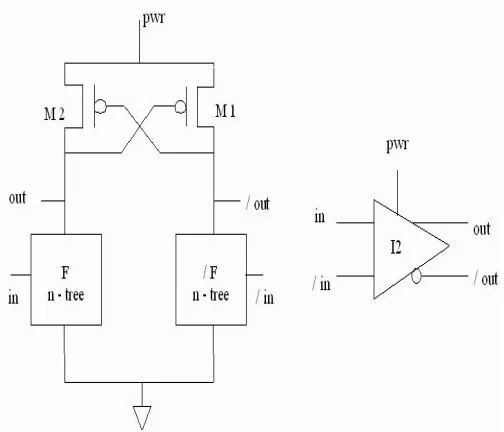
Efficient Charge – Recovery Logic (ECRL) proposed by Moon and Jeong 4, shown in Figure 4.1,
uses cross-coupled PMOS transistors. It has the structure similar to Cascode Voltage Switch Logic
NMOS transistors in the An AC power supply pwr is used for ECRL gates, so as to recover and reuse
the supplied energy. Both out and /out are generated so that the power clock generator can always drive
a constant load capacitance independent of the input signal. A more detailed description of ECRL can
be found in4 Full output swing is obtained because of the cross-coupled PMOS transistors in both
precharge and recovers phases. But due to the threshold voltage of the PMOS transistors, the circuits
suffer from the non-adiabatic loss both in the precharge and recover phases. That is, to say, ECRL
always pumps charge on the output with a full swing. However, as the voltage on the supply clock
approaches to
Figure 4.1. The Basic Structure of the Adiabatic ECRL Logic.
So the recovery path to the supply clock to the supply clock is disconnected, thus, resulting in
complete recovery. Vtp is the threshold voltage of PMOS transistor. The amount of loss is given as
EECRL =C|Vtp|2/ 2(4.2)
Thus, from Equation (4.2), it can be inferred that the non-adiabatic energy loss is dependent on
the load capacitance and independent of the frequency of operation.
B) Positive Feedback Adiabatic Logic:
The partial energy recovery circuit structure named Positive Feedback Adiabatic Logic (PFAL) 5
good robustness against technological parameter variations. It is a dual-rail circuit with partial energy
recovery. The general schematic of the PFAL gate is shown in Figure 4.3. The core of all the PFAL
gates is an adiabatic amplifier, a latch made by the two PMOS M1-M2 and two NMOS M3-M4, that
avoids a logic level degradation on the output nodes out and /out. The two n-trees realize the logic
functions. This logic family also generates both positive and negative outputs. The functional blocks are
in parallel with the PMOSFETs of the adiabatic amplifier and form a transmission gate. The two n-trees
realize the logic functions. This logic family also generates both positive and negative outputs.
The two major differences with respect to ECRL are that the latch is made by two PMOSFETs
and two NMOSFETS, rather than by only two PMOSFETs as in ECRL logic, and that the functional
blocks are in parallel with the transmission PMOSFETs. Thus the equivalent resistance is smaller when
the capacitance needs to be charged. The energy dissipation by the CMOS Logic family and Adiabatic
PFAL Logic family can be seen as in Figure 4.2.
Figure 4.2 Energy dissipation by the CMOS Logic family and Adiabatic PFAL Logic family
c) Adiabatic Full Adder using PFAL & ECRL:
A partially adiabatic logic family PFAL one-bit Full Adder block can be implemented as shown
in the Figure 5.23 ( for SUM block) and Figure 5.24 (for OUTPUT_CARRY) below, respectively. The
CMOS logic style and an adiabatic PFAL logic style. The basic principle behind implementing various
design units in the two logic styles is to compare them with reference to the average power dissipated by
all of them.
A family of full-custom conventional CMOS Logic and an Adiabatic Logic units were designed
in Mentor Graphics IC Design Architect using standard TSMC 0.35 µm technology, layout them in
Mentor Graphics IC Station and the analysis of the average dynamic power dissipation with respect to
the frequency and the load capacitance was done. It was found that the adiabatic PFAL logic style is
advantageous in applications where power reduction is of prime importance as in high performance
battery-portable digital systems running on batteries such as note-book computers, cellular phones and
personal digital assistants.
V. CONCLUSION:
With the adiabatic switching approach, the circuit energies are conserved rather than dissipated
as heat. Depending on the application and the system requirements, this approach can be used to
reduce the power dissipation of the digital systems. With the help of adiabatic logic, the energy
savings of upto 76 % to 90 % 5 can be reached. Circuit simulations show that the adiabatic design units
can save energy by a factor of 10 at 50 MHz logically equivalent conventional CMOS implementation
and about 2 at 250 MHz, as compared to
VI. FUTURE WORK:
(a) Adiamems
To perform digital logic in CMOS in a truly adiabatic (asymptotically thermodynamically
reversible) fashion requires that the logic transitions be driven by a quasi-trapezoidal (flat-topped)
power-clock voltage waveform, which must be generated by a resonant element with very high Q
(quality factor). Recently, MEMS resonators have attained very high frequencies and Q factors and are
becoming widely used in communications system-on-chip (SOC) for RF signal filtering, amplification,
etc.
(b) Application of Nano-Technology
to a spiraling shape. Thus, a good quality factor Q can be achieved. The work left to be done for this
design would include a method for causing it to keep its form, since nano-tubes are typically not rigid.
Also, putting the tube to use in a circuit would lower the effective Q due to the junction discontinuities.
(c) Spacecraft
The high cost-per-weight of launching computing-related power supplies, solar panels and
cooling systems into orbit imposes a demand for adiabatic power reduction in spacecraft in which these
components weigh a significant fraction of total spacecraft weight.
VII. REFERENCES:
1. A. P. Chandrakasan, S. Sheng, and R. W. Brodersen, “Low PowerCMOS Digital Design,” IEEE
Journal of Solid-state Circuits, April 1999; 27( 04): 473-484,.
2. H. J. M. Veendrick, “Short-circuit Dissipation of Static CMOS Circuitry and itsImpact on the
Design of Buffer Circuits,” IEEE JSSC, August 1984; 468-473.
3. T. Indermauer and M. Horowitz, “Evaluation of Charge Recovery Circuits and Adiabatic
Switching for Low Power Design,” Technical Digest IEEE Symposium Low Power Electronics,
San Diego, October 2002; 102-103.
4. Y. Moon and D. K. Jeong, “An Efficient Charge Recovery Logic Circuit,” IEEE JSSC, April
1996; 31(04): 514-522.
5. A. Blotti and R. Saletti, “Ultralow- Power Adiabatic Circuit Semi-Custom Design,” IEEE
Transactions on VLSI Systems, November 2004; 12(11): 1248-1253. J. M. Rabaey and M.
Pedram, “Low Power Design Methodologies,” KluwerAcademic Publishers, 2002.
6. A. Kamer, J. S. Denker and B. Flower, et al., “2N2D-order Adiabatic Computation with 2N-2P
and 2N- 2N2P Logic Circuits,” In Proc. of the International Symposium on Low Power design,
Dana Point, 1995; 191-196.
7. M. Horowitz, T. Indennaur and R. Gonzalez, “Low Power Digital Design, “Technical Digest
IEEE Symposium Low Power Electronics, San Diego, October 1994; 08-11.
8. T. Sakurai and A. R. Newton, “Alpha-Power Law MOSET Model and its Applications to CMOS
Inverter Delay and other Formulas,” IEEE JSSC, October 1990; 25(02), 584- 594.
9. A. P. Chandrakasan and R. W. Brodersen, Low-power CMOS digital design, Kluwer Academic,
10.Sung-Mo Kang and Yusuf Leblebici, CMOS Digital Integrated Circuits - Analysis and Design,
McGraw-Hill, 2003.
11.J. S. Denker, “A Review of Adiabatic Computing,” Technical Digest IEEE Symposium Low
Power Electronics, San Diego, October 1994; 94-97.
12.T. Gabara, “Pulsed Power Supply CMOS,” Technical Digest IEEE SymposiumLow Power
Electronics, San Diego, October 1994; 98- 99.
13. B. Voss and M. Glesner, “A Low Power Sinusoidal Clock,” In Proc. of theInternational
Symposium on Circuits and Systems, ISCAS 2001.
14.W. C. Athas, J. G. Koller and L. Svensson, “An Energy-Efficient CMOS Line Driver using
Adiabatic Switching,” Fourth Great Lakes symposium on VLSI, California, March 2005.
15. S. Younis and T. Knight, “Asymptotically Zero Energy Split-Level Charge Recovery Logic.
Proceedings Workshop Low Power Design, Napa Valley, California 1994; 177-182.
16.Dragan Maksimovic´, G. Vojin, Oklobdžija, Borivoje Nikolic´ and K. Wayne Current, “Clocked
CMOS Adiabatic Logic with Integrated Single-Phase Power-Clock Supply,” IEEE Transactions
on VLSI Systems, August 2000; 08(04): 460-463.
17.A. Blotti, S. Pascoli and R. Saletti, “Sample Model for Positive Feedback Adiabatic Logic Power
Consumption Estimation,” Electronics Letters, Jan. 2000; 36(2): 116-118.
18.C. HU, “Future CMOS Scaling and Reliability,” Proceedings IEEE, February 2004; 81(05)
682-689.
AUTHOR BIBLIOGRAPHY
A.KONDA GURAVA REDDY received B.TECH from Dr. SGIET, MARKAPUR, INDIA. His interested areas are Vlsi design, Inage processing and Embedded systems.
CH.ADI BABU received B.TECH from System College of