Abstract.We review the first measurements of the CKM angle from LHCb. These measurements have been performed withb-hadron decays dominated byb ! uandb ! ctree-level amplitudes, from which can be determined without theoretical uncertainties. Precision is achieved by averaging results fromB ! Dh (h=K,⇡) decays withD!h+h ,D!K+⇡ , andD! K+⇡ ⇡+⇡ , andD!K0
Sh+h . Prospects for these and future measurements of using neutralb-hadron decays are briefly discussed.
1 Introduction
The measurement of the CKM angle [ = arg( VudV⇤ub/VcdV⇤cb)] of the Unitarity Triangle (UT) is an important goal of the LHCb physics programme. The angle plays a unique role among all CP-violating param-eters because it can be determined using pure tree-level decays ofBmesons without theoretical uncertainties. As tree-level measurements are expected to be insensitive to physics beyond the Standard Model (SM), the value of determined in this way provides an important SM bench-mark against which other measurements, more likely to be a↵ected by phyics beyond the SM, can be compared. The power of this approach to new physics searches relies on precise measurements. Despite results fromB-factories and Tevatron have improved considerably the knowledge of the UT angles and sides, is still the least-well deter-mined angle, with an experimental uncertainty from tree-level measurements of 9 12 [1, 2]. This precision can be significantly improved with large datasets at LHCb.
The angle can be measured in a theoretically clean way by exploiting the interference betweenb ! uand b ! c tree-level transitions in decays ofb-hadrons with a charm meson in the final state. ManyB!DHdecays are suitable, whereDindicates a D0 orD0 andH is the bachelor hadronic system, e.g., a kaon or aK⇤0in the most sensitive measurements.
The first constraints on at LHCb have been ob-tained from time-integrated measurements of chargedB mesons [3], which do not require flavour-tagging, there-fore can exploit the full statistical power of the largebb production cross-section in pp collisions at the LHC. In these measurements is determined from the interference betweenB+ !D0h+andB+!D0h+(h= K,⇡)1, where D0 andD0 decay to a common final state. In addition to , the interference depends on twoBhadronic parameters,
ae-mail: [email protected]
1Charge-conjugation is implied throughout this paper unless
other-wise stated.
which are known as B, the relative strong phase between the twoBdecay amplitudes, andrB, the relative ratio of the suppressed over the favoured amplitude. Di↵erent meth-ods exist to determine these and otherDhadronic param-eters from data without theoretical uncertainties. Three types of D decays have been studied by LHCb, corre-sponding to three well-established methods to determine and all the unknown parameters: the GLW method [4, 5]), which uses decays toCP eigenstates (D ! K+K and
D ! ⇡+⇡ ); the ADS method [6]), which uses decays
to quasi-specific flavour eigenstates (D ! K+⇡ and
D!K+⇡ ⇡+⇡ ); and the GGSZ method [7], which uses
self-conjugate three-body final states (D ! K0
S⇡+⇡ and
D!K0
SK+K ).
Time-integrated measurements can also be performed with neutralb-hadrons when the concerned decay is self-tagged. This is the case ofB0!DK⇤0, where the charge of the kaon from theK⇤0 ! K+⇡ decay identifies the
flavour of the neutral B meson. Preliminary results on these decays have recently been presented by LHCb [8].
In addition, LHCb has recently performed the first time-dependent analysis ofB0
s!D⌥sK±decays [9], which is sensitive to 2 s[ s=arg( VtsV⇤tb/VcsV⇤cb)].
All the presented results use the 2011 dataset, corre-sponding to an integrated luminosity of 1 fb 1collected at ps
=7 TeV.
2 Measurements with charged B decays
2.1 ADS/GLW resultsCharged Bdecays to Dh+ with D ! h+h , where each
hcan be a kaon or a pion, are characterised by an easy topology and can be reconstructed with relatively high ef-ficiency at LHCb [10]. A combined GLW and ADS analy-sis is performed using the CP-even eigenstatesD!h+h
and the quasi-flavour-specific eigenstateD!K+⇡ . The
observables with sensitivity to are constructed by tak-ing ratio of yields, so that many systematic uncertainties
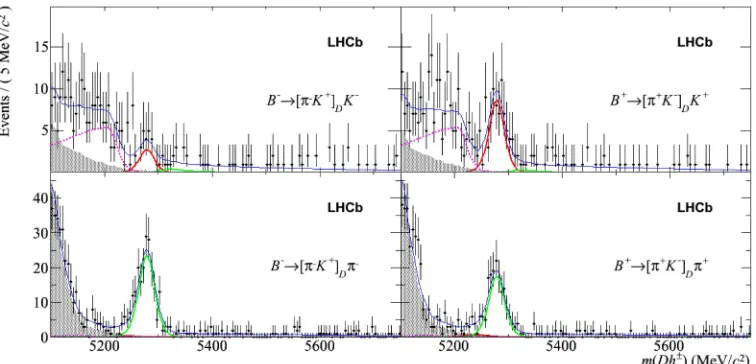
Figure 1.Mass distributions of the suppressed ADS decays: (left,top)B !D(K+⇡ )K ; (right,top)B+!D(K+⇡ )K+; (left,bottom) B !D(K+⇡ )⇡ ; and (right,bottom)B+!D(K+⇡ )⇡+.
cancel. CPasymmetries and ratios of partial widths of suppressed over favoured modes are determined with a si-multaneous fit to theBmass of all 16 possible final states. The expectedCPasymmetries in theB+!D⇡+channels
are smaller than the corresponding ones in theB+!DK+
channels, since the value ofrB, which controls the size of theCPinterference, is naively⇠20 times smaller, but the large yields in theB+ !D⇡+channels help constrain the
mass shape in the fit.
Among the results, we note the first evidence of non-zeroCPasymmetry,ACP, betweenB !DK andB+ ! DK+decays withD!K+K ,A
CP(KK)=0.148±0.037± 0.010, andD !⇡+⇡ ,A
CP(⇡⇡)=0.135±0.066±0.010, which combined give 4.5 significance forCPviolation in these modes. No significant asymmetry is found in the correspondingB+!D⇡+modes.
Another important result of this analysis is the first ob-servation of the rare ADS mode,B+ !D(K ⇡+)K+, with
more than 10 significance. This mode is particularly sensitive to since the two interfering amplitudes (i.e., the favoured ¯b!c¯transition, followed by a doubly-Cabibbo-suppressedDdecay, and the suppressed ¯b!u¯transition, followed by the Cabibbo-favoured D decay) have simi-lar size, hence can give simi-large asymmetries. The invari-ant mass distribution of both the suppressedB+ ! DK+
andB+ !D⇡+modes, separated byBcharge, are shown
in Fig. 1. There is evidence for largeCPasymmetry in theB+ !DK+mode,AK
ADS(K⇡)= 0.52±0.15±0.02, and a hint of asymmetry in theB+ ! D⇡+,A⇡
ADS(K⇡) = 0.143±0.062±0.011. Further results on GLW and ADS observables are given in Ref. [10].
More recently, LHCb has published measurements of CP observables using the B+ ! D(K⌥⇡±⇡⌥⇡±)h+
de-cay [11]. The ADS observables share the sameBdecay parameters (rB, B) withB+ !D(K⌥⇡±)h+, but di↵erent D decay parameters, therefore, the inclusion of this de-cay adds complementary information, not just additional statistics, to the determination of from a combined fit to
all the modes. We note that the suppressed ADS modes in both theB+ ! DK+ andB+ ! D⇡+ channels have not
previously been observed. In addition to the first obser-vation of these modes at LHCb, with a significance which exceeds 5 and 10 , respectively, we mention a hint ofCP asymmetry,AK
ADS(K3⇡)= 0.42±0.22 in theB+!DK+ mode. The asymmetry in theB+ ! D⇡+ mode is
mea-sured to beA⇡
ADS(K3⇡)=0.13±0.10.
2.2 GGSZ results
The GGSZ method exploits the di↵erent interference pat-tern, forB+ !DK+andB !DK decays, in theD!
K0
Sh+h Dalitz plot. This is a powerful method which
dominates the sensitivity on atB-factories, thanks to the rich resonance structure and the relatively large branching fraction of theD ! K0
S⇡+⇡ decay. The determination
of requires external information on the variation of the D ! K0
Sh+h amplitude phase over the Dalitz plot, D.
A model-independent approach is taken in the first LHCb analysis with this method, which uses the CLEO [12] mea-surements of Din bins of the Dalitz plot. The cartesian coordinatesx± =rBcos ( B± ) andy± =rBsin ( B± ), are then extracted from a simultaneous fit to theB±mass
distribution in each Dalitz-plot bin. The signal yields in each bin,N(B±)i, are related to the cartesian coordinates
by the following relations
N(B+)
±i/K⌥i+(x+2+y2+)K±i+2
p
K+iK i(x+c±i⌥y+s±i),
and
N(B )±i/K±i+(x2+y2)K⌥i+2pK+iK i(x c±i±y s±i),
whereciandsiare the amplitude weighted average cosine and sine of the strong phase di↵erence between theD0and D0 decay in bini, andK
iis the number of events in bini of a flavour-taggedD0 ! K0
S⇡+⇡ Dalitz plot. The
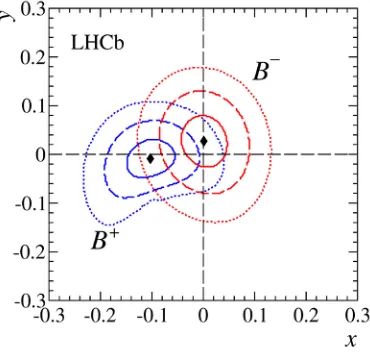
Figure 3. Cartesian coordinates results for (blue) B+ ! D(K0
Sh+h )K+ and (red) B ! D(KS0h+h )K : (solid) one, (dashed) two, and (dotted) three standard deviation confidence levels (statistical only). The points represent the best fit central values.
forD ! K0
S⇡+⇡ (D ! KS0K+K ). The chosen binning
schemes are shown in Fig. 2. The observedB+ ! DK+
yields are 690 forD!K0
S⇡+⇡ and 110D! KS0K+K .
In this analysis, theB± !D⇡± modes are used not only
to constrain theB ! DK mass shape in the fit, but are also used to determine the variation in the reconstruction efficiency over the Dalitz plot. To do so the assumption of noCPviolation in these decays is made and a systematic uncertainty is assigned.
The best fit values forx±andy±are given in Ref. [13]
and shown in Fig. 3 together with 1, 2, 3 contours for the statistical uncertainty which are obtained from the likeli-hood scan. A non-zero value of the angle between the two vectors joining the origin in the x–y plane and the best fit values is a signature ofCPviolation. The current data are compatible with both theCPviolation hypothesis and its absence. A frequentist approach is used to determine ,rB and Bfrom the results onx±andy±. The solution
for the physics parameters has a two-fold ambiguity, ( , B) and ( +180 , B+180 ). The solution that satisfies 0 < < 180 is = (44+43
38) , rB = 0.07±0.04 and B = (137+3546) . The value ofrB is consistent with, but
Figure 4. Two-dimensional projection of confidence regions onto the ( ,rB) plane showing the one (solid), two (dashed), three (dotted) standard deviation contours from the GGSZ method alone. The point marks are the central values.
3 The LHCb average
Precision on is achieved by combining all the results ob-tained with chargedBdecays that are mentioned in Sect. 2. A frequentist approach has been used by LHCb [3]. The combination uses additional inputs from CLEO [15] for theD ! K+⇡ andD ! K+⇡+⇡ ⇡+ decay parameters.
The recent evidence for a di↵erence in theCPasymmetries inD!K+K andD!⇡+⇡ , adir
CP=( 0.656±0.154)⇥ 10 2[16], is taken into account in the combination, how-ever it has only marginal e↵ects on the final results.
The combination of all the LHCb results fromB+ !
DK+decays gives at 68% C.L.
=71.1+16.6 15.7( ),
rB=0.092±0.008,
B=112.0+12.6 15.5( ).
Both the central value of and its uncertainty are in good agreement with the averages recently published by BaBar [17] and Belle [18]. While results fromB+!DK+
exhibit approximately Gaussian behaviour, as shown in Fig, 5, a double-peaked structure in the 1-C.L. plot arises when the GLW/ADS results forB+ ! D⇡+ are included
in the combination, as shown in Fig. 6. We set the confi-dence limits of
Figure 5.1-C.L. curve for for the combination of the measure-ments usingB+!DK+decays.
Figure 6.1-C.L. curve for for the combination of the measure-ments using bothB+!DK+andB+!D⇡+decays.
2[43.8,101.5] at 95% C.L.,
where all values are modulo 180 . We note that the best fit value shifts to 85 but the 95% confidence level is es-sentially unchanged. Despite the combined value is less than 1 from theB+!DK+best fit value, the impact of
B+ !D⇡+channel in the combination is probably larger
than naively expected, and corresponds to rather high val-ues ofrB(D⇡+) (2[0.010–0.024] at 64% C.L.), which are preferred by the data. LHCb is the only experiment which has includedB+ !D⇡+ results in the average.
Under-standing and eventually fully exploitingB+!D⇡+decays
will be investigated with the analysis of the 2012 dataset.
4 Measurements with
B
0decays
The use ofB0 ! DK⇤0decays is particularly interesting becauserBfor this mode is naively a factor⇠3 larger than the analogous ratio forB+ !DK+decays, hence the
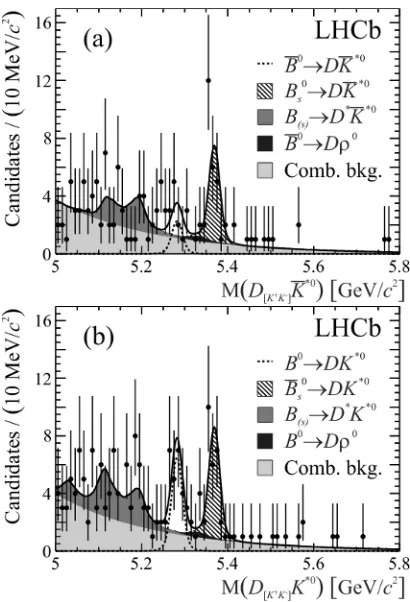
sys-tem can exhibit largeCP-violating e↵ects. The invariant mass distribution of the selectedD(K+K )K⇤0candidates is shown in Fig. 7. In addition to theB0mass peak, also a peak at theB0
s mass is observed. TheB0s ! DK⇤0 decay is used as control channel, as no largeCPviolation is ex-pected in this mode. TheCPasymmetries, computed from the efficiency-corrected signal yields, are found to be
Ad
CP= 0.45±0.23±0.02,
As
CP=0.04±0.16±0.01,
Figure 7.Invariant mass distributions of (a)D[K+K ]K⇤0and (b)
D[K+K]K⇤0candidates. The fit functions are superimposed.
forB0 and B0
s, respectively. Other results for the GLW observables can be found in Ref. [8]. These are the first measurements ofCPasymmetries inB0and B0
s toDK⇤0 decays with the neutralDmeson decaying into aCP-even final state. With more data, improved measurements of these and other quantities inB0 !DK⇤0 decays will set important constraints on .
5 Time-dependent measurements in the
B
0s
system
Interference e↵ects are expected to be large also in the tree-level decaysB0
s !D⌥sK±, since theB0s !D⌥sK±and B0
s ! D⌥sK±interfering amplitudes are of the same order in the Wolfenstein parameter ,O( 3). A time-dependent analysis is performed as the two final states of interest are accessible by bothB0
s andB0s. The decay time-evolution is sensitive to 2 s, where 2 sis theB0smixing phase, which is small in the SM and is measured withB0
s !J decays.
The first preliminary measurement of time-dependent CPviolation observables in B0
s ! D⌥sK± decays has re-cently been reported by LHCb [9]. This measurement is unique to LHCb, because it is the only existing experi-ment which has accumulated a sufficiently large sample ofB0
s decays and is able to distinguish the rapid B0s–B0s oscillations (thanks to its excellent proper-time resolution and the boost of theB0
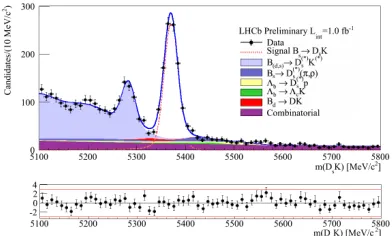
ex-Figure 8.Results of the mass fit toB0
s!D+sK candidates.
Figure 9. Results of the proper-time fit toB0
s ! D+sK candi-dates. The top magenta curve represents the result of the com-bined fit to all the samples. The green solid (dashed) curve repre-sents the result for the untaggedDsK+(D+sK ) sample. The four flavour-tagged samples are represented with red and blue curves corresponding toDsK+andD+sK , respectively; solid (dashed) lines are used for candidates tagged asB0
s(B0s) at production.
perimental challenges for this measurement are related to the efficiency of the flavour-tagging algorithms and the de-termination of the proper-time acceptance. The LHCb re-sults include both untagged and flavour-tagged candidates. Untagged events carry additional sensitivity to the weak phase since the decay width di↵erence in theB0s system, s, is sizeably di↵erent from zero. The mass distribu-tion of the total sample is shown in Fig. 8, and the proper-time distribution in Fig. 9, where the contribution of all the di↵erent components to the combined sample can be appreciated. The results on theCP observables can be found in [9]. The correlations between the systematic un-certainties have an important impact on the determination of 2 sand require further studies. No attempt has been made at this stage to derive confidence intervals for the weak phase.
6 Conclusions and prospects
Using 1 fb 1 of the 2011 dataset, LHCb obtains = 71.1+16.6
15.7( ) by combining GLW, ADS and GGSZB+ ! DK+ observables. This result is in good agreement and
has comparable precision to the combined results recently
Acknowledgements
I would like to thank the organisers of HCP2012 for the excellent conference and warm hospitality in beautiful Ky-oto.
References
[1] J. Charles et al. (CKMfitter Group), Eur.Phys.J.C41, 1 (2005), updated results and plots available at: http://ckmfitter.in2p3.fr
[2] D. Derkach (UTfit Collaboration), arXiv:1301.3300 (2013)
[3] R. Aaij et al. (LHCb collaboration), LHCb-CONF-2012-032 (2012)
[4] M. Gronau, D. London, Phys.Lett.B253, 483 (1991) [5] M. Gronau, D. Wyler, Phys.Lett.B265, 172 (1991) [6] D. Atwood, I. Dunietz, A. Soni, Phys.Rev.Lett.78,
3257 (1997)
[7] A. Giri, Y. Grossman, A. So↵er, J. Zupan, Phys.Rev.
D68, 054018 (2003)
[8] R. Aaij et al. (LHCb collaboration) (2012),
arXiv:1212.5205
[9] R. Aaij et al. (LHCb collaboration), LHCb-CONF-2012-029 (2012)
[10] R. Aaij et al. (LHCb Collaboration), Phys.Lett. B712, 203 (2012), erratum Phys. Lett.B713(2012) 351
[11] R. Aaij et al. (LHCb collaboration), LHCb-CONF-2012-030 (2012)
[12] J. Libby et al. (CLEO Collaboration), Phys.Rev. D82, 112006 (2010)
[13] R. Aaij et al., Phys. Lett.B718, 43 (2012)
[14] J. Beringer et al. (Particle Data Group), Phys.Rev. D86, 010001 (2012)
[15] N. Lowrey et al. (CLEO Collaboration), Phys.Rev. D80, 031105 (2009)
[16] Y. Amhis et al. (Heavy Flavor Averaging Group) (2012),arXiv:1207.1158
[17] J. Lees et al. (BABAR Collaboration) (2013),
arXiv:1301.1029
[18] K. Trabelsi (Belle collaboration) (2013),
arXiv:1301.2033
[19] R. Aaij et al. (LHCb Collaboration) (2012),