BOSNIAN JOURNAL OF BASIC MEDICAL SCIENCES 2010; 10 (2): 133-139
&
Abstract
Adverse drug reactions still pose an important clinical problem. Dihydropyrimidine dehydrogenase (DPD) is an enzyme that regulates -FU quantities available for anabolic processes and hence aff ects its pharmacokinetics, toxicity and effi cacy.
Th ere are several studies describing a hereditary (pharmacogenetic) disorder in which individuals with absent or signifi cantly reduced DPD activity may even develop a life-threatening toxicity following ex-posure to -FU. Th e most common mutation is known as the DPYD*A or as the splice-site mutation (IVS + G A) leading to creation of a dysfunctional protein. An objective behind the study was to ascertain existence of the IVS+ G A mutation among the population of Bosnia and Herzegovina. Our research has undeniably attested to existence of one heterozygote for the DPYD gene mutation, i.e. one heterozygote for IVS + G > A, DPYD*A mutation.
KEY WORDS: pharmacogenetics, Dihydropyrimidine dehydrogenase, DPYDA mutation
INVESTIGATION
OF IVS14+1G>A
POLYMORPHISM OF
DPYD GENE IN A
GROUP OF BOSNIAN
PATIENTS TREATED
WITH 5-FLUOROURACIL
AND CAPECITABINE
Timur Cerić1*, Nermina Obralić1, Lejla Kapur-Pojskić2,
Draženka Macić2, Semir Bešlija1, Anes Pašić1, Šejla Cerić3
1 Oncology Clinic, University of Sarajevo Clinics Centre, Bolnička , Sarajevo, Bosnia and Herzegovina
2 INGEB - Institute for Genetic Engineering and Biotechnology, Gajev trg , Sarajevo, Bosnia and Herzegovina
3 Nuclear Medicine Clinic, University of Sarajevo Clinics Centre, Bolnička , Sarajevo, Bosnia and Herzegovina
BOSNIAN JOURNAL OF BASIC MEDICAL SCIENCES 2010; 10 (2): 134-139
Introduction
Adverse drug reactions still pose an important clini-cal problem. Th erein, it was estimated that in the last decade alone they caused over , deaths annu-ally in the United States. As such, these reactions were the fourth leading cause of deaths in the U.S., immedi-ately after hearth diseases, malignancies and strokes (). Th ere is a direct link between therapeutical eff ects and
toxicity of -FU and the drug’s anabolic process relat-ed to nucleotides. In turn, this may inhibit activities of thymidylate synthetase or incorporate -FU into RNA and/or DNA. More than of the -FU dosage ad-ministered to human subjects was degraded through catabolic pathways, meaning that only app. of the dosage was left to the anabolic process. In the past ten years it became clear that the dihydropyrimidine de-hydrogenase (DPD) is an enzyme that regulates -FU quantities available for anabolic processes and hence affects its pharmacokinetics, toxicity and efficacy. The -FU anabolism leads to creation of fluoro’-deoxyuridine-’-monophosphate (FdUMP), which is a cytotoxic product of a multilevel activation pathway of the -FU. FdUMP acts as an inhibitor of the thymi-dylate synthetase (TS), thus causing an intracellular accumulation of the deoxyuridine monophosphate (dUMP) and a reduction in a level of deoxythymidine monophosphate (dTMP). Finally, this induces an ar-rest of a DNA synthesis. Th e initial and rate-limiting enzyme in the catabolism of the -FU is dihydropy-rimidine dehydrogenase (DPD) that catalyses a -FU reduction into ,-dihydrofl uorouracil (DHFU). Th en on, DHFU is degraded down to fluoro-β-ureido pro-pionic acid (FUPA) and flouro-β-alanine (FBAL) (). Th ere are several studies describing a hereditary (phar-macogenetic) disorder in which individuals with ab-sent or significantly reduced DPD activity may even develop a life-threatening toxicity following exposure to -FU. Here we need to consider the non-functional catabolic pathway due to a DPD inability to metabolise. Many studies, of which the most important are the ones by Van Kuilenburg and Johnson, have indicated that a high rate of the -FU toxicity is attributable to the re-duced DPD activity (). Van Kuilenburg has found that of oncological patients with -FU toxicity have also shown signs of reduced DPD activity, while John-son () saw this frequency to be , thereof app. having profound and app. partial DPD defi ciency. These patients are likely to develop an unanticipated toxic reaction subsequent to being treated with the -FU. When given in standard doses and coupled with
altered pharmacokinetics, -FU may lead to severe toxic reactions like mucositis, granulocytopenia, neu-ropathy, diarrhea and even death in the worst-case scenario. A cause to this toxicity seems to be in a de-creased drug clearance hence resulting in an extended -FU exposure. DPD-defi cient patients exhibit a normal phenotype until such time they have been adminis-tered with the -FU. It has been estimated that nearly - of the general population have the DPD activity below (<, nmol/min/mg for frozen samples) of the lower limit for the normal population (). It has been reported that of patients with reduced DPD activity suffers from the grade neutropenia, as op-posed to of patients with normal DPD activity (P = ,) (). Moreover, the toxicity occurs much earlier with regards to patients with low DPD activity (, ± , versus , ± , days, P < ,). Th e patients suff er-ing from the severe -FU toxicity have exhibited more than mutations in the DPYD gene to include one G to A mutation in the ’-splice recognition site of intron that resulted in a -bp deletion that correspond to exon . Th is mutation is known as the DPYD*A as per defi ned nomenclature or as the splice-site mutation (IVS + G A) leading to creation of a dysfunctional protein (). Th e mutation was not only the fi rst one to be analysed, but also the most frequently observed of all mutations in the population studies (app. ) ().
Materials and Methods
The study was approved by the local eth-ics committee, and written informed con-s e n t w a con-s o b t a i n e d f r o m e a c h p a t i e n t . Th is experimental research was designed as a prospec-tive, open and translation study. The study was per-formed among patients of the Oncology Clinic of the University of Sarajevo Clinics Centre treated in the period from -. An objective behind the study was to ascertain existence of the IVS + G ! A
muta-tion among the populamuta-tion of Bosnia and Herzegovina. A test group observed in the subject-matter research
consisted of subjects – patients at the Oncology of the University of Sarajevo Clinics Centre that have un-dertaken chemotherapy and been treated with -FU or Capecetabine in the period from to . Th erein, we have done a genomic analysis of DPYD gene for these patients. These patients were also divided into two subgroups regarding presence of toxicity grade or or without toxicity after administration of FU. All genotype analysis were conducted on samples of
BOSNIAN JOURNAL OF BASIC MEDICAL SCIENCES 2010; 10 (2): 135-139
taken by means of a venipuncture of a cubital vein that appears full and stored in vacutainers (BD biosciences) of ml with Na-EDTA anticoagulant. Th is was preceded by a written and informed consent by patients to par-ticipate in this study. Th e blood samples were refriger-ated for a short period of time on °C (not beyond hours) prior to their extraction. Th is was necessary as to preserve the quality and quantity of the isolated DNA. The DNA samples were stored on a tem-perature of –°C until we moved onto t h e n e x t p r o c e s s s t e p i n o u r a n a l y s i s . Determining a target DPYD gene structure was done by the Institute for Genetic Engineer-ing and Biotechnology in Sarajevo (INGEB) by means of the following methods and procedures: A genotyping methods applied in the study re-lied on the PCR technology. We have amplified a genotyping-relevant sequence by applying an ad-equate primer pair subsequent to which we sub-jected it to an appropriate gene expression profil-ing (an automatic or a manual fragment analysis). Genomic DNA was extracted from leuco-cytes with the standard techniques and actual genotyping was done by means of the PCR-RFLP. The DPYD exon and its flanking ’ do-nor intronic region was amplified with the PCR.
Primers used in the amplifi cation of the exon and its marginal regions (including newly formed Ndel restric-tion sites) are:
F: ’ ATC ˝AGG ACA TTG TGA CAT ATG TTT C ’ R: ’ CTT GTT TTA GAT GTT AAA TCA CAC ATA ’
In our study, we have applied a method of highly spe-cific typisation of the DNA sequence previously rep-licated during the PCR process. The PCR method followed the above outlined primer sequences as to ensure genotyping of DPYDA* polymorphisms in the DPYD gene. Relevant PCR products were tested by an agarose gel electrophoresis and then treated with the restriction enzyme Ndel (endo-nuclease) in an appropriate buffer solution on °C. During the RFLP processing, we have in-cubated ml of the PCR products over-night on °C with U endonuclease Ndel. Restriction fragments were separated by the aga-rose gel electrophoresis stained with ethidium bromide. The genotyping, i.e. assessment of the size of restric-tion fragments, was done on a visual basis by identify-ing the wild-type allele (IVS+G) by means of splic-ing bp with the PCR product to bp and bp fragments. Conversely, a mutant allele produced three fragments subsequent to Ndel digestion: bp, , bp and bp. Relevant results were record-ed by taking photographs of gels under an UV light.
Results
Th e human DPD gene (DPYD) is present as a single copy gene on the chromosome p and consists of exons.
w/o toxicity Toxicity Total
Age No .25 Percentage No .25 Percentage No. 50 Percentage
Median 62,8 59,8 Range 42-77 41-75 Sex
Male 14 56 13 52 27 54 Female 11 44 12 48 23 46 Diagnosis
Rectum 18 36
Colon 23 46
Ventricle 3 6
Pancreas 1 2
Breast 3 6
Gall Bladder 2 4
Th erapy
5-FU 42 84
Capecetabine 8 16
Toxicity Gr 3 Gr 4
Diarrhea 9 3 12 38,7
Neutropenia 8 5 13 41.9
Mucositis 5 1 6 19,35
Mutation 1 4 1 2%
Lethal outcome 2 8 2 4%
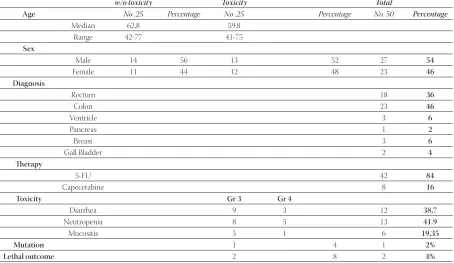
BOSNIAN JOURNAL OF BASIC MEDICAL SCIENCES 2010; 10 (2): 136-139Table . provides an overview of all patients who partici-pated in our study, their respective characteristics and responses to treatments vs. the subject-matter mutation.
Toxicity and lethal outcome
A toxic events analysis was done in accordance with the Common Toxicity Criteria (CTC). We have factored in only those toxic events that could be interpreted by means of either labora-tory tests or clinical examinations. There were also other cases like a neurological toxicity, but we have not taken it into consideration as we were unable to draw a clear line between this toxicity and the -FU. We have described three types of toxicities ex-hibited by our patients: diarrhea, neutrope-nia with a resulting leukopeneutrope-nia and mucosi-tis (to include stomatimucosi-tis as well) (Chart .) Majority of cases, i.e. subjects, had neutropenia, which is nearly of all symptoms, while remaining subjects had diarrhea and mucositis. Not one of these events had a statistical signifi cance over the other two. While the grade mostly involves diarrhea, the grade neutropenia, so it is evident that the only lethal outcomes occurred with patients with the grade neutropenia. This is to say that this occurrence bears a statistical significance of p=, according to the Fisher’s exact test. During our research, we had two lethal outcome cases that belonged to the group of subjects with toxicity subsequent to the -FU treatment. There-in, the significance level p was ,. Both of these cases occurred after the grade neutrope-nia, so this event bears a statistical significance of p= , according to the Fisher’s exact test.
IVS + G > A, DPYD*A MUTATION
Our research has undeniably attested to existence of one heterozygote for the DPYD gene mutation, i.e. one heterozygote for IVS + G > A, DPYD*A mutation.
BOSNIAN JOURNAL OF BASIC MEDICAL SCIENCES 2010; 10 (2): 137-139
Find below is an UV photograph ( Figure .) taken af-ter staining the agarose gel with ethidium bromide. Th e image displays wild-type DPYD in lane and het-erozygote mutation in lane . Th e latter is IVS + G > A, DPYD*A that appeared after restriction, while the wild-type allele was identified by splicing bp with a PCR product on bp and bp fragments. Conversely, the mutant allele produced three frag-ments after Ndel digestion: bp, , bp and bp.
Discussion
Although it was synthesised over years ago, the -FU remains one of the most prescribed cytostatic agents in treatment of various malignant diseases. Adverse drug reactions still remain one of the most signifi cant clinical problems. This, coupled with the meta-anal-ysis results involving , patients treated with the -FU, indicate that grades and toxicities occur with - of patients and have a lethality rate of , (). Although we are well aware now that many human ill-nesses are caused by gene mutations, there is a lesser awareness of a fact that known gene variances can affect a patient’s response to certain drugs (,).
The importance of the DPD deficiency and severe -FU-related toxicity is of even greater significance considering the wide range of the -FU administra-tion. Th e meta-analysis covering a group of over , patients suggests that more than of patients treated with the -FU experienced a major toxic event prompted by this medication. A frequency of low DPD enzyme activity in the general population was initialy evaluated to be somewhere between -.
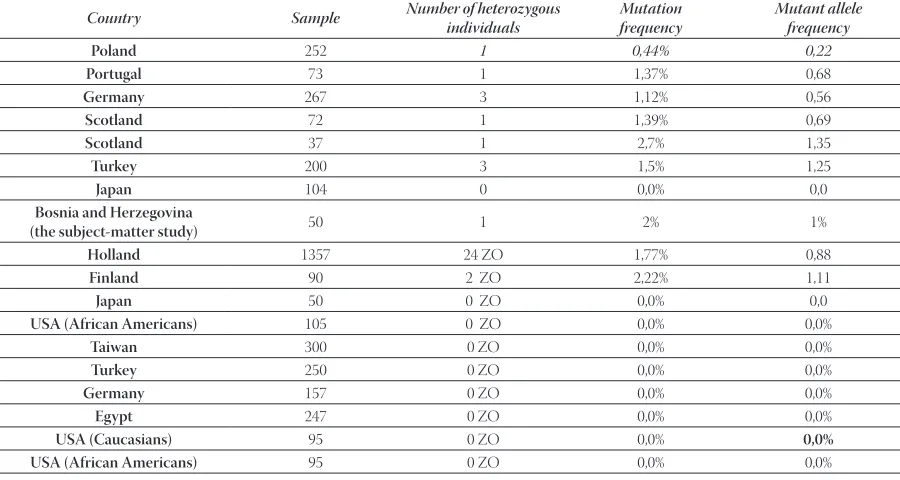
However, further studies have proven a significant variability between different ethnic groups (Table ). Th e human DPD gene (DPYD) is present as a single copy gene on the chromosome p and consists of exons. The Table . provides an insight into re-sults of certain studies (ours included) that dealt with determining relevant prevalence rate with patients of different ethnic groups. As we can see, none of the neighboring countries, has
BOSNIAN JOURNAL OF BASIC MEDICAL SCIENCES 2010; 10 (2): 138-139of the DPD defi ciency. Th erefore, the aforesaid number of patients would have been much greater even based solely on changes in one gene in the -FU metabolism.
Another interesting information here is that all hetero-zygous patients with proven mutations in all mentioned studies, have had the grade neutropenia. If we take the fi ndings of our study and compare it against the grade neutropenia alone (wherein relevant toxicity rate was above for patients with the DPYD A* mutation and ended in a lethal outcome) and considering that it indicates that of our test group with the grade neutropenia symptoms had the subject-matter muta-tion, then our results are very similar with such studies. Of course, we take due note of the earlier mentioned limitations imposed on this research. In conclusion, during our study, the lethal outcome occurred with two patients suffering from the grade neutropenia. It is pertinent to note here that the said mutation (IVS+G>A), in any case, does not represent a sole cause of death in patients developing the life-threaten-ing toxicity after the -FU administration. So far, the an-alysed gene displayed over mutations and other met-abolic pathways that may have caused the said lethality.
The deficient DPD activity is a pharmacogenetic syn-drome with a possible fatal outcome following the -FU therapy. Although molecular defects of DPYD lead-ing to the defi cient DPD activity can be root causes of the -FU syndrome, actual DPD regulatory mecha-nisms have not been clearly outlined. This calls for highly specific techniques for screening of the entire DPYD gene and for measuring DPD activity. Resul-tantly, this would enable us to draw clear conclusions of the relationship between the genotype and pheno-type of the pharmacogenetic syndrome in question.
Certainly, this is only a speculative statement on our part, as more elaborate and definite conclusions can be reached only after conducting a greater scale of re-search. Still, it provides us with indicative information.
Even major countries have not yet solved a matter of routine screening of patients, but there is an increasing tendency of such tests. Th is is rooted in a pharmaco-eco-nomic aspect as treatment costs for patients experienc-ing severe toxicity have already proven to be much great-er than screening costs. Needless to say, new screening methods are reducing inherent costs even further down.
Country Sample Number of heterozygous
individuals
Mutation frequency
Mutant allele frequency
Poland 252 1 0,44% 0,22
Portugal 73 1 1,37% 0,68
Germany 267 3 1,12% 0,56
Scotland 72 1 1,39% 0,69
Scotland 37 1 2,7% 1,35
Turkey 200 3 1,5% 1,25
Japan 104 0 0,0% 0,0
Bosnia and Herzegovina
(the subject-matter study) 50 1 2% 1%
Holland 1357 24 ZO 1,77% 0,88
Finland 90 2 ZO 2,22% 1,11
Japan 50 0 ZO 0,0% 0,0
USA (African Americans) 105 0 ZO 0,0% 0,0%
Taiwan 300 0 ZO 0,0% 0,0%
Turkey 250 0 ZO 0,0% 0,0%
Germany 157 0 ZO 0,0% 0,0%
Egypt 247 0 ZO 0,0% 0,0%
USA (Caucasians) 95 0 ZO 0,0% 0,0%
USA (African Americans) 95 0 ZO 0,0% 0,0%
BOSNIAN JOURNAL OF BASIC MEDICAL SCIENCES 2010; 10 (2): 139-139
Conclusion
Our study has indicated to the presence of the DPD mutation on the exon (IVS+G>A). Th is is the fi rst time such a case was reported with respect to the Bosnian population. (DPYD*A frequency is nearly ).
Furthermore, we attest to IVS+G>A DPYD mutation being responsible for a signifi cant proportion of the life-threat-ening toxicity in the -FU administration. Th is is based on a sample of four patients suff ering from the CTC-defi ned grade myelosupression after being treated with the -FU.
References
() Lazarou J., Pomeranz B.H., Corey P.N. Incidence of adverse drug reactions in hospitalized patients. JAMA ; :–.
() Maring J.G., van Kuilenburg A.B., Haasjes H., Piersma H., Groen J.M., Uges D.R., De Vries E.G. Reduced -FU clearance in a pa-tient with low DPD activity due to heterozygosity for a mutant allele of the DPYD gene. Br. J. Cancer ; : – .
() van Kuilenburg A.B., Haasjes J., Richel D.J., et al: Clinical impica-tions of dihydropyrimidine dehydrogenase defi ciency in patients with severe FU associated toxicity: identifi cation of new muta-tions in the DPD gene. Clin. Cancer Res. ; (): -.
() Johnson M.R., Diasio R.B. Importance of dihydropyrimidine de-hydrogenase defi ciency in patients exhibiting toxicity following treatment with - fl ourouracil. Adv. Enz. Regul. :; -
() Van Kuilenburg A.B.P., De Abreu R.A., van Gennip A..H. Phar-macogenetic and clinical aspects of dihydropyrimidine dehydro-genase defi ciency. Ann. Clin. Biochem. ; (): -
() Mc Leod H.L., Collie-Duguid E.S., Vreken P., et al. Nomenclature for human DPYD alleles. Pharmacogenetics. ;:-.
() Van Kuilenburg A.B.P., Vreken P., Abeling N.G., Bakker H.D., Meinsma R., Van Lenthe H., et al. Genotype and phenotype in patients with dihydropyrimidine dehydrogenase deficiency. Hum. Genet. ; :–.
() Van Kuilenburg ABP, Vreken P, Abeling NGGM, Bakker HD, Meinsma R, Van Lenthe H, et al. Genotype and phenotype in pa-tients with dihydropyrimidine dehydrogenase defi ciency. Hum Genet ; :–.
() Meta-Analysis Group in Cancer : Toxicity of fl uorouracil in pa-tients with advanced colorectal cancer: eff ect of administration schedule and prognostic factors.. J. Clin. Oncol. ; (): -.
() Haga S.B., Burke W. Using pharmacogenetics to improve drug safety and effi cacy. JAMA. ; ():-
() Goldstein D.B., Tate S.K., Sisodiya SM. Pharmacogenetics goes genomic. Nat. Rev.Genet. ; :-.
BOSNIAN JOURNAL OF BASIC MEDICAL SCIENCES 2010; 10 (2): 140-146&
Abstract
Th e aims of the study were to estimate the prevalence of excessive weight in infants and school-age chil-dren in Sarajevo Canton, to isolate the main causative agents and to propose a strategy for its effi cient prevention. Th e methods included anthropometry and originally designed questionnaire. Calculated body mass index was classifi ed according to the criteria proposed by Centre for Disease Control and Pre-vention (CDC). Th e research included students from elementary and secondary schools from Sa-rajevo Canton. Nearly / of subjects had excessive body weight while , of students were malnour-ished. Elementary school lower graders had the highest grade of excessive weight, while the secondary school students exhibited the lowest grade of excessive weight. During school hours, about , of stu-dents were fed on bakery produces and snacks. Non-sparkling, thickened juices are frequently consumed beverages (,), second only to water (,). , of children consume sweets on daily basis. Th is is even more prominent among secondary school students (,). Only / of students practice sports on daily basis, while , of them rarely engage in sports. Elementary school lower grade students had the lowest level of activity while the secondary school students were the most active. As many as , students spend two hours or more sitting by the computer or TV set.
Th e most signifi cant mediators of excessive weight gain are sedentary life-style, frequent consumption of sweets and thickened juices and unsuitable nutrition during school hours. Continuous preventive and therapeutically activities must be undertaken among as wide population as possible.
KEY WORDS: obesity, children, youth
EPIDEMIOLOGY AND
ETIOLOGY OF OBESITY IN
CHILDREN AND YOUTH
OF SARAJEVO CANTON
Sniježana Hasanbegović1*, Senka Mesihović-Dinarević1,
Mustafa Cuplov2, Amra Hadžimuratović2, Hajra Boškailo3,
Nevenka Ilić3, Azemina Njuhović4, Nermina Čengić1,
Emina Bajramović3, Šejla Brković2
1 Paediatric Clinic, University of Sarajevo Clinics Centre, Patriotske lige , Sarajevo, Bosnia and Herzegovina
2 Ministries of Health, Sarajevo Canton, Reisa Džemaludina Čauševića , Sarajevo, Bosnia and Herzegovina
3 Health Care Centres, Sarajevo Canton, Vrazova , Sarajevo, Bosnia and Herzegovina 4 Ministry of Education and Science, Sarajevo Canton, Reisa Džemaludina Čauševića ,
Sarajevo, Bosnia and Herzegovina
BOSNIAN JOURNAL OF BASIC MEDICAL SCIENCES 2010; 10 (2): 141-146
Introduction
Obesity epidemic is one of the most important health problems of modern age. Over the past two decades, obesity prevalence in European countries has tripled. About of adults have excessive weight while / of European population is obese. Even, - of Eu-ropean children and adolescents are overweight (, ). Statistical data by USA Centre for Disease Control and Prevention (CDC) also testify that the over-weight population has tripled over the past two de-cades. Also, of children and adolescents between and years of age are overweight (, , and ).
Approximately - overweight children grow up into obese adults, who lead to earlier and more frequent de-velopment of chronic non-infectious diseases: hyperten-sion, early atherosclerosis, Diabetes mellitus Type , or-thopaedic, endocrine and psycho-social deviations (, ). Although hereditary and hormonal factors may be significant in overweight development in chil-dren, excessive food consumption and low physi-cal activity are undoubtedly the major causes (, ).
Sedentary time spent with TV set and computer coin-ciding with the consumption of calories-rich food and sweet beverages in the long term leads to an imbal-ance between energy intake and expenditure. Th e re-sult of such imbalance is excessive body weight. Body mass index BMI > p is considered obese (, , ).
An alarming trend of obesity epidemic expansion, and increase in prevalence in young population in par-ticular, represent a problem of major economical and social consequences for every community (, ).
European charter on counteracting obesity adopted in proposes global measures for obesity prevention in all European countries. Precise epidemiological data on the number of obese children and youth and infor-mation of their eating habits and activities are preroga-tive for designing effi cient action plan for the preven-tion of obesity development in each country (, ).
Aims of the study
Th e aims of the study were:
- estimate the prevalence of excessive body weight in children and youth in Sarajevo Canton,
- delineate major causes of this condition and to propose the strategy for its effi cient prevention.
Materials and Methods
The study was conducted during and . It included representative sample of Sarajevo Canton elementary and secondary schools, which were ran-domly selected. The number of subjects per school class (elementary - and secondary -) was balanced. The students were requested to fill in a ques-tionnaire. The questionnaire was original-ly designed for this study and includes ques-tions that pertain to eating habits (frequency, quantity and types of consumed food), consumption of liquids, and physical activity (frequency and intensity). Th e questionnaire addressed subjects’ social status re-garding the total number of family members that are sus-tained from the same source per employed individual. The questionnaires for elementary and second-ary schools contained the same questions pre-sented in the form suitable for the participants’ age. Anthropometric measurements: body height, body weight, measured in all subjects. Th e height was mea-sured using vertical stat meter, the values were ex-pressed in centimetres (cm) and rounded at , cm. Body weight was measured using digital balance, the values were expressed in kilograms (kg) and rounded at , kg. The study was conducted by teams which in-cluded physicians and a certified nurse. The sub-jects participated in the study on voluntary basis. The data entered into database were anonymous. Th e statistical data processing was performed accord-ing to the age groups: I-IV and V-VIII grades of el-ementary school and I-IV grade of secondary school.
BMI was used to estimate the nutritional status. It was calculated automatically according to the formula: BMI = body weight (kg) / height (m)
Nutritional status was derived automatically based on CDC criteria ():
- BMI < percentile indicates malnourishment. - BMI < and > percentile indicates normal
nutri-tional status
- BMI > a < indicates higher body weight, - BMI > percentile indicates obesity.
Results
BOSNIAN JOURNAL OF BASIC MEDICAL SCIENCES 2010; 10 (2): 142-146Table presents an overview of the total number of sub-jects and breakdown according to school age and gender.
Table presents the data on BMI distribution among the examined students according to the school grade and gender.
The quality of nourishment during school hours in the examined students and in vari-ous school age groups is presented in Table .
Table presents distribution of beverages con-sumption during the day among the student groups.
Th e frequencies of sweets consumption among students are presented in Table .
Table presents the distribution of the degree of physi-cal activity among students that participated in the study.
Table presents the distribution of the time that stu-dents spend with computer or TV set (higher grades of elementary school and secondary school students).
Discussion
Th is is the fi rst study in the Federation of Bosnia and Herzegovina that presents data on the frequencies of obesity among students of elementary and second-Grade
School
Total
students M F I-IV
Elementary 1077 546 531 V-VIII
Elementary 1252 680 572 I-IV
Secondary 1279 531 748 Schools
Total 3608 1757 1851
Grade School Home-made sandwich (%) School provided sandwich (%) Bakery produc-es (%) Snacks (%) Do not eat at school (%) I-IV
Elementary 30,69 44,63 5,04 17,68 1,98 V-VIII
Elementary 16,57 24,62 42,67 10,96 5,27 I-IV
Secondary 2,70 41,09 42,01 8,89 5,37 Schools
Total 16,65 36,78 29,90 12,57 4,20
Grade School Water (%) Non-sparkling juice (%) Milk (%) Sparkling beverages (%) I-IV
Elementary 50,88 23,19 23,37 2,6 V-VIII
Elementary 54,94 21,71 12,45 11,87 I-IV
Secondary 49,35 16,77 13,19 20,72 Schools
Total 51,82 20,65 16,43 11,05
Grade School Active on daily basis (%) Active in sports classes only (%) Active 2-3 times weekly (%) Rarely(%) I-IV
Elementary 19,92 39,05 40,36 0,00 V-VIII
Elementary 36,42 27,56 24,52 11,50 I-IV
Secondary 46,89 29,19 18,08 5,65 Schools
Total 31,07 31,93 27,65 8,51
Grade School
< 1 hour (%)
1-2 hours (%)
2-3 hours (%)
> 3 hours (%) I-IV
Elementary 23,60 36,62 18,51 20,89 V-VIII
Elementary 13,81 30,56 27,74 27,96 I-IV
Secondary 18,70 33,59 23,12 24,42 Schools
Total 31,07 31,93 27,65 8,51 Grade
School
Sweets consumed on daily basis (%)
Sweets consumed rarely or occasionally (%) I-IV
Elementary 30,89 59,11 V-VIII
Elementary 64,53 33,47 I-IV
Secondary 80,85 19,15 Schools
Total 58,15 31,24 Grade
School
BMI classifi cation Malnourished (%) Ideal weight (%) Excessive weight (%) Obese (%) I-IV Elementary T: 20,86 M: 7,72 F: 13,14 T: 55,26 M: 28,68 F: 26,58 T: 12,28 M: 7,47 F: 4,81 T: 11,58 M: 6,77 F: 4,81 V-VIII Elementary T: 9,16 M: 4,65 F: 4,51 T: 69,80 M: 37,98 F: 31,82 T: 13,07 M: 7,49 F: 5,58 T: 8,00 M: 3,69 F: 4,31 I-IV Secondary T: 6,76 M: 1,31 F: 5,45 T: 80,43 M: 34,15 F: 46,28 T: 9,55 M: 5,18 F: 4,37 T: 3,24 M: 1,47 F: 1,77 Schools Total T: 12,49 M: 4,63 F: 7,86 T: 68,74 M: 33,60 F: 35,14 T: 11,86 M: 6,71 F: 5,15 T: 6,86 M: 1,32 F: 5,54 TABLE 1. Analysis of the examined student group
According to school level, grade and gender
TABLE 3. Quality of nourishment during school hours
TABLE 4. Types of beverages consumed during school hours
TABLE 6. Distribution of the degree of physical activity among the students
TABLE 7. Distribution of the time spent with computer or TV set TABLE 5. Distribution of sweets consumption frequencies