BOSNIAN JOURNAL OF BASIC MEDICAL SCIENCES 2008; 8 (4): 367-372
&
Abstract
Th ere is still debate whether sintethic graft (polytetrafl uoroethylene or Dacron) is equivalent to vein as bypass graft material for the above-knee femoropopliteal bypass. Th erefore, we per-formed prospective randomized trial to compare vein with polytetrafl uoroethylene/dacron for femoropopliteal bypasses with the distal anastomosis above the knee. Between January and June , femoropopliteal bypasses were performed. Th e indications for op-eration were severe claudication in cases, rest pain in cases, and ulcop-eration in cases. After randomization, reversed saphenous venous bypasses and polytetrafl uoroethylene/ dacron bypasses were performed. No perioperative mortality was seen, and of the patients had minor infections of the wound, not resulting in loss of the bypass, the limb, or life. After years, of the patients had died and were lost to follow-up. Only once saphenous vein was necessary for coronary artery bypass grafting. Primary patency rates after years were , for venous bypass grafts and , for polytetrafl uoroethylene/dacron grafts (p=,). Secondary patency rates were , for vein and , for polytetrafl uoroethylene/dacron bypasses (p = ,). In the venous group, bypasses failed, leading to four new bypasses. In the polytetrafl uoroethylene group, bypasses failed, leading to reinterventions. After years of follow-up, we conclude that a bypass with saphenous vein has better patency rates at all intervals and needs fewer reoperations. Saphenous vein should be the graft material of choice for above-knee femoropopliteal bypasses and should not be preserved for reinterven-tions. Polytetrafl uoroethylene/dacron is an acceptable alternative if the saphenous vein is not available.
KEY WORDS: femoro-poplitealn bypass, above knee, saphenous vein graft, polytetrafl oureth-ylen graft, Dacron graft.
FEMORO-POPLITEAL
BYPASS ABOVE KNEE
WITH SAPHENOUS VEIN
VS SYNTHETIC GRAFT
Emir Solaković, Dragan Totić*, Sid Solaković
Clinic for Vascular Surgery, University of Sarajevo Clinics Centre, Čekaluša , Sarajevo, Bosnia and Herzegovina
BOSNIAN JOURNAL OF BASIC MEDICAL SCIENCES 2008; 8 (4): 368-372
Introduction
It is generally accepted that autologous saphenous vein is the conduit of choice for a femoropoplitial bypass below the knee (,,,,). For the femorop-opliteal bypass with the distal anastomosis above the knee, controversy still exists whether prosthetic materials like polytetrafluoroethylene, Dacron, and human umbilical vein are equivalent to autologous saphenous vein. Studies supporting other conduit materials for bypass either are not randomized (,) or do not compare prosthetic material with vein (). In , this randomized controlled trial was started in our institution to answer the following questions: ) Are there any difference in cumulative pat-ency rates between saphenous vein and poly-t e poly-t r a f l u o r o e poly-t h y l e n e / D a c r o n b y p a s s g r a f poly-t s ? ) What are the consequences of bypass failure? And ) If polytetrafluoroethylene/Dacron is used, is the autologous vein still available and useful for more dis-tal procedures or for coronary artery bypass grafting?
The conclusions, reported after years of follow-up, were that there was no statistical significant differ-ence in primary and secondary patency rates between vein and polytetrafluoroethylene/Dacron. In the su-prageniculate position, polytetrafl uoroethylene/Dacron could be an acceptable alternative for femoropopliteal bypass grafting in above-knee procedures, especially in patients with a short life expectancy. There was minimal use of preserved veins for other bypass proce-dures. However, the follow-up period was only years. Before the start of this study, very few randomized trials comparing vein with polytetrafluoroethyl-ene/Dacron were published. AbuRahma, Robinson, and Holt () found no difference in primary pat-ency rates after years. However, Johnson and Lee () reported significantly better primary patency rates for vein than for polytetrafl uoroethylene after years. This study reports the results of our prospec-tive randomized trial with a -year follow-up period.
Patients and Methods
Patients who underwent a femoropopliteal bypass oper-ation between January and June were eligible for this study. All patients with disabling claudication, rest pain, or tissue-loss who underwent arterial recon-struction were included. Patients with an earlier arte-rial bypass graft procedure in the same leg or with the greater saphenous vein removed earlier were excluded.
BOSNIAN JOURNAL OF BASIC MEDICAL SCIENCES 2008; 8 (4): 369-372
Primary patency was considered to be uninterrupted patency with no procedures performed on the bypass or the adjacent native vessel. Secondary patency was the patency after restoration of an occlusion or after a procedure to protect the bypass from occluding. Most of the original bypass and at least one of the anas-tomosis must have been retained in continuity (). Randomization took place in bypass graft operations in patients between January and June . Th e risk factors and angiographic results were equally divided between those who received a venous bypass graft and those who received a polytetrafl uoroethylene/ Dacron bypass graft, except for diabetes mellitus, which was signifi cantly lower in the venous group (Table ).
Reversed vein was used in bypass grafts, and -mm stretched polytetrafluoroethylene or mm Dacron prostheses were used times. Bilateral re-construction was done in patients. Five patients received polytetrafluoroethylene/Dacron bypass grafts in both limb, two with bilateral venous bypass grafts, and five patients received polytetrafluoro-ethylene/Dacron in one limb and vein in the other.
Th e operating time from skin incision until skin closure was signifi cantly longer in venous bypasses (mean, minutes) than in polytetrafl uoroethylene/Dacron grafts (mean, minutes; p = ,). A superfi cial wound in-fection was seen in seven cases (three times with a polytetrafluoroethylene/Dacron and four times with a venous bypass). None of these infections resulted in reoperation or loss of the bypass. None of the patients died in the hospital or within days after the operation.
Results
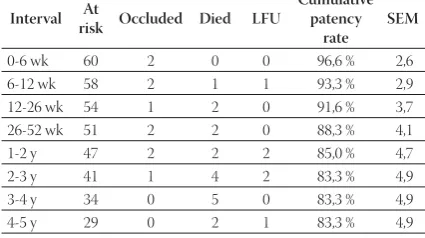
After years, patients had died (); with an open and with an occluded by-pass. Nine patients were lost to follow-up (). Primary patency rates after years were , for venous bypass grafts and , for polytetra-fluoroethylene/Dacron grafts (Tables and ).
Secondary patency rates were , for vein and , for polytetrafl uoroethylene/Dacron (Tables . and .).
In the venous bypass group, bypasses failed. In six pa-tients, we did not perform a reintervention because the patient only had mild claudication. Four new bypass op-Total Vein PTFE/Dacron P value
Reconstructions 121 60 61
Median age (y) 69 70 68 0,10 Male gender 70 33 37 0,28 Risk factors
Smoking 85 39 46 0,07 Diabetes mellitus 33 12 21 0,04 Cardiac history 31 15 16 0,44 Cerebrovascular
accident 7 5 2 0,12 Indication
Claudication 96 49 47 Rest pain 16 7 9 Necrosis 9 3 6 Open tibial arteries
3 64 34 30
2 38 17 21
1 19 9 10
TABLE 1. Patient characteristics from included patients
Interval At
risk Occluded Died LFU1
Cumulative patency
rate
SEM
0-6 wk 60 3 0 0 95,0% 2,9 6-12 wk 57 3 1 1 90,0% 3,4 12-26 wk 53 2 2 0 86,6% 4,2 26-52 wk 49 2 2 0 83,3% 4,7 1-2 y 45 2 2 2 80,0% 5,0 2-3 y 39 1 4 2 78,3% 5,2 3-4 y 32 1 5 0 76,6% 5,25 4-5 y 26 0 2 1 76,6% 5,25
Interval At
risk Occluded Died LFU1
Cumulative patency
rate
SEM
0-6 wk 61 3 0 0 95,1% 2,2 6-12 wk 58 2 0 0 91,8% 3,1 12-26 wk 56 4 1 0 85,2% 4,0 26-52 wk 51 4 3 0 78,7% 4,7 1-2 y 44 4 2 0 72,1% 5,4 2-3 y 38 4 3 1 65,6% 5,8 3-4 y 30 2 4 0 62,3% 5,9 4-5 y 24 2 3 2 59,1% 6,2
Interval At
risk Occluded Died LFU
Cumulative patency
rate
SEM
0-6 wk 60 2 0 0 96,6 % 2,6 6-12 wk 58 2 1 1 93,3 % 2,9 12-26 wk 54 1 2 0 91,6 % 3,7 26-52 wk 51 2 2 0 88,3 % 4,1 1-2 y 47 2 2 2 85,0 % 4,7 2-3 y 41 1 4 2 83,3 % 4,9 3-4 y 34 0 5 0 83,3 % 4,9 4-5 y 29 0 2 1 83,3 % 4,9 TABLE 2. Life-table analysis of primary patency rate of autologous saphenous vein
TABLE 3. Life-table analysis of primary patency rate of polytetrafl uo-roethylene/Dacron
BOSNIAN JOURNAL OF BASIC MEDICAL SCIENCES 2008; 8 (4): 370-372erations were performed: in three cases, a new polytetra-fl uoroethylene bypass was made above the knee and in one case, the venous bypass was extended with vein to below the knee for a femoroinfrapopliteal bypass. Failure of two of these redo bypasses led to two polytetrafl uoro-ethylene femorotibial bypasses but fi nally to an occlusion and an amputation (above-knee). In this group, one cor-onary bypass operation was performed with the saphen-ous vein from the contralateral side as the graft material. In the polytetrafluoroethylene group, bypasses failed. Ten times, no reinterventions were planned be-cause the patients only had mild claudication. Bebe-cause of severe claudication or rest pain, three times a new bypass above the knee was performed, all with polytet-rafl uoroethylene. Nine bypasses had to be performed below the knee: in seven cases, these were polytetra-fl uoroethylene bypasses; and in two cases, saphenous vein. One venous femorotibial bypass was constructed. Th ere were signifi cantly more reinterventions because
of a failing polytetrafluoroethylene bypass graft com-pared with failing venous bypasses. Because of failed reinterventions, three patients received a polytetra-fl uoroethylene femorotibial bypass. Two amputations had to be performed (above-knee). In this group, two coronary bypass reconstructions were performed, but no bypass was constructed of saphenous vein.
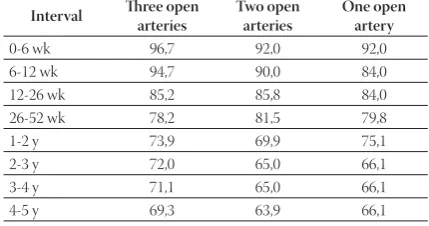
Primary patency rates were related to the outfl ow. Af-ter years, the patency rates were , in the group with three open crural arteries, , with two open arteries, and , with one open artery (Table .).
Discussion
The question of the best material for above-knee by-pass graft surgery, polytetrafl uoroethylene/Dacron or saphenous vein, was once controversial. Th e problem with many of these randomized trials, including our own, was that patient recruitment proved to be dif-fi cult, resulting in dedif-fi cient power for conclusion. Our conclusion after years of follow-up was that polytet-rafl uoroethylene/Dacron was a reasonable alternative but that long-term results should be awaited. Another problem is that follow-up is often defi cient. With respect to follow-up, we were successful in seeing all but nine of our patients in the outpatient clinic. After years of follow-up, we found a signifi cant diff erence in primary patency rates of , for vein and , for polytetra-fl uoroethylene/Dacron (p = ,). Th e secondary pat-ency rates were , and ,, respectively (p = ,).
In Table ., our results are compared with the three other published randomized trials (,,).
Th e diff erence between the four studies is that in the series of Veith et al. () and Johnson and Lee (), and , respectively, of the patients had severe isch-emia (rest pain or necrosis). This differs from our se-ries () and the sese-ries of AbuRahma, Robinson, and Holt ()(). It can be expected that the outflow in patients with severe ischemia is poor compared with those with claudication. This might explain the less favorable long-term patency rates described by Veith
Interval Th ree open arteries
Two open arteries
One open artery
0-6 wk 96,7 92,0 92,0 6-12 wk 94,7 90,0 84,0 12-26 wk 85,2 85,8 84,0 26-52 wk 78,2 81,5 79,8 1-2 y 73,9 69,9 75,1 2-3 y 72,0 65,0 66,1 3-4 y 71,1 65,0 66,1 4-5 y 69,3 63,9 66,1
Veith et al. (5) AbuRhama et al.(10) Johnson and Lee(11) Our study
Years Vein PTFE Vein Dacron Vein PTFE Vein PTFE/Dacron
1 82% 82% 88% 81% 84% 77% 83% 79%
2 79% 69% 78% 68% 81% 69% 80% 72%
3 70% 56% 76% 68% 77% 58% 78% 66%
4 61% 38% 76% 68% 75% 50% 77% 62%
5 76% 68% 74% 39% 77% 59%
TABLE 6. Primary patency after 5 years compared with number of patent tibial arteries with preoperative arteriography.
TABLE 7. Comparisons of primary patency rates of venous and polytetrafl uoroethylene or Dacron bypass grafts from randomized controlled trials
Interval At risk Occluded Died Cumulative patency rate SEM
0-6 wk 61 2 0 96,7% 1,8 6-12 wk 59 2 0 93,4% 2,8 12-26 wk 57 3 1 91,8% 3,7 26-52 wk 53 3 3 83,6% 4,0 1-2 y 47 4 2 77,0% 4,9 2-3 y 41 4 3 70,5% 5,4 3-4 y 33 2 4 67,2% 5,8 4-5 y 27 2 3 63,9% 6,2
BOSNIAN JOURNAL OF BASIC MEDICAL SCIENCES 2008; 8 (4): 371-372
et al and Johnson and Lee ( and , respectively). Michaels () estimated that grafts are required in the two randomized groups to have a chance of show-ing signifi cance (P < ,), assumshow-ing that there is a diff erence in -year patency rates. Despite the fact that we did not include that many patients, we found a statis-tical diff erence in favor of venous graft material. Johnson and Lee presented the only other trial with a statistically signifi cant diff erence between vein and polytetrafl uoro-ethylene. Th ey included patients in the venous group and in the polytetrafl uoroethylene group. If we com-pare the patency rates for vein and polytetrafl uoroeth-ylene in all four randomized trials, we see at all intervals a better primary patency rate for vein. It was shown in a critical review as well that if saphenous vein is avail-able, a venous bypass should be chosen (). When the saphenous vein is absent or not suitable for bypass graft-ing, polytetrafl uoroethylene or Dacron is a good alterna-tive for femoropopliteal bypass material above the knee. The only statistically significant risk factor difference between the two groups was the prevalence of diabetes, with signifi cantly more patients in the polytetrafl uoroeth-ylene/Dacron group. Evans et al () and Prendiville et al () found that diabetes has a negative infl uence on the patency of the bypass, whereas others did not fi nd that ef-fect (,). Because of the small numbers of patients with risk factors, no multivariate analysis could be performed. In failing venous bypasses, four patients had criti-cal ischemia and needed a reoperation. In the poly-tetrafluoroethylene/Dacron group, reoperations had to be performed for failing bypass grafts. Ten bypasses had to be placed below the knee. Clearly, less reoperation had to be performed in the venous group. The fact that in the polytetrafluoroethylene/ Dacron group during reoperation the distal anastomo-sis was more often below the knee might strengthen the idea that the polytetrafl uoroethylene/Dacron graft promotes progression of distal atherosclerosis (,). One of the arguments for use of polytetrafl uoroethyl-ene/Dacron for the above-knee femoropopliteal bypass graft is preservation of the vein for a later distal proce-dure or a coronary bypass. In the group of polytet-rafluoroethylene/Dacron bypasses, thus the group in which the vein was preserved, graft failures occurred, with necessity for a venous bypass in only two cases. Two coronary bypasses were performed with the
mam-mary artery in this patient group during the follow-up period. In other studies, these similar conclusions were made (,). So, it seems unnecessary to save the vein because in case of a failing bypass graft the spared vein was not used often. Moreover, if the vein were used for the above-knee bypass, less reoperations had to be per-formed below the knee with need for the vein. When an infrapopliteal bypass or a coronary bypass is needed, the saphenous vein of the contralateral side is still avail-able. To save the saphenous vein for coronary bypass grafts can be argued because of the advancement of cardiac revascularisation techniques, for example, per-cutaneous treatment or the use of the mammary artery.
Finally, four major amputations had to be performed: all upper leg amputations. In three of these cases, the indication for the femoropopliteal bypass was critical ischemia. These results are comparable with the re-sults described by Johnson and Lee, although they per-formed more bypasses in patients with critical ischemia. AbuRahma, Robinson, and Holt had no amputations at all and performed bypasses in patients with claudication only. Veith et al described limb salvage rates of af-ter years but also had many patients with critical isch-emia. No diff erence was seen between the venous and the polytetrafluoroethylene/Dacron group. Although the use of polytetrafl uoroethylene/ Dacron for above-knee bypass did not result in a signifi cant increase in major limb amputation rates compared with use of vein conduits, the patency rates for polytetrafl uoroeth-ylene/Dacron were distinctly inferior to those of vein and signifi cantly more reinterventions were necessary to maintain equivalent limb salvages rates in this se-ries consisting primarily of patients with claudication. An advantage of polytetrafluoroethylene/Dacron
BOSNIAN JOURNAL OF BASIC MEDICAL SCIENCES 2008; 8 (4): 372-372Conclusion
Our conclusion after years of follow-up was that polytetrafl uoroethylene/Dacron could be safely used for above-knee femoropopliteal bypass in patients with compromised conditions and in those with short life expectancy. Th e current results after years of follow-up show that saphenous vein has better patency rates at all intervals and needs fewer re-operations and that saphenous vein should not be spared for reinterventions. We therefore now prefer the vein as graft material in our institution for all patients needing an above-knee bypass procedure. Polytetrafl uoroethylene/Dacron is an acceptable alternative when the saphenous vein is not available.
List of Abbreviations
PTFE - Polytetrafl uoroethylene LFU - Lost to follow-up SEM - Standard error of mean
References
() Bergan J.J., Veith F.J., Bernhard V.M., Yao J.S., Flinn W.R., Gupta S.K., et al. Randomization of autogenous vein and polytetrafl uo-rethylene grafts in femoral-distal reconstruction. Surgery ; :–.
() Londrey G.L., Ramsey D.E., Hodgson K.J., Barkmeier L.D., Sum-ner D.S. Infrapopliteal bypass for severe ischemia: comparison of autogenous vein, composite, and prosthetic grafts. J. Vasc. Surg. ;:–.
() Sayers R.D., Raptis S., Berce M., Miller J.H. Long-term results of femorotibial bypass with vein or polytetrafl uoroethylene. Br. J. Surg. ;:–.
() Van de Pavoordt H.D., Eikelboom B.C., De Geest R., Vermeulen F.E. Results of prosthetic grafts in femoro-crural bypass opera-tions as compared to autogenous saphenous vein grafts. Neth. J. Surg. ;:–.
() Veith F.J., Gupta S.K., Ascer E., White-Flores S., Samson R.H., Scher L.A., et al. Six-year prospective multicenter randomized comparison of autologous saphenous vein and expanded polytet-rafl uoroethylene grafts in infrainguinal arterial reconstructions. J. Vasc. Surg. ; :–.
() O’Riordain D.S., Buckley D.J., O’Donnell J.A. Polytetrafl uoroeth-ylene in above-knee arterial bypass surgery for critical ischemia. Am. J. Surg. ;:–.
() Quinones-Baldrich W.J., Prego A.A., Ucelay-Gomez R., Freischlag J.A., Ahn S.S., Baker J.D., et al. Long-term results of infrainguinal revascularization with polytetrafl uoroethylene: a ten-year experi-ence. J. Vasc. Surg. ;:–.
() Abbott W.M., Green R.M., Matsumoto T., Wheeler J.R., Miller N., Veith F.J., et al. Prosthetic above-knee femoropopliteal bypass grafting: results of a multicenter randomized prospective trial. Above-Knee Femoropopliteal Study Group. [see comments] J. Vasc. Surg. ;:–.
() AbuRahma A.F., Robinson P.A., Holt S.M. Prospective controlled study of Dacron versus saphenous vein in claudicant patients with bilateral above knee femoropopliteal bypasses. Surgery. ;:–.
() Johnson W.C., Lee K.K. A comparative evaluation of polytetra-fl uoroethylene, umbilical vein, and saphenous vein bypass grafts for femoral-popliteal above-knee revascularization: a prospective randomized Department of Veterans Aff airs cooperative study. J. Vasc. Surg. ;:–.
() Rutherford R.B., Baker J.D., Ernst C., Johnston K.W., Porter J.M., Ahn S., et al. Recommended standards for reports deal-ing with lower extremity ischemia: revised version. J Vasc. Surg. ;:–.
() Mills J.L. P values may lack power: the choice of conduit for above-knee femoropopliteal bypass graft. J. Vasc. Surg. ;:–.
() Peto R., Pike M.C., Armitage P., Breslow N.E., Cox D.R., Howard S.V., et al. Design and analysis of randomized clinical trials requir-ing prolonged observation of each patient. I. Introduction and design. Br. J. Cancer ;:–.
() Michaels J.A. Choice of material for above-knee femoropopliteal bypass graft. Br. J. Surg. ;: –.
() Evans L.E., Webster M.W., Brooks D.H., Bahnson H.T. Expanded polytetrafl uoroethylene femoropopliteal grafts: forty-eight-month follow-up. Surgery ;:–.
() Prendiville E.J., Yeager A., O’Donnell T.F., Coleman J.C., Jaworek A, Callow AD, et al. Long-term results with the above-knee popliteal expanded polytetrafl uoroethylene graft. J Vasc Surg. ;:–.
() Rutherford R.B., Jones D.N., Bergentz S.E., Bergqvist D., Com-erota A.J., Dardik H., et al. Factors aff ecting the patency of infrain-guinal bypass. J. Vasc. Surg. ;:–.
() Poletti L.F., Matsuura J.H., Dattilo J.B., Posner M.P., Lee H.M., Scouvart M., et al. Should vein be saved for future operations? A -year review of infrainguinal bypasses and the subsequent need for autogenous vein. Ann. Vasc. Surg. ;:–. () Sterpetti A.V., Schultz R.D., Feldhaus R.J., Peetz D.J. Seven-year