Copyright © 2002, American Society for Microbiology. All Rights Reserved.
Calcium Binding Is Required for Calmodulin
Function in
Aspergillus nidulans
James D. Joseph and Anthony R. Means*
Department of Pharmacology and Cancer Biology, Duke University Medical Center, Durham, North Carolina 27710
Received 27 August 2001/Accepted 22 November 2001
To explore the structural basis for the essential role of calmodulin (CaM) inAspergillus nidulans,we have
compared the biochemical and in vivo properties ofA. nidulansCaM (AnCaM) with those of heterologous
CaMs. NeitherSaccharomyces cerevisiaeCaM (ScCaM) nor a Ca2ⴙbinding mutant ofA. nidulansCaM (1234)
interacts appreciably withA. nidulansCaM binding proteins by an overlay assay or activates two essential
CaMKs, CMKA and CMKB. In contrast, although vertebrate CaM (VCaM) binds a spectrum of proteins
similar to that for AnCaM, it is unable to fully activate CMKA and CMKB, displaying a higherKCaMand
reducedVmaxfor both enzymes. In correlation with the biochemical analysis, neither ScCaM nor 1234 can
supportA. nidulansgrowth in the absence of the endogenous protein, whereas VCaM only partially
comple-ments the absence of wild-type CaM. Analysis of VCaM and AnCaM chimeras demonstrates that amino acid variations in both N- and C-terminal domains contribute to the inability of VCaM to activate CMKB, but differences in the N terminus are largely responsible for the reduced activity towards CMKA. In vivo, the chimeric molecules support growth equivalently, but only to levels intermediate between those of VCaM and AnCaM, suggesting that the reduced ability to activate the CaMKs is not solely responsible for the inability of
VCaM to complement the absence of the wild-type protein. Thus, not only is Ca2ⴙbinding required for CaM
function inA. nidulans,but the essential in vivo functions ofA. nidulans CaM are uniquely sensitive to the
subtle amino acid variations present in vertebrate CaM.
Calmodulin (CaM), an EF-hand Ca2⫹ binding protein, is
highly conserved throughout evolution, with the vertebrate CaMs being identical at the amino acid level (2). In Saccha-romyces cerevisiae (6), Schizosaccharomyces pombe (44), As-pergillus nidulans(40), andDrosophila melanogaster (14), the unique CaM gene is essential. CaM regulates its binding part-ners in both Ca2⫹-dependent and Ca2⫹-independent manners
(2, 17). Genetic studies suggest that Ca2⫹/CaM-dependent
pathways are essential for the growth of fission yeast but not of budding yeast (27). InS. pombe, CaM requires at least one functional Ca2⫹binding site to support growth (30). However,
the S. cerevisiae CaM protein contains only three functional EF-hand motifs rather than the four Ca2⫹binding sites found
in all other CaMs and, in contrast to results of complementa-tion studies withS. pombe(30), does not require Ca2⫹binding
to supportS. cerevisiaegrowth (13). However, in both budding and fission yeast, vertebrate CaM complements the yeast null strains, suggesting that vertebrate CaM can perform both Ca2⫹-dependent and Ca2⫹-independent essential functions in
vivo (5, 30, 34).
ForS. cerevisiae, all identified CaM binding proteins that are essential for growth under normal circumstances do not re-quire Ca2⫹ binding, consistent with the importance of the
Ca2⫹-independent roles of CaM in this organism. However,
several critical functions for Ca2⫹-dependent CaM targets,
cal-cineurin and CaM kinases, have been identified forS. cerevi-siae, including survival of pheromone-induced growth arrest (3,
4, 29, 45), salt tolerance (1, 12, 15, 28, 31), and acquired thermotolerance (18). InS. pombe, no Ca2⫹-independent
tar-gets of CaM essential for growth have been identified. Whereas calcineurin is not essential for growth (47), other Ca2⫹/CaM-dependent enzymes, such as the serine/threonine
kinase CMK, have been identified but not evaluated in the context of gene deletion studies. Thus, neitherS. pombenorS. cerevisiae provides a system in which Ca2⫹-regulated CaM
structure-function relationships can be studied in vitro and in vivo in the context of known essential Ca2⫹/CaM-dependent
targets.
In contrast to the yeasts, other fungi such asA. nidulansand
Cryptococcus neoformans do contain genes encoding Ca2⫹/
CaM binding proteins that are essential for growth. In C. neoformans, the fungal pathogen that causes meningitis in im-munocompromised patients, both calcineurin A and B genes are required for growth at 37°C and for virulence (11, 33). The filamentous fungus A. nidulans possesses both Ca2⫹
-depen-dent and Ca2⫹-independent targets of CaM that are essential
for growth. In A. nidulans, four Ca2⫹/CaM-dependent
en-zymes, consisting of three serine/threonine protein kinases and one phosphatase (calcineurin), are homologous to known mammalian enzymes, and three of the four are essential. The protein kinases CMKA/CMPK and CMKB are required for the G2-to-M transition and for the reentry of spores into the proliferative cycle, respectively(7, 20), whereas calcineurin is required in G1 (39, 32). On the other hand,A. nidulansalso possesses Ca2⫹-independent targets of CaM, such as the class
I myosin MyoA, that are essential for growth (24).
We have examined structural requirements ofA. nidulans
CaM both in vitro and in vivo. First, we demonstrate that Ca2⫹
binding is essential for the activation of CMKA and CMKB * Corresponding author. Mailing address: Department of
Pharma-cology and Cancer Biology, Duke University Medical Center, Box 3813, Durham, NC 27710. Phone: (919) 681-6209. Fax: (919) 681-7767. E-mail: [email protected].
119
on September 8, 2020 by guest
http://ec.asm.org/
and is required to support growth in A. nidulans. Although vertebrate CaM appears to bind most CaM binding proteins in
A. nidulansextracts, it is unable to fully activate CMKA and CMKB and only partially supports growth in the absence of endogenous CaM. Analysis of chimeras betweenA. nidulans
and vertebrate CaM demonstrates that the N-terminal domain of VCaM harbors variations resulting in a severe defect in the activation of CMKA. However, neither chimeric CaM fully complements the loss of endogenous CaM in A. nidulans. These results demonstrate that while the CaM amino acid sequence is highly conserved, the protein does possess subtle sequence and structural variations that can dramatically alter the essential functions of the molecule in an organism-specific manner.
MATERIALS AND METHODS
Medium and growth conditions.A. nidulansconidia were grown in minimal medium containing 50 mM glycerol (MMG), 50 mM glycerol plus 100 mM Thr (MMGT), or 50 mM glucose (MMD) as the sole carbon source as described by Lu and Means (22). For strains with thepyrG89 orpyroA4 phenotype, the medium was supplemented with 5 mM uridine and 10 mM uracil or 2g of pyridoxine hydrochloride/liter, respectively. All strains were propagated at 37°C.
Generation of CaM expression vectors. A multistep process was used to generate a CaM expression plasmid containing thegpdA promoter, thepyroA nutritional marker, and thetrpC terminator sequence. First, a 1.42-kbXbaI/NcoI fragment of pAN 7–1 was ligated into a 4.75-kbXbaI/NcoI fragment of pAN 8–1 (both pAN 7–1 and 8–1 were gifts of A. M. J. J. Van Den Hondel [36]) to generate pAN 8–7. Second, pAN 8–7 was digested withXbaI, blunt ended, and digested withEcoRI. The resulting 3.22-kb fragment, containing thegpdA pro-moter andtrpC terminator, was subcloned into theEcoRI and bluntedPstI sites of pSX, pUC18 containing the 2.5-kbpyroA nutritional marker, thus generating pSXG. All CaMs were expressed as hemagglutinin (HA)-tagged fusion proteins to facilitate detection. The HA epitope was incorporated into theA. nidulans CaM cDNA by PCR, and the PCR product was cloned intoNcoI/Bam HI-digested pSXG as anAflIII/BamHI fragment generating pSXG-AnCaM. TheS. cerevisiae(gift of T. Davis) cDNA and allA. nidulans mutant cDNAs were subcloned into the NcoI/BamHI-digested pSXG-AnCaM. The chicken CaM cDNA was subcloned into theNcoI and bluntedBamHI sites as anNcoI/blunted XbaI fragment from pCaMpl (37). All point mutations and chimeric CaM cDNAs were generated using the megaprimer PCR-based mutagenesis tech-nique (42). All CaM cDNAs were sequenced prior to use.
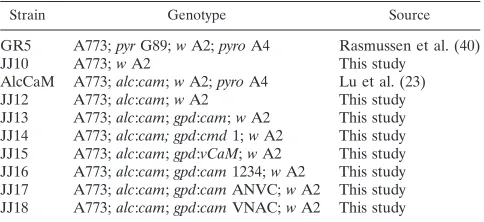
Ectopic CaM expression inA. nidulans.A. nidulansstrains used in this study are listed in Table 1. The AlcCaM strain ofA. nidulanswas transformed with the CaM expression vectors by either electroporation (41) or conventional polyeth-ylene glycol-mediated transformation (22). The control strains were generated by transforming the GR5 strain with pAL5 and pSXG vectors and the AlcCaM strain with pSXG. Positive transformants were screened for ectopic CaM protein expression. Extracts were generated from spores germinated for 15 h in MMG. Following filtration, the mycelia were frozen in liquid N2. The frozen mycelia were ground in a cold mortar and pestle in protein extraction buffer (50 mM Tris [pH 7.5], 5 mM EDTA, 10 mM benzamidine, 1g of pepstatin A/ml, 1g of leupeptin/ml and 1g of aprotinin/ml). The protein extracts were clarified by
Davis) and a monoclonal anti-CaM antibody (UBI, Lake Placid, N.Y.), respec-tively. The relative expression levels of the chimeric CaMs were determined by direct comparison to the AnCaM expressing strain by Western analysis using a monoclonal 12CA5 anti-HA antibody.
A. nidulansgrowth.The ability of the ectopically expressed CaMs to function-ally complement the absence of wild-type CaM was determined by a colony diameter assay as described by McGoldrick et al. (24). Briefly, the spores were diluted and plated on either MMG or MMD agar plates at a concentration of approximately four spores per plate. The average colony diameter was measured every 24 h for 5 days.
Calmodulin overlay.CaM overlay was performed using protein A-CaM fusion proteins as described by Stirling et al. (43). The protein A-CaM fusion proteins were generated in a multistep process. First, pALP1 (gift of M. Stark) was digested withEcoRI, blunted, and digested withBamHI. A HA-taggedA. nidu-lansCaM cDNA PCR product was subcloned as a bluntedAflIII/BamHI frag-ment, generating pALP-AnCaM. To place the chicken CaM and the four-Ca2⫹
-binding-site mutant CaM into the pALP1 vector as HA-tagged protein A CaM fusion proteins, the cDNAs were first shuttled into the bluntedEcoRI/BamHI sites of the original pALP1 plasmid asPvuII/BamHI fragments from the pSXG-based expression plasmids described above. Finally, the cDNAs were inter-changed with the AnCaM cDNA in pALP-AnCaM asNcoI/BamHI fragments, thereby creating pALP-VCaM and pALP-1234. TheS. cerevisiaeCaM-protein A fusion protein was expressed using pDS100 that was kindly provided by M. Stark (43). The fusion proteins were expressed constitutively in BL-21 bacteria and purified on phenyl-Sepharose resin (38). The concentration of the CaM fusion protein used in the overlay medium was 175 nM (6g/ml).
CaM kinase purification and assays.The CaM concentrations required for half-maximal kinase activation (KCaM) of both CMKA and CMKB were deter-mined using bacterially expressed hexa-histidine-tagged protein kinases and bac-terially expressed CaM. Both CMKA and CMKB were subcloned into pTrcHisB (Invitrogen, Carlsbad, Calif.) independently, CMKA as aSacI/EcoRI fragment and CMKB as aBamHI/EcoRI fragment. The kinases were expressed and purified as described by Joseph and Means (20). Kinase assays were performed in 30-l reaction mixtures in a buffer containing 50 mM Tris (pH 7.5), 10 mM MgCl2, 1 mM CaCl2, 1 mM dithiothreitol, 0.1% Tween 20, 200M ATP, 0.2l of [␥-32P]ATP/reaction, and a 200M concentration of the peptide substrate ADR1G (LKKLTRRASFSGQ) (8). CaM was added to reactions at various concentrations up to 1M, and the reactions were initiated with the addition of either 200 or 400 ng of CMKB and incubated at 30°C for either 5 or 10 min for CMKA and CMKB, respectively. The reactions were terminated by transferring 20l of the reaction mixture onto p81 phosphocellulose filters (Millipore, Bed-ford, Mass.), followed by extensive washing in 75 mM phosphoric acid (9). The specific activity was determined following liquid scintillation counting of the dried filters.
RESULTS
Vertebrate CaM is unable to fully activate CMKA and
CMKB.We first compared the abilities of A. nidulans CaM
(AnCaM), S. cerevisiae CaM (ScCaM), vertebrate CaM (VCaM), and a Ca2⫹ binding mutant of A. nidulans CaM
(1234) to interact withA. nidulansCaM binding proteins in an overlay assay. AnCaM is highly homologous with VCaM and ScCaM, sharing 84 and 60% amino acid identity, respectively (Fig. 1). Although the sequence is highly conserved, the abil-ities of these CaMs to bind proteins from crudeA. nidulans
extracts vary remarkably. AnCaM and VCaM bind similar spectra of proteins by CaM overlay, including two abundant and essential Ca2⫹/CaM-dependent enzymes, CNA and JJ17 A773;alc:cam;gpd:camANVC;wA2 This study
JJ18 A773;alc:cam;gpd:camVNAC;wA2 This study
on September 8, 2020 by guest
http://ec.asm.org/
CMKA (Fig. 2). In contrast, ScCaM binds few, if any, proteins and displays a pattern similar to that of the Ca2⫹ binding
mutant of AnCaM (1234), in which the Glu residue at position 12 of each EF hand is mutated to Ala (Fig. 1). Ye and Bretscher (46) used a similar overlay assay to show that S. cerevisiae CaM also fails to bind the CaM binding proteins present in bovine brain.
To further investigate the differential functions of these het-erologous CaM proteins, we tested their ability to activate two essential CaMKs present inA. nidulans, CMKA and CMKB (Fig. 3 and Table 2). Consistent with the CaM overlay, neither ScCaM nor 1234 is able to appreciably activate these kinases under the assay conditions. However, VCaM is unable to fully activate these kinases despite its similarly to AnCaM in the CaM overlay assay. The most profound difference between
FIG. 1. Alignment ofA. nidulansCaM with vertebrate andS. cerevisiaeCaMs. TheA. nidulans(40) (J05545), vertebrate (M36167), andS. cerevisiae(6) (P06787) CaM sequences were aligned using FASTA and shaded by BOXSHADE. Asterisks indicate the Glu residues mutated to Ala to generate the Ca2⫹-binding mutant CaM. The junction of theA. nidulans/vertebrate chimeric CaMs lies between the amino acids marked
with pluses.
FIG. 2. Identification ofA. nidulansCaM binding proteins by over-lay assay.A. nidulanscrude protein extract was separated by polyacryl-amide gel electrophoresis, transferred to an Immobilon-P membrane, and probed with eitherA. nidulansCaM, vertebrate CaM, S. cerevisiae CaM, or the Ca2⫹binding mutant CaM-protein A fusion protein. The
blots are identical exposures of 100g of crude protein extract probed in the presence of Ca2⫹as described in Materials and Methods.
FIG. 3. Activation of CMKA and CMKB byA. nidulansand het-erologous CaMs. The specific activity of hexa-histidine-tagged bacte-rially expressed and purified CMKA (A) and CMKB (B) was measured at different concentrations of purified AnCaM (closed square), VCaM (closed circle), ScCaM (closed triangle), or 1234 (closed diamond) CaM as described in Materials and Methods. The graphs are repre-sentative of three independent experiments.
on September 8, 2020 by guest
http://ec.asm.org/
VCaM and AnCaM is that VCaM exhibits an eightfold in-crease inKCaMfor CMKA. Additionally, theVmaxof VCaM is reduced to about one-half for CMKA and one-third for CMKB. Therefore, the qualitative results of the CaM overlay are not predictive of the ability of VCaM to activate CMKA and CMKB.
Activation ofA. nidulansCaMKs correlates with the ability
of heterologous CaMs to support fungal growth.To evaluate
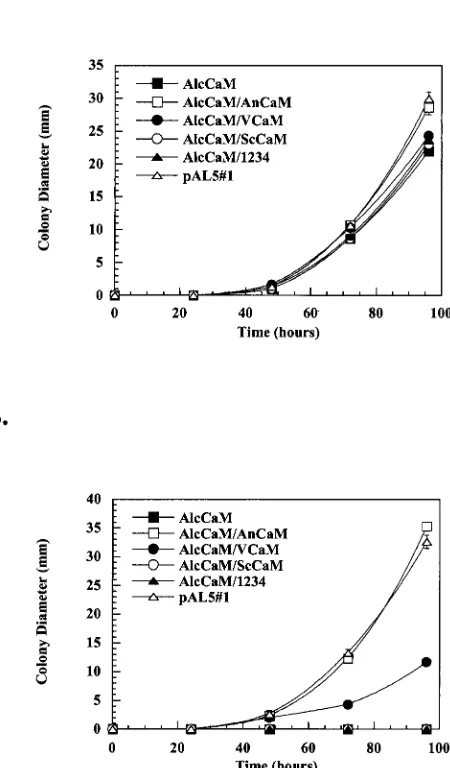
the abilities of heterologous CaMs or the AnCaM 1234 mutant to complement the loss of endogenous CaM inA. nidulans, we ectopically expressed different CaM proteins under the control of the constitutive gpdA promoter in the background of the AlcCaM strain. In the AlcCaM strain, the expression of the essential CaM gene is regulated by carbon source. In glucose, expression is repressed and the fungus fails to grow. In glyc-erol, expression is low and the fungus is able to maintain growth (23). Multiple strains expressing the heterologous CaMs were generated, and the expression levels were exam-ined by quantitative Western analysis or radioimmunoassay (Table 3). In glucose, the VCaM and ScCaM expression is similar to the levels of endogenous CaM in the parental GR5 strain, and all these values are similar to previously reported CaM concentrations (40, 23), while the Ca2⫹binding mutant
(1234) is expressed at a concentration about seven times higher than that of endogenous CaM.
Next, we wanted to determine how well the ability of CaM to activate CMKA and CMKB correlated with its ability to sup-port growth in the absence of endogenous CaM. As seen in Fig. 4A, all strains grew at a rate similar to that of the control when germinated on glycerol medium (allowing wild-type CaM
expression). When wild-type CaM expression was repressed by the presence of glucose, as demonstrated in Fig. 4B, the An-CaM/AlcCaM strain and the control strain grew at comparable rates, while the nutritionally complemented AlcCaM strain without any heterologous CaM failed to grow. Importantly, neither AlcCaM/ScCaM nor AlcCaM/1234 grows in the ab-sence ofA. nidulansCaM. Thus, ScCaM and 1234 are essen-tially inactive in biochemical assays in vitro (CaM overlay and CaMK activation), and those results correlate with their inabil-ity to support growth in vivo.
We also evaluated whether VCaM could functionally com-plement the absence of the endogenousA. nidulansCaM. In glucose, AlcCaM/VCaM grows at a rate approximately one-FIG. 4. Complementation ofA. nidulans by heterologous CaMs. AlcCaM strains expressing the ectopically expressed AnCaM (open squares), VCaM (closed circles), ScCaM (open circles), and 1234 (closed triangles) were inoculated onto either MMG (A) or MMD (B) agar plates, and their colony diameters were measured over a period of 5 days. A nutritionally complemented pAL5#1 strain (open triangles) was used to represent wild-typeA. nidulans(positive con-trol), and the nutritionally complemented AlcCaM strain (closed squares) was used as a negative control.
AlcCaM/1234 ND ND 1,418
AlcCaM/ANVC ND ND 276
AlcCaM/VNAC ND ND 489
aCaM concentration determined by RIA.
bCaM concentration determined by quantitative Western analysis. cNA, not applicable.
dND, not determined due to antibody cross-reactivity.
TABLE 3. Activation ofA. nidulansCaM kinases
CaM
CMKA CMKB
KCaM
(nM) (nmol/min/mg)Vmax K(nM)CaM (nmol/min/mg)Vmax
AnCaM 1.9⫾0.9 77.0⫾1.6 88.6⫾24.7 14.1⫾2.2 VCaM 15.9⫾7.1 33.2⫾3.2 133.1⫾34.7 4.3⫾0.4
ScCaM 37.8⫾8.5 9.4⫾2.8 ND ND
1234 NDa ND ND ND
ANVC 2.1⫾0.4 50.5⫾9.5 94.3⫾18.1 11.6⫾3.2 VNAC 7.7⫾0.6 56.1⫾3.8 102.9⫾16.3 10.3⫾2.6
aND, no detectable activity
on September 8, 2020 by guest
http://ec.asm.org/
third that of both AlcCaM/AnCaM and the nutritionally com-plemented control. Thus, VCaM partially performs the essen-tial functions of wild-type CaM in vivo, a result that is consistent with its ability to partially activate theA. nidulans
CaMKs in vitro.
The N terminus of CaM is critical for proper activation of
CMKA and CMKB.Since VCaM cannot fully complementA.
nidulans CaM despite sharing 84% amino acid identity, we questioned whether the amino acid differences responsible could be localized to the N- or C-terminal lobe of the protein. The C terminus is more divergent between these species, so we predicted that it would be most important in determining func-tional differences in vitro and in vivo. We created two chimeric CaM cDNAs in which the N- and C-terminal globular domains of theA. nidulansand vertebrate CaM are interchanged. The junction of the proteins (Fig. 1) is following Asn 61, so the chimeras generated are theAspergillusN terminus-vertebrate C terminus (ANVC) or theAspergillusC terminus-vertebrate N terminus (VNAC) proteins. First, we tested the activation of CMKA and CMKB by ANVC and VNAC (Table 3). Notably, theKCaMfor CMKA using ANVC is similar to that obtained with AnCaM rather than to that obtained with VCaM. In contrast, theKCaMusing VNAC falls between the values ob-tained with AnCaM and VCaM. Both chimeric CaMs demon-strate intermediate effects onVmax for CMKA. Interestingly, the chimeras display only subtle differences in ability to acti-vate CMKB and are most similar to AnCaM. These biochem-ical assays support two conclusions: first, the activation of CMKA is more sensitive to differences in the CaM sequence than that of CMKB, and second, amino acid variations in the N terminus, not the C terminus, of VCaM are the most im-portant in determining theKCaMfor activation of CMKA.
Both the N and C termini of AnCaM are required for
nor-mal growth. If the activation parameters of CMKA in vitro
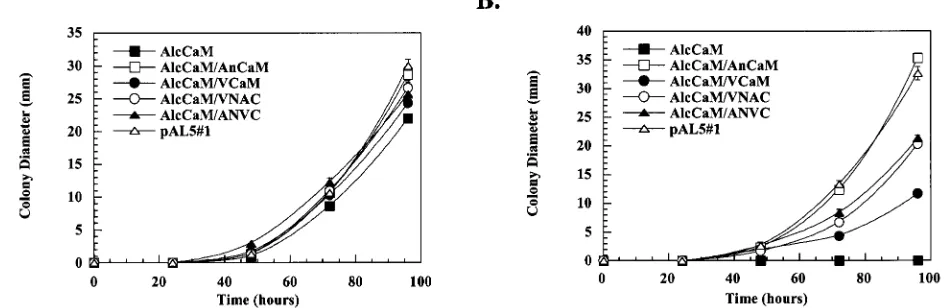
correlate with the ability to support growth in vivo, then ANVC would be better able to support the growth of the fungus than VNAC in the absence of endogenous CaM. To test this, the cDNAs were expressed in the AlcCaM strain, and their ability
to support growth was compared to that of AnCaM and VCaM. When germinated in glycerol, all of the strains grew at approximately the same rate (Fig. 5A). However, when germi-nated in glucose, which represses expression of the endoge-nous CaM, the strains containing the chimeric proteins at two to four times the level of endogenous CaM (Table 2) grew to an intermediate diameter two-thirds that of the wild type but significantly greater than that of AlcCaM/VCaM (Fig. 5B). Thus, even though ANVC and VNAC demonstrate differences in biochemical properties in vitro, these two chimeric proteins behave similarly in vivo and neither can completely comple-ment the absence of endogenous CaM.
DISCUSSION
In this study, we investigated the ability of the Ca2⫹binding
mutant of AnCaM (1234) and heterologous CaMs from yeast and vertebrate systems to complement the functions of An-CaM biochemically and genetically. As predicted based on the identification of multiple and essential Ca2⫹/CaM-dependent
enzymes inA. nidulans, 1234 is unable to activate CMKA or CMKB and cannot support growth of the fungus. Therefore, as withS. pombe(30) and in contrast toS. cerevisiae(13), CaM of
A. nidulans requires high-affinity Ca2⫹ binding to support
growth. Similar to 1234, ScCaM was unable to activate CMKA and CMKB or functionally complement the absence of the endogenous protein. This inability of ScCaM to complement AnCaM may be due to the significant amino acid alterations that occur throughout the two proteins, the inability of the fourth EF hand to bind Ca2⫹, or a combination of both types
of differences.
Despite sharing 84% amino acid identity with AnCaM, VCaM is unable to fully substitute for AnCaM in vitro or in vivo. Although the CaM overlays showed that AnCaM and VCaM interact with similar spectra of proteins present inA. nidulanscrude extracts, VCaM cannot maximally activate ei-ther of A. nidulans’ essential Ca2⫹/CaM-dependent protein
kinases, CMKA and CMKB. For both enzymes, the Vmax is FIG. 5. Complementation ofA. nidulansbyA. nidulans/vertebrate chimeric CaMs. The AlcCaM strains expressing AnCaM (open squares), VCaM (closed circles), VNAC (open circles) and ANVC (closed triangles) were grown on either MMG (A) or MMD (B) agar plates, and growth was quantified by measuring colony diameter over a period of 5 days. The nutritionally complemented pAL5#1 strain (open triangles) was used to represent the wild-typeA. nidulans(positive control), and the nutritionally complemented AlcCaM strain (closed squares) was used as a negative control.
on September 8, 2020 by guest
http://ec.asm.org/
contacts between vertebrate Ca /CaM- and CaM binding peptides based on available three-dimensional X-ray crystal and nuclear magnetic resonance structures reveals that only five of the variant residues interact with CaM binding peptides (10, 19, 25, 26, 35), whereas the other 19 residues lie outside of the CaM/CaM binding peptide interfaces. Although the resi-dues involved in peptide binding may be implicated in the inability of VCaM to complement AnCaM, results of prior biochemical and genetic studies argue that the solvent-exposed residues of CaM are also critical for enzyme activation. Bio-chemically, both AnCaM/VCaM chimeras are able to rescue the ability of VCaM to activate CMKB. However, the results with CMKA are markedly different. For CMKA the amino acid variation in the N-terminal globular domain is largely responsible for the inability of VCaM to fully activate the kinase. TheKCaMfor ANVC is similar to that of AnCaM, while the KCaM for VNAC is much greater than that of AnCaM. Within the N-terminal domain of AnCaM and VCaM there are only nine amino acid differences. Intriguingly, amino acids 9 to 12, just prior to the first EF hand, differ in three out of four residues. For AnCaM these residues are VSEY, but for VCaM (as well as for ScCaM and the CaMs of several other lower eukaryotes) these residues are IAEF. Both Ala10 and Phe12 interact with CaM binding peptides in crystallographic studies, and mutation of Phe12 to Ala reduces the ability of ScCaM to activate bothS. cerevisiaecalcineurin and Cmk1p (16). Based on these results, it seems reasonable to suggest that this four-amino-acid cluster may be functionally important. Another difference of potential significance lies at the fourth residue of the second EF hand, Asn in AnCaM and Gly in most other CaMs. Genetic studies ofParameciumidentified a mutation at this position (Gly59 to Ser) that abrogates the function of Ca2⫹-dependent Na⫹channels in vivo (21). Interestingly, the
Gly-to-Asn variation is also found in the fourth position of the third EF hand in AnCaM. Although these amino acid differ-ences can be speculated to result in biochemical and/or bio-logical consequences, the actual residue or residues responsi-ble for the functional differences cannot be conclusively identified based solely on sequence or structural analysis, since variation in residues within the hydrophobic pockets, on the outer surface of the CaM molecule, or in internally located residues that contribute to stabilizing the structure of the mol-ecule are all potential culprits.
Amino acid substitutions in both globular domains of CaM contribute to the inability of VCaM to fully support growth. Surprisingly, both ANVC and VNAC support A. nidulans
growth to roughly the same degree, better than VCaM but not as well as AnCaM, even though the biochemical deficits of VCaM can be largely attributed to the N-terminal globular domain. Although the activation of CMKA and CMKB corre-lates with the ability of ScCaM, VCaM, and 1234 to support
biochemical and in vivo analyses of CaM Phe-to-Ala mutants demonstrate that mutations that subtly attenuate calcineurin and CaMK activation in vitro do not appreciably alter the ability of yeast to survive an ␣-factor-induced growth arrest (16).
Perhaps it should come as no surprise that while the in vitro activation of CMKA and CMKB may correlate with the ability of the heterologous proteins to support growth, the in vivo target(s) involved in causing the phenotypes may be consider-ably more complex. For example, two essential CaM binding proteins in addition to CMKA and CMKB have been identified in A. nidulans. The Ca2⫹/CaM-dependent phosphatase,
cal-cineurin, and MyoA, a class I myosin, are each required for fungal growth (39, 24). Additionally, a recently identified ho-mologue ofS. cerevisiaeSpc110p andS. pombePcp1p would be predicted to perform an essential mitotic role inA. nidulans
based on the null phenotype in yeast (10a). Therefore, alter-ations in CaM binding or activation of at least five CaM bind-ing proteins may be contributbind-ing to the inability of the heter-ologous proteins to functionally replace the endogenous A. nidulansCaM. It will be an interesting challenge to dissect the multiple, essential functions of Ca2⫹/CaM-dependent and
-in-dependent pathways in the growth of this fungus.
ACKNOWLEDGMENTS
We thank Christina Kahl, Katharine Winkler, Ethan Corcoran, and David Chin for valuable discussions and critical reading of the manu-script. We also thank Michael Stark for the protein A-CaM expression vectors, Trisha Davis for theS. cerevisiaeCaM cDNA and antibody, and A. M. J. J. Van Den Hondel for theA. nidulansvectors.
National Institutes of Health grant GM-33976 awarded to A.R.M. funded this study.
REFERENCES
1.Breuder, T., C. S. Hemenway, N. R. Movva, M. E. Cardenas, and J. Heitman.
1994. Calcineurin is essential in cyclosporin A- and FK506-sensitive yeast strains. Proc. Natl. Acad. Sci. USA91:5372–5376.
2.Chin, D., and A. R. Means.2000. Calmodulin: a prototypical calcium sensor. Trends Cell Biol.10:322–328.
3.Cyert, M. S., R. Kunisawa, and J. Thorner. 1991. Yeast has homologs (CNA1 and CNA2) of mammalian calcineurin, a calmodulin-regulated phos-phoprotein phosphatase. Proc. Natl. Acad. Sci. USA88:7376–7380. 4.Cyert, M. S., and J. Thorner.1992. Regulatory subunit (CNB1 gene product)
of yeast Ca2⫹/calmodulin-dependent phosphoprotein phosphatases is
re-quired for adaptation to pheromone. Mol. Cell. Biol.12:3460–3469. 5.Davis, T. N., and J. Thorner.1989. Vertebrate and yeast calmodulin, despite
significant sequence divergence, are functionally interchangeable. Proc. Natl. Acad. Sci. USA86:7909–7913.
6.Davis, T. N., M. S. Urdea, F. R. Masiarz, and J. Thorner.1986. Isolation of the yeast calmodulin gene: calmodulin is an essential protein. Cell47:423– 431.
7.Dayton, J. S., and A. R. Means.1996. Ca(2⫹)/calmodulin-dependent kinase is essential for both growth and nuclear division inAspergillus nidulans. Mol. Biol. Cell7:1511–1519.
8.Denis, C. L., S. C. Fontaine, D. Chase, B. E. Kemp, and L. T. Bemis.1992. ADR1c mutations enhance the ability of ADR1 to activate transcription by a mechanism that is independent of effects on cyclic AMP-dependent protein kinase phosphorylation of Ser-230. Mol. Cell. Biol.12:1507–1514.
on September 8, 2020 by guest
http://ec.asm.org/
9.DeRemer, M. F., R. J. Saeli, D. L. Brautigan, and A. M. Edelman.1992. Ca(2⫹)-calmodulin-dependent protein kinases Ia and Ib from rat brain. II. Enzymatic characteristics and regulation of activities by phosphorylation and dephosphorylation. J. Biol. Chem.267:13466–13471.
10.Elshorst, B., M. Hennig, H. Forsterling, A. Diener, M. Maurer, P. Schulte, H. Schwalbe, C. Griesinger, J. Krebs, H. Schmid, T. Vorherr, and E. Car-afoli.1999. NMR solution structure of a complex calmodulin with a binding peptide of the Ca2⫹pump. Biochemistry38:12320–12332.
10a.Flory, M. R., M. Morphew, J. D. Joseph, A. R. Means, and T. N. Davis.
Pcp1p, an Spc110p-related calmodulin target at the centrosome of the fission yeastSchizosaccharomyces pombe. Cell Growth Differ., in press.
11.Fox, D. S., M. C. Cruz, R. A. Sia, H. Ke, G. M. Cox, M. E. Cardenas, and J. Heitman.2001. Calcineurin regulatory subunit is essential for virulence and mediates interactions with FKBP12-FK506 inCryptococcus neoformans. Mol. Microbiol.39:835–849.
12.Garrett-Engele, P., B. Moilanen, and M. S. Cyert.1995. Calcineurin, the Ca2⫹/calmodulin-dependent protein phosphatase, is essential in yeast
mu-tants with cell integrity defects and in mumu-tants that lack a functional vacuolar H(⫹)-ATPase. Mol. Cell. Biol.15:4103–4114.
13.Geiser, J. R., D. van Tuinen, S. E. Brockerhoff, M. M. Neff, and T. N. Davis.
1991. Can calmodulin function without binding calcium? Cell65:949–959. 14.Heiman, R. G., R. C. Atkinson, B. F. Andruss, C. Bolduc, G. E. Kovalick, and
K. Beckingham.1996. Spontaneous avoidance behavior inDrosophilianull for calmodulin expression. Proc. Natl. Acad. Sci. USA93:2420–2425. 15.Hemenway, C. S., K. Dolinski, M. E. Cardenas, M. A. Hiller, E. W. Jones,
and J. Heitman.1995. vph6 mutants ofSaccharomyces cerevisiaerequire calcineurin for growth and are defective in vacuolar H(⫹)-ATPase assembly. Genetics141:833–844.
16.Hiroyuki, O., M. S. Cyert, and Y. Ohya.1998. Importance of phenylalanine residues of yeast calmodulin for target binding and activation. J. Biol. Chem.
273:26375–26382.
17.Hook, S. S., and A. R. Means.2001. Ca(2⫹)/CaM-dependent kinases: from activation to function. Annu. Rev. Pharmacol. Toxicol.41:471–505. 18.Iida, H., Y. Ohya, and Y. Anraku. 1995. Calmodulin-dependent protein
kinase II and calmodulin are required for induced thermotolerance in Sac-charomyces cerevisiae. Curr. Genet.27:190–193.
19.Ikura, M., M. Clore, A. M. Gronenborn, G. Zhu, C. B. Klee, and A. Bax.
1992. Solution structure of a calmodulin-target peptide complex by multidi-mensional NMR. Science256:632–638.
20.Joseph, J. D., and A. R. Means.2000. Identification and characterization of two Ca2⫹/CaM-dependent protein kinases required for normal nuclear di-vision inAspergillus nidulans. J. Biol. Chem.275:38230–38238.
21.Ling, K., M. E. Maley, R. R. Preston, Y. Saimi, and C. Kung.1994. New non-lethal calmodulin mutations inParamecium. Eur. J. Biochem.222:433– 439.
22.Lu, K. P., and A. R. Means.1993. Conditional mutants for studying functions of calmodulin inAspergillus nidulans. Methods Mol. Genet.2:255–275. 23.Lu, K. P., C. D. Rasmussen, G. S. May, and A. R. Means.1992. Cooperative
regulation of cell proliferation by calcium and calmodulin inAspergillus nidulans. Mol. Endocrinol.6:365–374.
24.McGoldrick, C. S., C. Gruver, and G. S. May.1995. myoA ofAspergillus nidulansencodes an essential myosin I required for secretion and polarized growth. J. Cell Biol.128:577–587.
25.Meador, W. E., A. R. Means, and F. A. Quiocho.1993. Modulation of calmodulin plasticity in molecular recognition on the basis of X-ray struc-tures. Science262:1718–1721.
26.Meador, W. E., A. R. Means, and F. A. Quiocho.1992. Target enzyme recognition by calmodulin: 2.4 A structure of a calmodulin-peptide complex. Science257:1251–1255.
27.Means, A. R., C. R. Kahl, D. G. Crenshaw, and J. S. Dayton.1999. Traversing the cell cycle: the calcium/calmodulin connection, p. 512–528.InE. Carafoli and C. Klee (ed.), Calcium as a cellular regulator. Oxford University Press, New York, N.Y.
28.Mendoza, I., F. Rubio, A. Rodriguez-Navarro, and J. M. Pardo.1994. The protein phosphatase calcineurin is essential for NaCl tolerance of Saccha-romyces cerevisiae. J. Biol. Chem.269:8792–8796.
29.Moser, M. J., J. R. Geiser, and T. N. Davis.1996. Ca2⫹-calmodulin promotes
survival of pheromone-induced growth arrest by activation of calcineurin and Ca2⫹-calmodulin-dependent protein kinase. Mol. Cell. Biol.16:4824–4831.
30.Moser, M. J., S. Y. Lee, R. E. Klevit, and T. N. Davis.1995. Ca2⫹binding to calmodulin and its role inSchizosaccharomyces pombeas revealed by mutagenesis and NMR spectroscopy. J. Biol. Chem.270:20643–20652. 31.Nakamura, T., Y. Liu, D. Hirata, H. Namba, S. Harada, T. Hirokawa, and T.
Miyakawa. 1993. Protein phosphatase type 2B (calcineurin)-mediated, FK506-sensitive regulation of intracellular ions in yeast is an important determinant for adaptation to high salt stress conditions. EMBO J.11:4063– 4071.
32.Nanthakumar, N. N., J. S. Dayton, and A. R. Means.1996. Role of Ca⫹⫹/ calmodulin binding proteins in Aspergillus nidulanscell cycle regulation. Prog. Cell Cycle Res.2:217–228.
33.Odom, A., S. Muir, E. Lim, D. L. Toffaletti, J. Perfect, and J. Heitman.1997. Calcineurin is required for virulence ofCryptococcus neoformans. EMBO J.
16:2576–2589.
34.Ohya, Y., and Y. Anraku.1989. Functional expression of chicken calmodulin in yeast. Biochem. Biophys. Res. Commun.158:541–547.
35.Osawa, M., H. Tokumitsu, M. B. Swindells, H. Kurihara, M. Orita, T. Shibanuma, T. Furuya, and M. Ikura.1999. A novel target recognition revealed by calmodulin in complex with Ca2⫹-calmodulin-dependent kinase kinase. Nat. Struct. Biol.6:819–824.
36.Punt, P. J., and A. M. J. J. Van Den Hondel.1992. Transformation of filamentous fungi based on hygromycin B and phleomycin resistance mark-ers. Methods Enzymol.216:447–457.
37.Putkey, J. A., T. Ono, M. F. A. VanBerkum, and A. R. Means.1988. Func-tional significance of the central helix in calmodulin. J. Biol. Chem.263:
11242–11249.
38.Putkey, J. A., G. R. Slaughter, and A. R. Means.1988. Genetically engi-neered calmodulins differentially activate target enzymes. J. Biol. Chem.
260:9896–9903.
39.Rasmussen, C., C. Garen, S. Brining, R. L. Kincaid, R. L. Means, and A. R. Means.1994. The calmodulin-dependent protein phosphatase catalytic sub-unit (calcineurin A) is an essential gene inAspergillus nidulans. EMBO J.
13:3917–3924.
40.Rasmussen, C. D., R. L. Means, K. P. Lu, G. S. May, and A. R. Means.1990. Characterization and expression of the unique calmodulin gene ofAspergillus nidulans. J. Biol. Chem.265:13767–13775.
41.Sanchez, O., and J. Aguirre.1996. Efficient transformation ofAspergillus nidulansby electroporation of germinated conidia. Fungal Genet. Newsl.
43:48–51.
42.Sarkar, G., and S. S. Sommer.1990. The ⬘megaprimer’ method of site-directed mutagenesis. BioTechniques8:404–407.
43.Stirling, D. A., A. Petrie, D. J. Pulford, D. T. Paterson, and M. J. Stark.1992. Protein A-calmodulin fusions: a novel approach for investigating calmodulin function in yeast. Mol. Microbiol.6:703–713.
44.Takeda, T., and M. Yamamoto.1987. Analysis and in vivo disruption of the gene encoding calmodulin inSchizosaccharomyces pombe. Proc. Natl. Acad. Sci. USA84:3580–3584.
45.Withee, J. L., J. Mulholland, R. Jeng, and M. S. Cyert.1997. An essential role of the yeast pheromone-induced Ca2⫹signal is to activate calcineurin. Mol. Biol. Cell8:263–277.
46.Ye, R. R., and A. Bretscher.1992. Identification and molecular character-ization of the calmodulin-binding subunit gene (CMP1) of protein phospha-tase 2B from Saccharomyces cerevisiae. An alpha-factor inducible gene. Eur. J. Biochem.204:713–723.
47.Yoshida, T., T. Toda, and M. Yanagida.1994. A calcineurin-like gene ppb1⫹
in fission yeast: mutant defects in cytokinesis, cell polarity, mating and spindle pole body positioning. J. Cell Sci.107:1725–1735.