Iran J Public Health, Vol. 45, No.10, Oct 2016, pp.1300-1308
Original Article
Framework for Establishment of a Comprehensive and
Standardized Administration System for Prevention and Control
of Tuberculosis in College Student Community in China
*Shaoru ZHANG
1, Xiaohong LI
2, Tianhua ZHANG
3, Xiangni WANG
1, Weiping LIU
3,
Xuexue MA
1, Yuelu LI
1, Yahui FAN
11. Dept. of Nursing, School of Medicine, Xi’an Jiaotong University, Xi'an, China 2. Dept. of Nursing, Xi'an Medical University, Xi'an, China
3. Shaanxi Provincial Institute for TB Control and Prevention, Xi'an, China
*Corresponding Author: Email: [email protected]
(Received 07 Dec 2015; accepted 11 Mar 2016)
Introduction
Tuberculosis (TB) is distributed widely in the world. As many as 9 million cases of the active TB were estimated in 2013. Among which, 1.5 million cases died of this disease (1, 2). The TB cases in 22 countries with high TB burden ac-counted for 82% of the total TB cases in the world. TB is still one of the most important fatal diseases that poses the serious threat to the pub-lic health and thus, has become one of the
impor-is one of the 22 countries with high TB burden. There are over 500 million people infected with M. tuberculosis in China. The TB cases account for approximately 25% of the total TB cases in the world, making TB cases in China the second place in the world (5, 6). TB cases in China are still increasing in the rate of 60.76/100,000. Thus, TB epidemic in China is extremely serious (7). Among all the communities in society, the college Abstract
Background: College student community is the one with high risk of tuberculosis (TB). A systemic and standardized administration model for prevention and control of TB is significance in controlling TB spread in universities. Cur-rently, the universities in China have not established the comprehensive and standardized administration system for TB prevention and control in college student community.
Methods: Firstly, the literature research and brainstorming method (n=13) were used to construct the clause and sub-clause pool for the administration of TB prevention and control within college student communityin 2014. Secondly, a total of twenty experts in the field of TB prevention and control who are representatives of the east, west, south and north parts of China were selected and invited to participate the Delphi inquiry. After two rounds of letter-inquiry, the opinions of the experts reached a consensus and the framework for the administration system was con-structed.
Results: A framework for the administration system was constructed, which included 8 first class indexes, 26 second class indexes and 104 third class indexes.
Conclusion: The results are highly scientific and reliable, which can be helpful for improving the systemic and stan-dardized levels for the administration of TB prevention and control in universities in China and perhaps in other de-veloping counties with high TB burden as well.
high TB risk. In China, because during the last two decades, almost all the universities have ra-pidly expanded their enrollment scales and the numbers of enrolled students in campus have been dramatically increased. Almost all the stu-dents from freshmen to senior grades in universi-ties are living in the student dormitories. They live in dormitory rooms with high residential density where they contact each other more closely and frequently. Furthermore, the mobility of student population is very high. All these fea-tures make college student community become the one with high TB risk. In abroad, the TB rates among the college students in other coun-tries, especially in the developing councoun-tries, are also high. For instance, a more recent study re-ported that among 10,036 college students in Northwest Ethiopia investigated, 36 students had TB. The TB rate among college students in Ethi-opia was increased from 297.6/100000 in 2009 to 404/100000 in 2011(8). Thus, great attention should be given to the global public health issue for college students as the potentially high TB risk.
Strengthening the administration system of TB prevention and control among college students is essential to reduce TB incidence in universities. In dealing with the problems existing in the ad-ministration system of TB prevention and con-trol in universities, the investigators in both Chi-na and other countries have conducted some stu-dies. Certain progresses have been made in the aspects of TB prevention and control (9-11), ear-ly detection of TB patients (12-14), TB detection and warning (15-17) and health promotion (18-20). However, the current studies are mainly con-fined to analyze or resolve the problems in cer-tain aspects. TB prevention and control among college students in China are guided mainly by the China’s Working Guidelines to the Imple-ment of Prevention and TreatImple-ment of Tuberculo-sis (designated as “Guidelines” here) (21), but the Guidelines is the programmatic documents that guide the administrative work on the TB preven-tion and control in China in general and have a wide range of application. In term of the
particu-lar community, the “Guidelines” can only pro-vide the frame guide but cannot take the actual difficulties in the work of TB prevention and control for college students into full considera-tion. For effective administration of TB preven-tion and control among college students in Chi-na, it is essential to construct a comprehensive and high efficient system used to standardize and guide TB prevention and control among college students in China. Therefore, this project group applied the funding for the research project “Construction of GIS-based administration sys-tem for prevention and control of tuberculosis in college students in universities in China and its application” from China’s National Science Foundation, used “Guidelines” as the general guide, absorbed and referred the related expe-riences to construct an administrative system and
achieved the standardization and
informationization for the administration of TB prevention and control in college students in uni-versities.
Methods
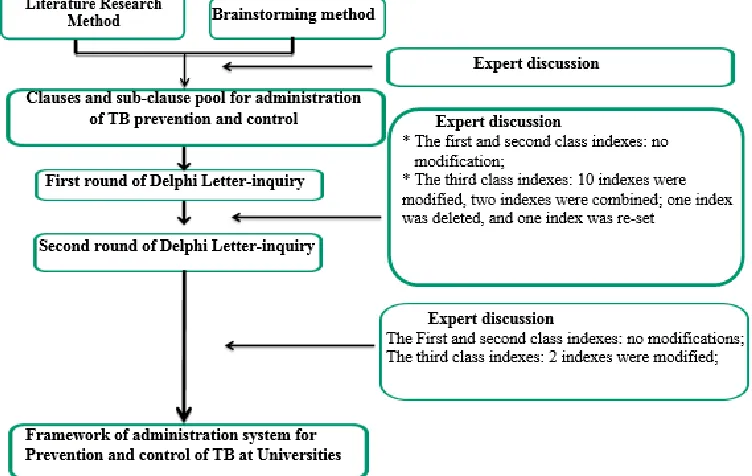
The literature search method, the brainstorming method and the Delphi method were used in this study. The whole technical flow chart is shown in Fig.1.
Literature Search and Brainstorming Meet-ing
Fig. 1: Technical flow chart
The brainstorming meeting was used to find a conclusion for administration of TB prevention and control among college students. Thirteen experts were selected from Shaanxi Province for brainstorming meeting. Among them, seven members were the personnel from the adminis-tration departments for TB prevention and con-trol at the provincial, prefecture city, and county levels. Four members were the personnel in charge of TB prevention and control at university hospitals. One member was the expert of clinical TB diagnosis and one member was the research expert in administration system of TB prevention and control in university campus. In Jun 2014, a brainstorming meeting with focus on “construction of clause and sub-clause pool for the administration system
for TB prevention and control in university campus” was
held in Xi'an City, Shaanxi Province. In this meeting, an initial clause and sub-clause pool for the administration system for TB prevention and control in university campus was formulated. The initial clause and sub-clause pool formulated by using literature research method and brains-torming methods, respectively, were combined
pool for the administration system for TB pre-vention and control. Finally, five expert mem-bers, including 4 from the TB prevention and control at the provincial and prefecture levels and one research expert in TB prevention and control in university campus, were selected and formed an expert group. This group discussed the forma-tion of preliminarily framework pool for TB pre-vention and control and the framework of the clause and sub-clause pool consisting of 8 first class indexes, 26 second class indexes and 107 third class indexes for the administration system of TB prevention and control in university cam-pus was constructed.
Delphi method
Selection of Experts
While for the modified Delphi method, there is no the uniform requirement for the number of experts for participating letter-inquiry, it could be appropriate to have 15-50 experts for Delphi let-ter-inquiry (24, 25). Thus, 20 experts were se-lected to participate in the Delphi process by let-ter-inquiry. The results of letter-inquiry have a national coverage, which can be applied national-ly. The experts were selected from the east, west, south and north parts of China. All the experts selected were engaged in the administration in
the agencies for TB prevention and control at national, provincial or municipal levels for at least 5 yr. During the process of selecting experts, we firstly communicated with the expert candidates and gave them the detailed explanation of the research contents and purposes. We decided to select those candidates interested and willing to participate as the experts of letter-inquiry. The basic information about consultant experts is shown in Table 1. The authority coefficient of these experts was 0.88.
Table 1:The basic information about consultant experts
Educational level Number
(%) Title Number (%) Years of work Number (%)
Above undergraduate 7 (35) Physician in-chief 14 (70) <10 9 (45) Undergraduate 11 (55) Associate physician in-chief 3 (15) 10-20 6 (30)
Below undergraduate 2 (10) Investigator 3 (15) >20 5 (250)
Design of questionnaires for Delphi investi-gation
We used the framework of clause and sub-clause pool obtained by applying the literature search, brainstorming meeting and Delphi methods to prepare and design the questionnaires for letter-inquiry and then invited the experts in TB pre-vention and control to evaluate these question-naires and to give their corresponding opinions, rationality and clarity. The questionnaires were modified according to the opinions and sugges-tions provided by these experts, and then, the modified Delphi questionnaires were used as the survey tool for expert letter-inquiry.
The questionnaires for letter-inquiry included four parts: 1) the general information about the experts; 2) explanation of Delphi consultation method with letter-inquiry, introduction into the research contents, research field and instruction for how to complete the investigation question-naires; 3) The expert’s authority; and 4) the judgment of experts on the importance of each clause and sub-clauses, the degree of familiarity with the of the clause and sub-clauses and the basis of their judgment. A column for remarks
was set following each clause and sub-clause so that they were convenient for experts to provide their opinions for revision and modification. The experts were requested to evaluate the im-portance of each index. The imim-portance was di-vided into three classes according to their priori-ty: important, relatively important and not impor-tant. The degree of familiarity of experts with these indexes was divided into three classes ac-cording to priority: familiar with, relatively famili-ar, and not familiar. The basis for expert’s judg-ment on these indexes was routinely divided into four aspects as follows: theoretical analysis, prac-tical experience, literature in Chinese and other languages, and the instinctive judgment. The ex-perts made their judgments based on their own situations.
Implement of Delphi method
The questionnaires were sent to experts and re-trieved from them via email. The duration of let-ter-inquiry was two wk. Before the closing date, the investigators reminded the experts via email. The screening and revision of the clauses and sub-clauses for questionnaires were conducted by using the bounding method. The opinions of ex-perts and the actual work situation were taken into comprehensive consideration. At the end of the first round of the letter-inquiry, statistical analysis was conducted. The questionnaires for the second round of letter-inquiry were designed after discussion. The modified questionnaires were sent to the experts timely. The experts scored again. After statistical analysis and com-prehensive analysis on the opinions provided by the experts, clauses and sub-clauses were revised. When the opinions of experts reached a consen-sus, the letter-inquiry was closed.
Statistical Analysis
The statistical software SPSS 18.0 (Chicago, IL, USA) was used to conduct statistical analysis on the results obtained from the first and the second-rounds of Delphi investigation.
We mainly used the bound value method to screen and evaluate these indexes. The percen-tage of full marks, arithmetic mean and analysis of variance were calculated according to the im-portance score for each index. The method used for calculating bound values of the percentage of full marks and the arithmetic mean was: bound value=mean value –standard deviation. The in-dexes with scores higher than bound value were
selected. The calculation method for bound value of analysis of variance was: bound value=mean value + SD. The indexes with scores lower than bound value were selected. In order to avoid the elimination of the important indexes, only those indexes that did not meet the requirement for the levels of three measurements mentioned above were deleted. For those indexes that did not meet the requirement of the levels of one or two mea-surements, they were either selected or deleted according to the actual situation after discussion.
Results
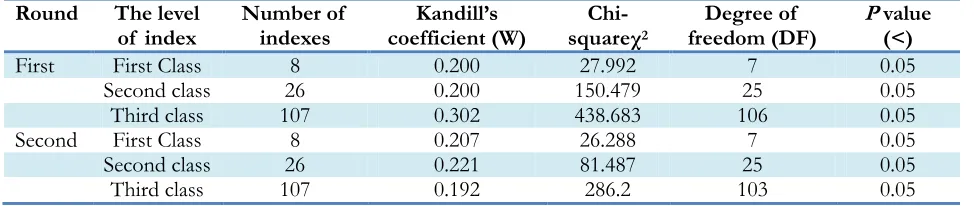
For the Delphi method, the degree of consensus of expert’s opinions was expressed as the mean assignment value for the importance of clause and sub-clauses. The mean scores for the impor-tance of the first, the second and the third class indexes given by experts in the first round were 2.66±0.48, 2.58±0.45 and 2.46±0.57, respective-ly. The mean scores for the importance of the first, the second and the third class indexes given by experts in the second round were 2.73±0.43, 2.67±0.47 and 2.65±0.49, respectively. During the two rounds of letter-inquiry for expert con-sultation, analysis of variance was conducted on the concordance coefficient of expert’s opinions on the importance of the first, the second and the third class indexes. The P values corresponding to χ2 were all <0.05, indicating that the
concor-dance of the expert’s opinions is quite good. The concordance coefficient of expert’s opinions and significant test are listed in Table 2.
Table 2: The concordance coefficient of expert’s opinions and significant test
Round The level
of index Number of indexes coefficient (W) Kandill’s squareχChi- 2
Degree of
freedom (DF) P value (<)
First First Class 8 0.200 27.992 7 0.05
Second class 26 0.200 150.479 25 0.05
Third class 107 0.302 438.683 106 0.05
Second First Class 8 0.207 26.288 7 0.05
Second class 26 0.221 81.487 25 0.05
After closing the Delphi letter-inquiry, we orga-nized a discussion meeting for the experts in the field of TB prevention and control to determine finally the framework for the system. A total of eight participating experts included five person-nel for prevention and control of TB at provin-cial, prefecture-level city and county (district) le-vels, one expert in clinical TB diagnosis, two re-search experts on TB prevention and control in universities. After discussion, all the experts agreed with the research results obtained with Delphi letter-inquiry and they finally confirmed framework for the system consisting of a total of 8 first class indexes, 26 second class indexes and 104 third class indexes. Because the detailed in-dexes table is very bulky and large, the 8 first class indexes and the 26 second class indexes were presented in appendix Table 1.
Discussion
The framework was constructed based on the “Guidelines” by taking the particularity of college student community and the status of the real work into consideration. This framework is an improvement of the existing administrative measures.
In this study, we selected 20 experts with exper-tise in TB prevention and control representative for different parts of China to participate in the letter-inquiry and authority coefficient of these experts was 0.88. A related study indicated that the authority coefficient of these experts of 0.7 or higher was acceptable and when this coefficient was higher than 0.8, the experts had relatively high certainty on the selection of the contents (26). Therefore, the experts selected to participate Delphi letter-inquiry are suitable and the results obtained are reliable. Moreover, other studies reported that the basic requirement for Delphi letter-inquiry is that returning rate of the ques-tionnaires should be at least the 50% and that 60% of returning rate was better and 70% of re-turning rate was very good (27, 28). In this study, the returning rates of questionnaires for both the first and the second-rounds of letter-inquiry were 100%. 60% and 45% of experts provided their
constructive opinions in the first and the second
-rounds of letter-inquiry, respectively, indicating that the consultant experts have a relatively strong support and high activeness toward the establishment of the administrative system for TB prevention and control in universities. The results obtained from application of Delphi me-thod were based on the opinions of a number of experts. Thus, the degree of the concordance of their opinions among different experts is ex-tremely important for the study results. After two rounds of letter-inquiry, the significant tests for the concordance coefficients for various indexes revealed that the mean P values for the corres-ponding indexes were all less than 0.05, indicating that the opinions of these experts tend to be of consistency and that the concordance is quite good. Thus, the results obtained from this study can be recommended.
Advantages and limitations of this study In this study, the framework for the administra-tion system for TB prevenadministra-tion and control among college students by referring the “Guidelines” is constructed, played important roles in standardiza-tion and guide of the work in TB prevenstandardiza-tion and control in general population. Additionally, during the study process, we applied literature research, brainstorming and Delphi methods and took the measures for strict quantitative control. After two rounds of letter-inquiry, the opinions of experts reached consensus. Thus, the established adminis-tration system for TB prevention and control in universities are scientific and reasonable. In spite of this advantage, there are still some limitations. The obvious one is that this administration system has not been systematically applied in real work yet. Thus, this system needs to be re-evaluated and improved according to the actual results after be-ing implemented.
Conclusion
control in universities in China and in turn, to improve the administrative levels of TB preven-tion and control. The established framework of the administration system still needs to be syste-matically verified in actual work. However, with the rapid development of informatization, the administration of the informatization for TB in universities also needs to be continuously up-dated and the warning and monitoring system needs to be further improved, so that the TB can be controlled effectively.
In the subsequent study, we will conduct in-depth study in this aspect and make this system perfect. While this study is conducted mainly for college students in China, the established frame-work for the administration system for preven-tion and control of TB in college students may also provide the reference for the administration of prevention and control of TB in college stu-dents in other countries, especially in the devel-oping countries with high TB burden.
Appendix
The framework for the administration system for prevention and control of TB in college students and the degree of consensus of opinions and coefficient of variation for the second-round of letter inquiry
Index Mean
stan-dard deviation Coefficient of variation
A1 Service system 2.9 0.3 0.11
B1 Organizational guarantee 2.8 0.4 0.16
B2 Personnel Guarantee 2.9 0.3 0.11
B3 Facility/Equipment Guarantee 2.4 0.5 0.21
B4 Funding Guarantee 2.9 0.3 0.11
A2 Health promotion 2.9 0.4 0.13
B5 Strategies and planning 2.6 0.5 0.19
B6 Health Education 3.0 0.2 0.08
B7 Environmental Support 2.5 0.5 0.21
A3 Finding the students with TB 2.9 0.3 0.11
B8 Daily monitoring 2.9 0.3 0.11
B9 Report and referral 2.9 0.4 0.13
B10 Screening the persons who have close contact with TB patients 2.8 0.4 0.15
B11 Admission of TB patient and diagnosis 2.6 0.7 0.27
B12 Verification and follow up 2.8 0.4 0.16
A4 Management of therapeutic treatment 2.8 0.4 0.15
B13 therapeutic treatment at the university location 2.6 0.6 0.23
B14 Therapeutic treatment in student’s home location 2.5 0.6 0.24
B15 Taking care of the Student TB patients 2.5 0.5 0.21
A5 Response to emergency and the unexpected events 2.9 0.3 0.11
B16 Report of epidemic surveillance 2.9 0.5 0.17
B17 Field investigation and handling 2.9 0.3 0.11
A6 Personnel Training 2.8 0.4 0.16
B18 Planning 2.4 0.5 0.21
B19 Implement 2.9 0.4 0.13
B20 Evaluation 2.5 0.5 0.21
A7 Supervision and Urge 2.4 0.6 0.25
B21 Preparation before supervision 2.3 0.6 0.28
B22 Supervision in site 2.7 0.6 0.21
B23 Summing up supervision 2.3 0.7 0.29
A8 Information administration 2.6 0.6 0.23
B24 Information input; 2.7 0.6 0.22
B25 Analysis and utilization 2.8 0.6 0.20
Ethical considerations
Ethical issues (Including plagiarism, informed consent, misconduct, data fabrication and/or fal-sification, double publication and/or submission, redundancy, etc.) have been completely observed by the authors.
Acknowledgements
This study is supported by the Project of Chinese National Science Foundation: Construction of GIS-based administration system for prevention and control of tuberculosis in college students in universities in China and its application (71373203). The authors declare that there is no conflict of interest.
References
1. O'Garra A, Redford PS, McNab FW, Bloom CI, Wilkinson RJ, Berry MP (2013). The immune response in tuberculosis. Annu Rev Immunol, 31: 475-527.
2. World Health Organization Global tuberculosis report (2014). Geneva.
http://apps.who.int/iris/bitstream/10665/1 37094/1/9789241564809_eng.pdf
3. Cheng SM (2005). Advances in research on the characteristics and control of global epidemics of tuberculosis. Chinese Journal of Health Educa-tion, 21(7): 4.
4. World Health Organization (2012). Global tu-berculosis report, Geneva.
http://apps.who.int/iris/bitstream/10665/7 5938/1/9789241564502_eng.pdf.
5. Luo XN, He J (2013). Study on the measures for control of tuberculosis in college students in universities in Chongqing City. The national se-minars of Defense tuberculosis association, 2013: 113-6.
6. Ehiri J, Li Y, Hu D, Zhang YQ, Wang QY, Zhang S, et al (2014). Framework of beha-vioral indicators for outcome evaluation of TB health promotion: a Delphi study of TB suspects and Tb patients. BMC Infect Dis, 14: 268.
7. Dai BZ, Zhan SK (2005). Control and the way to deal with tuberculosis in transient popula-tion. Shanghai Journal of Preventive Medicine, 17(3): 111-2.
8. Moges B, Amare B, Yismaw G, Workineh M, Alemu S, Mekonnen D, et al (2015). Preva-lence of tuberculosis and treatment outcome among university students in Northwest Ethiopia: a retrospective study. BMC Public Health, 15: 15.
9. Dowdy DW, Golub JE (2012). Tests for latent tuberculosis infection and isoniazid preven-tive therapy. Lancet Infect Dis, 12: 827-828. 10. Druszczyńska M, Kowalewicz-Kulbat M, Fol M,
Włodarczyk M, Rudnicka W. Latent M (2012). tuberculosis Infection –pathogenesis, diagnosis, treatment and prevention strategies.
Pol J Microbiol, 61: 3-10.
11. Qi GH, Ma XM, Zhou CS, Li CJ, Liu F (2011). Analysis of tuberculosis preventive therapy implementation among freshmen in universi-ties of Tongzhou district in Beijing. Chinese Journal of Antituberculosis, 33: 25-7.
12. Gorbunov AST, Kochetkova E (2007). Results of implementation of the subpro-grams Goal-oriented medical examination of the Moscow population for early tuberculosis detection.
Probl Tuberk Bolezn Legk, 10: 24-9.
13. Cook VJ, Shah L, Gardy J (2012). Modern con-tact investigation methods for enhancing tu-berculosis control in aboriginal communities.
Int J Circumpolar Health, 71: 18643.
14. Talbot EA, Harland D, Wieland-Alter W, Burrer S, Adams LV (2012). Specificity of the tuber-culin skin test and the T-SPOT. TB assay among students in a low tuberculosis inci-dence setting. J Am Coll Health, 60: 94-6. 15. Akkerman O, Al-Hajoj S, Parwati I (2010).
Mi-croevolution of Mycobacterium tuberculosis in a tuberculosis patient. J Clin Microbiol, 48: 3813-6.
16. Van Soolingen D, Schurch A (2012). DNA fin-gerprinting of Mycobacterium tuberculosis: From phage typing to whole-genome se-quencing. Infect Genet Evol, 12: 602-9.
18. Wang N, Chen QL, Wang XM Shima YY, Zhou L (2008). The evaluation on the use of health promotion tool kit of Chinese TB control and prevention. Chinese Journal of Antituberculosis, 30: 185-7.
19. Zhang SH (2009). The role of TB control net-work in health promotion. The Journal of the Chinese Antituberculosis, 31: 675-7.
20. Lou PA, He HJ, Shan XW, Liu J, Zhang M, Liu L (2007). Study on the role of health promo-tion in enhancing case-finding for tuberculo-sis. Chinese Primary Health Care, 21: 21-3. 21. 21.Department of Disease Control, Department
of Medical Administration, Chinese Center For Disease Control And Prevention (CDC), Ministry of Health, China Tuberculosis Pre-vention and Control Plan: guideline for pro-gramme planning and implementation. (2nd edition) (2008). Beijing: China Ministry of Health. Peking Union Medical College Press. 22. Chen W, Chen QL, Xia YY, Chen SM and
Na-tional Center for Tuberculosis Control and Prevention, Chinese Center for Disease Con-trol and Prevention (2013). Analysis of the characteristics of national TB epidemic
situa-tion in schools from 2008 to 2012. Chinese Journal of Antituberculosis, 35: 948-54.
23. Liu FY, Dong BQ, Wang XW, et al (2009). The Use of Delphi to establish comprehensive evaluation index system of TB control effect.
Chinese Journal of Health Statistics, 26: 96-7. 24. Huo YC, Wang M, Li XQ, et al. (2012).
Con-struction of surveillance and early-warning-index-system on tuberculosis in China. Zhong-hua Liu Xing Bing Xue Za Zhi, 33(5):505-8. 25. Zhou JA, Lu ZX, Cheng, JQ (2005).
Introduc-tion into performance assessment of com-munity health in Shenzhen. Chinese General Practice, 8: 356-8.
26. Yang WL, Fu WS (2010). Status of community care education in vocational college and strat-egies. Medical Research and Education, 27: 96-8. 27. Li PL (2002). Application of statistics in social
re-search. Social Science Academic Press. 2002: 113-4.