Enhancement On Completion Ability Of The
Olympiad Problems Through Training Programs
For Math Teachers Of Junior High School
Surya Wijaya, Samsul Arifin, Nerru Pranuta Murnaka
Abstract: This research is based on the requirement for junior high school students to be able to solve Mathematical Olympiad questions in the last few years, thus requiring their teachers to be able to solve Mathematical Olympiad questions and teach them. The purpose of this study is to investigate whether there is an increase in the ability of junior high school mathematics teachers after attending a training program on solving Mathematical Olympiad questions. This research was conducted in September 2018 with 14 junior high school mathematics teachers from Tobasa Regency, North Sumatra, Indonesia. This research uses a quantitative one-sample research method with one group pretest-posttest design. We use a technique of data analysis of improvement tests in the N-gain test using a t-test with the assumption that normality is fulfilled. The results showed that there was an increase in the ability to solve Mathematics Olympiad questions for junior high school teachers after attending training on developing Mathematical Olympiad questions, with an average N-Gain score of 0.778.
Index Terms: mathematical olympiad, N-Gain improvement, junior high school teachers
—————————— ——————————
1.
INTRODUCTION
One of the aims of mathematics at the Junior High School in the Education Unit Level Curriculum Standards (KTSP) is students can solve problems that include the ability to understand problems, design mathematical models, solve models and interpret the solutions obtained. Seeing these objectives the problem-solving ability is part of a very important mathematics curriculum in the process of learning mathematics (Fadillah, 2009). This problem-solving ability is one of the abilities students need to solve math olympiad questions. Globalization requires humans who live in the area must be able to follow the development of technology and information advancements. Besides, humans must also have qualified skills for survival in this century, namely the 21st century, commonly known as the term 21st-century life skills. Life skills are skills that a person must have to deal with life's problems without being depressed and able to find solutions to overcome them proactively and creatively (Ministry of National Education, 2002). For this reason, 21st-century learning requires abilities that are not merely learning to know, but also learning to do, learning to be, and learning to live together. Mathematical Olympiad is a competition in mathematics. The term Olympiads is usually used for level competitions between countries. To be able to take part in contests between countries, of course previously held a Regency-level competition followed by a Provincial-level competition and continued with a National-level competition. This has caused the term olympiad to also appear in competitions at the Regency, Provincial and National levels. One of the hopes of holding this competition is to increase positive and healthy competition among students (Astawa, 2007).
Students who have the opportunity to represent Indonesia in the international level Olympiads are students who have passed national, provincial and district selection. Of course,
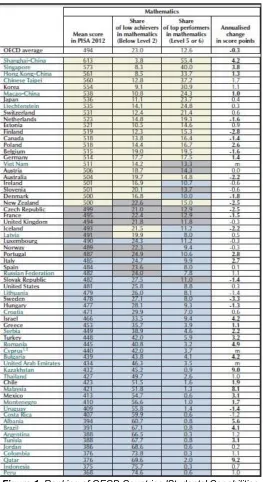
students who get the opportunity are students who have been prepared from an early age, one of the preparations is by conducting a mathematics Olympiad coaching both at school, district, provincial and national levels. Coaching from the district level to the national level usually involves professionals (lecturers, experts, or teachers), but coaching in schools is generally carried out by mathematics teachers at the school. Therefore, mathematics teachers in schools should also have to be able to guide their students to take part in the Math Olympiad or math competition in their area. To be able to do the mathematics olympiad coaching, the teacher must master the material that is used as olympiad questions (the material and type of the problem), strategies in solving Olympiad questions, and the teacher is also creative in making Olympiad questions. According to Trilling & Fadel (2009) in Wijaya, Sudjimat, and Nyoto (2016) Life skills that must be possessed by someone in the 21st century relate to learning and innovation, digital literacy, as well as career and life. In learning and innovation known as "4C", they are critical thinking and problem-solving, creativity and innovation, communication, collaboration. It is also about digital literacy in the form of information literacy, media literacy, and ICT literacy. For career and life will be more oriented to flexibility and adaptability, initiative and self-direction, social and cross-cultural interaction, productivity and accountability, and leadership and responsibility. The challenge of education in Indonesia lies in the still far behind Indonesia's achievements from other countries in the world which are included in the OECD. This is evident from the results of PISA 2012 (2014) that Indonesia ranks second lowest in tests on mathematics, reading, and science. Mathematical student results are still far behind. The ranking data of PISA 2012 participating countries can be seen in the Figure 1 below.
————————————————
1,3Mathematics Education Department, STKIP Surya, Tangerang, Indonesia 15115. E-mail: [email protected], [email protected]
Figure 1. Ranking of OECD Countries 'Students' Capabilities
in PISA Assessment
Based on the Southeast Asian Ministers of Education Organization or SEAMEO's ministry of education in Southeast Asia (www.seameo.org), the SEAMEO priority area for 2015-2035 is "Adoption of the 21st Century Curriculum". Teachers in Southeast Asia need to help students think critically, creatively, and solve complex problems.The problems raised above have not yet received the right solution. In addition to aspects of facilities and infrastructure, partner teachers realize that they do not yet have sufficient skills and abilities in solving Olympiad problems and fostering students in preparing National Science Olympiad. Partner teachers revealed that they had always wanted to have sufficient skills and abilities to solve mathematical problems, especially non-routine problems such as Olympiad-level questions. Mathematics teachers hope that through this community service activity their wishes will be realized as a first step in improving self-quality and
mathematics learning. Based on the explanation above, a training program or training is conducted to solve math olympiad questions for mathematics teachers in Tobasa, North Sumatra so that mathematics teachers in partner schools have the skills and abilities to solve Olympiad questions; able to foster students in preparing National Science Olympiad; and able to formulate questions that are at the Olympiad level as material in fostering students. Provision of skills and products produced by teachers are expected to be used and improved on an ongoing basis so that these partner schools can be more independent in preparing for competitions in the field of mathematics. Research methods of this paper will be discussed in Session 2. Furthermore, results and discussion will be given in Session 3. Finally, a conclusion in Session 4 will close this paper.
2
RESEARCH
METHODS
In this session, we will discussed about the research method that we use in this paper. This research uses quantitative research methods with one group pretest-posttest design research design. This design intends to compare the pretest and posttest scores, whether there is a change or not. The sample in this study was 14 teachers who came from Tobasa Regency, North Sumatra. The selection of this sample is based on the results of a selection test held to teachers. Data collection techniques using a test that is by giving several items that are level with the junior high school Olympiads. The instrument used was a set of junior high school mathematics olympiad questions. The pretest-posttest questions were arranged as many as 25 items in the type of essay. The score is if the correct answer is given a score of 4 and if incorrectly given a score of 0. The validation of the instrument is carried out by experts, namely some lecturers within the Surya Institute Foundation and Mathematics Education Study Program of STKIP Surya. Data analysis was performed on the pretest-posttest score and the average N-gain score. Pretest-posttest test with a comparative test (two paired samples) with nonparametric type Wilcoxon test because of n < 30, while the average test of N-gain score using descriptive test (one sample test) to see whether the increase is true at a high level. The formula used to find N-gain is the normalized gain formula developed by Meltzer (2002) as follows.
N-gain (g) = Skor posttest – Skor pretest Skor ideal – Skor pretests
Furthermore, to see the magnitude of the N-gain classification guidelines used the N-gain developed by Hake (1999) follows.
Tabel 2. Classification of N-gain Indeks N-gain Interpretation g ≥ 0,7 high
0,3 ≤ g < 0,7 medium g < 0,3 low
3
RESULTS
AND
DISCUSSION
In this session, we will give the research results and discussion.
3.1RESEARCH RESULT
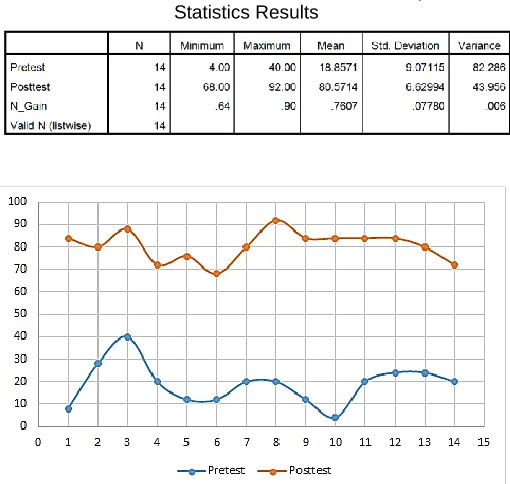
The education and training program for mathematics teachers was held on 3 to 8 March 2018 in Tobasa Regency, North Sumatra, which was attended by 14 mathematics teachers at the junior high school level. The purpose of this training program is to improve the ability of mathematics teachers to solve junior high school Olympiads. To find out this, researchers gave test instruments to training participants. Instrument tests were given twice, namely pretest and posttest. A pretest is given before the training process, while the posttest is given at the end of the training. This aims to see the magnitude of the participants' level of mastery after attending the training. The participants' pretest and posttest results can be seen in Table 3, Figure 4, and Figure 5 below.
Table 3. Pretest, Posttest, and N-Gain Descriptive Statistics Results
Figure 4. Graph of Pretest and Posttest values
Figure 5. Results of Improvement of Training Participants' Capabilities
From Figure 4 and Figure 5 it can be seen that there is an increase in the training participants' abilities. Next we will test statistically inferential to find out whether the increase that occurred was significant.
1.
TEST THE AVERAGE DIFFERENCE BETWEEN PRETEST ANDPOSTTEST WITH WILCOXON TEST
Because the data is n < 30, the average difference test uses the Wilcoxon test. This test uses a significance level of 𝛼� = 0.05 with the criteria if Sign. (2 tailed) < 𝛼� then H1 accepted, if Sign. (2 tailed) > 𝛼� then H1 rejected. The formulation of the hypothesis test is:
H0 = There is no significant effect of the Math Olympiads training for junior high school mathematics teachers on test results.
H1 = There is a significant (increase) effect of mathematics olympiad training for junior high school mathematics teachers on test results.
With the non-parametric test Wilcoxon test using SPSS software obtained the results as in the description below.
Table 6. Wilcoxon Test Results
Test Statistics
Posttest - Pretest
Z -3.302b
Asymp. Sig. (2-tailed) .001 a. Wilcoxon Signed Ranks Test
b. Based on negative ranks.
Because of Sign. (2 tailed) = 0.001, means Sign. (2 tailed) < 𝛼�
so H1 is accepted. The conclusion is that there is a significant (increasing) effect of mathematics olympiad training for junior high school mathematics teachers on test results.
2.
TEST ONE AVERAGE OF N-GAIN SCORE ABOUT THE ABILITYTO SOLVE OLYMPIAD PROBLEMS
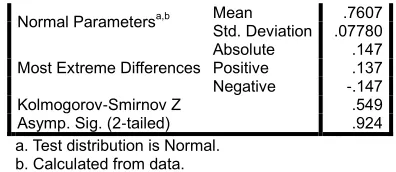
From the previous analysis, we know that the training provided affects the ability of teachers to solve Olympiad problems. If the increase is at a high criterion with an N-gain ≥ 0.7, it is necessary to do a one-sample comparison test. Because of n = 14 which means n < 30, the t-test is used. Previously, it will be checked whether the assumption of normality is met by the normality test. This normality test uses SPSS with the type of one sample test with Kolmogorov-Smirnov One-Sample. The test criteria used are for the significance level 𝛼� = 0.05, if sig. (2-tailed)> 𝛼� then H0 is accepted. The pair of test hypotheses are:
H0=Samples come from populations that are normally distributed
H1=Samples come from populations that are not normally distributed
By using SPSS the normality test results are obtained as in the following information.
Table 7. Display of normality test results on SPSS
One-Sample Kolmogorov-Smirnov Test N_Gain
Normal Parametersa,b Mean .7607
Std. Deviation .07780 Most Extreme Differences
Absolute .147 Positive .137 Negative -.147
Kolmogorov-Smirnov Z .549
Asymp. Sig. (2-tailed) .924 a. Test distribution is Normal.
b. Calculated from data.
Sign value. (2-tailed) is 0.924 which means sign. (2-tailed) >
𝛼�, so H0 is accepted. The conclusion is that the sample comes from a normally distributed population. Then one-sample t-test is performed to prove whether the increase is high. From the calculation of one sample t-test obtained sig. (2-tailed) of 0.03 which means less than 𝛼� = 0.05.
H0 = The average score increase = 0.71 H1 = The average score increase ≠ 0.71
Table 8. Display normality test results on SPSS
Test Value = 0.71 t df Sig.
(2-tailed)
Mean Difference
95% Confidence Interval of the Difference Lower Upper N_Gain 2.439 13 .030 .05071 .0058 .0956
From table 5 it can be seen that the value of Sig. (2-tailed) = 0.030 < 0.05. This means H0 is accepted, it can be concluded that the increase is 0.71
3.2DISCUSSION
Based on the results of the research shown above, the training participants had a high increase in their ability to solve math problems in the middle school Olympiads. The training undertaken by the teacher has benefits for the teacher as an effort for self-development related to professional development (Kemendikbud, 2012). This is supported by Mulyawan in Rakib, Rombe, and Yunus (2016) who revealed that efforts to improve teacher professionalism through training are very important and need to be done continuously to achieve quality performance for teachers. The following Figure 9 is an examples of teacher activities during training.
Figure 9. Example of training activities
The implementation of community service activities has been going well and can improve the competence of teachers in
completing and making math olympiad questions. There were 14 mathematics teachers present in this activity. The trainees have participated in the activity with enthusiasm. This can be seen from the attention of the participants who focused on the speakers when given a presentation about the characteristics of the Math Olympiad questions and their solution strategies. The same thing was also seen during the discussion session, in this session, the participants actively asked informants, expressing the problems faced by the teacher in conducting the Math Olympiad training to students in their schools. Thus it can be said that the process of implementing activities has been going well. The observations of the mathematics Olympiads problem-solving activity show that the teacher began to understand the strategy of harassing mathematical olympiad questions, even during the activity, some participants said: "oh it turns out the solution is very simple even though the problem looks very complicated". The test indicates there has been an increase in teacher competence in solving Olympiad questions. Then, participants with the direction of the resource person tried to modify the questions. The workshop participants' teachers have begun to understand how to make Olympiad-level questions, even though the questions created are new from the modification of the questions given by the speakers, but the teachers have been encouraged to try to develop their Olympiad questions. From this explanation, it can be said that this activity has succeeded in increasing the ability of teachers to solve and make math olympiad questions which will later be a provision for teachers to guide students in their respective schools. Through the knowledge obtained by the teacher through this training, the teacher can improve the ability of problem-solving and critical thinking students are importantly possessed by students because through these abilities is one important aspect that is needed by students in the process of learning mathematics especially to help students solve mathematical problems which are difficult (non-routine) (Mahmuzah, 2015). Teacher competency improvement was also evidenced by the posttest results which averaged 80.5714. The average value is sufficient to indicate that an increase in teacher competence in solving math olympiad questions, because at the beginning of the presentation there were no teachers who were able to answer the resource persons' questions related to the Olympiads question. The improvement of the teacher's ability to solve math olympiad questions is the result of strengthening the basic concepts of mathematics and mathematics problem exercises which are problem-solving problems (Puja Astawa, 2007). From the results of the questionnaire distributed to the teacher, it can be said that the teacher was very happy with the activities provided, and hoped that this activity did not stop here because there were so many problems faced by teachers that needed help from the Surya Institut Foundation.
4
CONCLUSION
This paper concludes that the participants of this training have increased the ability to solve junior high school mathematics olympiad questions. The level of improvement is high. Thus, this research can provide recommendations that this type of training can be carried out routinely for other junior high school teachers from districts outside Tobasa Regency.
5
ACKNOWLEDGMENT
REFERENCES
[1] Anderson, L. W. & Krathwol, D. R. (Eds). (2001). A Taxonomy for Learning, Teaching, and Assessing: A Revision of Bloom's Taxonomy of Educational Objectives. Newyork: Addison Wesley Longman.
[2] Depdiknas. (2002). Pendidikan Berorientasi Kecakapan Hidup (Life Skills Melalui Pendekatan Pendidikan Berbasis Luas (Broad Based Education). Jakarta: Depdiknas.
[3] Fadillah, S. (2009). Kemampuan Pemecahan Masalah Matematis dalam Pembelajaran Matematika. Prosiding Seminar Nasional Penelitian, Pendidikan dan Penerapan MIPA Fakultas MIPA, Universitas Negeri Yogyakarta, 16 Mei 2009. Hal.553-558
[4] Hake, R. R. (1999). Analyzing Change/Gain Scores. Indiana University: Department of Physics. Accessed on November, 2011 from: http://www.physics.indiana.edu/~sdi/Analyzingchange- Gain.pdf.
[5] Kemendikbud. (2012). Sertifikasi guru dalam jabatan: Buku 3. Pedoman Penyusunan Portofolio. Jakarta: Direktorat Jenderal Pendidikan Tinggi Kementerian Pendidikan dan Kebudayaan.
[6] Meltzer, D.E (2002). The relationship between
mathematics preparation and conceptual learning Gain in Physics. American Journal of Physics, 70, 1259-1268. [7] Pogrow, S. (2005). Hots revisited: A thinking development
reducing learning gap after grade 3. Phi Delta Kappan, September, 64-75.
[8] Programme for Internasional Student Assessmet. (2014). PISA 2012 Results in Focus: What 15-year- olds know and what they can do with what they know. Paris: OECD. [9] Puja Astawa, I W. (2007). Model Pembinaan Olimpiade Matematika Sekolah Dasar di Propinsi Bali. Jurnal Pendidikan dan Pengajaran Undiksha No 2. Hal 270-286. [10]Rakib, M., Rombe, A., & Yunus, M. (2016). Pengaruh pelatihan dan pengalaman mengajar terhadap profesionalisme guru. Ad’ministrare, 3-2, 137-148. [11]SEAMEO. Available at
http://www.seameo.org/SEAMEOWeb2/
[12]Trilling, B., & Fadel, C. (2009). 21st Century Skills: Learning for Life in Our Times. San Francisco, CA: John Wiley & Sons.