IJSRR, 7(4) Oct. – Dec., 2018 Page 1983
Research article Available online www.ijsrr.org
ISSN: 2279–0543
International Journal of Scientific Research and Reviews
Gc-Ms Analysis of Soil Application Of Extract Of
Hypnea Musciformis
Grown Leaves Of
Amaranthus Tristis
L.
T. Kumareswari* and S. Maria Victorial Rani
*Department of Botany, Kamaraj College, Thoothukudi, Tamil Nadu, India
Department of Botany, St. Mary’s College (Autonomous), Thoothukudi, Tamil Nadu, India, Affiliated to Manonmaniam Sundaranar University, Abishekapatti, Tirunelveli – 627012, Tamil Nadu, India.
ABSTRACT
The present investigation was carried out to determine the phytocomponents of methanol extract of soil application of extracts of Hypnea musciformis (Wulfen)J.V. Lamouroux grown leaves of Amaranthus tristis L. by using GC-MS analysis (Gas Chromatography - Mass Spectrum). The analysis revealed the Interpretation on mass spectrum GC-MS was conducted using the database of National Institute Standard and Technology (NIST). There were nine chemical compounds identified in leaves of control and 10 compounds in treated of which 4-Methoxy benzoic acid, methyl ester, 3-Hydroxyhexanoic acid, Deoxynivalenol, n-heptane and Napthazoline were present in both control and treated. Soil application of H. musciformis induced the synthesis of five different chemical components viz., Neopenthylhydroxyacetate, 11-Dodecenoicacid, -hydroxy-,methyl ester, Benzene,1-[(dimethoxymethyl)-1-ethyl]-4-methoxycarbonyl-1-ethyl,1,2-benzenedicarboxylic acid, disooctyl ester and (-)-Spathulenol which were not found in control. From the present study, it is concluded that seaweed induced new phytocomponents which were not present in control and these compounds correspond to various medicinal properties that can be exploited for the treatment of many diseases.
KEY WORDS: Phytocomponents, methanol extract, Gas Chromatography-Mass Spectrum,
Hypnea musciformis, Amaranthus tristis
*Corresponding author:
T. Kumareswari,
Assistant ProfessorDepartment of Botany,
Kamaraj College, Thoothukudi, Tamil Nadu, India
IJSRR, 7(4) Oct. – Dec., 2018 Page 1984
INTRODUCTION
Green leafy vegetables are regarded as ‘natures antiaging wonders’ due to its medicinal properties beyond essential sustenance1. They are the major component in traditional diet because of the presence of more phytochemicals with potential antioxidant properties2. They are commonly consumed by lower economic group people than the comfortable counterparts3. A. tristis is a common edible plant that contains amarantin, isoamarantin, betaine, aminoacids and sterols4. It has a great medicinal value, as it is used as an astringent in dysentery, diarrhoea, and hemorrhagic colitis, cough and bronchitis. Several species of Amaranthus are often considered as weeds, people around the world worth amaranths as leaf vegetables, cereals and ornamentals5. The pharmacological properties of amaranth products are considered of vital importance6. For reducing tissue swelling the leaves are well thought-out to be constructive, and they have a cleansing effect too. The leaves of amaranthus are used for the treatment of intestinal bleeding, excessive menstruation, diarrhoea and other related problems7. Though few reports are available with respect to the pharmacological properties of this plant, this may be the first time to identify the phytoconstituents of methanolic extract of Hypnea musciformis grown leaves of Amaranthus tristis using GC-MS analysis. Hence, the aim of the present study is to scientifically validate the phytochemical content of A. tristis.
MATERIALS AND METHODS
Collection of seaweed
H. musciformis (Wulfen) J.V. Lamouroux was collected during low tide, at Hare Island, Thoothukudi from November 2016 to February 2017. The sample was washed thoroughly with seawater followed by fresh water to remove sand particles and macroscopic epiphytes. After draining, the seaweed was shade-dried, powdered, sieved and used for the preparation of seaweed concentrate.
Preparation of seaweed extract for soil application
Seaweed extract (SWE) was prepared by adopting the standard method with certain modifications8. About 20g dried seaweed powder with 200ml distilled water was heated to 60oC and maintained at the temperature for 24 hr in a hot air oven. The extract was filtered and then centrifuged at 10000 rpm to remove suspended impurities. The filtrate was stored in air tight bottles at 4oC (100% seaweed concentrate) for further use.
Experimental design
IJSRR, 7(4) Oct. – Dec., 2018 Page 1985
were thinned to ten plants per pot and allowed to grow for a period of 30 days. Weeding and watering were done at regular intervals throughout the experimental period. 1% SWE was applied in soil (along with 100ml of distilled water in the ratio of 1: 10) after expansion of first leaf and was continued for twenty days. Enough replicates were maintained.
Determination of chemical compounds by Gas Chromatography Mass
Spectrophotometric analysis (GC-MS)
25 g leaf sample was extracted with 250 ml of methanol in the ratio of 1:10 in soxhlet apparatus. The extract was allowed to dry and the residue thus obtained was analysed. GC-MS analysis was performed using a Perkin-Elmer GC Clarus 500 system and Gas Chromatography interfaced to a Mass Spectrophotometer (GC-MS) equipped with a Elite-5MS fused silica capillary column (30 m x 0.25 mm x 0.25 μm) composed of 5% diphenyl / 95% dimethyl polysiloxane9
. For GC-MS detection, an electron ionization system with ionizing energy of 70 Ev was used. Helium gas (99.999%) was used as the carrier gas at constant flow rate 1 ml /min and an injection volume of 2 μl was employed; split ratio of 10:1; injector temperature 250oC. The oven temperature was programmed from 110oC (isothermal for 2 minutes) with an increase of 100C/minutes to 200oC, then 50C/minutes to 280oC, ending with a 9 minutes isothermal at 280oC. Mass spectra were taken at 70 eV; 200oC of inlet line source temperature, a scan interval of 0-2 minutes and mass scan from 45 to 450 (m/Z). Total GC running time was 36 minutes. The relative % amount was calculated
IJSRR, 7(4) Oct. – Dec., 2018 Page 1986
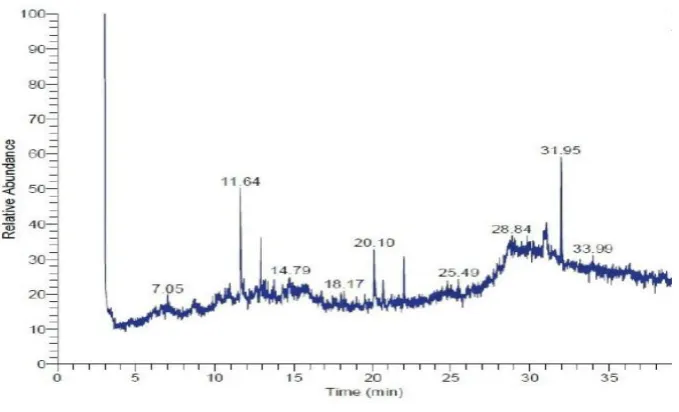
Figure 1: GC-MS spectrum of methanolic leaf extract of A. tristis (control)
IJSRR, 7(4) Oct. – Dec., 2018 Page 1987
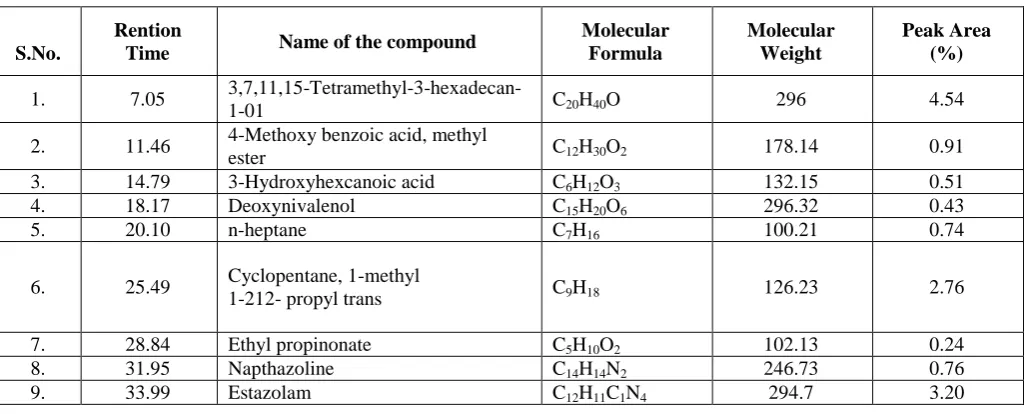
Table No. 1: Phytocomponents detected in the methanolic extract of A. tristis (control) by GC-MS analysis
S.No.
Rention
Time Name of the compound
Molecular Formula
Molecular Weight
Peak Area (%)
1. 7.05
3,7,11,15-Tetramethyl-3-hexadecan-1-01 C20H40O 296 4.54
2. 11.46 4-Methoxy benzoic acid, methyl
ester C12H30O2 178.14 0.91
3. 14.79 3-Hydroxyhexcanoic acid C6H12O3 132.15 0.51
4. 18.17 Deoxynivalenol C15H20O6 296.32 0.43
5. 20.10 n-heptane C7H16 100.21 0.74
6. 25.49 Cyclopentane, 1-methyl
1-212- propyl trans C9H18 126.23 2.76
7. 28.84 Ethyl propinonate C5H10O2 102.13 0.24
8. 31.95 Napthazoline C14H14N2 246.73 0.76
9. 33.99 Estazolam C12H11C1N4 294.7 3.20
* Compounds and their activities were identified from the database stored in the National Institute of Standard Technology (NIST - Version, 2005). Leaf extract was used for analysis. Control = Plants were irrigated with water.
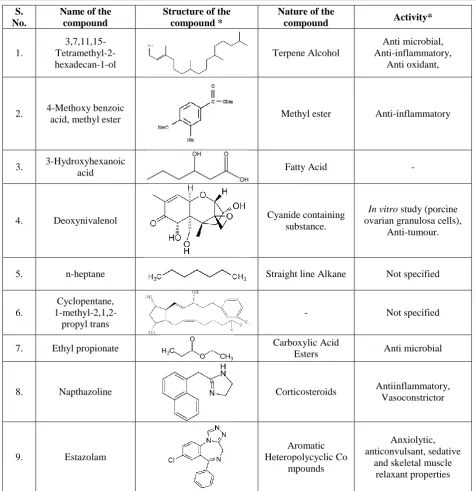
Table No. 1a: Chemical nature and activity of phytocomponents identified in the methanolic extract of A. tristis
IJSRR, 7(4) Oct. – Dec., 2018 Page 1988
S. No.
Name of the compound
Structure of the compound *
Nature of the
compound Activity*
1.
3,7,11,15- Tetramethyl-2-hexadecan-1-ol
Terpene Alcohol
Anti microbial, Anti-inflammatory,
Anti oxidant,
2. 4-Methoxy benzoic
acid, methyl ester Methyl ester Anti-inflammatory
3. 3-Hydroxyhexanoic
acid Fatty Acid -
4. Deoxynivalenol Cyanide containing
substance.
In vitro study (porcine ovarian granulosa cells),
Anti-tumour.
5. n-heptane Straight line Alkane Not specified
6.
Cyclopentane,
1-methyl-2,1,2-propyl trans
- Not specified
7. Ethyl propionate Carboxylic Acid
Esters Anti microbial
8. Napthazoline Corticosteroids Antiinflammatory,
Vasoconstrictor
9. Estazolam
Aromatic Heteropolycyclic Co
mpounds
Anxiolytic, anticonvulsant, sedative
and skeletal muscle relaxant properties
*Name of the compound was identified from the database stored in the National Institute of Standard Technology (NIST-version
2005). Leaf extract was used for this analysis. Control = Plants were irrigated with water.
IJSRR, 7(4) Oct. – Dec., 2018 Page 1989
S.No. Rention Time Name of the compound* Molecular Formula
Molecular Weight
Peak Area (%)
1 2.48 Neopenthylhydroxyacetate C7H14O3 146.00 98.41
2 11.64 4-Methoxy benzoic acid, methyl
ester C12H30O2 178.14 0.91
3 13.12 11-Dodecnoic acid, 10-hydroxy-,
methyl ester C13H24O3 228.00 1.46
4 14.79 3-Hydroxyhexcanoic acid C6H12O3 132.15 0.51
5 14.87
Benzene, 1- [(dimethoxymethyl)ethyl]-4-methoxycarbonyl
-1-ethyl
C15H22O4 266.00 0.62
6 18.17 Deoxynivalenol C15H20O6 296.32 0.43
7 20.10 n-heptane C7H16 100.21 0.74
8 25.58 1,2-benzenedicarboxylic acid,
disooctyl ester C24H38O4 390.00 23.00
9 28.63 (-)-Spathulenol C15H24O 220.35 20.76
10 31.95 Napthazoline C14H14N2 246.73 0.76
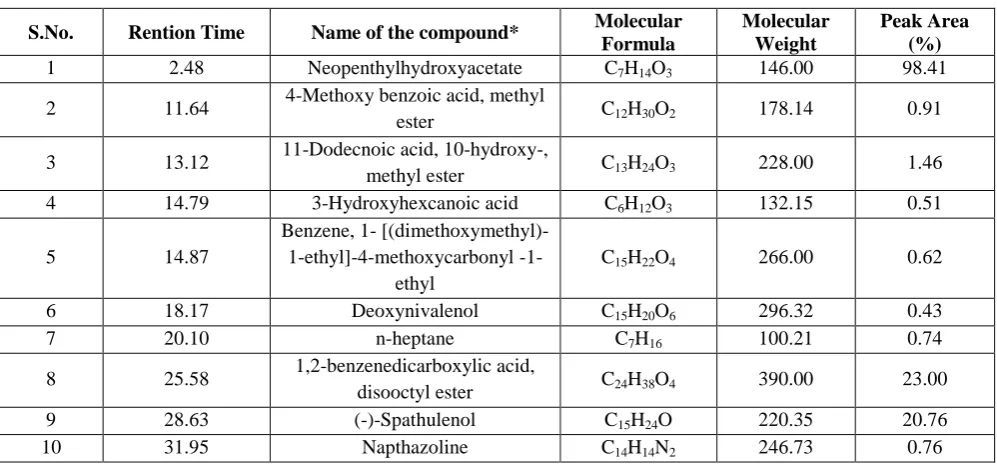
*Name of the compound was identified from the database stored in the National Institute of Standard Technology (NIST-version 2005). Leaf extract was used for analysis.Treated = H. musciformis extract (1%) was applied through soil.
Table No. 2a: Chemical nature and activity of phytocomponents identified in the methanolic extract of A. tristis
IJSRR, 7(4) Oct. – Dec., 2018 Page 1990
S.
No. Name of the compound
Structure of the Compound*
Nature of the
compound Activity
1. Neopenthylhydroxy
Acetate Ester No activity was found
2. 4-Methoxy benzoic acid,
methyl ester Methyl ester Anti-inflammatory
3. 11-Dodecnoic acid,
10-hydroxy-, methyl ester Fatty Acid
In nutraceutical forms as a food additives and dietary supplements
4. 3-Hydroxyhexanoic acid Fatty Acid -
5. Benzene, 1- [(dimethoxymethyl)-1-ethyl]-4-methoxycarbonyl -1-ethyl Aromatic compounds/ Aromatic disubstitued compounds
Detergents, drugs and pesticides
6. Deoxynivalenol Cyanide containing
substance.
In vitro study (porcine ovarian granulosa cells),
Anti-tumour.
7. n-heptane Straight line Alkane No activity
8
1,2-benzenedi carboxylic acid, disooctyl
ester
Plasticizer compound
Anti microbial, Anti oxidant, Cancer
preventive, immunostimulant, Chemopreventive, Lipoxygenase,
9 (-)-Spathulenol
Hydroxyl Cyclic compounds/ Non Benzenoid compounds Antibacterial, antiinflammatory allergy, rheumatism, arthiritis
10 Napthazoline Corticosteroids Antiinflammatory
and Vasoconstrictor
* Compounds and their activities were identified from the database stored in the National Institute of Standard Technology (NIST - Version, 2005). Leaf extract was used for this analysis. Treated = H. musciformis extract (1%) was applied through soil.
IJSRR, 7(4) Oct. – Dec., 2018 Page 1991
National Institute of Standards and Technology library sources were also used for matching the identified chemical components from the methanolic leaves extract of A. tristis (Tables 1a and 2a). There were nine chemical compounds identified in leaves of control and 10 compounds in treated of which 4-Methoxy benzoic acid, methyl ester, 3-Hydroxyhexanoic acid, Deoxynivalenol, n-heptane and Napthazoline were present in both control and treated (Figures 1 and 2). In addition, soil application of H. musciformis induced the synthesis of five different chemical components viz., Neopenthylhydroxyacetate, 11-Dodecenoicacid,-hydroxy-, methylester, Benzene,1-[(dimethoxymethyl)-1-ethyl]-4 methoxycarbonyl-1-ethyl, 1,2-Benzenedicarboxylic acid, disooctyl ester and (-)-Spathulenol which were not found in control. Among the five compounds, 1,2-benzenedicarboxylic acid, disooctyl ester and (-)-Spathulenol were referred to have anti-inflammatory, antioxidant, cancer preventive, immunostimulant, chemopreventive, antibacterial, anti allergy, antirheumatic properties. While the other two ester and aromatic compounds were valued as nutraceutical, food additives, dietary supplements, detergents and pesticides. Moreover, Neopenthylhydroxyacetate compounds activity was unable to be identified. 1, 2, Benzenedicarboxylic acid, disooctyl ester was reported to increase protein phosphorylation rapidly in HeLa cells via protein kinase C and casein kinase10. -(-) Spathulenol was reported to have antimicrobial, Immunomodulatory and antitumor activity11. The present study is lined up with my previous report12 that SWEs induced the synthesis of different chemical components.
CONCLUSION
From this result concluded that twelve phytochemical constituents have been identified from methanolic extract of seaweed grown leaves of A. tristis by Gas Chromatogram-Mass spectrometry analysis. The new compounds identified need further confirmation, and the results opened up a new window for comprehensive investigation.
ACKNOWLEDGEMENT
The author is grateful to Dr. S. Maria Victorial Rani, Former HOD of Botany and Dean of Research, St. Mary’s College (Autonomous), Thoothukudi for giving valuable suggestions and constant support to complete this research work.
IJSRR, 7(4) Oct. – Dec., 2018 Page 1992
1. Gupta, D, Prakash KR. Antioxidant phytochemicals of nutraceutical importance. The Open Nutrls J. 2009; 2: 22-36.
2. Khanam UKS, Oba S, Yanase E, Murakami Y. Phenolic acids, flavonoids and total antioxidant capacity of selected leafy vegetables. J. Func. Fds. 2012; 4: 979–987.
3. Rensberg, JVWS, Averbeke VW, Slabbert R, Faber M, Jaarsveld VP, Heeden VI, Oelofse WFA. 2007. African leafy vegetables in South Africa. Water SA. 2007; 33: 317–326.
4. Velu, I, A. Ravi A, Gopalakrishnan M, Manivannan B, Sathiavelu M, S. Arunachalam. Comparison of antioxidant activity and total phenolic content of Amaranthus tristis and
Celosia argentea var spicata. Asian Pac. J. Trop. Biomed. 2012; 1-4.
5. Bielski St and Szwejkowska B. Influence of some agro-technical treatments on the development and yields of Amaranth. Bulg. J. Agric. Sci. 2015; 21: 909-915.
6. Ahmed, SA, Hanif S, Iftkhar T. Phytochemical profiling with antioxidant and antimicrobial screening of Amaranthus viridis L. leaf and seed extracts. Open J Med. Microbiol. 2013; 3(3): 164-171.
7. Sivagnanam S, Chandra AP. Preliminary phytochemical analysis of Amaranthus viridis. Res. J. Pharm. Biol. Chem. Sci, 2016; 7(1): 1-7.
8. Rao RK. Preparation, properties and use of liquid seaweed fertilizer from Sargassum. In: Workshop on Algal Products and seminar on Phaeophyceae in India, Seaweed Research and Utilization Association, Madras, India, 1990; 7-8.
9. Hema R, Kumaravel S, Gomathi S, Sivasubramaniam C. Gas Chromatography-Mass Spectroscopic analysis of Lawsonia inermis leaves. NY Sci J. 2010; 3(11): 141-143.
10.Lahousse SA, Beall SA, Johnson KL. Mono-(2-ethylhexyl) phthalate rapidly increases celsr2 protein phosphorylation in HeLa cells via protein kinase C and casein kinase 1: Toxicol. Sci. 2006; 91(1): 255-264.
11.Rajeshwari N, Ramlakshmi S, Muthuchelian K. GC - MS analysis of bioactive components from the ethanolic leaf extract of Conthium dicoccum, J. Chem. Pharm Res. 2011; 3(3): 792 – 798.