Model-Based Keyword Success Learning (Bksl):
Increased Computer Practicum Learning
Competency
Fauzan Putraga Al Bahri, Jhony Syafwadhinata
Abstract : Method Based Keyword Success Learning (BKSL) is learning based on the application of keywords in understanding learning material on computer use. In this learning method the application of BSKL involves media and techniques consisting of games; debate; discussion; story; film; conversation; and vocabulary, the type of learning media most interested by AMIK Indonesia students is the game with a score of 4.07 with very capable information, and followed by the use of films with a score of 3.73, vocabulary with a score of 3.50, and debates, conversations, stories, and discussions with score 2.82 with sufficient information. The use of game and film media can facilitate students in understanding English conversation which indirectly adds to the vocabulary of each individual student, in practicum learning with a variety of computer uses can help AMIK Indonesia students in operating computers in practicum activities.
Index Terms: based on keyword successs learning (BKSL), learning competency, practicum.
—————————— ——————————
1.
INTRODUCTION
This type of cooperative learning method has various models, but from the various cooperative learning models that are felt to be the most appropriate for students in learning in terms of the ability of academic potential. In addition to cooperative learning, another suitable method used to improve learning outcomes according to researchers is the Based Success Keyword Learning (BSKL) method. BSKL method is learning based on the application of keywords in understanding learning material on computer use. In this learning method, the application of keywords can be obtained from the field or experience from students in understanding computer learning materials and adding English vocabulary, besides that problems can also be obtained from students' ignorance of the competencies to be taught. One strategy used to present effective information is the strategy of using keyword-based learning, with strategies and systematic ways to improve student memory in developing better ways to encode information so that it will be easier to remember (Al-Zahrani, 2011). The keyword method is a way of facilitating the relationship between new forms of vocabulary and their meaning in learning foreign language vocabulary (Campos, 2003). Hauptmann (2004) states that keyword-based learning is described as the art of refreshing, enhancing, or developing memory with artificial aids. So it can be concluded that keyword-based learning is a procedure, technique, or method that improves memory to store new information and remember it easily whenever the learners need, this process helps learners to achieve learning success. Learning strategies are one component that determines the development of student learning outcomes. Meanwhile, according to Wina Sanjaya (2007), learning strategies are plans that contain a series of activities designed to achieve certain educational goals. Teaching strategy is a whole of methods and procedures that focus on student activities in the teaching and learning process to achieve predetermined goals. Computer Assisted
Learning is a computer application as an integral part of the learning system of the learning and teaching process that aims to help students in learning through two-way interaction patterns through computer terminals and multi-direction that are expanded through computer networks (both local and global) and also expanded its function through a multimedia interface (Emithu, 2010). The taxonomy is used to give members extreme differences in teaching materials and learning environments. The difference between computers for presentations and computers for enrichment is clearly chosen between the use of computers to teach the contents of lecture material and the use of computers to support students' learning environments.
Related research conducted by Dascalu et al (2015), on how students can access and find additional bibliographic resources for learning by using special learning tools that are personalized online. The results of the study produced two types of learning recommendations namely as suggestions and shortcuts for learning materials as supporting learning tools in order to help students to navigate better through educational resources. Dečman (2015) also conducted research on e-learning modeling in tertiary institutions with the use of Unified Theory of Acceptance and Use of Technology (UTAUT), the purpose of this study was to assess and evaluate the feasibility of UTAUT in e-learning environments specifically required to be used in education and to examine the effects of gender and education on the use of these technologies. The results prove the general application of the UTAUT model in e-learning settings and show that social influence and performance expectations significantly influence the intention to use technology. The results also prove there is no significant influence from previous education or gender of students on the appropriate model. The results show that teens think that they handle modern technology well and are ready to use it if only the expected performance improvements are in line with their expectations. Darmawan and Harahap (2016) conducted a study with the title communication strategies to improve the quality of non-formal education graduates through computer-based tests (CBT) in West Java Indonesia, in this study showing that the competency of students in formal education at that time was a quite good environment. In particular, the results of the measurements ————————————————
Fauzan Putraga Al Bahri is a lecturer in Department of Informatics, Faculty Informatics of Management, AMIK Indonesia. E-mail: [email protected]
carried out through the Computer Based Test (CBT) on the subjects of national test results are quite good. This finding is quite close to the results of competency tests conducted on students in a formal education environment. The conclusion shows that the results of research on the use of CBT in measuring the quality of non-formal education graduates in Indonesia are successful, especially in West Java. Another case by Aparicio et al (2017) is that e-learning systems are emerging in many settings in our society. Schools, universities, and several other organizations use this system. This medium might seem to be the answer to all learning barriers, but the effects of non-cognitive skills on the success of e-learning systems have not yet been explored. Recent studies have shown that students with high grit levels, stamina in pursuing long-term goals, achieve better learning outcomes. In this study, proposing a theoretical model of grit learning as a determinant of the success of e-learning systems. The study was conducted on a sample of student samples, and the theoretical model was validated using structural equation modeling (SEM). The results show that grit has a positive effect on student satisfaction and performance. The results help improve e-learning strategies and understand the success of e-learning, explained by students' skills and system characteristics. From the related research results that researchers took from various journal sources, only research conducted by Dascalu et al. Conducted the study with the relevance of this research, but the results of the study were only on bibliography sources as a learning reference, whereas other studies only referred to learning systems. the use of information systems such as e-learning and have not done research on the BSKL model. So this research is expected to be a novelty that can be a reference for learning in Indonesia, especially AMIK Indonesia in computer lab learning. English language learning has now evolved with the use of technology through games, songs, gadgets, and tools as well as social media that users unwittingly have understood a little about English. However, on the learning problems at AMIK Indonesia where computer practicum material is available, only a few students understand the competency of the material and terms in the use of computers that involve English. In addition, students are still confused in finding learning materials and mastering practicum materials. Learning with the Model-Based Keyword Success Learning (BKSL) is one of the models that must be owned by the world of education, the application of learning English, especially in computer science is very different in its application so that the absorption of learning English in computers is ineffective and inefficient. This study aims to develop a learning model Based on Keyword Success Learning (BSKL) so that in its application students can find out the level of understanding using different media and techniques, it is hoped that this model can become a novelty in learning research, so that later it will be used as a measuring tool for students in mastering English material and understanding in computer practicum especially AMIK Indonesia.
2
RESEARCH
METHOD
The approach used in this study is a qualitative approach with descriptive methods. Data collection stages include: a) interview; b) observation; and c) documentation, the technique of drawing conclusions by means of analyzing documents both written, drawing, and electronically, while the data analysis techniques go through stages: a) data reduction; b) data
presentation; and c) drawing conclusions. The subjects in this study were 60 active AMIK Indonesia students, consisting of 3 different semesters. The research was conducted for three (6) months, this is because the process of preparing the lattice and research instruments which took a little more or less for three (3) weeks with detailed stages, namely: the first three weeks of the instrument preparation process, the next two weeks the interview process with lecturers and students, and the next four weeks the researchers' observation of the learning ability of the models offered. As well as the last two weeks the researcher collected the necessary documentation data. in addition, the authors prepare research administration, and other things needed in the field later.
3 RESULTS
AND
DISCUSSION
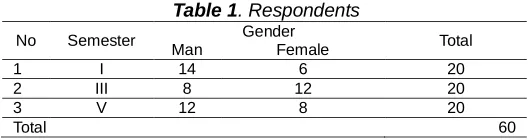
Based on the results of the above research data, it has been proven that it can be shared by several criteria and has interesting methods to choose the ability to draw and solve problems in English language problems. In line with motivation theory, Siswanto (2012: 119) states that: "Motivation appears as a positive effort in moving the power and potential of employees so that they can productively achieve goals". This form of motivation is also found in the way about the tasks and motivations of a student so that students can understand and be confident and confident in English, and also quick to remember difficult vocabulary. Indirectly students create a harmonious learning atmosphere so that learning activities are not carried out in a forced condition. From the number of students who can be sampled for this study, it can be seen from the following table.
Table 1. Respondents
No Semester Gender Total
Man Female
1 I 14 6 20
2 III 8 12 20
3 V 12 8 20
Total 60
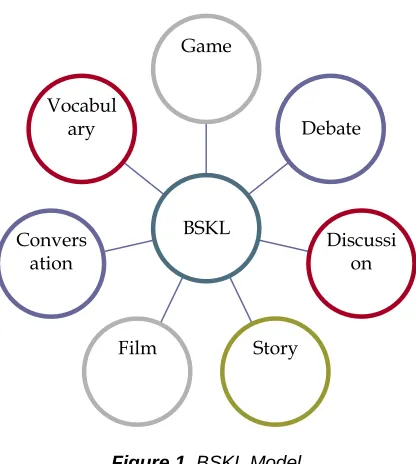
Figure 1. BSKL Model
This BSKL model involves several assessment variables in making the assessment results consisting of namely; games, debates, discussions, stories, films, conversations, and vocabulary. As for the results of the assessment recap, the following results are obtained.
Figure 2. Individual Skills of BSKL Model Students
From this picture we can explain that there are several categories in the assessment divided into five scores with details:
1 Not able 2 Poor Capability 3 Quite capable 4 Able
5 Very capable
From the results of the analysis that the first, third, and fifth semester students were obtained based on Figure 2, the students were able to total 31 (52%), then the able students amounted to 25 (41%), then the less capable students numbered 4 (7%), then for the assessment very capable and unable to amount to 0 (none).
Figure 3. Ability of Student Semester
From the results of the analysis of students per semester shows that there are several assessments given to students per semester, i.e.;
Figure 4. The ability of semester I students
From the results of the analysis in Figure 4 above it can be concluded that the first semester students, who get underprivileged scores amounted to 1 person (5%), then students who get a capable score of 9 people (45%), and students who get sufficiently capable assessments amount to 10 people (50%). Furthermore, for the assessment of not being able and very capable, there are no / (0 people).
Figure 5. The ability of Semester III Students Vocabul
ary
Convers ation
Film Story
Discussi on Debate Game
Furthermore, from the results of the analysis in Figure 5 it can be concluded that the third semester students who get underprivileged assessments amount to 3 students (15%), then students who get a fairly capable assessment amount to 6 students (30%), then students who get a capable assessment there are 11 students (55%), and for the very capable and unable assessment are 0 (none).
Figure 6. The ability of Semester V Students
Furthermore, from the results of the analysis in 6 above it can be concluded that the fifth semester students who get a sufficiently capable assessment are numbered 9 students (45%), then students who get a capable rating are 11 students (55%), and for the very capable assessment and inadequate and less able amounted to 0 (none).
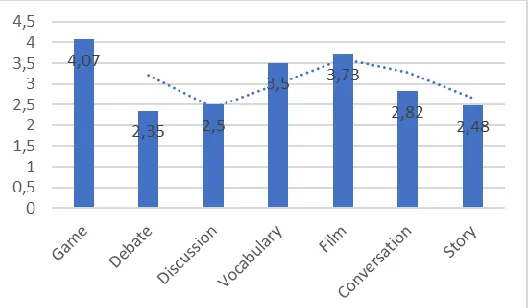
Figure 7. Students' Ability in Understanding English.
Based on the research conducted, it can be seen the percentage of students in the use of BSKL method variables found that students are more comfortable and more interested in capturing "vocabulary", so that sentences understood by students with game media can be quickly remembered and easily repeated, use this game also makes students feel bored and lazy, the game also makes students more active in carrying out tasks in finding words or sentences in English, In Figure 7 above it is known that the percentage of games is the highest percentage of several learning models that reach 4.07 with a very wide range of capabilities to understand and capture the English language on computers. Then in the learning model using "film" is an attraction for students to focus more on the discussion of learning provided, using film media students are more helped to understand the words and
sentences in order to more quickly understand the intended goals and desires, and students can also recount what happened when precisely and quickly, students can also digest a sentence spoken in this film model and can explain it broadly. Not only that, there are some students in learning who prefer visual media to help memory in understanding English. The percentage of the use of film media reached 3.73, this value is a value that is included in the category of able of the total students, this model becomes the second priority to motivate students to get results quickly. Furthermore, from the results of the assessment issued in the vocabulary model (vocabulary), namely memorizing vocabulary directly / directly there are some students who enjoy using this model some students who do not like the vocabulary model, this vocabulary model becomes interesting for students who enjoy reading language dictionaries English and is also attached manually in the notebook so that the biased vocabulary can be installed and can be practiced directly in daily life and in using computers. Regarding vocabulary students more interested in unique vocabulary and many similarities with vocabulary in unique student areas, it becomes easier to remember students. If seen in Figure 7, it can be concluded that students who use the vocabulary model of the discussion of learning English using BSKL, students get results/scores of 3.50 (able). This proves that students also have a strong memory for memorizing English vocabulary on a computer, and also students also have an interest in achieving a goal or a problem that they consider to be a goal for the future. Then in learning BSKL using a conversational or conversion model, from research conducted by students also interested in this model, consider there are some students who are happy with practical learning that directly uses English conversation on a computer, and there are some students who cannot be seen or explained clearly, some students are only biased by explaining in fully written learning, In this language, students who use the conversation or conversion model get a score with a score of 2.82 (able). In addition, students also have the desire to be able to try and be curious about computers in English. Pray from the analysis and competency test that we have from the percentage of the picture above and the students also have their own power to start conversations using English that is both oral and written Because each student has various ways so that he can understand and explain so that he can understand about English in operating a computer. For BSKL learners, story models, debates, and student group discussions, there are only a few students who are happy with this model, but there are also those who are happy with this model where there are some that have become daily hobbies of the students themselves who want to improve their learning of English on the computer. This story, debate and discussion model is a bit more difficult, with only a few students who are really right and like it, which is liked. Learning this learning can be categorized as less desirable. The story learning model, debate, and discussion in the percentage in figure 7 above can be categorized as getting a rating, namely:
1. Discussion group: 2.50 (capable enough)
This group is quite capable because students have limitations in understanding English. So it can be difficult for them to establish good communication. However, some students do that, despite its limitations.
2. Story: 2.48 (quite capable)
understanding English. However, interest in telling stories to students has encouraged them to practice this method. Although not evenly.
3. Debate: 2.35 (quite capable)
The debate group is less in terms of practice when compared with other groups. This is not just in understanding English, but there are also other obstacles, such as the lack of debate among students and the difficulty of practicing the debate method.
5.
CONCLUSION
From this research, the Based Success Keyword Learning (BSKL) model involves media and techniques consisting of games; debate; discussion; story; film; conversation; and vocabulary, the type of learning media most interested by AMIK Indonesia students is the game with a score of 4.07 with very capable information, and followed by the use of films with a score of 3.73, vocabulary with a score of 3.50, and debates, conversations, stories, and discussions with score 2.82 with sufficient information. The use of game and film media can facilitate students in understanding English conversation which indirectly adds to the vocabulary of each individual student, in practicum learning with a variety of computer uses can help AMIK Indonesia students in operating computers in practicum activities.
ACKNOWLEDGMENT
A big thank you to the Directorate General of Research and Technology Strengthening and Development of the Ministry of Research, Technology and Higher Education as funders for this research in the 2019 Beginner Lecturer Research (PDP) scheme, and do not forget to the Institute for Research and Community Services (LPPM) AMIK Indonesia has provided moral support so that this research can be carried out in accordance with expectations. Thank you also to the Expert Team and AMIK Indonesia Lecturers who provided suggestions so that the results of this study could be developed as a solutive and innovative media.
REFERENCES
[1] Al-Zahrani, M.A.B., 2011. The Effectiveness of Keyword-Based Instruction in Enhancing English Vocabulary Achievement and Retention of Intermediate Stage Pupils with Different Working Memory Capacities. Online Submission.
[2] Aparicio, M., Bacao, F. and Oliveira, T., 2017. Grit in the path to e-learning success. Computers in Human Behavior, 66, pp.388-399.
[3] Campos, A., Gonzales, M.A., & Amor, A. 2003. Limitations of the mnemonic keyword-method. The Journal of General Psychology, Vol.130, No. 4, Pp. 399-414.
[4] Dascalu, M.I., Bodea, C.N., Moldoveanu, A., Mohora, A., Lytras, M. and de Pablos, P.O., 2015. A recommender agent based on learning styles for better virtual collaborative learning experiences. Computers in Human Behavior, 45, pp.243-253. [5] Darmawan, D. and Harahap, E., 2016. Communication Strategy
For Enhancing Quality of Graduates Nonformal Education Through Computer Based Test (CBT) in West Java Indonesia. [6] Dečman, M., 2015. Modeling the acceptance of e-learning in
mandatory environments of higher education: The influence of previous education and gender. Computers in human behavior, 49, pp.272-281.
[7] Hauptmnn, J. 2004. The Effect of the Integrated Keyword Method on Vocabulary Retention and Motivation. Ph.D. Thesis, University of Leicester, UK.