2118
Requirements Prioritization Techniques Focusing
on Agile Software Development: A Systematic
Literature Review
Noor Hazlini Borhan, Hazura Zulzalil, Sa‘adah Hassan, Norhayati Mohd Ali
Abstract: Requirement prioritization plays a crucial role in the software development process. In Agile Software Development (ASD), requirement prioritization (RP) is challenging to maintain and requires a more formal process. It is essential to prioritize the requirements for making the correct decision for either single or multiple releases of a product. Ignorance of critical requirements during prioritization results in poor quality and unsatisfied clients. Various techniques have been proposed to prioritize requirements based on specific criteria. This SLR aims to identify the RP techniques focusing on Agile Software Development, as well as the issues or limitations of previous works. It will serve as a guideline for the practitioners to develop an effective RP process that can produce high-quality requirements that are expected to meet the needs of the intended users. Search terms with appropriate keywords were utilized in several online databases to recognize primary studies mostly related to RP in ASD. This SLR also shows the significant research gaps regarding techniques and issues for requirements prioritization in ASD. The researchers identified that a total of 25 papers report complete empirical results. Some critical issues of RP in ASD include severe limitations in terms of scalability, complexity, uncertainty, time consumption, starvation issue, dependency issues among requirements, limited research focused on the non-functional requirements and a lower automation approach. There are some significant challenges of RP techniques in ASD, such as a conflict between the stakeholders, changes in the priority list lead towards rework, and requirement selection factors during the RP process.
Index Terms: Requirements Prioritization, Prioritization Techniques, Prioritization Factors, Agile Software Development, Systematic Review
————————————————————
1
I
NTRODUCTIONRequirement Prioritization is a primary phase in requirement engineering, as not all requirements have equivalent customer fulfillment. From the viewpoint of the project manager, the requirements that can be implemented easily should be implemented first [1]. Conversely, the financial manager is in favor of the requirements that cost less [1]. Each requirement has different interests depending on the software to be built. Many factors affect the importance of each requirement. Delivering functionalities which achieve customer satisfaction and fit into the project constraints, while discarding requirements that are not worth implementing is the aim of requirement prioritization [2]. RP plays a role in the success or failure of a software product. If the correct or essential requirements are not prioritized at the right time, a software product can go wrong or fail. Hence, there is a need for an endless or complete requirements prioritization technique, model, or framework that extends all the factors that must be considered while prioritizing requirements in ASD. The success of quality software development depends on the correct choice of requirement candidates, which are then prioritized based on essential priority perspectives. Various techniques are used in prioritizing requirements. Based on a reviewed done in this study, these techniques include the Analytic Hierarchy Process (AHP), Value-Oriented Prioritization (VOP), Wieger‘s method, MoSCoW technique, Hierarchical Cumulative Voting (HCV), Goal-Based Technique, Planning Game (PG) and Agile User Stories Prioritization (AUSP) method.
____________________________
Noor Hazlini Borhan is from FCSIT, UNIMAS, Sarawak, Malaysia E-mail: [email protected]
Assoc. Prof. Dr. Hazura Zulzalil is from FCSIT, UPM, Serdang, Malaysia
Dr. Sa’adah Hassan is from FCSIT, UPM, Serdang, Malaysia
Dr. Norhayati Mohd Ali is from FCSIT, UPM, Serdang, Malaysia
2119 found techniques that can reduce effort, time, and costs during
requirement prioritization. However, there are still some essential issues neglected by previous researchers. This paper is structured as follows. Section 2 presents the motivation of the study. Section 3 presents the related work, while Section 4 presents the research method with the research question, search process, inclusion, and exclusion criteria and quality assessment. Section 5 describes the research findings, and Section 6 discusses the research findings. Section 7 concludes the paper.
2 motivation
That requirements have varying importance is a widely acknowledged reality. Techniques for requirements prioritization have not progressed, either theoretically or practically [5]. Based on some reviews, several organizations think that allocating priorities to requirements is an important step, and decisions should be made [5]. Consequently, it seems that few organizations knew about how to allocate priorities or about the way that these priorities should be communicated to the project team members. There are various techniques of requirement prioritization illustrated by researchers in the domain of Software Engineering. Choosing a particular prioritization technique depends upon the type and purpose of the project. In the last few years, due to the need for flexibility in software projects, Agile Software Development (ASD) methods (e.g., Scrum and Extreme Programming) are becoming more popular [5,6]. ASD gives some benefits compared to traditional software development methods such as the delivery of business value in short iterations, following an incremental and empirical development process. Additionally, continuous communication (e.g., face to face communication) and a development process open to changes are encouraged by ASD methods. Initially, requirements are defined with customers but are then continuously refined [7].
3 related work
This section summarizes related research publications on ASD requirements prioritization. Extensive research has been conducted on the requirements of prioritization techniques. There are various techniques available today for prioritization, each with multiple criteria and pre-conditions. Different researchers have evaluated the results of varying prioritization approaches, and then based on these results, they have developed new techniques. Karlsson et al. Have conducted a research in which they have evaluated different techniques [8] and recorded the results of different techniques. Karlsson et al. applied the different prioritization methods in order ―to prioritize 13 well-defined quality requirements on a small telephony system‖ [8]. The results provided by most of the techniques, except AHP, are unreliable and prone to errors; on the other hand, AHP is more reliable but time-consuming due to the decisions which one must make in terms of requirements prioritization methods [8]. Though AHP is a reliable technique for requirements prioritization, the technique is complex to implement and time-consuming due to pair comparisons. The prioritization techniques of Binary Search and Priority Groups are also unreliable because of unsatisfactory results. The role of the consistency index is vital because it helps to reduce human error. All these techniques are applied to only a few requirements, so AHP, even though it is efficient, is still considered problematic when requirements are scaled up [9]. Laurent et al. have said, ―AHP does not
2120 requirements. A systematic literature review conducted by
[20], focuses on the technical aspects only, and it covers issues of scalability, complexity, ease of use, reliability, validation, evolution, and dependencies. This contribution has missed out the important business aspects and factors. Similarly, many existing latest surveys and current researches by the researchers, on the present work, are not discussed and analyzed. Besides, the authors do not focus merely on requirement prioritization in Agile Software Development (ASD). Therefore, in this systematic literature review, it is focusing more on the issues and limitations in the requirement prioritization, focusing on Agile Software Development. The findings in this study are important as a guideline to the researchers and practitioners who will research this area of study in the future.
4 review method
The review processes for this SLR followed SLR guidelines for software engineering [21]. Based on the guidelines, there are three primary phases involved in this SLR: planning the review, conducting a review, and reporting the review, as shown in Fig. 1.
Fig. 1. Systematic Literature Review (SLR) phases and stages
Initially, a set of research questions were formulated based on the objective of this research. The research questions for this SLR include five components. The components are known as PICOC (Population, Intervention, Comparison, Outcomes, and Context). It was proposed by [21]. Table 1 shows the criteria and scope of the research questions.
TABLE 1 CRITERIA AND SCOPE OF RESEARCH QUESTIONS
Criteria Scope
Population Challenges, Classification, Analysis and Limitations of requirement prioritization in ASD
Intervention Requirement prioritization technique in ASD
Comparison NA
Outcomes Structure of requirement prioritization the technique applied in ASD
Context Review(s) of any empirical studies of the requirement prioritization in ASD
This research work aims to identify and analyze existing prioritization techniques and related issues or limitations by illustrating various requirements and prioritization practices, methodologies, frameworks, and models focused on ASD.
Four research questions have been defined to achieve the aim of this study:
RQ1: What requirement prioritization techniques used in ASD are available in the research literature?
RQ2: How are the proposed techniques evaluated?
RQ3: What are the issues or limitations in the current ASD technique?
RQ4: What are the factors involved in RP for ASD?
5 data sources
The research questions help to define the limits of the research while exploring the published research in a specified domain. The search process is designed and formulated based on keyword-technical terms derived from existing studies. Six online databases have been chosen as data sources: ACM Digital Library, Google Scholar, IEEE Xplore Digital Library, ScienceDirect, SpringerLink, and Scopus. The selection of online databases was based on a list available in an online database subscribed to by the University Putra Malaysia‘s Library under the ―Computer Science‖ subject category.
6 search process
Since the search process distinguishes SLR from the traditional survey, it is necessary to follow the search strategy. Trial searches with combinations of terms derived from the research questions need to be done before finalizing the search string. The following steps have been taken to formulate the search query for this SLR:
Derivation of significant terms from the research question.
Identifying synonyms of significant terms. Identifying keywords in relevant papers or books. Boolean OR for alternative synonyms or variants of
each keyword.
Boolean AND to link significant terms.
The researcher attempted several search strings. The researcher would find too many unrelated papers rather than requirement prioritization in agile when using the term ―requirement prioritization‖ alone. Based on that reason and number of trials, the researcher decided to use the term ―requirement prioritization‖ and ―agile‖ linked together both terms with a Boolean ‗AND‘. Using the terms ―requirement prioritization‖ and ―agile,‖ the researcher found almost all papers related to requirement prioritization in agile. The resulting search string is described as follows:
((“Requirement Prioritization” AND “Agile”) OR “Prioritization in Agile”) OR (“Requirement Prioritization” AND “Agile” AND “classification”) OR (“Requirement Prioritization” AND “Agile” AND
“challenges”) OR (“Requirement Prioritization” AND “Agile” AND “analysis”) OR (“Requirement Prioritization” AND “Agile” AND “limitations”))
2121 needed advanced settings, such as IEEE Xplore and Scopus.
The researcher then added alternative words and expressions to the search string.
7 study selection
Many research studies were collected, but there was a need to sort out related research studies. The research process was narrowed down to get the most relevant papers, and filtering was performed based on the inclusion and exclusion criteria [22]. Fig. 2 shows the review protocol phases involved in this research.
Fig.2. Review protocol phases
7.1 Inclusion and Exclusion Criteria
Inclusion and exclusion criteria for this SLR is based on the research question [21]. Since this SLR is focused on the RP technique in ASD, to select only relevant papers, it was necessary to define inclusion and exclusion criteria. The inclusion and exclusion criteria are shown in Table 2.
TABLE 2 THE INCLUSION AND EXCLUSION CRITERIA
Inclusion Criteria Exclusion Criteria All papers are written in Papers are not published in the English language. the English language. Technical aspects of Papers that do not have any Requirements link with the research prioritization was questions.
discussed.
Papers discussing the Simple articles which are RP techniques in ASD. published on websites. Papers published on RP Papers that are publishes in ASD from the year before 2013.
2013 to 2019.
All potential published Duplicate papers. papers that can answer
the research questions.
7.2 Data Extraction and Quality Assessment
The quality assessment for this study covered quantitative and qualitative studies since there were no restrictions in terms of experimental design. A quality assessment study checklist was used to ensure the data extraction process meets the quality criteria [22]. The quality assessment checklist was designed based on the guidelines proposed by [21]. Table 3 shows a list of general questions to measure the quality of the selected studies. Three scales were coded for the quality assessment checklist and given a score: Yes =1; Partially=0.5; No = 0.
Based on the item checklist, each article ranged from 0 (very poor) to 5 (very good).
TABLE 3 QUALITY ASSESSMENT CHECKLIST
No Item Answer
QAC1 Are the aims and objectives Yes/No of the research clearly stated?
QAC2 Is the research design clearly Yes/No/Partially specified?
QAC3 Have the researcher(s) Yes/No/Partially properly carried out the
process of data collection?
QAC4 Have the researcher(s) given Yes/No/Partially enough data to support their
results and conclusions?
QAC5 Is there involved comparison Yes/No of other technique in the
experiment?
8
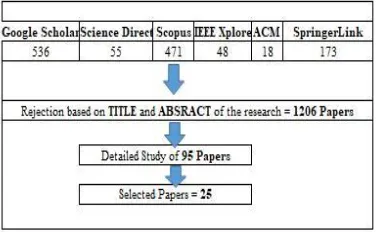
RESEARCH FINDINGSIn the first stage of the search process, the researcher found 1,301 papers using the defined search terms. After screening titles and abstracts, only 95 papers were potentially relevant. Each of the papers was filtered for referring inclusion and exclusion criteria before being accepted for the synthesis of evidence. At this stage, irrelevant studies and duplicate studies were eliminated. The researcher read the full articles to categorize the paper relevant or not to the research area. Ninety-five papers are very carefully analyzed at the initial stage to extract the required information. Finally, only 25 papers were selected to provide answers to the formulated research questions. Fig. 3 shows the results of the search and selection papers process.
Fig. 3. Search and Selection Papers Stage
8.1 Quality of Factors
2122 TABLE 4 QUALITY ASSESSMENT SCORES
9
DISCUSSIONThis section presents and discusses the results related to the research questions. A detailed description of the findings is presented in this section with the research questions.
RQ1: What requirement prioritization techniques used in ASD are available in the research literature?
The purpose of this research question is to investigate the current requirement prioritization techniques used in ASD. From the SLR studies, a majority of the papers (12 percent) implemented the Analytic Hierarchy Process (AHP) technique during the RP process. Some of the papers combined techniques by using different types of hybrid techniques, such as Adaptive Fuzzy Hierarchical Cumulative Voting (AFHCV), hybrid Gamified method with AHP, FuzzyHCV –hybrid of HCV and Fuzzy Expert System, Interactive Genetic Algorithm (IGA) and search-based method and the combination of PG and AHP. From the literature, some researchers agreed that using more than one RP technique during the prioritization process can give better results and maybe more efficient [5, 6, 8, 16]. Table 5 depicts the most commonly utilized techniques based on SLR evaluations.
TABLE 5 MOST POPULAR AND UTILIZED TECHNIQUES
Techniques Authors
Analytic [8,15,17,23,24,27] Hierarchy
Process (AHP)
Cumulative
Voting (CV) [23,5,25,24,26]
Kano Model [13,24] Value- [15,16] Oriented
Prioritization
Even though the AHP and CV methods proved to be a very reliable and widely utilized technique among researchers, it still suffers from scalability problems and is time-consuming, as more comparisons are needed when the number of requirements increases [14,15,20]. There is a need for AHP and CV techniques, to combine or hybrid with other methods to provide more reliable and effective results to overcome the scalability and time-consuming issues.
RQ2: How are the proposed techniques evaluated?
In accessing the effectiveness and efficiency of the existing techniques, the reporting of empirical studies is very
important. Most of the papers that used a case study agreed to apply real software system or industry for their future work [10,14,30,31]. Out of 25 papers, 18 reported that they used a case study to evaluate their proposed techniques. The remaining seven papers said that they used online data for their experiment.
RQ3: What are the issues or limitations in the current ASD technique?
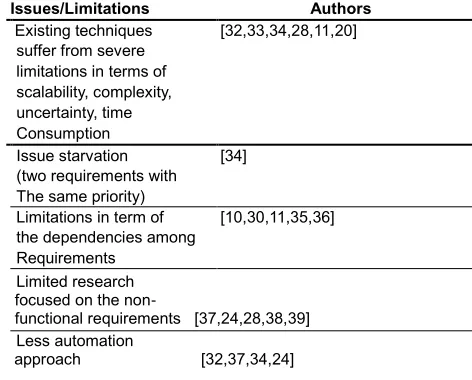
Many techniques have been developed by numerous researchers. However, the existing RP techniques failed to resolve some issues which are considered as limitations to their research. The limitations will be used as a basis to improve the RP techniques in ASD. In summary, Table 6 depicts the significant issues or limitations of existing RP techniques in ASD.
TABLE 6 SIGNIFICANT ISSUES OR LIMITATIONS OF RP TECHNIQUES IN ASD
Issues/Limitations Authors Existing techniques [32,33,34,28,11,20] suffer from severe
limitations in terms of scalability, complexity, uncertainty, time
Consumption Issue starvation [34] (two requirements with
The same priority)
Limitations in term of [10,30,11,35,36] the dependencies among
Requirements Limited research
focused on the non-
functional requirements [37,24,28,38,39]
Less automation
approach [32,37,34,24]
There are few challenges of RP techniques in Agile Software Development. Table 7 represents the significant challenges of RP techniques focusing on ASD. The challenges facing by the practitioners and researchers during the prioritization process are such as conflict between the stakeholders, changes done by the stakeholders in the priority list that can lead towards rework or re-prioritization and the selection of factors involved during the RP process.
TABLE 7 SIGNIFICANT CHALLENGES OF RP TECHNIQUES IN ASD
Challenges Authors
A conflict between the [29,24,11,3,16,10,28] Stakeholders
Changes in the priority list
lead towards rework [32,16,40] Requirement selection [28,6,7,5]
factors during RP process
RQ4: What are the factors involved in RP in ASD? Quality Very Poor Fair Good Very Total
Poor (>=2) (>=3) Good
Scale (>=1) (=5)
No of 10 25
Studies
Percentage
2123 The main goal of ASD is to deliver business value (Agile
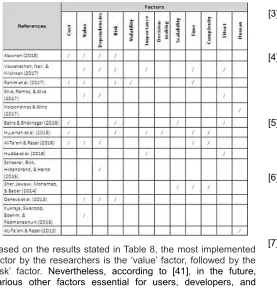
Manifesto). One way to achieve this is ―the continuous and value-driven requirements prioritization from customer‘s respective‖ [40,18]. Factors are aspects that are taken into consideration while prioritizing requirements. It is easy to prioritize using a single factor. However, when considering multiple factors, the high priority ranked requirements would receive less priority with some change in factors [9,11]. Through the SLR done by the researchers, there are some factors involved during RP in ASD. All factors depend on the purpose of the research since not all factors are suitable to be used during the RP process. Practitioners need to select the factors according to their project. Table 8 shows some factors that are typically implemented in the current RP process.
TABLE 8 SUMMARY OF RP USING DIFFERENT FACTORS
Based on the results stated in Table 8, the most implemented factor by the researchers is the ‗value‘ factor, followed by the ‗risk‘ factor. Nevertheless, according to [41], in the future, various other factors essential for users, developers, and testers can be considered for prioritization of the requirements. These new methods can be included in the prioritization process in ASD for the rapid and high-quality delivery of software products to customers.
10 CONCLUSION
The main objective of this SLR was to identify the RP techniques used in ASD and the current issues related to the RP techniques. The analysis in this SLR has been based on the constructed research question. A total of 25 primary studies were selected and analyzed. The results of this SLR show that many researchers have not reported their empirical results thoroughly. However, the results have shown that RP in ASD research continues to increase annually as the RP in the ASD technique is increasingly essential [16,32,41]. The essence of this SLR may be used to identify areas for possible improvement for RP in ASD. A systematic literature review has shown that researchers have a deep interest in the area of RP, especially in ASD. More research areas were introduced after
studying the published research work, and several further improvements are desirable. As mentioned in Table 6 and Table 7, there are still some issues, limitations, and challenges for RP in ASD that can be taken into consideration in future works.
Acknowledgment
The authors would like to thank Universiti Malaysia Sarawak and Universiti Putra Malaysia for supporting the research.
R
EFERENCES[1] Ritu, and Gill, N. S. 2015. A Comparison among Various Techniques to Prioritize the Requirements. International Journal of Computer Science and Management Studies, 12(03), 601–607.
[2] Suzanne Robertson, J. R. 2015. Requirements & Process. In Mastering the Requirements Process: Getting Requirements Right (pp. 1–3).
[3] Tonella, P., Susi, A., and Palma, F. 2013. Interactive requirements prioritization using a genetic algorithm. Information and Software Technology,55(1), 173–187. https://doi.org/10.1016/j.infsof.2012.
[4] Sharif, N., Zafar, K., & Zyad, W. (2014). Optimization of requirement prioritization using Computational Intelligence technique. In 2014 International Conference on Robotics and Emerging Allied Technologies in Engineering, iCREATE 2014 - Proceedings. https://doi.org/10.1109/iCREATE.2014.6828370
[5] Jawale, B. B., Patnaik, G. K., and Bhole, A. T. 2017. Requirement Prioritization Using Adaptive Fuzzy Hierarchical Cumulative Voting. Proceedings - 7th IEEE International Advanced Computing Conference, IACC 2017, 95–102. https://doi.org/10.1109/IACC.2017.0034 [6] Al-Ta‘ani, R. H., and Razali, R. 2016. A Framework for
Requirements Prioritisation Process in an Agile Software Development Environment: Empirical Study. International Journal on Advanced Science, Engineering and Information Technology, 6(6),
846. https://doi.org/10.18517/ijaseit.6.6.1375 [7] Silva, A., Ramos, F., and Silva, A. 2017. Ordering the
Product Backlog in Agile Software Development Projects: A Systematic Literature Review Ordering the Product Backlog in Agile Software Development Projects: A Systematic Literature Review.Researchgate.Net(April).
https://doi.org/10.18293/SEKE2017-007
[8] Karlsson, L., Thelin, T., Regnell, B., Berander, P., and Wohlin, C. 2007. Pair-wise comparisons versus planning game partitioning-experiments on requirements prioritization techniques. Empirical Software
Engineering, 12(1), 3–33.
https://doi.org/10.1007/s10664-006-7240-4.
[9] Andrews, P. B. and A. A. 2002. Requirements Prioritization. Journal in Engineering and Managing Software Requirements. https://doi.org/10.1007/3-540-28244-0_4.
[10] Alawneh, L. 2018. Requirements Prioritization Using Hierarchical Dependencies. In Advances in Intelligent Systems and Computing (Vol. 558). https://doi.org/10.1007/978-3-319-54978-1.
2124 Systems, INFOS 2014, SW18– SW24.
https://doi.org/10.1109/INFOS.2014.7036697
[12] Ammar, H., and Bhutta, M. 2019. Requirement Prioritization in Agile Development - A Review. Journal of Multidisciplinary Approaches in Science (JMAS), 1(1), 18–26.
[13] Asghar, A. R., Shahid, N. B., Atika, T., and S Asim, A. S. 2017. The Impact of Analytical Assessment of Requirements Prioritization Models: An Empirical Study. (IJACSA) International Journal of Advanced Computer Science and Applications, 8(2), 303–313. https://doi.org/10.14569/IJACSA.2017.080240
[14] Al-Ta‘ani, R. H., and Razali, R. 2017. Process Model For Systematic Requirements Prioritization Process In An Agile Software Development Environment Based On 5S Approach: Empirical Study. Journal of Theoretical and Applied Information Technology, 95(8), 1715. https://doi.org/10.18517/ijaseit.6.6.1375
[15] Khan, J., Izaz-ur-Rehman, Khan, S. P., Qasim, I., Khan,Y. H., Hayat, Y., and Khan, Y. H. 2016. An Evaluation of Requirement Prioritization Techniques with ANP. (IJACSA) International Ammar, H., & Bhutta, M. (2019). Requirement Prioritization in Agile Development - A Review, 1(1), 18–26.
Journal of Advanced Computer Science and
Applications, 7(7), 419–429.
https://doi.org/10.14569/ijacsa.2016.070758
[16] Alkandari, M., and Al-Shammeri, A. 2017. Enhancing the Process of Requirements Prioritization in Agile Software Development - A Proposed Model. Journal of Software, 12(6),439–453. https://doi.org/10.17706/jsw.12.6.439-453
[17] Kaur, G., & Bawa, S. (2013). A Survey of Requirement Prioritization Methods. International Journal of Engineering Research & Technology (IJERT), 2(5), 958– 962.
[18] Pergher, M., & Rossi, B. (2013). Requirements prioritization in software engineering: A systematic mapping study. 2013 3rd International Workshop on Empirical Requirements Engineering, EmpiRE 2013 -
Proceedings, (August), 40–44.
https://doi.org/10.1109/EmpiRE.2013.6615215
[19] Pitangueira, A. M., Maciel, R. S. P., & Barros, M. (2015). Software requirements selection and prioritization using SBSE approaches: A systematic review and mapping of the literature. Journal of Systems and Software, 103, 267–280. https://doi.org/10.1016/j.jss.2014.09.038 [20] Achimugu, P., Selamat, A., Ibrahim, R., & Mahrin, M. N.
R. (2014). A systematic literature review of software requirements prioritization research. Information and Software Technology, 56(6), 568–585.
https://doi.org/10.1016/j.infsof.2014.02.001
[21] Kitchenham, B., and Charters, S. 2007. Guidelines for performing Systematic Literature Reviews in SE. https://doi.org/10.1145/1134285.1134500
[22] Hassan, N. H., Ismail, Z., and Maarop, N. 2015. Information Security Culture: A Systematic Literature Review. Proceedings of the 5th International Conference on Computing and Informatics, (205),456–463. https://doi.org/10.4018/IJCWT.2015040103
[23] Bakly, A. H. El, and Darwish, N. R. 2018. A Proposed Hybrid Prioritization Technique for Software Requirements based on Fuzzy Logic. CiiT International
Journal of Fuzzy Systems, 10(2-February), 45–52 [24] Rida, A., Nazir, S., Tabassum, A., Sultan, Z., and Abbas,
R. 2016. Role of Requirements Elicitation & Prioritization to Optimize Quality in Scrum Agile Development. International Journal of Advanced Computer Science and Applications, 7(12), 300– 306. https://doi.org/10.14569/IJACSA.2016.071239
[25] Hudda, S., Mahajan, R., and Chopra, S. 2016. Prioritization of User-Stories in Agile Environment. Indian Journal of Science and Technology, 9(45).
https://doi.org/10.17485/ijst/2016/v9i45/105069
[26] Thakurta, R. 2013. A framework for prioritization of quality requirements for inclusion in a software project. Software Quality Journal, 21(4), 573–597.
https://doi.org/10.1007/s11219-012-9188-5
[27] Alshehri, S., Benedicenti, L., and Ismail, M. 2013. Using AHP for Prioritizing the XP User Stories from the Developers and Customers Perspectives. International Journal of Computer and Communication Engineering, 2(1), 41–43, Journal, 21(4), 573–597. https://doi.org/10.1007/s11219-012-9188-5
[28] Alam, S., Nazir, S., Asim, S., and Amr, D. 2017. Impact and Challenges of Requirement Engineering in Agile Methodologies: A Systematic Review. International Journal of Advanced Computer Science and
Applications, 8(4),411–420.
https://doi.org/10.14569/IJACSA.2017.080455
[29] Anand, R. V., and Dinakaran, M. 2017. Handling stakeholder conflict by agile requirement prioritization using Apriori technique. Computers and Electrical
Engineering, 61, 126–136.
https://doi.org/10.1016/j.compeleceng.2017.06.022 [30] Bakalova, Z., Daneva, M., Herrmann, A., and Wieringa,
R. 2015. Agile Requirements Prioritization: What Happens in Practice and What Is Described in Literature? (May).
https://doi.org/10.1007/978-3-642-19858-8
[31] Maya Danevaa et al. 2013. Agile Requirements Prioritization in Large-scale outsourced system Projects: An Empirical Study. Journal of Systems and Software, 86(5), 1333–1353.
[32] Saher, N., Baharom, F., and Romli, R. 2018. A Review of Requirement Prioritization Techniques in Agile Software Development. Knowledge Management International Conference (KMICe), 25–27. Retrieved from http://www.kmice.cms.net.my/ProcKMICe/KMICe2018/p df/CR63.pdf
[33] Hujainah, F., Binti, R., Bakar, A., Abdulgabber, M. A., and Zamli, K. Z. 2018. Software Requirements Prioritization: A Systematic Literature Review on Significance, Stakeholders, Techniques and Challenges. IEEE
Access, 6, 71497–71523.
https://doi.org/10.1109/ACCESS.2018.2881755
[34] Rahim, M. S., Chowdhury, A. Z. M. E. M. E., and Das, S. 2017. Rize: A proposed requirements prioritization technique for agile development. 2017 IEEE Region 10 Humanitarian Technology Conference (R10-HTC), 2018-Janua(December), 634–637.
https://doi.org/10.1109/R10-HTC.2017.8289039
[35] Herrmann, A., Bakalova Zornitza, Daneva, M., and Wieringa, R. 2013. Agile Requirements Prioritization: What Happens in Practice and What Is Described in
2125 https://doi.org/10.1007/978-3-642-37422-7
[36] Martakis, A., and Daneva, M. 2013. Handling requirements dependencies in agile projects: A focus group with agile software development practitioners. Proceedings – International Conference on Research Challenges in Information Science.
https://doi.org/10.1109/RCIS.2013.6577679
[37] Sachdeva, S., Arya, A., Paygude, P., Chaudhary, S., and Idate, S. 2018. Prioritizing User Requirements for Agile Software Development. 2018 International Conference On Advances in Communication and Computing Technology, ICACCT 2018, 495–498. https://doi.org/10.1109/ICACCT.2018.8529454
[38] Boerman, M. P., Lubsen, Z., Tamburri, D. a., Visser, J., Ruhe, G., Eberlein, A., and Padmanabhuni, S. 2015. Measuring and Monitoring Agile Development Status. 2015 IEEE/ACM 6th International Workshop on Emerging Trends in Software Metrics, 81(1), 54–62. https://doi.org/10.1109/WETSoM.2015.15
[39] Dabbagh, M., Lee, S. P., and Parizi, R. M. 2014. Application of hybrid assessment method for priority assessment of functional and non- Functional requirements. ICISA 2014 - 2014 5th
International Conference on Information Science and Applications, (May).
https://doi.org/10.1109/ICISA.2014.6847365
[40] Racheva, Z., Daneva, M., Sikkel, K., Herrmann, A., Wieringa, R., Herrmann, A., and Wieringa, R. 2010. Do We Know Enough about Requirements Prioritization in Agile Projects: Insights from a Case Study? Proceedings of the 2010 18th IEEE International Requirements Engineering Conference, RE2010, (September 2010), 147–156.
https://doi.org/10.1109/RE.2010.27
[41] Sheemar, H., and Kour, G. (2019). Enhancing User-Stories Prioritization Process in Agile Environment. International Conference on Innovations in Control, Communication and Information Systems, ICICCI 2017, 1–6.