Electrochrornic Iridium Oxides
PREPARATION AND PROPERTIES OF HYDROUS FILMS
By
L.
D.
Burke and R.
A.
Scannell
Chemistry Department, University College, Cork, Ireland
The recent development of potential cycling procedures ,for producing relatively thick hydrous noble metal oxide layers, plus the introduction of sputtering techniques for laying down such .films on other substrates such as conducting glass, has added an important new dimension to the study of noble metal oxidation. Differences in composition, apparent density and redox behaviour between the hydrous and anhydrous layers are discussed here with particular reference to the iridium oxide
system. Commercial applications that may result from its
electrochromic activity are also considered.
Interest in the anodic behaviour of the rarer platinum metals, especially ruthenium and iridium, has increased significantly over the past decade, largely due to the adoption of Ru02-activated titanium anodes in the chlor- alkali industry ( I ) and the discovery of marked electrochromic behaviour in hydrous iridium oxide layers (2, 3). Platinum and gold still
possess major advantages as substrates for the investigation of the initial stages of metal oxida- tion. Apart from the absence of dissolution, which can be significant for instance in the case of palladium, these two metals show a clear separation between the potential ranges for hydrogen adsorption and surface oxidation. The layers formed on the rarer noble metals, however, are generally more interesting as these surface oxides show intermediate transitions, for example Ir(III)/Ir(IV), which can give rise to marked electrocatalytic and electrochromic behaviour.
For any of these metals it is important to distinguish between two different types of oxides. First there are compact, anhydrous oxides such as PtO, A u P 3 and R u 0 2 where the only ligands bonded to the cations in the bulk phase are bridging oxygen (-0-) species as in rutile. Secondly there are dispersed (or extended) hydrous oxides in which the surface layer is present in poorly crystallised, gel form.
Again these oxides can be observed for platinum and gold. The ligands involved may include 0, OH and OHz species and there may be considerable quantities of water and electrolyte adsorbed and trapped within the layer. Most electrochemical studies of both oxidation and oxides to date have been concer- ned with the formation and reactivity of the more anhydrous materials. The techniques for producing hydrous oxide films, especially on the rarer platinum metals, have only recently been developed. Their redox and electrochromic properties are rather novel and progress in these areas will be reviewed here with particular reference to hydrous iridium oxide.
Formation
of
Hydrous
Oxide Layers
Although hydrous oxide films may be produced on gold (4, 5) and platinum (6) under severe anodic (d.c.) conditions, this method is apparently ineffective in the case of iridium. In fact the hydrous film grown on iridium on cycling dissolves at potentials above about I .6 V with respect to the reference hydrogen electrode (R.H.E.) (2). The most widely used
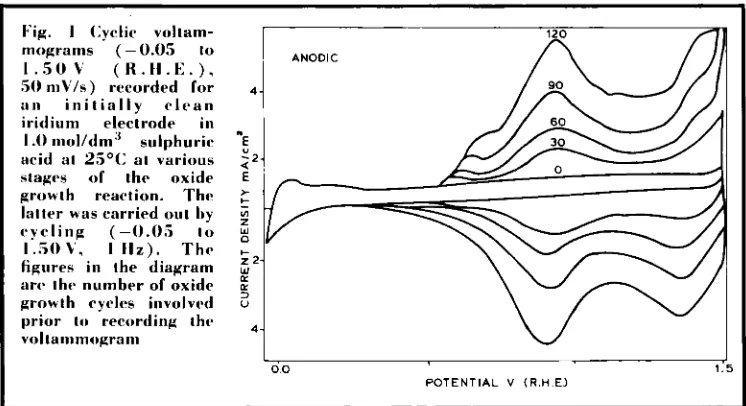
procedure for producing hydrous iridium oxide at the present time is the potential cycling technique, see F i g u r e I , described independently by Rand and Woods (7) and
Fig. I (:yclic voltam- mograms (-0.05 l o
1 . 5 O C ( R . H . E . ) ,
SO niC /s ) recorded for
a i l i n i t i a l l y c l e a n iridium electrode i n
1 .O mol/dm,' sulphurir acid at 2 5 O C a1 various stages o f the oxide growth reaction. T h e lalter was carried out by
r y c l i u g ( - 0 . 0 5 to
1.50 C , I 112). ' I h c figures i n the diagram are' the number of oxide growth cycles involved prior 10 recording the vol la mmogram
ANODIC
4 -
:
a
2-E
t
*
VIz w 0 c
z 2- w
(L 3
U
4-
0 0
POTENTIAL V ( R . H E.)
Buckley and Burke (2). Detailed investigation has shown that in 1.0 mol/dm3 sulphuric acid
the optimum upper and lower limits for a triangular growth sweep at 1 0 Hz are about
1.60 and 0.01 V (R.H.E.), respectively (8). This
procedure is also effective in dilute (9), but not in strong (8), base. As outlined recently for platinum, hydrous oxides are frequently more stable with regard to reduction than their anhydrous analogues, especially in base ( 1 0 ) . However, their formation under d.c. conditions is unfavourable since, with the platinum atom largely embedded in the metal lattice, a full oxyligand co-ordination state is not readily attainable. Instead, during the initial sweep the metal surface becomes coated with a layer of hydroxy species, which apparently are charged
( I I). These rapidly alter, via place-exchange type reactions, to form a largely anhydrous surface film which in the case of iridium scarcely extends beyond one or two monolayers. From the work with platinum it appears that the function of the lower limit in such cycling experiments is to disrupt the initial anhydrous film by extensive reduction (10). Renewed ano-
disation then results in oxidation not only of the displaced metal atoms formed on reduction but also some of the underlying metal. The outer region of the oxide thus produced is evidently more prone to hydration, giving a rather
disperse, stable material which is not readily reduced. Growth continues at the inner region, that is at the metal/(porous oxide
+
solution) interface, usually at a decreasing rate. Recent Rutherford back-scattering analysis indicates that with thick films produced in this manner the water content of the hydrous layer decreases across the film, that is on going from the oxideholution to the oxide/metal interface( I 2). Hydrous oxide formation is therefore assumed to be inhibited by the accumulation of increasing quantities of poorly hydrated material at the latter boundary. The function of the upper limit is less clear; possibly vigorous anodisation is needed to drive oxygen species into the outer layer of the metal lattice, since on subsequent reduction this would enhance the degree of disturbance of the outer region of the metal.
Another approach for the generation of hydrous iridium oxide films involves the use of sputtering techniques (13, 14, 15). In the literature the two types of deposits are some- times distinguished by the acronyms AIROF and
SIROF, anodic and sputtered iridium oxide
of iridium dioxide, in an argodoxygen (80/20)
atmosphere at a net pressure of approximately 33pm of mercury onto cooled substrates. Inadvertent traces of water in the deposition chamber were found to be highly beneficial, although high levels had a detrimental effect. The dispersed nature of the oxide is clear from the mean density values quoted for the various deposits. These range (in p/cm3) from I I .68 for
bulk anhydrous I r 0 2 to 10 or 7.8 for sputtered
films of low reactivity in the as-deposited and cycled condition, respectively ( I 6), about 4.0 for active, blue, sputtered films ( I 5) and, finally,
about 2.0 for films grown by potential cycling
(17). T h e two latter types of film are obviously highly hydrated in aqueous media and their redox and electrochromic properties are quite similar. The less active sputtered films, deposited in pure oxygen, evidently have a less porous structure. Generally they have a higher electrical conductivity ( I 5) and are more resistant to dissolution under oxygen evolution conditions ( I 8). However, they apparently require conditioning, that is potential cycling, during which they swell due to solvent uptake before displaying significant charge storage behaviour. Even then the peak potential for the main charge storage process is observed at a sig- nificantly lower potential as compared with active deposits (15). T h e active deposits also maintain their open-circuit potentials (and optical densities) in the oxidised or reduced state for longer times, that is to say they have a better memory than the inactive deposits ( I 5).
This is probably due to the greater degree of conversion of the material in the more dispersed form to the reduced or oxidised state in the first instance. Differential thermal and evolved gas analysis studies by Beni and co-workers ( I 6, I 9) have shown that the amorphous iridium oxide layers produced by sputtering techniques undergo an irreversible exothermic transition (AH 106 kJ/mol), with little change in stoichiometry, at about 3ooOC. This was attributed to an arnorphous/crystalline transi- tion in the oxide and resulted in a loss of electrochrornic properties. An endothermic reaction was noted at about 7o0°C and this was
accompanied by significant loss of water, hydrogen and oxygen. There was also some initial loss of water at lower temperature (about
I 2oOC) under vacuum conditions.
PotentiaVpH
and
Electrochromic
Behaviour
Although there are indications in cyclic voltammetry data recorded for iridium oxide layers of about four redox transitions in th? oxide region ( 2 I), discussion will be restricted here to the major peak observed just below 1.0
V (R.H.E.) in acid. The initial claim by Buckley and Burke (2, 8) that the reaction involved here is an Ir(III)/Ir(IV) transition in a hydrated oxyhydroxide film appears to be borne out by the work of McIntyre and co-workers (17).
There is, however, an unusual aspect of hydrous oxide electrochemistry involved here that is most clearly demonstrated by the pH- dependence of the reversible peak potential values. While it is widely accepted that the reversible potentials of oxide electrode systems vary by 59 mV per unit change in solution pH with respect to a pH-independent reference electrode, such as standard hydrogen or calomel
(22), the observed value for the main reversible charge storage peak for hydrous iridium oxide
(8, 20, 23) is close to 88.5 mV, that is 3/2 (2.303 RT/F) V, per unit change in pH. In terms of a
hydrogen reference in the same solution, that is on the R.H.E. scale, the corresponding values are o and 29.5 mV/pH unit, respectively.
T o explain this result, it has been assumed
(20,24), by analogy with earlier work on the hydrous gold oxide system (4, 5), that the redox behaviour in the iridium case is of the form: 2[Ir02(OH)22H20]n-2n
+
2ne-+ 3nH' =In this scheme the main oxide component in the surface layer is regarded as a porous, cross- linked gel or polymer (the composition given above is largely nominal), the polymer strands bearing a negative charge with the counterion present in the aqueous phase which permeates throughout the porous oxide layer. The assumptions here are not unusual; transition [ I ~ ~ O ~ ( O H ) ~ . ~ H Z O ] , - ~ " + 3nH2O [il
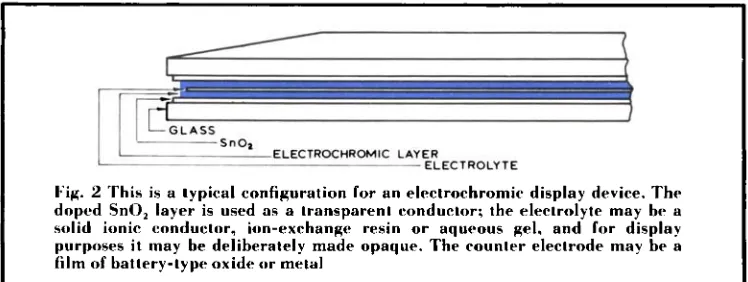
Fig. 2 'This is a typical configuration for an electrochromic display device. The doped SnO, layer is used as a transparent conductor; the electrolyte may be a solid ionic conductor, ion-exchange resin or aqueous gel, and for display purposes i t may be deliberately made opaque. The counter electrode may be a
film of battery-type oxide or metal
media frequently exist in anionic form due to hydrolysis effects (25). T h e acidity and
therefore ion-exchange capacity of the oxide increases on oxidation. This is reflected in the insertion of hydroxide ions, which in acid media are supplied by locally bound or trapped water molecules, when film oxidation occurs in accordance with Equation [i]. Since delocalised counterions (identified by the subscript "f ") are already present in the film, it is convenient to distinguish between these and ions which must transfer between the film and bulk solution (the latter are identified by the subscripts "s"). T h e main charge storage reaction in the film may therefore be represented by Equation [ii] for acid:
~ ( [ I ~ O ~ ( O H ) Z ~ H ~ O ] . ~ ~ " . ~ ~ H T + J
+
2ne-+ znH,'
=([Ir203(OH)~.3H20],-3".3nHr+l + 3nH2O [ii] and Equation [iii] for base:
z([IrO2(OH)2zH20], '".2nMr+ 1
+
zne- = ([Ir203(0H)3.3H20In 3".3nMf+J+ 3nOH-
+ nM,'
[iii] The major difference between the hydrous and anhydrous oxides is that the open structure of the former enables interaction to occur between most of the oxyspecies in the film, not just those at the external surface as in the case of anhydrous material, and solution species, especially HS and OH- ions. Such interaction influences not only the extent of charge storage capacity of the films but also the ther- modynamic, that is the potentiaVpH, behaviour of the redox transition, as recently described elsewhere (5, 24).
There has been considerable controversy in
the literature recently as to the nature of the ion-insertion reaction in the charge storage process. Some authors assert that the process involved is proton insertiodremoval (2, 12)
while others have claimed that the hydroxide species is involved (26). In fact it appears from
increasing thickness of hydrous material (28).
Finally, there is the electrochromic effect; the reduced form of the hydrous layer is trans- parent to visible radiation while the oxidised state is strongly absorbing, the layer in the latter case appearing deep blue. Since the electrochemical reactions (Equations [ii] and [iii]) giving rise to the change in oxidation state are quite rapid, considerable interest has developed recently with regard to potential applications of this effect.
Applications
Much effort has been devoted recently, mainly in Bell Laboratories, to the development
of devices such as optical displays based on the colour changes associated with the main redox transition in hydrous iridium oxide layers and first reported by Buckley and Burke (2). In its
simplest form an electrochromic cell may be regarded as a thin film battery with a significant colour difference between the charged and discharged states. Typical construction details are given in Figure 2. In an early publication in
this area Gottesfeld and McIntyre (29) pointed
out that the iridium oxide system possessed numerous advantages compared with WOh the traditional electrochromic material. These are: (a) fast response, (b) strong absorp- tion in the written state throughout the visible spectral region, (c) good open-circuit memory, (d) an operating range that avoids electrolyte decomposition and (e) the ability to grow and remove the oxide layer in situ within the electro-optic display cell. They also demons- trated that slow oxide dissolution in acid media could be avoided by operating at higher pH. In
R e f e r
I H . Beer, Chem. Ind., I 978, ( I 4), 49 I
2 D. N. Buckley and L. D. Burke,
3.
Chem. SOC., Faraday Trans. I , 1975, 11, (71, 14473 S. Gottesfeld, J. D. E. McIntyre, G. Beni and J.
L. Shay, Appl. Phys. Lerr., 1978, 33, (2), 208 4 L. D. Burke and M. McRann,
3.
Electroanal.Chem. Inrerfaciat Electrochem., I 98 1, 125, (2),
5 L. 387 D. Burke, M. E. Lyons and D. P. Whelan,
ibid., 1982, 1 3 9 , ( 1 ) , 131
0.5 mol/dm3 sodium sulphate with pH = 3.5,
negligible loss of film thickness or optical con- trast was noted after more than 5 x I O ~
colouration/bleaching cycles at 0.5
Hz.
In addi- tion Beni and co-workers have pointed out that W 0 3 films in acid degrade in the presence of water, and altering to non-aqueous solvents containing Lit or Na+ salts increased the switching time from about 0 . I to 1 .o s (26); the corresponding value for the iridium-based devices is about 20 ms. The main advantages ofelectrochromic, as compared with liquid crystal, displays are the wide viewing angle and open- circuit memory; at present their major disadvantage is their large peak currents at fast switching rates (30).
The fabrication of a seven-segment, sputtered iridium oxide display device, and its incorporation into a simple, low-power, battery- operated driver circuit, have been described recently by Shay and co-workers (30). A further development in this area is the recent descrip- tion of a matrix addressable system in which the display segments are not driven individually but are connected in rows and columns (3 I), the desired image being generated by controlling the potential of the individual rows or columns. A theoretical treatment of the application of electrochromics in this area has also been published and shows that in principle these electrochromic systems can be used in large complex active displays (32). Finally, the application of optical writing, where patterns are etched on electrochromic material by a laser beam, should not only enhance the possible use of these films in display devices but also lead to applications in optical data storage systems (33).
ences
6 S. D. James,
3.
Electrochem. SOC., I 969, I 16, ( I 2),1681
7 D. A. J. Rand and R. Woods,
3.
Elecrroanal. Chem. Interfacial Elecrrochem., I 9 7 4 , 5 s , (3), 375 8 D. N. Buckley, L. D. Burke and J. K . Mulcahy,J.Chem. SOC., Faraday Trans. I , I 976,72, (9), 1896 9 M. S. Ureta-Zanarru and J. H. Zagal, Ext. Abs.
Spring Meeting, Montreal, 1982, The Electrochem. Sac., Pennington, New Jersey,
1 0 L. D. Burke and M. B. C. Roche,
3.
Electroanal. Chem. Interfacial Electrochem., in pressI I L. D. Burke and M. B. C. Roche, J. Electroanal. Chem. Interfacial Electrochem., 1983, 159, ( I ) , 89
1 2 J. D. E. McIntyre, S. Basu, W. F. Peck, W. L.
Brown and W. M. Augustyniak, Phys. Rev. B,
1 3 L. M. Schiavone, W. C. Dautremont-Smith, G. Beni and J. L. Shay, Appl. Phys. Lett., 1979, 3 5 , 1982, 25, (121, 7242
(101,823
14 idem.,J. Electrochem. Soc., 1981, 128,(6), 1339 1 5 K. S. Kang and J. L. Shay,
3.
Electrochem. SOC.,I 6 S . Hackwood, G. Beni and P. K. Gallagher, Solid
Stare lonics, I 98 I , 2 , (4), 297
17 J. D. E. McIntyre, W. F. Peck and S. Nakahara, 3 . Electrochem. Soc., 1980, 127, (6), I 264 1 8 G. Beni, L. M. Schiavone, J. L. Shay, W. C.
Dautremont-Smith and B. S. Schneider, Nature,
19 S. Hackwood, A. H. Dayem and G. Beni, Phys. Rew. B, I 982, 26, (2), 47 I
20 L. D. Burke and D. P. Whelan,
3.
Elecrroanal. Chem. Interfacial Electrochem., I 98 I , 124, (1/2),333
2 1 J. Mozota and B. E. Conway, Electrochim. Acta,
1983, 13% (4), 766
1979, 282, (5736), 28 I
1983,28,(1), I
2 2 G. Kortum, “Treatise on Electrochemistry”,
2 3 B. E. Conway and J. Mozota, Electrochim. Acta,
24 L. D. Burke and D. P. Whelan,
3.
Electroanal. Chem. Interfacial Electrochem., in press2 5 F. A. Cotton and G. Wilkinson, “Advanced
Inorganic Chemistry”, 3rd Edn. Interscience, New York, 1972, p. 646
26 G. Beni, C. E. Rice and J. L. Shay,
3.
Electrochem. Soc., 1980, 127, (6), 1342
27 S. H. Glarum and J. H. Marshall,
3.
Electrochem.28 L. D. Burke and E. J. M. O’Sullivan, J .
Electroanal. Chem. Interfacial Electrochem., I 98 I ,
29 S. Gottesfeld and J. D. E. McIntyre, 3 .
Electrochem. Soc., I 979, 126, ( 5 ) , 742
30 J. L. Shay, L. M. Schiavone, R. W. Epworth and D. W. Taylor, J. Appl. Phys., I 982,53, (9), 6004
31 G. Beni and L. M. Schiavone, Appl. Phys. Left.,
32 G. Beni, J. Electrochem. Soc., 1980, 127, (lo),
33 S. Hackwood, G. Beni, M. A. Bosch, K. Kang, L. M. Schiavone and J. L. Shay, Phys. Rev. B, 1982,
26, ( 1 21, 7073
Elsevier, Amsterdam, 1965, pp. 326-328
1983928, ( 1 ) , 9
Soc.7 19809 127, (71, 1467
1 1 7 9 ( 1 ) 3 1 5 5
198 1 7 38, (8), 593
467C
Precision Temperature Measurements
EFFECTS OF AIR QUENCHING A N D STRESSING
ONPLAT1NUM:RHODIUM-PLATINUM
THERMOCOUPLES
I n 1979 the Ottawa laboratories of the Physics Division of t h e National Research Council of Canada issued the first two volumes of‘ a report o n the use o f p l a t i n u m : ~ ~ per cent rhodium-platinum thermocouples for measur- ing temperatures with a precision of at least 0.r0C ( I ) .
A third volume has now been published, examining in considerable detail “the ther- moelectric effects of mild quenching and defor- mation that might be experienced by the individual elements during t h e preparation and use o f standard thermocouples” (2).
T h e earlier report specified that for precision use the couples (usually 1 8 6 c m long) should, before use, be electrically annealed in air at
I 3ooOC for I to I o hours and, after cooling in air, be annealed for I hour at 450°C to eliminate quenched-in vacancies and finally, after sheathing, be given a recovery and equilibrium anneal at 450°C overnight.
After this elaborate pretreatment it is not easy to visualise why a competent experimenter intent o n using the couple t o measure
temperatures with a precision o f
?O.I”C,
should air-quench either elements from temperatures between 800 and 1300OC or should stretch t h e wires to near their breaking point or twist the ends into tight spirals.
However, the present volume examines con- scientiously in meticulous detail t h e effects of such mistreatments. It provides a tribute t o t h e care and thoroughness with which this study of the factors affecting t h e readings of this ther- mocouple has been conducted. It may be reassuring to industrial users to note that the greatest damage recorded by any of these treat- ments amounts t o no more than a reduction in temperature reading of 0.8”C.
References
I E. H. McLaren and E. G. Murdock, “The
Properties of PdPtRh Thermocouple for Ther- mometry in the Range 0-1 IOOOC”, Parts I and 11,
I 979, Ottawa, National Research Council Canada; see also Platinum Metals Rev., I 979,23, (4), I 53
2 Part 111, Effect of Metal Quenching and Deforma- tion on Standard Thermocouples, October 1983
J. C. C.