C O M M E N T A R Y
Open Access
Developing key performance indicators to
measure the progress of regional
regulatory convergence and cooperation in
Asia-Pacific Economic Cooperation (APEC)
Sannie Siaw Foong Chong
1*, John C. W. Lim
2and Toshiyoshi Tominaga
3Abstract
Regulatory convergence and cooperation among the authorities in the field of medical products (medicines and medical devices) are essential to deliver safe and efficacious products quickly to patients. APEC established the Regulatory Harmonization Steering Committee (RHSC) to advance this cause among member economies. This paper identifies four areas of appropriate regulatory practice in which APEC economies could converge, and explores the feasible processes of how APEC economies could cooperate in order to bring about realization of a maximum level of regulatory convergence by 2020.
Keywords:APEC, Regulatory convergence and cooperation, Key performance indicators
Background
Since the inception of the International Council for Har-monisation of Technical Requirements for Pharmaceuti-cals for Human Use (ICH) in 1990, harmonization of regulatory requirements has been progressively and suc-cessfully achieved in major jurisdictions around the world. This has benefited global public health and na-tional health systems mainly through transparency and predictability of what scientific dataset is required to support the approval of a new pharmaceutical, hence ad-vancing the innovation of drug development. In addition, convergence and cooperation (information exchange, work sharing, reliance, and recognition) (WHO Good Regulatory Practices 2016) have been facilitated among the ICH regulatory members (ICH Official website2018) in order to optimize efficiency in regulatory processes without duplication in efforts.
In 2010, the RHSC established under APEC’s Life Sci-ences Innovation Forum (LSIF) advocated for regulatory convergence in pharmaceuticals for improved public
health and economic development among its 21 econ-omies (APEC Member Econecon-omies 2017). Convergence will focus on the process of aligning multiple countries’ regulations for greater regulatory cooperation and does not necessarily require the regulations to be “ harmo-nized”. According to an RHSC strategic framework document released in 2010, while each economy may adopt each phase on its own timeframe, the ultimate aim would be for APEC economies to achieve the max-imum level of regulatory convergence feasible by 2020 (APEC RHSC Vision2020).
This paper identified four areas of appropriate regula-tory practice in which APEC economies could converge. The four areas are related to the use of (1) Certificate of Pharmaceutical Product (CPP); (2) the Pharmaceutical Inspection Co-operation Scheme (PIC/S) membership; (3) managing multiple sites in one license; and (4) risk-based reliance evaluation system. These four areas could be explored together with the feasible processes of how APEC economies could cooperate that would facili-tate the defining or development of key performance in-dicators (KPIs) to measure the progress of convergence to assess whether “the regulatory requirements across economies become more similar or ‘aligned’over time” (APEC RHSC Vision2020).
* Correspondence:[email protected]
1Asia Pacific Technical Regulatory Policy, Pharma Technical Regulatory Policy
and International Operations, Roche Singapore Technical Operations, F. Hoffmann La-Roche Ltd, Singapore, Singapore
Full list of author information is available at the end of the article
Evolution of regulatory harmonization, convergence, and cooperation: The ICH experience
From the early 1990s onwards, international regulatory harmonization for new drug development has been pur-sued under the efforts of ICH. This has given rise to a standardized format, i.e. the common technical docu-ment (CTD), for companies to consolidate their scien-tific dataset for regulators’ evaluation. Over the years, ICH members have also jointly developed some 70 guidelines to provide scientific principles and assessment details of the various sections listed in the CTD. Through the acceptance and full implementation of ICH guidelines by ICH members, regulatory requirements were harmonized among the ICH members. This great achievement has not only advanced access of new drugs to patients, but has also become the gold standard by which any regulatory authority can base its assessment framework for approving a new drug that is shown to be safe, efficacious and of good quality.
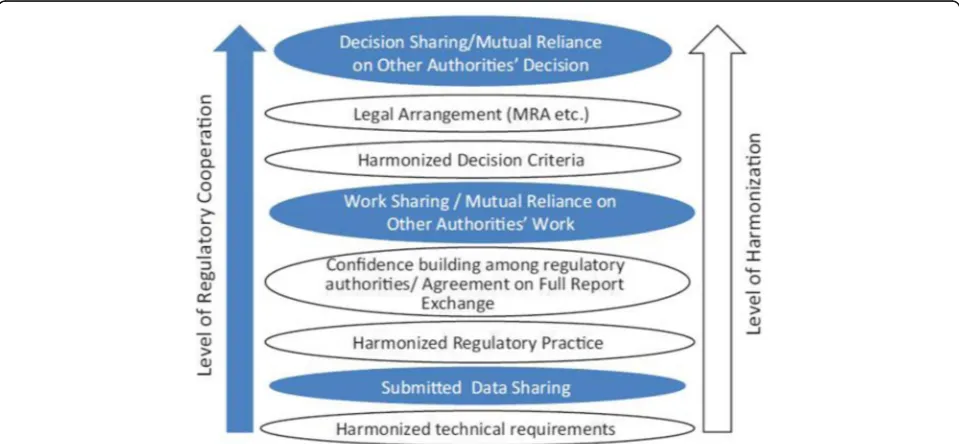
The ICH efforts have created a “common language” among international regulatory stakeholders and has promoted increasing cooperation among national regula-tory authorities. Three levels of cooperation can gener-ally be identified as shown in the shaded ellipses of Fig.1(Tominaga2013):
Level 1: Information sharing/reliance. Level 2: Working-sharing/mutual reliance. Level 3: Mutual recognition.
Level 1 cooperation is feasible for regulators who adopt ICH requirements but are not yet full members of ICH, and who can leverage on the assessments com-pleted by stringent regulatory authorities (SRA) (WHO collaborative procedure2017). The use of a SRA’s assess-ment report enables a non-ICH regulator to expedite learning of ICH guidelines applied to evaluate scientific datasets and arriving at sound decisions while minimiz-ing duplication efforts.
Level 2 cooperation takes place when the regulatory practice made on the data is also harmonized. For ex-ample, when confidence building is in place and the pro-cedures for Good Manufacturing Practice (GMP) audit are harmonized, one authority can rely on the audit re-ports of another authority to base its decisions without duplicating the physical auditing process of the same manufacturing premises. This mutual reliance on work products of other authorities or work sharing among au-thorities is the next level of regulatory cooperation.
Level 3 and the highest level of regulatory cooperation is mutual recognition. However, the sharing of regula-tory decisions among national regularegula-tory authorities cannot be achieved easily due to factors such as differ-ences in expertise and capacity, legal and risk frame-works, mutual understanding of systems and processes, and sovereignty issues. It is even more difficult when the process needs formalization and a legal arrangement such as a mutual recognition arrangement (MRA) must be concluded.
The PIC/S established since 1995, is an extension to the Pharmaceutical Inspection Convention (PIC) of 1970. PIC/S is a non-binding co-operative agreement be-tween regulatory authorities in the field of GMP of me-dicinal products for human or veterinary use. PIC/S aims at harmonizing the inspection procedures world-wide by developing common GMP standard and provide training opportunities to inspectors. It also aims to facili-tate co-operation and networking between regulatory authorities (PIC/S Brochure 2016). The common stan-dards and practices of ICH and PIC/S requirements have facilitated the following examples of cooperation among ICH members:
(a) Information-sharing/reliance: Health Canada
does not evaluate the drug master file of a generic drug if a Certificate of Suitability (CEP) issued by the European Directorate for the Quality of Medicines and Healthcare (EDQM) is already available (Government of Canada2017);
(b)Work-sharing/mutual reliance: The U.S. Food
and Drug Administration (USFDA) and European Medicines Agency (EMA) initiated their pilot joint assessment of Quality by Design dossier (EMA-FDA pilot program2013);
(c) Mutual recognition: US FDA and EMA are
currently developing a GMP MRA (EU-US mutual recognition of inspections2017).
Best practices and feasible processes for APEC economies’convergence
In 2010, the APEC RHSC advocated for regulatory con-vergence in pharmaceuticals among its 21 economies so as to improve public health and economic development. The term “convergence” was clearly defined by the RHSC (APEC RHSC Vision2020) with the understand-ing that:
Regulatory convergence represents avoluntary processwhereby the regulatory requirements across economies become more similar or“aligned”over time as a result of the gradual adoption of internationally recognized technical guidance documents, standards and scientific principles (harmonization) and common or similar practices and procedures.
Itdoes notrepresent the harmonization of laws and regulations, which is not necessary to allow for the alignment of technical requirements and for greater regulatory cooperation.
The RHSC initiative does not seek to develop new guidances; rather, it relies upon existing guidances already developed by international harmonization
organizations, with ICH as the primary source. The ef-forts of RHSC focus on “convergence”, i.e. on the process of aligning APEC economies’regulatory require-ments based on best practices for optimal regulatory cooperation.
For the purposes of APEC RHSC activities and this Framework, the concept of “harmonization” represents the development and adoption of the same standards or requirements. Harmonization may also be applied to procedures and practices to see that these are the same across economies. The significance of the introduction of this concept is the emphasis that harmonization and convergence of drug regulations among multiple coun-tries across the Asia-Pacific are ultimately for regulatory cooperation to expedite the access of patients to medi-cines and to benefit public health. In order for cooper-ation at the various levels (Fig. 1) to take place, regulatory processes and practices essential for such co-operation will first need to be put in place. However, while harmonization refers to processes that develop uniform standards across jurisdictions, regulatory con-vergence is a more pragmatic and feasible approach that better accommodates sovereignty and legal issues which make it difficult to achieve complete standardization across different economies.
This section aims to recommend four prioritized areas of appropriate regulatory practice in which convergence can be maximally achieved by 2020. Accordingly, KPIs can be developed in relation to these four areas to meas-ure the progress of convergence to determine whether the regulatory requirements across economies become more aligned over time. The four areas are:
A. The appropriate use of the CPP;
B. The appropriate use of PIC/S membership; C. The appropriate management of multiple sites; and D. The appropriate use of risk-based evaluation based
on information
(A) The appropriate use of the CPP
CPPs but as its regulatory system matured, the require-ment for the CPP has been removed from both its pre-and post-marketing control requirements.
With “convergence”, the understanding is that “each economy may adopt each phase on its own timeframe” (APEC RHSC Vision 2020). In discussing a phased ap-proach to achieve a maximum level of regulatory con-vergence by 2020, the 21 APEC economies may be broadly placed into 2 groups, namely those that depend on a CPP for regulatory decision making and those that do not.
Australia, Canada, Japan, Singapore and the United States of America (USA) are examples of non CPP-dependent APEC economies which do not require CPP for their product registrations. It is worth noting that these five examples are both regulatory members of PIC/S and ICH. Another observation is that various forms of cooperation already exist among these five APEC economies as that described in the preceding sec-tion. Such cooperation is facilitated by the common standards of ICH coupled with regulatory systems aligned with international practices implemented in their regulatory processes.
Among the APEC economies which are considered “CPP-dependent”, China in recent years has undergone a series of regulatory reforms by converging its require-ments towards international standards. One of the revi-sions China made in October 2017 is working towards the removal of CPP for Clinical Trial Application (CTA) and New Drug Application (NDA) applications for new chemical products and innovative biological products (CFDA Order No. 352017). It would therefore be useful for China to share with the other CPP-dependent APEC economies its rationale and approach for progressing from CPP-dependent to independent regulatory reviews based on ICH standards.
As the CPP is used to replace full or partial review of quality, safety and efficacy in line with WHO’s advice, it is recommended that the need for CPP dependency amongst APEC economies that have already acquired PIC/S membership be reviewed, since these countries have already demonstrated capability to comply with international standards. It is therefore timely to review the relevance of CPP in both their pre- and post-marketing systems (WHO CPP Scheme 2015). However, for economies yet to achieve PIC/S member-ship, the CPP remains relevant in line with WHO advice.
(B) The appropriate use of PIC/S membership
The APEC economies that are PIC/S members could utilize the PIC/S network and common high standards to make significant positive moves towards greater con-vergence in GMP compliance assessment and conduct
of inspections. It is recommended that these PIC/S members streamline existing procedures so that:
(a) The current GMP related documentation required before inspections to support compliance
assessment are minimized with country specific requirements such as unnecessary declaration forms, various reports and raw data, etc. (Nishimura2017)
(b) Acceptance/reliance of PIC/S member inspection reports or GMP certification is in place so that inspection efforts are not unnecessarily duplicated (WHO Guidance on Good Practices2017). Instead, on-site inspections should focus on manufacturing sites which are of concern, which have not historic-ally been inspected by PIC/S inspectors, or have re-cently been noted to have GMP/quality concerns.
(C) The appropriate management of multiple sites
In October 2015, Chinese Taipei formally issued a new regulatory policy to allow a single product made in mul-tiple sites to only have one license (Taiwan regulation
2015). Furthermore, when a new site is required to be added after its initial approval, a new license will not be warranted. Chinese Taipei changed its policy to align with international standards of regulating multi-sites in one license, and managing subsequent site additions as a post approval change, similar to what is practiced by ICH members.
The one-site-one-license process is commonly de-ployed among the APEC economies which are“ CPP-de-pendent” (ASEAN Variation Guidelines 2013; Hong Kong Drug Office 2017), and this approach is quite the opposite of that practiced by ICH members. This results in highly duplicative and onerous procedures which are mainly administrative and have little (if no) positive im-pact on quality, safety and efficacy. The burden to apply and maintain multiple licenses for a single product significantly reduces product sourcing flexibility and affects continuity of supply, thus impacting patients in the case of product shortages. It is therefore strongly recommended that the APEC economies with the one-site-one-license requirement consider reviewing this system to allow for single licenses for multiple sites in order to converge regional regulatory practice in this particular area.
(D) The appropriate use of risk-based evaluation based on information-sharing
therapies emerge. It is extremely important for regula-tory authorities to prioritize optimal use of resources, while working towards attaining fully functional and ef-fective regulatory systems according to international standards such as PIC/S. While working towards attain-ing PIC/S membership and to manage issues of scarce resources and expertise, APEC economies could con-sider adopting more risk-based approaches that leverage on evaluations conducted by stringent regulatory author-ities, and focusing their regulatory resources on issues that are of locally critical significance. This will not only promote greater convergence in areas where appropriate scientific and technical assessments have already been completed by allied regulatory authorities but also help deploy expertise more efficiently (WHO Good Regula-tory Practices 2016). An overview of Singapore’s ap-proach to risk-based evaluation that adopted this pragmatic approach to optimize limited resources effect-ively while maintaining robustness in its decisions con-stitutes a useful case study.
The Singapore Health Sciences Authority (HSA) attained PIC/S membership in 2000 (PIC/S members). This enabled HSA to be a member of a forum of estab-lished inspectors for networking and confidence build-ing. For product evaluation, HSA leveraged on public assessment reports and stringent regulations of its five Reference Agencies (HSA Guidance (page 42 of 166)
2016) to approve products. Through the years of cooper-ation with these five agencies (involving memorandums of understanding, communication, training, information sharing, and staff attachments), HSA identified elements in the benefit-risk assessment that are more critical in the local context, and HSA was able to leverage the work of larger agencies while ensuring the benefit-risk assessments were applicable to the Singapore population (Patel et al.2017). At the same time, the agency also im-plemented process reviews whereby its requirements be-come more aligned over time to established regulatory authorities as a result of the gradual adoption of inter-nationally recognized guidance documents, scientific principles and best practices. It is of note that HSA eventually attained full membership of ICH in 2017 (HSA gains international acceptance2017). This enabled Singapore to develop the necessary capabilities to per-form full reviews for first-in-the-world products that had not been registered elsewhere (Wong & Lim2003). Cap-abilities to perform independent evaluation remain stra-tegically critical and this ensures support for regional biomedical research and development growth population (Patel et al.2017).
To ensure the effective use of resources, HSA also conducted a series of business process reviews (Haydock I 2010) to optimize productivity while ensur-ing robustness. This enabled HSA to rationalize what
documents needed to be provided by the industry and which departments in the agency should evaluate the doc-uments throughout the life cycle of the products. Pre- and post-marketing experts were organized into one common vigilance team to take charge of alert responses through-out the entire life-cycle of products, with activities includ-ing quality surveillance testinclud-ing and pharmacovigilance monitoring. This streamlined the regulatory procedures to enable a seamless, integrated and science-based frame-work that is highly effective in risk mitigation, and also less bureaucratic in nature. To further increase efficiencies and avoid duplicative work, HSA introduced the“ verifica-tion route”in 2004; this requires product approval by two or more reference agencies and HSA focuses on verifying the benefit-risk based on the assessment report of the se-lected reference agencies. This route has a short timeline of 60 working days (Patel et al.2017).
On the basis of similarity in standard and procedures, a MRA on GMP conformity assessment between Australia and Singapore was signed on 26 February 2001. The agreement is of treaty status and includes the sector on Medicinal Product GMP Inspection. Under the MRA, the Therapeutic Goods Administration (TGA) of Australia accepts the conclusions of inspections of manufacturers carried out by GMP Auditors of HSA, Singapore and vice-versa. The GMP inspection report/ certificate is made available to the requesting party ex-peditiously, and the time taken should not exceed 30 cal-endar days (HSA International Accreditation 2001). In 2011, two of Singapore’s Reference Agencies, Health Canada and the TGA, invited Singapore to embark on a work sharing initiative for generics evaluation (Inter-national Consortium 2012). This highlights that Singapore is recognized as a credible partner in a four-member regulatory consortium that was established in 2007 (Australia-Canada-Singapore-Switzerland2017).
Proposed KPIs to measure APEC regulatory convergence and cooperation
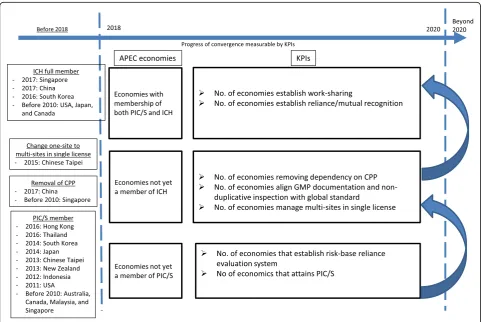
Based on the discussion above, several KPIs linked to the four areas of appropriate regulatory practice could be used to help measure the progress of regulatory con-vergence on regulatory approval procedures for medical products across APEC economies by 2020 (Fig.2).
The potential KPIs for the various economy groupings are as follows:
(a) APEC economies not yet a member of PIC/S:
(i) Number of economies with risk-based reliance evaluation system;
(ii) Number of economies attaining PIC/S status.
(b) APEC economies not yet a member of ICH:
(i) Number of economies removing CPP dependence and aligning with ICH practice;
(ii) Number of economies aligning GMP
documentation and non-duplicative inspection to that of international practice;
(iii) Number of economies managing multi-sites in a single license.
(c) APEC economies with membership of both PIC/S and ICH:
(i) Number of economies with work-sharing arrange-ments and mechanisms;
(ii) Number of economies with reliance/mutual recognition arrangements and mechanisms.
Regulatory convergence and cooperation should be promoted together. This is because for convergence to be meaningful, greater targeted cooperation amongst regulatory authorities should be realized in areas such as information sharing, relying on each other’s decisions and work sharing to minimize duplication and enhance efficiency. Accordingly, the degree of success of regula-tory convergence and cooperation will need to be mea-sured by defining or developing a combination of KPIs that collectively measure convergence and cooperation.
Capacity building
To help promote convergence across the APEC region, capacity building is a clear need and enabler. Capacity building activities for regulatory authorities should be designed with clear awareness that one major purpose is for trainees to acquire skills and knowledge to enable
their organizations to start leveraging on stringent au-thorities’ assessments and decisions in an appropriate manner, while developing their own regulatory capabil-ities to conduct independent, science-based reviews and other important local regulatory functions such as phar-macovigilance and supply chain integrity, in line with WHO’s recommendation that regulatory authorities should focus “on what cannot be done by others while leveraging the work of other trusted NRAs and regula-tory networks”(WHO Good Regulatory Practices2016).
APEC has already introduced the frameworks for iden-tifying and supporting Centres of Excellence (COEs) such as those in Duke-NUS Medical School in Singapore, Beijing University, Japan’s Asia Training Cen-ter and NorthwesCen-tern University in the USA (APEC Harmonization Center 2018). The courses of these COEs should aim to incorporate training on the use of public assessment reports or inspection reports issued by the stringent authorities to identify elements that matter in order to conduct appropriate benefit-risk as-sessments and reach sound regulatory decisions without compromising on scientific robustness. Trainees should be encouraged to develop risk-based reliance evaluation processes in their respective regulatory frameworks and become competent to eventually conduct independent evaluations based on international standards.
APEC economies can draw lessons from each other’s experiences to expedite convergence through meaningful practical training that will bring about maximal out-comes. Based on the success stories of various APEC economies achieving convergence efforts cited in this paper, the following economies could potentially be in-vited to share experience in the context of existing or new CoEs:
(a) China - streamlining CPP dependency;
(b) Australia and Singapore - risk-based evaluation procedures based on information-sharing; (c) Mexico - attaining PIC/S membership
(Mexico to join PIC/S2017);
(d) Canada, Australia and Singapore - minimizing country specific GMP documentation required as pre-inspection packages and non-duplicative inspection based on best practices (HSA Guidance Page 51–55,2016);
(e) South Korea - becoming ICH member by the adoption of ICH Q1, Q7 and E6 guidelines (ICH Members & Observers2017);
(f ) Chinese Taipei - managing multi-sites in one license.
Conclusion
National regulatory authorities are charged with the re-sponsibility to ensure that the health products used by
their populations are safe, efficacious and of good qual-ity. It is also the duty of these authorities to expedite ac-cess of patients to the medicines and medical devices they need in a timely manner. With the ever increasing complexity of new biomedical and biotechnological products and development, coupled with the challenges arising from the global supply chain, the need for regula-tory convergence and cooperation is essential rather than optional. In today’s world, no single regulatory au-thority can claim that it is fully resourced to manage all issues relating to pre- and post-marketing of all the medicines and medical devices available in its country. The rational way forward is therefore to optimize the use of scarce resources in cooperation with regional and international regulatory counterparts, while administer-ing a robust regulatory system that does not duplicate efforts to ensure timely access of health products to pa-tients in a reliable and efficient manner.
APEC’s continuing efforts to develop and promulgate good review practices are paving the way toward the sharing of review reports among participating authorities (Lin et al. 2015). Specifically, APEC regulators should embark on aligning best practices and processes of those prioritized areas as highlighted in this paper, as essential building blocks for ensuring the success of regulatory convergence.
Abbreviations
APEC:Asia Pacific Economic Cooperation; CEP: Certificate of suitability; COE: Centres of excellence; CPP: Certificate of pharmaceutical product; CTA: Clinical trial application; CTD: Common technical document; EDQM: European directorate for the quality of medicines and healthcare; EMA: European Medicines Agency; GMP: Good manufacturing practice; HSA: Health Sciences Authority; ICH: International council for harmonisation of technical requirements for pharmaceuticals for human use; LSIF: Life sciences innovation forum; MOU: Memorandums of understanding; MRA: Mutual recognition arrangement; NDA: New drug application; PIC: Pharmaceutical inspection convention; PIC/S: The pharmaceutical inspection co-operation scheme; RHSC: Regulatory Harmonization Steering Committee; SRA: Stringent Regulatory Authorities; TGA: Therapeutic Goods Administration; USA: United States of America; USFDA: U.S. Food and Drug Administration
Acknowledgements
SSFC thanks Dr. Wassim Nashabeh from F. Hoffmann La-Roche Ltd. for his in-spirational leadership in the advocacy of APEC regulatory convergence. The authors acknowledge Dr. Dorothy Toh from Singapore HSA for reviewing the case study of her organization, and Ms. Shamsuria Sumsoory for providing editorial support.
Funding
Processing fee of AAPS open was provided by SSFC’s organization.
Authors’contributions
Competing interests
The authors declares that they have no competing interests.
Publisher’s Note
Springer Nature remains neutral with regard to jurisdictional claims in published maps and institutional affiliations.
Author details
1Asia Pacific Technical Regulatory Policy, Pharma Technical Regulatory Policy
and International Operations, Roche Singapore Technical Operations, F. Hoffmann La-Roche Ltd, Singapore, Singapore.2Centre of Regulatory
Excellence, Duke-NUS Medical School, Singapore, Singapore.
3Pharmaceuticals and Medical Devices Agency (PMDA), Tokyo, Japan.
Received: 22 January 2018 Accepted: 23 April 2018
References
APEC Harmonization center (2018) Center of Excellence Overviewhttp://www. nifds.go.kr/apec/content/view.do?contentKey=288&menuKey=318
APEC RHSC Vision 2020 (2010) A Strategic Framework: Regulatory Convergence for Medical Products by 2020.http://mddb.apec.org/documents/2011/MM/ AMM/11_amm_004att1.pdf
ASEAN Variation guidelines for pharmaceutical products (2013)http://www.hsa. gov.sg/content/dam/HSA/HPRG/Western_Medicine/Overview_Framework_ Policies/Guidelines_on_Drug_Registration/ASEAN%20Variation%
20Guideline%20for%20Pharmaceutical%20Products%207.2%20clean%20draft. pdf
Asia-Pacific Economic Cooperation (APEC), Member Economies (2017)
https://www.apec.org/About-Us/About-APEC/Member-Economies
Australia-Canada-Singapore-Switzerland (ACSS) Consortium (2017)https://www. tga.gov.au/australia-canada-singapore-switzerland-acss-consortium
CFDA Order No. 35 (2017) "Decision on Adjusting the Management of Imported Drugs Registration”(October 2017).http://www.sfda.gov.cn/directory/web/ WS01/CL0053/178363.html
Deloitte & Touche LLP (2017) Fostering Biomedical Innovation & Excellence: Collaborating to enhance access to innovative medicines in Singapore EMA-FDA pilot program for parallel assessment of Quality-by-Design applications:
lessons learnt and Q&A resulting from the first parallel assessment (2013)
http://www.ema.europa.eu/docs/en_GB/document_library/Other/2013/08/ WC500148215.pdf
EU-US mutual recognition of inspections of medicines manufacturers enters operational phase (2017)http://www.ema.europa.eu/docs/en_GB/document_ library/Press_release/2017/10/WC500237909.pdf
Government of Canada (2017) Guidance Document: Use of Certificates of Suitability as supporting information in Drug Submissionshttps://www. canada.ca/en/health-canada/services/drugs-health-products/drug-products/ applications-submissions/guidance-documents/chemical-entity-products- quality/guidance-document-use-certificates-suitability-supporting-information-drug-submissions.html
Haydock I (2010) Singapore looks beyond its shores. Regulatory Affairs J Pharma 21(4):229–230
Hong Kong Drug Office (2017) Guidelines on Application for Change of Registered Particulars of a Registered Pharmaceutical Product.http://www. drugoffice.gov.hk/eps/do/en/pharmaceutical_trade/guidelines_forms/ lcopGuide.html
HSA Therapeutic Products Guidance Page 42 of 166 (2016).http://www.hsa.gov. sg/content/dam/HSA/HPRG/Western_Medicine/Overview_Framework_ Policies/Guidelines_on_Drug_Registration/DR_Guide_2016/
DR%20guide%202016%20final/Guidance%20on%20Therapeutic%20Product% 20Registration%20in%20Singapore%202016.pdf
HSA Therapeutic Products Guidance Page 51–55 (2016).http://www.hsa.gov.sg/ content/dam/HSA/HPRG/Western_Medicine/Overview_Framework_Policies/ Guidelines_on_Drug_Registration/DR_Guide_2016/DR%20guide%202016% 20final/Guidance%20on%20Therapeutic%20Product%20Registration%20in% 20Singapore%202016.pdf
HSA gains international acceptance as a member of the ICH (2017).http://www. hsa.gov.sg/content/hsa/en/News_Events/Press_Releases/2017/hsa-gains-internationalacceptanceasamemberoftheinternationalcoun.html
HSA International Accreditation, Liaisons and Agreements (2001)http://www.hsa. gov.sg/content/hsa/en/Health_Products_Regulation/Manufacturing_
Importation_Distribution/Overview/International_Accreditation_Liaisons_ and_Agreements.html
ICH Members & Observers (2017)http://www.ich.org/about/members-observers.html
ICH Official website (2018)http://www.ich.org/home.html
International Consortium Aims to Facilitate Availability of Generic Drugs for Patients Through Focus on Generic Drug Review Collaboration (2012).http:// www.hsa.gov.sg/content/hsa/en/News_Events/HSA_Updates/2012/ international_consortium.html
Lim J-CW (co-author). Healthcare Regulation. In: Singapore’s Health Care System
–What 50 Years Have Achieved. World Scientific Publishing Co Pte Ltd; 2016. p 94–116. ISBN 9814696048
Lin H-Y, Chen S J-Y, Gau C-S, Liu L-L (2015) APEC Workshop Report of Good Review Practices on Medical Products, DIA Therapeutic Innovation & Regulatory Science 49(4):483–492. DOI:https://doi.org/10.1177/ 2168479015572835.http://journals.sagepub.com/doi/pdf/10.1177/ 2168479015572835
Mexico to join PIC/S from January 1st2018 (2017)https://www.picscheme.org/ en/news?itemid=44
Nishimura T (2017) Potential Areas for Improvement of GMP Compliance Assessment: Suggestion from Japan Pharmaceuticals Manufacturers Association (JPMA). Powerpoint presented at the 6thAsia Partnership
Conference of Pharmaceutical Associations (APAC).http://apac-asia.com/ achievements/6th_apac.html
Patel P, McAuslane N, Liberti L, Connelly P (2017) Facilitating the review of new medicines through risk-based evaluations: How can a stratification process be utilised to achieve an effective use of resources, Workshop Report, Centre for Innovation in Regulatory Science (CIRS)
PIC/S Brochure 2016,https://www.picscheme.org/layout/document.php?id=692. PIC/S Members Official website.https://www.picscheme.org/en/members
Taiwan regulation.http://regulation.cde.org.tw/. Notice No. 1041409729 (2015).
http://regulation.cde.org.tw/doc_data_display?sid=2398&doctype2=
Tominaga T (2013) The ICH, the GHTF, and the future of harmonization initiatives. Therapeutics Innov Regul Sci 47:572
WHO CPP Scheme in today’s regulatory environment–is it time for change (2015). WHO drug information Vol. 29, No 4
WHO Certification Scheme on the quality of pharmaceutical products moving in international commerce: Questions and Answers (2016). WHO Drug Information Vol. 30, No. 3
WHO collaborative procedure in the assessment and accelerated national registration of pharmaceutical products approved by stringent regulatory authorities (2017)
WHO Guidance on Good Practices for desk assessment for compliance with Good Manufacturing Practices, Good Laboratory Practices and Good Clinical Practices for Marketing Authorization of Medical Products (2017)
WHO Good Regulatory Practices (2016) Guidelines for national regulatory authorities for medical products