R E S E A R C H
Open Access
A feasibility cluster randomised controlled
trial of a preschool obesity prevention
intervention: ToyBox-Scotland
Stephen Malden
1*, John. J. Reilly
1, Ann-Marie Gibson
1, Farid Bardid
2,3, Carolyn Summerbell
4, Marieke De Craemer
3,
Greet Cardon
3, Odysseas Androutsos
5, Yannis Manios
5and Adrienne Hughes
1Abstract
Background:High levels of childhood obesity have been observed globally over the last three decades. Preschools are promising settings to implement obesity prevention interventions in the early years. The aim of this study was to test the feasibility of a cluster randomised controlled trial of the ToyBox-Scotland preschool obesity prevention intervention.
Methods:Six preschools in predominantly deprived areas of Glasgow, UK, were randomised to either the ToyBox intervention (n= 3) or usual curriculum control group (n= 3). The intervention ran for 18 weeks from March–June 2018, and consisted of practitioner-led physical activity and sedentary behaviour sessions in preschools, with an additional interactive home component. Primary outcome measures were intervention fidelity, recruitment rates, attrition rates, and compliance with trial procedures. Secondary outcomes were body mass index (BMI)z-score, bioelectrical impedance analysis (BIA), objectively measured physical activity and sedentary time via activPAL accelerometer, and parent-reported home eating, snacking, and water consumption.
Results:The preschool component of the intervention was implemented with high fidelity (64%), while the home component was implemented with low fidelity (41%). A cluster-level recruitment rate of 10% was achieved, and the individual-level recruitment rate was 18% (42/233 children, mean age 4.4 years; 17 girls). The attrition rate was 14%, and compliance rates varied considerably by the outcome. Compliance was highest for BMI (86%), while 19% of the sample returned valid accelerometer data for both baseline and follow-up and the parental questionnaire response rate was 23%. Both intervention and control groups showed small increases in BMIz-scores at follow-up of 0.02 and 0.06, respectively. Both groups had small decreases in physical activity and increases in sedentary time at follow-up. Conclusions:Before progression to an effectiveness trial, additional procedures should be considered to improve recruitment rates, compliance with outcome measures, and implementation of the home-based component of the ToyBox-Scotland intervention.
Trial registration:ISRCTN12831555
Keywords:Childhood obesity, Feasibility, Physical activity, Sedentary behaviour, Prevention
© The Author(s). 2019Open AccessThis article is distributed under the terms of the Creative Commons Attribution 4.0 International License (http://creativecommons.org/licenses/by/4.0/), which permits unrestricted use, distribution, and reproduction in any medium, provided you give appropriate credit to the original author(s) and the source, provide a link to the Creative Commons license, and indicate if changes were made. The Creative Commons Public Domain Dedication waiver (http://creativecommons.org/publicdomain/zero/1.0/) applies to the data made available in this article, unless otherwise stated. * Correspondence:[email protected]
1Physical Activity for Health Group, School of Psychological Sciences and Health, University of Strathclyde, Graham Hills Building, 40 George Street, Glasgow G1 1XP, UK
Background
High levels of childhood obesity are evident globally [1], with obesity in the early years being linked to elevated total and low-density lipoprotein (LDL) cholesterol in children as young as 3 years [2]. While the causes of childhood obesity are multifactorial, research has dem-onstrated causal links between excess weight and energy balance-related behaviours such as physical activity (PA), sedentary behaviour (SB), and diets high in fat and re-fined sugars [3,4].
Preschools offer a potentially effective setting to ad-dress obesity prevention, and a number of interventions have targeted such settings with varying levels of success [5–7]. Specifically, multicomponent interventions which target PA, SB, and diet both in the preschool and home environment tend to show the most promise with regards to improving energy-balance-related behaviours and preventing obesity in young children [8,9].
One such intervention is called ToyBox, which em-ploys teacher-led sessions to target energy-balance re-lated behaviours at preschool, while behaviours in the home environment are targeted using informative mate-rials for parents [10]. The intervention, when tested in six countries across Europe, led to significant
improve-ments in water consumption [11], PA, SB [6], and
family-related determinants of unhealthy snacking [12]. The intervention has subsequently been adapted for use in other European countries, Malaysia [13], and most re-cently in Scotland [14], where context-specific adapta-tions were made to the intervention content and delivery to suit the social and cultural needs of Scottish preschools. However, prior to testing an intervention in an effectiveness trial, the UK Medical Research Council recommends that a feasibility study should be conducted first as it is considered an integral aspect of intervention development and evaluation [15]. Therefore, the aim of this study was to test the feasibility of a cluster rando-mised controlled trial (RCT) of the ToyBox-Scotland preschool obesity prevention programme to inform the design of a future full-scale RCT.
Methods Study design
This study was designed in accordance with the
CON-SORT statement’s extension to randomised pilot and
feasibility trials [16]. This study had a cluster RCT de-sign consisting of an intervention group (three pre-schools) and a control group (three prepre-schools). As this was a feasibility study, no sample size calculation was undertaken. As all participating preschools were similar in size and demographics, no matching was undertaken prior to randomisation. An independent researcher was presented with six identical envelopes by a member of the research team not involved in data collection or
analysis. Each envelope contained the name of the par-ticipating preschools. They were then instructed to se-lect three envelopes at random to be control preschools. The remaining envelopes were assigned to the interven-tion group. Data were collected between January and June 2018. This study was approved by the University of
Strathclyde’s School of Psychological Sciences and
Health Ethics Committee.
Setting, sampling, and participants
Glasgow is the largest urban area in Scotland and is one of the most socioeconomically deprived areas in West-ern Europe, with over a third of the cities’children
esti-mated to be living in poverty [17]. A Glasgow City
Council representative contacted a convenience sample of all local authority preschools in the Glasgow City area via email to seek expressions of interest to participate (n= 112). Eleven preschools expressed an interest to par-ticipate in the study, of which 6 were selected based on similarities in demographics, size, and socio-economic status (SES). Head teachers at participating preschools were visited by the study manager and provided with in-formation sheets and consent forms, which they distrib-uted to parents/caregivers of all 3–5-year-old children at their preschools. Children were excluded from the study if they had a health condition that would significantly limit their ability to participate in the intervention or if parental consent was not provided. The intervention was delivered to all 3–5-year-old children in the intervention preschools. All six preschools received £200 after the completion of the study to offset any participation costs.
Intervention
Prior to the commencement of the present study, the original ToyBox intervention [10] was adapted to suit the Scottish preschool setting. The process of adaptation is described in detail elsewhere [14]. Briefly, alterations to the number of PA and SB sessions were made to re-flect the focus on child-led learning in Scottish pre-school practice and classroom manuals were re-written to reflect the language used in the Scottish education system. Additional adaptations included the removal of the preschool-based eating/snacking and water con-sumption components and the addition of more inter-active parent/child activities to address energy-balance behaviours (i.e. eating/snacking, water consumption, PA, and SB) in the home environment. All adaptations were undertaken using a co-creation approach [18], whereby relevant stakeholders and an experienced early years’ practitioner assisted the research team with the adapta-tion process.
additional classroom materials such as kangaroo hand puppets and classroom activity guides. Classroom activ-ity guides offered detailed instructions on the delivery of PA and SB sessions, and the setup of the classroom en-vironment to encourage PA and active play and to re-duce SB. Practitioners were given autonomy to deliver the intervention throughout the day when time allowed, but were encouraged to deliver activities for a total of 1 h per week, and gradually increase this as the interven-tion progressed. Parents received a sticker wallchart and bi-weekly activity packs containing tip cards, newsletters, interactive games and sticker incentives to award to their child after they completed each of the home-based activ-ities. The intervention was delivered for 18 weeks, where PA and SB were targeted in both the preschool and home environment, and eating and water consumption was targeted in the home environment, as detailed in Table1.
Procedures and outcomes
Participants were measured at two time-points by one researcher (SM) and a fieldwork assistant, who were both trained in the measures. Baseline assessment was undertaken in late January/early February 2018, with follow-up measurement taking place 15–17 weeks later.
An early years’ practitioner at each preschool was
present for all data collection procedures to prepare and accompany children through data collection and assist with any issues. Although parental consent was collected for all participating children, child assent was obtained from each child on the measurement day, and children who did not want to participate in any of the data collec-tion procedures were not obliged to do so. The primary outcome measure for this study was the feasibility of the intervention and trial. Therefore, the primary outcomes of interest were recruitment rates, attrition rates, imple-mentation fidelity and compliance rates with data collec-tion procedures. A number of secondary outcomes were also assessed, detailed below.
Implementation fidelity
Implementation fidelity refers to the extent to which an intervention is implemented as intended by those who developed it [19]. Fidelity was assessed in both the pre-school and home environments using the following methods:
Preschool component
In order to assess implementation fidelity at preschools, practitioners were supplied with a monthly logbook for the duration of the programme, which was adapted from the original ToyBox study logbook [20]. For each month that the intervention was delivered (n= 4), practitioners completed five-point Likert scales, which assessed the extent to which the components of the intervention were delivered. Namely, changes to the classroom envir-onment, children performing health behaviours, and classroom experiences.
Home component
Practitioners recorded how many eligible children were supplied with home activity packs each month, while parents/caregivers received a post-intervention question-naire (Additional file 1). This questionnaire comprised yes/no questions and 5-point Likert scales, with ques-tions designed to identify to what extent the parents/ caregivers received and engaged with the intervention materials at home.
Secondary outcome measures Body mass index
Height and weight were measured by the same re-searcher with children wearing light clothing and with shoes removed. Height was measured using a stadi-ometer (Marsden, UK) to the nearest 0.1 cm, and weight
was measured using an electronic scale (Tanita,
Amsterdam, Netherlands) to the nearest 0.1 kg. Mea-surements were conducted in a private meeting room, with children measured in small groups of 3–4 at a time. Only the researcher was able to see the readings. Both height and weight measurements were taken twice and the average calculated. Body mass index (BMI) z-scores were calculated from the height and weight data using standardised methods [21]. Children aged≥4 years were categorised using UK90 growth reference charts [22], while the WHO growth reference was used to calculate
z-scores for 3-year-olds [23]. Children < 85th percentile were classified as normal weight, ≥85th percentile as overweight, and≥95th percentile as obese.
Objectively measured PA
PA was measured objectively using the activPAL acceler-ometer (model ActivPAL3; PAL Technologies Ltd.,
Table 1Intervention structure for ToyBox-Scotland
First focus Repetition
3 weeks 3 weeks 3 weeks 3 weeks 2 weeks 2 weeks 1 week 1 week
Preschool PA SB PA SB PA SB PA SB
Home WC PA ES SB WC PA ES SB WC PA ES SB WC PA ES SB
Glasgow, UK). The activPAL is a small wearable device that is attached to the front of the mid-thigh and mea-sures postural information, which can be categorised into sitting/lying, standing and moving/stepping activity [24]. Once attached, the device can be worn continu-ously for 7–10 days. Participants were fitted with the activPAL by assisting early-years practitioners under the instruction of the researchers. Parents were instructed to leave the activPAL on for seven consecutive days, with 3 days wear time [25] considered valid for this study.
Body composition
Supine arm-to-leg bioelectrical impedance analysis (BIA) was used to measure fat mass and fat-free mass with the Bodystat 1500 (Bodystat Ltd., Douglas, Isle of Man). Measures were taken twice and the average was calcu-lated. A full description of the procedures and formulae to use with this age group is available elsewhere [26].
Objectively measured SB
The activPAL was used to assess sedentary time during waking hours using the same procedure as PA described above [27]. Periods of nighttime sleep were differentiated from waking sedentary time by studying the raw data files to determine when no significant changes in axis of movement (from sitting/lying to standing) were detected from one 24-h period to the next, as such observations indicate the participant is asleep during these times.
Home eating, snacking, water consumption, and screen time
The Primary Caregiver Questionnaire (PCQ) and the Food Frequency Questionnaire (FFQ) used in the ori-ginal ToyBox study were adapted for use in the present study. Specifically, the number of questions in each were reduced as recommended by stakeholders during devel-opment meetings (questions related to maternal/post-natal nutrition were removed from the FFQ and family history questions removed from the PCQ). The ques-tionnaires required parents to provide information on their children’s fruit/vegetables, confectionary, water, and sugar-sweetened beverage consumption in addition to the use of screen devices and sleep patterns. Ques-tionnaires were supplied to preschools by the research team in paper format and were then distributed to par-ticipating parents when they collected their children by preschool staff. Full details regarding the development, validity, and test-retest reliability of the questionnaires are reported elsewhere [28–30].
Analysis
In order to assess fidelity of implementation in this study, scoring systems used by Verloigne et al. [31] and Pinket et al. [32] were adapted and used to assign codes to
participant’s logbook and questionnaire responses that in-dicated the level of implementation. For dichotomous items, a positive response (yes) was coded as 1, while a negative response (no) received a 0. For Likert scale items, a response of either 4 (agree/often) or 5 (strongly agree/al-ways) was coded as 1, while all other responses (1–3, strongly disagree/never; disagree/not often; neither agree nor disagree/sometimes) were coded as 0. Total imple-mentation fidelity scores of 72 and 11 were available for practitioners and parents, respectively. Accelerometer data were entered into PAL analysis software and mean daily time spent in PA, step count, sedentary time, and sleep were computed for all devices which met the 3-day valid wear-time cut-off. To calculate and categorise participant’s weight status from the height and weight measurements, data was entered into the LMS Growth add-in for Micro-soft Excel to generate z-scores and percentile scores. As this is a feasibility study, the use of inferential statistics and effectiveness testing is not recommended due to the small sample size and the preliminary nature of the out-comes measured [33]. Instead, descriptive statistics were used to assess feasibility parameters such as fidelity of im-plementation, recruitment, retention and attrition rates from baseline to follow-up, presented as proportions. High, medium, and low fidelity was classified as an overall implementation score of ≥60%, ≥50 < 60%, and < 50% respectively, following recommendations from similar studies [19]. For the secondary outcomes, means ± stand-ard deviations are presented, with the mean change from baseline to follow-up for each outcome calculated along with 95% confidence intervals where appropriate. Process evaluation data (e.g. teacher logbooks and parental feed-back surveys) were analysed prior to outcome data, as rec-ommended by current guidelines on process evaluation [34].
Results
Feasibility of trial recruitment and retention
Eleven out of 112 preschools responded positively to an invitation to take part in the study (cluster-level re-sponse rate = 10%). A total of 233 consent forms were distributed, of which 42 children (mean age 4.4 ± 0.46 years; 17 girls) provided parental consent and completed baseline assessment (individual-level recruitment rate = 18%) before preschools were randomised to the ToyBox-Scotland intervention arm (3 centres;n= 26; 10 girls) or the usual curriculum control arm (3 centres; n= 16; 7 girls). See Fig.1for CONSORT flow diagram.
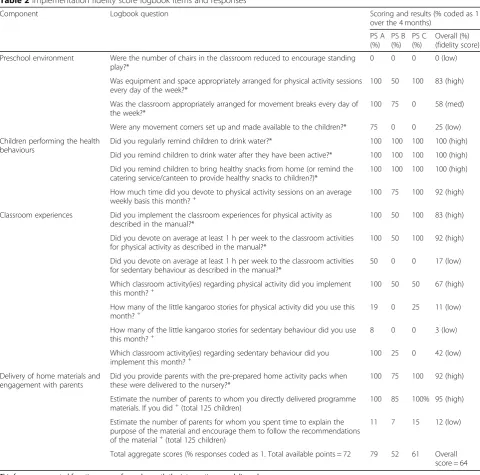
Intervention fidelity
implementing with medium fidelity (52%), and two with high fidelity (79% and 61%). Intervention components relating to PA were generally implemented with higher fidelity than SB components (Table 2). Twenty-six par-ents returned post-intervention feedback surveys, of which seven were incomplete and excluded (19/125; 15% response rate). The overall implementation score for the home component of the intervention was low (41%) based on post-intervention survey responses. Specific preschool implementation scores from practitioners’ log-book data are detailed in Table2.
Participation in outcome measures Anthropometry
Eighty-six percent (36/42) of participants provided valid height and weight measurements at baseline and follow-up. Five children were absent on the follow-up data col-lection day, and one did not want to participate.
Body composition
Six children out of 42 (14%) adequately complied with the BIA protocol at baseline. However, the readings
from these were not valid as children did not adhere to the protocol and the use of BIA was not carried forward to follow-up.
Accelerometry
Fifty-two percent of the participants provided valid ac-celerometer data at baseline (n= 22). Reasons for invalid
measurement were as follows: device malfunction (n=
8); removed before valid wear-time due to skin irritation (n= 7); device loss (n= 5). Only participants who sup-plied valid data at baseline were fitted with an acceler-ometer at follow-up. Nineteen percent of the original sample returned valid accelerometer data at follow-up. Reasons for loss of data at follow-up were removed be-fore valid wear time cut-off (no specific reason provided;
n= 5); device lost (n= 4); child absent on data collection day (n= 5).
Parental questionnaires (demographics/family history, dietary habits, screen time)
baseline (n= 42). Twenty-three percent of parents returned completed questionnaires for both baseline and follow-up (n= 10).
Behavioural and health outcomes
For the 22 participants that provided valid accelerometer data at baseline, mean daily minutes spent in PA was 163 (30) and 151 (40) for the intervention and control groups respectively (mean daily steps of 11,437 (2351) for the intervention group, and 10,827 (2895) for the control group). The intervention group spent an average
of 420 (72) min/day sedentary, and the control group
spent 396 (72) min sedentary. Table 3 summarises the
results for participants that completed measurement at baseline and follow-up. Small increases in BMI z-score were observed for both groups; however, the increase was larger in the control group. Both groups showed re-ductions in mean daily minutes spent in PA and daily steps from baseline to follow-up, with the larger de-creases observed in the intervention group. Sedentary time per day increased by almost 30 min and 10 min in the intervention and control groups, respectively.
Table 2Implementation fidelity score logbook items and responses
Component Logbook question Scoring and results (% coded as 1
over the 4 months) PS A
(%) PS B (%)
PS C (%)
Overall (%) (fidelity score) Preschool environment Were the number of chairs in the classroom reduced to encourage standing
play?*
0 0 0 0 (low)
Was equipment and space appropriately arranged for physical activity sessions every day of the week?*
100 50 100 83 (high)
Was the classroom appropriately arranged for movement breaks every day of the week?*
100 75 0 58 (med)
Were any movement corners set up and made available to the children?* 75 0 0 25 (low) Children performing the health
behaviours
Did you regularly remind children to drink water?* 100 100 100 100 (high) Did you remind children to drink water after they have been active?* 100 100 100 100 (high) Did you remind children to bring healthy snacks from home (or remind the
catering service/canteen to provide healthy snacks to children?)*
100 100 100 100 (high)
How much time did you devote to physical activity sessions on an average weekly basis this month?+
100 75 100 92 (high)
Classroom experiences Did you implement the classroom experiences for physical activity as described in the manual?*
100 50 100 83 (high)
Did you devote on average at least 1 h per week to the classroom activities for physical activity as described in the manual?*
100 50 100 92 (high)
Did you devote on average at least 1 h per week to the classroom activities for sedentary behaviour as described in the manual?*
50 0 0 17 (low)
Which classroom activity(ies) regarding physical activity did you implement this month?+
100 50 50 67 (high)
How many of the little kangaroo stories for physical activity did you use this
month?+ 19 0 25 11 (low)
How many of the little kangaroo stories for sedentary behaviour did you use this month?+
8 0 0 3 (low)
Which classroom activity(ies) regarding sedentary behaviour did you
implement this month?+ 100 25 0 42 (low)
Delivery of home materials and engagement with parents
Did you provide parents with the pre-prepared home activity packs when these were delivered to the nursery?*
100 75 100 92 (high)
Estimate the number of parents to whom you directly delivered programme
materials. If you did+(total 125 children) 100 85 100% 95 (high) Estimate the number of parents for whom you spent time to explain the
purpose of the material and encourage them to follow the recommendations of the material+(total 125 children)
11 7 15 12 (low)
Total aggregate scores (% responses coded as 1. Total available points = 72 79 52 61 Overall score = 64
This form was repeated four times, once for each month the intervention was delivered
*Scoring determined by 5-point scale,“1= never,2= not often,3= sometimes,4= often,5= always”≥4 = 1;≤3 = 0
+
Discussion
This study investigated the feasibility of a cluster rando-mised controlled trial of the adapted ToyBox-Scotland childhood obesity prevention intervention. Participating preschools were willing to be randomised, and trial pro-cedures and pre-school-based intervention components were deemed feasible by preschool staff. The interven-tion was implemented with high fidelity within the
pre-school. However, implementation of the home
component was lower, a finding that is commonly re-ported in other school-based interventions with home components [32, 35]. The cluster-level recruitment rate of 10% in this study is lower than that achieved in simi-lar feasibility studies targeting young children [36–38], as was the observed individual-level recruitment rate of 18% [36, 37, 39, 40]. Conversely, the overall trial reten-tion rate of 86% (14% attrireten-tion rate) is similar to or higher than other trials [6, 36]. However, within those participants that were retained from baseline to follow-up, the collection of valid measures varied considerably by the outcome.
At 41%, the level of implementation observed in the home environment was low. Additionally, the low post-intervention survey response rate of 15% indicates that implementation was even lower, as it is unlikely that non-respondents engaged highly with the intervention. These findings are unsurprising, considering the home environment has previously been identified as one of the more challenging settings to implement obesity preven-tion intervenpreven-tions in [41], particularly in low SES groups. While overall preschool intervention fidelity was high, it was apparent from logbook responses that PA compo-nents of the intervention were implemented at a higher
level than SB components (Table 2). This finding was
also observed in the original ToyBox study, where SB implementation scores were relatively low across mul-tiple intervention sites within the six participating re-gions [35]. Considering these findings, we adapted the programme accordingly, reducing the number of more time-consuming activities in the intervention [14]. Des-pite this, the relatively poor implementation scores ob-served for SB activities highlights that further adaptation may be needed for the SB component and for the home-based components as a whole.
In the Belgian ToyBox study cohort, recruitment in-volved a personal visit by a member of research staff to all eligible preschools (n= 97), which resulted in a cluster-level recruitment rate of 28% [6]. Additionally, the study achieved an individual-level recruitment rate
of 39%, utilising the same procedures of
staff-administered information sheets and consent forms to parents as our study. However, it is important to con-sider the differences in demographics recruited between the two studies. The Belgian study recruited participants from 27 preschools, for which 55% were classed as either medium or high SES. In our study, all but 1 of the 6 recruited preschools were within the 20% most deprived areas in Scotland. An abundance of research has demon-strated that more deprived population groups are more difficult to recruit into trials and are also more likely to drop out than participants in higher SES groups [42–44]. Therefore, the lack of medium-high SES pre-schools recruited to this present trial may have nega-tively impacted on the recruitment rates achieved. Considering these observations, in any future trial, it may be of benefit to conduct personal visits to eligible preschools to improve the school recruitment rates, and also target preschools in areas of high, medium, and low SES, using different strategies to recruit participants from deprived populations to account for the lower re-cruitment rates observed within these areas.
Eighty-six percent of the original sample completed height and weight measures in this study, which is com-parable to anthropometric measurement rates of similar studies [7, 39, 45, 46], indicating that these procedures are feasible with this population group. However, we en-countered significant issues with the collection of valid BIA data at baseline, and measurement of this outcome was not carried forward to the follow-up. Obtaining ac-curate BIA readings requires participants to follow a strict protocol consisting of a period of fasting and re-stricted PA prior to and during the collection of the readings, which was not possible with this sample. Fur-thermore, there are conflicting arguments in the litera-ture regarding the validity of such methods with children [47]. Our intended use of BIA was to further validate BMIz-scores with another measure, as BMI is a crude proxy measure for adiposity [48,49]. Therefore, in
Table 3Behavioural and health outcomes at baseline and follow-up
Pre and post- results Intervention Control
Baseline Follow-up Baseline Follow-up
any future trial, it may be beneficial to use other an-thropometric measures alongside BMI such as waist cir-cumference, skinfold thickness or hip-waist ratio which have proved feasible in other trials [6, 45], and show high agreement with BMI estimates.
With regard to accelerometry, a number of factors pre-vented the collection of valid wear-time data at both base-line and follow-up. Studies that use objective measures of free-living PA and SB in children offer conflicting findings with regards to compliance with measurement proce-dures. A recent review of attrition rates and non-compliance with accelerometers in childhood PA trials found that non-compliance at follow-up ranged from 3 to 70% across 23 studies [50]. Conversely, Jones et al. (2011) used Actigraph accelerometers worn for two consecutive days in a pilot RCT of a fundamental movement skills and PA intervention in preschool children, reporting high ad-herence rates of 96% and 97% for baseline and 6-month follow-up, respectively [51], indicating that reduced wear-time may increase compliance. However, a similar study used the Actigraph for 7 days in pre-schoolers and achieved an 86% adherence rate, indicating additional fac-tors likely influence accelerometer compliance [51].
While some unavoidable reasons for loss of data such as device malfunction/loss and child absence in our study reflect issues commonly encountered in acceler-ometer studies mentioned previously, a number of rea-sons for the early removal of the device are specific to the activPAL accelerometer that we used. Specifically, a small number of parents reported that their child devel-oped a rash due to wearing the waterproof medical ad-hesive which attached the device to the leg. While this was likely a harmless sweat rash, a recent study also found that adolescents who were asked to record their reasons for removing the activPAL in a compliance study cited skin irritation as the primary reason for early removal [53], a finding which is supported by another study on pre-schoolers [24]. These issues could be ad-dressed by reducing the required wear time and improv-ing communication with parents so that they are aware of how to reattach the device or how to distinguish a sweat rash from an allergic reaction. Alternatively, the activPAL showed to be comparable with other wearable devices that are perhaps less invasive and more participant-friendly in their attachment methods [24,27] which may be valid alternatives in further trials. Regard-less of the device used, creating better links with parents from recruitment through to follow-up will likely facili-tate the collection of a higher proportion of valid accel-erometer data and should be a priority in any future trial. A number of trials have reported favourable results from the use of reminder texts/phone calls to parents or the provision of small monetary incentives for the safe return of accelerometers [39].
Parental response rates to the FFQ and PCQ ques-tionnaires were also considerably lower than rates observed in the original ToyBox study and in other trials [54]. Although efforts to reduce the length of these questionnaires were taken prior to the trial commencing, additional adaptation may be needed to increase the response rates. Due to the need to calculate portion sizes and recall dietary patterns,
the FFQ can be time-consuming to complete [55,
56], and parents may not know what their child has
eaten while at preschool. This, coupled with the relatively low levels of adult literacy observed in the
areas which we sampled [57], may have negatively
impacted our questionnaire response rates. There-fore, other more time-efficient alternatives to the FFQ should be explored [56].
This study had a number of limitations. Firstly, due to the low preschool-level response rate, it was only pos-sible to sample preschools located in areas of lower SES, which limits the generalisability of our findings to the wider Scottish preschool population. However, this issue is somewhat unavoidable when conducting research within Glasgow, which has a significantly higher concen-tration of deprived localities than the rest of Scotland’s local authority areas [58]. This issue could be addressed in the future through the use of stratified sampling, which would allow for the assessment of differences in intervention effectiveness between SES groups. Despite this, due to the marked social patterning observed in obesity risk, there is a need to target interventions at low SES groups [59]; therefore, the lessons learned from this study will be of value during the design of future trial procedures.
Secondly, while the aim of this study was to test feasibility, and not to test effectiveness, the low re-sponse rates to questionnaires and non-compliance with accelerometer measures makes it difficult to de-termine any direction of intervention effect, which would have indicated whether the intensity of the intervention was likely to be sufficient. Despite these limitations, the data gathered during this trial are suf-ficient to assess the feasibility of the study design and the fidelity of the intervention, which will assist with the development of effectiveness and efficacy trials. Another important aspect of feasibility testing not ad-dressed in this present paper is the acceptability of the intervention and trial procedures. Items pertaining to acceptability were included in both teacher and parent post-intervention questionnaires, and qualita-tive interviews and focus groups were conducted with both parents and practitioners, respectively. A separ-ate paper will present these data and explore
accept-ability by identifying important barriers and
Conclusions
The findings of this study indicate that although aspects of this cluster RCT of the ToyBox Scotland intervention were feasible, more efforts to increase recruitment rates, accelerometer compliance, and questionnaire response rates should be further investigated before progression to any future trial. Specifically, more development activities should be undertaken with preschools, parents, and chil-dren to ensure that both the intervention components and the methods of evaluation are appropriate and acceptable before progressing to further effectiveness testing.
Testing feasibility before progressing to a fully pow-ered trial is an effective way to identify issues with sam-pling/recruitment, implementation fidelity, trial design, and methods of outcome measurement. This study, coupled with the results of an ongoing investigation of the barriers and facilitators to implementation of the intervention, will further highlight priorities for further adaptation prior to any future trial of the ToyBox Scotland intervention.
Supplementary information
Supplementary informationaccompanies this paper athttps://doi.org/10. 1186/s40814-019-0521-7.
Additional file 1.The ToyBox preschool health programme parent/ guardian feedback form.
Abbreviations
BIA:Bioelectrical impedance analysis; BMI: Body mass index; FFQ: Food frequency questionnaire; LDL: Low-density lipoprotein; PA: Physical activity; PCQ: Primary caregiver questionnaire; SB: Sedentary behaviour;
SES: Socioeconomic status; ST: Sedentary time; WHO: World Health Organisation
Acknowledgements
The authors thank all preschool staff, parents, and children who participated in the study. The authors thank Kay Hamilton and Julie Martin from Glasgow City Council Education services for their assistance with recruitment to the study.
Authors’contributions
SM managed the study and wrote the first draft of the manuscript. JJR, AH, and AMG assisted with intervention adaptation, ethics applications, and study design and writing of the second draft of the manuscript. FB, MDC, CS, GC, OA, and YM substantially contributed to the final draft of the manuscript. All authors read and approved the final manuscript.
Funding
Research relating to this study was funded by the Cunningham Trust. The funders had no role in study design, data collection, data analysis, interpretation of findings, or preparation of this manuscript.
Availability of data and materials
As data were collected from local authority preschool children, public availability of the datasets is restricted by Glasgow City Council data protection policies. However, datasets relating to this study are available from the corresponding author upon reasonable request.
Ethics approval and consent to participate
This study was granted approval by the University of Strathclyde’s School of Psychological Sciences and Health ethics committee. All parents/caregivers of participating children provided written informed consent for their child to participate in the study.
Consent for publication
All participants in this study gave their consent for results to be published as part of the informed consent process. No individual data are presented in this paper.
Competing interests
The authors declare that they have no competing interests.
Author details
1Physical Activity for Health Group, School of Psychological Sciences and Health, University of Strathclyde, Graham Hills Building, 40 George Street, Glasgow G1 1XP, UK.2School of Education, University of Strathclyde, Glasgow, UK.3Department of Movement and Sports Sciences, Ghent University, Ghent, Belgium.4Department of Sport and Exercise Sciences, Durham University, Durham City, UK.5Department of Nutrition and Dietetics, School of Health Science and Education, Harokopio University, Athens, Greece.
Received: 26 July 2019 Accepted: 17 October 2019
References
1. Broyles S, Denstel K, Church T, Chaput J, Fogelholm M, Hu G, et al. The epidemiological transition and the global childhood obesity epidemic. Int J Obes Suppl. 2015;5(S2):S3.
2. Skinner AC, Perrin EM, Moss LA, Skelton JA. Cardiometabolic risks and severity of obesity in children and young adults. N Engl J Med. 2015;373(14): 1307–17.
3. Saldanha-Gomes C, Heude B, Charles M, de Lauzon-Guillain B, Botton J, Carles S, et al. Prospective associations between energy balance-related behaviors at 2 years of age and subsequent adiposity: the EDEN mother– child cohort. Int J Obes. 2017;41(1):38.
4. Jackson SL, Cunningham SA. The stability of children's weight status over time, and the role of television, physical activity, and diet. Prev Med. 2017; 100:229–34.
5. Jouret B, Ahluwalia N, Dupuy M, Cristini C, Negre-Pages L, Grandjean H, et al. Prevention of overweight in preschool children: results of kindergarten-based interventions. Int J Obes. 2009;33(10):1075. 6. De Craemer M, De Decker E, Verloigne M, De Bourdeaudhuij I, Manios Y,
Cardon G. The effect of a kindergarten-based, family-involved intervention on objectively measured physical activity in Belgian preschool boys and girls of high and low SES: the ToyBox-study. Int J Behav Nutr Phys Act. 2014; 11(1):38.
7. Reilly JJ, Kelly L, Montgomery C, Williamson A, Fisher A, McColl JH, et al. Physical activity to prevent obesity in young children: cluster randomised controlled trial. Bmj. 2006;333(7577):1041.
8. Bluford DA, Sherry B, Scanlon KS. Interventions to prevent or treat obesity in preschool children: a review of evaluated programs. Obesity. 2007;15(6): 1356–72.
9. Brown T, Moore THM, Hooper L, Gao Y, Zayegh A, Ijaz S, et al. Interventions for preventing obesity in children. Cochrane Database Syst Rev. 2019;7. 10. Manios Y. The‘ToyBox-study’obesity prevention programme in early
childhood: an introduction. Obes Rev. 2012;13(1):1.
11. Lambrinou CP, van Stralen MM, Androutsos O, Moreno LA, Iotova V, Socha P, et al. Mediators of the effectiveness of an intervention promoting water consumption in preschool children: the ToyBox study. J Sch Health. 2018; 88(12):877–85.
12. Lambrinou C-P, van Stralen MM, Androutsos O, Cardon G, De Craemer M, Iotova V, et al. Mediators of the effectiveness of a kindergarten-based, family-involved intervention on pre-schoolers’snacking behaviour: the ToyBox-study. Public Health Nutr. 2019;22(1):157–63.
13. Reeves S, Poh B, Essau C, Summerbell C, Cheah W, Koh D, et al. ToyBox Study Malaysia: improving healthy energy balance and obesity-related behaviours among pre-schoolers in Malaysia. Nutr Bull. 2018;43(3):290–5. 14. Malden S, Hughes AR, Gibson A-M, Bardid F, Androutsos O, De Craemer M,
et al. Adapting the ToyBox obesity prevention intervention for use in Scottish preschools: protocol for a feasibility cluster randomised controlled trial. BMJ Open. 2018;8(10):e023707.
16. Eldridge SM, Chan CL, Campbell MJ, Bond CM, Hopewell S, Thabane L, et al. CONSORT 2010 statement: extension to randomised pilot and feasibility trials. BMC Pilot Feasibility Stud.2016;2(1):64.
17. Child Poverty: Glasgow Centre for Population Health; 2017. Available from:
https://www.understandingglasgow.com/indicators/children/poverty/ overview. Accessed 25 Jan 2019.
18. Jackson CL, Greenhalgh T. Co-creation: a new approach to optimising research impact. Med J Aust. 2015;203(7):283–4.
19. Durlak JA, DuPre EP. Implementation matters: a review of research on the influence of implementation on program outcomes and the factors affecting implementation. Am J Community Psychol. 2008;41(3–4):327–50. 20. Androutsos O, Apostolidou E, Iotova V, Socha P, Birnbaum J, Moreno L, et al.
Process evaluation design and tools used in a kindergarten-based, family-involved intervention to prevent obesity in early childhood. The T oy B ox-study. Obes Rev. 2014;15:74–80.
21. Cole TJ. The LMS method for constructing normalized growth standards. Eur J Clin Nutr. 1990;44(1):45–60.
22. Cole T. Growth monitoring with the British 1990 growth reference. Arch Dis Child. 1997;76(1):47–9.
23. Group WMGRS. WHO Child Growth Standards based on length/height, weight and age. Acta Paediatr Suppl. 2006;450:76.
24. De ED, De MC, Santos-Lozano A, Van EC, Cardon G. Validity of the ActivPAL™and the ActiGraph monitors in preschoolers. Med Sci Sports Exerc. 2013;45(10):2002–11.
25. Addy CL, Trilk JL, Dowda M, Byun W, Pate RR. Assessing preschool children’s physical activity: how many days of accelerometry measurement. Pediatr Exerc Sci. 2014;26(1):103–9.
26. De Beer M, Timmers T, Weijs PJ, Gemke RJ. Validation of total body water analysis by bioelectrical impedance analysis with deuterium dilution in (pre) school children. E-SPEN, the European e-Journal of Clinical. Nutr
Metabolism. 2011;6(5):e223–e6.
27. Martin A, McNeill M, Penpraze V, Dall P, Granat M, Paton JY, et al. Objective measurement of habitual sedentary behavior in pre-school children: comparison of activPAL with Actigraph monitors. Pediatr Exerc Sci. 2011; 23(4):468–76.
28. Mouratidou T, Miguel M, Androutsos O, Manios Y, De Bourdeaudhuij I, Cardon G, et al. Tools, harmonization and standardization procedures of the impact and outcome evaluation indices obtained during a kindergarten-based, family-involved intervention to prevent obesity in early childhood: the ToyBox-study. Obes Rev. 2014;15:53–60.
29. Mouratidou T, Graffe MIM, Huybrechts I, De Decker E, De Craemer M, Androutsos O, et al. Reproducibility and relative validity of a
semiquantitative food frequency questionnaire in European preschoolers: the ToyBox study. Nutrition. 2019;65:60–7.
30. González-Gil E, Mouratidou T, Cardon G, Androutsos O, De Bourdeaudhuij I, GóźdźM, et al. Reliability of primary caregivers reports on lifestyle behaviours of E uropean pre-school children: the T oy B ox-study. Obes Rev. 2014;15:61–6.
31. Verloigne M, Ahrens W, De Henauw S, Verbestel V, Mårild S, Pigeot I, et al. Process evaluation of the IDEFICS school intervention: putting the evaluation of the effect on children's objectively measured physical activity and sedentary time in context. Obes Rev. 2015;16:89–102.
32. Pinket A-S, Van Lippevelde W, De Bourdeaudhuij I, Deforche B, Cardon G, Androutsos O, et al. Effect and process evaluation of a cluster randomized control trial on water intake and beverage consumption in preschoolers from six European countries: the ToyBox-study. PLoS One. 2016;11(4): e0152928.
33. Abbott JH. The distinction between randomized clinical trials (RCTs) and preliminary feasibility and pilot studies: what they are and are not. JOSPT, Inc. JOSPT, 1033 North Fairfax Street, Suite 304, Alexandria, VA…; 2014. 34. Moore GF, Audrey S, Barker M, Bond L, Bonell C, Hardeman W, et al. Process
evaluation of complex interventions: Medical Research Council guidance. BMJ. 2015;350:h1258.
35. Langford R, Jago R, White J, Moore L, Papadaki A, Hollingworth W, Metcalfe C, Ward D, Campbell R, Wells S, Kipping R. A physical activity, nutrition and oral health intervention in nursery settings: process evaluation of the NAP SACC UK feasibility cluster RCT. BMC PublicHealth. 2019;19(1):865. 36. Latomme J, Cardon G, De Bourdeaudhuij I, Iotova V, Koletzko B, Socha P,
et al. Effect and process evaluation of a kindergarten-based, family-involved intervention with a randomized cluster design on sedentary behaviour in
4-to 6-year old European preschool children: the ToyBox-study. PLoS One. 2017;12(4):e0172730.
37. Barber SE, Jackson C, Hewitt C, Ainsworth HR, Buckley H, Akhtar S, et al. Assessing the feasibility of evaluating and delivering a physical activity intervention for pre-school children: a pilot randomised controlled trial. Pilot Feasibility Stud. 2016;2(1):12.
38. Ginja S, Arnott B, Araujo-Soares V, Namdeo A, McColl E. Feasibility of an incentive scheme to promote active travel to school: a pilot cluster randomised trial. Pilot Feasibility Stud. 2017;3(1):57.
39. Lloyd JJ, Wyatt KM, Creanor S. Behavioural and weight status outcomes from an exploratory trial of the Healthy Lifestyles Programme (HeLP): a novel school-based obesity prevention programme. BMJ Open. 2012;2(3): e000390.
40. Brown B, Harris KJ, Heil D, Tryon M, Cooksley A, Semmens E, et al. Feasibility and outcomes of an out-of-school and home-based obesity prevention pilot study for rural children on an American Indian reservation. Pilot Feasibility Stud. 2018;4(1):129.
41. Knowlden A, Sharma M. Systematic review of family and home-based interventions targeting paediatric overweight and obesity. Obes Rev. 2012; 13(6):499–508.
42. Heinrichs N, Bertram H, Kuschel A, Hahlweg K. Parent recruitment and retention in a universal prevention program for child behavior and emotional problems: barriers to research and program participation. Prev Sci. 2005;6(4):275–86.
43. Plueck J, Freund-Braier I, Hautmann C, Beckers G, Wieczorrek E, Doepfner M. Recruitment in an indicated prevention program for externalizing behavior-parental participation decisions. Child Adolesc Psychiatry Ment Health. 2010; 4(1):15.
44. McDonald L, FitzRoy S, Fuchs I, Fooken I, Klasen H. Strategies for high retention rates of low-income families in FAST (families and schools together): an evidence-based parenting programme in the USA, UK, Holland and Germany. Eur J Dev Psychol. 2012;9(1):75–88.
45. Sacher PM, Kolotourou M, Chadwick PM, Cole TJ, Lawson MS, Lucas A, et al. Randomized controlled trial of the MEND program: a family-based community intervention for childhood obesity. Obesity. 2010;18(S1):S62–S8. 46. Hughes AR, Stewart L, Chapple J, McColl JH, Donaldson M, Kelnar C, et al.
Randomized, controlled trial of a best-practice individualized behavioral program for treatment of childhood overweight: Scottish childhood overweight treatment trial (SCOTT). Pediatrics. 2008;121(3):e539–e46. 47. Talma H, Chinapaw M, Bakker B, HiraSing R, Terwee C, Altenburg T.
Bioelectrical impedance analysis to estimate body composition in children and adolescents: a systematic review and evidence appraisal of validity, responsiveness, reliability and measurement error. Obes Rev. 2013;14(11): 895–905.
48. Kakinami L, Henderson M, Chiolero A, Cole TJ, Paradis G. Identifying the best body mass index metric to assess adiposity change in children. Arch Dis Child. 2014;99(11):1020–4.
49. Reilly J, Dorosty A, Emmett P. Identification of the obese child: adequacy of the body mass index for clinical practice and epidemiology. Int J Obes. 2000;24(12):1623.
50. Howie EK, Straker LM. Rates of attrition, non-compliance and missingness in randomized controlled trials of child physical activity interventions using accelerometers: a brief methodological review. J Sci Med Sport. 2016;19(10): 830–6.
51. Jones RA, Riethmuller A, Hesketh K, Trezise J, Batterham M, Okely AD. Promoting fundamental movement skill development and physical activity in early childhood settings: a cluster randomized controlled trial. Pediatr Exerc Sci. 2011;23(4):600–15.
52. Stark LJ, Spear S, Boles R, Kuhl E, Ratcliff M, Scharf C, et al. A pilot randomized controlled trial of a clinic and home-based behavioral intervention to decrease obesity in preschoolers. Obesity. 2011;19(1):134–41. 53. Shi Y, Huang WY, Yu JJ, Sheridan S, Sit CH-P, Wong SH-S. Compliance and
practical utility of continuous wearing of activPAL™in adolescents. Pediatr Exerc Sci. 2019;00:1–7.
54. De Craemer M, Lateva M, Iotova V, De Decker E, Verloigne M, De Bourdeaudhuij I, et al. Differences in energy balance-related behaviours in European preschool children: the ToyBox-study. PLoS One. 2015;10(3): e0118303.
questionnaire for assessing the fat, fiber, and fruit and vegetable intakes of rural adolescents. J Am Diet Assoc. 2001;101(12):1438–46.
56. Koleilat M, Whaley SE. Reliability and validity of food frequency questions to assess beverage and food group intakes among low-income 2-to 4-year-old children. J Acad Nutr Diet. 2016;116(6):931–9.
57. Dani K, Stobo D, Capell H, Madhok R. Audit of literacy of medical patients in North Glasgow. Scott Med J. 2007;52(2):21–4.
58. Macintyre S, Macdonald L, Ellaway A. Do poorer people have poorer access to local resources and facilities? The distribution of local resources by area deprivation in Glasgow, Scotland. Soc Sci Med. 2008;67(6):900–14. 59. Knai C, Lobstein T, Darmon N, Rutter H, McKee M. Socioeconomic
patterning of childhood overweight status in Europe. Int J Environ Res Public Health. 2012;9(4):1472–89.
Publisher’s Note