Study on the Effect of Different Types of Crude Oils on the Rate of
Corrosion and the Properties of Some Selected Ferrous Metals
S. Aluvihara 1,, J. K. Premachandra2
1Department of Chemical and Process Engineering, Faculty of Engineering, University of Peradeniya, Perqadeniya, Sri Lanka.
2Department of Chemical and Process Engineering, Faculty of Engineering, University of Moratuwa, Katubedda, Sri Lanka.
A B S T R A C T
Crude oil is a predominant natural resource and also it causes the metallic corrosion in the industry of crude oil refining due to some corrosive properties of crude oils. In the current research, it is expected to investigate the effect of such compounds of crude oils on the rate of corrosion of seven different types of ferrous metals which are frequently used in the crude oil refining industries. The sulfur content, salt content, acidity, and mercaptans content of each crude oil are determined in order to use XRF analyzer, salt analyzer, and titration methods. A set of equal size metal pieces are immersed in both crude oils separately for 15, 30, and 45 days and their corrosion rates are determined by using relative weight loss after these time periods while observing the corroded metal surface under the optical microscope, and the dissolved metal concentration in each crude oil sample is tested by the AAS. The hardness of each metal piece is tested before and after the immersion in crude oil with the aid of Vicker’s hardness tester. It is found that a higher amount of sulfur, acidity, and mercaptans and lower amount of salt present in Das blend than Murban. We have found there is some significant rate of corrosion from most of the metals and higher amount of dissolved metallic concentration in samples of both crude oils with respect to those metals. It is observed that there is a slight reduction in hardness of all metal pieces due to the corrosion.
Keywords:Crude oils, Corrosive properties, Ferrous metals, Corrosion rate, Decay, Hardness. Article history: Received: 04 January 2019 Revised: 12 March 2019 Accepted: 01 April 2019
1. Introduction
Crude oil is an essential earth resource which provides fuels to fulfill the most of needs of human beings. In the industry of crude oil refining, ferrous metals proceeds a major role regarding the refining equipment, transportation and storage of crude oil and refined products. The metallic corrosion is one of foremost phenomenon that affects adversely on the properties of the metals
Corresponding author
E-mail address: [email protected] DOI: 10.22105/riej.2019.170944.1078
International Journal of Research in Industrial
[1-5]. Basically the formation of metal oxides, sulfides and hydroxides on the surface of relevant metals are known as the corrosion. The ferrous metal needs to exposure either some stronger oxidizing agent or an environment that consists of water and oxygen. That process is modified by the salts and organic acids that present in the medium [2-9]. Crude oils consist of some of corrosive aided properties such as the sulfur content, organic acid content, salt content, mercaptans content, and effect of bacteria [2-4]. According to the geological formation of crude oil, it can be consisted of NaCl, CaCl2, MgCl2, and organic acids that called as “naphthenic acids” which are having a general formula of RCOOH. Investigation of the way of effecting both Murban and Das Blend crude oil on the rate of seven different types of selected ferrous metals and the variation of hardness of those metals due to the effect of corrosive properties of both crude oils are the major objectives of this research. Murban and Das Blend are the two types of crude oils differ in their chemical compositions; also seven types of ferrous metals vary in their chemical composition including carbon and trace elements [3-18]. Beside of that, it can be affected by the surrounding conditions of the metal including the temperature.
2. Materials and Methodology
2.1 Materials
According to the objectives of the current research, two different types of crude oils have selected as the samples. There are three different types of carbon steel and three different types of stainless steel which are contained Fe as the most abundant element and Monel metal which is contained Ni and Cu as most abundant elements [3]. The selected ferrous metals and their typical applications are given in the below.
Carbon Steel (High)-Transportation tubes.
Carbon Steel (Medium)-Transportation tubes.
Carbon Steel (Mild Steel)-Heat exchanges.
410-MN: 1.8 420-MN: 2.8 (Stainless Steel)-Crude distillation unit.
410-MN: 1.7 420-MN: 1.7 (Stainless Steel)-Crude distillation unit.
321-MN: 1.4 304-MN: 1.9 (Stainless Steel)-Crude distillation unit.
Monel 400-Heat exchangers, Tanks.
The two selected crude oils are Murban and Das Blend that are different in their chemical compositions including essential compounds for the metallic corrosion such as the elemental sulfur, organic acids, and salts [2, 4, 7, 14, and 15].
2.2 Methods of Testing Corrosive Properties of Crude Oils
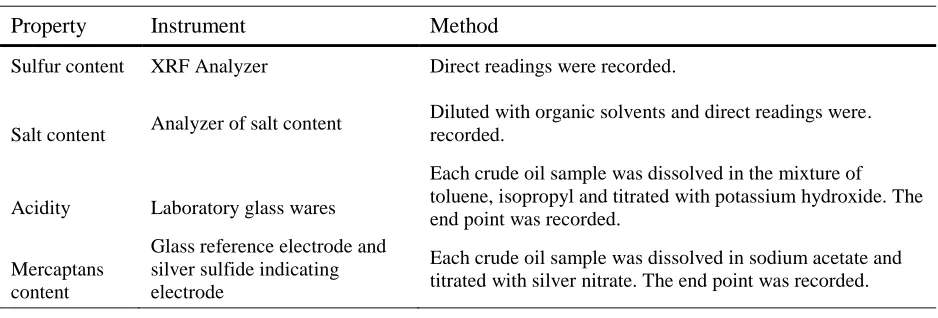
Table 1. Corrosive aided properties of crude oils and their testing methods.
Property Instrument Method
Sulfur content XRF Analyzer Direct readings were recorded.
Salt content Analyzer of salt content
Diluted with organic solvents and direct readings were. recorded.
Acidity Laboratory glass wares
Each crude oil sample was dissolved in the mixture of toluene, isopropyl and titrated with potassium hydroxide. The end point was recorded.
Mercaptans content
Glass reference electrode and silver sulfide indicating electrode
Each crude oil sample was dissolved in sodium acetate and titrated with silver nitrate. The end point was recorded.
2.3. Determination of the Rate of Corrosion on the Surfaces of Metals
The chemical composition of each type of metal was determined with the aid of XRF detector. A set of metal pieces were prepared in equal dimensions and the surfaces of those metal pieces were cleaned while observing those surfaces through the 400X lens of an optical microscope. The cleaned metal pieces were immersed separately and those containers were existed under air-tighten conditions with respect to the metal type and also with respect to both crude oils. After 15 days from the immersion, one metal piece from each metal with respect to crude oils was taken out and the corroded metal surface of each metal observed through the 400X lens of the same optical microscope before the determination of the rate of corrosion. The same procedure was executed for another two sets of metal pieces after 30 and 45 days after the immersion in crude oils. The corrosion rate of each metal piece was determined by using the weight loss method [10]. The weight loss method is defined in the Eq. (1) and terms are defined below.
CR=W*k/(D*A*t). (1)
2.4 Method of Testing Dissolved Metal Concentration in Crude Oils
The dissolved metal concentration in each crude oil sample was tested by the Atomic Absorption Spectroscopy (AAS) after diluted 1ml of each crude oil sample with 9ml of 2-propanol. The concentrations of Fe were tested in crude oil samples which were interacted with the carbon steel and stainless steel while testing the Cu concentration of crude oil samples which were interacted with the Monel.
2.5 Hardness of Metals
The hardness of each metal piece was tested by the Vicker’s hardness tester before immersing in crude oil and after corroding. The Vicker’s hardness tester gives direct reading of the corresponding position of the metal surface as a numerical value. In the current research, there were tested the hardness of at least three points on each metal surface, and the average values were interpreted as the typical hardness of each metal piece at each occasion.
3. Results and Discussion
3.1 Corrosive Properties of Crude Oils
The determined corrosive properties of both crude oils are given in the Table 2.
Table 2. Corrosive aided properties of both crude oils. Crude oil
Property Murban Das Blend
Sulfur content (wt. %) 0.758 1.135
Salt content (ptb) 4.4 3.6
Acidity (mg KOH/g) 0.01 0.02
Mercaptans content (ppm) 25 56
According to the results of sulfur content of both crude oils, the higher sulfur content is from Das Blend crude oil. The reaction of elemental sulfur and sulfur compounds with the water presence in crude oils at some high temperatures, tends to be caused the metallic corrosion which is called as the localized corrosion [6, 13, and 14]. The elemental sulfur tends to form the iron sulfides on the surfaces of the metals as explained in the reaction below.
8 𝐹𝑒 + 𝑆8 → 8 𝐹𝑒𝑆 (2)
Comparing the content of salt in both crude oils shows there is higher amount of salt in Murban crude oil than the salt content of Das Blend crude oil. Due to the chemical reaction between salt and water in crude oil at some higher temperatures, salts tend to be broken into HCl. When the system is approaching to the low temperatures, those HCl can be behaved as a highly corrosive compounds and finally; it can be formed the metal sulfide on the surface of metal as explained in the Eqs. (3-5) below [2, 4, and 7].
𝐶𝑎𝐶𝑙2 + 𝐻2𝑂 → 𝐶𝑎𝑂 + 2𝐻𝐶𝑙 (3)
𝐻𝐶𝑙 + 𝐹𝑒 → 𝐹𝑒𝐶𝑙2 + 𝐻2 (4)
𝐹𝑒𝐶𝑙2 + 𝐻2𝑆 → 𝐹𝑒𝑆 + 2𝐻𝐶𝑙 (5)
According to the results of the acidity of both crude oils, Das Blend crude oil has higher amount of acids than the Murban crude oil. Crude oils may tend to compose naphthenic acids due to the geological formation of them which is highly depended on the geological background of formed such as the surrounded rocks. Results of the previous researches interpreted some kind of relationships between the corrosiveness and the amount of acid presence in such crude oil [2, 12, and 15]. Even though, regarding the past results, there cannot be correlated a general relationship between these two properties. The general chemical reaction happened in the acidic corrosion is given in the Eqs. (6-8) as shown below [4].
𝐹𝑒 + 2 𝑅𝐶𝑂𝑂𝐻 → 𝐹𝑒 (𝑅𝐶𝑂𝑂) 2 + 𝐻2 (6)
𝐹𝑒𝑆 + 2 𝑅𝐶𝑂𝑂𝐻 → 𝐹𝑒 (𝐶𝑂𝑂𝑅) 2 + 𝐻2𝑆 (7)
𝐹𝑒 (𝐶𝑂𝑂𝑅) 2 + 𝐻2𝑆 → 𝐹𝑒𝑆 + 2 𝑅𝐶𝑂𝑂𝐻 (8)
There was found the higher amount of acids from Das Blend than Murban. Also, it expressed that there was a higher tendency of corrosion in Das Blend crude oil than the Murban. The effect of on the metallic corrosion of mercaptans is difficult to explain without discussing the effect of the temperature because this process is highly dependable on conditions of the temperature [2 and 13].
3.2 Chemical Composition of Metals
Table 3. Chemical composition of used metals according to the XRF detector.
Metal No. Metal Fe (%) Ni (%) Cu (%)
1 Carbon Steel (High)
98.6 0.17 0.37
2 Carbon Steel (Medium)
99.36 - -
3 Carbon Steel (Mild Steel) 99.46 - -
4
410-MN: 1.8 420- MN: 2.8 (Stainless Steel)
88.25 0.18 0.1
5 410-MN: 1.7 420-MN: 1.7 (Stainless Steel)
87.44 - -
6 321-MN:1.4 304- MN:1.9 (Stainless Steel)
72.47 8.65 -
7 Monel 400 1.4 64.36 33.29
3.3 Corrosion Rates of Metals
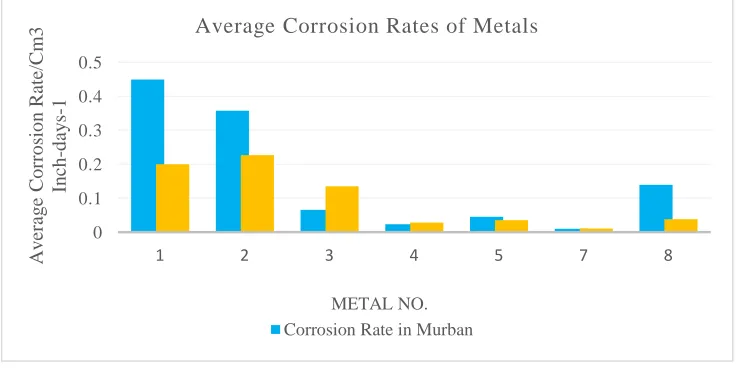
The average corrosion rates of each type of metal with respect to both crude oils are given in the Figure 1.
Figure 1. Average corrosion rates of metals in both crude oils.
According to the above results, some higher rates of corrosion were found from carbon steels, and relatively lesser corrosion rates were found from stainless steel while the Monel metal showed an intermediate corrosion rate. When comparing the corrosion rate respect to both crude oils, four types of metals showed the higher rate of corrosion in Murban crude oil than the corrosion rate in Das Blend crude oil. Regarding the corrosive properties of both, only the salt content is higher in Murban crude oil than Das Blend crude oil while the acidity, sulfur content, and the content of mercaptans are higher in Das Blend crude oil than Murban crude oil. It can be
0 0.1 0.2 0.3 0.4 0.5
1 2 3 4 5 7 8
A
v
er
ag
e
C
o
rr
o
sio
n
R
ate/Cm
3
In
ch
-d
ay
s-1
METAL NO.
Average Corrosion Rates of Metals
concluded that the corrosive tendency of Murban is higher than the corrosive tendency of Das Blend crude oil. In the explanation, it was suggested that the corrosion of metal due to the influence of salts is happened stronger than the process of “Sulfidation” which is happened due to the presence of sulfur in crude oil. Further, the conditions of temperature can be expressed as the reason for the variations of those processes. Usually, the process of breaking sulfide is occurred at high temperatures, and the formed HCl can be remained in the crude oil and under the low temperature conditions; it tends to react with moist and form FeS. But the “Sulfidation” process is properly occurred at high temperatures, the range between 230-4600C, and in presence of elemental sulfur or sulfur compounds in the crude oil [2, 8, 7, 13, 14, and 15]. Even in the performance of experiment under the room temperature, the corrosion occurred due to the presence of salt in crude oil in most of cases can be concluded. Presence of higher amount of acid in Das Blend crude oil can be suggested as the reason for the observations of high corrosion rate of some metals in Das Blend crude oil.
3.4 Microscopic Analysis
According to the qualitative analysis of corrosion, the microscopic analysis interprets some of important information which can be used as the confirmation of formed corrosion compounds in metal surfaces. The identifications are based on the physical appearances of those compounds foremost the color [1, 3, 5, and 17]. The observed surface of carbon (mild) steel which was immersed in Das Blend crude oil and the surface of corresponding metal piece before the immersion in crude oil are given in the Figure 2.
Figure 2. Corroded surface of carbon steel (mild steel) in das blend.
Table 4. The descriptive summary about corrosion compounds. Corosion
Compound Appearances
Relationship with Current Observations
Fes Black, brownish black, dark pits, crack, property of powder
Observed most of them on the surface of each metal
Fe2O3 Rusty color Idetified rarely
CuS Dark indigo, dark blue Unable to specify
According to the observations on the corroded surface of carbon steel (mild steel) in Das Blend crude oil that there can be concluded, the formation of corroded compound is given in the below.
(A), (C)-Ferrous Sulfide (FeS)-Black color, dark pits, cracks, and powdered surface.
(B)-Ferric Oxide (Fe2O3)-Rusty color.
In each observation, there was easily identified at least one feature with respect to the corrosion compound on each metal surface. In most of observations, there were found corrosion cracks, dark pits, and black color appearances which are in respect to Ferrous Sulfides. Therefore, the formation of Ferrous Sulfides as the corrosive compound in most of metals can be concluded.
3.5 Metal Concentrations in Crude Oils
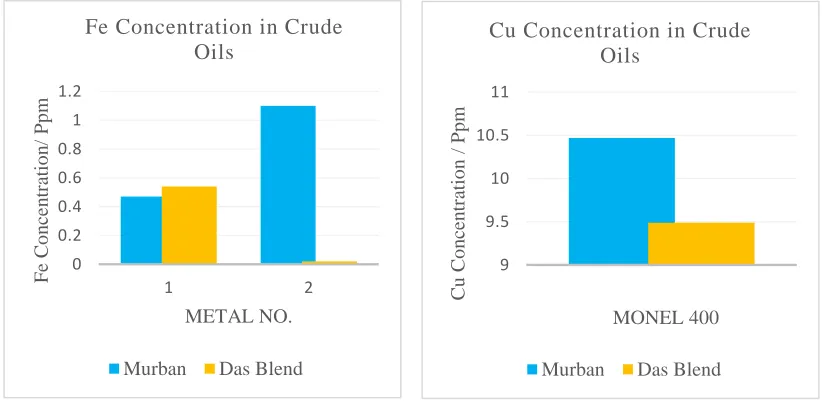
The elemental concentrations of Fe and Cu with respect to the crude oil samples which were exposed to the metal pieces are given in the Figure 3.
Figure 3. The elemental concentrations of Fe and Cu with respect to the crude oil samples.
By observing the testing corrosion rate of metal pieces, invisible weight losses were identified according to the received data. The dissolved metal concentration test was performed based on the assumption of decay of metals in crude oils. According to the obtained results, highest
0 0.2 0.4 0.6 0.8 1 1.2 1 2 Fe C o n ce n tr atio n / P p m METAL NO.
Fe Concentration in Crude Oils
Murban Das Blend
9 9.5 10 10.5 11 1 C u C o n ce n tr atio n / P p m MONEL 400
Cu Concentration in Crude Oils
corrosion rates were observed from the types of carbon steel, high amount of Fe concentration in both crude oils and the least corrosion rates were observed from the types of stainless steel, and any crude oil wasn’t composed with Fe regarding to every kind of stainless steel. According to the results of Monel metal, an intermediate corrosion rate was observed from the Monel. But high amount of Cu concentration was relatively observed in both crude oils regarding to the Monel metal. These observations can be used as evidences of the confirmation of the metallic interaction with both crude oils forever. This can be explained, under the mechanism of corrosion because of the occurrence of the corrosion, the metallic oxide, sulfide, hydroxide or a certain metallic compound are usually formed. After the formation of the corrosion, the relevant compounds tend to be removed from the metal surface due to the repulsive and attractive forces between the successive electrons and protons [1, 3, and 5].
3.6 Variation of the Hardness of Metals
The average values of the hardness after 15, 30, and 45 of immersion in crude oil according to the Vicker’s hardness tester are given in the Figure 4.
Figure 4. The average values of the variation of hardness in both crude oils.
0 100 200 300
1 2 3 4 5 6 7
HA
R
DNESS
(
HV)
METAL NO.
Variations of the Hardness of Metals in Murban
Initial Hardness Hardness after Corrosion
0 50 100 150 200 250 300
1 2 3 4 5 6 7
HA
R
DNESS
(
HV)
METAL NO.
Variations of the Hardness of Metals in Das Blend
According to the results of hardness, slight reduction of the initial hardness can be identified after the corrosion in most of metals. In the analysis of the reduction of the hardness with the exposed time period in the crude oil, exactly there cannot be identified any sequence or order. Although, some unexpected situation can be identified because of observation of the increment of the hardness at once. The hardness of metals may be varied with the position of test and due to that reason, some of results were observed in the experiment [1]. After formations of corrosive compound on the metallic surface, the stability of the metallic surface will be reduced due the tendency of removing those compounds [1, 3, 5, and 17]. The reduction of hardness also happened under those conditions. Finally the asymmetric variation of the reduction of the hardness also can be concluded as some variations of values due to the position on the metal surface and due to the asymmetric corrosion distribution on the metallic surface.
4. Conclusions
According to the obtained results, higher corrosion rates were observed relatively from types of carbon steels which are composed of severe amount of Fe. While lesser corrosion rates were relatively observed from stainless steel which are composed of intermediate amount of Fe. When the corrosive tendencies were compared regarding to both crude oils, Murban was shown higher tendency of corrosion with most of metals due to the significant contribution of salt there was, while the high sulfur content, acidity, and mercaptans content were not in progress properly in the cause of metallic corrosion at the room temperature. The microscopic analysis interpreted the essential features on the surfaces of metals that explained the formation of FeS, Fe2O3, and trace corrosive compounds according to their physical appearances foremost the color of such compounds. The AAS results showed the higher amount of Fe concentration in both crude oils, while crude oil samples that interacted with stainless steel showed negative results for Fe concentration. Even though, crude oil samples that interacted with Monel metal showed some considerable amount of Cu, also it relatively showed higher corrosion rate and it can be concluded that there could be formation of copper compounds in the interaction with crude oils. There was identified a slight reduction of the initial hardness in most of metal pieces due to the corrosion of those metals. The microscopic analysis, hardness, and AAS analysis was concluded as the confirmation steps of metallic corrosion in crude oils that was tested under the weight loss method forever.
5. Acknowledgement
References
Khana, O. P. (2009). Materials science and metallurgy. New Delhi: Dhanpet Rai and Sons publication, India.
Fahim, M. A., Al-Sahhaf, T. A., & Elkilani, A. (2009). Fundamentals of petroleum refining. Amsterdam: Radarweg Press, The Netherland.
Calister, W. D. (2003). An introduction of materials science and engineering, New York: John Wiley & Sons Inc, USA.
Davis, M. E. & Davis, R. J. (2003). Fundamentals of chemical reaction engineering, 1st Ed. New
York: McGraw-Hill, USA.
Singh, R. (2006). Introduction to basic manufacturing process and engineering workshop. New Delhi: New Age International Publication.
Bolton, W. (1994). Engineering materials technology, 2nd Ed. London: B. H Newnes Limited, United
Kingdom.
Badmos, A. Y., Ajimotakan, H. A., & Emmanuel, E. O. (2009). Corrosion in petroleum pipelines. New York science journal, 2(5), 36-40.
Speight, J. G. (1999). The chemistry and technology of petroleum, 3rd Ed. New York: Marcel Dekker.
Afaf, G. A., Badia, H. A., & Hassan, E. E. (2015). Corrosion management methods of high TAN crude case study: (fula crude oil-sudan). American scientific research journal for engineering, technology, and sciences (ASRJETS), 11(1), 1-7.
Oparaodu, K. O., & Okpokwasili, G. C. (2014). Comparison of percentage weight loss and corrosion rate trends in different metal coupons from two soil environments. International journal of environmental bioremediation & biodegradation, 2(5), 243-249.
Usman, A. D., & Okoro, L. N. (2015). Mild steel corrosion in different oil types. International journal of scientific research and innovative technology, 2(2), 9-13.
Elnour, M. M., Ahmed, M., & Ibrahim, T. (2014). Study the effects of naphthenic acid in crude oil equipment corrosion. Journal of applied and industrial sciences, 2(6), 255-260.
Rickard, D., & Luther, G. W. (2007). Chemistry of iron sulfides. Chemical reviews, 107(2), 514-562. Fang, H., Nesic, S. & Young, D. (2008). Corrosion of mild steel in the presence of elemental sulfur.
Corrosion conference and Expo. NACE International.
Bota, G. M., Qu, D. M., Nesic, S. M., & Wolf, H. A. (2010). Naphthenic acid corrosion of mild steel in the presence of sulfide scales formed in crude oil fractions at high temperature. Corrosion conference and Expo. NACE International.
Müller, M. (1982). Theoretical considerations on corrosion fatigue crack initiation. Metallurgical transactions, 13(4), 649-655.
William F., S, & Hashemi, J. (2006). Foundations of materials science and engineering. Mcgraw-Hill Publishing.