INTERNATIONAL JOURNAL OF PHARMACEUTICAL, CHEMICAL AND BIOLOGICAL SCIENCES
Available online at
www.ijpcbs.com
DEVELOPMENT AND VALIDATION OF RP-HPLC METHOD FOR THE
DETERMINATION OF MONTELUKAST SODIUM IN BULK AND IN
PHARMACEUTICAL FORMULATION
K. Naga Raju2, T. Gopala Swamy3 and A. Lakshmana Rao1*
1V.V. Institute of Pharmaceutical Sciences, Gudlavalleru, Andhra Pradesh, India.
2Sir C.R. Reddy College of Pharmaceutical Sciences, Eluru, Andhra Pradesh, India.
3M.R.R. College of Pharmacy, Nandigama, Andhra Pradesh, India.
*Corresponding Author
INTRODUCTION
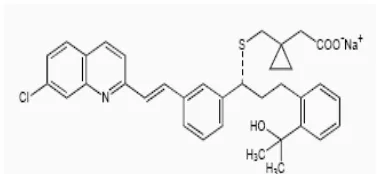
Montelukast sodium is a selective and orally active leukotriene receptor antagonist that inhibits the cysteinyl leukotriene CysLT1 receptor. Montelukast sodium is described chemically as [R-(E)]-1-[[[1-[3-[2-(7-chloro-2quinolinyl)ethenyl]phenyl]-3-[2-(1-hydroxy -1-methylethyl) phenyl] propyl] thio] methyl]
cyclopropaneacetic acid, monosodium salt1
(Figure 1). Montelukast binds with high affinity and selectivity to the CysLT1 receptor (in preference to other pharmacologically important airway receptors, such as the
prostanoid, cholinergic, or β-adrenergic receptor). Montelukast inhibits physiologic actions of LTD4 at the CysLT1 receptor without any agonist activity.
Fig. 1: Chemical structure of montelukast sodium
Literature survey reveals that various HPLC
2-5, LC-MS6 and spectrophotometric7 methods
have been reported for the estimation of montelukast sodium. The present study illustrates development and validation of a simple, accurate and precise procedure for
Research Article
ABSTRACT
determination of montelukast sodium by RP-HPLC in bulk and in tablet dosage form. EXPERIMENTAL
Instrumentation
HPLC system is used for this study, the specifications are given below. Quantitative HPLC was performed on a gradient high pressure liquid chromatography (Agilent Technologies 1200 Series), with UV/VIS detector, Eclipse XDB C18 column 150x4.6mm, 5µ.
Reagents and chemicals
Montelukast sodium working standard was received as a gift sample from MSN
Laboratories, Bollaram, Hyderabad.
Commercial formulations of montelukast sodium were procured from local pharmacy. Methanol (HPLC grade) and ammonium acetate (AR grade) was supplied by Merck, Mumbai. Triple distilled water obtained by using a Milli-Q apparatus (Milli pore) was used to prepare all solutions for the method. Preparation of buffer
Dissolve accurately 3.85 g of ammonium acetate in 1000 ml of Milli-Q water, adjust the pH to 3.5±0.05 with glacial acetic acid.
Mobile phase preparation
Mobile phase was prepared and degassed the mixture 15 volumes of the above buffer and 85 volumes of methanol.
Preparation of standard stock solution
Weigh accurately montelukast sodium
working standard equivalent to about 20 mg of montelukast into 20 ml volumetric flask, add 15 ml of diluent and sonicate to dissolve for about 10 min, further make up the volume with diluent. And dilute 1 ml to 10 ml with methanol. From this, a working standard solution of 500 µg/ml of strength was prepared, from this dilution of 50, 60, 80, 100, 120, 140, & 150 µg/ml were made in 100 ml volumetric flasks and make up with ammonium acetate buffer pH 3.5±0.05, 10 µl of each dilutions was injected each time into the column at a flow rate of 1 ml/min. Each
dilution was injected 3 times into the column and the corresponding chromatograms were obtained.
Preparation of sample solution
Weigh accurately a quantity of the powdered tablets equivalent to about 10 mg of montelukast in to 100 ml volumetric flask, add about 60 ml of diluents, sonicate for about 30 min and dilute to 100 ml with methanol. Filter through 0.45 µ filter.
Assay of montelukast sodium in tablets Twenty tablets were weighed and finely powdered. An accurately weighed portion of the powder equivalent to 100 mg of montelukast sodium was transferred to 100 ml volumetric flask containing 10 ml of methanol and the contents of the flask were sonicated for 15 min, to ensure the complete solubility of the drug. The mixture was then made up to 100 ml with ammonium acetate buffer pH 3.5±0.05. The resulting solution was thoroughly mixed and filtered through a 0.45 µ membrane filter. 5 ml of this solution was added to 100 ml volumetric flask and made up to the mark with ammonium acetate buffer pH 3.5±0.05. This solution (10 µl) was injected three times into the column. The mean values of peak areas of five such determinations were calculated and the drug content in the tablets was quantified using the regression equation.
Chromatographic conditions
The content of the mobile phase were ammonium acetate buffer pH 3.5±0.05 and methanol in the ratio of 15:85 % v/v. The contents of mobile phase were filtered before use through 0.45 µ membrane filter and sonicated for 15 min. The flow rate of the mobile phase was maintained at 1.0 ml/min.
The column temperature was set at 250C and
the detection was carried out by UV-Detector wave length was set at 254 nm. The run time was set at 10 min and the volume of the injection loop was 10 µl. Prior to injection of
the drug solution, the column was
mobile phase flowing through the system. The data were acquired, stored and analyzed. Calibration procedure
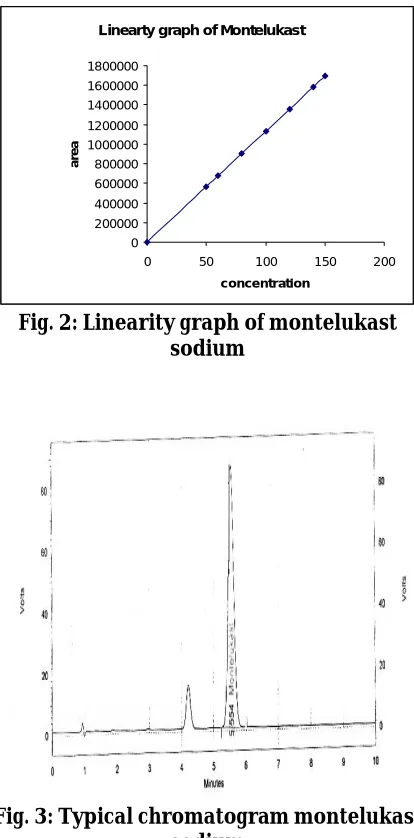
The calibration curve was plotted with five concentrations of the standard drug solution 50-150 µg/ml solution and chromatography was repeated thrice for each dilution. The linearity was evaluated by linear regression analysis, before injecting solutions, the column was equilibrated for at least 30 min with the mobile phase flowing through the system five determinations were carried out for each solution, peak area ratios were recorded for all the solutions. The correlation graph was constructed by plotting the peak area ratios obtained at the optimum wave length of detection versus the injected amounts of the respective concentrations (Figure 2).
RESULTS AND DISCUSSION
The applied chromatographic conditions permitted a good resolution of montelukast sodium (50µg/ml) in standard solution (Figure 3). No drug decomposition was observed during the analysis. The LC method was validated for the parameters reported below.
System suitability
Prepare montelukast sodium, standard solution as per test procedure and make 5 injections of STD preparation and establish system suitability as per methodology. The results are tabulated in the Table 1.
Linearity
The montelukast sodium was
chromatographed using the mobile phase, the linearity of peak area responses versus concentrations was studied from 50-150 µg/ml for montelukast sodium. A linear response was observed over the examined
concentration range. The correlation
coefficient found to be 0.999.
Linearty graph of Montelukast
0 200000 400000 600000 800000 1000000 1200000 1400000 1600000 1800000
0 50 100 150 200
concentration
a
re
a
Fig. 2: Linearity graph of montelukast sodium
Fig. 3: Typical chromatogram montelukast sodium
Specificity
The montelukast sodium was evaluated for the interference of blank, placebo with the analyte peak as per the methodology.
Accuracy
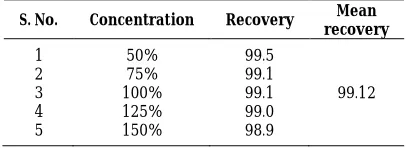
the procedure described above for the estimation of montelukast sodium in the tablet formulations. In both the cases the recovery studies were replicated five times. The accuracy was expressed in terms of the recovery and calculated by multiplying the ratio of measured drug concentration with 100, so as to give the percent recovery. The results are tabulated in the Table 2.
Precision
Repeatability: Determine the precision of
test method by preparing six test
preparations using the product blend by mixing the active ingredient with excipients as per manufacturing formula. Calculate relative standard deviation of assay results. Intermediate precision: To demonstrate intermediate precision of assay method, conduct analyst to analyst variability or along with system to system or column to column variability study. The results are tabulated in the Table 3.
Robustness
Robustness was performed by small variation in the chromatographic conditions and found to be unaffected by small variations like ±2% variation in volume of mobile phase composition, ±0.1 ml/min in flow rate of mobile phase, ±0.1 variation in pH and temperature.
Ruggedness
The ruggedness of the method was checked on different systems and by different columns and standard was able to give same results which indicate that the method is rugged. The results are tabulated in the Table 4.
Table 1: System suitability parameters of montelukast sodium
Parameter Result
Linearity (g/ml) 50-150 Correlation coefficient 0.9999 Theoretical plates (N) 12051 Tailing factor 1.08 LOD (g/ml) 0.4 LOQ (g/ml) 1.0
Table 2: Recovery of montelukast sodium using proposed method
S. No. Concentration Recovery Mean
recovery 1
2 3 4 5
50% 75% 100% 125% 150%
99.5 99.1 99.1 99.0 98.9
99.12
Table 3: Precision for montelukast sodium assay in pharmaceutical dosage form
S. No. Parameter % RSD Assay
1 Repeatability 1.31% 99.4%
2 Intermediate precision
Analyst 1= 1.31% Analyst 2= 0.64%
Analyst 1= 99.4% Analyst 2= 98.9%
Table 4: Ruggedness of the of montelukast sodium by the proposed method
S. No. Parameter % RSD Assay
1 System variability
System 1= 1.31% System 2= 0.93%
System 1= 99.4% System 2= 99.4%
2 Column variability
Column 1 =1.31%
Column 2 =0.83% Column1= 99.4% Column2= 98.9%
Limit of detection and limit of quantitation The parameters LOD and LOQ were determined on the basis of signal to noise ratio, LOD & LOQ was calculated by the method which was based on the standard deviation (S.D.) of the response and the slope (S) of the calibration curve at levels approximating the LOD & LOQ and was found to be 0.4 and 1.0 µg/ml respectively.
CONCLUSION
The proposed reverse phase high
consumption leads to a cost effective and represents a good procedure of montelukast sodium determination in bulk and in pharmaceutical dosage forms.
REFERENCES
1. www.rxlist.com
2. Amin RD, Cheng H, Rogers JD.
Determination of montelukast in
human plasma by liquid
chromatography. J Pharm Biomed Anal. 1995;13:155-158.
3. Liu L, Cheng H, Zhao JJ, Rogers JD.
Determination of montelukast and its S-enantiomer in human plasma by
stereoselective high-performance
liquid chromatography with column switching. J Pharm Biomed Anal. 1997;15:631-638.
4. Ochiai H, Uchiyama N, Takano T, Hara
K, Kamei T. Determination of
montelukast sodium in human plasma
by column-switching high
performance liquid chromatography
with fluorescence detection. J
Chromatogr B Biomed Appl.
1998;713:409-414.
5. Kitchen CJ, Wang AQ, Musson DG,
Yang AY, Fisher AL. A semi automated 96-well protein precipitation method for the determination of montelukast
in human plasma using high
performance liquid
chromatography/fluorescence
detection. J Pharm Biomed Anal. 2003;31:647-654.
6. Robert P, Pauline L, Wayne M,
Elizabeth K. A rapid and sensitive method for the quantitation of montelukast in sheep plasma using liquid chromatography/tandem mass
spectrometry. J Chromatogr B.
2007;858:282-286.
7. Radhakrishna T, Narasaraju A,
Ramakrishna M, Satyanarayana A.
Simultaneous determination of