INTERNATIONAL JOURNAL OF PHARMACEUTICAL, CHEMICAL AND BIOLOGICAL SCIENCES
Available online at www.ijpcbs.com
PHASE STRUCTURE, DIELECTRIC AND PIEZOELECTRIC
PROPERTIES OF MODIFIED-PZT CERAMICS NEAR THE
MORPHOTROPIC PHASE BOUNDARY
Necira Zelikha
1,
Boutarfaia Ahmed
1,2,
Kharief Amel
3,
Menasra Hayet
1,
Bounab Karima
1,
Abba Malika
1,
Abdessalem Nora
1and
Meklid Abdelhek
11Laboratoire de Chimie Appliquée LCA, Département des Sciences de la Matière, Université de Biskra Algérie.
2Université de Ouargla, Algérie.
3Laboratoire de Chimie Moléculaire, Université Mentouri Constantine, Algérie.
1. INTRODUCTION
Piezoelectric ceramics have attracted considerable attention because of their possible uses in device applications such as sensors, actuators and transducers1-7. A wide range of these applications
are based on lead zirconate titanate (PbZrx Ti1-x O3
or PZT) complex perovskite ceramics8,9.
Especially, the solid solution composition located near the rhombohedral (antiferroelectric
PbZrO3)–tetragonal (ferroelectric PbTiO3) morphotropic phase boundary (MPB, x ≈ 0.5), depending in Zr/Ti ratio possesses eminent piezoelectric characteristics10-15.Each application
area of PZT piezoceramics requires a particular combination of electrical properties: dielectric permittivity (ε), dielectric losses (tgδ), mechanical quality factor (Qm), electromechanical coupling
coefficient (Kp), and piezoelectric factor (d31 and
Research Article
ABSTRACT
Modified-PZT ceramics with a formula Pb[(ZrxTi(0.98 –x) (Mg1/3 Nb2/3)0.01(Ni1/3 Sb2/3)0.01] O3(doped
with hardeners : Mg2+ ; Ni2+ and softeners : Nb5+ ; Sb5+ ions) abbreviated as PZT-PMN-PNS quaternary system with varying Zr/Ti ratios in the range: 0.42 ≤ x ≤ 0.54 located near the
morphotropic phase boundary (MPB) were prepared by conventional solid state process. The phase structure, dielectric and piezoelectric properties of the system were investigated. Phase analysis using X-ray diffraction (XRD) indicated that the phase structure of sintered PZT-PMN-PNS ceramics was transformed from tetragonal to rhombohedral, with Zr/Ti ratio increased in system. The MPB, in which the tetragonal and rhombohedral phases coexist, is in a composition range of Zr content from 48 to 52 mol%. Scanning electron micrographs of sintered ceramic surfaces (at 1180°C) showed the dense and uniform microstructure for composition close to MPB (Zr/Ti = 50/48) with apparent density of 7.9 g/cm3 (≈ 98 % of the theoretic density). For 1.0 mol%
(Mg, Nb) and 1.0 mol% (Ni, Sb) doped PZT composition with x = 50, electrical properties were significantly improved. The main parameters of Pb [Zr0.50 Ti 0.48 (Mg1/3 Nb2/3)0.01 (Ni1/3 Sb2/3)0.01]O3
piezoceramic system are: εr(max) = 16624.79 at 1 kHz, Tc = 340 ◦C,tgδ = 0.86 %, ρ = 22.85 (*10 6
Ω.cm), -d31 = 120.4 pC/N, Kp = 0.69, Qm = 461.9. The properties of this type of ceramics make it
a very promising piezoelectric material for device applications.
d33). Classically, the electrical properties of PZT
ceramics are modulated by the incorporation of small amounts of cations (doping) (typically 0.5–2 mol %). Modification of PZT with suitable substitutions of single or multiple cations at Pb2+
and Zr4+/Ti4+ sites helps in enhancing its physical
and electrical properties. There are two principal categories of dopants16-18:
• Donor dopants (softeners) which are higher valence substituents like Nb5+ or Sb5+ in the place
of (Zr4+/Ti4+) or Gd3+ or Eu3+ in the place of Pb2+
and cause the following changes of the characteristics of PZT: higher dielectric constant and losses (at room temperature); higher charge coefficient d31/d33; much lower mechanical quality
factor Qm and easy to depolarize by mechanical
stress. The excess of positive charge in soft PZT is compensated by lead vacancies.
• Acceptor dopants (hardeners) which are lower valence substituents like Mg2+ or Fe3+ (B-site) or
Na+ (A-site) and cause the following changes of the
characteristics of PZT: lower dielectric constant and losses (at room temperature); lower d33;
much higher mechanical Qm; difficult to depolarize
by mechanical stress. The lack of positive charge in hard PZT is compensated by oxygen vacancies. The complex doping of two or more elements is expected to combine the properties of donor doped and/or acceptor doped PZT, which could exhibit better stability or improved piezoelectric and dielectric properties than those of the single element doped PZT19-23.
In the present study, to combine and to improve the electrical properties of PZT ceramics, a complex doping with more metal elements including acceptor (hardener) :Mg2+ ; Ni2+ and
donor (softener): Nb+5 ; Sb+5 replaces Zr4+ or Ti4+
on the B-Site has been adopted. Compositionally modified-PZT ceramics with variable Zr/Ti ratios were prepared by the conventional solid state reaction process in which all starting oxides are mixed directly to fabricate electronic ceramics. The effects of Zr/Ti ratio on the properties of sintered PZT-PMN-PNS quaternary system ceramics were investigated systematically.
2. EXPERIMENTAL PROCEDURE
Compositionally modified-PZT [doped with hardeners (Mg2+, Ni2+) and softeners (Nb5+, Sb5+)
on the B-Site], with a nominal composition of Pb[(ZrxTi(0.98 –x) (Mg1/3 Nb2/3)0.01(Ni1/3 Sb2/3)0.01] O3
containing different Zr/Ti ratios (0.42 ≤ x ≤ 0.54)
ceramics of near the MPB compositions were prepared by the conventional solid-state reaction of metal oxides. Polycrystalline samples were
obtained using reagent-grade raw materials form of high purity: Pb3O4 (99.0%), ZrO2 (99. 0%), TiO2
(99.0%), MgO (99.6% purity), Nb2O5 (99.95%
purity), NiO (99.6% purity) and Sb2O3 (>99.0%
purity). These oxides were mixed in stoichiometric proportions. The mixture powders were milled for approx. 4 hours in an acetone medium. After drying and crushing, the obtained powders were calcined on alumina plates at 800°C
for 2 hours with heating and cooling rates of 2 °C/mn24. The calcined powders were crushed for a
second time and pressed into discs of 13 mm diameter and ~1 mm thickness at a pressure of 3500 Kg.cm-2 using a uniaxial hydraulic press.
These pellets were then sintered in a closed alumina crucible at in the range between 1100 °C and 1200 °C for 2 hours. To prevent PbO volatilization from the disks, a PbO atmosphere was maintained by placing PbZrO3 powders in the
crucible. The density measurements of the sintered pellets were determined by the Archimedes method. Crystal structure and phases identification of the sintered specimens crushed into powders were carried out by X-ray diffractometers (X Pert Graphics and Simens D500) at room temperature using CuKα radiation. The compositions of the PZT-PMN-PNS phases were identified by analysis of the peaks [(0 0 2)T,
(2 0 0)R, (2 0 0)T] in a range of Bragg angles 2θ
3. RESULTS AND DISCUSSIONS 3.1. Phase structure
Figure 1 shows the dependences of the measured density of the PZT-PMN-PNS ceramics as a function of sintering temperature. The measured densities of the PZT-PMN-PNS samples increase significantly with increasing sintering temperature achieving a maximum value at 1180 °C and then decrease. From this figure, it was concluded that optimal sintering temperature for all samples was 1180 °C.
Figure 2 (a)-(c) shows the SEM micrographs of the fractured surface of the PZT-PMN-PNS specimen with Zr/Ti ratio of 50/48 sintered from 1100 to 1180 °C for 2 h. The SEM images reveal that the increase of sintering temperature resulted in significant changes in the microstructure of the specimen. The images also show that the grain size of the specimen varied considerably from 0.637 to 1.361 μm. Interestingly, the density
results can be correlated to the microstructure because low−density of sintered ceramic at 1100
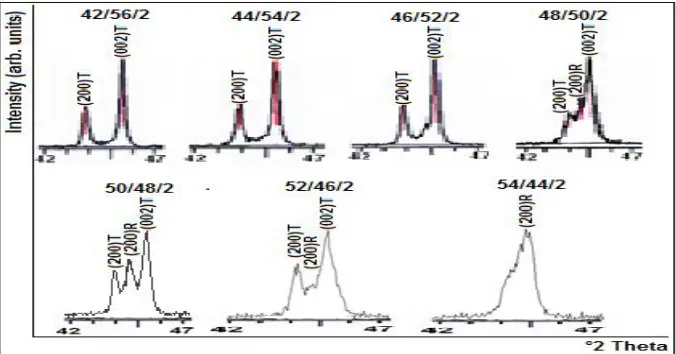
°C contain many closed pores (Fig.2(a)), whereas high-density of sintered ceramic at 1180 °C show high degrees of grain close packing (Fig.2 (c)). To investigate the phase formation and the crystal structure, the ceramics with optimum sintering temperature were examined by XRD. Figure 3 shows the room temperature XRD patterns of PZT-PMN-PNS samples sintered at 1180 °C with different Zr/Ti ratios. It is observed that a pure perovskite phase is obtained. The tetragonal, rhombohedral and tetragonal–rhombohedral phases are identified by an analysis of the peaks [002(tetragonal), 200 (tetragonal), 200
(rhombohedral)] in the 2θ range of 42–47° correlated with JCPDS file number 33-0784 (T) and JCPDS file number 73-2022 (R). The splitting of the (002) and (200) peaks indicates that they are the ferroelectric tetragonal phase (FT), while
the single (200) peaks consistent with the ferroelectric rhombohedral phase (FR). A
transition from the tetragonal to the rhombohedral phase is observed as Zr/Ti ratio increases. Previously, a similar behavior was also observed with increasing Zr content in modified PZT based ceramics.
The multiple peak separation method was used to estimate the relative fraction of coexisting phases. The relative phase fraction (MR) was then
calculated using the following equations25:
200
002
200
200 T I T I R I R I R M
(1)
200
002
200
002 200 T I T I R I T I T I MT
(2)
Where IR(2 00) is the integral intensity of the
(200) reflection of the rhombohedral phase and IT(2 00) and IT(0 02) are the integral intensities of
the(200) and (002) reflections of the tetragonal phase, respectively. Analysis of the relative phase fractions in the PZT–PMN–PNS ceramics indicates that the tetragonal and rhombohedral phases coexist in the composition range of 0.49 ˂ x ˂0.51
as shown in Fig. 4. It can be seen clearly that the MPB is over abroad composition range. The width of the MPB in PZT systems has been extensively investigated and found to be related to the heterogeneous distribution of Zr4+ and Ti4+ cations
on the B-site of the perovskite lattice (ABO3). In
addition, the tetragonal and rhombohedral phases may co-exist in one grain, so that even a grain which consists mainly of one phase may contain nuclei of the other phase26.
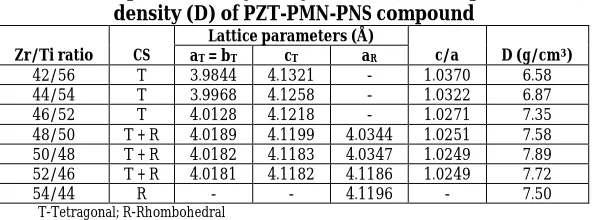
Table 1 shows the lattice parameter values of a and c axes for each PZT–PMN–PNS composition calculated from the XRD patterns. It can be seen that the lattice structure changes from the tetragonal to the rhombohedral phase as the ratio of Zr to Ti increases. In the tetragonal phase, the lattice parameter aT increases linearly, while the cT
parameter decreases with increasing Zr/Ti ratio. The variation of these parameters is related to the distortion of the tetragonal structure defined by the cT/aT ratio (Tab. 1), which decreases with
increasing Zr content, also confirming the occurrence of phase transition from tetragonal to rhombohedral symmetry. The rhombohedral lattice parameter aR appears to oscillate between
4.0344 and 4.1196 Å. The influence of the Zr/Ti ratio on the lattice structure can be explained by the difference between the ionic rays of Zr and Ti (0.72 and 0.605 Å, respectively)27.
3.2. Dielectric properties
Temperature dependences of the dielectric constant (εr) of sintered PZT-PMN-PNS specimens
with different Zr/Ti ratios are shown in Fig. 5. It can be seen that all the compounds undergo diffuse ferro-paraelectric phase transition at their respective phase transition temperatures.
The εr (max) increases from Zr/Ti: 42/56 and shows
(defined as the Curie temperature (Tc) at which εr
is maximum at 1 kHz) is observed. It is noticed that an increase in Zr content leads to a decrease in Tc, most likely due to crystal structure of the
materials was changed from tetragonal to rhombohedral, as shown in XRD patterns in Fig. 3.
Also, this is due to the decrease of amount of PT content that has the relative high Curie temperature of 495 °C9. It is important to note that
the values of Tc at morphotropic phase region
were found to be nearly constant (~340 °C)in our choosing system (Fig.5).
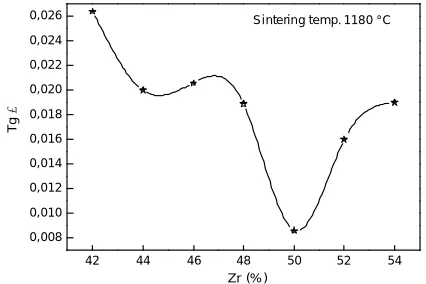
Figure 6 shows Zr/Ti ratio dependence of
dielectric losses (tanδ) of sintered PZT-PMN-PNS samples (at room temperature, 1 kHz). The values
of tanδ decrease with increasing Zr from 0.42 to
0.50 mol% and then increase when Zr content increases further. When Zr/Ti ratio is 50/48 for the sample included in the morphotropic phase
boundary (MPB), value of tanδ show the lower
values of 0.0086.This lower values of dielectric losses is attributed to the high density and uniform microstructure of the sample (50/48/2) as observed in SEM graphs (Fig 2.c).
3.3 Piezoelectric properties
Obviously, the piezoelectric properties of sintered PZT-PMN-PNS ceramics are affected by Zr/Ti ratio. Fig. 7(a)-(c) shows the planar coupling factor (kp), piezoelectric coefficient (d31) and mechanical quality factor (Qm) as a function of the Zr/Ti ratio.
PZT-PMN-PNS exhibits desirable kp and d31 values
around the MPB. From the trend of the piezoelectricity, the sample reaches the maximum values of kp = 0.689, - d31=120 pC/N, which coincides with the maxima of the dielectric constant when Zr/Ti ratio is 50/48 as listed in Tab.2. This maximum of piezoelectric activity can be explained by the presence of several
directions of spontaneous polarization relating to the existence of the tetragonal and rhombohedral phases. The variation of Qm is in accordance with the result of kp and d31. Although, Qm reflects the
mechanical loss resulting to internal friction caused by moving of the tetragonal and rhombohedral phases near the MPB, a maximum value of 461.9 is obtained at Zr/Ti ratio of 50/48, clearly indicating the maximum mechanical
quality factor at MPB. This is presumably attributed to the effect of hard and soft doping in the chosen PZT-PMN-PNS system. Complex doping with Mg+2, Ni+2 (hard) and Nb+5, Sb+5 (soft) ions at
the B-site produces materials with the advantages of both soft and hard materials. The improved piezoelectric properties, i.e., enhanced Qm with remaining relatively higher kp, are obtained in the modified-PZT composition.
The introduction of hard and soft dopants well modified the properties of the PZT ceramics and hence, with property selected additives and compositions, enhanced electrical properties for modified- PZT for various applications could be achieved. A similar behavior has also been observed in other systems with similar MPBs28-31.
4. CONCLUSIONS
The effects of Zr/Ti ratio on phase structure and electrical properties of Pb[(ZrxTi(0.98 –x) (Mg1/3
Nb2/3)0.01(Ni1/3 Sb2/3)0.01] O3 quaternary system
(abbreviated as PZT-PMN-PNS) were discussed. The present results can be summarized as follows: 1. High dense perovskite structure and a uniform microstructure of PZT-PMN-PNS ceramics were found at a sintering temperature of 1180°C.
2. The phase structure of system was transformed from tetragonal to rhombohedral with an increase of Zr/Ti ratio. The MPB of the tetragonal and rhombohedral phases in the present system was a broad composition region of 46 < x < 54.
3. PZT-PMN-PNS exhibited high electrical properties around the MPB which was suitable for high-power applications was acquired with Zr/Ti = 50/48 at sintering temperature of 1180°C. The improved dielelectric and piezoelectric properties, i.e., enhanced Qm with remaining higher
ɛr and kp for chosen system were obtained by modifying PZT composition with hard (Mg+2 Ni+2) and soft (Nb+5 Sb+5)
dopants at B-site. The optimum values of
Fig. 1: Density of PZT-PMN-PNS ceramics with different Zr/Ti ratios as a function of sintering temperature
Fig. 2: SEM micrographs of Pb[(Zr0.50Ti0.48) (Mg1/3Nb2/3)0.01 (Ni1/3Sb2/3)0.01]O3 specimen with increasing sintering temperature: (a) 1100°C, (b) 1150°C, and (c) 1180°C
Fig. 3: XRD patterns of sintered PZT–PMN–PNS specimens with different Zr/Ti ratios (2θ range of 42–47°)
1100 1120 1140 1160 1180 1200 5,8
6,0 6,2 6,4 6,6 6,8 7,0 7,2 7,4 7,6 7,8 8,0
x = 42 x = 44 x = 46 x = 48 x = 50 x = 52 x = 54
D
e
n
s
it
y
(
g
/c
m
3 )
Fig. 4: Variation of the relative content of the tetragonal and rhombohedral phases with different Zr/Ti ratios in the PZT–PMN–PNS samples
Fig. 5: Dielectric constant (εr) of sintered PZT-PMN-PNS specimens with different Zr/Ti ratio as a function of the temperature (f =1kHz)
Fig. 6: Dielectric losses (tanδ) of sintered PZT-PMN-PNS specimens as a function of the Zr/Ti ratio (f=1 kHz)
50 100 150 200 250 300 350 400 0
1500 3000 4500 6000 7500 9000 10500 12000 13500 15000
16500 Sintering temp. 11 80 °C
x = 42 x = 44 x = 46
x = 48
x = 50
x = 52
x = 54
D
ie
le
c
tr
ic
c
o
n
s
ta
n
t
(
r
)
Temperature (°C)
42 44 46 48 50 52 54
0,008 0,010 0,012 0,014 0,016 0,018 0,020 0,022 0,024 0,026
Zr (% )
T
g
Fig. 7: d31, kp and Qm of sintered PZT-PMN-PNS specimens as a function of the Zr/Ti ratio
42 44 46 48 50 52 54
0,35 0,40 0,45 0,50 0,55 0,60 0,65 0,70
Sintering temp. 1180 °C
E
le
ct
ro
m
e
ch
a
n
ic
a
l
c
o
u
p
li
n
g
f
a
c
to
r
(K
p
)
(a)
Zr (%)
42 44 46 48 50 52 54
88 92 96 100 104 108 112 116 120 124
Sintering temp. 1180 °C
Pi
e
z
o
e
le
c
tr
ic
c
o
n
s
ta
n
t
-d3
1
(
*
1
0
-1
2 C
/N
)
Zr (%)
(b)
42 44 46 48 50 52 54
200 250 300 350 400 450 500
Sintering temp. 1180 °C
M
e
c
h
a
n
ic
a
l
q
u
a
lit
y
fa
ct
o
r
(Q
m
)
Table 1: Comparison of crystal system (CS), lattice parameters, density (D) of PZT-PMN-PNS compound
Zr/Ti ratio CS
Lattice parameters (Å)
c/a D (g/cm3)
aT = bT cT aR
42/56 T 3.9844 4.1321 - 1.0370 6.58
44/54 T 3.9968 4.1258 - 1.0322 6.87
46/52 T 4.0128 4.1218 - 1.0271 7.35
48/50 T + R 4.0189 4.1199 4.0344 1.0251 7.58
50/48 T + R 4.0182 4.1183 4.0347 1.0249 7.89
52/46 T + R 4.0181 4.1182 4.1186 1.0249 7.72
54/44 R - - 4.1196 - 7.50
T-Tetragonal; R-Rhombohedral
Table 2: Dielectric and piezoelectric properties of sintered PZT–PMN–PNS ceramics near MPB at 1kHz
ACKNOWLEDGEMENTS
Authors are thankful to Pr. A. Meghazzi, Director, Applied Chemistry Laboratory of University of Biskra (Algeria), for constant encouragement to this work. The authors also are greatly thankful to Pr. M. Poulain,Photonic materials Laboratory of University of Rennes1 (France), for providing some analyses help.
REFERENCES
1. M.E. Lines, A.M. Glass: Principles and applications of ferroelectrics and related materials (Oxford 1977).
2. Y. Xu, Ferroelectric materials and their applications, Elsevier Sci. Pub., Amsterdam, Netherlands, 1991).
3. G. H. Haertling, Ceramics materials for electronics: Processing, Properties and Application, New York, p.139 (1986).
4. G.H. Haertling, Ferroelectric ceramics: history and technology. J. Am. Ceram. Soc., 82, pp.797–818, (1999).
5. S. UEHA and Y. TOMIKAWA, Ultrasonic motors theory and applications (Oxford, New York, 1993).
6. Cross, L. E., Ferroelectric materials for electromechanical transducer applications. Jpn. J. Appl. Phys., 34, pp. 2525–2532, (1995). 7. A. G. Moulson and J. M. Herbert,
Electroceramics, Second ed., John Wiley & Sons, Chichester, (2003).
8. B. Jaffe, R. S. Roth and S. Marzullo, Piezoelectric properties of lead zirconate–lead
titanate solid solution ceramic ware. J. Res. Nat. Bur. Stand, 55(5), pp. 239–254, (1955). 9. B. Jaffe, W.R. Cook, H. Jaffe, Piezoelectric
ceramics, Academic Press, New York, pp.135– 171, (1971).
10. M. R. Soares, A. M. R. Senos and P. Q. Mantas, Phase coexistence region and dielectric properties of PZT ceramics. J. Eur. Ceram. Soc., 20, pp. 321–334, (2000).
11. N. Vittayakorn, G. Rujijanagul, X. L. Tan, M. A. Marquardt, and D. P. Cann, The morphotropic phase boundary and dielectric properties of
the xPb(Zr1/2Ti1/2)O3-(1–
x)Pb(Ni1/3Nb2/3)O3 perovskite solid solution. J. Appl. Phys. 96, p. 5103, (2004) 12. A. Babulescu, Eva. Barbulescu and D. Darb,
Phase transition in PZT solid solutions. Ferroelectrics, 47, pp. 221–230, (1983). 13. A. Boutarfaia, Investigations of co-existence
region in lead zirconate– titanate solid solutions: X-ray diffraction studies. Ceram. Int., 26, p. 583, (2000).
14. A. Boutarfaia and E. Bouaoud, Tetragonal and rhombohedral phase co-existence in the system: PbZrO3–PbTiO3–Pb(Fe1/5, Ni1 /5,Sb3/5)O3. Ceram. Int., 22, pp. 281–286, (1995).
15. Noheda, B., Gonzalo, J. A., Cross, L. E., Guo, R., Park, S.-E., Cox, D. E. and Shirane, G., Tetragonal-to-monoclinic phase transition in a ferroelectric perovskite: The structure of PbZr0.52Ti0.48O3. Physical Review B
(Condensed Matter), 61, pp. 8687–8695, (2000).
composition ɛr at RT ɛr(max) at Tc
tg δ (%) at RT
ρ (*106 Ω.cm) Kp
(pC/N) d31
(pC/N) Qm
48/50/2 589.86 14978.90 1.89 18.440 0.618 116.08 445.5
50/48/2 818.30 16624.79 0.86 22.850 0.689 120.40 461.9
16. B. Guiffard, E. Boucher, L. Lebrun, D. Guyomar, Characteristics of F doped PZT ceramics using different fluorine sources, Materials Science and Engineering B, 137, pp. 272–277, (2007). 17. Wei Hng, Q. and Hoon, H., Effects of dopants
on the microstructure and properties of PZT ceramics, Mater. Chem. And Phys., 75, pp.151– 156, (2002).
18. Qi Tan, Z Xu, Jie-Fanfg Li, and Dwight Viehland, Influence of lower-valent A-site modifications on the structure-property relations of Lead Zirconate Titanate. J. Appl. Phys., 80, (10), pp. 5866-74, (1996).
19. Byeong Woo Lee · Eon Jong Lee, Effects of complex doping on microstructural and electrical properties of PZT ceramics, J Electroceram, 17, pp. 597–602, (2006). 20. Garg, A. and Agrawal, D. C., Effect of rare earth
(Er, Gd, Eu, Nd, and La) and bismuth additives on the mechanical and piezoelectric properties of lead zirconate titanate ceramics, Mater. Sci. and Eng. B, 86, pp.134–143, (2001). 21. S. Zahi, R. Bouaziz, N. Abdessalem, A. Boutarfaia, Dielectric and piezoelectric properties of PbZrO3-PbTiO3-Pb(Ni1/3
Sb2/3)O3 ferroelectric ceramics system, Ceram.
Int. 29, pp.35-39, (2003).
22. Yeongho Jeong, Juhyun Yoo, Sangho Lee, Jaeil Hong, Piezoelectric characteristics of low temperature sintering Pb(Mn1/3Nb2/3)O3–
Pb(Ni1/3Nb2/3)O3–Pb(Zr0.50Ti0.50)O3 according
to the addition of CuO and Fe2O3, Sensors and
Actuators A, (2006).
23. Pharatree Jaita, Anucha Watcharapasorn and Sukanda Jiansirisomboon, Effect of BNT addition on microstructure and mechanical properties of PZT ceramics, Journal of the Microscopy Society of Thailand, 24 (1), pp. 21-24 (2010).
24. Z. Necira, A. Boutarfaia, M. Abba and N. Abdessalem, Synthesis of PZT powder by conventional method at various conditions, European Physical Journal Conferences: Published by EDP Sciences, 29 00038 (2012). 25. G. H. Haerding and C. E. Land, Soc, 45, pp.
1-11, (1974).
26. A. Boutarfaia, S. Boudaren, A. Mousser and E. Bouaoud, Study of phase transition line of PZT ceramics by X-ray diffraction. Ceram. Int., 21, p. 391, (1995).
27. Chih-Yen Chen, Yi Hu, Hur-Lon Lin, Wan-Yi Wei, Influence of the sintering temperature on phase development in PMnN–PZT ceramics, Ceramics International, 33, pp.263–268, (2007).
28. Anurak Prasatkhetragarn, Muangjai Unruan, Athipong Ngamjarurojana, Yongyut Laosiritaworn, Supon Ananta, Rattikorn Yimnirun, David P. Cann, Effects of Zr/Ti ratio on dielectric and ferroelectric properties of 0.8Pb(ZrxTi1-x)O3–0.2Pb(Co1/3Nb2/3)O3
ceramics, Current Applied Physics 9, pp. 802– 806, (2009).
29. Haiyan Chen, Chunhua Fan, Phase structure and electrical properties of PSN–PMN–PZ–PT quaternary piezoelectric ceramics near the morphotropic phase boundary, Physica B , 405, pp.1941–1945, (2010).
30. Hongliang Du, Shaobo Qu , Jun Che, Zhibin Pei & Wancheng Zhou, Effect of Zr/Ti ratio on piezoelectric and dielectric properties of PNW–PMS–PZT ceramics, J Electroceram, 21, pp. 589–592, (2008).
31. N. Abdessalem, A. Boutarfaia, Effect of composition on the electromechanical properties of Pb [Zrx Ti(0.9 - x)(Cr1/5, Zn1/5,
Sb3/5)0.1]O3 ceramics, Ceramics International,