Intra-site CoMP Operation Effect of Fifth
Generation Techniques on 802.16e Downlink
Stream
Firas S. Alsharbaty#1, Saad A. Ayoob*2,
#
Lecturer, Electrical Dept-Engineering College Mosul University
Mosul-Iraq
Abstract
The cornerstone problem that affects adversely on the consumption of system resources is the weak signal against the noise at user side specifically at the edge of the cell. This is related to the user's situation is outside the will of the service provider subsequently the user may be located in the place where the signal against noise is the worst. On the other side, the increment of power is not the ideal solution. This paper offers coordinated of multipoint operation (CoMP) to support the downlink direction of system of 802.16e. The research deals with the users of cell edge only (weak signal) in case of intra-site fashion. When CoMP is used, the results show that improvement percentage are equal to 4.3% and 4.9% with the sent and the received traffic, respectively.
Keywords - CoMP, 5G, 802.16e , Downlink I. INTRODUCTION
Normally, users of any system are distributed randomly. In fact, there are three types of users with respect to signal to noise ratio: the users of high strength, the users of weak signal and the users which lay between first and second groups. However, the consuming of resources at users stations are greatly impacted by the strength of signal to noise ratio. For instance, suppose that a user at the perfect conditions. This case qualifies the user to invest the highest-level scheme of modulation and coding rate hence about five bits would send for each burst of the subcarrier in case of 802.16e standard. For the same example, suppose the circumstances of the user is turned from the perfect to the worst thus the scheme of modulation and coding rate will change to the robust to compensate the impairments of the channel. In this case, about one bit would send at each burst of transmission [1]. It is obvious that the consumption of the resources at low signal to noise ratio would increase about five times.
The process of improving the signal strength of the user can be implemented by the base station or the user station physically by adding extra devices. It is recognized that this addendum would raise the cost of
the service. From the user perspective, it is not be preferable to add the accessories at user station.
On the other hand, there are techniques could be used at base station side to improve the signal against the noise, one of them is Coordinated of multipoint technique (CoMP) [2], it is an operation of coordination and cooperation among the base stations to assistance the user to increase the value of weak signal [3]. In general, the CoMP divides into two main parts: intra site and inter-site. This classification depends on the type of cooperation among sectors of one base station (intra-site) or the coordination among different base stations (inter-site). This paper submits intra CoMP to support the system of 802.16e standard as a term of signal to noise ratio of the user.
It is worth to explain that, in third generation partnership project standard (3GPP) that is responsible for LTE technology, it is taken into consideration the outlined points and the details for CoMP operation like scenarios and architecture where it is divided the operation of CoMP into uplink and downlink and locates the types of this operation (beamforming, scheduling, and joint processing) [4]. While in the case of 802.16e standard, the general details of CoMP operation in this standard are unclear in the same way as LTE technology [5]. The standard of 802.16e does not frame the operation of CoMP and lets the specialists in the field to develop this operation in order to support the system of 802.16e standard. The absence of free platform tools and standardization contribute to departure the researchers from this aspect.
II. LITERATURE REVIEWS
Authors in [6] submitted one of fifth generation features, they dealt with beamforming technique in the design of an energy-efficient 5G network in order to improve the instantaneous bit rate for the users and deployed on a realistic area in Ghent, Belgium. The results of this paper shown that in case of deploying the beamforming, 5G networks are 3 times more energy-efficient than 4G networks.
support the network of fifth generation as a term of multi-gigabit and low latency. They presented a tutorial on a developed full-stack mmWave module using ns–3 simulator.
The principles of Software Defined Networking (SDN) is proposed by N. M. Akshatha, P. Jha and A. Karandikar for adapting the third Generation Partnership Project (3GPP). Centralized network functions using in the 5G network core is used to reduction the costs of signaling between the radio access network and the core network. Their model are built using ns-3 simulations. The results of this paper shown that improvements in attach time and the whole throughput.
M. G. Kibria, K. Nguyen and et al.[9] submitted an overview of the new radio project (NR) of 3GPP standard in LTE system. They presented the LTE-NR dual connectivity beside the integration of multipath transmission control protocol with LTE-NR DC and DC-like aggregation to explain legacy LTE to full-fledged 5G.
Sh.Sun , Th. S. Rappaport and M. Shaft [10] invested the CoMP operation to propose four analog and digital hybrid beamforming schemes for nominal number of users in multicell. They compared among these schemes from Spectral efficiency point of view. The results indicated that CoMP improved spectral efficiency as compared to the case of without coordination. Futhermore, the results shown that the interference level depended on the cell radius and the number of users per cell.
Authors in [11] investigated a mixed quality of service issue in uplink direction in the system of fifth generation. They dealt with massive MIMO in order to enhance the throughput in case of real time users where the paper trended to maximize the minimum user rate under satisfying the SINR constraints of the real time users.
III. AIM OF THE PAPER
Fifth generation could be dealt with supporting tools in order to enhance the resources of systems such as mmWave, massive MIMO and CoMP techniques. This is related to compensate the problem of heavy applications and offers data capacity. Furthermore, another feature of fifth generation is the compatibility with previous generations which include systems and standards like 802.16e.
Unfortunately, 802.16e system experiences the weak signal of users at the cell edge, this issue will lead the system to consumption the resources rapidly. Consequently, the difficulty of keeping pace with the fifth-generation systems to compensate the heavy applications of the users.
This research offers CoMP technique to the system of 802.16e in order to enhance the signal against noise for users at cell edge. It improves the signal at downlink direction only.
IV.IEEE 802.16E STANDARD BASICS
802.16e is a modify standard for initial standard of IEEE 802.16. Basiclly, it is based on (OFDMA) in download direction, then it is developed to scalable orthogonal frequency division multiple access (SOFDMA)[12]. Whilst in uplink, it depends on single carrier frequency division multiple access SC-FDMA for fixed and mobile stations. It supports different number of subcarriers up to 2048 subcarriers. The length of frame which transmitted changes from 2 msec up to 20 msec. The bandwidth is a flexible from 1.25MHz to 20MHz [5]. This kind of standard supports more than one mode of operation. In the mode of point to multipoint of operation, the base station plays important role in the whole system; it gathers the information about all users and establishes the connection with them. Furthermore, it locates the scheme of modulation and coding rate depending on the strength of signal to noise ratio. In other words, the base station is the essential part in the system. This standard permit to support the basic parts of system corners using extra tools as a term of capacity such as MIMO, and relay techniques. One of interested techniques to support the capacity of systems is coordinated of multipoint operation.
V. THE FIFTH GENERATION
The world is witnessing tremendous growth in wireless communications through competition among international companies to provide the best services to subscribers through the introduction of the fifth generation. The fifth generation does not only use modern technologies such as mmWave, massive MIMO[13], beamforming, Software-defined networking (SDN) technology, etc., but also adapts the previous technologies used in all places and at any time in order to provide services commensurate with the requirements of development [14]. Although the fifth generation uses a new band and frequency [15][16], the presence of many different technologies increases the inter-cell interference (ICI), especially the previous techniques used in the 802.16e. On the basis of the above, CoMP was proposed for the purpose of reducing interference through coordination and to improve the performance of 802.16e to meet the requirements of the fifth generation.
VI.PRINCIPALSOFCOMPOPERATION
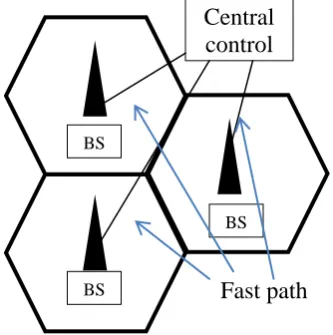
coordination related to the central unit. The main advantage of this style reduces the interference among base stations. However, the size of overhead will increase: information of users for the whole system. Besides that, in order to compensate the extra latency, the basic capacity of the system must be appropriate and the parts of the system must be connected by fast path such as fiber, see Fig. 1.
Fig. 1: Centralized fashion of CoMP.
In decentralized coordination, the jurisdictions are distributed among base stations to accomplish the coordination. Any two base stations could coordinate to submit the support to a user in term of the power where the information of users sends to related base stations [17]. There is no fixed central control and the overhead will decrease but the level of discipline will decrease too, see Fig. 2.
The aim of this coordination among base stations is to compensate the weak signal of users either in the cell edge location or users who suffer from interference.
VII. MODEL ASSUMPTIONS AND SCENARIOS
The model of the paper reflects a system which consists of three cells, each cell includes three sectors. The sectors of the cell are controlled by the base station of the cell as illustrated in Fig. 3.
The users are distributed randomly as shown in Table 1. S1, S2 and S3 represent the sectors of base stations. For example, the number 6 in S1 for BS1 shows the number of users in this sector while the number 8 represents the number of users in S1 for BS2. The model is built using OPNET modeler. The simulation of the model contains two scenarios, the first scenario is implemented without the operation of CoMP technique, each user in the model have downlink and uplink. While the second scenario is included the CoMP operation. In the second scenario, the CoMP operation dealt with the users of weak signal only (i.e. up to the scheme of QPSK3/4). This is related to reduce the overhead of 802.16e system. When the modulation and coding scheme in downlink
direction of a user is QPSK1/2 or QPSK3/4, the sectors are coordinated and cooperated to raise the level of scheme to QPSK3/4 or 16QAM1/2. It should be noted that the scheme of modulation and coding rate in uplink direction with CoMP keeps fixed like without CoMP operation. Table 2 explains the assumptions of the model.
Fig . 2: Decentralized fashion of CoMP.
Fig . 3: The model of the system.
Central
control
BS
BS
BS
Fast path
BS
BS
BS
BS
CLOUD Server
BS
S1
S2
S3
S1
S1
S2
S2
TABLE 1THE DISTRIBUTION OF USERS WITHOUT AND WITH COMP
.
TABLE 2 THE MODEL ASSUMPTIONS.
VIII.THERESULTS
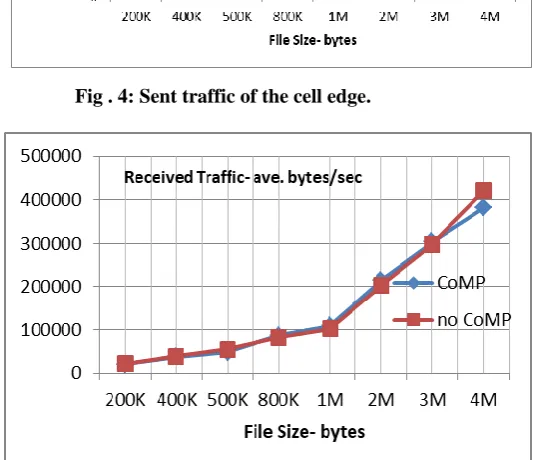
Fig.4 explains the relationship between file size and sent traffic in the cases of without and with CoMP technique for the users of the cell edge. In other words, the users of the cell edge in case of the without CoMP are the users who use the schemes of QPSK1/2 and QPSK3/4, the number of these users are shown in Table 1. In general, the traffic is increased with the increment of file size. At the large size of file, the effect of CoMP becomes more clearly where the CoMP contributes to represent the same information using less traffic of data. The received traffic and file size illustrate in Fig. 5 in the cases of without and with CoMP technology for the users of
the cell edge. This Figure explains that most of the sending data is received successfully. It is obvious that with the large size of the files, the effect of CoMP seems more clearly.
Fig . 4: Sent traffic of the cell edge.
Fig . 5: Received traffic of the cell edge.
The effect of CoMP technology is explained in Fig. 6 as a term of lost data. Firstly, with the small size of files, the capacity of 802.16e system can absorb the sending data in cases of without and with CoMP where all data are received successfully. At the file size large than 500kB, the system loses the possibility of delivery of all data successfully. The effect of CoMP fixes the problem of lost data. This is related to upgrade the schemes of modulation and coding rate of the users at the edge of the cell from QPSK1/2 and QPSK3/4 to QPSK3/4 and 16QAM1/2 respectively. After 3MB of file size for each user, although the system starts to breakdown but the CoMP operation tries to reduce the collapse.
The use of CoMP improves the signal to noise as well as improving the type of modulation and reducing the amount of transmission and receiving for the same data value, which in turn leads to power saving. BEFORE CoMP BS3 BS2 BS1 Scheme S3 S2 S1 S3 S2 S1 S3 S2 S1 4 7 6 9 5 8 4 7 6 QPSK1/2 6 6 4 2 5 2 6 3 4 QPSK3/4 3 3 4 3 5 4 5 3 3 16QAM1/2 4 2 3 4 3 4 2 5 4 16QAM3/4 1 1 2 1 2 1 2 1 2 64QAM2/3 2 1 1 1 0 1 1 1 1 64QAM3/4 AFTER CoMP BS3 BS2 BS1 Scheme S3 S2 S1 S3 S2 S1 S3 S2 S1 0 0 0 0 0 0 0 0 0 QPSK1/2 4 7 6 9 5 8 4 7 6 QPSK3/4 9 9 8 5 10 6 11 6 7 16QAM1/2 4 2 3 4 3 4 2 5 4 16QAM3/4 1 1 2 1 2 1 2 1 2 64QAM2/3 2 1 1 1 0 1 1 1 1 64QAM3/4
Type Description
No. of cells 3
No. of BSs 3
No. of sectors/BS 3
No. of sectors 9
No. of users/cell 60
No of users/system 180
User station Fixed
Users' distribution Random
Standard/ based on 802.16e/SOFDMA
Bandwidth 20 MHz
No. of subcarriers 2048
CoMP Intra-site
It is used the maximum data to send for each subscriber through the value (3MB/sec) for the purpose of the CoMP impact statement. Fig. 7 shows the amount of instantaneous sent traffic of the system with simulation time in the case of send data with the existence of CoMP and its absence. It is important to note that CoMP does not only improve service in the cell edge, but also improves service in each cell as shown in Fig. 7 which also shows that the average sent traffic is equal to (673943.194B/s) and (702290.1818B/s) with the presence of CoMP and its absence, respectively. The improvement percentage is 4.3%.
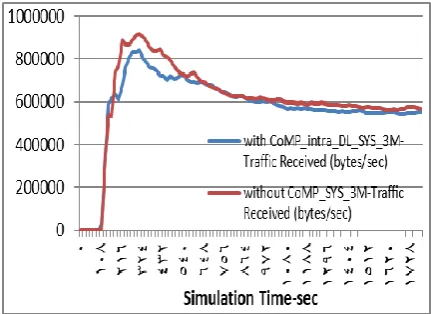
The instantaneous received traffic of the system with simulation time is shown in Fig. 8 for the case of downlink transmission with the existence of CoMP and its absence. It is clear that CoMP improves the received traffic through the sectors collaboration to improve the signal to noise ratio for all users in the cell specially, the users in the cell edge. It is simply to find that the average sent traffic is equal to (609380.3658 Byte/s) and (639892.2237 Byte/s) with the presence of CoMP and its absence, respectively. The improvement percentage is 4.9%.
Fig. 6: Lost traffic of the cell edge.
Fig. 7: The sent traffic with varying simulation time.
Fig. 8: The received traffic with varying simulation time.
IX.CONCLUSION
The impact of intra-site CoMP technique on the downlink direction traffic of the system of 802.16e standard is presented by this paper. The research dealt with the users of low-level scheme of modulation and coding rate in case of file transfer application for different sizes. The results shown that the CoMP technique enhanced the capacity of 802.16e as a term of sent traffic and received traffic hence CoMP technique saved a part of the traffic. For instance, at 3Mbps file size for each user, the system with CoMP operation is successfully supported the traffic of the system by 2.8% as compared with the case of no CoMP. While in case of 4Mbps for each user, the CoMP reduced the loss of the traffic about 50% as compared with no CoMP. It is worth mentioning that performance improvement in the case of receiving data is better than the state of transmission and this is the focus of this research. The future work will deal with all users of the system (i.e. with all schemes of modulation and coding rate of 802.16e).
ACKNOWLEDGMENT
This work was supported by Electrical Department, Engineering College, Mosul University.
REFERENCES
[1] S. Shah and S. Islam," A Survey on Cooperative Communication in Wireless Networks", I.J. Intelligent Systems and Applications, DOI: 10.5815, MECS, pp: 66-78, 2014.
[2] F. Mismar and B. Evans," Deep Learning in Downlink Coordinated Multipoint in New Radio Heterogeneous Networks", IEEE Wireless Communications Letters, DOI: 10.1109/LWC.2019.2904686, pp:1-4, 2019.
[3] P. Marsch, and G. P. Fettweis, "Coordinated Multi-Point inMobile Communications, From Theory to Practice", Cambridge University Press,2011.
[4] S. A. Ayoob, and A. N. Hammodat, " Modeling and Simulating of Coordinated Multi- Point (CoMP) Technology in LTE- A", International Journal of Computer Applications, vol.182, no. 17, pp 34-39, 2018.
IEEE Standard for Local and metropolitan area networks, Revision of IEEE Std 802.16e, 2006.
[6] M. Michel, D. Margot, T. Emmeric, M. Luc and J. Wout," Simulations of beamforming performance and energy efficiency for 5G mm-wave cellular networks", Wireless Communications and Networking Conference, ISSN: 15253511, IEEE, 2018.
[7] M. Mezzavilla, M. Zhang, M. Polese, R. Ford, S. Dutta, S. Rangan and M. Zorzi," End-to-End Simulation of 5G mmWave Networks", Communications Surveys and Tutorials, IEEE, Vol.20, Issue 3, pp:2237-2263,2018. [8] N. Akshatha, P. Jha and A. Karandikar," A Centralized
SDN Architecture for the 5G Cellular Network", 2018 IEEE 5G World Forum (5GWF) conference, IEEE, pp: 147 – 152, 2018.
[9] M. Kibria, K. Nguyen, G. Villardi, K. Ishizu and F. Kojima,"Next Generation New Radio Small Cell Enhancem ent: Architectural Options, Functionality
and Performance Aspects", IEEE Wireless Communications, Vol.25, Issue 4, pp:120-128, 2018.
[10] S. Sun ,T. Rappaport and M. Shaft," Hybrid beamforming for 5G millimeter-wave multi cell networks" , IEEE INFOCOM 2018 - IEEE Conference on Computer Communications Workshops (INFOCOM WKSHPS), pp:589-596, 2018.
[11] B. Manijeh, C. Kanapathippillai, B. Alister G., N. Quoc and P. Vincent," Mixed Quality of Service in Cell-Free Massive MIMO", IEEE Communications Letters, , Vol. 22 , Issue 7 , pp: 1494 – 1497, 2018.
[12] N. Kaur and M. Sharma, " Comparative Analysis of Techniques used for Traffic Prediction", International Journal of Engineering Trends and Technology (IJETT), Vol.50, Number 4, pp:238-242, 2017.
[13] R.Nath and P. Singh, " MIMO Antenna for UWB Applications", International Journal of Engineering Trends and Technology (IJETT), Vol. 53, Number 1, pp:13-18, 2017.
[14] Qimei Cui; Hui Wang; Pengxiang Hu; Xiaofeng Tao; Ping Zhang; Jyri Hamalainen; Liang Xia, "Evolution of Limited-Feedback CoMP Systems from 4G to 5G: CoMP Features and Limited-Feedback Approaches", IEEE Vehicular Technology Magazine, Vol. 9, Issue 3, pp. 94-103, Sept. 2014.
[15] Tikhomirov, A., Omelyanchuk, E., & Semenova, A., "Recommended 5G frequency bands evaluation", IEEE, Conference Location: Moscow, Russia, 2018 Systems of Signals Generating and Processing in the Field of on-Board Communications. doi:10.1109/sosg.2018.8350639, 2018. [16] J.D. Kumar and C.Balamurugan, " Performance Measures of
Filter Bank MultiCarrier Waveform for 5G Communication", International Journal of Engineering Trends and Technology (IJETT), Vol. 67 , Issue 1 , 2019, pp: 34 – 37.