Soil Conditioner by Artificial Ammoxidation
of Lignin and Optimization Using Response
Surface Methodology
Shailaja V. Kamble
1, Dr. Y.C. Bhattacharyulu
2Laximinarayan Institute of Technology, Nagpur. Rashtrasant Tukadoji Maharaj Nagpur University, Amravati Road,
Bharat Nagar, Nagpur, India 1
Professor, Department of Chemical Engineering, Anuradha Engineering College, Anuradha Nagar Sakegaon Road,
Dist. Buldhana, Chikhli, India 2
ABSTRACT: Lignin biomass was obtained from black liquor, using acid H3PO4. The residue so obtained was used for
preparation of soil conditioner by artificial ammoxidation process in a batch reactor. The process parameters identified
were composition of oxidizing agent (H2O2+ammonia), reaction time, and temperature. The present study also
encompasses optimization of process parameters involved by the application of response surface methodology (RSM), so as to understand the interaction of these parameters. The statistical significance of the model equation was evaluated by the F-test for analysis of variance, which showed that the model is statistically significant at 95% confidence level. The model F-value of 228.48 for ammoxidation process implied that the model was statistically significant. To test the
fit of the model, the regression equation and determination coefficient, R2 were evaluated. In this case, the value of the
determination coefficient R2 = 0.9942 indicated that the model could explain 99.42% of the variability.
KEYWORDS:Soil conditioner, Kraft lignin, Oxidizing agents, Experimental design Introduction
I. INTRODUCTION
A fertile soil is basis of human health, it is important to maintain the fertility status of soil compact. Three fold benefits
can be achieved by using biomass obtained from black liquor as soil conditioner, produced by artificial ammoxidation
process. Lignin available in nature in abundance as renewable resource, and it forms the basis for humus production [1]. It can act as an additive to balance the agricultural soil which is deficient in necessary organic matter, thereby curtail the massive use of inorganic fertilizer and increase tilth of soil. Land use of such an amendment may enhance soil fertility by improving physical, chemical and biological properties [2]. Thus improving crop yield along with
providing sustainable environment management, by supporting economical viable alternative to pulp and paper
industries, especially small to medium scale industries which are under constant environmental threat, can find remedy [3].
Globally the demand for paper and paper board is increasing and expected to raise to 16.7 million tons in 2016-17, so as the generation of black liquor by these industries [4]. Lignin and lignin related compounds (L & LRC), which are major constituents of black liquor are no longer considered as waste materials of paper industry, rather, it is looked upon as non exhaustible resources of biomass, which deserves clever application and scientific research support so
that one day it may turn into a treasure troves [5,6] . This area is under research for the last 5-10 years, many workers
explored this potential of lignin biomass to minimize the use of inorganic fertilizers [7-9].
responsible for the degradation of lignin macromolecules, the cleavage of aromatic ring units, and the final
incorporation of nitrogen into the structures resulting products[12].
The procedure of conventional ammoxidation required several hours, done exclusively at high pressure and temperature. Ammonia and air, oxygen and potassium permanganate, nitric acid were used as source of nitrogen and oxidizing agents [13,14]. Literature survey reveals that batch process was more preferred, only a few experiments were
done by using continuous bed reactor [10]. Many processes were further developed to give acceptable levels of N2 for
its use as slow releasing fertilizer as found by Marvin Weil el.at. [15] and other workers [16]. The process parameters
of ammoxidation reactions, such as time, temperature and pressure got reduced significantly by achieving more
nitrogen into the finished product, by using H2O2 as an oxidizing agent at atmospheric pressure [17, 18]. Similar studies
were done by other workers [19, 20], for N-fuctionionalized Kraft lignin. It was found later on that at lower technical expenditure, ammoxidized product, resembling to natural like humus is possible to produce, by using mild operating conditions, at nearly ambient pressure, with phosphoric acid as one of the reagent [21].
Present paper studies artificial ammoxidation process, wherein the lignin biomass was obtained by precipitating BL,
using phosphoric acid. The important process parameters studied were composition of oxidizing agents (H2O2 active
oxidizing agent+ ammonia), reaction time, and temperature. Optimization of these process parameters was done by using response surface methodology (RSM) so as to establish a quantitative relationship between the independent and the dependent variables.
II. MATERIAL AND METHOD
The Kraft black liquor was collected from nearby paper industry using, hardwood and bamboo as raw material for producing pulp, at pH=13.2. There are two reasons for precipitation of black liquor, the BL available is in liquid stage and contains large amount of water (67%) and its solid content is only 33%, prove uneconomical if processed at this stage. It was found that as compared to direct oxidation of black liquor, it is advantages to isolate the lignin biomass first, and then use it by oxidation process so as to gain more nitrogen in the final product [13]. In this case acid ortho-
H3PO4 was used, instead of conventional H2SO4 for precipitation with the aim to incorporate phosphorous ions also in
the nutrient deficient matrix of biomass [22]. After precipitation, the residue (biomass) was collected at pH 8.89(~9), it
was washed at the same pH, with the same acid to purify the biomass [23], and then it was dried, grinded, and screened for utilization. Table 1 below gives elemental analysis of biomass obtained, using a Perkin Elmer 640-C Analyzer.
Table 1 Elemental analysis of lignin
Element C H N S O
Wt. % 56.7 2.7 0.6 2.3 37.7
Experimental Procedure
In the present studies ammoxidation of biomass, as obtained above was carried out in a batch process as studied by Gonzalez C.and Jiang Qi-pei [13,18].
The Stainless steel container having capacity of 1 L called as digester heated externally was used. Each batch consists
of 30 g acid-precipitated lignin and on wt. basis hydrogen peroxide and ammonia liquor was used, the time and temperature were varied, details of experimental conditions used are shown in Table 2. These materials were placed into digester and distilled water was added to make up the total volume to 300 ml. The parameters studied were
temperature (100-1500C), reaction time (60-180 minutes) and oxidant concentration was varied between 20 to 30% of
H2O2 in NH3 solutionas shown in Table.3.
Ammoxidized products were air dried (Temperature 40 to 45 0C), in a Petri dish for two days and further in a
desiccators over P2O5 for one day. The soil conditioner, so obtained was then analyzed for nitrogen content by
III. RESULTS AND DISCUSSION
Box-Behnken Design of Experiments
A Box-Behnken factorial design with three factors and three levels including 12 factorial points and three center points was used for fitting a second-order response surface Table 2 gives the factors and their values. Table 3 describes the experimental design and responses. In the present study two replications were carried out and the average values were presented. Experiments were performed randomly to minimize the effects of unexpected variability in the observed responses. This methodology allows the formulation of a second-order equation that describes the process.
The amount of % N2 in the reaction product was analyzed by the multiple regressions through the least squares method,
to fit the following equation:
Y = β0 + β1X1+ β2X2+ β3X3 + β12X1X2+β13X1X3 + β23X2X3 + β11X12 + β22X22 + β33X32 …… (1)
WhereY was the %N2 in the reaction product. β0 is the intercept term, β1, β2, and β3 were linear coefficients, β12, β13,
and β23 were interactive coefficients, β11, β22, and β33 were quadratic coefficients, and X1, X2 and X3 were coded
independent variables.
In the present study, preliminary experiments and information from literature revealed that time, temperature and oxidant concentration plays a crucial role in ammoxidation process, hence these variables were selected in the design of
experiments. The key process variables were % oxidizing agents and source of ammonia ( H2O2+ liq. Ammonia),
temperature (100-1500C), reaction time (60-180 minutes), oxidants concentration (% H2O2 and NH3) by 20-30% were
changed as shown in Table 2. Here the objective was to incorporate N2 into the product so as to serve as soil
conditioner for slow release of N2 into the soil. The factor levels were coded as -1(low), 0 (central point) and +1(high).
The experimental conditions used are as tabulated below in Table 2 and Table 3, wherein RSM was used for
optimization of variables in the oxidation process.
Table 2 Experimental range and levels of the independent variables.
Variables Symbols Range and levels
– 1 0 + 1
Temperature, 0C X1 100 125 150
Reaction time, minutes X2 60 120 180
Oxidant Concentration
(%wt. H2O2 +NH3 )
X3 20 25 30
Optimization of variables in Ammoxidation process by RSM
Based on the Box-Behnken design and results of experiments (Table 4), the quadratic regression model (based on the coded factors) of the experimental data was fitted in the following expression (2)
Y = 3.75 + 0.44 X1 + 0.82 X2 + 0.53 X3 + 0.16 X1 X2 + 0.077 X1 X3 + 0.051 X2X3 … (2)
Where Y was the %N2 in the product, X1-temperature (0C), X2 – Reaction time, (minutes), and X3 – Oxidant
concentration (Wt.%) H2O2 +NH3.
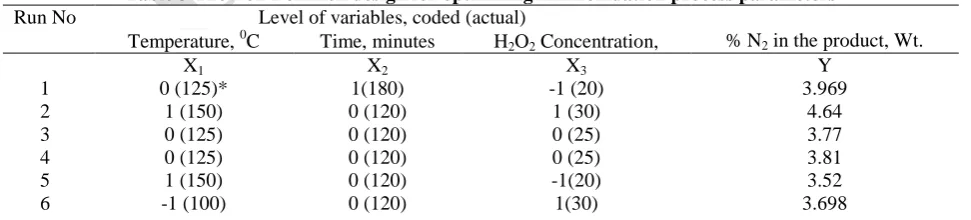
Table 3 The Box-Behnken design for optimizing Ammoxidation process parameters
Run No Level of variables, coded (actual)
% N2 in the product, Wt.
Temperature, 0C Time, minutes H2O2 Concentration,
X1 X2 X3 Y
1 0 (125)* 1(180) -1 (20) 3.969
2 1 (150) 0 (120) 1 (30) 4.64
3 0 (125) 0 (120) 0 (25) 3.77
4 0 (125) 0 (120) 0 (25) 3.81
5 1 (150) 0 (120) -1(20) 3.52
7 1 (150) -1 (60) 0 (25) 3.271
8 1 (150) 1(180) 0 (25) 5.227
9 0 (125) 1 (180) 1(30) 5.205
10 -1(100) -1 (60) 0 (25) 2.638
11 -1(100) 0 (120) -1(20) 2.886
12 0 (125) -1 (60) 1(30) 3.47
13 0 (125) -1(60) -1(20) 2.437
14 -1 (100) 1 (180) 0 (25) 3.947
15 0(125) 0 (120) 0 (25) 3.79
* Values within the parenthesis indicate the actual values.
The statistical significance of the model equation was evaluated by the F-test for analysis of variance (ANOVA) which showed that the regression is statistically significant at 95% confidence level. The model F-value of 228.48 for ammoxidation process implied that the model was statistically significant. There was only 4.40% chance that a "model F-value", this large value could occur due to noise. Values of “ Prob > F-value “ less than 0.05 indicated that model
terms were signifcant. In this case X1, X2, X3 and interaction terms X1, X2 were significant model terms.
Table 4 Analysis ofVariance of the experimental Results.
Source Sum of squares DF Mean square F-value Prob> F
Model 9.20 6 1.53 228.48 < 0.0001
X1 1.52 1 1.52 226.74 < 0.0001
X2 5.33 1 5.33 794.74 < 0.0001
X3 2.21 1 2.21 328.73 < 0.0001
X1 X2 0.10 1 0.10 15.59 0.0042
X1 X3 0.024 1 0.024 3.53 0.0969
X2X3 0.010 1 0.010 1.54 0.2505
In this case, the value of the determination coefficient R2 = 0.9942 indicated that the model could explain 99.42% of
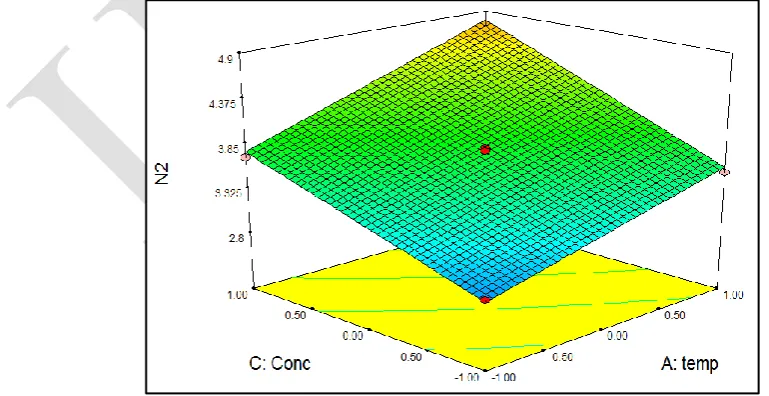
the variability. “Adeq Precision” measures the signal to noise ratio. A ratio greater than 4 is desirable. A ratio of 48.341 indicated an adequate signal. This model could be used to navigate the design space. Three – dimensional response surfaces were plotted on the basis of the model equation, to investigate the interaction among variables and to
determine the optimum condition of each factor for maximum %N2 in the product. The response surface plots are
shown in Figs 1-3, showing the effect of variables such as temperature, time, and % composition of (H2O2 +NH3) on
amount of nitrogen in the product.
Above figure, shows the effects of temperature and concentration (H2O2 +NH3) on amount of nitrogen. The nitrogen
content increases in the concentration range 25 to 30%. It can be seen that each parameter, individually plays a role, at the same time the combined effect of both the parameters is also influential, to enhance nitrogen content.
Fig. 2 Response surface plots of the effect of temperature and reaction time on amount of nitrogen.
Fig.2 shows the effects of temperature and reaction time on amount of nitrogen. It can be seen that time is affecting more intensely than the temperature but, the combined effect of both the parameters is more significant, thus both these factors individually and together contribute significantly to enhance nitrogen content of the product.
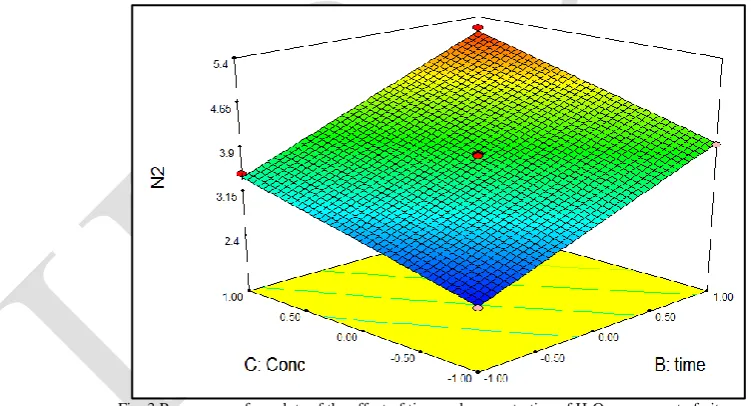
Fig. 3 Response surface plots of the effect of time and concentration of H2O2 on amount of nitrogen.
Fig.3 shows the effects of concentration of (H2O2 +NH3) and reaction time on amount of nitrogen. It shows that, not
only their linear effects are great, but their combined effect is also high under the range of experimental conditions studied.
IV. CONCLUSION
The present study showed the efficiency of artificial ammonization process for incorporation of N2 into the product so
study clearly showed that optimization of variables in the process can be successfully achieved to maximize N2 in the
finished product by using Box-Behnken factorial design for experimental design and analysis of results. The study of ANOVA, showed that the regression is statistically significant at 95% confidence level, with the model F-value of
228.48 for the process implied. The value of the determination coefficient R2 = 0.9942 indicated that the model could
explain 99.42% of the variability, showed that the model was statistically significant. Thus soil conditioner so obtained is capable of meeting the high demand of humus material effectively, in short time span; thereby shows potential to restrict the use of chemical fertilizers.
REFERENCES
1. Calvo-Flores Francisco Garcia, Dobado Jose A., “Lignin as Renewable Raw Material”, ChemSus Chem, Vol. 3, pp. 1227–1235, 2010. 2. Jose Maria Rosa De la, Lopez-Martin Maria, Liebner Falk and Knicker Heike, “Effects of N-ammonoxidized lignins amendment on N
availability and soil fertility: An incubation study”, Geophysical Research Abstracts, Vol.15, pp. 5499-1, 2013.
3. Ning Liu, Hongbo He, Hongtu Xie, Zhen Bai, Xudong Zhang, “Impact of long-term organic fertilizer application on lignin in Mollisol”,Advanced Materials Research, Vol. 113-114, pp. 1332-1335, 2010.
4. Ministry of Commerce and Industry, Govt. of India, New Delhi, DIPP (Department of Industrial Policy & Promotion), The working group for pulp & paper sector for 12th Five year plan, Chaired by Mr. S.P. Singh, IAS, Secretary, 2011.
5. Sandra Le Barron,“Characterizing and Determining Beneficial Use of Paper Production Residuals that Otherwise Become Waste”, Director of Environmental Health and Safety ,Finch Paper LLC, Cornell Waste Management Institute, Crop and Soil Sciences Department, Finch Paper, LLC, Glens Falls, NY, 2014.
6. Wertz Jean-Luc, Olivier Bedue, “Lignocellulosic Biorefineries”, CRC Press, NY, 2013.
7. Ayyachamy Manimaran, Maria G. Tuohy Finola E. Cliffe, Jessica M. Coyne, John Collier, “Lignin: untapped biopolymers in biomass conversion technologies”, Journal Biomass Conversion and Biorefinery, Springer-Verlag, Vol.3, pp. 255-269, 2013.
8. Yang-Jie Li, Luo jie, “Application of Lignin and its Derivatives in Agriculture and Forestry”, Journal of Anhui Agricultural Sciences, Vol. 33, pp. 10794-10795, 2007.
9. Jun-he Liao, “Physical and Chemical Properties of Lignin and Its Study as Carrier of Fertilizers”, Journal of Cellulose Science and Technology, Vol. 04, pp.55-60, 2001.
10. Klaus Fischer, Rainer Schiene, “Nitrogenous Fertilizers from Lignins - A Review”, Chemical Modification, Properties, and Usage of Lignin, pp.167-198, 2002.
11. Yan-zhi Liao, A-san Yang, Qin Sun, Zhe-ke Zhong,“Research Progress of Ammoxidation of Technical Lignin”,Transactions of China Pulp and Paper, pp.109-113, 2007.
12. Zhou Lev Lu, Zhao Xian-Tao, Qiu De-Sheng, Yu-Gui, “Structural Changes of Lignins Caused by Oxidative Ammonolysis”, Acta Chimica Sinica, Vol.60, pp.2, 2002.
13. Gonzalez C., R. Alvarez and J. Coca, “Use of Kraft Black Liquors From a Pulp Mill for the Production of Soil Conditioners”,Waste Manag Res, Vol.10,pp.195,1992.
14. Kim Y. K., Plain W. M. & Hatfield J.D.,“Fertilizer from oxidative ammoxidation of saw dust”,Ind. Eng. Chem. Prod. Res. Dev. Vol. 20, pp. 205-212, 1981.
15. Marvin Weil O. Simon, B.K. Singh, M.J. Weil, “Elaboracion Laboracion Caracterizacion de lignosulfonatos Amonificados A Partir de Pinzote de Banano Y Aserrin de Laurel (Cordia alliodora) Para Utilizarse Como Fertilizante de Liberacion Lenta”, Tierra Tropical, Vol.1, pp.21-26, 2005.
16. Srivastava, Anita, Bandari, “ Oxidative ammonolysis of commercial lignin by a new concept to produce N modified lignin”, Indian Forester, Vol. 126, pp. 643-646, 2000.
17. Yongcan Jin, Jinying Quan, Yueqiu Wang and Zhongzheng Li, “ Oxiammonolysis of Wheat Straw Alkaline Lignin by Hydroperoxide III. The Effect of Transitional Metal Ions on Oxiammonolysis Reaction”. Journal of Cellulose Science and Technology, Vol. 4, 2001.
18. Jiang Qi-pei, Zhang Xiao-Yong, Mo Has-tan,Li Zuo-hu, “Ammoxidation of straw pulp alkaline Lignin by H2O2 with Iron II calion”,. Chem.Biochem Eng Q, Vol.20, 437- 441,2006.
19. Tamer Ragab, “Studies of the Nitrogen Binding Forms in Ammoxidized Lignins, University of Natural Resources and Applied Life Sciences”,Department of Organic Chemistry,Vienna.Austria.Chemistry, Vienna.Austria,othes.univie. 2008.
20. Ramirez F., G. Varela, E. Delgado, F. Lopez-Dellamary, V. Zúñiga, V. González, O. Faix, Meier D., “Reactions characterization and uptake of ammoxidized kraft lignin labeled with 15N ”, Bioresource Technology, Vol.98, Issue 7, pp. 1494-1500, 2007.
21. Klinger Karl Michael, Liebner Falk, Hosoya Takashi, Potthast Antje and Rosenau Thomas, “Ammoxidation of Lignocellulosic Materials: Formation of Nonheterocyclic Nitrogenous Compounds from Monosaccharides, J. Agric. Food Chem., Vol.61, pp.9015−9026, 2013.
22. Brauns F. E., The Chemistry of Lignin by Brauns and Brauns, D. A., New York, 1960.