Cloud Migration Model
Priscila Cathoud de Queiroz¹, Tiago Bittencourt Nazaré², Felippe Cathoud de Queiroz³
¹Student of Information Systems, Faculdades Unificadas de Cataguases - DOCTUM
²Master in Engineering systems management, Universidade Católica de Petrópolis-UCP
³Bachelor degree of Computer Science, Universidade Federal de Viçosa
Cataguases/MG, Brazil ¹[email protected]
²[email protected] ³[email protected]
Abstract - Considering current competition on the IT market, the study in question aims to evaluate a cloud migration model to companies who wants to enter in this universe, with the goal to show that migration can be a good investment and a success option given its low costs. According to the methodologies and case study that proved its benefits.
Keywords: Cloud Computing, Migration, E-mail Service, Internal Management.
I. INTRODUCTION
Cloud Computing is a concept and model of the use of resources and services that has made room for its high impact in the Information Technology industry. The new standard, cloud computing, goes far beyond the many technologies that make it possible, such as virtualization and the abstraction of features and services. It has transformed the market in the same way that the Internet has done since its consolidation in the various areas of the market.
From professionals, businesses, to the end user, cloud computing has revolutionized the way in which computing, data storage and application resources are consumed, bringing them closer to the real needs of each user for each purpose and creating unique conditions for innovation and accelerating the development of economies.
In practice, the model can be compared to renting a property, which means that rent is paid for the right to use the services. More than that, at any time you can stop using it without additional costs, pay more to get new features and pay less if you do not need all the features it offers. It is not necessary to purchase licenses, because the service is rented, if you acquire the right to use it and exempt software and third-party license expenses (database, operating system, backup tools and others) in [1] [2].
The focus of the theme is to demonstrate that migration from traditional to cloud-based systems can be done and that it is indeed a good investment, and that any company that wishes to enter into this universe can succeed by following the procedures laid down in the work through the understanding of the organizational profile, the evaluation of the
internal computational barriers and the migration strategies. The adoption of migration depends on these processes and the most targeted feature is what the company identifies as the main motivating factor for it to migrate all or part of its systems to the cloud. Migration to the cloud without proper planning and care can have drastic consequences for companies, since data can be lost and critical systems, if not evaluated, can be stopped, resulting in losses of all kinds, impacting each sector of the company. Consequently, this prevents the migration from being made or effected, and in any case the damage can be very high and without an immediate repair.
The present study intends to approach an effective case study, where part of the service was migrated, being the e-mail service related to the company of Mining and Construction (U&M). Among the objectives of the present research are the evaluation and analysis of cloud migration methodologies; and exposure tools for internal management purpose. For these purposes, the work occurred in a descriptive way with a qualitative approach, through the case study, and with bibliographical researches.
The study was based on already elaborated documents, such as books, periodicals, as magazines and publications of scientific articles and critical essays, as well as with data collected through the base work of [1] [2].
The organization of the present work has its structure divided into 6 section, in which the first 5 are part of the bibliographic review.
Section 2 covers the essential concepts and attributes of the cloud, architectural layers, and service models.
Section 3 addresses the first steps of migration to understand the organization's profile, assess migration barriers and strategies. These 3 bases are directly interconnected.
Section 4 discusses the migration methodology, in stages, where the process flows and subprocesses that highlight the proposed procedure are highlighted.
provide the maximum autonomy to the company so that it has a better management over its expenses, by the local IT or third parties.
Section 6 presents the case study carried out, and it can be contemplated the practical application of all the material discussed in previous sections.
II. LITERATURE REVIEW
This session seeks to list the existing information technology services that are necessary to describe for the understanding of the migration process and its minutiae.
A. Models of service
• Infrastructure as a Service – IaaS
The focus is the distribution of infrastructure resources such as hardware, storage and processing, in the form of service, where the user has virtual control of the physical part using virtualization tools [3].
• Platform as a Service – PaaS
Provides the resources required for the development and execution of applications and for security issues [4].
• Software as a Service – SaaS
Is understood to be the ability to provide applications through cloud architecture, used as a medium to the Internet [5].
• Public cloud
Are those that are run by third parties. One of the benefits of public clouds is that they can be much larger than a private cloud, for example, because they allow for greater scalability of resources [6].
• Private cloud
In the private model the cloud infrastructure is used exclusively by the organization. It can be managed by the organization itself or by outside suppliers [5].
• Community cloud
Is intended to share resources from a cloud provider between two or more organizations [3].
• Hybrid cloud
Combines multiple clouds, these being private and public, retaining their original identities [7].
III. MIGRATION FIRST STEPS This section seeks to illustrate the processes of understanding the company’s profile, assessment of company barriers, migration strategies, as well as their methodologies, processes and subprocesses of activities that are intrinsic to migration.
A. Company’s profile
Understanding the organization is fundamental to understanding the nature of the business. At first glance it does not seem to be an important goal, but in developing a representation of the organization it is possible to understand the sensitivity of its systems and information stored in them. This can be a decisive factor when choosing which type of cloud to use, whether public, private, hybrid, etc. [8].
There are six issues that need to be addressed before undergoing any decisive process. The first concerns understanding the corporation’s motivation to conduct the migration. In this way there is a need to have an environment that facilitates management, reduces expenses and acts as an active facilitator of positive results.
The second question leads to an analysis of the organization's business benefits and efforts to migrate their traditional infrastructure to a cloud environment.
Following the initial analysis, the third one leads to reflect on how the company acquires and allocates its computational resources. Migration of corporate systems to a cloud environment implies, to some extent, centralization, or convergence of most of the resources devoted to data center equipment into a single environment. This can facilitate the acquisition process as well as can guarantee a standardization of equipment tested and approved.
The fourth is understanding how the corporation develops, tests, and implements products and services. The fifth presents a reasoning regarding legal aspects, as well as legal restrictions on the physical location of data and applications. The analysis of these criteria directs to a number of laws, regulations and standards, and foremost to the primary perspective and purpose of the company.
The sixth consists in the analysis of the level of experience of IT professionals and their ability to negotiate and engage in technical discussions in foreign languages, if necessary, or even if they are able to deal with the mechanisms used to make the migration process alone or with support from third parties, mainly for professionals who do not speak English.
B.Assessment of company barriers
This process is reserved for an analysis of potential factors that will facilitate or hinder migration to the cloud environment. Analyzing these factors allows one to detect early on some particularity that may become an impediment to the migration.
If there is positive signaling of the analysis performed in this subprocess, the study continues to develop, concentrating efforts on understanding the specific characteristics of the applications and the infrastructure that will host them [9].
C.Migration strategies
In a traditional environment, there are typically different types of systems and technologies applied to physical or virtualized servers. This may convey some degree of complexity and impose challenges when you have your systems migrated to the cloud [10].
Systems, such as page servers, web applications, intranets, small databases, etc. Generally, require little migration work.
Some systems are more difficult to migrate, like applications that have many dependencies, especially specific versions of their components, distributed and balanced databases, legacy systems among others.
Finally, there are systems that are much more complex, requiring a greater effort in the migration process, in addition to possible additional spending on proprietary software. This is the case of proprietary systems or applications developed in programming languages like C, C ++, Cobol and Delphi.
In the migration process, the requirements that can be migrated must first be evaluated and identified. Having identified these requirements, the next task is to analyze those requirements in the context of existing architecture in order to gain a better understanding of the type of architectural modification that should be made or not. Finally, the architecture will be modified according to the identified change need.
IV. MIGRATION METHODOLOGY Before demanding efforts, it is necessary to study and document some aspects that should be considered throughout the project. This study is the initial procedure adopted to conduct the other migration processes.
The study should generate a document to be archived for migration control and history. The first part of the study should identify the purpose of the migration. Thus, the purpose is to achieve the migration of a system in a traditional environment to the cloud environment.
Next, it is important to clarify the goals of migrating a certain solution to this cloud environment. These objectives should be achieved at the end of the procedure and should be described as achieved or not at the end of the procedure. In accordance with the available hosting service, one must diagnose and list the resources needed to perform the migration.
Testing is the essential part of any migration process.
Tests must be performed by a group of testers or even by a group of selected users, internal or external to the company. The test result is related to the functional requirements of the system. Individual tests should also be performed [11].
The central point is the record made from the execution of the tests and their results. From these records it is possible to analyze them and recover, if they occur, the errors in the test procedures.
Finally, the report must be delivered and communicated to the migration manager and his / her team. The team can elaborate a migration termination term, just to formalize the end of the migration and indicating that the system is ready to be used in the production environment.
V. INTERNAL MANAGEMENT
Just as every precaution should be taken to deploy a cloud, you must also choose the most appropriate tool for network design.
It is important to choose and study the best software for the scenario in which the company is located, so that the resources provided by the cloud can be monitored, by its local team. This way the company can manage the resources being consumed.
This information provided aims to show and collect the resources that the contracting company consumed. The company needs to have its own diagnosis and control, in case there are discrepancies in the account and in the diagnosis proposed by the service providers, the company can rely on one or more tools that will be discussed in the document. In addition, the tool can help optimize internal processes.
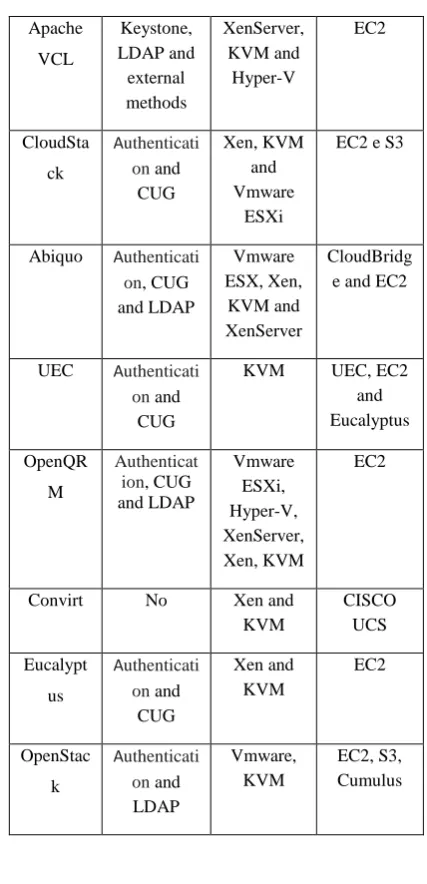
In author [12] proposed there is a collection of tools for this purpose, the section seeks to address some of these tools, such as: Nimbus, OpenNebula, Eucalyptus, CloudStack, Apache VCL, OpenStack, OpenQRM, Ubuntu Enterprise Cloud, Abiquo, ConVirt.
Each of the tools offers a range of utilities and it is up to the company to define what it will use according to its current needs. The proposed features are: storage, virtualization, management, network, security and support. Based on these characteristics one can choose the most appropriate tool for the company in a coherent and supported way.
Table 1 - Comparison of tools I
Tool Monitoring Storage Network
Nimbus Nagios NFS,
iSCSI
and
NFS
OpenNebula OpenNebula Sunstone NFS, iSCSI, LVM Bridge, VLAN and Open Vswitch
Apache VCL Nagios iSCSI VLAN
CloudStack Traffic
Sentinel
iSCSI
and
NFS
VLAN
Abiquo Abiquo
Monitor NFS, iSCSI and LVM VLAN
UEC UEC
Monitor iSCSI and AoE Bridge and VLAN
OpenQRM
OpenQRM-monitord NFS, iSCSI, AoE and LVM Bridge and VLAN
Convirt Convir
Monitor NFS, iSCSI and LVM VLAN
Eucalyptus Nagios AoE,
iSCSI and NFS Brigde and VLAN
OpenStack OpenStack
Clanavi NFS, iSCSI and NFS VLAN and Open Vswitch
Table 2 – Comparison of tools II
Tool Security Virtualizat ion
Integratio n
Nimbus Authenticati on, CUG and Active Diretory Xen, KVM and Vmware ESXi Authenticat ion, CUG and Active
Diretory
OpenNeb
ula
Authenticati on and
CUG Xen, KVM and Vmware EC2, EBS, AMI, S3, IAM Apache VCL Keystone, LDAP and external methods XenServer, KVM and Hyper-V EC2 CloudSta ck Authenticati on and
CUG
Xen, KVM and Vmware
ESXi
EC2 e S3
Abiquo Authenticati on, CUG and LDAP Vmware ESX, Xen, KVM and XenServer CloudBridg e and EC2
UEC Authenticati
on and CUG
KVM UEC, EC2
and Eucalyptus
OpenQR
M
Authenticat ion, CUG and LDAP Vmware ESXi, Hyper-V, XenServer, Xen, KVM EC2
Convirt No Xen and
KVM CISCO UCS Eucalypt us Authenticati on and
CUG Xen and KVM EC2 OpenStac k Authenticati on and LDAP
Vmware, KVM
EC2, S3, Cumulus
VI. CASE STUDY
The study aimed to show the process of adoption of this technology in the company's e-mail service, with studies of needs prior to its adoption, and the solution that was most appropriate to the company's reality. the study sought to follow the direction as was proposed in section 3. Subsequently, the results including the reduction of the total cost of ownership were analyzed [1].
U&M's need lies in its need for enterprise mobility. Due to the convergence in the global markets, it is necessary that its directors remain connected throughout the day. The intention is to provide an increasingly interconnected environment.
Unfortunately, the traditional environment was not able to meet the expectations of a virtualized and connected environment, at least not without additional investments in IT infrastructure.
usability problems reported by customers and U&M’s staff.
During the negotiations to update this tool, there were options to update the email to a cloud-based version. In addition to the upgrade option, an analysis of the cloud-based e-mail tools available in the market was made to choose the best option for the company's environment.
The tool chosen was the Online Exchange, based on the SaaS model and part of the Microsoft Office 365 package. This solution provides access to the application through the Microsoft’s cloud services, with system administrators having all the functionality of the email service, without worrying about server administration, including the security and / or backup structure.
Table 3 shows the technical advantages that were raised with the adoption of Online Exchange over Lotus Notes.
After choosing the software, the implementation of the U&M account was started. As the Microsoft technology was already used in the corporate scope of the U&M, it was possible to synchronize it with the active directory (AD) by adding information security, since the domain service was extended to the online environment.
Initially, it was necessary to prepare Microsoft's cloud environment for receiving U&M mailboxes, such as domain configuration and domain name system (DNS). Once the environment was prepared, the AD integration process was started, this configuration was performed through the Online Exchange control panel without major problems and worked better than expected.
The migration in question was of two different technologies and it became necessary to use a specific tool to convert the basis of Notes to Exchange Online. The software used for this procedure was the migration manager for the Exchange, which was efficient in the conversion of the bases, although it is a rather slow process, since the volume of emails to be migrated was great, a total of 150 databases with approximately 500 Mb each.
Table 3 - Comparison between cloud and local solutions
Exchange online Lotus notes (local tool) No need to purchase,
upgrade and manage hardware and software
Costs with license acquisition and hardware maintenance Integration with
Activity directory
Tool does not provide integration with active
directory
Hight availability and redundancy with
Availability was guaranteed by the local IT staff who was
support staff available 24/7
reduced and do not work on a 24/7 scale. 25GB of storage for
each user
The standard is maintained for each
user was 500Mb of storage Antispam and
antimalware tools
Third-party antispam and anti-malware tools
were used generating additional cost
To upload these databases to the cloud, the internet bandwidth of the tool was limited, so as not to compromise the company's other services. As a result, around 15 to 20 e-mail bases per day were migrated and at the end of 16 days all the bases were migrated to the Online Exchange environment.
The volume of support increased considerably after the migration, as several users had doubts about the functionality of the new tool and how to use it.
In the beginning some difficulties were faced by some users. However, the acceptance of the tool was very good, and the benefits were noticed early on, such as the ease of setting up email with mobile devices and increasing the inbox limit.
The initial experience in the UM company was quite satisfactory for the company and its partners, obtaining the expected reduction in costs of its e-mail system and also optimization the service.
In the future, the company intends to migrate other services to the cloud, due to the good results obtained with the migration of the e-mail service.
VII. CONCLUSIONS
The company UM mining and construction made the migration of its e-mail service to maximize the efficiency of enterprise solutions, as well as the efficiency of information technology solutions within the corporation. Interested in optimizing efficiency and at the lowest cost, cloud computing proved to be the right and viable option to do.
The study aimed to show the process of adoption of this technology in the company's e-mail service, with studies of needs prior to its adoption, and the solution that was most appropriate to the company's reality.
REFERENCES
[1] NASCIMENTO DE SOUZA, Tiago; MONTEIRO DE
RESENDE COSTA, Romualdo. ADOÇÃO DE CLOUD
COMPUTING COMO ESTRATÉGIA
CORPORATIVA. v. 1, n. 2. 2014. Disponível em: <https://seer.cesjf.br/index.php/cesi/issue/view/11>. Acesso em: 10 jun. 2018.
[2] MORAIS, Nathaniel SIMCH DE. Proposta de modelo de migração de sistemas de ambiente tradicional para nuvem privada para o Polo de Tecnologia da Informação do Exército brasileiro. 2015. Disponível em: <http://repositorio.unb.br/handle/10482/18758>. Acesso em: 10 jun. 2018.
aplicações e desafios. II Escola Regional de Computação Ceará, Maranhão e Piauí (ERCEMAPI), 150-175 [4] LV, Hexin; LIU, Jingjing. RCMS: Rapid Cloud Migration
Solution. In: Computational Intelligence and Design (ISCID), 2013 Sixth International Symposium on. IEEE, 2013. p. 426-429.
[5] Mell, Peter, and Tim Grance. "The NIST definition of cloud computing." National institute of standards and technology53.6 (2009): 50.
[6] CHIRIGATI, Fernando Seabra. Computação em
nuvem. Rio de Janeiro, RJ, 2009.
[7] ZHANG, Qi; CHENG, Lu; BOUTABA, Raouf. Cloud
computing: state-of-the-art and research
challenges. Journal of internet services and applications, v. 1, n. 1, p. 7-18, 2010.
[8] Andrade, P. R., Araujo, R. G., Cronemberger Filho, J., Pereira, T. R., Albuquerque, A. B., & Mendonca, N. C. (2015, March). Improving business by migrating applications to the cloud using cloudstep. In Advanced Information Networking and Applications Workshops (WAINA), 2015 IEEE 29th International Conference on (pp. 77-82). IEEE.
[9] KIM, Hee-Woong; KANKANHALLI, Atreyi.
Investigating user resistance to information systems implementation: A status quo bias perspective. MIS quarterly, p. 567-582, 2009.
[10] ZHAO, Jun-Feng; ZHOU, Jian-Tao. Strategies and methods for cloud migration. International Journal of Automation and Computing, v. 11, n. 2, p. 143-152, 2014.
[11] Andrikopoulos, V., Binz, T., Leymann, F., & Strauch, S. (2013). How to adapt applications for the cloud environment. Computing, 95(6), 493-535.