Volume 3 Issue 4 October 2018 34
Black Hole Worm Hole Attack on MANET
using AODV Routing Algorithm
Mr.Santosh A.Korde, Mr.Vishal D.Patil[email protected], [email protected]
Department of Computer Engineering DYPCOE,Akurdi
ABSTRACT
Security issue in mobile ad hoc network (MANET) could be a promising analysis. In 2011, we had accomplished a survey of region attacks in MANETs. But network technology is dynamical with every passing day, a vast range of novel schemes and papers are projected and published in recent years. During this paper, we survey the literature on malicious attacks in MANETs published throughout past five years, particularly the region attack. Region attacks are classified into non-cooperative and cooperative region attacks. Except black hole attacks, alternative attacks in painter also are studied, e.g., hole and flooding attacks. Additionally, we conceive the open problems and future trends of region detection and hindrance in MANETs supported the survey results of this paper. We tend to summarize these detection schemes with 3 systematic comparison tables of non-cooperative region, cooperative region and alternative attacks, severally, for a comprehensive survey of attacks in MANETs.
Keywords : Collaborative Black Hole Attack, Flooding Attack, Mobile Ad Hoc Network, Non-‘cooperative Black Hole Attack, Wormhole Attack
INTRODUCTION
MANET is wireless and an autonomous system that means it’s not recur communications. The wireless network is not used physically wired. In manet nodes perform dynamically nature or at random in ad-hoc network. The randomly nature of mobile ad-hoc network build it more exposed [1]. In manet numerous styles of attacks such like black hole and cooperative
region attacks. Black hole attack may be a kind of active attacks and use of malicious node in which receive to any or all information packets in ad-hoc network. In this way, the helpful all packets within the ad-hoc network are dropped. Once a bunch of region nodes with no difficulty utilized at the aspect of routing in mobile ad-hock networks. This kind of attack is characteristic cooperative black hole attack [2]. Because of high quality of approach routing is huge dispute in ad-hoc network. The ad-hoc on demand distance vector routing may be a reactive routing protocol. The routing protocol is characteristic and transmit packet from supply node to destination node. This routing protocol is using only sequence variety.
Routing Protocols
Volume 3 Issue 4 October 2018 35 between AODV and DSR is that DSR not solely
records next hop info however additionally maintains the route cache in routing table, that is completely different to the AODV records ensuing hop information solely. In keeping with this survey, we tend to found that the majority of researchers apply reactive routing protocols like AODV and DSR to their detection and interference schemes. This is often attributed to the reason that PDR is important importance to the operation of MANETs. The proactive routing protocol is additionally called the table-driven routing protocol. 2 well-known proactive routing protocols are the destination sequenced distance vector (DSDV) [2] and therefore the optimized link state routing (OLSR) [3] protocols. In an exceedingly proactive routing protocol, mobile nodes broadcast routing info sporadically that leads to higher routing overhead. Once network scale increases, the routing overhead raises because of a lot of routing info from a lot of mobile nodes. A node with proactive routing protocol must maintain its routing table once topology changes. The routing table of a node records its neighbour info, like adjacent nodes and reachable nodes. Once a node leaves or joins the network, every node updates its routing table so black hole detection and interference will be a lot of instant. The hybrid routing protocol integrates reactive and proactive routing protocols into a replacement routing method. 2 acquainted hybrid routing protocols square measure the temporally-ordered routing formula (TORA) [4] and therefore the zone routing protocol (ZRP) [5]. A hybrid routing protocol starts with proactive routing method that collects routing info in routing table, and updates routing table with reactive routing technique once topology changes.
RELATED WORK
MANET is incredibly a lot of standard due to the fact that these networks are dynamic, infrastructure less and measurability. Despite the actual fact of the recognition of Manet, these networks are considerably exposed to attacks [1, 2]. During this section we study the varied attacks that are projected within the
Volume 3 Issue 4 October 2018 36 reply message by the intermediate. This
technique avoids the intermediate node to reply that avoid insure case the hole and implements the secure protocol. The answer projected in [7] concentrate on the requirement of a supply node to attend unless the arrival of the RREP packet from over 2 nodes. Once it receives multiple RREPs the supply node certify there's any share hops or not. The supply node can think about the routed safe if it finds the share hops. Its downside is that the introduction of your time delay it's to attend for the arrival of multiple RREPs before it judges the authentication of the node
AODV Routing Protocol
AODV (Ad-hoc on Demand Distance Vector) could be a reactive routing protocol [8] and it works as follows. Whenever a node needs to speak with another node, it's for an available path to the destination node, in its native routing table. If there's no path exists, then it broadcasts a route request (RREQ) message to its neighbourhood nodes. Any node that receives this message for route discovery appearance for a path leading to the several destination node. Management messages used for the invention and breakage of route are as follows:
Route Request Message (RREQ), Route Reply Message (RREP) and Route Error Message (RERR) each node in an Ad hoc network maintains a routing table, that contains information concerning the route to a selected destination.
The routing operations of AODV [9] typically encompass 2 phases:
Route discovery and Route maintenance.
Route Discovery: Route discovery is performed through broadcasting RREQ message. Whenever a node has to send data packets to a destination, it 1st checks if it's associate existing route within the routing table. If not, the supply node can initiate a RREQ and broadcast this request to all or any the neighbours. Then neighbouring nodes can update their routing table according to the received message. Once RREQ reaches the destination, a RREP are generated by the
destination node as a response to RREQ. The RREP are transmitted back to the originator of RREQ so as to tell the route. If an intermediate node has an energetic route towards destination, it can reply the RREQ with a RREP that is termed Gratuitous Route Reply. The intermediate node also will send associate RREP to destination node. The RREP are sent in reverse route of RREQ if a bidirectional link exists.
Volume 3 Issue 4 October 2018 37 routes towards it and doesn't permit forwarding
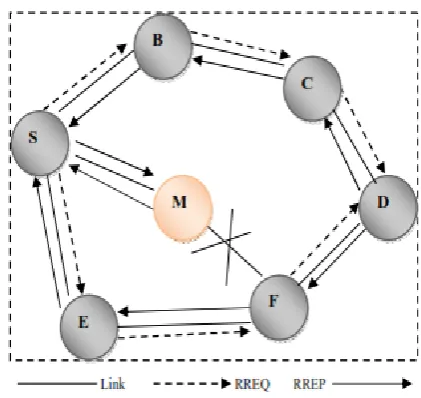
any packet. This attack is termed region because it permits (drops) all data packets [10]. In figure, S and D are assumed to be supply and destination nodes severally. Let M is that the malicious node. S being the supply node would initiate the route discovery method and broadcasts a RREQ that's received by the nodes B, M and E being the neighbours of node S. Upon receiving the RREQ from the node S, node B and E makes a, search to their cache for a recent route to the destination. Non availability or older entry in their route table causes nodes to rebroadcast the RREQ and this method is sustained until the RREQ arrives at node D. however node M claims to own the recent route to destination and sends RREP packet to the supply node S. The reply from the malicious node reaches the supply node much prior alternative legitimate nodes, because the malicious nodes doesn't have to be compelled to check its routing table. Nodes those have route to the destination would update their route table with the accumulated hop count and therefore the destination sequence number of the destination node and generate a RREP management message. The destination sequence range that determines the freshness of a route could be a 32-bit whole number related to every route [11]. The malicious node claims to own a underclassman route by together with a really high destination sequence range in RREP packet. The supply node chooses the trail provided by the malicious node and starts causation the info packets, which are born by the malicious node.
Figure 1 Black hole attack on AODV in MANET
Issue in MAnet
Volume 3 Issue 4 October 2018 38 forestall malicious attacks however difficult.
No matter what theme used, it trades certain overhead off for detection accuracy, e.g., a lot of routing overhead for higher PDR, larger end-to-end delay for higher network turnout, higher computation load for higher PDR. For this reason, once applying detection and hindrance methodology, the important issue is the way to trade appropriate performance metrics off supported the major object, e.g., the highest PDR or network turnout, or the lowest routing overhead or end-to-end delay.
CONCLUSION
As there's increasing threats of attacks on the mobile network, MANETs should have a secure approach of transmission and communication and this quite difficult and important issue in this paper we study the black hole and wormhole attack on routing protocol AODV in MANETs. During this section the black hole attack is more practical in MANETs as compared to the wormhole attack. This can be because of the actual fact that in black hole attack the offender forcefully makes himself an intermediate node on a specific route. Because of this the offender is nearly always able to launch an attack throughout the communication process. On the opposite hand, just in case of hollow attack the effect of attack isn't invariably terribly high and extremely depends on the position of each the colluding attackers
REFERENCES
[1] Y.F.Alem, Z.C.Xuan, “Preventing Wormhole Attack in Mobile Ad-hoc Networks Using Anomaly Detection”, 2nd International Conference on Future Computer and Communication (ICFCC 2010), Vol. 3, pp. 672-676, May, 2010.
[2]. M.Parsons, P.Ebinger, “Performance Evaluation of the Impact of Attacks on mobile Ad-Hoc Networks” April. 10, 2010.
[3] M Al-Shurman, S-M Yoo and S. Park, “Black Hole Attackin Mobile Ad Hoc Networks”, ACM
Southeast Regional Conf, 2004.
[4] Y.-C. Hu, D. B. Johnson, and A. Perrig, “Secure efficient distance vector routing for mobile wireless
ad-hoc networks,” Proceedings of the Fourth IEEE
Workshop on Mobile Computing Systems and Applications, 2002.
[5] C.Jiwen, Y.Ping, C.Jialin, W.Zhiyang, L.Ning, “
An Adaptive Approach to Detecting Black and Gray Hole Attacks in Ad Hoc Network”,24th IEEE
International Conference on Advance Information Networking and Application (AINA 2010), pp. 775-780, April,2010.
[6] J. W. Creswell,” Research Design: Qualitative, Quantitative and Mixed Methods Approach”, 2nd
Ed, Sage Publications Inc, California, July 2002.
[7] P.A.R Kumar, S.Selvakumar, “Distribute Denial-of- Service (DDoS) Threat in Collaborative Environment A survey of DDoS Attack Tools and Traceback Mechanism”,
[8] Kamini, Rakesh K “VANET Parameters and Applications: A Review”, Global Journal of Computer Science and Technology, September 2010.
[9] C.E. Perkins and E.M. Royer “Ad-Hoc on-Demand Distance Vector Routing,” Proc. of IEEE Workshop Mobile Computing Systems and Applications, pp 90-100, 1999.
[10] Dokurer, Semih “Simulation of Black hole attack in wireless Ad-Hoc networks”, Master’s thesis, Atihm University, September 2006.