Geschke Center
Doctoral Dissertations Theses, Dissertations, Capstones and Projects
2017
Exploring the Racial and Gender Identity
Formation of Men of Color in Student Leader
Roles who have white Women Supervisors and
Advisors in Higher Education
Alejandro Frank Covarrubias
University of San Francisco, [email protected]
Follow this and additional works at:https://repository.usfca.edu/diss
Part of theBilingual, Multilingual, and Multicultural Education Commons
This Dissertation is brought to you for free and open access by the Theses, Dissertations, Capstones and Projects at USF Scholarship: a digital repository @ Gleeson Library | Geschke Center. It has been accepted for inclusion in Doctoral Dissertations by an authorized administrator of USF Scholarship: a digital repository @ Gleeson Library | Geschke Center. For more information, please [email protected].
Recommended Citation
Covarrubias, Alejandro Frank, "Exploring the Racial and Gender Identity Formation of Men of Color in Student Leader Roles who have white Women Supervisors and Advisors in Higher Education" (2017).Doctoral Dissertations. 332.
EXPLORING THE RACIAL AND GENDER IDENTITY FORMATION OF MEN OF COLOR IN STUDENT LEADER ROLES WHO HAVE WHITE WOMEN
SUPERVISORS AND ADVISORS IN HIGHER EDUCATION
A Dissertation Presented to
The Faculty of the School of Education
International and Multicultural Education Department
In Partial Fulfillment
of the Requirements for the Degree Doctor of Education
By
Alejandro Covarrubias San Francisco
ii
Exploring the Racial and Gender Identity Formation of Men of Color in Student Leader
Roles who have white Women Supervisors and Advisors in Higher Education
Daily experiences of isolation and invalidation create adverse campus climates
that often lead to men of color dropping out of higher education. Student leadership
positions can increase feelings of belonging, provide greater access to campus resources
and increase retention for men of color, particularly when they centralize identity
exploration. White women are overrepresented in student affairs direct student contact
positions in higher education and are likely to supervise and/or advise men of color
student leaders, but many student affairs professional are not properly trained to
supervise or advise through an identity-based framework. This study explored: how do
men of color make sense of their racial and gender identity formation during their
undergraduate experiences in student leadership settings? and how do men of color
describe their experiences of racial and gender identity formation while being supervised
and/or advised by white women student affair professionals?
It blended elements of Constructivist Grounded Theory with a Participatory
Action Research approach to create a new methodology: Co-Constructivist Grounded
Theory. Three co-researchers collectivity interviewed eight racially and ethnically diverse
participants who attend a variety of four-year institutions. The co-researchers used memo
writing, axial coding, thematic coding, and co-researcher meetings to develop the
iii
between men of color student leaders and their white women supervisors are best
understood when they are situated within the institutional climate and the student
leadership microclimates where the men of color are engaged. They experience specific
types of interactions within each climate and relationship that have positive and negative
impacts on their experiences. Men of color learn to respond to their different climates by
shifting their energy between focusing on healthy identity growth within positive
environments and employing resiliency strategies to navigate and survive within negative
environments. Race was the most salient identity for all of the participants in the steady.
The men who had nurturing environments where they could heal from institutional
racism were more able to explore their masculine identity and understand their privilege
iv
and approved by the members of the committee, has been presented to and accepted by
the Faculty of the School of Education in partial fulfillment of the requirements for the
degree of Doctor of Education. The content and research methodologies presented
in this work represent the work of the candidate alone.
______________________________________ ____________________
Alejandro Covarrubias, Candidate Date
Dissertation Committee
______________________________________ ____________________
Shabnam Koirala-Azad, Ph. D., Chairperson Date
______________________________________ ____________________
Desiree Zerquera, Ph. D.
______________________________________ ____________________
v
This dissertation is dedicated to my family. To my mom, Audrey, thank you for
your endless support, guidance, compassion, laughter, and love. To my pop, Manuel,
thank you for being my greatest role model, for teaching me how to be a humble loving
man, and for teaching me how to fight for justice. I am so blessed to have parents who
can call my friends and who are people that I deeply respect and admire. I love you both
with all of my heart.
To my sister Andrea, thank you for being my partner on so many journeys.
Whether it is cheering me on at a triathlon or supporting me when I am down and feeling
lost, you are my ride or die person. I know I can always call on you for support, to keep
me it real with me and to keep me in check. I hope you know I am always here for you
too. Your realness, strength, drive, and faith inspire me to be better everyday. To my big
brother Manny, thank you for keeping me grounded, for being there for me and
understanding my struggles in ways that only you could. Some of my best moments in
my life are when I get to sit in your chair at the shop and get a haircut. It makes me so
happy to see how many other people admire and respect you in the same ways that I do.
To my sister in-law Alex, thank you for reminding me to have fun and to smile;
and for all of your support. To my nephew and niece, Manny and Bella, I love you both
so much and it has been so hard to see you both grow up from afar. I hope you will come
to realize that all this sacrifice in so many ways has been for the both of you. I promise to
be around more and I cannot wait to see the amazing things you both do in the world. My
greatest hope is that I am helping to create a world that is more accepting, more loving,
vi
My dissertation journey was only possible with support of my community. Thank
you to University of San Francisco International and Multicultural Education community
of faculty, students, and staff. This has been the most humanizing and empowering
educational experience of my life. Thank you to my advisor and chair Dr. Shabnam
Koirala-Azada for your mentorship and guidance; and thank you to my committee
members Dr. Desiree Zerquera and Dr. Patrick Camangian for your time and support.
Also a big thank you to Dr. Uma Jayakumar and to Dr. Dawn Lee Tu for believing in me,
pushing me, and seeing me as a scholar before I saw myself as one.
My endless gratitude, respect, and love to my co-researchers Matthew
Nazario-Miller and Samuel Nieto. I am a better scholar, Chicano man, and human being because
of your friendship and support. This study would not have happened without your
generosity and brilliance. A huge thanks to all of the participants in the study who trusted
us with their narratives, we hope we honored your stories and your lives.
I also want to acknowledge all the current and former co-workers, interns, staff
and faculty who make up the USF Cultural Centers family. This journey was challenging
and arduous at times. Thank you for believing in me and for supporting my journey.
Finally, I want to honor a man in my life who rarely gets recognized. To my
Uncle Frank Olivares. Thank you for always coming to my graduations, for encouraging
me and for quietly always being there for me. Thank you for all the beers and shots of
tequila together at family parties. Those simple moments of being just one of the boys
with you have meant more to me than I could ever express. Thank you showing me how
vii
Dissertation Abstract ... ii
Dedication ... v
Acknowledgements ... vi
Table of Tables ... xii
Table of Figures ... xiii
CHAPTER I: THE RESEARCH PROBLEM ... 1
Statement of the Problem ... 6
Background and Need for the Study ... 9
Purpose of the Study ... 13
Research Questions ... 13
Theoretical and Conceptual Frameworks ... 14
Matrix of Domination ... 14
Critical Race Theory ... 17
Critical Hope ... 18
Significance of the Study ... 22
Delimitations ... 23
CHAPTER II: LITERATURE REVIEW ... 25
Critical Race Theory and Racial and Gender Identity Formation ... 26
Critical Race Theory in education ... 26
Racial identity formation ... 32
Life span Black identity development ... 33
Racial/Cultural Identity Development model ... 36
Racial formation ... 38
Gender formation ... 41
Gender performance ... 42
The Higher Education Context ... 54
Pathways to higher education ... 55
viii
Webs of support ... 63
Experiences of men of color in student leadership roles ... 65
Student Affairs Professionals in Higher Education ... 70
Student affairs foundations ... 70
Student affairs practitioner training ... 74
Theories of Agency ... 78
Resistance ... 80
Ally development ... 83
Summary ... 86
CHAPTER III: METHODOLOGY ... 87
Purpose of the Study ... 87
Research Design ... 88
Population and Sample ... 91
Researcher’s Role ... 94
Data Collection and Interpretation Procedures ... 95
Ethical Considerations ... 100
Limitations ... 101
CHAPTER IV: RESULTS ... 103
Participant Demographics and Profiles ... 104
Alex ... 107
Donald ... 107
Felix Diaz ... 108
Isaiah ... 108
Joel ... 109
Myron ... 110
Rob ... 110
Oscar ... 111
Findings ... 111
ix
Student Leadership Microclimates ... 120
Diverse student leadership microclimates ... 122
Impacts of interactions within diverse student leadership microclimates ... 124
Racial and gender identity formation in diverse student leadership microclimates ... 125
Homogenous student leadership microclimates ... 126
Interactions within homogeneous student leadership microclimates . 126 Impacts of the interactions in homogeneous student leadership microclimates ... 128
Resilience and growth in homogenous student leadership microclimates ... 130
Student leadership microclimates summary ... 131
Relationships with White Women Gardeners ... 132
Positive relationships with white women gardeners ... 132
Positive interactions ... 132
Positive impacts with white women gardeners ... 137
Racial and gender identity formation in positive relationships with white women gardeners ... 138
Negative relationships with white women gardeners ... 139
Negative interactions with white women gardeners ... 139
Impacts of negative interactions with white women gardeners ... 143
Resilience as a response to negative impact ... 145
Relationships with white women gardener summary ... 148
The Ecological Resiliency Model for Men of Color Student Leaders ... 149
Institutional climate ... 150
Student leadership microclimates ... 151
Relationships with white women gardeners ... 152
The Ecological Resiliency Model for Men of Color Student Leaders summary ... 156
Participatory Action Research Approach Impact on the Research Collective ... 158
x
Findings ... 161
Engaging with white women ... 162
Researcher identity ... 163
Action research ... 165
CHAPTER V: DISCUSSION ... 167
Study Summary ... 167
Purpose of the study ... 169
Research questions ... 170
Sample and research collective recruitment ... 170
Data collection and analysis process ... 172
Discussion of the Methodology ... 172
Discussion of the Findings ... 175
Implications of the Ecological Resiliency Model for Men of Color Student Leaders ... 175
Continuums ... 176
Positive interactions for change ... 178
Multiple layered climates for men of color student leaders ... 180
How constellations of climates impact identity formation ... 181
Navigating multiple microclimates ... 189
Implications for white women supervisors and advisors ... 194
Neglect ... 194
Positive strategies and attributes for white women supervisors and advisors ... 196
Conclusions ... 200
Strategies for men of color student leaders ... 201
Final thoughts ... 203
xi
Appendix B: Updated Recruitment Letter ... 216
Appendix C: Consent Form for Study Participants ... 218
Appendix D: Research Collective Formation Curriculum ... 222
Appendix E: Interview Protocol ... 231
Appendix F: Initial Visual Model ... 233
xii
Table 1. Percentage of 18 – 24 Year Olds Enrolled in Degree-granting Postsecondary
Institutions by Sex and Race/Ethnicity in 2014 ... 3
Table 2. 205 NASPA & ACPA Membership Breakdown by Gender and Race ... 8
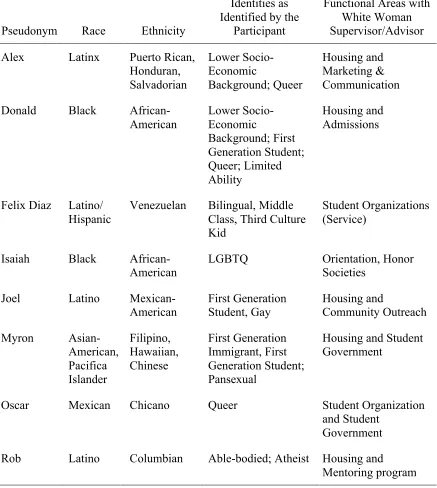
Table 3. Participant Demographics ... 106
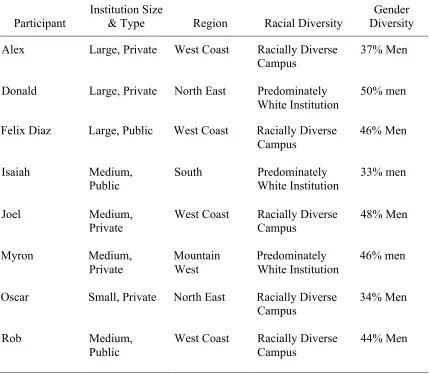
Table 4. Participants’ Undergraduate Institution Information ... 115
xiii
Figure 1. Overview of the conceptual and theoretical frameworks for the study ... 22
Figure 2. Structure of the literature review ... 25
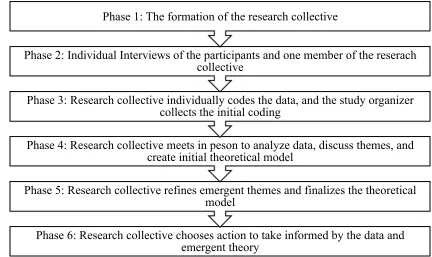
Figure 3. Six phases of data collection, analyses, theory development, and action planning ... 96
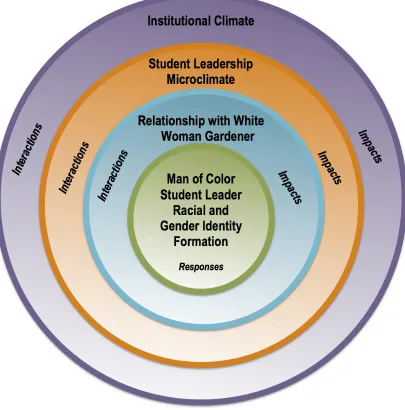
Figure 4. The initial framework of the Ecological Resiliency Model for Men of Color Student Leaders ... 113
Figure 5. Ecological Resiliency Model for Men of Color Student Leaders ... 150
Figure 6. The six constellations of the participants’ experiences. ... 184
CHAPTER I: THE RESEARCH PROBLEM
As my parents drove me up to Spokane, Washington to start my first year of
college, I remember my dad half-jokingly warning me that I was entering the “Great
White North.” He was referring to both the cold weather I would encounter for the first
time and the new level of whiteness that would surround me. As a young man of color
from Southern California, I was not prepared for the overwhelming impact whiteness
would have on me as I entered higher education. My small, private, Catholic Jesuit
university was a predominately white institution in both numbers and culture. I became
very involved on campus through cheerleading, campus ministry, and serving as a
resident assistant. As a student leader, I exclusively had white supervisors, most of them
white women. I grew as a leader and learned professional skills like public speaking,
event planning, and enforcing policy with my peers, but rarely were my social group
identities, as a man, as a Chicano, as a heterosexual, etc., discussed on campus or even
acknowledged as part of my holistic and intersectional development. Much like walking
on fresh snow in the morning, I learned how to tread carefully around my identities with
my white peers and white supervisors because of the slippery ground that lay beneath,
ready to take my feet out from under me.
The impact learning to be a leader in a white system had on my identity formation
as a man of color was most starkly revealed to me when I was a graduate student working
as a graduate resident coordinator. I had a woman of color supervisor for the first time,
and discussions about my Chicano identity and my masculinity, along with the multiple
identities of our staff, were centralized in our development as professionals and leaders. I
bring my whole self into my professional life because my supervisor, and later mentor,
honored my multiple intersecting identities. I felt like for the first time in higher
education, my feet were finally firmly grounded, and this ultimately was the experience
that led me to become a student affairs professional.
I wonder and worry about other young men of color who become student leaders1
and never have a supervisor or advisor who looks like them, who authentically honors
their holistic identities, or who can guide them to firm ground. Like all student leaders,
men of color student leaders in higher education benefit from empowering supervision
and advising that is holistic in nature. Supervisors who can support students in their
holistic identity development help to increase retention and graduation rates and provide
vital skills for future professional positions in all fields (Arminio et al., 2000; Strayhorn,
2010).
Over the last two decades, numerous articles, blogs, conference presentations, and
webinars have addressed the decline of male students in higher education and the lack of
men in student leadership roles on campus. The dwindling number of men attending
college is more starkly evident for men of color when compared to white men and
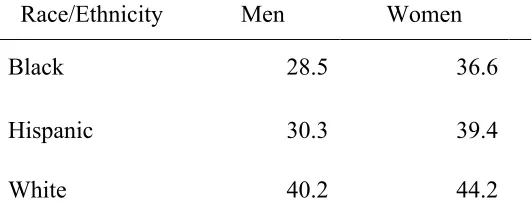
women and when compared to women of color (seen in Table 1). The U.S. Department of
Education and the National Center for Education Statistics (2016) found that in 2014, 10
percent more white men ages 18-24 were enrolled in degree-granting post-secondary
institutions than Hispanic men and nearly 12 percent more white men were enrolled than
Black men. Since the late 1980s, women have been enrolling in college and graduate
1For the purpose of this study, the term “student leader”refers to students in formal
school at higher rates than men across all racial groups. In 2014, 8 percent more 18 –
24-year-old Black women were enrolled in degree-granting post-secondary institutions than
Black men, and 9 percent more Hispanic women were enrolled than Hispanic men (U. S.
Department of Education, 2016).
Table 1
Percentage of 18 – 24 Year Olds Enrolled in Degree-granting Postsecondary Institutions by Sex and Race/Ethnicity in 2014
Race/Ethnicity Men Women
Black 28.5 36.6
Hispanic 30.3 39.4
White 40.2 44.2
Note. Adapted from “Percentage of 18- to 24-year-olds enrolled in degree-granting
postsecondary institutions, by level of institution and sex and race/ethnicity of student:
1970 through 2014,” by U.S. Department of Education, Institute of Education Sciences,
National Center for Education Statistics, 2016, Digest of Education Statistics, 2015,
Table 302.60. Copyright 2016 by the National Center for Education Statistics.
Men of color have been historically blamed for their own lack of retention and
persistence in higher education because they are viewed as “at-risk”—unengaged, less
focused on their studies, and academically less prepared than their white counterparts
(Howard, 2008). The stereotyping of men of color in higher education is an extension of
the institutional racism found in the K-12 educational system. Howard (2008) notes that
particularly Black men, as inherently hypersexual, lazy, and academically apathetic, but
the research lens has not been utilized to thoroughly investigate the deep racism within
the system of education. This allows educators to see boys of color as more than their
stereotypes, while still blaming them for their academic failures. Without a critique of the
educational system, whether it be K-12 or higher education, educators can safely
acknowledge the holistic individual without taking accountability for the systems they
create that disenfranchise and usher young men of color towards academic failure.
Astin’s (1984) development of student involvement theory pushed faculty and
staff in higher education to rethink how students successfully learn. The mere presence of
social, academic, and financial resources does not inherently add to student development.
Students must invest sufficient physical and psychological energy in those resources and
the content of the classroom to learn and grow (Astin, 1984). As a result, student affairs
professionals have worked tirelessly to encourage students to be involved on campus and
to invest in meaningful ways. This, theoretically, leads to increased student success. In an
attempt to specifically retain and graduate men of color, student affairs professionals
have put an emphasis on student leadership roles and mentoring programs. Many college
campuses intentionally recruit men of color to be resident advisors, orientation leaders,
peer health educators, student activity board members, and to engage in other formal
leadership roles. The hope is that men of color in leadership roles will have advisors,
supervisors, and, potentially, mentors, who can support their development as leaders and
their identity development as holistic beings.
Astin’s (1984) theory of involvement places responsibility on both individual
opportunities that will lead to student growth. Institutional efforts to create spaces that
affirm the identities and cultural wealth of marginalized students are even more vital for
the success of men of color (Harper, 2009; Strayhorn, 2010). These spaces need
professionals who reflect the identities of a diverse student body and have the
competencies to support students from diverse backgrounds.
While there has been a shift for campuses to actively engage men of color in
student leadership roles, many of them do not put the same emphasis on recruiting or
retaining men of color student affairs professionals. According to the membership
information from the American College Personnel Association (ACPA), one of the
largest student affairs professional organizations with over 6,000 members, 57% identify
as women and 72% identify as white (A. Ponda, personal communication, November 19,
2015). While men of color students make up a small fraction of student leaders on college
campuses, white women student affairs professionals make up the largest sub-group in
the profession. While the lack of racial and gender diversity in Student Affairs is an issue,
the impact of white women leadership goes far beyond representation.
Gender inequities in educational leadership have come under greater scrutiny in
the last 20 years, because as more women enter the field, they have named the systemic
sexism within education. However, racial inequities in educational leadership have
received less attention (Blackmore, 2010). Whiteness continues to be protected
throughout the K-20 educational system, including within graduate preparation programs
(Ladson-Billings, 1999; Patton, 2016). In student affairs graduate programs, critical
dialogues about race and racism are silenced to maintain the comfort of mostly white
Harris, Allen, & Hubain, 2015). As a result, many white women, who become leaders in
student affairs, have personally developed awareness, knowledge, and skills to address
gender inequities along a binary, but they may lack the ability to address their own biases
along race, socio-economic class, and other identities (Blackmore, 2010; Bondi, 2012).
Many universities struggle to recruit, hire, and retain professionals who have the
awareness, knowledge, or skills to support the multiple intersecting identities of an
increasingly diverse student body. As a result, men of color student leaders often receive
supervision and mentorship from people who do not look like them, particularly from
white women student affairs professionals, who may lack the cultural competencies to
support them.
Critical Race Theory (Ladson-Billings & Tate, 2000; Patton, 2016) reminds us
that the identities of those in positions of power matter because they shape the
relationship dynamics on the individual, group, and systemic levels. The importance of
authentic and empowering supervision and advising for men of color cannot be
understated, because men of color rarely have the opportunity to openly explore their
identities, especially their racial and gender identities, in a brave and supportive space.
Thus the exploration of how the racial and gender identity formation of men of color is
impacted by white women in supervisory and advising relationships is critical.
Statement of the Problem
Men of color experience racial microaggressions from peers, faculty, and staff
while navigating institutional racism on a daily basis in higher education. Racial
microaggressions are subtle forms of racism manifesting in insults and invalidations,
Ceja, & Yosso, 2000). For a young man of color on a college campus, this can be campus
police officers stopping him on the way to class and asking for a student ID because he is
wearing a hoodie and jeans; a professor assuming he has been using drugs because he
came to class with red eyes, instead of assuming he was up all night writing a paper; or
classmates assuming he is in college because of an athletic scholarship simply because he
is tall and Black. These daily experiences of isolation and invalidation often lead to men
of color dropping out of higher education (Solorzano & Bernal, 2001; Solorzano, Ceja, &
Yosso, 2000). Men of color can greatly benefit from holding student leadership positions
and finding mentorship, as both have the potential to increase feelings of belonging and
connectedness to campus resources that can lead to increased graduation rates (Harper,
2009; Saenz & Ponjuan, 2011; Strayhorn, 2010). However, from a Critical Race Theory
(CRT) and a LatCrit Theory lens (Solorzano & Bernal, 2001; Solorzano et al., 2000),
these opportunities must centralize the intentional exploration of racial, gender, and other
social group identities to be effective as a means to combat the impact of daily racial
microaggressions. Men of color student need spaces to reflect on their identities and
make sense of how they are seen on campus, as students and as leaders, and how they are
seen in the broader context of the world around them. These healthy counter spaces
provide both healing and accountability and push back on internalizing racist messages,
but the question remains: who is providing these spaces?
Student Affairs as a profession continues to lack racial and gender diversity,
which has resulted in white women being overrepresented in entry level and direct
student contact positions. The National Association of Student Personnel Administrators
professional organizations; NASPA has over 15,000 members, and ACPA has just over
6,000 members. Both organizations collect demographic information, but it is not
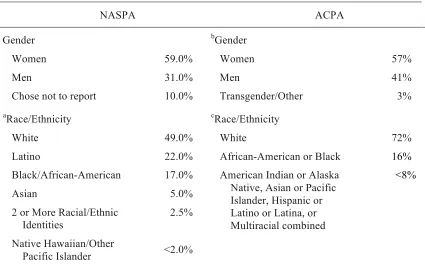
required of its membership. Table 2 shows the racial and gender breakdown of NASPA
and ACPA membership as of 2015 (A. Ponda, personal communication, November 19,
2015; A. Wesaw, personal communication, September 25, 2015). Because demographic
information is optional, the percentages in the table are based on the members in each
organization who chose to share their racial and gender identity information.
Table 2
205 NASPA & ACPA Membership Breakdown by Gender and Race
NASPA ACPA
Gender bGender
Women Men
Chose not to report
59.0% 31.0% 10.0% Women Men Transgender/Other 57% 41% 3%
aRace/Ethnicity cRace/Ethnicity
White Latino
Black/African-American Asian
2 or More Racial/Ethnic Identities Native Hawaiian/Other Pacific Islander 49.0% 22.0% 17.0% 5.0% 2.5% <2.0% White
African-American or Black American Indian or Alaska Native, Asian or Pacific Islander, Hispanic or Latino or Latina, or Multiracial combined
72%
16% <8%
Although this information is incomplete, it does show that white women make up
one of the largest groups in the Student Affairs profession. Critical race theory illustrates
how the racial and gender identities of men of color student leaders are being shaped by
whiteness on a systemic level in higher education (Patton, 2016; Solorzano et al., 2000).
This membership data shows that men of color student leaders are likely to have a white
female supervisor at some time during their formative college years and that their racial
and gender identities will be shaped by whiteness on an individual level. However, little
is known about how those identities are being impacted or what men of color are truly
experiencing with their white women supervisors.
Background and Need for the Study
A critical look at the experiences of boys of color in the K-12 education system is
necessary to understand the limited pathways into higher education for men of color.
Within K-12 education, boys of color, specifically Black and Latino boys, are disciplined
more often and in more severe ways than their white counterparts. Ross et al.’s (2012)
study found that 19 percent of Latino males and 42 percent of Black males had been
suspended or expelled by ninth grade. This is compared to only 14 percent of white
males. This deficit-model approach, which assumes that Black and Latino boys are
inherently more disruptive, lack academic skills, and are apathetic, leads many educators
to believe these young boys of color deserve to be expelled or suspended at higher rates
(Howard, 2008; Solorzano et al., 2000). However, critical research calls this
deficit-model approach into question and focuses on the way society’s depictions of even young
for the same behaviors their white counterparts engage in, but are rarely disciplined for in
such severe ways (Howard, 2008).
Therefore, it is important to reflect on who is administering this discipline. The
National Center for Education Information found that 84 percent of public school
teachers in the United States are female and 84 percent are white (Feistritzer, 2011). This
means that boys of color are learning how to express and behave themselves, and
arguably view themselves, in educational settings through the lenses of white women
teachers. The overrepresentation of white women is not bad in and of itself, but they are
situated in a system that does not ask them to reflect on their white privilege or develop
the intercultural skills to engage with boys of color in authentic and effective ways
(Blackmore, 2010). White women become a tool that perpetuates the school to prison
pipeline. This results in the systemic punishment of boys of color, which quickly narrows
the pipeline and the number of young boys of color who may enter college in two ways.
First, boys of color are deemed “troublemakers” as early as kindergarten and tracked out
of school completely. Second, boys of color are institutionally taught that they are not
good enough to go on to college and self-select out of the application process (Saenz &
Ponjuan, 2009). However, a small group of “well behaved” boys of color do move on to
higher education, but they carry their experiences with white women teachers and its
impact on their identity formation into the college setting.
Boys and men of color experience a specific kind of intersectional racism that
deems them dangerous, violent, hypersexual, and apathetic to school. This deficit model
is a product of the K-12 school to prison pipeline described above that pathologizes boys
carry with them both the negative stories and stereotypes told about their brothers,
cousins, and friends; they carry the label of being “the good one who made it” or the
“golden child” who is smarter, stronger willed, and better than the other boys. The “good
boy of color” label separates college-going men of color from their peers, and these men
are often used as tools against their peers, which causes alienation from their
communities (College Board Advocacy & Policy Center & Business Innovation Factory,
2011; Duncan-Andrade, 2009).
Men of color then walk onto most college campuses struggling to find other
students, staff, and faculty who look like them or understand their lived experiences.
They also encounter student, staff, and faculty who hold conscious and unconscious
biases about men of color. As a result, they encounter both racial microaggressions and
overt acts of racism that further reinforce their feelings of not belonging on campus
(Solorzano & Bernal, 2001; Solorzano, et al., 2000). These experiences of racism include
being asked to represent their entire race in the classroom by faculty, faculty members
assuming English is a student’s second language because of their last name, or
administrators being surprised by how “articulate” they are in meetings. Some men of
color need academic and financial support, as many are first-generation college students
and lack the social capital to easily navigate systems of higher education. However, even
more than academic support, men of color on college campuses are deserving of
emotional and psychosocial support that empowers them to navigate racist institutions
designed to keep them out of the classroom and off the commencement stage.
Much like the K-12 system of teachers, white women are overrepresented in
support to students. White women in these roles have the responsibility to supervise,
advise, and engage young college students as they explore their leadership identity as
well as their social group identities. The majority of student affairs professionals attend
graduate programs where they learn student development and leadership theory, but often
from colorblind and gender-blind frameworks that do not explicitly discuss or integrate
racial or gender identity development in significant ways (Bondi, 2012). Linder, Harris,
Allen, and Hubain (2015) found that students of color in higher education and student
affairs graduate programs experienced racial microaggression in the classroom and that
faculty in those programs were often unable to facilitate difficult conversations about race
and other social justice issues. Robbins and Jones (2016) found that even when white
women in student affairs graduate programs do develop awareness, knowledge, and skills
to talk about race and whiteness, they might not have developed the personal courage to
engage in those difficult conversations; thus, they continue to perpetuate the protection of
whiteness. If faculty are unable to facilitate meaningful conversations about race and
gender and white women continue to lack the courage to engage in conversations about
race, then many student affairs professionals, particularly white women, are likely not
adequately prepared to address the unique needs men of color student leaders.
Being involved on campus can help students develop a deeper sense of personal
identity and connection to the campus community and build leadership skills that prepare
them for life after college (Astin, 1984; Harper, 2009). It is also well documented that
men of color navigate race and racism in those roles as well as in other places on campus
(Harper et al., 2011; Solorzano & Bernal, 2001). What is not known are the experiences
women. We do not know how men of color successfully navigate predominately white
female educational spaces that are still deeply rooted in patriarchy and racism or how
they grow in their understanding of their own racial and gender identities.
Purpose of the Study
The purpose of this study is to engage men of color student leaders in collective
inquiry around ways in which they understand, navigate, and form their racial and gender
identities in institutions of higher education and, specifically, in the area of student
affairs, where the majority of supervisors tend to be white women (A. Ponda, personal
communication, November 19, 2015; A. Wesaw, personal communication, September
25, 2015). This study specifically focuses on three dimensions: (a) understanding the
nuances in positional and identity-based power differentials between men of color student
leaders and their white female supervisors and advisors, especially in terms of race and
gender; (b) collectivizing around commonly experienced realities that are often
individually experienced and therefore ignored; and (c) using collective inquiry,
Participatory Action Research (PAR), to highlight these experiences and to translate new
knowledge generated towards tangible changes. This type of approach has rarely been
used in the field of student affairs, especially with men of color student leaders. The use
of PAR intentionally pushes back against the uncooperative and disengaged dominant
narrative told about men of color in higher education.
Research Questions
1) How do men of color make sense of their racial and gender identity formation
during their undergraduate experiences in student leadership roles and
settings?
2) How do men of color student leaders in higher education describe their
experiences of racial and gender identity formation while being supervised
and/or advised by white women student affairs professionals?
3) For the research collective in the study, how does engaging in a Participatory
Action Research approach impact the co-researchers’ views about their racial
and gender identity formation?
Theoretical and Conceptual Frameworks
This study employs three frameworks to explore both the breadth and the depth of
the racial and gender identity formation of men of color in student leadership roles who
are supervised and advised by white women student affairs professionals. The blended
methodology of Constructivist Grounded Theory and Participatory Action Research
inform why the Matrix of Domination, Critical Race Theory, and Critical Hope are used
in this study. An overview of the individual frameworks is necessary to understand how
they are used together.
Matrix of Domination
Black Feminist thought insists that social change is created from both an
individual’s changed consciousness and from transforming political and economic
institutions. The Matrix of Domination views oppressive systems from a both/and
opposition to the white patriarchal either/or perspective that would have subordinated
groups believe oppressive systems are separate or do not exist at all (Collins, 1990).
Collins (1990) states that the Matrix of Domination is grounded in the
marginalization of subordinated groups across race, gender, and class (as well as other
identities) that are situated in economic, political, and ideological systems. Although all
subordinated groups share in a common structure of domination that is interrelated,
oppression of one group is not interchangeable with another. Each subordinated group
has its own socio-political history that has created unique methods of oppression and
domination that change over time. There are three levels of domination within the matrix.
The first level is personal biography, which is made of each individual’s unique group
identities and lived experiences. The second level is the group or community, which is
where individuals learn how to behave and specific thought patterns associated with their
group. The third, and broadest, level is the systemic level of institutions that represents
the dominant groups’ viewpoints and perspectives (Collins, 1990). If individuals in their
subordinated identities learn the ascribed behaviors and ways of thinking for their group,
which are dictated by the dominant group, then they are rewarded. But by ascribing to the
dominant order of being, subordinated individuals and communities give up their power
and indigenous ways of knowing and creating knowledge (Collins, 1990).
Collins’s Matrix of Domination provides the backdrop for understanding how
men of color student leaders and white women student affairs professionals are situated
within higher education. Men hold similar power and privilege over women as
white-identified people hold power and privilege over people of color, but the methods and
(1990) states, oppression is not additive, but rather is a both/and. For the context of this
study, the Matrix of Domination within higher education is that white men’s privilege
provides them the broadest access to capital and resources, and women of color have the
narrowest access. While white men and women of color are not the focus of this study,
both communities are deeply imbedded in systems of whiteness and patriarchy, which
shape spaces through power and privilege. White men benefit from remaining invisible
within the system through their power and privilege and are able to navigate higher
education more freely, with fewer consequences and less accountability than other
communities. Women of color are made invisible through subordination and oppression,
and thus are forced to navigate higher education with fewer resources and less support
but are burdened by heavier emotional and economic consequences of not completing
their degree2.
This phenomenon leaves men of color and white women in a middle ground
where each community experiences both the privileges of support and resources in some
areas and the subordination of forced invisibility in others. It is vital to remember that as
white women and men of color interact, their privileged identities and oppressed
identities do not cancel each other out, but rather add to the complexity of their
interactions. An additional layer to these interactions for this study is the positional power
staff and faculty maintain over students. This study attempts to explore the complexities
that come with the multiple layers of power and privilege held by white women in staff
2It is important for me to name that I have described gender oppression along the gender
binary of men and women. I honor that the transgender community continues to
positions to shape the leadership experiences and the identities of men of color student
leaders. This study will examine men of color’s perceptions and experiences of those
dynamics by centralizing the narratives of men of color student leaders and decentralizing
their white female supervisors and advisors.
To help centralize the narratives of men of color and foreground race as a central
part of the lived experience of men of color student leaders this study will utilize Critical
Race Theory as a theoretical framework and will also incorporate Jeffery
Duncan-Andrade’s Critical Hope essay as a conceptual framework. Both frameworks provide
lenses that foreground social group identities (race and gender) and provide tools to
analyze relationship dynamics on the individual, group, and systemic levels.
Critical Race Theory
Critical Race Theory (CRT) has its roots in law and was developed by legal
scholars in the 1970s who were analyzing the disparities and injustices experienced by
communities of color on systemic levels. Since then, CRT has expanded to multiple
disciplines, including sociology, anthropology, and education. There are also a number of
other critical theories that were developed either parallel to CRT or from CRT
foundations (Delgado & Stefancic, 2001). Critical Race Theory has five defining
elements (Bernal, 2002):
1) an emphasis on experiential knowledge;
2) a challenge to dominant ideologies;
3) the importance to transdisciplinary approaches;
4) the centrality of race and racism and their intersectionality with other forms of
5) a commitment to social justice.
Each of these elements makes CRT ideal for the topic of this study, as it validates
the lived experiences and narratives of men of color student leaders who exist in the
white supremacist and patriarchal system of higher education. Critical Race Theory
foregrounds their racialized experiences with white women supervisors, while
simultaneously holding the intersectionality of their experiences as men along with other
social group identities. One goal of this study is to push back on the deficit model
narrative about men of color. Critical Race Theory is committed to challenging and
changing dominant systems. This is accomplished through sharing counter-narratives of
the marginalized and exposing the system’s inequitable practices (Solorzano & Bernal,
2001).
Critical Hope
In his essay Note to Educators: Hope Required when Growing Roses in Concrete,
Duncan-Andrade (2009) uses elements of CRT critique how the education system often
creates a narrative of false hope for marginalized students. He also constructs a
framework that offers concepts for educators to create tangible change.
Duncan-Andrade (2009) outlines three enemies of hope: hokey hope, mythical
hope, and hope deferred. “Hokey hope projects some of kind multicultural, middle-class
opportunity structure that is inaccessible to the overwhelming majority of working-class,
urban youth of color” (Duncan-Andrade, 2009, p. 183). Itis an enemy of hope because it
ignores the daily trauma marginalized students must endure to be successful and
invalidates the type of hard work it will take for them to be successful. “Mythical hope is
individual exceptions. These individuals are used to construct a myth of meritocracy that
simultaneously fetishizes them as objects of that myth” (Duncan-Andrade, 2009, p. 184).
It is an enemy of hope because the exception to the rule becomes the unfounded norm to
which all others are unfairly compared. Hope deferred is created when educators can
critique inequitable social structures that marginalized students exist in, but do not have
the skills or frameworks to help students close the gap between not having their basic
human needs met and having their higher educational needs addressed. Hope deferred is
an enemy of hope because educators are asking students to make sacrifices that they
themselves are not willing to make to properly educate students.
Duncan-Andrade (2009) then goes on to develop the Critical Hope framework,
which is comprised of material hope, Socratic hope, and audacious hope. Material hope
is a challenge to educators to provide tangible support and honor the lived experiences of
students. It reminds educators that being a sincere and competent educator, who can
validate both classroom knowledge and lived experiences, is the greatest resource they
can share with their students. “Socratic hope requires both teachers and students to
painfully examine our lives and actions within an unjust society and to share the
sensibility that pain may pave the path to justice” (Duncan-Andrade, 2009, p. 188). This
honest reflection about the injustices of life invites students and educators to be in
authentic community and work in solidarity towards change. Audacious hope “…defies
the dominant ideology of defense, entitlement, and preservation of privileged bodies at
the expense of the policing, disposal, and dispossession of the marginalized ‘others’”
space for marginalized students to express their sadness, frustration, and rage as an
essential part creating change.
Critical Hope calls educators into a process of deep reflection on both personal
and systemic levels. The enemies of hope provide an understanding of how men of color
student leaders are often lifted up and used as tools to denigrate other men of color who
do attend college. They do this by focusing on individual actions and hiding a lack of
systemic support. The enemies of hopelessness provide a roadmap for how men of color
student leaders could be supported by their white women supervisors. The Critical Hope
conceptual framework will be used in this study to explore how men of color navigate
white-dominated spaces and understand the ways their supervisors provide or do not
provide effective support.
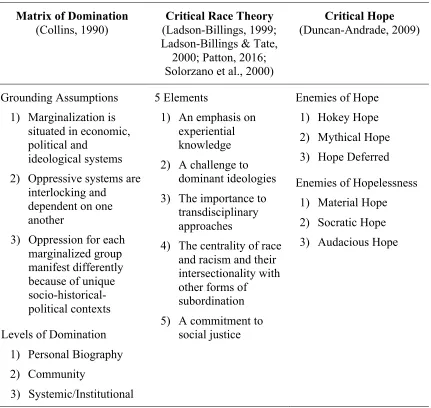
Figure 1 provides an overview of the three theoretical and conceptual
frameworks. The frameworks work in concert with each other and with the blended
methodology of this study. Participatory Action Research (Cammarota & Fine, 2008;
Torre, Fine, Stoudt, & Fox, 2012) seeks to centralize the voices of marginalized
communities and amplify their indigenous knowledge to create change. I will use CRT
(Ladson-Billings, 1999; Ladson-Billings & Tate, 2000; Patton, 2016; Solorzano et al.,
2000) to validate the counter-narratives of men of color student leaders and affirm their
realities as sources of knowledge for action and change. Critical Race Theory will be
necessary to explore how men of color student leaders navigate their racial identity
formation, along with other salient identities, with white women supervisors.
Constructivist Grounded Theorists (Charmaz, 1996; Mills, Bonner, & Francis, 2006)
understand how the multiple constructed realities of individuals can come together to
form common reality and ultimately a theory. On the broadest level, the study applies the
conceptual framework of the Matrix of Domination (Collins, 1990) to contextualize the
experiences of both men of color student leaders and white women professionals within
the complex system in higher education. Lastly, Critical Hope (Duncan-Andrade, 2009)
provides an understanding of how the Matrix of Domination (Collins, 1990) uniquely
manifests within the specific system of education and constructs the false hope narrative
for men of color. It also provides a framing to imagine the ways men of color student
leaders can be positively supported by their white women supervisors and advisors from
Matrix of Domination
(Collins, 1990) (Ladson-Billings, 1999; Critical Race Theory Ladson-Billings & Tate,
2000; Patton, 2016; Solorzano et al., 2000)
Critical Hope
(Duncan-Andrade, 2009)
Grounding Assumptions 1) Marginalization is
situated in economic, political and
ideological systems 2) Oppressive systems are
interlocking and dependent on one another
3) Oppression for each marginalized group manifest differently because of unique socio-historical-political contexts
Levels of Domination 1) Personal Biography
2) Community
3) Systemic/Institutional
5 Elements
1) An emphasis on experiential knowledge 2) A challenge to
dominant ideologies 3) The importance to
transdisciplinary approaches
4) The centrality of race and racism and their intersectionality with other forms of subordination
5) A commitment to
social justice
Enemies of Hope
1) Hokey Hope
2) Mythical Hope
3) Hope Deferred
Enemies of Hopelessness 1) Material Hope 2) Socratic Hope
3) Audacious Hope
Figure 1. Overview of the conceptual and theoretical frameworks for the study
Significance of the Study
This study aims to contribute to a greater understanding of the experiences of
racial and gender identity formation for men of color in higher education in hopes of
increasing their retention and graduation rates. Much of the literature focuses on the ways
men of color struggle in higher education from a deficit model. It has been easy for
higher education to focus on the dwindling number of men of color and perpetuate the
study will shift the lens of the critique onto the system of higher education and more
directly onto student affairs, which lacks racial diversity and is overrepresented by white
women. My hope is that by centralizing the narratives of men of color student leaders and
their experiences with white women supervisors and advisors, their voices will provide a
counter-narrative to the deficit-thinking model about men of color that permeates all
levels of education. The significance of this study will be illuminating the struggles men
of color face within a white-dominant system of supervision as they also navigate their
privileged identities. It will also explore the strategies these men use to successfully grow
and develop within oppressive systems and where they find support and allyship. Lastly,
the study hopes to shed new light on the intersections of race, gender, and power
dynamics within the supervisor relationship between student affairs professionals and
student leaders through collective inquiry.
Delimitations
The delimitations of this study are connected to the sample selection. The sample
of this study will be limited to cisgender men of color who are currently enrolled in
graduate student affairs or higher education programs and have had a significant
supervisory or mentoring relationship with white women during their undergraduate
career (operationalized as at least one full academic year of supervision or advising.) I am
broadly defining men of color as men who self-identify as Black/African-American,
Latino/Chicano/Hispanic, Asian/Asian-American/South Asian/Pacific Islander, Native
American/American Indian, Middle Eastern, and/or Mixed/Multiracial. The study will
focus on men of color in student affairs and higher education graduate programs because
experiences as student leaders during their undergraduate career. Additionally, the hope
is that the participants will grow as student affairs practitioners and be better equipped to
support men of color student leaders through their participation in the study.
Another delimitation is the intentional exclusion of the white women supervisors
and advisors as participants. My goal is to centralize the narratives of men of color
student leaders. Including the voices of white women in the study could shift the focus
when the public reads the research. Whiteness and people in positions of authority are
often given more credibility and focus than people of color and subordinates. Although
the men in the study do have male privilege, the inclusion of white women supervisor
CHAPTER II: LITERATURE REVIEW
The purpose of this study is to engage men of color student leaders in collective
inquiry around ways in which they understand, navigate, and form their racial and gender
identities in institutions that are predominantly white, specifically in the area of student
affairs, where the majority of supervisors tend to be white women. A thorough
investigation of the literature is necessary to understand how the racial and gender
identities of men of color in student leadership positions are being impacted when they
have white women supervisors and advisors. The literature review is divided into three
sections with subsections to explore the complex interactions happening in supervisor
and advising relationships across multiple identities, as outlined in Figure 2.
Figure 2. Structure of the literature review • Critical Race Theory in Education • Racial Formation
• Gender Performance
CRT and Racial and Gender Identity Formation
• The Experiences of Men of Color in Higher Education
• Student Affairs Professionals in Higher Education The Higher Education Context
• Resistance
The first section is a deeper survey of racial and gender identity formation and the
conceptual frameworks used in this study; the second section is an exploration of the
experiences of men of color in higher education and an analysis of both the field student
affairs and the professional formation of student affairs practitioners; the third section is a
survey of theories of agency that both men of color student leaders and white women
student affairs professionals may use to create social change and engage in meaningful
conversations about identity.
Critical Race Theory and Racial and Gender Identity Formation
Two of the primary frameworks for this study are the Matrix of Domination
(Collins, 1990) and Critical Race Theory (CRT) (Bernal, 2002; Ladson-Billings, 1999;
Patton, 2016; Solorzano, Ceja, & Yosso, 2000). These frameworks form the lenses
through which the study will examine the complex relationships men of color student
leaders have with white women supervisors within the context of higher education. In
addition to these frameworks, an exploration of racial and gender identity formation
theories is necessary for this study. In this first section, I examine both sociological and
psychological racial identity development theories through the lens of CRT. Then I
explore how sociological and psychological gender identity formation theories can
intersect with racial identity development to better understand the dynamics between men
of color and white women.
Critical Race Theory in education
Critical Race Theory provides a lens through which the educational context the
men of color student leaders exist in while forming their racial and gender identities can
and was developed by legal scholars in the 1970s who were analyzing the disparities and
injustices experienced by communities of color on a systemic level within the legal
system. Critical Race Theory has since expanded to multiple disciplines and is used to
analyze racial inequalities on the individual and systemic levels. It has five defining
elements (Bernal, 2002; Solorzano & Bernal, 2001):
1) an emphasis on experiential knowledge;
2) a challenge to dominant ideologies;
3) the importance of transdisciplinary approaches;
4) the centrality of race and racism and their intersectionality with other forms of
subordination; and
5) a commitment to social justice.
Ladson-Billings and Tate (2000) applied the elements of CRT to the field of
education to better understand how racial inequalities manifest for students of color. They
set forth three propositions for a critical race theoretical perspective on education: “(1)
race continues to be significant in the United States; (2) U.S. society is based on property
rights rather than human rights; (3) the intersection of race and property creates an
analytical tool for understanding inequity” (p. 47). Ladson-Billings (1999) also used the
areas of curriculum, instruction, assessment, school funding, and desegregation to further
the discussion about the relationship between CRT and education.
Ladson-Billings and Tate (2000) applied CRT through central propositions one,
two, and three to analyze educational inequities. First is race as endemic and deeply
engrained in American life. Racism is systemic and embedded in every institution from
daily-lived experiences that if feels normal and biological, but it is not. Second is a
reinterpretation of ineffective civil rights laws. Critical Race Theory is critical of the civil
rights movement because the United States is based in property rights and not human
rights. This means that the struggle for individual rights, although meaningful in many
ways, did not adequately shift white systems that allow whites to maintain property and
power. Third is challenging claims of neutrality, objectivity, color-blindness, and
meritocracy. The authentic voices and narratives of students and teachers of color are
necessary to push educational research forward and shift systemic racial inequalities.
Voice is fundamental in CRT for these reasons: 1) much of reality is socially constructed,
so counter narratives disrupt the dominant story; 2) stories provide marginalized
communities a medium for healing and self-care; and 3) the telling of counter narratives
to the dominant group can shift their reality and help them become more empathetic to
the oppression that they do not see or experience (Ladson-Billings & Tate, 2000).
The third proposition, the intersection of race and property creates an analytical
tool for understanding inequity, is best understood through a discussion of the four
property functions of whiteness (Ladson-Billings & Tate, 2000). The right of disposition
benefits whites because the educational system is embedded in whiteness and designed to
reward it. The curriculum normalizes white supremacy and often leaves out the histories
of people of color. The white instruction pedagogy is also designed to reward white
students for their behaviors, while students of color are punished for not assimilating.
Teachers take a deficit model perspective of students of color and blame them for their
lack of academic success by employing color-blind ideologies (Ladson-Billings, 1999).
benefit. This can be seen in the ways that the desegregation of schools was promoted
primarily in ways that benefited white students through incentive programs and
curriculum design (Ladson-Billings, 1999). Reputation and status property is based in
libel and slander legal cases. To liken a white person to Blackness is defamation, so in an
educational setting to state a school or program is specifically for people of color means
it is of less quality and value. The absolute right to exclude first manifested in the denial
of education for Black, Native American, and other communities of color. The current
manifestation is the use of property taxes, districting, and school funding, which have led
to schools in the United States being just as segregated now as they were prior to the
1960s (Ladson-Billings, 1999; Ladson-Billings & Tate, 2000).
Ladson-Billings and Tate (2000) interrogated raceless policies and practices in the
K-12 system through a CRT lens to show how white supremacy is protected and
perpetuated in primary education. Patton (2016) expands this work and uses CRT to
examine how racism and white supremacy manifest in higher education in both implicit
and explicit ways. “Capturing the present context of racism/White supremacy in higher
education requires acknowledging its violent, imperialistic and oppressive past” (p. 317).
She explores the racist historical context of U.S. higher education through three
propositions:
Proposition 1: The establishment of U.S. higher education is deeply rooted in racism/white supremacy, the vestiges of which remain palatable.
Proposition 2: The functioning of U.S. higher education is intricately linked to imperialistic and capitalistic efforts that fuel the intersections of race, property, and oppression.
From its inception, the U.S. higher education system has both benefited from and
perpetuated inequality. For example, many universities used slave trade and slave labor to
establish their financial stability and exploited racist legislation and ideologies to steal
indigenous land through the guise of educating Native Americans. Some institutions have
acknowledge this part of their history, but few have done anything to address these
injustices beyond symbolic gestures (Patton, 2016). Higher education has used the areas
of science, technology, engineering, and mathematics (STEM) to maintain white
supremacy in a number of ways. First, STEM fields historically have been
overwhelmingly white, which is maintained through racist tenure and promotion
practices. Second, STEM research has created racist scientific theories and ideologies
that have allowed governments, corporations, and other entities to protect whiteness in
their areas. These racist scientific findings are then rewarded by the people they benefit
through financial support. This capitalistic research grant reward system lifts STEM
research above research done in education and the humanities, which is where many
scholars of color reside.
Higher education protects white supremacy and sustains inequality in many
different ways, but it is still seen as a place of opportunity. Patton (2016) writes,
Popular rhetoric suggest that higher education is the great equalizer and affords life opportunities to those who, regardless of circumstance, “work hard.” This meritocratic discourse is laced with racist and classist assumptions that ensure hard work alone is insufficient for marginalized groups to excel. This discourse attaches nobility to higher education without examining its contributions to the inequity it purports to disrupt. (p. 318)
Patton moves on from the historical context and uses a series of questions grounded in
CRT to expose the ways the history of inequality in higher education continues on
the skills to reflect on their own racial identity. This results in many students, particularly
white students, never having the opportunity reflect on race or racism in a critical way.
While diversity has become part of national conversations, it has been appropriated by
whiteness as value added to the student experience, but it still benefits white students the
most. Patton states,
The idea of diversity is a fashionable concept used throughout higher education, regardless of context…However, higher education has not reached a point of true racial diversity, in terms demographics, or with regard to policies, procedures, the curriculum, and numerous other areas. Diversity is espoused in higher education, but not sufficiently enacted. (p. 332)
Students of color continue to experience negative campus climates and feel
silenced by racist policies and practices at predominately white institutions. Yet when a
campus has too much diversity, it is no longer seen as an “elite” institution. This is
exemplified by the disparity of funding on many levels between “elite” institutions,
which are predominately white, and other institutions, like Historically Black Colleges
and Universities, Tribal Colleges, and Hispanic Serving Institutions. Because of white
supremacy, the mission of serving marginalized communities is equated with less
academic rigor (Patton, 2016).
Even though white supremacy is embedded throughout higher education and
students of color continue to be negatively impacted, higher education can still be a place
of liberation and growth for marginalized students. Patton (2016) closes her article with a
fourth proposition, “Higher education serves as a space for transformative knowledge
production that challenges dominant discourse and ways of operating in and beyond the
academy” (p. 335). If scholars and student affairs practitioners can begin to infuse CRT
place for dismantling white supremacy and a place that educates future leaders to
dismantle oppression in their fields.
Critical Race Theory is a powerful lens for viewing the educational context in
which men of color student leaders are forming their racial identity. The creation of
knowledge in higher education, based in white supremacy, reinforces stereotypes of men
of color as violent and lazy to the point of being scientific (Patton, 2016). The protection
of white students, teachers, and administrators in classrooms from primary school to
higher education maintains white supremacy and silences people of color from
challenging whiteness (Ladson-Billings & Tate, 2000; Patton, 2016). Men of color
student leaders are forming their racial identity within a system of education that was not
made for them and continues to actively root them out, and men of color still find ways to
develop healthy and rich racial and gender identities within this oppressive context. The
next section surveys racial identity development models and broader theories about racial
formation.
Racial identity formation
The exploration of racial identity development models informs how the
participants in my study make sense of their experiences in student leadership spaces and
with their white women supervisors and advisors. I provide an overview of two racial
identity development models that come from the field of psychology and are regularly
used in student development. Cross and Fhagen-Smith (2001) were some of the first
researchers to write about racial identity development models, so it is important to
include their foundational theory of Life Span Black Identity Development. The