Geschke Center
Doctoral Dissertations Theses, Dissertations, Capstones and Projects
Spring 5-17-2019
The Role of Stigma on Mental Health
Service-Seeking Among Armenian-American Men
Anthony Saroyan [email protected]
Follow this and additional works at:https://repository.usfca.edu/diss Part of thePsychological Phenomena and Processes Commons
This Dissertation is brought to you for free and open access by the Theses, Dissertations, Capstones and Projects at USF Scholarship: a digital repository @ Gleeson Library | Geschke Center. It has been accepted for inclusion in Doctoral Dissertations by an authorized administrator of USF Scholarship: a digital repository @ Gleeson Library | Geschke Center. For more information, please [email protected].
Recommended Citation
Saroyan, Anthony, "The Role of Stigma on Mental Health Service-Seeking Among Armenian-American Men" (2019).Doctoral Dissertations. 486.
The Role of Stigma on Mental Health Service-Seeking
Among Armenian-American Men
_______________________
A Dissertation Defense
Presented to
The School of Nursing and Health Professions
University of San Francisco
San Francisco, California
_______________________
In Partial Fulfillment
of the Requirements for the Degree,
Doctor of Psychology
_______________________
by
Anthony Mampre Saroyan
Committee Chair: Dellanira Garcia, Ph.D.
Assistant Professor, School of Nursing and Health Professions
University of San Francisco
Committee Member: Brent R. Ferm, Ph.D.
Professor, School of Nursing and Health Professions
University of San Francisco
Committee Member: Albert Meza, Ed.D.
Staff Psychologist, Counseling and Psychological Services
i
ABSTRACT ... iii
ACKNOWLEDGEMENTS ... iv
SPECIFIC AIMS ...1
LITERATURE REVIEW ...3
METHOD ...17
RESULTS ...22
Themes ...25
DISCUSSION ...54
Implications for Practice ...63
Conclusion ...64
REFERENCES ...56
APENDICES...72
Appendix A: Recruitment Flyer...72
Appendix B: Recruitment Consent Script ...73
Appendix C: Participant Screening Form ...74
Appendix D: Consent Form ...76
Appendix E: Interview Guide ...80
Appendix F: Tables ...83
ii
iii
I wish to thank those individuals who helped in the completion of this dissertation.
Without their generous assistance and care, this study would not have been successfully
completed.
My sincerest thanks go to Dr. Dellanira Valencia-Garcia, my committee chairperson, who
not only offered me practical solutions to my dissertation questions, but also gave me guidance
and support despite her very busy professional and family life. Many thanks are further extended
to Dr. Brent R. Ferm and Dr. Albert V. Meza for their valuable suggestions which helped shape
this project.
I am indebted to the Armenian Community of the San Francisco, Bay Area, who
encouraged me to study and delve into the real mental health issues of its underserved members.
This includes the anonymous participants who entrusted me with their most personal concerns.
I write this dissertation in memory of all those who perished as well as survived the
Armenian Genocide of 1915, amongst them, my great-grandparents who include my namesake,
Mampre Saroyan, Ardemis Saroyan, Zenop Ayanian and Zarouhi Ayanian.
I want to sincerely and wholeheartedly acknowledge the unconditional support and love I have
received and continue to receive from my parents, John and Gladys Saroyan, as well as my
sisters Danielle and Lynn throughout my educational journey.
I am also grateful for the University of San Francisco which includes my cohort group,
my professors and the support staff for their time and assistance in completing my Doctor of
iv
This study examined the role of stigma on mental health service-seeking among
Armenian-American men who self-identified as having lived through or currently are living with
a mental health issue. This qualitative study utilized interpretive phenomenological analysis to
ensure that the lived experiences of Armenian-American men are represented through their
perspective. A total of six participants engaged in this study. All participants self-identified as
male and as having experienced a mental health issue, have utilized mental health services at
least once in their lifetime, resided in the San Francisco Bay Area, and as being of Armenian
descent. Through exploring the lived experiences and reflections of participants in this study,
several themes and sub-themes emerged. These themes included stigma, mental health
treatment, gender views, and moving forward to decrease stigma. As expected, stigma emanating
from the Armenian community was seen to be a deterrent to seeking mental health services.
Furthermore, the role of felt stigma appeared to serve as a significant barrier. Negative views of
self and cognitive distortions influenced participants’ decisions to pursue mental health services.
This study found various factors, such as cultural beliefs and values, socio-economic status, a
lack of understanding of mental health issues and resource availability as potential barriers for
1
SPECIFIC AIMS
The purpose of this study is to explore the role of stigma on mental health
service-seeking among Armenian-American men in the United States. To acknowledge and
accommodate the cultural influences that play a role in Armenian-American men’s mental health
service-seeking behavior, we must first understand the culture and value system of those men
within the Armenian community who have suffered from mental illness. Stigma needs to be
explored from a cultural point of view so that we may understand beliefs and traditions held by
the Armenian people, regarding the perception of living with and treating mental illness. This
study sought to investigate the barriers that Armenian-American men experience with stigma
when having a mental illness and the impact it has on their mental health service-seeking
behavior. Research on mental health issues related to the Armenian-American population,
particularly men, must be further explored to provide them with optimal mental health services.
This qualitative study utilized interpretive phenomenological analysis to ensure that the
lived experiences of Armenian-American men are represented through their perspectives. This
study explored various factors, in addition to stigma, such as cultural beliefs and values,
socio-economic status, a lack of understanding of mental health issues and resource availability which
may serve as potential barriers for service-seeking behaviors amongst Armenian-American men.
This study examined the following research questions:
o Question #1: What are the experiences of Armenian-American males that have
encountered stigma pertaining to their self-identified mental health issue? How have
2
o Question #2: How do Armenian-American males perceive other males from their own
ethnic community who have a mental health problem?
o Question #3: How does having a mental health issue change the way that the individual
3
LITERATURE REVIEW
Armenians have a unique culture that dates to the Bronze Age era (~3,000-1,200 B.C.),
however, they are often misconstrued by others as being members of the dominant Western
European culture. This cultural inaccuracy only further misrepresents their ethnic beliefs and
practices, thus preventing a true understanding of their distinct culture.
The Armenian-American community, like various other ethnic minority communities,
experience culturally based mental illness stigma (Corrigan, 2004; Dagirmanjian, 1996). Studies
on the impact that stigma plays on Armenian-American men service-seeking behaviors for
mental illness are scarce. Given the lack of information on mental health issues pertaining to
Armenian-American men, it is important to investigate issues facing this population so that
proper assistance may be provided by culturally competent mental health service providers to
members of this community.
According to the United States Census Bureau (2000), California was home to the highest
number of Armenians in the United States. At that time, California registered 204,631
Armenians (United States Census Bureau, 2000). In comparison, the second highest number of
documented Armenians in the United States was 26,595 in Massachusetts (United States Census
Bureau, 2000). It should be noted that the most recent census of the Armenian population
residing in the United States dates from the year 2000, therefore these numbers may not reflect
the current population. Despite this large community of Armenians, little research regarding
mental health issues exists for this population. With a lack of understanding of cultural-specific
issues on barriers to mental health services within this population, practitioners will remain
4
Armenian Genocide of 1915
The Armenian people come from a unique historical background defined by triumphs,
resilience, and devastations. One cannot discuss the history of the Armenian people without
acknowledging the Armenian Genocide of 1915 (Dagirmanjian, 1996). The events of the
Armenian Genocide occurred from 1915-1922. It is estimated that 1.5 million Armenians were
murdered during this time (Van Gorder, 2006; Kloian, 1988; Kuzirian, 2012). With orders from
the Turkish Ottoman Interior Minister Talaat Pasha, the Ottoman military forced men out of their
homes to be murdered, led women and children on death marches through the desert, and
destroyed whole Armenian villages (Kuzirian, 2012; Van Gorder, 2006). This attempted
extermination of the Armenian people led to a mass emigration of refugees seeking refuge in
neighboring Middle Eastern countries, as well as the distant United States (Kuzirian, 2012; Van
Gorder, 2006). Such trauma plays a role in how a culture begins to identify itself as it happened
to the Armenian community. To this day, many Armenian community members continue to
identify themselves as both as victims as well as a survivor of a near-extinct ethnic and religious
annihilation attempt by the Ottoman Turks (Boyajian & Grigorian, 1982; Dagirmanjian, 1996;
Kuzirian, 2012).
According to Dagirmanjian (1996), the majority of Armenians who migrated to the
United States in the early 1900’s fled and survived the Armenian Genocide. According to
Malkasian (1984), the US State Department documented approximately 817,873 Armenian
refugees in 1921 who fled the Ottoman Empire. This suggests that a large percentage of
Armenian-Americans are direct descendants of genocide survivors, thus potentially affected by
the genocide through their ancestors’ experiences. As natives of their motherland yet considered
5
Armenians felt the weight of discrimination and disadvantage in their homeland (Arlen, 1975).
While the horrifying acts of this genocide may have ended, the repercussions linger. The events
of these heinous crimes against humanity continue to impact the victims’ families, their
communities and their culture.
Historical Trauma
Many scars created from the Armenian Genocide are not visible but are internally
experienced amongst members of the Armenian community. For example, a common
occurrence observed in children of Armenian Genocide survivors is implicit sadness (Boyajian &
Grigorian, 1986). This characteristic, which is commonly found among genocide survivors is
believed to persist in following generations (Boyajian & Grigorian, 1986). The
trans-generational historical trauma experienced by Armenian-Americans may manifest as
post-traumatic symptoms, such as suspiciousness, cautiousness, and distrust of outsiders (Garavanian,
2000; Yesayan, 2014). These trans-generational effects of mass trauma, such as genocide, are
also seen within Native American populations (Duran & Duran, 1995). For instance, lasting
effects of the Native American genocide have led to elevated rates of alcoholism and violent
crimes, which were rare prior to the Native American Genocide (Duran & Duran, 1995).
Armenians who survived the genocide of 1915 were observed to experience
symptomatology similar to survivors of the Jewish Holocaust (Kellermann, 1999). Common
characteristics expressed by both survivor groups included survivor’s guilt, anhedonia, anxiety,
depression, and a feeling of lost identity (Boyajian & Grigorian, 1986). Although these shared
commonalities exist amongst survivors of the Jewish Holocaust, the Native American Genocide,
and the Armenian Genocide, an important distinction is that the Armenian and Native American
6
Genocide was acknowledged ‘on behalf of the people of the United States’ by President Obama,
in his 2009 Native American Apology Resolution, the Native American Genocide was still not
formally recognized as an act committed by the United States Government. The consistent
denial of these crimes against humanity hinders both the Armenian and Native American
people’s opportunity in making peace with their traumatic past (Duran & Duran, 1995). The
genocide scholar, Israel W. Charny (1984) described the use of denial by genocide perpetrators
as a tool to attack the collective identity and national cultural continuity of the people victimized.
With the Armenian Genocide of 1915 lacking formal recognition, the wounds of Armenians
remain unhealed.
Immigration
Armenian-Americans can largely trace their familial existence within the United States in
two migration waves during the 1900’s (Dagirmanjian, 1996). The first mass migration of
Armenian people emigrated from the Ottoman Turkish Empire to the United States around the
end of WWI in the 1910’s and 1920’s. By the year 1922, the population of Armenian in the
United States was approximately 125,000 (Malkasian, 1984). Those able to seek refuge in
America formed their own communities, most notably in California’s central valley. The second
significant influx of Armenians into the United States occurred after the fall of the Soviet Union
in 1991 (Dagirmanjian, 1996). After WWI, Armenia was included as a member of the Soviet
Union and remained a member until its collapse in 1991. Many Armenians then immigrated to
the United States in pursuit of a better standard of living (Dagirmanjian, 1996) and most of them
settled in dense Armenian enclaves around Los Angeles, such as Glendale and Pasadena
7
Religion
The Armenian Apostolic Church is central to the Armenian culture and plays a key role
in the development of a modern Armenian Identity (Yesayan, 2014). In the year 301 A.D.,
Armenia became the first country to adopt Christianity as its national religion (Arlen, 1975).
Their church and religion unified its people throughout the ensuing centuries by its unchanging
rituals and Christian values. During the 1915 Genocide, Armenians were given two dire options,
either convert to Islam or face death (Van Gorder, 2006). Approximately 95,000 Armenians
were forced “to embrace Islam” by the Ottoman Turks (Malkasian, 1984). As a result of this
religious persecution, Armenians hold Christianity as sacred and important to their ethnic
identity and as a symbol of their cultural identity (Van Gorder, 2006).
There is a strong relationship between church and state within the Armenian culture
(Dagirmanjian, 1996). With religion being a central element within the Armenian community,
the Armenian people utilize their religion as a method of coping and healing (Yesayan, 2014).
Prior to seeking mental health services, Armenians tend to seek support from members of their
community (Yesayan, 2014). With the Armenian church having a close connection with the
community, the Armenian church serves as a potential outlet for those struggling with mental
health issues.
Acculturation
Adapting to foreign cultures is nothing new to the Armenian people. Similar to other
collectivistic minority cultures, many Armenians have had learned to live within host societies as
well as to avoid the pressures of assimilation by creating their own cultural communities
(Aghanian, 2007). Those able to integrate their heritage and host culture tend to be better at
8
neither culture (Berry, 1995). By resisting the pressures of total assimilation into the dominant
culture of their adopted nations, Armenians have preserved and maintained their culture for
future generations, through the creation of Armenian schools, churches, and organizations
(Miller & Miller, 1993). Due to these avenues of inter-generational transmission, the Armenian
language, culture, and history has survived (Dagirmanjian, 1996).
According to Gevorkyan (2013), Armenian-Americans who are more acculturated
towards the dominant American culture hold significantly more positive attitudes towards
psychotherapy when compared to Armenian-Americans who are less acculturated into the
dominant American culture. This study helps provide insight into the impact that one’s
acculturation and ethnic identity may contribute to their attitudes towards psychotherapy.
Additionally, the relationship between acculturation and ethnic identity on seeking mental health
services has been supported by Ogaryan (2016), who found that ethnic identity served as a risk
factor for Armenian-American parents when making decisions on whether to utilize mental
health services for their children. In this study, Armenian-American parents who were less
acculturated into the American culture were less likely to seek mental health services for their
children (Orgaryan, 2016).
Armenian Family Values
The Armenian culture holds traditional values that are passed on into families from
generation to generation. Several of these familial values that are heavily placed on family
members include obedience, respect, and nobility (Ayvazian, 2009). Generally, the needs of the
family supersede individual needs, and that holds true to this day. Armenian families tend to
carry a sense of responsibility in maintaining and transmitting their language, culture, and
9
from the tragedy that their ancestors endured (Boyajian & Grigorian, 1986; Garavanian, 2000;
Yesayan, 2014). Many Armenians feel this sense of pressure to pass down their culture to future
generations in order to ensure the survival of their historically threatened culture (Saroyan,
2015).
Armenian families are traditionally patriarchal, and men hold a leadership role in the
family (Ayvazian, 2008). Children in these families feel an obligation to abide by the needs and
desires of their parents and are expected to be obedient (Dagirmanjian, 1996). These values are
instilled in many Armenian families with a notion that life is serious and that they should behave
in a serious manner (Boyajian & Grigorian, 1986). Armenian parents tend to be highly
protective of their children, as a means of protecting their ‘investment’ for the continued success
of their familial lineage (Dagirmanjian, 1996). Children are viewed as the future of their
families’ continuation and history thus must be protected at all cost (Boyajian & Grigorian,
1986; Garavanian, 2000). The emphasis on children to succeed is overtly expressed by parental
pressures while covertly influenced by a sense of communal responsibility.
The Armenian community’s strong values in the family system resemble those of other
collectivistic cultures (Dagirmanjian, 1996). The collectivistic culture of the Armenian people
stands in sharp contrast to the individualistic American culture. Collectivism is depicted as the
value orientation of interdependence amongst members of a group (Katz, 1999). Individuals
from collectivistic cultures tend to be more sociable and place an emphasis on family integrity
and cohesion (Wu et al., 2011). There is an emphasis on prioritizing the needs of the family or
the group over the individual's needs, as well as the honoring of the family unit (Dagirmanjian,
1996). On the other hand, members of an individualistic culture rely primarily on their own
10
1995). Characteristics portrayed in individualistic cultures include competitiveness and
emotional distance from their peers, which is not the case for collectivistic cultures who are more
likely to come together to achieve common goals. Within the Armenian family, the notion of
family, community, and honor are prioritized. With most Armenian families holding a
collectivistic worldview, issues among family members are generally private and not shared with
others. Given this orientation, it can lead to Armenians being hesitant in seeking mental health
services or disclosing personal information to others (Arslanian, 2003; Minassian, 2010;
Yesayan, 2014).
The Armenian culture, in general, is also characterized as a culture that highly values
masculinity (Malakyan, 2013). While the emphasis in masculinity is not unique to the Armenian
community, one must note the impact this emphasis has on men from this community.
According to Connell (1987), hegemonic masculinity is the dominant notion of masculinity
within a specific cultural context. This stereotypic notion of masculinity shapes the socialization
and aspirations of young men within their communities (Connell, 1987). Westernized cultures,
such as the United States and Europe, tend to place an emphasis on traditionally masculine traits,
including competitiveness, inability to express emotions aside from anger, inability to
acknowledge weakness, and the devaluation of feminine traits in men (Brittan, 1989; Kupers
2005). The importance of understanding masculinity ideals among men and mental illness is
crucial when working with males from communities that historically have under-utilized mental
health services.
Cultural Beliefs Towards Psychotherapy
From the Armenian-American perspective, the concept of paying for advice runs counter
11
(Dagirmanjian, 1996). In fact, studies suggest that when some Armenian-Americans accept
psychotherapy as an option, they tend to do so only when the problem is causing intense distress
or there is pressure from external sources (Dagirmanjian, 1996). In addition, other barriers to
seeking psychological services among the Armenian-American population include the lack of
culturally competent mental health providers in densely populated Armenian communities
(Arzumanian, 2008; Yesayan, 2014). Mental health professionals who work with minority
populations, such as Armenian-Americans, should be culturally competent and provide cultural
humility in order to understand the role of culture in influencing clinical diagnoses, assessment,
and treatment (Dagirmanjian, 1996). According to Tervalon & Murray-Garcia (1998), the term
cultural humility incorporates a lifelong commitment to self-evaluation and self-critique, to
redressing the power imbalances in the patient-clinician dynamic, and to developing mutually
beneficial and non-paternalistic clinical and advocacy partnerships with communities on behalf
of individuals and defined populations. Armenians may encounter this concept of culturally
incompetent health care when they perceive that clinicians do not accept and respect their
ancestral history (Eron & Lund, 1993). Thus, knowledge of this population’s cultural and
historical factors is critical to building a therapeutic alliance.
When developing a successful therapeutic alliance with Armenian-Americans, it is
important to understand how moving past their elevated wariness of outsiders (referred to as
“odar” in the Armenian language, which translates to “stranger”) contributes to their potential
resistance of receiving mental health services. Even if clinicians of non-Armenian descent can
demonstrate their trustworthiness, it may be hard for some Armenian families to accept that the
clinician could teach them something that they do not already know about themselves
12
phenomenon that impedes mental health service-seeking behaviors for necessary and effective
psychological services. It is critical that clinicians address these challenges and motivate their
clients by providing them with meaningful reasons to continue treatment.
Stigma
The term stigma is commonly believed to originate from marks of crucifixion, appearing
on the hands and feet of Christian saints, known as stigmata (Gary, 2005). In modern usage, the
term stigma refers to the possession of a trait that is deeply discrediting (Goffman, 1963).
Furthermore, individuals who experience stigma are often disqualified from full social
acceptance (Goffman, 1963). Stigma is shown to impede treatment participation; it both
diminishes self-esteem and robs people of social opportunities (Corrigan, 2004). According to
Valencia-Garcia et al. (2008), stigma has also been shown to inhibit access to mental health
resources. For those with mental illness, stigma creates a public label which may hinder life
opportunities that allow for the achievement of personal goals (Corrigan, 2004). As a result of
the prejudices aimed towards those with mental illness, one’s access to obtaining good jobs and
adequate housing is obstructed (Corrigan, 2004).
Stigma exists both overtly and covertly and has been found to come in various forms.
Research focused on exploring the experiences of patients with epilepsy, who experienced
stigma as a result of their medical condition, opened the door to the development of two forms of
stigma: enacted and felt (Scrambler & Hopkins, 1986). Enacted stigma, also referred to as
discrimination, refers to the unfair treatment by others (Gary, 2005). This external stigma
expressed both overtly and covertly may lead to the individual internalizing their experience,
thus creating a felt stigma. Felt stigma, also referred to as self-stigmatization, refers to the shame
13
experiences (Gary, 2005). This form of internal stigma may further create barriers to seeking
mental health services. Results of felt stigma may lead to further isolation and withdrawal when
in need of social support (Gary, 2005).
The existence of stigma for those who experience mental illness can present as being
more complicated for those from ethnic minority groups (Ciftci et al., 2012; Rao &
Valencia-Garcia, 2014). The relationship between stigma and cultural norms impact perceptions of
disease and disability; perceived deviations that run counter to an individual’s cultural and social
behavioral norms can lead to social punishment or social ostracism in cultural communities (Rao
& Valencia-Garcia, 2014). Similar to other ethnic minority groups, the Armenian community
holds an intense stigma regarding both mental and emotional issues (Tanielian, 2011). Many
Armenian-Americans have an equivocally charged stigma attached to seeking mental health
professionals for their mental health issues (Ho et al., 2007; Tanielian, 2011). The importance of
raising awareness to existing mental health and emotional issues within the Armenian
community is vital to breaking down the barriers that have limited their utilization of mental
health services (Tanielian, 2011).
Intersectionality
The concept of intersectionality has been used to understand the interlocking relationship
between complex systems of multiple identities and histories of oppression (Collins, 1986;
Crenshaw, 1994; McCall, 2008). These multiple layers of one’s identity create unique
experiences which can often result in the creation of several stigmas from the various layers, or
intersections, of one’s identity (Berger, 2006). The intersectionality of stigma may be referred to
as the interdependence of multiple, co-occurring devalued social identities (Cole, 2009). The
14
intersectional factors, that when combined, may create unique clinical presentations (Das, 2001;
Yang et al., 2007). The mere existence of intersectionality can significantly contribute to the
negative effects of stigma on health outcomes (Rao & Valencia-Garcia, 2014; Reidpath & Chan,
2005). The Armenian identity is complex. Armenians within the United States have multiple
sub-identifies, such as place of family origin, place of birth, Armenian language dialect, political
affiliation, religion, gender, as well as numerous other factors that define their Armenian
identity. While Armenian-Americans may experience stigma and oppression due to their
intersectional factors, this pressure is created not only from the dominant American community
but also from within the Armenian community itself (Dagirmanjian, 1996).
Mental Health Service-Seeking Behavior
The majority of research on Armenian-American mental health service-seeking behavior
has been conducted through dissertations, such as Ayvazian (2008) and Yesayan (2014). In a
quantitative study exploring the help-seeking behaviors of 168 Armenian-American women by
Ayvazian (2008), it was found that perceptions about mental health as well as knowing someone
with mental health issues strongly predicted help-seeking behaviors among Armenian-American
women. Furthermore, this study found no relationship between an increase in help-seeking
behaviors and higher acculturation levels. This study indicated that the Armenian individuals’
acculturation level within the westernized American culture did not show a significant
relationship with their decisions to seek mental health services. Overall, this study highlighted
that knowing someone who had a mental health issue tended to increase the likelihood of
engaging in help-seeking behavior amongst Armenian-American women (Ayvazian, 2008).
According to Yesayan (2014), factors that contributed to positive views of mental health
15
available, knowing someone who received mental health treatment, and knowing someone who
works in the mental health field. Armenian women with these forms of exposure were more
likely to hold more positive attitudes towards seeking mental health services.
Armenian-Americans tended to have more accurate beliefs about psychotherapy when they were provided
with knowledge and a clearer understanding of the concept of psychotherapy (Yesayan, 2014).
The phenomenon of utilizing medical services for a mental health issue as a primary
resource relates to the tendency by some Armenian-Americans to present somatic symptoms
instead of psychological symptoms to primary care providers (Yesayan, 2014). Seeking
assistance from medical physicians for mental health issues is common in the
Armenian-American community, as well as other minority communities within the United States (Jamin,
Yoo, Moldoveanu, & Tran, 1999). According to Yesayan (2014), Armenians tend to be more
receptive to visiting their family physician when experiencing a mental health issue rather than a
mental health clinician. In addition, Armenians are more likely to accept a referral for
psychological serves when referred by their family physician. This avenue of initially seeking
medical help for a mental health issue appears to hold less stigma in the eyes of
Armenian-Americans (Yesayan, 2014).
Summary
The review of the literature highlights the lack of empirical data relating to the lived
experiences of Armenian-American men who have a mental illness and the role that stigma may
have on their utilization of psychological services. While research on the Armenian-American
population does exist, the literature on mental health primarily targets Armenian-American
women and Armenian-Americans non-gender specific. This is an understudied topic that
16
examines the experiences of Armenian-American men who have sought mental health services
and uncovering the role stigma holds as a potential barrier to their utilization of services. The
goal of this study is to explore the phenomenon of stigma and its impact on Armenian-American
17
METHOD Overview
A qualitative research methods approach was utilized to complete the present study.
Qualitative research is an analytical process of insight based on specific methodological
traditions of analysis which examines a social or human problem (Creswell, 1998). The
qualitative method provides an opportunity to understand the lived experiences of
Armenian-American men through examining their stories, statements, descriptions, and meaning-making of
what it is like to seek mental health services within this ethnic community. The goal of this study
was aimed towards building an intricate comprehensive picture, examine words, report in-depth
views of participants, and conduct the study within an organic, natural setting (Creswell, 1998).
Interpretive phenomenological analysis (IPA) is a qualitative analysis approach that aims
to understand how individuals make sense of their lived experiences (Smith, Flowers & Larkin,
2009). This form of analysis requires the researcher to obtain thorough, reflective first-person
accounts of the participant’s experience (Harper & Thompson, 2011). Studies utilizing IPA
require small sample sizes with a focus on depth and range of experiences (Smith et al., 2009).
IPA focuses on the quality of data over the quantity of data, which allows for the organic
development of the individual’s narrative as it pertains to the phenomena being studied.
Participants
The participants for the present study included six Armenian-American men. The
inclusion criteria for this study included: (1) a history of or a current mental health issue(s), (2)
experienced stigma based on their mental health issue(s), (3) a history of or currently receiving
mental health services, (4) at least 18 years of age or older, (5) identify as male, (6) reside in
18
that ethnic background), (8) able to speak English fluently. For the purpose of this study, mental
health issue(s) were provided via self-report by participants.
Procedures
This study was approved by the Institutional Review Board (IRB) at the University of
San Francisco. No major foreseeable risks were anticipated for participants who partook in this
study, besides possible emotional discomfort. All human subjects were attended to in
compliance with the IRB. Since this study included the topic of mental health and stigma the
welfare of the participant always remained the priority. Given this, participants were informed
of mental health resources within their respected communities that they could access.
Purposive, convenience sampling techniques were utilized to recruit participants that met
the criterion of this study. Purposive sampling methods assisted in locating participants who
were able to provide information about the phenomenon being researched. Recruitment of
participants for this study occurred through targeted specific avenues including posting virtual
recruitment flyers (See Appendix A) on social media (e.g. Facebook) and in-person presentations
made to local Armenian organizations. An e-mail address was created and used solely for the
purpose of this study. In addition, the researcher’s phone number was provided on the flyer as
contact information to facilitate participation in the study. The Recruitment Script (See
Appendix B) was read to participants who were present at in-person presentations as well as to
those who contacted the researcher via-phone. Participants who contacted the researcher of this
study via e-mail were provided with the Recruitment Script to review. Potential participants who
made contact via e-mail were then asked to provide a contact telephone number if interested in
being screened for their appropriateness to participate in this study. The participant Screening
19
study. Participants who met the screening requirements were then scheduled for an in-person
interview at one of the various university campus locations based on their preference.
Interviews were conducted in private, reserved rooms at the University of San Francisco
campus. The participants were provided with a consent form (See Appendix D) prior to the
interview. The researcher reviewed the consent form with the participants and asked if they had
any questions. Each participant was notified at the beginning of each interview session of their
right to refuse to answer any question or close the interview session at their own will.
Following the completion of the consent form, a semi-structured, face-to-face individual
interview was utilized in this study. Data was obtained through verbatim transcriptions of an
audio recorded first-person account that was generated by the research participant in response to
questions provided by the researcher. All questions followed a sequence as outlined in the
Interview Guide and were asked in the same chronological order for each participant (See
Appendix E). The researcher aimed to remain neutral and facilitative to ensure that participants
had the opportunity to share their personal narratives. At the conclusion of each interview,
participants in this study received a $35 cash compensation.
Confidentiality of each participant’s identity remained a priority throughout this study.
Steps to protect the identities of participants and maintain their anonymity were taken which
included providing each participant with a pseudonym during the interview and for data analysis.
The pseudonyms are used within all written records. This study utilized the transcription service
called Trint for the purpose of transcribing the interviews. Trint is a software that transcribes
audio recorded data and was used to transcribe audio recordings of all participants. Following
20
audio recording to the transcription provided by Trint. To ensure each participant’s responses
were captured verbatim, edits were then made to the transcriptions.
No identifiable information of participants was used during this process. Only direct
study staff, which includes the researcher and the dissertation chair, have access to the actual
names, e-mail addresses, and phone numbers of the participants.
Data Analysis
The aim of interpreting data in IPA is focused on developing an organized, detailed,
plausible, and transparent account of the meaning of the data provided (Harper & Thompson,
2011; Smith et al. 2009). In addition, the goal of data collection in IPA is to make sense of
everyone’s unique experiences (Smith et al., 2009). The five stages of interpretative
phenomenological analysis are detailed below (Willig, 2008).
The first stage of IPA began with the researcher conducting a thorough reading of the
transcripts. During this stage, the researcher utilized an open coding technique that includes
identifying relevant responses and statements within each participant’s transcript (Willig, 2008)
The second stage involved identifying themes. This was done by marking major and
minor themes that emerged throughout transcripts (Willig, 2008). Through re-reviewing
transcripts, the researcher explored the information to gain a more accurate account of each
interview. The goal of this stage is to develop brief phrases which hold enough substance to
remain grounded in the participants’ responses and provide clarity to the material (Smith et al.,
2009).
In the third stage, the researcher structured the analysis into major themes. The emerging
21
goal for this stage was to identify patterns in the themes that emerged to create a structure that
assisted in featuring converging themes (Smith et al., 2009).
The fourth stage included the production of a summary table for themes. This table
displays key themes and subthemes that were obtained from the data. Quotes or illustrative data
were extracted from the transcripts to highlight each theme (Smith et al., 2009). In addition, any
themes that were not well-represented were not included in these categorizations.
The fifth and final stage was the construction of a cohesive narrative (Willig, 2008). The
narrative’s foundation was structured around the summary table and quotations previously
extracted were then used to add depth and richness to themes and sub-themes (Willig, 2008).
This final stage adds to understanding the lived experiences of the phenomena under study
22
Results
Participants
The participants in this study consisted of six Armenian-American males residing in the
San Francisco Bay Area. Clinical diagnoses of participants were not formally assessed during
the interview. During the recruitment phase, a total of twelve participants were screened for this
study. Of the twelve participants, six participants did not advance to the interview phase of this
study. During the recruitment phase, two participants chose not to participate in this study due to
personal reasons and four participants did not meet all eligibility criteria required.
A total of six participants advanced to the interview phase of this study. Participant ages
ranged from 23 years to 54 years (Refer to Table 1). All participants identified as male and
self-identified as having experienced a mental health issue(s), have utilized mental health services at
least once in their lifetime, resided in the San Francisco Bay Area, and identified as being of
Armenian ethnic descent. Four participants in this study identified as being of only Armenian
descent, of these, two participants were born outside of the United States. Two participants
identified as half-Armenian and half-Caucasian. Mental health issues reported in the interviews
consisted of anxiety, depression, substance use, and adjustment disorder. Pseudonyms were
chosen for each participant in this study to ensure their privacy was protected in all stages of the
23 Table 1: Participant Demographics
Age Ethnicity Pseudonym Mental Health Issue
30 Full Armenian Hagop Anxiety
30 Full Armenian Suren Adjustment Disorder/Anxiety
23 Half Armenian Antranik Depression
23 Full Armenian Narek Anxiety
24 Full Armenian Saro Substance Use/Anxiety
54 Half Armenian Vahe Anxiety
Below, is a brief synopsis of each participant, based on their descriptions of mental health
issues and cultural background factors.
Hagop
Hagop is a 30-year-old Armenian-American male of full Armenian descent. Hagop’s
primary mental health issue discussed was anxiety. Hagop shared having participated in mental
health services during his mid-20’s at his university’s outpatient counseling center as well as in
private practice. He has chosen to minimize his family’s involvement in his mental health
24 Suren
Suren is a 30-year-old Armenian-American male of full Armenian descent. Suren
experienced adjustment disorder during his first year of university away from home. Suren later
developed what he identified as anxiety during his 20’s. Suren shared having utilized
medication, individual therapy, and group therapy at outpatient clinics. His family and partners
have been very supportive and involved with his mental health journey.
Antranik
Antranik is a 23-year-old male who identified as half-Armenian and half-Caucasian. He
expressed questioning his Armenian identity growing up with being a half-Armenian who has an
“odar” (non-Armenian) parent. Antranik went to family therapy at the age of 8 due to familial
conflicts. Antranik described experiencing embarrassment for utilizing mental health services
when he was a child. He also described experiencing symptoms of depression throughout his
adolescence and early adulthood. During his time in university, Antranik made the decision on
his own to utilize mental health services. Antranik’s family is supportive of his mental health
struggles.
Narek
Narek is a 23-year-old Armenian male of full Armenian Descent. Narek emigrated to the
United States during his childhood. Narek shared that his first exposure to the concept of
psychology was during his time in university when he sought treatment for anxiety. Narek’s
25 Saro
Saro is a 24-year-old male of full Armenian descent. Saro moved to the United States
during his early adolescence. Saro utilized recreational drugs, such as marijuana, during his
childhood to cope with stressors unrecognized to him at the time. The finding of Saro’s
marijuana paraphernalia by his parents led to his parents sending him to see a mental health
clinician. Saro shared having continued to utilize mental health services during his early 20’s to
help control his symptoms of anxiety. Saro shared that his family does not discuss their own
mental health experiences. In addition, Saro’s involvement in the Armenian community is
tenuous due to his internal conflicts with religion which is intertwined within his community.
Vahe
Vahe is a 54-year old male of half Armenian and half Caucasian descent. Vahe shared
first utilizing mental health services during his 30’s to help control his symptoms of anxiety.
Vahe shared having a positive experience with his mental health clinician and actively
encouraged his fellow Armenian peers to seek help for their mental health issues. Vahe
expressed having an open-door policy with his family regarding both his and their mental health
struggles.
Themes
Four major themes were identified: (1) stigma, (2) mental health treatment, (3) gender
views, and (4) moving forward to decrease stigma. Additionally, ten sub-themes were identified
26 Table 2: Themes and Sub-themes
Theme 1: Stigma
Sub-theme 1: Enacted Stigma
Sub-theme 2: Felt Stigma
Sub-theme 3: Disclosure
Theme 2: Mental Health Treatment
Sub-theme 1: Initial Exposure
Sub-theme 2: Therapeutic Qualities
Sub-theme 3: Therapeutic Experiences
Theme 3: Gender Views
Sub-theme 1: Being Male
Sub-theme 2: Gender Expectations
Theme 4: Moving Forward to Decrease Stigma
Sub-theme 1: Pessimism for the Future
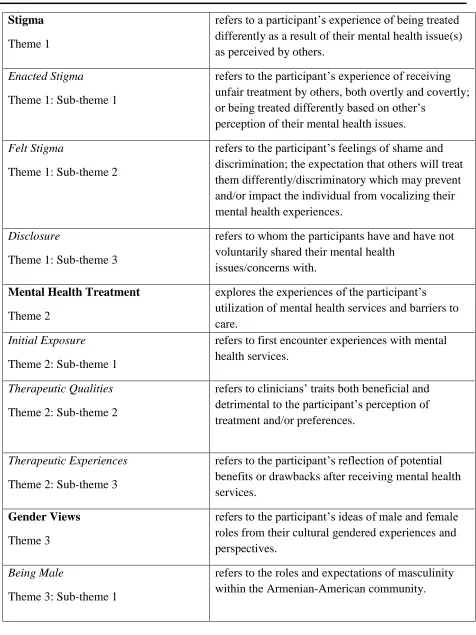
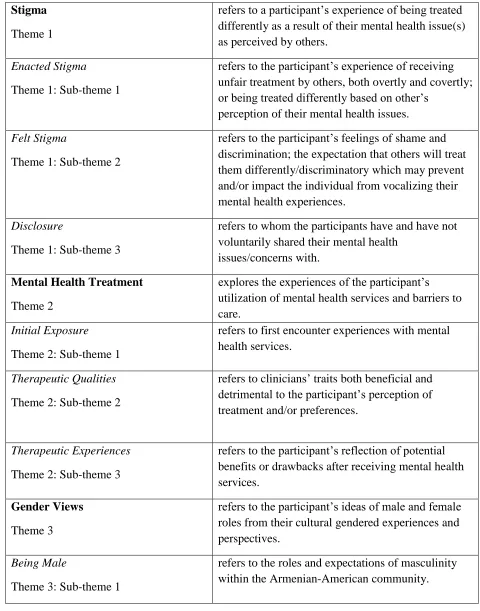
27 Table 3: Definitions of Themes and Sub-themes
Stigma
Theme 1
refers to a participant’s experience of being treated differently as a result of their mental health issue(s) as perceived by others.
Enacted Stigma
Theme 1: Sub-theme 1
refers to the participant’s experience of receiving unfair treatment by others, both overtly and covertly; or being treated differently based on other’s
perception of their mental health issues.
Felt Stigma
Theme 1: Sub-theme 2
refers to the participant’s feelings of shame and discrimination; the expectation that others will treat them differently/discriminatory which may prevent and/or impact the individual from vocalizing their mental health experiences.
Disclosure
Theme 1: Sub-theme 3
refers to whom the participants have and have not voluntarily shared their mental health
issues/concerns with.
Mental Health Treatment
Theme 2
explores the experiences of the participant’s utilization of mental health services and barriers to care.
Initial Exposure
Theme 2: Sub-theme 1
refers to first encounter experiences with mental health services.
Therapeutic Qualities
Theme 2: Sub-theme 2
refers to clinicians’ traits both beneficial and detrimental to the participant’s perception of treatment and/or preferences.
Therapeutic Experiences
Theme 2: Sub-theme 3
refers to the participant’s reflection of potential benefits or drawbacks after receiving mental health services.
Gender Views
Theme 3
refers to the participant’s ideas of male and female roles from their cultural gendered experiences and perspectives.
Being Male
Theme 3: Sub-theme 1
28 Gender Expectations
Theme 3: Sub-theme 2
refers to the perceived social differences in mental health experiences between males and females. In addition, gender expectations refer to the perceived culturally appropriate roles for men and women.
Moving Forward to Decrease Stigma
Theme 4
refers to the participant’s expectations for the future of Armenian-Americans who experience mental health stigma. Pessimism for the Future
Theme 4: Sub-theme 1
refers to the participant’s low expectations of a decrease in mental health stigma within the Armenian-American community.
Necessary Steps for Change
Theme 4: Sub-theme 2
refers to the participant’s belief of what is required to decrease mental health stigma within the
Armenian community.
Theme 1: Stigma
The theme stigma refers to a participant’s experience of being treated differently as a
result of their mental health issue(s) as perceived by others. The theme of stigma was broken
down into several sub-themes, which include: (1) enacted stigma, which refers to the
participant’s experience of receiving unfair treatment by others, both overtly and covertly; or
being treated differently based on other’s perception of their mental health issues, (2) felt stigma,
refers to the participant’s feelings of shame and discrimination; the expectation that others will
treat them differently/discriminatory which may prevent and/or impact the individual from
vocalizing their mental health experiences, and (3) disclosure, which refers to whom the
participants have and have not voluntarily shared their mental health issues/concerns with.
Throughout each interview, the theme of stigma became a salient focal topic. Topics of
enacted stigma, felt stigma, and disclosure emerged. Participants shared stories of experienced
29
experienced internally, which brought upon emotions of shame and guilt. In addition,
participants shared their unique mental health disclosure processes which influenced their
decision to access mental health services. Several words were referenced by participants to
identify the labels of stigma, these included crazy, dangerous, different, drug user, and psycho.
Sub-theme 1: Enacted Stigma. Enacted stigma refers to the participant’s experience of
receiving unfair treatment by others, both overtly and covertly. Participants detailed the events that led to experiences where they were treated differently due to their mental health issue. In
addition, participants described actions and statements, committed by those within and outside of
their Armenian community, which lead to the stigmatization of those with mental health issues.
Antranik described how those perceived as different at a young age are susceptible to
bullying by peers:
I think there's a lack of understanding especially when people are younger. I also think people try to get a leg up on you in general so they can't look for any weakness you may have. If it's mental you know you have you say something funny you wear glasses yet you're in a bad mood. You're depressed. That's like, that gives like a bully or someone who likes to make fun of people…(mumbles).
Hagop acknowledged that mental health stigma may lead to the way friends, peers, and
even family members behave around the individual who has a mental health issue. He highlights
the discrimination sometimes experienced in these instances by others and even when it may not
be negative, he discusses being treated differently:
30
The fear of being ostracized and losing social status within the Armenian community
pushed Suren to suppress mental health symptoms and put on a ‘face’ to hide any issues he was
experiencing. His perception of being well in the eyes of others from the Armenian community
was something very salient to him:
I would probably add that whenever I saw Armenians it would be kind of sporadic and I would tend to like muster up more energy than I would normally. So, I would tend to hide things more, you know, events like sports weekend or something you know, don’t, don’t come around that often. So, it’s, it’s hard to like do an apples to apples because like every time I was with Armenians, I would add that they definitely encouraged me or just intrinsically like I wanted to do my best or be on my best, when I was like around the community. So, I would either like suck up things a little bit more or fake things a little bit more. Probably be a little less open with that type of thing.
Antranik shares an imprinted memory he holds of his experience with enacted stigma by
peers at a middle school party:
…but I can't really talk to anyone about it [mental health issues] and only people like I kind of hated that it that they would make fun of me. Specifically, I remember I had like my therapist’s business cards in my wallet and I was like a middle school party and I had dropped my wallet. And you know it like [had] a psychotherapist on it and like think like some kids reached down and they go "psycho, you're a psycho."
With concerns of being discriminated against due to mental health issues, Hagop believes
changes in the relationship dynamic may still occur regardless of good intentions:
Yeah, I think in general it's kind of a little bit of judgment when. Well it depends. Right. So, I think in the past the traditional thought is that having a mental health condition or seeking therapy for it is kind of a bad thing. There's something wrong with the individual who more recently has become more accepting and in fact encouraged to seek out help. If you do, are you encountering an issue when you may need some guidance? So, I think that's definitely has changed over the past.
Narek shared harsh stigmatic perceptions held by members in his community and
perceptions people have of individuals who suffer from mental illness.
31
kids with schizophrenia and how their parents are, you know, lock them up in the apartment and just don't let them out... They’re really seen as aliens. I don't know, if someone has a mental illness especially if they're, they're just, they're ostracized they're not treated as an equal. And yeah you just get labeled as a crazy person. Yeah. And I think this label goes to everyone pretty much with mental illness.
Sub-theme 2: Felt Stigma. Felt stigma refers to the participant’s expected shame and discrimination (they expect that others will treat them differently/discriminatory) which prevents
the participant from vocalizing their mental health experiences and may serve as a barrier to
seeking mental health services. Participants’ statements revealed the experience of negative
self-views of their lived experiences with mental health issues. This internalized stigma may serve as
a barrier that projects the anticipation of stigma from others.
Saro shared his internal need to keep his mental health appointments private at work and
would go to great lengths to make “new excuses” to leave early for his therapy sessions:
I kept it very much under wraps. I was working at the time and I would need to take an hour and a half off of like a Tuesday to go and I would come up with a new excuse every time. I did not make it clear. Maybe I should have actually… That’s also another part of like perception of mental health. Never wanting to admit that you have a doctor’s
appointment.
Stigma also showed up as fears of burdening family, of being treated as different, and
fears of their own discomfort about telling others influenced Narek’s decision to keep his mental
health symptoms private from his family:
32
Growing up experiencing mental health issues Suren shared his experience of feeling
unique or marked in some way, like that of an outsider. With age and growth in awareness,
Suren learned of the commonness of mental health struggles and was able to gain a sense of
normality in his personal struggles with mental health:
Because it’s not anything to be ashamed about anymore. It’s not a, actually, I think the more you grow up, the more you realize everybody has those kinds of problems. It’s funny how when you are younger, the experience, kind of feels like unique… Something about it makes it feel like I guess that's just how growing up is. Everything that's like happened to you feels so unique to you and then sometimes you feel like possibly alone with the problem because you couldn’t imagine other people in a similar situation, because it feels so foreign.
Hagop provided insight into his own experiences with being socially distanced by those
in his community while reflecting upon his own social distancing of those with mental health
issues as well:
I'm not sure. I don't know. And to be honest it's possible that I do the same thing. I mean having gone through it I think I understand giving people the space but making sure that I'm there for them. I don't know why people are treated differently when it happens obviously you want to help others, so you make a change in how you interact with them. At the same time if you feel like you're not responsible for helping that person you probably take a more indifferent stance. And I think something that could have been a very natural interaction turns into a little bit more distance.
Subtheme 3: Disclosure. Disclosure refers to whom the participant has and has not voluntarily shared his mental health issues/concerns with. Participants discussed their decisions
to both disclose and hide their mental health issues from family and peers. In addition,
participants discuss whether they opened up with members within or outside of the Armenian
community. Additionally, as evidenced by some of the quotes above, stigma and the perception
that others will treat you different because of mental health issues were a common
33
Narek described having a wariness on disclosing his mental health issues within the
Armenian-American community due to the small size of the community. With concerns of
losing his privacy in the community, Narek shared his preference with disclosing to his
non-Armenian peers outside of his community.
Outside I was more free to talk with people, especially you know, they also shared their experiences. And I was more comfortable sharing. So yeah but, but like when it came to like the inner circle and because the community was small, I felt like everyone knows each other. So, what if they tell people. The word gets out.
Echoing Narek’s notion of the Armenian community’s closeness, Saro explains the risk
of disclosure within the community:
…They don’t stigmatize it by any means but it’s definitely not something that is
advertised or broadcasted that’s very much just within the family and even within like the immediate family. I don’t think the extended family knows at all, like anything.
Especially if there’s any risk for the greater community to know about something then it’s almost 100% under wraps because the tightly networked community and yeah that news can spread fast and given what we know about the stigma within the community I think just not something that we want to deal with.
The act of disclosure is not inherently a negative event. For some, relief and support may
receive, while for others, isolation and stress may ensue. In Hagop’s situation, he experienced
both positive and negative repercussions of his disclosure process. Hagop shared his discussions
with peers about his mental health issues being positive. Hagop described how his experience
with disclosing his mental health issues to his parents led to an increase in worrying and anxious
feelings on their behalf:
I talked to some close friends who encouraged it and weren't judgmental at all. But then when I think people like my parents found out about it I think they were extremely
34
Saro discusses the perceived norm within the Armenian community for friends not to
disclose their mental health issues to each other unless the friends are considered to be extremely
close.
Like if I had a friend that I was that close or at like the same amount of closeness to that friend I would also expect that friend to not tell me about these things. But it's just it's another factor about Armenians not talking about this at all unless they're like very, very close.
Theme 2: Mental Health Treatment
The theme mental health treatment explores the experiences of the participant’s
utilization of mental health services and barriers to care. The theme of mental health treatment
included sub-themes of (1) initial exposure, refers to first encounter experiences with mental
health services, (2) therapeutic qualities, which refers to clinicians’ traits both beneficial and
detrimental to the participant’s perception of treatment and/or preferences, and (3) therapeutic
experience, which refers to the participant’s reflection of potential benefits or drawbacks after
receiving mental health services.
Subtheme 1: Initial Exposure. Initialexposure refers to first encounter with mental health services. Participants discussed the situations that led to their initial exposure to mental
health services. For some participants, this decision was voluntarily made while for others, their
decision was involuntary or mandated by others. The methods of accessing initial mental health
services varied and obtaining treatment included recommendations from peers, accessing
university counseling services to surpass familial involvement, and parental decisions.
Antranik shares his initial exposure to mental health therapeutic services as a child due to
35
Well my mom had my sister when I was 7 and afterwards she had postpartum depression, and she was on a mix of medications like Paxil, and she had some very negative side effects from that, and she also developed like alcoholism with it, so the police came to our house a few times and there is some like traumatic sort of things that happened, so like probably a year after that my parents put me into a weekly, bi-monthly counseling about that.
Saro expressed non-congruence with his decrease of external stressors and his continuing
to feel mental health symptoms leading him to explore further help:
So, my first time was, I didn’t end up like pursuing it very well… I think it was when I realized that I was in a situation that didn’t have that much stress and I had everything going for me,… I knew something was off. That was the point. So, it was always like, oh, okay, this makes sense because I'm in this stressful situation but the moment all those stresses were gone, I realized everybody that I talk to was like, damn you have
everything. And I was like yeah, I kind of do. But I would still feel the same symptoms. That was the point where I thought, oh, okay, I should probably go check it out.
Hagop shared having an openness with peers’ feedback when discussing his mental
health state through his ability to self-reflect on their noticeable changes on his presentation. The
social mirror provided by his peers allowed for his ability to connect the dots on his symptom
manifestation. Hagop provided an example of his experience which influenced his initial
exposure to mental health services:
I think it was the inability to sleep and being pointed out that some of my actions were common symptoms of anxiety, and then the light bulb clicking and being like, you know, I think that, that there is some anxiety in my current state. I think that you know what to do. And some friends, they mentioned that, they had mentioned it [therapy] a while ago, and when that clicked that I was like, you know, maybe I should go check it out.
With the unfamiliarity of seeking mental health services, Narek sought services at his
university’s counseling center despite concerns of the perceived stigma from family and peers
that may have ensued as a result. In an attempt to minimize being seen as “inferior or different
36
friend.” He described his processes of utilizing services while emphasizing his need for privacy
in order to protect himself from social backlash:
I was seeking services, but I did not tell people. Didn’t tell my family, didn’t tell my friends, only told a person, just a very close friend. Yeah, but the fear was kind of being judged and seen as inferior or different or weird. So yeah, I didn’t really talk about it in the first place.
Narek revealed his barriers to treatment, which included concerns of not having his
Armenian background being understood by a clinician of a different ethnicity and the therapeutic
dialogue being focused on anxiety induced by educational factors, which allowed for him to
control the therapeutic dialogue while avoiding his true internal conflicts. Furthermore, Narek’s
held belief of therapy not being an activity that Armenian men typically engage in suggests he
was initially concerned with losing a part of his masculine identity by his utilization of
therapeutic services:
It's just not a thing Armenian guys do. So yeah, I decided to give it a try and, but, it was under the umbrella of ‘I have anxiety from school’ and you know, assignments and performing and I kept getting involved with a bunch of things just to compensate for say low grades so yeah, but I never, through therapy, I never got to talk about what I wanted to talk about. And like, what that is causing and what my thoughts are about. I was having a lot of issues, but I only kept it to a level, like just school. Maybe that’s because I didn’t feel like the therapist would understand. The therapist was not Armenian, she was Hispanic, so I never really went into therapy with like an open mind, like just being free, so I just, I was really conserved in the therapy room and it was weird, so that’s kind of how I got there.
Further into the interview, Narek described the conflict he believes that many Armenians
experience, of being both “emotional creatures” and avoidant in addressing their emotions. He
continued to share how emotions may lead to maladaptive coping responses by those who are
unwilling to accept and address their emotions. Narek described his development in gaining