Perception-Driven Resizing for Dynamic Image
Sequences
Lingling Zi1,2, Junping Du1⋆, Lisha Hou1, Xiangda Sun1, and Jangmyung Lee3
1 Beijing Key Lab of Intelligent Telecommunication Software and Multimedia
School of Computer Science, Beijing University of Posts and Telecommunications 100876 Beijing, China
{lingling19812004,junpingdu,mssim1205,sunxiangda88}@126.com
2
School of Electronic and Information Engineering, Liaoning Technical University 125105 Huludao, China
3
Department of Electronics Engineering, Pusan National University, Busan, Korea
Abstract. With the development of multimedia display devices, dynamic
image sequence resizing, which can adapt image sequences to be dis-played on devices with different resolutions, is becoming more important. However, existing approaches do not resize results from the viewpoint of the user. In this paper, we present a new resizing framework, which uses the feature descriptor technique and the image interpolation tech-nique, that aims to improve the resizing quality of the important content perceived by user. To accomplish this, we use a coarse-to-fine detection approach to determine the important content of image sequences, and construct a partition interpolation model to improve the definitions of im-portant content. By adopting a region energy protection approach we can obtain high quality image displays. Compared to representative algorithms in image resizing, our method can achieve satisfactory performance not only in terms of image visualization but also in terms of quantitative mea-sures.
Keywords:image resizing, human visual perception, image Interpolation,
feature descriptor, dynamic image sequence.
1.
Introduction
Image sequences resizing has gained significant importance because of rapid increases in the diversity and versatility of display devices. Because of the lim-ited screen sizes of different devices, the same image sequence is frequently required to be displayed in different sizes [16]. Therefore, it is common to resize the dynamic image sequences to fit each target display device. Standard resiz-ing approaches include scalresiz-ing and croppresiz-ing. The former relies on a uniform ratio to resize the images, which results in obvious distortion [18]. The latter can only remove pixels from the image boundary and therefore inevitably dis-cards information [17]. To overcome the above shortcomings, the seam carving
method [2] has been proposed to resize image sequences through removing or duplicating seams [8]. Through analyzing those approaches, we find that they have only focused on inherent characteristics of image sequences and lack enough attention to resizing results from the viewpoint of the user. In this pa-per, we propose a novel perception-driven resizing algorithm (PDR). Two main issues need to be addressed to enhance the quality of the important content perceived by user. The first is the need to determine the important content from the users’ viewpoint. The second is the need to improve the definitions of the important content during resizing. Therefore, we introduce an image process-ing technique based on human visual perception to address the first issue and an image interpolation technique to address the second issue. This allows us to obtain high quality resizing results displayed on devices with different resolu-tions.
Fig.1 shows an example of our proposed algorithm. Given the input image sequence (a), attention regions (b) are acquired before the corresponding inter-polated images (c) are obtained. Next, we compute the energy of pixels in (c) as shown in (d), and the seams (including low energy pixels) are removed, as shown by the red lines in (e). Finally, resizing results are shown in (f).
Fig. 1. An example of perception-driven resizing displaying the (a) input, (b)
attention region, (c) interpolated image, (d) pixel energy display, (e) removed seams, and (f) output
The rest of this paper is structured as follows: Section 2 discusses related work. Section 3 illustrates the outline of PDR. Section 4 shows the implemen-tation details of PDR. Section 5 presents experimental work. Finally, Section 6 concludes the paper.
2.
Related Work
We complete the resizing task of dynamic image sequences by combining three technologies: the human visual perception technique, the feature descriptor technique, and the image interpolation technique. This section will briefly re-view the above technologies.
The human visual perception technique uses research results from many subjects [13] (e.g., computer neuroscience, visual neuroscience, cognitive sci-ence, and visual physiology) to accomplish visual tasks according to the princi-ples of image perception and information processing used in the human visual system [9]. Humans perceive images through eye retina, which contains two dif-ferent types of photoreceptors: rods and cones. Rods scatter light in the surface of the retina to determine an overall image, and they respond quickly to weak light. Cones are mainly located in the middle part of the retina [4]. The density of cones is much higher than other visual sensors in the visual central area, and the central area has almost no rods [11]. The visual central area is the most visually sensitive area; perception ability for optical input signals decreases fur-ther from the central area of the retina [3]. This is the source of inspiration for PDR.
People hope that computers can identify the objective world and make wise decisions. However, computers do not possess enough memory to distinguish between different complex objects. That is because people have not found an effective way to convert from real objects into a digital form. As a result of 21st
century advances in the theory of discrete scale space, local invariant feature techniques have been developed to solve practical problems in the computer vision [15]. Subsequently, the scale-invariant feature transform (SIFT) was de-veloped to effectively describe object features [7]. Recently, the method using compact and real-time descriptors (CARD) has been proposed to establish a quick visual correspondence between two images [1] and the computation time per descriptor is approximately 16 times faster than SIFT. In an attempt to de-termine the attention region of dynamic image sequences, we adopt CARD to acquire local descriptors caused by temporal variation of the consecutive im-ages.
the neighboring pixels. The second step iteratively modifies the obtained pixel values based on energy computation, which is the highlight of ICBI. Many ex-periments have shown that ICBI obtains good performance in objective and subjective tests. In this paper, we apply ICBI to produce clear resizing results for the attention regions of dynamic image sequences.
3.
Overview
LetDI[1, m] ={DI{t}}mt=1be a dynamic image sequenceDIdefined on the 3D spaceO. The spaceOis divided into attention regionsOarand general regions
Ogr,
O = Oar∪Ogr,Oar∩Ogr=ϕ . (1)
TheDI is decomposed usingDIO
{t} = (DI
Oar
{t} , DI
Ogr
{t} ). In this paper, our goal
is to resizeDI{Ot}fromHinitial×WinitialtoHnew×Wnew. Here our stress is
en-larging resizing, i.e., satisfying Hnew>Hinitial andWnew>Winitial. To achieve
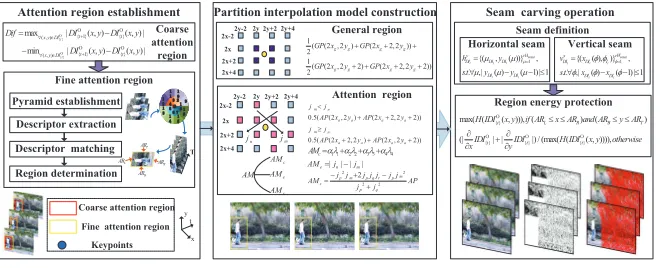
this amount of resizing, we propose a PDR algorithm with an architecture that is illustrated in Figure 2. PDR is roughly divided into the three steps: atten-tion region establishment, partiatten-tion interpolaatten-tion model construcatten-tion, and seam carving operation.
Attention region establishment
x t y Coarse attention region
Fine attention region
Partition interpolation model construction
2x-2 2x 2x+2 2x+4
2y-2 2y 2y+2 2y+4 General region
Attention region
Seam carving operation
{ }
{ } { 1} { } ( , )
{ 1} { } ( , )
max | ( , ) ( , ) | min | ( , ) ( , ) |
t
t
t t x y DI
t t x y DI
Dif DI x y DI x y DI x y DI x y O O O O + " Î O O + " Î = --
-Coarse attention region
Keypoints Fine attention region
Y T L AR R AR T AR B AR 1
( (2 , 2 ) (2 2, 2)) 2
1
( (2 , 2 2) (2 2, 2 2)) 2
g g g g g g g g GP x y GP x y GP x y GP x y
+ + + + + + + 2x-2 2x 2x+2 2x+4
2y-2 2y 2y+2 2y+4
m j n j AM c AM e AM s AM
0.5( (2 , 2) (2 2, 2 2))
0.5( (2 2, 2) (2 , 2 2))
m n
a a a a m n
a a a a j j
AP x y APx y j j
AP x y AP x y
<
+ + +
³
+ + +
1 2 2 3 3 4 4
c
AM=al a l a l a l+ + +
| | | |
e n m AM=j-j
2 2
2 2
2 m
p m pqr p s
p q jj j j j j j AM AP j j - + -= + Seam definition Horizontal seam 1 {( , ( ))} , . . ,| ( ) ( 1) | 1
initial
t t t
t t
rH y DI DI DI
DI DI h y st y y
m
m m
m m m
=
=
" - - £
Vertical seam
1
{( ( ), )} , . . ,| ( ) ( 1)| 1
initial
t t t
t t
rW x DI DI I
DI DI v x st x x
f
f f
f f f
=
=
" - - £
Pyramid establishment
Descriptor extraction
Descriptor matching
Region determination
Region energy protection
{ }
{ } { } { }
max( ( ( , ))), ( ) ( ) (| | | |) / (max( ( ( , )))),
t L R B T
t t t
H IDI x y if AR x AR and AR y AR IDI IDI H IDI x y otherwise x y
O
O O O
£ £ £ £
¶ 
+
¶ 
Fig. 2.Architecture of the proposed algorithm
First, we propose the coarse-to-fine detection approach to computeDIOar
{t} ,
so that the correspondingDIOgr
{t} can be obtained. Specifically, the coarse
at-tention regionCDIOar
{t} is determined using a frame difference method and the
fine attention regionDIOar
{t} is obtained using the feature descriptor technique,
whose calculating process includes pyramid establishment, keypoint descriptor extraction, descriptor matching, and attention region determination.
Second, we construct a partition interpolation model to simulate the ef-fects of human visual perception, resulting in interpolated image IDIO
a scale ratior, i.e., the size of theIDIO
{t} isrHinitial×rWinitial. Note that this
model adopts different calculation approaches for different regions of the origi-nalDIO
{t}. ForDI
Oar
{t} , we compute the initial value of interpolated pixel, denoted
asAP(2xa+1,2ya+ 1), wherexa∈Oarandya∈Oar. The initial value is modified
using energy calculations that include the curvature continuity energyAMc, the
curvature enhancement energyAMe, and the isolevel curve smoothing energy
AMs. For DI
Ogr
{t} , we use four adjacent pixels to quickly compute interpolated
pixel value, denoted asGP(2xg+ 1,2yg+ 1), wherexg∈Ograndyg∈Ogr.
Finally, we compute the overall energy for each pixel ofIDIO
{t}. Adopting
the proposed region protection method, we remove(Hnew−rHinitial)vertical
seams and(Wnew−rWinitial)horizontal seams containing low energy pixels,
and obtain the enlarged dynamic image sequenceDIO
{t}withHnew×Wnew.
4.
PDR Implementation
In this section, we will elaborate the details of the PDR in each step. The core part of PDR is the second step, which is the partition interpolation model struction. The first step is the foundation of partition interpolation model con-struction and the last step is resizing using a constructed partition interpolation model.
4.1. Attention region establishment
First, we demonstrate the calculation approach ofCDIOar
{t} . Given that ∀(x, y),
(x, y)∈DIO
{t}, if|DI
O
{t+1}(x, y)−DI O
{t}(x, y)| ≥Dif×c, then(x, y)∈CDI
Oar
{t} .
Here,Dif represents the difference value, as shown in Eq.2, andcis a prede-fined value, for which we set the default value to0.2.
Dif = max∀(x,y)∈DIO
{t}|DI
O
{t+1}(x, y)−DI O
{t}(x, y)|
−min∀(x,y)∈DIO
{t}|DI
O
{t+1}(x, y)−DI O
{t}(x, y)|.
(2)
Next, we elaborate the calculation approach ofDIOar
{t} in detail. The first step
is to establish an image pyramid using Eq.3 as follows:
L(xm, ym, t, σ−1) =L2↓(xm, ym, t, σ), (3)
whereL(xm, ym, t, σ)represents scale function,xm andymrepresent the
val-ues of abscissa and ordinate of the pixel inCDIOar
{t} ,σrepresents the level of
the image pyramid, and 2 ↓ represents the down sampling factor. Using the corner detectors technique, we find the keypoints of theCDIOar
{t} and the
corre-sponding keypoint set denoted asKt={kt(xk, yk)|(xk, yk)∈CDI{Otar} }.
The second step is to extract descriptors forKt. To maintain invariance to
ofKt. The magnitude and orientation ofAH(htk)are shown as follows:
mAH(xi, yi) = ((CDI{Otar} (xi+ 1, yi)−CDI{Otar} (xi−1, yi))2
+ (CDIOar
{t} (xi, yi+ 1)−CDI
Oar
{t} (xi, yi−1))
2)1
2, (4)
ωAH(xi, yi) =arctg
CDIOar
{t} (xi+ 1, yi)−CDI{Otar} (xi−1, yi)
CDIOar
{t} (xi, yi+ 1)−CDI
Oar
{t} (xi, yi−1)
. (5)
Next, we adopt the binning table to extract descriptors based onAH(ht
k)and
obtain the descriptor setDt
k ={d
t
k}ofKt.
The third step is to find the matched descriptor. According to Eq.6, we com-pute the matching descriptordtkm+1 fordt
k and the corresponding matching
de-scriptor setKm.
dtkm+1= arg mindt+1
τ ∈Dkt+1
dtτ+1−dtk1, (6)
where Dtk+1 = {dkt+1} denotes the descriptor set of Kt+1 corresponding to
CDIOar
{t+1}. In order make the computation proceed faster, we adopt a short binary code conversion technique that changes Eq.6 into Eq.7:
dtkm+1= arg minp∈Kt(
∑L
q=1|ζ
t+1
p (q)−ζ
t
k(q)|), (7)
whereζt
k = (1 + sgn(WTdtk))/2,ζkt∈ {0,1}L, in whichW represents the weight
matrix, andLrepresents the length of changed binary code. In the last step, we acquire four boundary values ofDIOar
{t} , including the left
borderARL, right borderARR, top borderART, and bottom borderARB.
ARL= mink(xi,yi)∈Kt∪Kmxi−υL, ARR= maxk(xi,yi)∈Kt∪Kmxi+υR,
ART = mink(xi,yi)∈Kt∪Kmyi−υT, ARB= maxk(xi,yi)∈Kt∪Kmyi+υB,
(8)
where υL, υR, υT and υB denote predefined adjustment values, the default
values of which are all 8.
Fig.3 shows some examples of attention regions. We use red lines to mark the coarse attention region, and yellow lines to mark the fine attention region containing feature points denoted by blue dots. It can be seen that our detec-tion approach can perform well in capturing regions of general interest, which provides a good foundation for improving the quality of resizing results.
4.2. Partition interpolation model construction
The computation of interpolated pixels in the general region is simple, as shown in Eq.9.
GP(2xg+ 1,2yg+ 1) = 12(GP(2xg,2yg) +GP(2xg+ 2,2yg))
Fig. 3.Attention regions of different dynamic image sequences: (a) a walking man, (b) a jumping woman, (c) a walking man with a dog, (d) space image sequence 1, and (e) space image sequence 2
Inspired by the ICBI algorithm, the computation of interpolated pixels in the attention region includes two steps. In the first step, we compute AP(2xa +
1,2ya+ 1)according to Eq.10, Eq.11 and Eq.12.
jm(2xa+ 1,2ya+ 1) =AP(2xa,2ya) +AP(2xa+ 4,2ya)+
AP(2xa+ 2,2ya−2) +AP(2xa,2ya+ 4) +AP(2xa−2,2ya+ 2)
+AP(2xa+ 2,2ya+ 2)−3AP(2xa,2ya+ 2)−3AP(2xa+ 2,2ya),
(10)
jn(2xa+ 1,2ya+ 1) =−3AP(2xa,2ya) +AP(2xa+ 4,2ya+ 2)
+AP(2xa+ 2,2ya+ 4) +AP(2xa,2ya−2) +AP(2xa−2,2ya)
+AP(2xa+ 2,2ya) +AP(2xa,2ya+ 2)−3AP(2xa+ 2,2ya+ 2),
(11)
AP(2xa+ 1,2ya+ 1) =
1
2(AP(2xa,2ya) +AP(2xa+ 2,2ya+ 2)),
if jm(2xa+ 1,2ya+ 1)< jn(2xa+ 1,2ya+ 1),
1
2(AP(2xa+ 2,2ya) +AP(2xa,2ya+ 2)), otherwise . (12) In the second step, we continually modifyAP(2xa+ 1,2ya+ 1)using iterative
energy computation to accurately predict the values of unknown pixels. The formula of energy computation is
AM(2xa+1,2ya+1) =mcAMc(2xa+ 1,2ya+ 1)
+meAMe(2xa+ 1,2ya+ 1) +msAMs(2xa+ 1,2ya+ 1),
(13)
wheremc,meandmsare modification coefficients that satisfymc+me+ms= 1.
The first energy termAMc can be computed using Eq.14.
AMc(2xa+ 1,2ya+ 1) =α1λ1+α2λ2+α3λ3+α4λ4,
s.t. λ1,2=|jm(2xa,2ya)−jm(2xa+1,2ya±1)|+|jn(2xa,2ya)−jn(2xa+1,2ya±1)|,
λ3,4=|jm(2xa,2ya)−jm(2xa−1,2ya±1)|+|jn(2xa,2ya)−jn(2xa−1,2ya±1)|, (14) whereαi(i = 1...4)is a weight coefficient. The second energy termAMe can
be computed using Eq.15.
The third energy termAMscan be computed using Eq.16.
AMs(2xa+ 1,2ya+ 1) = −T
2Z+2T U B−T Z2
T2+U2 AP(2xa+ 1,2ya+ 1),
s.t. T =jp(2xa+ 1,2ya+ 1) =12(AP(2xa,2ya)−AP(2xa+ 2,2ya+ 2)),
U =jq(2xa+ 1,2ya+ 1) = 12(AP(2xa,2ya+ 2)−AP(2xa+ 2,2ya)),
B=jr(2xa+ 1,2ya+ 1) = 12(AP(2xa+ 1,2ya−1) +AP(2xa+ 1,2ya+ 3))
−1
2(AP(2xa−1,2ya+ 1) +AP(2xa+ 3,2ya+ 1)),
Z=jm(2xa+ 1,2ya+ 1).
(16)
4.3. Seam carving operation
Aiming to achieve regional energy protection, we introduce definitions for the horizontal seam and the vertical seam to PDR, which are shown as follows:
The horizontal seamhyDI
t ofIDI
O
{t}is given by
hyDI
t ={h
y
µ}
rHinitial
µ=1 ={(µDIt, yDIt(µ))}
rHinitial
µ=1 , s.t.∀µ,|yDIt(µ)−yDIt(µ−1)| ≤1,
(17) and the vertical seamvDIy
tofIDI
O
{t}is given by
vDIx
t ={v
x
ϕ}
rWinitial
ϕ=1 ={(xDIt(ϕ), ϕDIt)}
rWinitial
ϕ=1 , s.t.∀ϕ,|xDIt(ϕ)−xDIt(ϕ−1)| ≤1.
(18) On this basis, we redefine the energy function (see Eq.19) to preserve the pixels in the attention region.
eHoG(IDI{Ot}) =
max(H(IDI{Ot}(x, y))),
if(ARL≤x≤ARR)and(ARB ≤y≤ART),
|∂
∂xIDI
O
{t}|+|∂y∂IDI
O
{t}|
max(H(IDIO
{t}(x,y)))
,
otherwise .
(19)
WhereH(IDIO
{t}(x, y))denotes the oriented gradient histogram of the pixels in
IDIO
{t}.
Fig.4 shows the examples of seam removal. We used red curves to denote the removed seams from interpolated images and from this figure, it can be seen that image content in the attention region can be protected on the premise of ensuring a global visual effect.
5.
Experimental results and discussion
Fig. 4.Seam removal: finding and removing the seams in the general region
First, we demonstrate the performance of our proposed partition interpo-lation model. The dynamic image sequences used in Figures 5 and 6 are publically available video sequences (obtained from http://www.wisdom.
weizmann.ac.il/vision/SpaceTimeActions.html). Fig.5(a) shows the
original frame in the sequence of the walking man, and Fig.5(b) and 5(c) show resizing results from 180×144 to 345×287 using our method and scaling re-spectively. Similarly, Fig.5(d) and 5(e) are the resizing results from 180×144 to 700×575. In the same manner, Fig.6 shows the resizing examples of jumping. In these figures, we use a yellow-bordered region to mark attention regions. The scaling method appears to introduce jagged effects, however, our method generates clearer image details, which results in a better resizing quality for the attention region.
Fig. 5.Attention region comparison of resizing results of a walking man. (a) the
original frame(180×144), (b) and (c) show results (345×287) using PDR and scaling, (d) and (e) show results (700×575) using PDR and scaling
To measure the resizing quality of the attention region in the dynamic se-quences, five evaluation indicators (average gradient (AG), edge intensity (EI), information entropy (IE), spatial frequency (SF), and image definition(ID)) are adopted and the quantitative results are shown in Table 1. This table shows that the results using our method are higher than those of the scaling method, proving that our method can effectively improve the resizing quality of attention region.
us-Fig. 6.Attention region comparison of resizing results of a jumping woman. (a) the original frame(180×144), (b) and (c) show results(200×287) using PDR and scaling. (d) and (e) show results (440×575) using PDR and scaling
Table 1.Quality comparison of the attention region
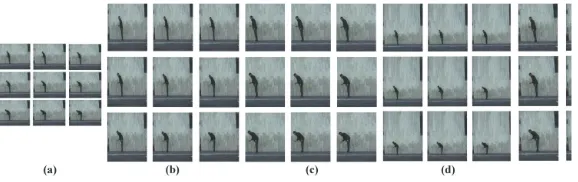
ing four methods, including scaling, the best cropping, seam carving, and our method. Fig.7(b) shows that using scaling method, the walking man and his dog all become vaguer than before. Fig.7(c) shows that using the best result from the cropping method, the walking man is only partly displayed, resulting in the original information becoming missing. Fig.7(d) shows that using seam carv-ing, the prominent part of this image sequence becomes smaller than before, indicating that the seam carving method is not suitable for image enlarging. Fig.7(e) shows that our method clearly displays the prominent objects from the original frames and ensures a global visual effect when the image sequence resolutions are changed. Similarly, resizing results of the sequence of a man with waist bent are shown in Fig.8.
Fig. 7. Comparison results of a walking man with a dog for the four resizing
methods when the resolution is resized from 180×144 to 200×288: (a) the original frames, (b) scaling, (c) the best cropping, (d) seam carving, and (e) our algorithm
Fig. 8.Comparison results of a man with waist bent for the four resizing
meth-ods when the resolution is resized from 180×144 to 220×277: (a) the original frames, (b) scaling, (c) the best cropping, (d) seam carving, and (e) our algo-rithm
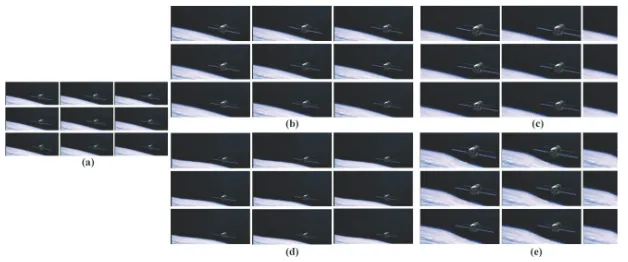
better performance in terms of visual quality. For example, the airship’s flight action can be distinctly displayed in Fig.9(e).
Fig. 9. Comparison results of a space image sequence for the four resizing
methods when the resolution is resized from 592×256 to 884×392: (a) the original frames, (b) scaling, (c) the best cropping, (d) seam carving, and (e) our algorithm
In Fig.10, for measurements of the resizing quality of the above image se-quences, we show the average gradient, edge intensity, and information entropy comparison results. The original images of Fig.10(a), Fig.10(d) and Fig.10(g) are shown in Fig.7(a). Similarly, the original images of Fig.10(b), Fig.10(e) and Fig.10(h) are shown in Fig.8(a), and the original images of Fig.10(c), Fig.10(f) and Fig.10(i) are shown in Fig.9(a). In Fig.10, the cyan curve stands for scal-ing, the blue curve for the best croppscal-ing, the green curve for seam carvscal-ing, and the red curve for our method. It is obvious that the red curve is always above the others, which shows that our algorithm can generally achieve the highest AG, EI, and IE. This indicates that our algorithm obtains an encouraging perfor-mance in image quantization measure.
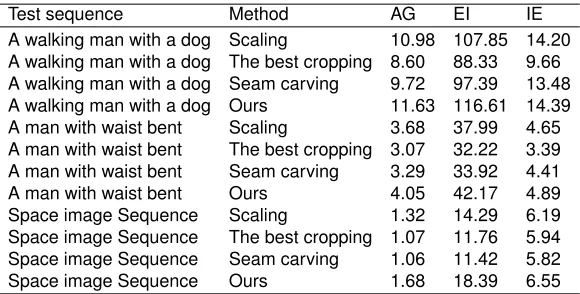
Table 2 summarizes the average indicator values for the three image se-quences corresponding to Fig.7, Fig.8 and Fig.9. This table shows that our algo-rithm always obtains the highest average values. Because of the encouraging performance in terms of image visualization and quantitative quality assess-ment, our proposed algorithm is very competitive.
6.
Conclusions
4 6 8 10 12 8 9 10 11 12 Frame number A G
Average gradient comparison
Scaling Cropping Seam carving
Ours
6 8 10 12 14 16
3 3.5 4 4.5 Frame number A G
Average gradient comparison
594 596 598 600 602
0.5 1 1.5 2 Frame number A G
Average gradient comparison
4 6 8 10 12
80 90 100 110 120 Frame number EI
Edge intensity comparison
6 8 10 12 14 16
30 35 40 45 Frame number EI
Edge intensity comparison
594 596 598 600 602
10 15 20
Frame number
EI
Edge intensity comparison
Scaling Cropping
Seam carving Ours
4 6 8 10 12
5 10 15
Frame number
IE
Information entropy comparison
Scaling Cropping Seam carving
Ours
6 8 10 12 14 16
3 3.5 4 4.5 5 Frame number IE
Information entropy comparison
594 596 598 600 602
5.5 6 6.5 7 Frame number IE
Information entropy comparison (a) (d) (g) (e) (h) (b) (c) (f) (i)
Fig. 10.Comparison of indicators using four resizing methods for a walking man
with a dog, a man with waist bent and space image respectively. Subplots (a)-(c) are the average gradient comparison results, (d)-(f) are the edge intensity comparison results, and (g)-(i) are information entropy comparison results
Table 2.Comparison of the average indicator values for the four image resizing
methods
Test sequence Method AG EI IE
steps: attention region establishment using a coarse-to-fine detection approach based on a feature descriptor, the construction of a partition interpolation model based on real-time artifact-free image upscaling, and a seam carving operation using a region energy protection approach. Our experiments demonstrate that our proposed method can obtain more satisfactory results than the representa-tive algorithms previously used in image resizing. In the future, we will improve the perception ability of our method by adding the salient detection technique to our resizing framework.
Acknowledgments.This work is supported by the National Basic Research Program
of China (973 Program) 2012CB821200 (2012CB821206), the National Natural Sci-ence Foundation of China (No.91024001, No.61070142) and the Beijing Natural SciSci-ence Foundation (No.4111002).
References
1. Ambai, M., Yoshida, Y.: Card: Compact and real-time descriptors. In: Proceedings of 2011 International Conference on Computer Vision. pp. 97–104. Barcelona, Spain (2011)
2. Avidan, S., Shamir, A.: Seam carving for content-aware image resizing. ACM Trans-actions on Graphics 26(3), Article 10 (2007)
3. Chen, L.Q., Xie, X., Fan, X., Ma, W.Y., Zhang, H.J., Zhou, H.: A visual attention model for adapting images on small displays. Multimedia Systems 9(4), 353–364 (2003)
4. Fang, F., Boyaci, H., Kersten, D.: Border ownership selectivity in human early eisual cortex and its modulation by attention. Journal of Neuroscience 29(2), 460–465 (2009)
5. Giachetti, A., Asuni, N.: Real-time artifact-free image upscaling. IEEE Transactions on Image Processing 20(10), 2760–2768 (2011)
6. Hou, Z., Zhang, Q.: Interpolation algorithm for recovering the missing phase values in 3d measurement. Optik 121(14), 1324–1329 (2010)
7. Huang, F.C., Huang, S.Y., Ker, J.W., Chen, Y.C.: High-performance sift hardware accelerator for real-time image feature extraction. IEEE Transactions on Circuits and Systems for Video Technology 22(3), 340–351 (2012)
8. Kumar, M., Conger, D.D., Miller, R.L., Luo, J., Radha, H.: A distortion-sensitive seam carving algorithm for content-aware image resizing. Signal Processing Systems 65(2), 159–169 (2011)
9. Liu, H.: Generative 3d images in a visual evolutionary computing system. Computer Science and Information Systems 7(1), 111–125 (2010)
10. Lucilio, C.G., Gonzalo, V.S.F., Pablo, C.d.l.H., Carlos, A.L.: A markov random field approach for topology-preserving registration: Application to object-based tomo-graphic image interpolation. IEEE Transactions on Image Processing 21(4), 2047– 2061 (2012)
11. Mayhew, S.D., Li, S., Kourtzi, Z.: Learning acts on distinct processes for visual form perception in the human brain. Journal of Neuroscience 32(3), 775–786 (2012) 12. Ni, K.S., Nguyen, T.Q.: An adaptable k-nearest neighbors algorithm for mmse image
13. Paltoglou, A.E., Neri, P.: Attentional control of sensory tuning in human visual per-ception. Journal of Neurophysiology 107(5), 1260–1274 (2012)
14. Pan, M.s., Yang, X.l., Tang, J.t.: Research on interpolation methods in medical image processing. Journal of Medical Systems 36(2), 777–807 (2012)
15. Pedro, N., Ricardo, V.M., Antonio, B.: Visual odometry based on structural matching of local invariant features using stereo camera sensor. Sensors 11(7), 7262–7284 (2011)
16. Wang, Y.S., Hsiao, J.H., Sorkine, O., Lee, T.Y.: Scalable and coherent video resizing with per-frame optimization. ACM Transactions on Graphics 30(4), Article 4 (2011) 17. Wang, Y.S., Tai, C.L., Sorkine, O., Lee, T.Y.: Optimized scale-and-stretch for image
resizing. ACM Transactions on Graphics 27(5), Article 118 (2008)
18. Zhang, G.X., Cheng, M.M., Hu, S.M., Martin, R.R.: A shape-preserving approach to image resizing. Computer Graphics Forum 28(7), 1897–1906 (2009)
Lingling Ziis a Ph.D. candidate in School of Computer Science Beijing
Univer-sity of Posts and Telecommunications. Also she is Lecturer in School of Elec-tronic and Information Engineering Liaoning Technical University. She was born in 1981 and obtained her Master Degree in 2007. Her research interests include multimedia systems and intelligent information systems.
Junping Du is a full professor and Ph.D. tutor with the School of Computer
Science and Technology, Beijing University of Posts and Telecommunications. She received the Ph.D. degree in computer science from the University of Sci-ence and Technology, then held a post-doctoral fellowship with the Department of Computer Science at Tsinghua University, Beijing, China. She was a visiting professor with the Department of Computer Science at Aarhus University, Den-mark, from September 1996 until September 1997. Now, she is the Director of the Computer Applications Center in Beijing University of Posts and Telecom-munications University. Her current research interests include Multimedia sys-tems, artificial intelligence and intelligent management systems.
Lisha Hou is a master degree candidate at Beijing University of Posts and
Telecommunications, China. Her research interests include multimedia systems and intelligent information systems.
Xiangda Sunis a master degree candidate at Beijing University of Posts and
Telecommunications, China. His research interests include multimedia systems and intelligent information systems.
Jangmyung Lee is a Professor with the Intelligent Robot Laboratory, Pusan
National University, Busan, Korea. He received the B.S. and M.S. degrees in electronic engineering from Seoul National University, Seoul, Korea, in 1980 and 1982, respectively, and the Ph.D. degree in computer engineering from the University of Southern California, Los Angeles, in 1990. His current research in-terests include intelligent robotic systems, ubiquitous ports, and intelligent sen-sors.