CLINICAL REPORT
Testing for Drugs of Abuse in Children and Adolescents
abstract
Drug testing is often used as part of an assessment for substance use in children and adolescents. However, the indications for drug testing and guidance on how to use this procedure effectively are not clear. The complexity and invasiveness of the procedure and limitations to the information derived from drug testing all affect its utility. The objective of this clinical report is to provide guidance to pediatricians and other clinicians on the efficacy and efficient use of drug testing on the basis of a review of the nascent scientific literature, policy guidelines, and published clinical recommendations.Pediatrics2014;133:e1798–e1807
INTRODUCTION
The recreational use of drugs is an underrecognized cause of mortality and morbidity in children and adolescents. It is, in fact, a public health priority.1Although annual surveys of drug use by children and adoles-cents may showfluctuation, the underlying rates remain high.2 Numer-ous adverse consequences accompany use, not the least of which is the increased risk of dependence among those who began smoking, drink-ing, and using drugs before 18 years of age.3,4Furthermore, most adults with substance use disorders initiated use during childhood or adoles-cence.5 Pediatricians are on the front lines for deterring, delaying, detecting, and diminishing the use of drugs by children. It is imperative that all pediatricians understand and are ready to use the tools and strategies effective for these endeavors.
Drug testing has been recommended in a variety of settings and clinical situations to avert substance use, to identify use as part of an as-sessment, or as part of treatment of individuals with substance use disorders. To date, there is little consensus among physicians regarding the indications for drug testing and little guidance on how to use this procedure effectively for any indication.6 The federal government has issued extensive guidance on the use of urine drug testing with federal and other employees,7although this guidance is not applicable for all situations and age groups. Experts have called for further evidence-based studies to guide best practices with adolescents.8
The complexity and invasiveness of the procedure and limitations to the information derived from drug testing all affect its utility. The objective of this clinical report is to provide guidance on the efficacy and efficient use of drug testing on the basis of a review of the nascent scientific literature, policy guidelines, and published clinical recom-mendations.
Sharon Levy, MD, MPH, FAAP, Lorena M. Siqueira, MD, MSPH, FAAP, and COMMITTEE ON SUBSTANCE ABUSE
KEY WORDS
drug testing, drug testing results, positive and negative drug testing results
ABBREVIATIONS
AAP—American Academy of Pediatrics THC—tetrahydrocannabinol
This document is copyrighted and is property of the American Academy of Pediatrics and its Board of Directors. All authors havefiled conflict of interest statements with the American Academy of Pediatrics. Any conflicts have been resolved through a process approved by the Board of Directors. The American Academy of Pediatrics has neither solicited nor accepted any commercial involvement in the development of the content of this publication.
The guidance in this report does not indicate an exclusive course of treatment or serve as a standard of medical care. Variations, taking into account individual circumstances, may be appropriate.
All clinical reports from the American Academy of Pediatrics automatically expire 5 years after publication unless reaffirmed, revised, or retired at or before that time.
www.pediatrics.org/cgi/doi/10.1542/peds.2014-0865
doi:10.1542/peds.2014-0865
PEDIATRICS (ISSN Numbers: Print, 0031-4005; Online, 1098-4275).
Copyright © 2014 by the American Academy of Pediatrics
SPECIMEN TYPES
Six biological matrices are commonly used for drug assays: urine, blood, breath, saliva, sweat, and hair. Neonates may also be tested using meconium. The choice of sample is influenced by the cost, ease of sample collection, risk of adulteration, test type (instant or labo-ratory based), scope of drugs being tested, time frame (acute or chronic use), time since last use, and indications for testing. Practices and laboratories should only conduct tests for which they are certified by the Clinical Laboratory Improvement Amendments.
Breath testing is mainly used by law enforcement and alcohol treatment programs for detection of recent alcohol use; it is not, however, routinely used in primary care. It is an easy-to-use, non-invasive test that is considered a good proxy for blood alcohol concentrations; urine alcohol concentrations, on the other hand, do not correlate well with blood alcohol concentrations or corre-sponding central nervous system im-pairment. Alcohol mouthwash or breath sprays used immediately before testing may result in false-positive test results.
Carbon monoxide and a nicotine me-tabolite known as cotinine are the 2 products in tobacco that are used for screening. Carbon monoxide can be measured in the breath up to 24 to 48 hours after smoking and then falls to nonsmoker levels. Cotinine is regarded as the best biomarker of tobacco ex-posure because it has a long half-life and can be measured in blood, saliva, hair, and urine.9,10
Blood concentrations are most useful for detecting alcohol and other drug use that occurred within 2 to 12 hours of the test and are best correlated with the level of impairment and morbidity seen in emergency situations. Blood testing is costly because of the need for specially trained personnel and equip-ment and is intrusive. Because of these
drawbacks, blood testing is rarely used in the primary care setting.
Saliva (oral fluid) and sweat testing provide similar information to blood testing but are less invasive and do not require extensive training for sample collection. Saliva allows for detection of drug excreted from the blood after re-cent use (ie, within 24–48 hours) that may not yet be detectable in urine. It is less subject to contamination than urine; smoking and methods used to stimulate saliva production to increase specimen volume may affect the results. Therefore, this method requires patient supervision in the 30 minutes before sampling.11Point-of-care tests are avail-able for saliva testing.12
Sweat may be used to detect drug use in 2 ways. First is a patch that is worn from 3 to 7 days and detects drug use that occurred just before the patch was applied (most drugs will be excreted within 48 hours) and drug use that occurs while the patch is in place. Second, a swipe may detect drug use within the past 24 hours (collection device not approved by the US Food and Drug Administration). The collection is noninvasive and has a similar cost to urine. Although difficult, environmental contamination can occur and lead to false-positive results.13 Specimen vol-ume may be affected both by the patient’s sweat secretion rates or re-moval of the patch during the collection period. The sample size obtained with oral fluid and sweat patch tests limits the ability to repeat tests and perform confirmatory testing. Both saliva and sweat assays are less standardized than urine or blood tests, and the ac-curacy of sweat testing remains con-troversial.14–16
Hair testing allows for detection of past use that has occurred over an extended time because drugs and metabolites are incorporated into the hair matrix over time. Hair cannot be used for detection of use in the
pre-vious 7 to 10 days. It is most reliable for heavy, frequent past use and not for detection of recent or occasional drug use. The hair needs to be cut as close to the scalp as possible, and usually the first 3 cm is used for testing, which covers a 90-day period (hair grows 1 cm a month). If longer hair is sent, the laboratory will cut it into segments before testing, and 4 tests will allow for screening over a period of a year. If the scalp is shaved, hair from other body areas may be sent instead. However, hair grows at a slower rate on the body, and a time frame cannot be used in this circumstance. Hair collection can be directly observed and is non-invasive, hair is easily stored and transported, and adulteration and substitution is difficult. However, hair testing is not useful clinically, because it has a long window of detection. In addition, hair structure, growth rate, melanin content, hygiene, and cosmetic treatment can affect the results. Drug concentrations in hair can be altered by shampoos, bleaches, or dyes, and false-positive results may be obtained with volatile drugs such as marijuana, which may adhere to hair.17,18No point-of-care tests are available; laboratory testing is costly, and it takes a long time to obtain results.
URINE DRUG TESTS
Two types of drug testing assays are available: qualitative tests usually used for screening and quantitative tests used for confirmation. Qualitative tests are point-of-care tests and home drug test kits. They are easy to perform, relatively inexpensive, and use immu-noassays, such as enzyme-linked im-munoassay or radioimim-munoassay, that give instant positive or negative re-sults. Although they are sensitive and function well as screening tests, they are susceptible to cross-reactions, re-sulting in false-positive results, which limit their specificity. Some laborato-ries use qualitative tests as a“ screen-ing procedure”; in this method, negative test results are discarded, and only positive test results are run through more expensive confirmatory testing, although the 2-step procedure has become less common as the cost of confirmatory testing has decreased. Confirmatory tests are performed in laboratories and not at the point of care. Most laboratories use a combi-nation of gas chromatography and mass spectrometry and can positively identify a substance and generate quantitative concentrations.
INDICATIONS FOR DRUG TESTING
The illicit and often secretive nature of substance use may result in adoles-cents being unwilling to give accurate information about their substance use, and thus drug testing may yield im-portant information, as in the various situations discussed below.
Emergent Clinical Care
Drug testing may identify possible toxins when a patient presents with altered mental status. In truly emer-gent situations, consent may be inferred, and testing should be con-sidered in accident victims, after a suicide attempt, for unexplained
seizures, for syncope or arrhythmias, or in the presence of toxidromal signs and symptoms that render the patient incapable of informed consent. In the case of a toxidrome, physical findings should guide the clinician to test for a specific panel of substances, even with minimal or no history available. A positive test result for a substance suspected on the basis of clinical
findings is less likely to be a false-positive or spurious result because of the higher pretest probability in this setting. However, drug testing has significant limitations, even in the emergency setting. Standard labora-tory tests detect drug metabolites with an unreliable frequency and often have reference ranges far lower than therapeutic dosages; thus, they may identify substances that are present but not causing the observed symp-toms. Emergency management of an obtunded patient, such as the decision to give naloxone, is made on clinical grounds and not on the basis of results of a laboratory test. Nonetheless, the results of a drug test may be helpful in determining management once the patient is stabilized.19
Assessment of Behavioral or Mental Health Symptoms
Drug use by teenagers often presents to medical attention with nonspecific signs and symptoms (such as fatigue, excessive moodiness, school failure) and, as such, may be hard to diagnose definitively. Voluntary drug testing may be a useful part of an assessment when a parent, clinician, or other adult suspects recent or ongoing drug use on the basis of observed symptoms. Like any other laboratory procedure, drug testing should be an adjunct to a thorough history rather than a re-placement. In cases in which an ado-lescent denies use, a positive drug test result may afford an opportunity to begin an honest conversation. Drug testing may be unnecessary if a patient
is forthcoming regarding his or her drug use history. Unfortunately, sig-nificant limitations to laboratory drug testing limit the information garnered from the procedure (see “Sources of Error in Interpreting Urine Drug Tests”). Like any other laboratory test, drug test results must always be interpreted within the context of his-tory, including both collateral and self-reports when possible.
THERAPY AND MONITORING
a program; when appropriate, paren-tal monitoring may also serve as a contingency, with negative results intrinsically rewarding. One study found that a drug-testing program in which parents received test results from the physician would be accept-able to adolescents,26 although to date, no study has demonstrated the effectiveness of such an approach.
SCREENING
A national survey of physicians found that few respondents use “ suspicion-less” drug testing as a means of screening for drug use in the medical home,6 and most experts agree that drug tests are not a useful screening procedure for general clinical pop-ulations because their sensitivity for detecting drug use in unselected pop-ulations is low.27,28 However, home-, school-, or employment-based pro-grams may include a screening com-ponent (ie, unselected or general populations may be tested) to detect or deter drug use. Participant consent should be required for all of these programs, as it would be in a clinical setting.
Results of studies of school-based drug testing programs are mixed: drug testing has poor sensitivity for detecting drug use, although some studies have found a deterrent effect. The American Academy of Pediatrics (AAP) does not endorse widespread implementation of school-based drug testing because of the limited efficacy, its cost, and the potential for unin-tended effects, such as breach of
con-fidentiality. School-based drug testing is discussed in greater detail in a sep-arate AAP statement.29
HOME DRUG TESTING
Drug tests have been commercially available and marketed to parents to prevent adolescent drug use for the
past 15 years. Marketing Web sites often include “home drug testing pol-icies” that recommend drug testing on either a routine basis to prevent drug use or when a parent has spe-cific concerns.30 Home drug testing has been endorsed by several school districts and police departments around the country. To date, the effi -cacy of home drug testing for re-ducing substance use by adolescents has not been rigorously tested. The AAP does not endorse home drug testing because of concerns about the complexity of testing with significant potential for parents to misinterpret test results, limited evidence that home drug testing reduces drug use, and theoretical concerns about a neg-ative effect on the relationship be-tween parents and their children. A professional evaluation should be considered whenever a parent has concerns about substance use.31
SCHOOL CLEARANCE
Some schools require “medical clear-ance,” including a negative drug test result, before readmitting a student who has been suspended for drug use or possession. In these cases, the AAP suggests that the pediatrician conduct a thorough history to understand the student’s level of drug involvement. Although there are no specific guide-lines for“medical clearance,”the AAP suggests that students who have been caught with drugs or paraphernalia or who were impaired at school should be allowed to return to school (after disciplinary consequences set by the school). At the conclusion of a medical evaluation, it is important to include a plan for follow-up and/or treatment in addition to considering a return to school, unless assessment suggests a serious substance use disorder requiring a more restrictive treatment setting, in which case the adolescent should be referred. The AAP cautions that “clearance” has no
uniformly accepted definition in the medical or legal literature; various individuals, such as parents, teachers, and school administrators may have different interpretations of clearance than do pediatricians. Pediatricians could, therefore, report the following as appropriate: (1) the student has received an appropriate medical evalu-ation and (2) reasonable medical stan-dards indicate that return to school is a reasonable option. Furthermore, par-ents must consider their adolescent’s individual risks and benefits while continuing to monitor their adolescent’s behaviors.
A drug test may be particularly useful for adolescents who report limited or infrequent drug use. In these cases, a negative test result would be ex-pected and would support the ado-lescent’s history. A brief period of monitoring with random tests may further support the student’s history of limited use. Adolescents who report heavy use, particularly of marijuana, are likely to have a positive drug test result even several days to weeks af-ter af-termination of use. In these cases, a period of monitoring until a negative test result is obtained may be useful, although the AAP suggests that the adolescent return to school while awaiting a negative test result. Quan-titative tetrahydrocannabinol (THC) concentrations may be followed to distinguish between prolonged excre-tion and ongoing drug use. These levels should be corrected for urine concentration to improve accuracy; one common method is to calculate a THC-to-urine creatinine ratio.32
a school’s right to require drug testing for students who participate in sports or other extracurricular activities.33,34 The AAP suggests that the pediatrician advise the student and family in this situation to submit to a drug test and then advocate for returning to school as outlined previously, although ulti-mately, the student and his or her parent determine how to proceed.
SOURCES OF ERROR IN
INTERPRETING URINE DRUG TESTS
False-Positive Results
Like any medical laboratory test, drug testing can yield positive or false-negative results. In urine drug testing, a “clinical” false-positive result (ie, drug detection in the absence of illicit drug use) is more likely to occur on a screening test because of cross-reactivity with an unrelated substance in the urine. For example,fl uoroquin-olone antibiotics have been reported to cross-react with immunoassay opiate screens.35,36 Confirmatory tests are highly unlikely to yield false-positive results but can yield a “clinical false-positive” result when a patient takes a certain prescription medication or ingests a food that metabolizes into a substance included in the drug test-ing panel. For example, a patient taktest-ing amphetamine and dextroamphetamine for attention-deficit/hyperactivity dis-order will have a positive test result for amphetamines, which may be falsely positive for substance abuse. Unfortunately, drug testing cannot distinguish between appropriate use and misuse of prescribed medica-tions. To interpret drug test results accurately, it is necessary to know an individual’s complete medical history, including prescribed medications. In addition, the practitioner needs to know the limitations of the selected matrix, the substances for which the drug panel tests, and potential cross-reactivity. The practitioner should not
hesitate to ask for assistance in or-dering the correct test or interpreting results.
False-Negative Results
A negative drug test result does not necessarily mean that an adolescent is not using a particular substance. The urine specimen submitted may not be a valid sample, as when an adolescent attempts to evade a positive test by submitting someone else’s urine, dilutes his or her own urine, or adds an adul-terating (or “masking”) agent to the sample to interfere with the screening immunoassay (eg, soap, bleach, ammo-nia). Even in the absence of adulteration, use may escape detection because of the timing of use relative to the testing, or if the cutoff concentration for a positive test result is set too high, small amounts of drug or metabolite may be missed. Another example occurs when the psy-choactive substance used is not part of the standard test panel, resulting in a“clinical false-negative”test result (eg,
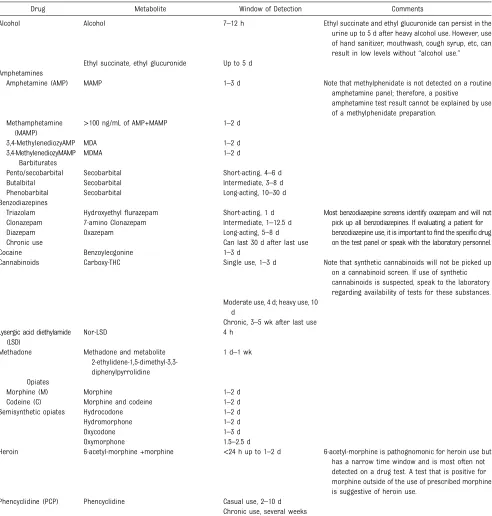
“spice”and newer designer drugs). Test panels often use a common metabolite to identify an entire class of substances (see Table 1). However, individual sub-stances with variant metabolism can still be missed. For example, benzodiazepine panels that identify oxazepam will not identify clonazepam, which is commonly misused by adolescents but not metabo-lized through this pathway. Thus, inter-preting drug test results can be exquisitely complex, even for experienced clinicians, and should be done with cau-tion. Seeking assistance from the testing laboratory is important, particularly when test results do not correlate with clinical findings and when a physician suspects the use of a particular sub-stance that is not included in a test panel.
URINE SPECIMEN COLLECTION
An accurate test result is dependent on obtaining a proper specimen. Direct observation is the most reliable
method for specimen collection. It is recommended that each treatment facility have a protocol in place that describes how urine specimens intended for drug testing will be col-lected from both male and female patients. It is also recommended that random specimens or those taken without supervision be labeled as such. Specimens that may have pertinence to a legal matter (eg, those taken after a motor vehicle crash or as part of a court-ordered program) may require collection in a tamper-proof container and also require chain of custody. When this is not practical, the patient should be referred to a laboratory facility that has this capability.
A less-invasive collection method involves excluding coats and bags and using a specially prepared restroom without running water, soap, or other chemicals. Toilet water should be tinted. The specimen’s appearance and color should be documented and the tem-perature should be taken within 4 minutes, preferably by use of a collection container with a temperature-sensitive strip on the outside. The tempera-ture should be recorded within 4 minutes of collection and should range from 90°F to 100°F (32°–38°C). The procedure should be explained to the patient before any collection. A national survey of physician practices found that most offices use none of these procedures (although many pro-vide a staff member outside the door to listen for running water).37 If un-supervised collection is used, results should be interpreted with caution.
Modesty
clinical decisions on history and physical examination alone. This may include re-ferring a patient for further evaluation or treatment on the basis of a high index of suspicion of drug use. Signs and symptoms of a mental health, be-havioral, or substance use disorder
should not be discounted because of inability to obtain a drug test.
CONFIDENTIALITY
Many national organizations, including the AAP, have consistently cautioned
against involuntary drug testing in adolescents.31 Adolescents should be engaged in their own care and, in most states, can consent to substance abuse treatment on their own.38,39Drug testing of a competent adolescent without his or her consent is, at best, impractical TABLE 1 Approximate Duration of Detectability and Common Cutoffs for Selected Drugs
Drug Metabolite Window of Detection Comments
Alcohol Alcohol 7–12 h Ethyl succinate and ethyl glucuronide can persist in the urine up to 5 d after heavy alcohol use. However, use of hand sanitizer, mouthwash, cough syrup, etc, can result in low levels without“alcohol use.” Ethyl succinate, ethyl glucuronide Up to 5 d
Amphetamines
Amphetamine (AMP) MAMP 1–3 d Note that methylphenidate is not detected on a routine amphetamine panel; therefore, a positive amphetamine test result cannot be explained by use of a methylphenidate preparation.
Methamphetamine (MAMP)
>100 ng/mL of AMP+MAMP 1–2 d
3,4-MethylenediozyAMP MDA 1–2 d 3,4-MethylenediozyMAMP MDMA 1–2 d
Barbiturates
Pento/secobarbital Secobarbital Short-acting, 4–6 d Butalbital Secobarbital Intermediate, 3–8 d Phenobarbital Secobarbital Long-acting, 10–30 d Benzodiazepines
Triazolam Hydroxyethylflurazepam Short-acting, 1 d Most benzodiazepine screens identify oxazepam and will not pick up all benzodiazepines. If evaluating a patient for benzodiazepine use, it is important tofind the specific drug on the test panel or speak with the laboratory personnel. Clonazepam 7-amino Clonazepam Intermediate, 1–12.5 d
Diazepam Oxazepam Long-acting, 5–8 d Chronic use Can last 30 d after last use
Cocaine Benzoylecgonine 1–3 d
Cannabinoids Carboxy-THC Single use, 1–3 d Note that synthetic cannabinoids will not be picked up on a cannabinoid screen. If use of synthetic cannabinoids is suspected, speak to the laboratory regarding availability of tests for these substances. Moderate use, 4 d; heavy use, 10
d
Chronic, 3–5 wk after last use Lysergic acid diethylamide
(LSD)
Nor-LSD 4 h
Methadone Methadone and metabolite 2-ethylidene-1,5-dimethyl-3,3-diphenylpyrrolidine
1 d–1 wk
Opiates
Morphine (M) Morphine 1–2 d
Codeine (C) Morphine and codeine 1–2 d Semisynthetic opiates Hydrocodone 1–2 d Hydromorphone 1–2 d
Oxycodone 1–3 d
Oxymorphone 1.5–2.5 d
Heroin 6-acetyl-morphine +morphine <24 h up to 1–2 d 6-acetyl-morphine is pathognomonic for heroin use but has a narrow time window and is most often not detected on a drug test. A test that is positive for morphine outside of the use of prescribed morphine is suggestive of heroin use.
and without his or her knowledge is unethical and illegal. However, an ado-lescent’s refusal to consent to a drug test should not prematurely conclude an evaluation of a substance use problem or disorder. If a pediatrician suspects that an adolescent is using drugs and that adolescent is refusing a drug test, his or her refusal should be documented, and referral to an addic-tion or mental health specialist is war-ranted. Pediatricians may also coach parents on appropriate limit setting or discipline. For example, a parent may suspend driving privileges if there is suspicion that an adolescent is using psychoactive substances; privileges may be restored if the teenager can rea-sonably demonstrate that he or she is not using substances.
Adults who have a long-term re-lationship with an adolescent are often aware of early behavioral, mental health, and physical changes that may prompt the request for drug testing. Before drug testing, the pediatrician should get a detailed description of the concerns to formulate a differential diagnosis and determine whether a drug test may be a helpful part of an assessment. If so, a discussion about the limited scope of information available from testing as well as the need to reach a consensus on an ac-tion plan for both positive and negative results should be undertaken. This will make any intervention easier to im-plement. The concerns raised by the adult and the recommendation for a drug test should then be discussed with the adolescent, and assent, in-cluding permission to share results, should be obtained before testing. If an adolescent refuses to consent to sharing the drug test results with a parent then they should not be shared. If the drug test was requested by the parents, the pediatrician should explain to them that their son or daughter has not consented to release
drug test results. However, as in all situations, if an adolescent’s behavior puts him or her at acute risk of harm to self or others, the pediatrician should consider breaching confidentiality.
MANAGEMENT
Ideally, drug test results may reassure parents or lead to an honest conver-sation about drug use that can guide further intervention. Unfortunately, if managed poorly, drug test results may be contentious, cause friction between an adolescent and his or her parents, and create a difficult situation for the clinician to manage. The AAP believes good outcomes are more likely if the pediatrician reviews how test results will be managed beforea test is sent to the laboratory.
In most instances in which a drug test is ordered for an adolescent patient, parents will want to know the results, and with few exceptions, sharing drug test results with parents is a helpful part of the process of drug testing. One exception would be a treatment-seeking adolescent who does not want to inform parents, and testing is used as a form of therapy. This situ-ation is rare in primary care, but if encountered, the pediatrician should respect the engaged adolescent’s au-tonomy. Adolescents younger than 18 years are able to consent to sub-stance use treatment without parental consent in more than half of the United States. It is important for the practitioner to learn about laws gov-erning confidentiality in the states in which they practice.
Positive Test Results
Because drug tests may yield false-positive test results, we suggest that the clinician always review positive results first with the ado-lescent to determine whether some-thing other than substance misuse may explain the observed results. The
pediatrician should consider both the laboratory results and the history before assessing the likelihood of substance use and presenting infor-mation back to parents.
The pediatrician may begin the inter-action by informing the adolescent that the drug test gave unexpected results (which could refer to a test interpreted by the physician as posi-tive, dilute, or adulterated) and asking for more information. In some in-stances, the adolescent may report substances not detected on the panel, ultimately yielding more information than the test results alone conveyed. If the adolescent’s report matches the drug test results, the pediatrician can begin a conversation about the next steps, which may include an absti-nence trial, ongoing testing, and/or a referral to counseling or other treat-ment. If reports of drug use match the results of a point-of-care test, confi r-matory testing, which adds consider-able expense, could reasonably be omitted.
If an adolescent denies substance use despite a positive drug test re-sult without a reasonable alternative explanation, the pediatrician can present available information to par-ents (assuming consent has been ob-tained). Laboratory testing is not perfect, and spurious results are possible. Repeat drug testing may be of value; adolescents with serious drug dis-orders are likely to ultimately have multiple positive drug test results.
Negative Test Results
health evaluation is warranted in such cases.
A single negative drug test result does not exclude the possibility of drug use or a substance use disor-der. If a substance use disorder is highly suspected on a clinical basis, the pediatrician should consider the possibility of a substituted, adulter-ated, or diluted sample; use of a substance not detected by the test panel; or a missed window of de-tection. If one of these conditions is suspected, other testing consid-erations include repeating the urine test serially, using a different matrix, changing the method (eg, to labo-ratory testing if a point-of-care test was used), adding specimen validity testing, or changing/adding to the test panel. In addition, the pediatri-cian should consider referral to an addiction or mental health specialist for further evaluation. Paradoxically, a “falsely” negative drug test result (ie, a test result that is negative despite ongoing drug use) might inadvertently delay detection and treatment of a substance use disor-der if symptoms are dismissed and further evaluation is not pursued.
Dilute Specimens
All urine drug test orders should include a check for specimen in-tegrity. Creatinine, which is a product of muscle metabolism, is used as a marker of urine concentration and should be ordered with each sample. Urine samples with a random cre-atinine concentration between 2 and 20 mg/mL should be considered di-lute. Some of these samples may be positive for one or more 1 sub-stances and should be considered both positiveanddilute because it is possible to miss substances present in lower concentrations (eg, a urine specimen may test positive for marijuana
but be too dilute to identify low levels of cocaine).
Dilute specimens present a difficult clinical challenge in interpreting drug test results. Smaller adolescents or those with less muscle mass are more likely to have lower random urine creatinine concentrations. Adolescents may consume a large volume offluid before the test either spuriously to be able to produce a urine specimen rapidly, or intentionally to attempt to defeat the test. These different sce-narios cannot be distinguished on the basis of drug test results alone, and clinical correlation is warranted. In these cases, a repeat drug test may also be helpful. First-morning specimens generally result in samples with ade-quate concentration. If a first-morning specimen is not possible, the adoles-cent can limit fluid intake in the few hours before providing a specimen.
Substituted or Adulterated Specimens
Urine specimens that have been substituted or adulterated in vitro should always be considered “ posi-tive” and may represent a serious substance use disorder and/or co-occurring mental health or behav-ioral disorder. In these cases, referral to an addiction specialist or mental health expert is warranted. Substituted specimens may be cold, may have a urine creatinine concentration
≤2 mg/mL, or may be found in the adolescent’s possessions. Adulterated specimens may have an unusual color or smell, may have out-of-range pH, or may result in a positive “adulterant panel” (available from some com-mercial laboratories). In these cases, if drug testing is to be repeated, ob-served urine collection may reduce the opportunity to tamper with the specimen.
Managing Confidentiality Between Patients and Outside Entities
Care should be taken to protect all information about substance use, in-cluding historical reports and drug test results that are recorded in the medical record. In primary care, the Health In-surance Protection and Accountability Act of 1996 (Pub L No. 104-191) stip-ulates how all medical records must be protected and can only be released via signed informed consent or other le-gally authorized means. For care pro-vided in a substance abuse treatment program, federal substance abuse confidentiality regulations (CFR 42 Part 2) supersede the Act and provide even more stringent criteria for release of information (the form must designate the specific information to be released).
SUMMARY
Drug testing is a complex procedure that, when used properly, may have a number of clinical indications. However, drug testing also has a number of drawbacks; it can be invasive, it yields only limited in-formation, and results are easily misinterpreted. Drug testing should never be the sole basis for making a diagnosis of a substance use dis-order; rather, test results should be used to supplement information obtained by history and physical examination. Signs and symptoms of
a mental health, behavioral, or sub-stance use disorder should not be dismissed solely on the basis of a negative drug test result or in-ability to obtain a test; these symp-toms always require further evaluation, and referral to a specialist should be considered.
LEAD AUTHORS
Sharon Levy, MD, MPH, FAAP Lorena M. Siqueira, MD, MSPH, FAAP
COMMITTEE ON SUBSTANCE ABUSE, 2013–2014
Sharon Levy, MD, MPH, FAAP, Chairperson
Seth D. Ammerman, MD, FAAP Pamela K. Gonzalez, MD, FAAP Sheryl A. Ryan, MD, FAAP
Lorena M. Siqueira, MD, MSPH, FAAP Vincent C. Smith, MD, FAAP
LIAISONS
Vivian B. Faden, PhD – National Institute of Alcohol Abuse and Alcoholism
Gregory Tau, MD, PhD–American Academy of Child and Adolescent Psychiatry
STAFF
Renee Jarrett, MPH James Baumberger, MPP Katie Crumley, MPP
REFERENCES
1. The National Center on Addiction and Substance Abuse (CASA) at Columbia Uni-versity. Adolescent Substance Use: Amer-ica’s #1 Public Health Problem. New York, NY: The National Center on Addiction and Substance Abuse (CASA) at Columbia Uni-versity; 2011
2. Johnston LD, O’Malley PM, Bachman JG, Schulenberg JE. Monitoring the Future National Survey Results on Drug Use, 1975–2011. Volume II. College Students and Adults Ages 19–50. Ann Arbor, MI: Institute for Social Research, University of Michigan; 2012
3. Hingson RW, Heeren T, Winter MR. Age at drinking onset and alcohol dependence: age at onset, duration, and severity.Arch Pediatr Adolesc Med. 2006;160(7):739–746 4. Substance Abuse and Mental Health
Ser-vices Administration. Results From the 2009 National Survey on Drug Use and Health. Vol. I: Summary of National Findings
[Publication No. SMA 10-4856]. Rockville, MD: Department of Health and Human Services, Office of Applied Studies; 2010
5. Kessler RC, Berglund P, Demler O, Jin R, Merikangas KR, Walters EE. Lifetime prev-alence and age-of-onset distributions of DSM-IV disorders in the National Comor-bidity Survey Replication [published cor-rection appears in Arch Gen Psychiatry. 2005;62(7):768].Arch Gen Psychiatry. 2005; 62(6):593–602
6. Levy S, Harris SK, Sherritt L, Angulo M, Knight JR. Drug testing of adolescents in
ambulatory medicine: physician practices and knowledge.Arch Pediatr Adolesc Med. 2006;160(2):146–150
7. US Department of Transportation, Office of Drug and Alcohol Policy and Compliance.
Urine Specimen Collection Guidelines. Available at: http://www.dot.gov/odapc/ urine-specimen-collection-guidelines. Accessed July 12, 2013
8. Irwin CE Jr. To test or not to test: screening
for substance use in adolescents.J Adolesc Health. 2006;38(4):329–331
9. Benowitz NL. Cotinine as a biomarker of environmental tobacco smoke exposure.
Epidemiol Rev. 1996;18(2):188–204 10. Benowitz NL, Bernert JT, Caraballo RS,
Holiday DB, Wang J. Optimal serum cotinine levels for distinguishing cigarette smokers and nonsmokers within different racial/ ethnic groups in the United States
be-tween 1999 and 2004.Am J Epidemiol. 2009; 169(2):236–248
11. Bosker WM, Huestis MA. Oral fluid testing for drugs of abuse.Clin Chem. 2009;55(11): 1910–1931
12. Drummer OH. Drug testing in oralfluid.Clin Biochem Rev. 2006;27(3):147–159 13. Kidwell DA, Smith FP. Minimal standards for
the performance and interpretation of toxicology test in legal proceedings.J Fo-rensic Sci. 2000;45(1):237–239
14. Chawarski MC, Fiellin DA, O’Connor PG, Bernard M, Schottenfeld RS. Utility of sweat
patch testing for drug use monitoring in
outpatient treatment for opiate depen-dence.J Subst Abuse Treat. 2007;33(4):411– 415
15. Barnes AJ, De Martinis BS, Gorelick DA, Goodwin RS, Kolbrich EA, Huestis MA. Dis-position of MDMA and metabolites in hu-man sweat following controlled MDMA administration.Clin Chem. 2009;55(3):454– 462
16. Huestis MA, Scheidweiler KB, Saito T, et al. Excretion of Delta9-tetrahydrocannabinol in sweat.Forensic Sci Int. 2008;174(2–3):173– 177
17. Wennig R. Potential problems with the in-terpretation of hair analysis results. Fo-rensic Sci Int. 2000;107(1–3):5–12 18. Ropero-Miller JD, Huestis MA, Stout PR.
Cocaine analytes in human hair: evaluation of concentration ratios in different cocaine sources, drug-user populations and surface-contaminated specimens. J Anal Toxicol. 2012;36(6):390–398
19. Boyer EW. Management of opioid analgesic overdose. N Engl J Med. 2012;367(2):146– 155
20. Petry NM, Tedford J, Austin M, Nich C, Carroll KM, Rounsaville BJ. Prize re-inforcement contingency management for treating cocaine users: how low can we go, and with whom?Addiction. 2004;99(3):349– 360
22. Kamon J, Budney A, Stanger C. A contin-gency management intervention for
ado-lescent marijuana abuse and conduct
problems. J Am Acad Child Adolesc Psy-chiatry. 2005;44(6):513–521
23. Carroll KM, Rounsaville BJ. A perfect plat-form: combining contingency management
with medications for drug abuse. Am J Drug Alcohol Abuse. 2007;33(3):343–365 24. Henggeler SW, Halliday-Boykins CA, Cunningham
PB, Randall J, Shapiro SB, Chapman JE. Juvenile drug court: enhancing outcomes
by integrating evidence-based treatments.
J Consult Clin Psychol. 2006;74(1):42–54 25. Halliday-Boykins CA, Schaeffer CM, Henggeler
SW, et al. Predicting nonresponse to juvenile drug court interventions. J Subst Abuse Treat. 2010;39(4):318–328
26. Levy S, Knight JR, Moore T, Weinstein Z, Sherritt L, Weiss RD. Acceptability of drug
testing in an outpatient substance abuse
program for adolescents.J Adolesc Health. 2011;48(3):229–233
27. Schwartz RH, Clark HW, Meek PS. Labora-tory tests for rapid screening of drugs of
abuse in the workplace: a review.J Addict Dis. 1993;12(2):43–56
28. Hammett-Stabler CA, Pesce AJ, Cannon DJ.
Urine drug screening in the medical set-ting.Clin Chim Acta. 2002;315(1–2):125–135 29. Mears CJ, Knight JR; Council on School
Health, American Academy of Pediatrics; Committee on Substance Abuse, American
Academy of Pediatrics. The role of schools in combating illicit substance abuse. Pedi-atrics. 2007;120(6):1379–1384
30. Levy S, Van Hook S, Knight J. A review of Internet-based home drug-testing products
for parents. Pediatrics. 2004;113(4):720– 726
31. American Academy of Pediatrics Committee
on Substance Abuse. Testing for drugs of abuse in children and adolescents. Pediat-rics. 1996;98(2 pt 1):305–307
32. Smith ML, Barnes AJ, Huestis MA. Identify-ing new cannabis use with urine
creatinine-normalized THCCOOH concen-trations and time intervals between
speci-men collections.J Anal Toxicol. 2009;33(4): 185–189
33. Veronia School Dist. 47J v Acton, 115 S Ct 2386 (1995)
34. Board of Education v Earls, 536 US 822 (2002)
35. Zacher JL, Givone DM. False-positive urine opiate screening associated with fl
uo-roquinolone use.Ann Pharmacother. 2004; 38(9):1525–1528
36. Baden LR, Horowitz G, Jacoby H, Eliopoulos GM. Quinolones and false-positive urine
screening for opiates by immunoassay technology.JAMA. 2001;286(24):3115–3119 37. Levy S, Harris SK, Sherritt L, Angulo M,
Knight JR. Drug testing of adolescents in general medical clinics, in school and at home: physician attitudes and practices.J Adolesc Health. 2006;38(4):336–342 38. Weisleder P. The right of minors to confi
-dentiality and informed consent. J Child Neurol. 2004;19(2):145–148
39. Weisleder P. Inconsistency among American states on the age at which minors can
DOI: 10.1542/peds.2014-0865 originally published online May 26, 2014;
2014;133;e1798
Pediatrics
Sharon Levy, Lorena M. Siqueira and COMMITTEE ON SUBSTANCE ABUSE
Testing for Drugs of Abuse in Children and Adolescents
Services
Updated Information &
http://pediatrics.aappublications.org/content/133/6/e1798 including high resolution figures, can be found at:
References
http://pediatrics.aappublications.org/content/133/6/e1798#BIBL This article cites 33 articles, 6 of which you can access for free at:
Subspecialty Collections
http://www.aappublications.org/cgi/collection/substance_abuse_sub Substance Use
nce_abuse
http://www.aappublications.org/cgi/collection/committee_on_substa Committee on Substance Use and Prevention
http://www.aappublications.org/cgi/collection/current_policy Current Policy
following collection(s):
This article, along with others on similar topics, appears in the
Permissions & Licensing
http://www.aappublications.org/site/misc/Permissions.xhtml in its entirety can be found online at:
Information about reproducing this article in parts (figures, tables) or
Reprints
DOI: 10.1542/peds.2014-0865 originally published online May 26, 2014;
2014;133;e1798
Pediatrics
http://pediatrics.aappublications.org/content/133/6/e1798
located on the World Wide Web at:
The online version of this article, along with updated information and services, is
by the American Academy of Pediatrics. All rights reserved. Print ISSN: 1073-0397.