INTERNATIONAL RESEARCH JOURNAL OF PHARMACY
www.irjponline.com
ISSN 2230 – 8407
Research Article
DEVELOPMENT OF FORMULATION AND EVALUATION OF GARLIC ORODISPERSIBLE FILMS
Dnyaneshwar R Pawar *, Santosh R Butle
School of Pharmacy, “Dnyanteerth”, Vishnupuri, Swami Ramanand Teerth Marathwada University, Nanded, Maharashtra,
India
*Corresponding Author Email: [email protected]
Article Received on: 03/10/18 Approved for publication: 12/11/18
DOI: 10.7897/2230-8407.0911275
ABSTRACT
The present study emphasizes on development and evaluation of orodispersible film formulation containing stabilized garlic extract of Allium sativum
Linn. prepared by solvent casting method. Drug-excipients interaction was studied by Fourier transform infrared spectroscopy andDifferential scanning calorimetry which shows that concentrated garlic extract and excipients are compatible to each other. Initially three preliminary trials – P1, P2 and P3 were taken by varying concentration of Hypromellose (METHOCEL E3 Premium LV) and Glycerin (Pricerine 9093) and Macrogol 400. P2 formulation was found suitable for further optimization. Amongst them METHOCEL E3 Premium LV and Glycerin (PRICERINE 9093) were selected for further optimization of formulation (E1 to E9 formulations) by 32 Factorial Design. Formulation E8 was found to be optimized formulation with 35.56% w/w
of Hypromellose (METHOCEL E3 Premium LV) and 3.33% w/w Glycerin (PRICERINE 9093). The E8 optimized garlic orodispersible film formulation was evaluated for stability studies and analysed for physical and mechanical properties. It was found that there were no significant changes in chemical, physical and mechanical properties.
Keywords: Allium sativum, Orodispersible film, METHOCEL E3 Premium LV, Glycerin, 32 Factorial Design.
INTRODUCTION
Hoffmann (2011), in his study on advances in orodispersible films for drug delivery found use of different terminologies for orodispersible films in Germany. For example, wafer, oral film, thin strip, orally dissolving film, flash release wafer, quick dissolve film and melt-away film. Melt-away film and melting film are rather inappropriate terms because the films are not melting but dissolving, or at least disintegrating in saliva. Therefore, the term ‘soluble film’ (in some cases ‘buccal or oral soluble film’) is preferred by the FDA, whereas the European Medicines Agency (EMA) is using ‘orodispersible film’ (p.299).1
As defined in the European Pharmacopoeia (Monograph 1807) in Europe definition of the dosage form “Orodispersible films (ODFs) are formulations intended for administration in the oral cavity. The Ph. Eur. 9th edition specifies that these formulations “consist of a film-forming polymer (most common are cellulose derivates such as hypromellose), which serves as carrier matrix for the Active Pharmaceutical Ingredient (API); in some cases an additional plasticizer is needed to ensure the film flexibility. Different excipients such as saliva stimulating agents, fillers, colours and flavours can be added (p.796).” 2
Preis (2012) in his study on development of a taste-masked orodispersible film containing dimenhydrinate in Germany have described on limit for disintegration time. As orodispersible films are supposed to disperse or disintegrate rapidly, disintegration of the film should correspond to complete drug release. In this study, disintegration within three minutes was defined as the appropriate limit, according to the monograph of orodispersible tablets (p.552).3 The current study emphasizes on development of garlic orodispersible film and optimization of formulation by quality by design approach.
MATERIALS AND METHODS
Hypromellose (METHOCEL E3 Premium LV) from Dow Chemical Mumbai, Polyvinyl alcohol from S D Fine Chemicals Ltd. Mumbai, Macrogol 400 from Spectrum Chemicals Mumbai, Mannitol (PEARLITOL 25 C) from Roquette, Glycerin (Pricerine 9093) from CRODA India Pvt. Ltd. Navi Mumbai, India were procured as gift sample. Vitamin C, Zinc sulphate monohydrate and Elemental selenium, Steviose and Menthol (Levo-Menthol) were obtained as gift sample from Omni Active Health Technologies Ltd. Thane, Simethicone Emulsion 30% were obtained from Thurs Organic Pvt. Ltd. Mumbai, Titanium dioxide were purchased from Bimal Pharma Pvt Ltd. Mumbai, Red beet root colour were purchased from Herbo Nutra Delhi India.
All the chemicals and reagents used were analytical grade. The crude garlic cloves was collected from Nanded (MS), India and authenticated by the scientist of the Botanical Survey of India, Pune M. S. India (Certificate No. BSI/WRC/IDEN. CER./2018/H13-49). The extraction was done using maceration process with water and alcohol (80:20) as solvent with a ratio of 1:1.4 Stability of garlic extract was improved using appropriate quantities of Vitamin C, Zinc sulphate monohydrate and Elemental Selenium hence onward described as “Stabilized Garlic Extract” (Garlic Extract: Vitamin C: Zinc sulphate monohydrate: Selenium – 1:5:3.33:0.013).5, 6
Physical parameter evaluation
Visual inspection and surface morphology 7
To get information about colour, homogeneity and transparency orodispersible films were visually inspected. There should not be any pores and surface should have uniformity.
Thickness measurements 7
Orodispersible films are evaluated for thickness at five different locations (centre and four corners) by using calibrated digital vernier callipers and then subsequently average was calculated. Three samples from all the batches are withdrawn and evaluated for thickness.
Surface pH study 7
The surface pH of orodispersible film is determined to find out the possibility of any side effects In-vivo. As an acidic or alkaline pH may cause irritation to the oral mucosa, hence it is desirable to keep the surface pH as close to neutral as possible to avoid any kind of irritation to the mucosal lining of the oral cavity. Combined pH electrodes are used for this purpose. Orodispersible films are slightly wet with the help of water. The pH is measured by bringing the electrode in contact with the surface of the oral film. The experiments are performed in triplicate and average values are reported. Surface pH of films should be around neutral pH,
Measurement of mechanical properties 7
Mechanical properties of film were evaluated using Z wick Testing Instrument (Model D-89079 Ulm, Germany) with a 5- kilogram load cell. Film strips in dimensions of 3 cm x 2 cm and free from air bubbles or physical imperfections are held between two clamps positioned at a distance of 2 cm during measurement. The strips are pulled by the top clamp at a rate of 10 cm/min. The force and elongation were measured when the film broke. Measurements were run in triplicate for each film. Three mechanical properties, namely, tensile strength (TS), elastic modulus (EM), and percent elongation (% E) are computed for the evaluation of the film.
Ideally orodispersible film should possess moderate tensile strength, high percent elongation (% E), low EM and shorter time for disintegration. Hardness and brittleness are characteristics of the films which are related with Young’s modulus and tensile strength. A hard and brittle film depicts higher value of tensile strength and Young’s modulus with small elongation
Tensile strength (TS)
Primarily, this test is performed to measure the mechanical strength of films. Tensile strength is the maximum stress applied to a point at which the film specimen breaks and can be computed from the following equation:
Tensile strength = Force at break (N)/ Initial cross-sectional area of the sample (cm2)
Percent elongation (% E)
On applying stress on a film, the specimen stretches which is referred as strain. Strain is defined as the change in length of film divided by its initial length of the film specimen. Percent elongation is related quantitatively to the amount of plasticizer used in film formulation. Increased plasticizer concentration in the film generally results in enhanced elongation of the strip. The percent elongation (% E) was calculated using the following equation:
The percent elongation %E = [Ls-L0/L0]*100
Where L0 is the original length and Ls is the length of the film after elongation.
Elastic modulus (EM)
Elastic modulus is also known as “Young’s modulus”. Elastic modulus is the measure of film stiffness. It is found as ratio of applied stress to the strain in the elastic deformation region. The modulus of elasticity of films was calculated from the following equation:
F/A = EM [Ls-L0/L0]
Where F= breaking load (N), A = cross-sectional area of the sample, and (EM) is the modulus of elasticity.
Folding endurance
Folding endurance is another procedure to estimate the mechanical properties of a film. It is measured by repeatedly folding a film at the same point until it breaks. Folding endurance value is number of times the film is folded without breaking. Higher folding endurance value depicts the more mechanical strength of a film. A direct relation exists between mechanical strength and folding endurance of films. As mechanical strength is governed by plasticizer concentration so it is clearly evident that plasticizer concentration also indirectly affects folding endurance value. Average (n=3) folding endurance of film were determined for each batch.
Uniformity of dosage units of the orodispersible film 7
Contents of a film were determined by standard assay method specified for individual drug in different pharmacopoeia. This test was performed on 20 units using analytical techniques. The acceptance value of the test is less than 15% in accordance with Japanese pharmacopoeia. According to USP27, the contents should range from 85% to 115% with the standard deviation of less than or equal to 6%. Content uniformity was worked out for estimating drug contents in individual film. The content uniformity of dosage units of the garlic orodispersible film were tested for API content using UV spectroscopy. Garlic showed the absorption maxima at 220 nm in 0.1N HCl (pH 1.2) and the absorption was linear through 10μg/ml to 50μg/ml. This method was found to be accurate and precise.
Drug content
The drug content of prepared garlic orodispersible film was determined for using suitable validated evaluation technique such as UV spectroscopy. The results were expressed as mean of three determinations.
In-vitro disintegration time 7
Generally, the disintegration time is the function of composition of film as it varies with the formulation and generally ranges from 5 to 30 seconds. Mostly, the USP disintegration apparatus is used for this test. As on date, there are no official guidelines available for determining disintegration time of orally fast disintegrating films. There are two methods for determining disintegration time of film:
Slide frame method: A drop of distilled water is poured onto the film clamped into slide frames placed on petri dish. The time taken by the film to dissolve is noted as disintegration time.
Petri dish method was used for measurement In-vitro disintegration time.
In-vitro dissolution study 7
Standard USP type I basket apparatus was used for conducting dissolution studies on garlic orodispersible films. Sink conditions were maintained during dissolution. Sometimes while performing this process, film floats over the medium making it difficult to perform the test properly. Weight used to settle the film sample. Therefore to overcome this problem basket apparatus is mostly preferred. Dissolution media was developed as per solubility of drug. Temperature was maintained at 37 ± 0.5°C and rotation speed was optimized to get maximum drug release. Dissolution media parameters are shown in table 1.
Samples of drug dissolved were collected at pre-determined intervals and filtered through 0.45 µm membrane filter. The concentration of the dissolved content was determined using spectrophotometric technique at 220 nm (Model: UV-1700, Make: SHIMADZU). And then the % release of garlic extract from orodispersible film was measured, the results were expressed as mean of three determinations.
Weight variation 7
Weight variation of a film was calculated by cutting the film and determining weight of each film. Uniformity in thickness is important to ascertain as it is directly proportional to dose accuracy of the film.
Moisture uptake 7
Moisture uptake of a film was determined by first cutting the garlic orodispersible film with the dimension of 3*2 cm2. Then these garlic orodispersible films were exposed to environment with a relative humidity of 75% at room temperature for 7 days. Moisture uptake was determined as percent weight gain of the garlic orodispersible film by using following formula.
Percentage moisture uptake = [Final weight - Initial weight / Initial weight]*100
Moisture Loss 7
Moisture loss is defined as the amount of moisture transmitted through unit area of film in unit time. It gives idea about the hydrophilicity and disintegration time of orodispersible films. Percent moisture loss is a parameter that determines the hygroscopicity of a orodispersible film. This parameter was determined by first taking the initial weight of the film, afterward, putting this film in a desiccator containing calcium carbonate for 72 hours. After 72 hours garlic orodispersible film were taken out and weighed again. Moisture loss was determined by applying the following formula.
Percentage moisture loss = [Initial weight - Final weight / Initial weight]*100
Pre-formulation studies
Fourier-transform infrared spectroscopy (FTIR) 8, 9
FTIR spectra for concentrated garlic extract alone and with all excipients mixture were taken using a fourier transform infra red spectrometer (FTIR) with KBr pellets for the identification of the drug and to study drug-excipients interaction. The sample was placed in FTIR cuvette and scanned over the range of 4000-400 cm-1 on an FTIR (Model: Avatar 370, Make: Thermo Nicolet, Spectral range: 4000-400 cm-1, Resolution: 4 cm-1). FTIR spectra of concentrated garlic extract alone and with all excipients
mixture were recorded and reported in figure 1 to 2 respectively while FTIR spectra interpretation are shown in table 6.
Differential scanning calorimetry (DSC) 8, 9
The thermal behaviour of concentrated garlic extract alone and with all excipients mixture was studied using DSC (Model: TA60WS Thermal Analyzer, Make: Shimadzu, Range: Ambient to 1000°C) for the identification of the drug and to study drug-excipients interaction. Accurately weighed samples of concentrated garlic extract (4.4 mg) were hermetically sealed in aluminium pan and heated at a constant rate of 20°C/min over temperature range of 20 to 300°C. The DSC thermo-grams were recorded and reported in figure 3 and figure 4 for concentrated garlic extract alone and with all excipients mixture respectively.
Analytical method development 9
Preparation of stock solution
The stock solution was prepared by accurately weighing 25 mg of the concentrated garlic extract, dissolved in sufficient quantity of distilled water and the volume made up to 25 ml (1000 µg/ml).
Preparation of serial dilution
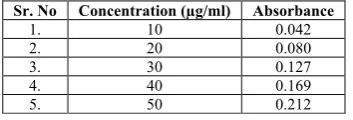
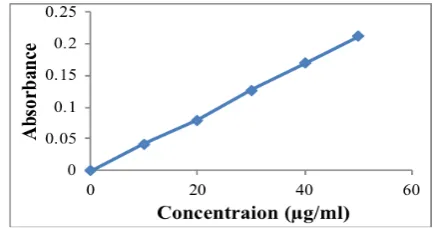
Different aliquots were taken from stock solution and diluted with distilled water separately to prepare series of concentrations from 10-50 µg/ml shown in table 8. The λ max was found to be 220 nm from UV spectrum of concentrated garlic extract in distilled water, during scanning from 200-400 nm. Absorbance was measured at 220 nm against distilled water as blank on a UV-Visible Spectrophotometer (UV-1700 SHIMADZU). The calibration curve was prepared by plotting absorbance versus concentration of concentrated garlic extract shown in figure 5.
Manufacturing process
Following process describes preparation of 10%w/w dispersion in distilled water (For solid content of 45 mg of each orodispersible film 405 mg of distilled water was required).
The total weight of orodispersible film was adjusted to 45 mg/ film using Mannitol. Same manufacturing process were used for preparation of active orodispersible film in which garlic extract was added in first step Batch size of 1000 orodispersible films were kept for each batch:
Step I: “Stabilized Garlic Extract” was added to distilled water. Then Simethicone emulsion was added to form a homogeneous dispersion under continuous stirring. Macrogol 400 and Mannitol added to the prepared homogeneous dispersion under continuous stirring and dispersed. Steviose was added and dispersed. Step II: Film forming polymer (quantities mentioned in table 2 for preparation of preliminary trial batches and table 5 for preparation of 32 factorial design batches) was added in distilled water and the dispersion was stirred for 1.0 hour thereby allowed the polymers to hydrate.
Step III: The dispersion prepared in step II was added to step I and mixed under continuous stirring.
Step IV: Glycerin, Polyvinyl alcohol, Red beet root colour, Titanium dioxide and Menthol was added to the dispersion of step I and dispersed.
Step V: Films were casted using the dispersion prepared in step IV. The films were dried, cut and packed in aluminium pouch. 10
Preliminary trial batches
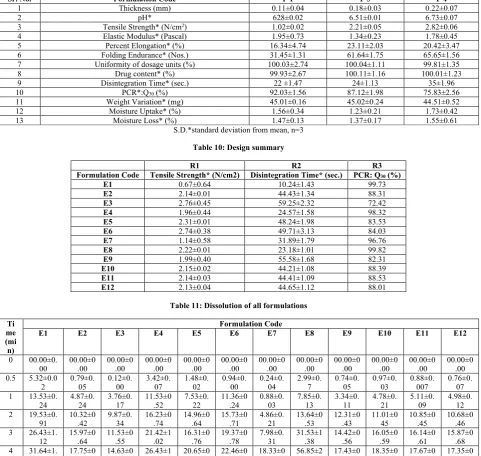
evaluated for thickness, pH, tensile strength, elastic modulus, percent elongation, folding endurance, uniformity of dosage units, drug content, disintegration time, Percent Cumulative Release (PCR), weight variation, moisture uptake and moisture loss.
32 Factorial design batches 11
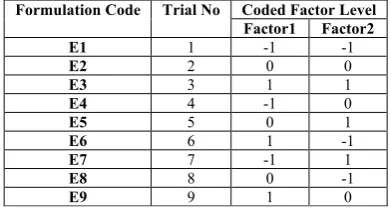
In the present study, a 32 full factorial design was employed. 2 factors evaluated at 3 levels and experimental trials were performed at all 9 possible combinations along three batches of centre points viz., E10, E11 and E12. The independent variables selected for the present study were Hypromellose (METHOCEL E3 Premium LV) (X1) and Glycerin (Pricerine 9093) (X2). The translation of coded values for 32 factorial experimental designs is shown in table 3. The total 12 runs were designed for experimentation as shown in table 4. Composition of 32 factorial design batches was as shown in table 5.
The levels of independent variables had been selected from the preliminary batches and the literature envisaged.
Dependent (response) variables evaluated include: R1 = Effect of design factors on tensile strength (R1) R2 = Effect of design factors on disintegration time (R2) R3 = Effect of design factors on amount of drug dissolved in 30 minutes (CPR Q30: R3)
Formulation of garlic orodispersible film
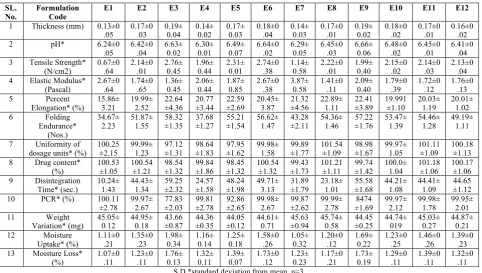
Based on results of preliminary trial batches, 32 factorial design batches were prepared with composition as shown in table 5 and evaluated for thickness, pH, tensile strength, elastic modulus, percent elongation, folding endurance, uniformity of dosage units, drug content, disintegration time, Percent Cumulative Release (PCR), weight variation, moisture uptake and moisture loss as shown in table 12.
Stability studies
From the literature survey, it was observed that garlic products require cold storage. Therefore the prepared garlic orodispersible films were evaluated for stability studies at 25°C±2°C/60%RH±5%RH for 1, 2, 3 and 6 months and at 5°C±3°C for 1, 2, 3 and 6 months and analysed for thickness, surface pH, tensile strength, percent elongation, elastic modulus, folding endurance, uniformity of dosage units (initial), drug content “In-vitro” disintegration time, “In-vitro” dissolution study, weight variation, moisture uptake and moisture loss as shown in table 13. 13
RESULTS & DISCUSSION
Pre-formulation studies
Fourier transform infrared spectroscopy (FTIR) studies
In the physical mixtures of concentrated garlic extract of Allium sativum Linn. with all other excipients, there was no much sifting of peak as compared to FTIR spectra of concentrated garlic extract of Allium sativum Linn. alone (figure 1 and 2). So we can conclude that concentrated garlic extract of Allium sativum Linn. and all other excipients are compatible with each other. The spectral elucidations for concentrated garlic extract and all other excipients are shown in table 6.
Observation of several functional groups could be attributed due to presence of several components in garlic viz., lipid-soluble allyl sulfur compounds such as diallyl disulfide (DADS) and diallyl trisulfide (DATS), and other one is the water-soluble compounds, c-glutamyl S-allylcysteine group such as S-allylcysteine (SAC) and S-allylmercaptocysteine (SAMC).
Differential scanning calorimetry (DSC) studies
DSC thermo-gram of concentrated garlic extract of Allium sativum Linn. shows one endothermic peak of fusion, having peak maximum of 126.22°C. This was in accordance with the reported (figure 3).
The endothermic peak at 131.77ºC can be attributed as melting point of components of concentrated garlic extract of Allium sativum Linn (figure 4). Thus the thermo-gram showed that the concentrated garlic extract of Allium sativum Linn. + All excipients are compatible with each other since there is no significant difference in endothermic peak of concentrated garlic extract of Allium sativum Linn. alone and physical mixture of concentrated garlic extract of Allium sativum Linn. with all other excipients.
Calibration curve of concentrated garlic extract
The standard solution of concentrated garlic extract of Allium sativum Linn. Shows a linear curve with correlation coefficient of 0.99814. The equation of line is y = 0.00425x+0.00235. The observations are shown in Table 7 and figure 5
The UV spectrophotometric method was selected for estimation of concentrated garlic extract of Allium sativum Linn. The UV spectrum exhibited maximum absorbance (λmax) at 220 nm. The UV spectrophotometeric method was linear for concentrations of 10.0-50.0 μL/mL.
On the basis of Infrared spectrum, DSC thermo-gram and UV spectrum, the achieved concentrated garlic extract of Allium sativum Linn. was found to be identical and acceptable in purity and quality. Hence the sample was taken for further studies.
Evaluation of preliminary trial batches
Thickness, tensile strength, percent elongation, folding endurance of formulation P1 was very low while elastic modulus was high. in formulation P3 thickness, tensile strength, percent elongation, folding endurance was satisfactory but disintegration and dissolution was very low. From the above observation, it was found that formulation P2 was having all the desired properties as compared to P1 & P3. Therefore it was decided to proceed further with P2 formulation.
Experimental design
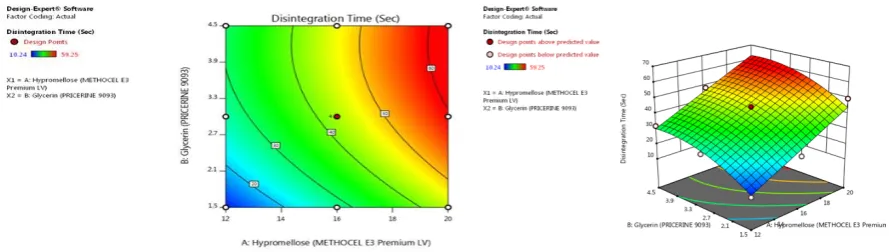
The independent variables selected for the present study Hypromellose (METHOCEL E3 Premium LV) (X1) and Glycerin (PRICERINE 9093) (X2) shown significant effect on dependent variables, tensile, strength (R1) disintegration time (R2) and amount of drug dissolved in 30 minutes (CPR Q30: R3). The data clearly shows strong influence of X1 and X2 on selected responses R1, R2 and R3. The polynomial equations can used to draw conclusion after considering magnitude of coefficient and mathematical sign it conveys either positive or negative. Results for experimental design batches and its ANOVA are shown in table 13 and figure 7, 8, 9. Table 10 shows design summary, table 11 shows dissolution of all formulation batches and 12 shows evaluation of 32 factorial design batches of garlic orodispersible films. Actual equations for regression analysis of model calculated using Design of Experiment software tool (Version:11, Make: Stat-Ease) are shown in table 13.
Effect of design factors on tensile strength (R1)
Table 1: In-vitro dissolution media
Drug Name Dosage Form USP
Apparatus (RPMs) Speed Medium Volume (mL) Recommended Sampling Times (minutes)
Concentrated
garlic extract Orodispersible films I (Basket) with sinker 50 0.1 N HCl, pH 1.2 900 ml. 0.5,1, 2, 3, 4, 5, 10, 15, 20,30 &45
Table 2: Composition of preliminary trial batches
Sr.
No. Ingredients Manufacturer/ Supplier Function P1 Quantity (mg/film) P 2 P 3
1 Concentrated garlic extract* In-house Active 1.5 1.5 1.5
2 Vitamin C* Omni Active Health Technologies Ltd. Thane Antioxidant 7.5 7.5 7.5
3 Zinc sulphate monohydrate* Omni Active Health Technologies Ltd. Thane Stabilizer 5 5 5
4 Elemental selenium* Omni Active Health Technologies Ltd. Thane Stabilizer 0.02 0.02 0.02
5 Hypromellose (METHOCEL
E3 Premium LV)
Dow Chemicals Film forming Polymer 20 16 12
6 Polyvinyl alcohol S D Fine Chemicals Ltd. Mumbai lubricant 0.5 0.5 0.5
7 Simethicone Emulsion 30% Thurs Organic Pvt. Ltd. Antifoaming agent 0.04 0.04 0.04
8 Macrogol 400 Spectrum Chemicals Plasticizer 0.2 0.5 0.8
9 Mannitol (PEARLITOL 25 C) Roquette Diluent, Plasticizer,
Sweetener 14.69 8.89 3.09
10 Steviose Omni Active Health Technologies Ltd. Thane Sweetener 1 1 1
11 Glycerin (PRICERINE 9093) CRODA
India Pvt. Ltd. Navi Mumbai
Humectant, Plasticizer 1.5 3 4.5
12 Menthol (LEVO-MENTHOL) Omni Active Health Technologies Ltd. Thane Flavour 0.5 0.5 0.5
13 Titanium dioxide Bimal Pharma Pvt Ltd Opacifier 0.5 0.5 0.5
14 Red beet root colour Herbo Nutra Colouring agent 0.05 0.05 0.05
15 Purified water# In-house Solvent q.s. q.s. q.s.
Total weight (mg) 45 45 45
#Removed during drying process.
*Appropriate quantities of Vitamin C (5 times of concentrated garlic extract), Zinc sulphate monohydrate (3.33 times of concentrated garlic extract) and Elemental selenium (0.013 times of concentrated garlic extract) were added to the 9.00 gm of concentrated garlic extract. Concentrated garlic extract (9 gm) along with Vitamin C 45.00 gm, Zinc sulphate monohydrate 30.00 gm and Selenium 0.013 gm here after described as Stabilized garlic extract (Stabilized garlic extract = Concentrated garlic extract + Vitamin C + Zinc sulphate monohydrate + Elemental selenium: 84.013 gm = 9.00 gm + 45.00
gm + 30.00 gm + 0.117 gm) and it was used in formulation. It was exposed to UV light and packed in suitable container for use in formulation development as it is.
Table 3: Translation of coded values for 32 factorial experimental designs
Sr. No Coded Value Level Experimental Actual Value X1
[(Concentration of
Hypromellose (METHOCEL E3 Premium LV)]
X2 [(Concentration of Glycerin (Pricerine 9093)]
1 -1 Low 12 1.5
2 0 Intermediate 16 3
3 1 High 20 4.5
Table 4: Experimental design as per 32 factorial designs
Formulation Code Trial No Coded Factor Level Factor1 Factor2
E1 1 -1 -1
E2 2 0 0
E3 3 1 1
E4 4 -1 0
E5 5 0 1
E6 6 1 -1
E7 7 -1 1
E8 8 0 -1
Table 5: Composition of 32 factorial design batches
Ingredients (mg) E1 E2 E 3 E4 E5 E6 E7 E8 E9 E10 E11 E12
1 Concentrated garlic extract 1.5 1.5 1.5 1.5 1.5 1.5 1.5 1.5 1.5 1.5 1.5 1.5
2 Vitamin C 7.5 7.5 7.5 7.5 7.5 7.5 7.5 7.5 7.5 7.5 7.5 7.5
3 Zinc sulphaye monohydrate 5 5 5 5 5 5 5 5 5 5 5 5
4 Elemental selenium 0.02 0.02 0.02 0.02 0.02 0.02 0.02 0.02 0.02 0.02 0.02 0.02
5 Hypromellose (METHOCEL E3
Premium LV)
12 16 20 12 16 20 12 16 20 16 16 16
6 Polyvinyl alcohol 0.5 0.5 0.5 0.5 0.5 0.5 0.5 0.5 0.5 0.5 0.5 0.5
7 Simethicone Emulsion 30% 0.04 0.04 0.04 0.04 0.04 0.04 0.04 0.04 0.04 0.04 0.04 0.04
8 Macrogol 400 0.5 0.5 0.5 0.5 0.5 0.5 0.5 0.5 0.5 0.5 0.5 0.5
9 Mannitol 14.3
9 8.89 3.39 12.89 7.39 6.39 11.39 10.39 4.39 8.89 8.89 8.89
10 Steviose 1 1 1 1 1 1 1 1 1 1 1 1
11 Glycerin 1.5 3 4.5 3 4.5 1.5 4.5 1.5 3 3 3 3
12 Menthol 0.5 0.5 0.5 0.5 0.5 0.5 0.5 0.5 0.5 0.5 0.5 0.5
13 Titanium dioxide 0.5 0.5 0.5 0.5 0.5 0.5 0.5 0.5 0.5 0.5 0.5 0.5
14 Red beet root colour 0.05 0.05 0.05 0.05 0.05 0.05 0.05 0.05 0.05 0.05 0.05 0.05
15 Purified water# q.s. q.s. q.s. q.s. q.s. q.s. q.s. q.s. q.s. q.s. q.s. q.s.
Total weight (mg) 45.0
0 45.00 45.00 45.00 45.00 45.00 45.00 45.00 45.00 45.00 45.00 45.00
# Removed during drying process.
Table 6: Fourier transform infrared spectral assignments for concentrated garlic extract of Allium sativum Linn.
Sr. No Energy (Wavenumber cm-1) Functional Group Assignments Type of Vibration
Reported Sample
1 3200-3600 3412.97 O-H Stretch
2 2850-3000 2941.59 C-H Stretch
3 2100-2260 2117.46 Stretch
4 1620-1680 1639.58 C=C Stretch
5 1350-1480 1458.34 -C-H Bending
6 1350-1480 1413.93 -C-H Bending
7 1080-1360 1245.86 C-N Stretch
8 1000-1300 1058.33 C-O Stretch
9 675-1000 932.39 =C-H Bending
10 675-1000 870.17 =C-H Bending
11 675-1000 819.87 =C-H Bending
12 675-1000 779.68 =C-H Bending
13 500-600 502.16 C-Br Stretch
Table 7: Calibration curve of concentrated garlic extract of Allium sativum Linn.
Sr. No Concentration (µg/ml) Absorbance
1. 10 0.042
2. 20 0.080
3. 30 0.127
4. 40 0.169
5. 50 0.212
Table 8:Dissolution profile of preliminary trail batches P1, P2 and P3
Dissolution Time Points (min)
% Dissolution of preliminary trail batches
P1 P2 P3
0.5 5.64±0.21 0.77±0.03 0.11±0.00
1 11.36±0.45 4.64±0.05 0.73±0.03
2 15.73±0.73 9.96±0.21 3.74±0.11
3 19.37±0.81 14.79±0.64 5.83±0.16
4 22.46±1.01 16.85±0.072 8.43±0.21
5 25.75±1.04 21.78±0.81 11.42±0.35
10 48.72±1.21 41.46±1.23 21.46±0.92
15 67.83±1.32 63.74±1.62 33.94±1.51
20 81.95±1.43 77.53±1.74 49.75±1.89
30 92.03±1.56 87.12±1.98 75.83±2.56
Table 9: Evaluation of preliminary trail batches P1, P2 and P3
Sr. No. Formulation Code P 1 P 3 P 4
1 Thickness (mm) 0.11±0.04 0.18±0.03 0.22±0.07
2 pH* 628±0.02 6.51±0.01 6.73±0.07
3 Tensile Strength* (N/cm2) 1.02±0.02 2.21±0.05 2.82±0.06
4 Elastic Modulus* (Pascal) 1.95±0.73 1.34±0.23 1.78±0.45
5 Percent Elongation* (%) 16.34±4.74 23.11±2.03 20.42±3.47
6 Folding Endurance* (Nos.) 31.45±1.31 61.64±1.75 65.65±1.56
7 Uniformity of dosage units (%) 100.03±2.74 100.04±1.11 99.81±1.35
8 Drug content* (%) 99.93±2.67 100.11±1.16 100.01±1.23
9 Disintegration Time* (sec.) 22 ±1.47 24±1.13 35±1.96
10 PCR*:Q30 (%) 92.03±1.56 87.12±1.98 75.83±2.56
11 Weight Variation* (mg) 45.01±0.16 45.02±0.24 44.51±0.52
12 Moisture Uptake* (%) 1.56±0.34 1.23±0.21 1.73±0.42
13 Moisture Loss* (%) 1.47±0.13 1.37±0.17 1.55±0.61
S.D.*standard deviation from mean, n=3
Table 10: Design summary
R1 R2 R3
Formulation Code Tensile Strength* (N/cm2) Disintegration Time* (sec.) PCR: Q30 (%)
E1 0.67±0.64 10.24±1.43 99.73
E2 2.14±0.01 44.43±1.34 88.31
E3 2.76±0.45 59.25±2.32 72.42
E4 1.96±0.44 24.57±1.58 98.32
E5 2.31±0.01 48.24±1.98 83.53
E6 2.74±0.38 49.71±3.13 84.03
E7 1.14±0.58 31.89±1.79 96.76
E8 2.22±0.01 23.18±1.01 99.82
E9 1.99±0.40 55.58±1.68 82.31
E10 2.15±0.02 44.21±1.08 88.39
E11 2.14±0.03 44.41±1.09 88.53
E12 2.13±0.04 44.65±1.12 88.01
Table 11: Dissolution of all formulations
Ti me (mi n)
Formulation Code
E1 E2 E3 E4 E5 E6 E7 E8 E9 E10 E11 E12
0 00.00±0.
00
00.00±0 .00
00.00±0 .00
00.00±0 .00
00.00±0 .00
00.00±0 .00
00.00±0 .00
00.00±0 .00
00.00±0 .00
00.00±0 .00
00.00±0 .00
00.00±0 .00 0.5 5.32±0.0
2 0.79±0.05 0.12±0.00 3.42±0.07 1.48±0.02 0.94±0.00 0.24±0.04 2.99±0.7 0.74±0.05 0.97±0.03 0.88±0.007 0.76±0.07
1 13.53±0.
24 4.87±0.24 3.76±0.17 11.53±0.52 7.53±0.22 11.36±0.24 0.88±0.03 7.85±0.13 3.34±0.11 4.78±0.21 5.11±0.09 4.98±0.12
2 19.53±0.
91 10.32±0.42 9.87±0.34 16.23±0.74 14.96±0.64 15.73±0.71 4.86±0.21 13.64±0.53 12.31±0.43 11.01±045 10.85±0.45 10.68±0.46
3 26.43±1.
12 15.97±0.64 11.53±0.55 21.42±1.02 16.31±0.76 19.37±0.78 7.98±0.31 31.53±1.38 14.42±0.56 16.05±0.59 16.14±0.61 15.87±0.68
4 31.64±1.
43 17.75±0.75 14.63±0.73 26.43±1.24 20.65±0.92 22.46±0.97 18.33±0.87 56.85±2.21 17.43±0.79 18.35±0.84 17.67±0.79 17.35±0.72
5 43.54±2.
04
22.75±1 .03
17.63±0 .76
39..32± 1.56
23.13±1 .11
25.75±1 .12
32.65±1 .45
69.84±2 .39
18.74±0 .76
23.34±1 .04
22.67±1 .08
22.62±1 .04 10 58.98±2.
45 42.53±2.01 39.64±1.37 51.53±2.54 44.63±2.11 48.72±2.23 45.32±2.02 81.45±2.46 38.85±1.31 43.01±1.53 42.78±1.61 41.24±1.57 15 77.76±2.
48 64.64±2.32 56.74±1.45 70.43±2.59 61.65±2.22 67.83±2.34 62.39±2.21 87.53±2.51 58.75±1.43 64.97±1.68 65.86±1.72 63.57±1.67 20 95.75±2.
52
78.64±2 .39
66.85±1 .78
93.43±2 .62
72.42±2 .34
71.95±2 .43
88.97±2 .36
92.54±2 .62
72.75±1 .68
79.47±1 .76
78.89±1 .47
78.25±1 .73 30 99.73±2.
67 88.31±2.51 72.42±1.97 98.32±2.69 83.53±2.45 84.03±2.56 96.76±2.54 99.82±2.74 82.31±1.74 88.39±1.81 88.53±1.57 88.01±1.98
45 100.11±
Table 12: Evaluation of 32 factorial design batches of garlic orodispersible films
SL.
No. Formulation Code E1 E2 E3 E4 E5 E6 E7 E8 E9 E10 E11 E12
1 Thickness (mm) 0.13±0
.05 0.17±0.03 0.19±0.04 0.14±0.02 0.17±0.03 0.18±0.04 0.14±0.03 0.17±0.01 0.19±0.02 0.18±0.02 0.17±0.01 0.16±0.02
2 pH* 6.24±0
.05 6.42±0 .04 6.63± 0.02 6.30± 0.01 6.49± 0.07 6.64±0 .02 6.29± 0.05 6.45±0 .03 6.66± 0.06 6.48±0 .02 6.45±0 .01 6.41±0 .04 3 Tensile Strength*
(N/cm2) 0.67±0.64 2.14±0.01 2.76±0.45 1.96±0.44 2.31±0.01 2.74±0.38 1.14±0.58 2.22±0.01 1.99±0.40 2.15±0.02 2.14±0.03 2.13±0.04 4 Elastic Modulus*
(Pascal) 2.67±0.64 1.74±0.65 1.36±0.45 2.06±0.44 1.87±0.85 2.67±0.38 3.87±0.58 1.41±0.11 2.09±0.40 1.79±0.39 1.72±0.12 1.76±0.13
5 Percent
Elongation* (%) 15.86± 3.21 19.99± 2.52 22.64 ±4.36 20.77 ±3.44 22.59 ±2.69 20.45± 3.87 21.32 ±4.56 22.89± 1.11 22.41 ±3.89 19.991 ±1.10 20.03± 1.19 20.01± 1.02
6 Folding
Endurance* (Nos.)
34.67±
2.23 51.87±1.55 58.32±1.35 ±1.27 37.68 55.21±1.54 56.62±1.47 43.28±2.11 54.36±1.46 57.22±1.76 53.47±1.39 54.46±1.28 49.19±1.11
7 Uniformity of dosage units* (%)
100.25 ±2.15 99.99± 1.23 97.12 ±1.31 98.64 ±1.83 97.95 ±1.62 99.98± 1.58 99.89 ±1.77 101.54 ±1.09 98.98 ±1.67 99.97± 1.05 101.11 ±1.09 100.18 ±1.13
8 Drug content*
(%) 100.53±1.05 100.54±1.21 98.54±1.32 ±1.86 99.84 98.45±1.32 100.54±1.32 99.43±1.73 101.21±1.11 99.74±1.42 100.0±1.04 101.18±1.06 100.17±1.06 9 Disintegration
Time* (sec.) 10.24± 1.43 44.43± 1.34 59.25 ±2.32 24.57 ±1.58 48.24 ±1.98 49.71± 3.13 31.89 ±1.79 23.18± 1.01 55.58 ±1.68 44.21± 1.08 44.41± 1.09 44.65 ±1.12
10 PCR* (%) 100.11
±2.78 99.97±2.67 77.83±2.03 ±2.78 99.81 92.86±2.65 99.98±2.67 99.87±2.62 99.99±2.78 ±1.69 8474 99.97±2.12 99.98±1.78 99.95±2.01
11 Weight
Variation* (mg) 45.05±0.12 44.95±0.18 43.66±0.87 ±0.35 44.36 44.05±0.12 44.61±0.71 45.63±0.94 45.74±0.58 44.45±0.25 44.74±019 45.03±0.27 44.87±0.21
12 Moisture
Uptake* (%) 1.11±0.21 1.35±0.23 1.98±0.34 1.16±0.14 1.25±0.18 1.58±0.26 1.05±0.32 1.20±0.12 1.69±0.22 1.23±0.25 1.46±0.26 1.39±0.23 13 Moisture Loss*
(%) 1.07±0 .11 1.23±0 .11 1.76± 0.13 1.32± 0.11 1.39± 0.07 1.73±0 .12 1.23± 0.23 1.17±0 .21 1.73± 0.19 1.29±0 .11 1.39±0 .11 1.32±0 .11 S.D.*standard deviation from mean, n=3
Table 13: Regression analysis of model
S. No. Actual Equation
1. Percent Cumulative Release (Q30) =136.83666666-2.335416666666Hypromellose (METHOCEL E3 Premium LV)-3.43 Glycerin
(PRICERINE 9093)
2. Disintegration time = 64.5617 + 4.07667 * Hypromellose (METHOCEL E3 Premium LV) + 21.9567 * Glycerin (PRICERINE 9093) + -2.61778 * Glycerin (PRICERINE 9093)^2
3. Tensile strength = -0.450833 + 0.155 * Hypromellose (METHOCEL E3 Premium LV)
Table 14: Stability data of optimized garlic orodispersible films formulation at accelerated condition (25°C±2°C/60%RH±5%RH) and long term condition (5°C±3°C)
Sr. No.
Evaluation Parameter
Initial Accelerated Condition (25°C±2°C/60%RH±5%RH)
Long Term Condition (5°C±3°C)
1 2 3 6 1 2 3 6
1 Thickness (mm) 0.17±0.0
1 0.17±0.01 0.17±0.02 0.17±0.04 0.17±0.05 0.17±0.01 0.17±0.01 0.17±0.03 0.17±0.04
2 pH* 6.45±0.0
3 6.44±0.06 6.46±0.04 6.45±0.05 6.47±0.07 6.45±0.06 6.44±0.05 6.45±0.02 6.46±0.01 3 Tensile Strength*
(N/cm2) 2.14±0.0 1 2.13±0.0 2 2.13±0.0 3 2.13±0.0 4 2.12±0.0 7 2.14±0.0 7 2.14±0.0 9 2.13±0.0 2 2.13±0.0 2 4 Elastic Modulus*
(Pascal) 1.41±0.11 1.41±0.14 1.40±0.12 1.40±0.15 1.40±0.08 1.41±0.12 1.41±0.15 1.41±0.18 1.40±0.07
5 Percent
Elongation* (%) 22.89±1.11 22.78±1.15 22.75±1.17 22.73±1.19 22.71±1.21 22.85±1.12 22.84±1.14 22.83±1.16 22.81±1.18
6 Folding
Endurance* (Nos.) 54.36±1. 46 54.23±1. 56 54.21±1. 67 54.19±1. 68 54.17±1. 71 54.31±1. 47 54.29±1. 49 54.26±1. 51 54.24±1. 53 7 Drug content* (%) 101.54±1
.09 101.52±1.10 101.47±1.11 101.37±1.13 101.13±1.15 101.53±1.09 101.52±1.10 101.50±1.12 10147±1.15 8 Disintegration
Time* (sec.) 23.18±1.01 23.53±0.56 24.12±0.45 25.23±0.39 26.03±0.31 23.21±1.14 23.29±1.18 23.35±1.21 24.02±1.27
9 PCR* (%) 101.65±2
.12 101.13±2 .33 101.02±2 .54 100.53±2 .67 100.31±2 .89 101.45±2 .17 101.31±2 .23 101.03±2 .43 100.89±2 .51 10 Weight Variation*
(mg) 45.74±0.58 45.71±0.53 45.68±0.49 45.62±0.45 45.53±0.35 45.76±0.59 45.79±0.60 45.82±0.62 45.94±0.65 11 Moisture Uptake*
(%) 1.20±0.12 1.20±0.10 1.18±0.07 1.18±0.04 1.17±0.02 1.20±0.11 1.19±0.09 1.19±0.08 1.18±0.06 12 Moisture Loss*
Figure 1: FTIR spectrum of concentrated garlic extract of Allium sativum Linn.
Figure 2: FTIR spectrum of concentrated garlic extract of Allium sativum Linn. + All excipients
Figure 3: DSC thermogram of concentrated garlic extract of Allium
sativum Linn. obtained at heating rate of 20° C/min garlic extract of Figure 4: DSC thermogram of physical mixture of concentrated Allium sativum Linn. + All excipients obtained at heating rate of 20° C/min
Figure 5: Calibration curve of concentrated garlic extract of Allium
sativum Linn. Figure 6: Dissolution profile of preliminary trail batches P1, P2 and P3
Figure 8: Contour plot and 3D Surface Response plot of disintegration time against concentration of Hypromellose (X1) and Glycerin (X2).
Figure 9: Contour plot and 3D Surface Response plot of CPR (Q30) against concentration of Hypromellose (X1) and Glycerin (X2).
Effect of design factors on disintegration time (R2)
Disintegration time was found to be increasing with increase in both Hypromellose (METHOCEL E3 Premium LV) and Glycerin (PRICERINE 9093)
Effect of design factors on amount of drug dissolved in 30 minutes (CPR Q30: R3)
CPR (Q30) was found to be decreasing with increase in both Hypromellose (METHOCEL E3 Premium LV) and Glycerin (PRICERINE 9093)
The formulation (film) E8 was found to be superior compared to other E1 to E9 formulations when evaluated for thickness, pH, tensile strength, elastic modulus, percent elongation, folding endurance, uniformity of dosage units, drug content, disintegration time, Percent Cumulative Release (PCR), weight variation, moisture uptake and moisture loss. Therefore stability of formulation E8 was evaluated.
Stability study
There were no significant changes in thickness, pH, tensile strength, elastic modulus, percent elongation, folding endurance, drug content, disintegration time, Percent Cumulative Release (PCR), weight variation, moisture uptake and moisture loss during stability study of optimized formulation (E8). Based on the stability study data presented table 14, cold storage condition was recommended for the product shelf life.
CONCLUSION
The findings of the present study suggest that orodispersible film formulation containing stabilized garlic extract of Allium sativum Linn. prepared by solvent casting method possesses acceptable mechanical properties like thickness, pH, tensile strength, elastic modulus, percent elongation, folding endurance, uniformity of dosage units, drug content, disintegration time, Percent
Cumulative Release (PCR), weight variation, moisture uptake and moisture loss. Garlic orodispersible film formulation could be a future’s nutraceutical dosage. There were no incompatibilities between drug and excipients as evidenced by FTIR and DSC. Optimized formulation (F8) was stable for six months at evaluated accelerated and long term condition with storage condition being “Cold Storage”. The regression analysis of the results leads to an equation that describes the influence of the selected formulation variables, concentration of Hypromellose (METHOCEL E3 Premium LV) and concentration of Glycerin (PRICERINE 9093) on the responses under study.
ACKNOWLEDGEMENT
It's a great pleasure to the authors to express their gratitude to Dr. Surendra G Gattani Dean, School of Pharmacy, Swami Ramanand Teerth Marathwada University, Nanded, Maharashtra India for his valuable suggestions and constant support throughout the course of study.
REFERENCES
1. Hoffmann EM, Breitenbach A, Breitkreutz J. Advances in Orodispersible Films for Drug Delivery. Expert Opinion on Drug Delivery 2011; 8 (3): 299-316.
2. Europarat. European Department for the Quality of Medicines. European pharmacopoeia. European treaty series, no. 50, Films, orodispersible. 9th ed. Europe. Strasbourg Council of Europe; 2016. P. 796.
3. Preis M, Pein M, Breitkreutz J. Development of a Taste-Masked Orodispersible Film Containing Dimenhydrinate. Pharmaceutics 2012; 4: 551-562.
4. Majekodunmi SO. Review of extraction of Medicinal Plants for Pharmaceutical Research. Merit Research Journal of Medicine and Medical Sciences 2015; 3(11): 521-527. 5. Josling P. Allicin and Vitamin C – Power, Performance, 1st Ed.
6. Wilson L. Selenium, A Critical Mineral for Health and Development. 5th Ed. London: L.D. Wilson Consultants Inc.; 2017 [cited 2018 June 11]. Available from: https://www.drlwilson.com/articles/SELENIUM.htm. 7. Irfan M, Rabel S, Bukhtar Q, Qadir MI, Jabeen F, Khan A.
Orally Disintegrating Films: A Modern Expansion in Drug Delivery System. Saudi Pharmaceutical Journal 2015; 24:537-546.
8. Senthilkumar K, vijaya c. Formulation Development of Mouth Dissolving Film of Etoricoxib for Pain Management. Advances in Pharmaceutics 2014; 2015: 1-11.
9. Jani R, Patel R, Shah P. Formulation and Evaluation of Orodispersible Film of Hydroxyzine Hydrochloride. World Journal of Pharmaceutical Research 2015, 4 (9): 754-770. 10. Sagban TH, Ismail KY. Formulation and Evaluation of
Orodispersible Film of Sildenafil Citrate. International Journal of Pharmacy and Pharmaceutical Sciences 2014; 6 (2): 80-86.
11. https://www.fda.gov. US: United State Food Drug and
Administration; 2000-01 [updated 2012 April; cited 2018 Sept 30]. Available from: https://www.fda.gov/downloads /Drugs/.../UCM304305.pdf.
12. Basu B, Desai P. Design and Evaluation of Fast Dissolving Film of Domperidone. International Research Journal of Pharmacy 2012; 3 (9):134-145.
13. Poluri K, Mulpur E, Puttugunta BS, Govada BK. Formulation Development and Evaluation of Novel Oral Soluble Films of Ziprasidone Hydrochloride in the Treatment of Schizophrenia. International Journal of Pharmacy and Pharmaceutical Sciences 2013; 5(2): 619-627.
Cite this article as:
Dnyaneshwar R Pawar and Santosh R Butle. Development of formulation and evaluation of garlic orodispersible films. Int. Res. J. Pharm. 2018;9(11):145-155 http://dx.doi.org/ 10.7897/2230-8407.0911275
Source of support: Nil, Conflict of interest: None Declared