Complementary and Alternative Medicine Use in
a Large Pediatric Autism Sample
abstract
BACKGROUND AND OBJECTIVE:Children and adolescents with autism spectrum disorder (ASD) often use complementary and alternative med-icine (CAM), usually along with other medical care. This study aimed to determine associations of ASD diagnostic category, co-existing conditions, and use of medications with use of CAM.
METHODS:We used the Autism Speaks Autism Treatment Network pa-tient registry, which collects information on CAM use, medical condi-tions, and psychotropic medication at enrollment. CAM was categorized as special diets versus “other” CAM; ASD was defined as autism, pervasive developmental disorder (PDD), or Asperger’s. Gastrointes-tinal symptoms, seizure disorders, sleep problems, and medication use were determined from parent report. Child Behavior Checklist (CBCL) scores were used to measure behavioral symptoms. Logistic regression was used to determine associations of diagnostic cate-gory, other medical conditions, and medication use with CAM treat-ments, controlling for demographic characteristics.
RESULTS:Of 3413 subjects in the registry as of April 2011, 3173 had complete data on CAM use: 896 (28%) reported any use; 548 (17%), special diets; and 643 (20%), other CAM. Higher rates of CAM use were associated with gastrointestinal symptoms (odds ratio [OR] = 1.88), seizures (OR = 1.58), and CBCL total score.70 (OR = 1.29). Children with PDD (OR = 0.62), Asperger’s (OR = 0.66), or using medications (0.69) had lower rates.
CONCLUSIONS:Children with ASD use more CAM when they have co-existing gastrointestinal symptoms, seizure disorders, and behavior problems. This study suggests the importance of asking about CAM use in children with ASD, especially those with complex symptoms.
Pediatrics2012;130:S77–S82
AUTHORS:James M. Perrin, MD,aDaniel L. Coury, MD,b
Susan L. Hyman, MD,cLynn Cole, PNP,cAnn M. Reynolds,
MD,dand Traci Clemons, PhDe
aDepartment of Pediatrics, Harvard Medical School, MassGeneral
Hospital for Children, Boston, Massachusetts;bNationwide
Children’s Hospital, The Ohio State University School of Medicine, Columbus, Ohio;cGolisano Children’s Hospital, University of
Rochester School of Medicine, Rochester, New York;dChildren’s
Hospital Colorado, University of Colorado, Aurora, Colorado; and
eEMMES Corporation, Rockville, Maryland KEY WORDS
autism spectrum disorders, complementary and alternative medicine
ABBREVIATIONS
ADOS—Autism Diagnostic Observation Schedule ASD—autism spectrum disorder
ATN—Autism Treatment Network
CAM—complementary and alternative medicine CBCL—Child Behavior Checklist
CSHQ—Child Sleep Health Questionnaire
DSM-IV—Diagnostic and Statistical Manual of Mental Disorders, Fourth Edition
GI—gastrointestinal OR—odds ratio
PDD-NOS—pervasive developmental disorder not otherwise spec-ified
www.pediatrics.org/cgi/doi/10.1542/peds.2012-0900E
doi:10.1542/peds.2012-0900E
Accepted for publication Aug 8, 2012
Address correspondence to James M. Perrin, MD, Department of Pediatrics, Harvard Medical School, MassGeneral Hospital for Children, 100 Cambridge St, #1542, Boston, MA 02114. E-mail: [email protected]
PEDIATRICS (ISSN Numbers: Print, 0031-4005; Online, 1098-4275).
Copyright © 2012 by the American Academy of Pediatrics
FINANCIAL DISCLOSURE:The authors have indicated they have nofinancial relationships relevant to this article to disclose.
to promote health, often as adjuncts to conventional medical treatment. CAM may be defined as a group of diverse medical and health care systems, practices, and products that are not generally considered part of conven-tional medicine.1 Parents often use
CAM in the care of children who have autism spectrum disorder (ASD), most typically in combination with conven-tional medical treatments, a practice sometimes labeled as integrative medi-cine. Data from the National Health In-terview Survey indicate that 38.3% of US adults and 12% of US children use CAM,2although a 2008 review indicated higher rates, with 20% to 40% of chil-dren using some CAM.3 Use of CAM
is higher in children and adults who have chronic health conditions. Among families represented in the Interactive Autism Network, more than one-half of children and youth who have ASD receive supplements. Families who choose to use CAM for their children who have ASD report an average of 7 CAM therapies.4At the time of a
diag-nostic visit for ASD, almost one-third of children were already treated with a dietary intervention.5
Most previous work on CAM in children/ youth with autism has come from small samples or large national data sets lacking substantial clinical data. Ear-lier work has associated increased CAM use among children with chronic conditions, higher socioeconomic status, and parental use of CAM for themselves.3
Valicenti-McDermott et al6 examined
the associations of CAM with parent stress and clinical symptoms of gas-trointestinal (GI), sleep, and behavioral problems. They found higher use of CAM among families of children with ASD compared with children with other developmental disabilities. Higher rates of CAM use were associated with
problems.
We examined CAM use in a large and diverse population of children who have ASD for whom a clinical database documented medical diagnosis and care. Given previous work in this area, we were particularly interested in the associations of CAM use with diagnostic categories of ASD, co-occurring con-ditions including other mental health conditions, and use of other treatments, while controlling for child demographic characteristics.
METHODS
This study was a cross-sectional anal-ysis of data from a large multisite registry of children and adolescents with ASD involved in a North American collaborative to improve health care for children who have ASD. The Autism Speaks Autism Treatment Network (ATN), a collaboration among 17 aca-demic health centers in the United States and Canada, has developed a common registry protocol for chil-dren enrolled in all sites. Main registry inclusion criteria are age 2 to 18 years as well as an Autism Diagnostic Ob-servation Schedule (ADOS) -supported andDiagnostic and Statistical Manual of Mental Disorders, Fourth Edition
(DSM-IV) diagnosis of ASD. Sites enroll new patients and collect data on re-turning patients who have continuing care at the site. Enrollment (based on the date of consent) for the reg-istry began in December 2007. We included all children enrolled in the ATN registry as of the end of April 2011.
Variables
CAM Usage
The medical history questionnaire com-pleted by the parent at entry to the registry includes a series of questions
were queried as to whether their chil-dren use various treatments such as acupuncture, chelation, chiropractic, or hyperbaric oxygen therapy; dietary sup-plements (vitamin supsup-plements, probiotics, antifungal agents, digestive enzymes, glutathione, sulfation, amino acids, or essential fatty acids); and special diets (classified as gluten free, casein free, Feingold, no processed sugars, no sali-cylates, or other). Because of the infre-quent endorsement of most of the CAM therapies, the variables were collapsed into a primary outcome of any CAM use versus no CAM use and 2 subgroup outcomes of (1) special diets versus no CAM use; and (2)“other”CAM use versus no CAM use.
Clinical Diagnosis
All children entered into the registry had clinical diagnoses of ASD with documentation of DSM-IV criteria and completion of the ADOS. ADOS and DSM-IV criteria scores were used to define categories of ASD (autism, pervasive developmental disorder not otherwise specified [PDD-NOS], or Asperger’s).
Co-occurring Conditions
The initial medical history questionnaire queried GI symptoms, specifically con-stipation, diarrhea, abdominal pain, and GI allergy. We dichotomized children into those with reported GI symptoms and those without. To determine presence of sleep disorders, the Child Sleep Health Questionnaire (CSHQ), a 33-item parent questionnaire, was used.7Insofar as the
CSHQ has been studied well only to age 10 years, we limited analyses of sleep disorder associations with CAM use to children ,11 years old.8 Total CSHQ
Checklist (CBCL) was used to determine presence of co-existing mental health symptoms, using cutoff scores of 70 on the CBCL internalizing, externalizing, and total scores denoting risk for behavioral problems.9 Finally, we used parent
re-port of use of medication, specifically for behavior problems.
Previous research has documented re-lations of age, race, and parental edu-cation with use of CAM.3 Thus, these
variables were included as control vari-ables in our analyses. We categorized age as 2 to 5 years, 6 to 11 years, and 12 to 18 years. Maximum education level, collected from the child’s primary and secondary caregivers, was grouped as follows: high school graduate or less, some college, college graduate, or post-graduate work. Race and ethnicity came from parent report. Race was categorized as white, black, Asian-American, or other; ethnicity was categorized as Hispanic or non-Hispanic origin.
Analyses
We determined associations with the use of any CAM through a 3-stage pro-cess by using logistic regression (SAS procedure LOGREG). In all analyses, use of any CAM was compared with the referent control group (no CAM usage). In stage 1, each factor (diagnostic cat-egory, co-occurring conditions, and use of medications) was included sepa-rately in bivariate analyses. Variables associated with CAM use at a level of
P,.20 or less were retained as factors for further analysis. Multilevel cate-gorical variables were retained if any of the comparisons (eg, high versus low, top versus bottom) were signifi -cant. Parent education and race/ethnicity were included as controls in the mul-tivariable analyses.
In stage 2, all variables retained from stage 1 analyses were entered as a group into a multivariable model, along with the control variables (age, race/ethnicity, and parental education).
In stage 3, model simplification con-sistent withx2 tests of change in de-viance was performed. Variables not statistically significant were excluded from the model. Model simplification continued until the reduced model yielded a significant (P#.05) worsen-ing of fit according to the likelihood ratio criterion.
A similar staged modeling approach was also used for the 2 subgroup comparisons of interest: (1) any special diet usage versus no CAM usage; and (2)“other”CAM usage versus no CAM usage.
Prevalence odds ratios (ORs) and 95% confidence intervals, which describe the association between use of any CAM, special diets, or other CAM and the risk factors, were computed relative to the control group of no CAM usage.
RESULTS
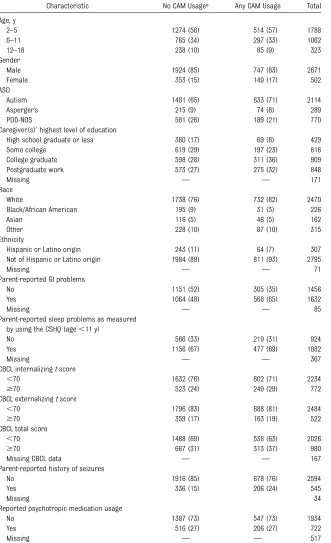
A total of 3413 participants were en-rolled in the ATN registry as of April 28, 2011. A total of 3173 had available data on CAM usage. Children with no avail-able CAM data were more likely to have a diagnosis of autism (73% vs 67%;P= .01) and be of Hispanic ethnicity (15% vs 6%; P = .02). The demographic characteristics of the 3173 partic-ipants who were included in the anal-ysis are shown in Table 1, grouped according to usage of CAM (any CAM usage versus no CAM usage). A total of 896 (28%) participants reported use of any CAM; 548 (17%) reported use of a special diet; and 643 (20%) reported use of other CAM treatment (Table 2). As with other research regarding CAM use in children and adolescents,3
wealthier households had higher rates of reported CAM usage in their chil-dren, as did white families compared with African-American or Latino fami-lies. ORs for each risk factor according to the 3 outcomes from the stage 1 bi-variate analyses are given in Table 3. ORs significant atP,.20 are noted.
The stage 3 reduced multivariable lo-gistic regression model had acceptable
fit. Estimated ORs and significant asso-ciations (P#.05) from the stage 3final models are given in Table 4. We report here associations that remained signif-icant in multivariable analyses.
Differences in CAM Use by Autism Diagnostic Category
Children and adolescents with a di-agnosis of Asperger’s or PDD-NOS had significantly decreased use of any CAM compared with children with a di-agnosis of autism (OR = 0.62 for Asperger’s and OR = 0.66 for PDD-NOS). Those with PDD-NOS or Asperger’s had significantly lower reports of use of special diets than those with autism (ORs = 0.44 and 0.65, respectively), whereas those with PDD-NOS had sig-nificantly lower reports of use of other CAM than those with autism (OR = 0.67).
CAM Use and Co-occurring Conditions
Parents of children in the ATN registry reported significantly higher rates of CAM use when they also reported GI problems (OR = 1.88 for CAM use in general; OR = 2.38 for special diets; OR = 1.82 for other CAM). Similarly, children whose parents reported a history of seizures also reported higher CAM use (OR = 1.58 for CAM use in general; OR = 1.97 for special diets; OR = 1.664 for other CAM). We found no significant association of CAM use with presence or absence of sleep problems.
CAM Use and CBCL Scores
Children with CBCL scores (interna-lizing, externa(interna-lizing, and total) above the cutoff of 70 had significantly higher rates of CAM and special diet usage than children with lower scores. After con-trolling for other factors, this associa-tion remained only for the CBCL total problem score (OR = 1.29 for CAM; OR = 1.34 for special diets).
Use of Psychotropic Medications
Children with reported psychotropic medication use had significantly lower current use of special diets (OR = 0.69).
DISCUSSION
We found substantially higher rates of CAM use in children who have classic autism compared with children and
youth who have Asperger’s or PDD-NOS. Parents also reported higher rates of CAM use if their child had certain co-existing conditions, specifically GI symp-toms, seizures, or evidence of behavior problems, although children taking psy-chotropic medications had lower use of special diets. This report extends pre-vious work related to CAM usage among children and adolescents who have ASD4–6
by documenting associations of CAM use with co-existing medical conditions.
The CAM use in this clinical population is similar to that of children and adoles-cents who have other chronic health conditions, although the rates reported are somewhat lower than in other studies reporting on children with ASD.4,5
Our findings may better reflect the prevalence of CAM use in similar pop-ulations because interest in the topic may bias samples of volunteers for online surveys. Furthermore, our sam-ple is fairly young, with less exposure to CAM. Kemper et al3 reported rates
varying from 30% to 70% among chil-dren who have chronic conditions. In another study, 74% of 112 children with ASD in a referral practice reportedly use Age, y
2–5 1274 (56) 514 (57) 1788
6–11 765 (34) 297 (33) 1062
12–18 238 (10) 85 (9) 323
Gender
Male 1924 (85) 747 (83) 2671
Female 353 (15) 149 (17) 502
ASD
Autism 1481 (65) 633 (71) 2114
Asperger’s 215 (9) 74 (8) 289
PDD-NOS 581 (26) 189 (21) 770
Caregiver(s)’highest level of education
High school graduate or less 360 (17) 69 (8) 429
Some college 619 (29) 197 (23) 816
College graduate 598 (28) 311 (36) 909
Postgraduate work 573 (27) 275 (32) 848
Missing — — 171
Race
White 1738 (76) 732 (82) 2470
Black/African American 195 (9) 31 (3) 226
Asian 116 (5) 46 (5) 162
Other 228 (10) 87 (10) 315
Ethnicity
Hispanic or Latino origin 243 (11) 64 (7) 307
Not of Hispanic or Latino origin 1984 (89) 811 (93) 2795
Missing — — 71
Parent-reported GI problems
No 1151 (52) 305 (35) 1456
Yes 1064 (48) 568 (65) 1632
Missing — — 85
Parent-reported sleep problems as measured by using the CSHQ (age,11 y)
No 566 (33) 219 (31) 924
Yes 1156 (67) 477 (69) 1882
Missing — — 367
CBCL internalizingtscore
,70 1632 (76) 602 (71) 2234
$70 523 (24) 249 (29) 772
CBCL externalizingtscore
,70 1796 (83) 688 (81) 2484
$70 359 (17) 163 (19) 522
CBCL total score
,70 1488 (69) 538 (63) 2026
$70 667 (31) 313 (37) 980
Missing CBCL data — — 167
Parent-reported history of seizures
No 1916 (85) 678 (76) 2594
Yes 336 (15) 206 (24) 545
Missing 34
Reported psychotropic medication usage
No 1387 (73) 547 (73) 1934
Yes 516 (27) 206 (27) 722
Missing — — 517
Data are presented as number (%).
aPercentages may not add to 100 due to rounding.
Any CAM 896
Special diets 548
Gluten-free diet 249
Casein-free diet 289
No processed sugars 69
No sugars or salicylates 28
Feingold diet 14
Other specified special diet 293
Other CAM 643
Other vitamin supplements 413
Probiotics 274
Essential fatty acids 171
Digestive enzymes 116
Higher dosing vitamin B6and magnesium 99
Chiropractic 77
Amino acids 59
Antifungals 58
Glutathione 33
Chelation 19
Hyperbaric oxygen 12
Acupuncture 10
Sulfation 7
CAM, especially dietary supplements and additions.10In 2 pediatric practices,
95% of children used CAM, mainly di-etary treatments, melatonin, chiropractic therapy, antifungal agents, and sensory integration.11 The initial medical
his-tory regarding CAM use did not specify melatonin or sensory integration as CAM treatments, thus leading to lower rates of identification in this popula-tion. More than 30% of 284 newly di-agnosed children with ASD used CAM; 9% of them used potentially harmful CAM, such as chelation, antibiotics, or excessive amounts of vitamins.5In our
population, a small percentage reported using CAM treatments that have been identified as potentially harmful (chela-tion reported in,4% of children). In the report by Levy et al, surprisingly, Latino children had much higher rates of CAM use than did white or African-American children. Our findings are similar to
those of Valicenti-McDermott et al,6in a
much smaller sample, in which reports of food allergies and behavior problems were associated with increased CAM use.
How these clinical characteristics of children affect the use of CAM is unclear, and our data do not directly address mechanisms underlying use. Parents of children who have classic autism may view their child’s condition as more se-vere and seek alternative treatments to complement other care the child re-ceives. Families seek to address prob-lematic behaviors or symptoms by using CAM; therefore, parents whose children have GI symptoms may particularly try both dietary changes and other CAM treatments to improve their child’s trition and symptoms. Dietary and nu-tritional concerns are among the most prominent questions that parents ask about their children who have autism.
Families whose children experience the feeding problems and food aversion that are common among children with au-tism might tend toward nutritional sup-plementation either to compensate for perceived dietary deficiencies or as a primary treatment. Why children who have seizures have higher rates of CAM use is unclear, although the presence of seizures may also indicate more clinical severity to parents, encouraging them to seek alternative therapies. Parents whose children use psychotropic medi-cations, conversely, may feel that they have active and somewhat effective treatments and turn to alternative treatments less than other families.
This study has several limitations. Es-sentially all information comes from parent report, without having confi r-matory information from other observ-ers or measures of the child’sfindings or health status. The registry questions
TABLE 3 Associations (ORs) Between Use of Any CAM and Subgroup Categories of Special Diets and“Other”CAM
Factor Exposure Any CAM
(n= 896)
Special Diets (n= 548)a
Other CAM (n= 643)a
A Versus B
Gender Male Female 0.92 0.96 0.88
ASD Asperger’s Autism 0.81* 0.51* 0.91
PDD-NOS Autism 0.76* 0.70* 0.77*
Parent-reported GI problems Yes No 2.01* 2.46* 1.91*
Parent-reported sleep problems as measured by using the CSHQ
Yes No 1.07 1.08 0.96
Parent-reported history of seizures Yes No 1.76* 2.16* 1.71*
CBCL internalizing T score Yes No 1.29* 1.39* 1.19*
CBCL externalizing T score Yes No 1.19* 1.29* 1.01
CBCL total score Yes No 1.30* 1.42* 1.14*
Reported psychotropic medication usage
Yes No 1.01 0.79* 1.14
aCompared with the no CAM usage group.
* Nominally significant,P,.20.
TABLE 4 Multivariable Associations (ORs) Between Use of Any CAM, Special Diets, or Other CAM
Factor Exposure Any CAMa(n= 896) Special Dietsa,b(n= 548) Other CAMa,b(n= 643)
A Versus B
ASD Asperger’s Autism 0.62 (0.46–0.84) 0.44 (0.28–0.69) 0.72 (0.52–1.00) PDD-NOS Autism 0.66 (0.54–0.82) 0.65 (0.49–0.85) 0.67 (0.53–0.84) Parent-reported GI problems Yes No 1.88 (1.57–2.25) 2.38 (1.86–3.05) 1.82 (1.50–2.22)
CBCL total score Yes No 1.29 (1.06–1.56) 1.34 (1.04–1.72) NSc
Parent-reported history of seizures Yes No 1.58 (1.27–1.96) 1.97 (1.50–2.59) 1.66 (1.30–2.10) Reported psychotropic medication usage Yes No NSc 0.69 (0.52–0.91) NSc
aORs (95% confidence intervals) from stage 3 model, comparing the outcome with no CAM usage. bCompared with the no CAM usage group.
cNon significant differences.
such as melatonin, herbal remedies, massage, or sensory integration. Thus, this study may have underestimated CAM use. Families participating in the ATN registry represent a population with generally more access to large medical centers in large metropolitan areas and may not be as representative as those with transportation barriers to re-ceiving care. Families participating in the ATN registry may also represent a group more willing to participate in clinical research and more oriented to-ward conventional medicine, which may not be as representative of CAM users in general. Several of the measures used indicate symptoms rather than provide actual indicators of specific conditions (eg, the GI symptom questionnaire and the CBCL). As a cross-sectional study, the
cannot determine whether GI symptoms in children led to higher rates of CAM use or alternatively whether higher rates of CAM use caused more GI symptoms. It will help to develop better longitudinal measures that will allow determination of the effects of CAM use on key child outcomes.
This study provides strong evidence associating certain medical conditions with differential use of CAM among families raising children with ASD. As with other CAM use, it will help to de-termine more about the potential synergistic effects of CAM with medical treatments as well as ways that CAM use may interfere with improvement in medical conditions. The review by Huffman et al12 also documents the
need for substantially more study of the
The common CAM treatments (ie, spe-cial diets, vitamin and nutrient supple-ments) have the potential to affect conventional treatments recommended by practitioners operating in the medi-cal home model, and primary care providers should inquire about and be aware of CAM use in their patients and families.13 The American Academy of
Pediatrics has called for pediatricians to establish a dialogue with families surrounding CAM, encouraged education of both consumers and clinicians re-garding CAM, and sought better evidence of CAM treatments to guide clinical practice.14Our study points out the
im-portance of understanding more about parents’motivations to use CAM and es-pecially how their children’s other health conditions influence those motivations.
REFERENCES
1. National Center for Complementary and Alternative Medicine, National Institutes of Health. Available at: http://nccam.nih.gov/ health/whatiscamccessed. Accessed De-cember 4, 2011
2. Barnes PM, Bloom B, Nahin RL. Comple-mentary and alternative medicine use among adults and children: United States, 2007.Natl Health Stat Report. 2008:1–23
3. Kemper KJ, Vohra S, Walls R; Task Force on Complementary and Alternative Medicine; Provisional Section on Complementary, Holistic, and Integrative Medicine. Ameri-can Academy of Pediatrics. The use of complementary and alternative medicine in pediatrics.Pediatrics. 2008;122(6):1374– 1386
4. Green VA, Pituch KA, Itchon J, Choi A, O’Reilly M, Sigafoos J. Internet survey of treatments used by parents of children with autism.
Res Dev Disabil. 2006;27(1):70–84
5. Levy SE, Mandell DS, Merhar S, Ittenbach RF, Pinto-Martin JA. Use of complementary and alternative medicine among children recently diagnosed with autistic spectrum disorder.J Dev Behav Pediatr. 2003;24(6): 418–423
6. Valicenti-McDermott M, Bernstein L, Burrows B, et al. Use of complementary and alterna-tive medicine in children with autism and controls: associations with ethnicity, child co-morbid symptoms and parental stress. Abstract presented at: International Meeting for Autism Research; May 12, 2011; San Diego, CA
7. Owens JA, Spirito A, McGuinn M. The Children’s Sleep Habits Questionnaire (CSHQ): psychometric properties of a sur-vey instrument for school-aged children.
Sleep. 2000;23(8):1043–1051
8. Goodlin-Jones BL, Sitnick SL, Tang K, Liu J, Anders TF. The Children’s Sleep Habits Questionnaire in toddlers and preschool children.J Dev Behav Pediatr. 2008;29(2): 82–88
9. Achenbach T, Rescorla L. Child Behavior
Checklist.Burlington, VT: ASEBA; 2000
10. Hanson E, Kalish LA, Bunce E, et al. Use of complementary and alternative medicine among children diagnosed with autism spectrum disorder. J Autism Dev Disord. 2007;37(4):628–636
11. Harrington JW, Rosen L, Garnecho A, Patrick PA. Parental perceptions and use of
complementary and alternative medi-cine practices for children with autistic spectrum disorders in private practice.
J Dev Behav Pediatr. 2006;27(suppl 2):
S156–S161
12. Huffman LC, Sutcliffe TL, Tanner IS, Feldman HM. Management of symptoms in children with autism spectrum disorders: a com-prehensive review of pharmacologic and complementary-alternative medicine treat-ments.J Dev Behav Pediatr. 2011;32(1):56– 68
13. Gilmour J, Harrison C, Asadi L, Cohen MH,
Vohra S. Natural health product-drug
interactions: evolving responsibilities to take complementary and alternative medi-cine into account. Pediatrics. 2011;128 (suppl 4):S155–S160
14. Committee on Children with Disabilities; American Academy of Pediatrics: counsel-ing families who choose complementary and alternative medicine for their child with chronic illness or disabilities. Com-mittee on Children with Disabilities [pub-lished correction appears in Pediatrics.
DOI: 10.1542/peds.2012-0900E
2012;130;S77
Pediatrics
and Traci Clemons
James M. Perrin, Daniel L. Coury, Susan L. Hyman, Lynn Cole, Ann M. Reynolds
Sample
Complementary and Alternative Medicine Use in a Large Pediatric Autism
Services
Updated Information &
http://pediatrics.aappublications.org/content/130/Supplement_2/S77 including high resolution figures, can be found at:
References
BIBL
http://pediatrics.aappublications.org/content/130/Supplement_2/S77# This article cites 11 articles, 2 of which you can access for free at:
Subspecialty Collections
http://www.aappublications.org/cgi/collection/autism:asd_sub Autism/ASD
al_issues_sub
http://www.aappublications.org/cgi/collection/development:behavior Developmental/Behavioral Pediatrics
following collection(s):
This article, along with others on similar topics, appears in the
Permissions & Licensing
http://www.aappublications.org/site/misc/Permissions.xhtml in its entirety can be found online at:
Information about reproducing this article in parts (figures, tables) or
Reprints
DOI: 10.1542/peds.2012-0900E
2012;130;S77
Pediatrics
and Traci Clemons
James M. Perrin, Daniel L. Coury, Susan L. Hyman, Lynn Cole, Ann M. Reynolds
http://pediatrics.aappublications.org/content/130/Supplement_2/S77
located on the World Wide Web at:
The online version of this article, along with updated information and services, is
by the American Academy of Pediatrics. All rights reserved. Print ISSN: 1073-0397.