The Royal Institution of Great Britain
Davy-Faraday Research Laboratory
University College London
Department of Physics & Astronomy
University of London
Development and Application of Embedded Cluster
Methodologies for Defects in Ionic Materials
Thesis submitted for the degree of Doctor of Philosophy
by
Petr Valentinovich Sushko
ProQuest Number: U642439
All rights reserved
INFORMATION TO ALL USERS
The quality of this reproduction is dependent upon the quality of the copy submitted. In the unlikely event that the author did not send a complete manuscript and there are missing pages, these will be noted. Also, if material had to be removed,
a note will indicate the deletion.
uest.
ProQuest U642439
Published by ProQuest LLC(2015). Copyright of the Dissertation is held by the Author. All rights reserved.
This work is protected against unauthorized copying under Title 17, United States Code. Microform Edition © ProQuest LLC.
ProQuest LLC
789 East Eisenhower Parkway P.O. Box 1346
A b stra ct
The m ain objectives of the present Thesis were to develop a m ethod and com puter code for calculating the properties of point defects in insulators, and to study defects and the mechanisms of defect processes in the bulk and at surfaces of ionic crystals.
We develop an embedded cluster m ethod and a com puter code, which allows us to trea t a defect in a crystal quantum mechanically in the effective potential of the rest of the polarisable crystal. This m ethod has several advantages w ith respect to existing m eth ods: i) it can be applied to bulk and surface defects; ii) it allows application of several quantum-mechanical methods, including the Hartree-Fock m ethod and different configu ration interaction techniques, and m ethods based on the Density Functional Theory; iii) it allows one to calculate the spectroscopic properties of point defects, such as optical absorption, vibrational spectra and hyperhne interactions, taking into account the defect interaction w ith the rest of the crystal; iv) the atomic structure of the defect can be op timised self-consistently using an effective procedure. The new m ethod and the com puter code have been tested on a number of well-established systems.
The m ethod has been applied to study the electronic structure and properties of several defects, and to model the mechanisms of various surface processes, i) We have calculated the position of the top of the (001) MgO surface valence band with respect to the vacuum level and the energy levels of neutral and charged oxygen vacancies w ith respect to the top of the valence band and the vacuum level, ii) The study of the electronic stru ctu re of excitons at low coordinated oxygen sites of the MgO surface has dem onstrated a significant dependence of the excitation energies on oxygen coordination, iii) A variety of geometric configurations of the [FeCl„(CN)6-n]^~ and [FeCl„(CN)6-n]^~ im purities in the bulk of
C o n te n ts
A b s tr a c t... 2
Table of C o n te n ts ... 3
List of Figures ... 6
List of T a b l e s ... 8
A cknow ledgem ents... 1 0 In tr o d u ctio n 11 1 E m b e d d ed C lu ster approach to ionic solid s 14 1 . 1 General I n tro d u c tio n ... 14
1.1.1 Properties of point defects: Typical p r o b le m s ... 14
1.1.2 Models and m e th o d s ... 15
1.1.3 Definitions ... 17
1.1.4 Requirements for cluster models ... 18
1.2 Examples of e m b e d d in g ... 19
1.2.1 Isolated QM c l u s t e r ... 19
1.2.2 QM cluster in the Madelung f ie ld ... 20
1.2.3 QM cluster in the polarisable en v iro n m en t... 2 1 1.2.4 Description of the quantum effects of surrounding la ttic e ... 24
1.2.5 Towards ion-covalent (polar) c r y s ta ls ... 27
1.3 Em bedding approach based on group functions t h e o r y ... 28
1.3.1 Group function t h e o r y ... 28
1.3.2 Atomistic representation of the E n v ir o n m e n t... 31
1.4 S u m m a r y ... 35
2 G U E SS: m eth o d o lo g y and te s ts 36 2 . 1 Q uantum cluster in the polarisable env iro nm en t... 37
2.2 The embedded cluster calculation: practical re a lis a tio n ... 38
2.2.1 Model for the embedded cluster calcu latio n s... 38
2.2.2 Galculation of the to tal energy and f o r c e s ... 40
2.2.3 Organisation of the to tal energy minim isation of the s y s te m ...41
2.2.4 Reference ch arg es... 44
2.2.5 Q uantum mechanical c l u s t e r s ... 44
2.2.6 Ab initio methods, calculation of defect p r o p e r t i e s ... 46
2.3 Tests of the com puter c o d e ... 47
2.4 Tests of the m o d e l ... 49
2.4.1 Perfect lattice test: NaGl, LiBaFg ... 49
2.4.2 Schottky and Frenkel defects in NaGl ... 51
2.5 S u m m a r y ...56
3 P r o p e r tie s o f d efec ts in th e bulk o f ionic cry sta ls 57 3.1 Properties of the iron cyanide ions trapped in NaCl host l a t t i c e ...57
3.1.1 Introduction ... 57
3.1.2 Experim ental and theoretical b a c k g r o u n d ... 59
3.1.3 Details of c a lc u la tio n s ... 61
3.1.4 Results of c a lc u la tio n s ... 62
3.1.5 S u m m a r y ... 6 8 3.2 Effect of the embedded cluster model on optical properties of Ce^"^ doped L iB a F s ... 69
3.2.1 Introduction ... 69
3.2.2 Experim ental and theoretical b a c k g r o u n d ... 69
3.2.3 Details of c a lc u la tio n s ... 70
3.2.4 Results and d isc u ssio n ... 72
3.2.5 S u m m a r y ... 76
4 D e fe c ts at th e surface o f M gO 78 4.1 Electronic properties of the ideal and defective s u r f a c e ... 78
4.1.1 Experim ental b a c k g ro u n d ... 78
4.1.2 Details of c a lc u la tio n s ... 80
4.1.3 MgO (001) surface rumpling ... 82
4.1.4 Position of the top of the valence band: Ionisation potential of the MgO (001) s u r f a c e ... 83
4.1.5 Position of the bottom of the conduction band: Electron affinity of the surface ... 8 6 4.1.6 Oxygen c o r n e r ... 87
4.1.7 Surface and corner F, F+ and Y a centres ... 89
4.1.8 Surface peroxy s p e c ie s ... 93
4.1.9 D iscussion... 96
4.2 Electronic structure of excited states at low-coordinated MgO surface sites . 97 4.2.1 Experim ental b a c k g r o u n d ... 97
4.2.2 Details of c a lc u la tio n s ... 98
4.2.3 Results and D iscussion... 99
5 P r o c e sse s at th e surfaces o f ionic cry sta ls 105 5.1 Laser induced desorption of Mg"'" ions from the (001) MgO s u r f a c e ...105
5.1.1 The process of induced desorption and general e x p e rim e n t...105
5.1.2 Experim ental and theoretical b a c k g r o u n d ... 106
5.1.3 Electrostatic m o d e l... 107
5.1.5 Results of c a lc u la tio n s ...108 5.1.6 Discussion and su m m a ry ...110 5.2 Interaction of a silicon tip w ith the (001) NaCl surface; possibility of tip
c o n tam in a tio n ...I l l 5.2.1 Embedded cluster m odelling... 112 5.2.2 Results and d is c u s s io n ...114 5.2.3 S u m m a r y ...117
S u m m a ry 118
List o f Figures
1 Crystal with a point defect: relation of the conventional two-region model (a) to the model for embedded cluster calculations (b)... 3 9
2 Organisation of the energy minimisation procedure... 42
3 Generation of the nano-cluster from electrically neutral unit cell. Example of LiBaFs crystal... 46
4 QM clusters used for the perfect lattice test: NaCl... 49
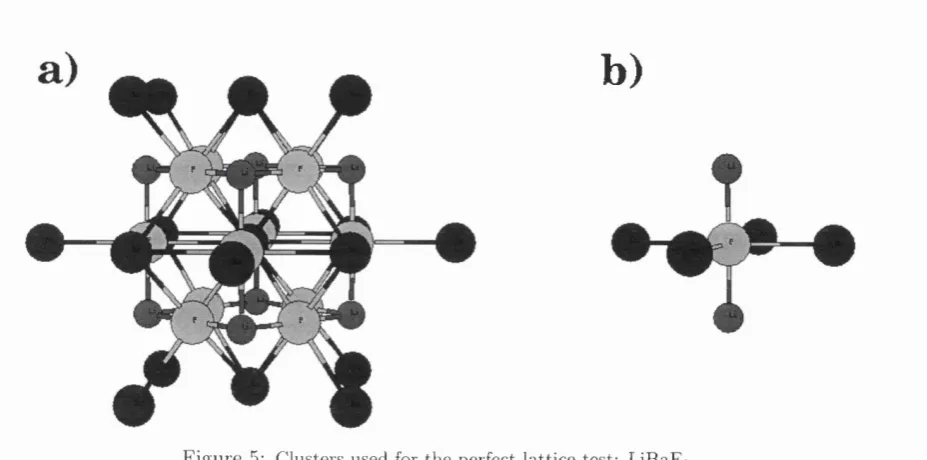
5 Clusters used for the perfect lattice test: LiBaFs... 51
6 QM clusters used to study oxygen vacancy in bulk MgO... 53
7 Possible configurations of the two cation vacancies in the vicinity of a [FeCln(CN)6-n]^~ complex in bulk NaCl... 59
8 The Tsg-Fg splitting of the central Fe^~'“ ion d-levels in the octahedral field of its ligands... 60
9 Qualitative splitting of the Fe^+ d-levels in the field of ligands and cation vacancies. 61 10 Clusters used in the study of iron cyanides... 62
11 Local atomic structure of the Ce^+ ion in LiBaFs... 74
12 The models for the surface (a) and corner (b) used in the embedded cluster calcu lations... 81
13 The quantum mechanically treated clusters used in the embedded cluster calcula tions of the surface and corner states... 82
14 Rumpling for the MgO (001) surface... 83
15 The spin density of the hole state at the MgO (001) surface... 85
16 The spin density of the additional electron in the Mg5 70 2s cluster modelling the (001) MgO surface... 8 8 17 The spin density of the hole state at the oxygen corner of the MgO... 90
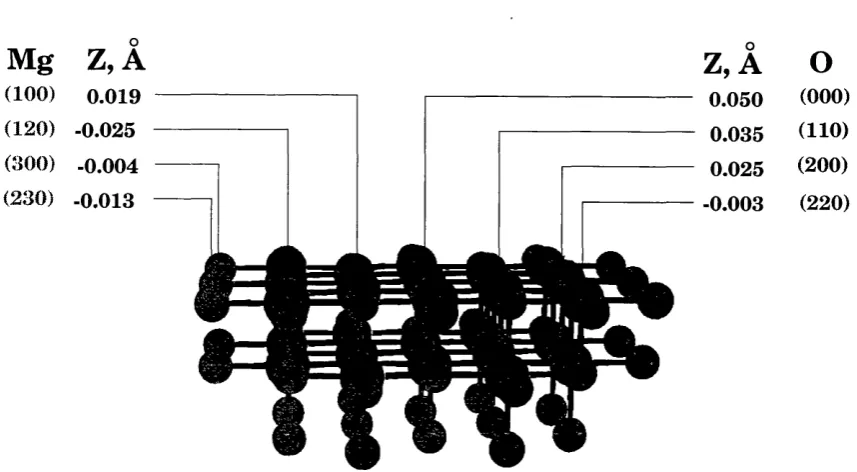
18 The electron density of oxygen vacancies at the MgO (001) surface...92
19 Schematic explanation of notations used to calculate the ionisation energies and electron affinities of different charge states of the anion vacancy at the surface and anion corner of MgO (see Table 23)... 93
20 Peroxy ion at the MgO (001) surface... 95
21 Positions of the defect and excited states with respect to the vacuum level and to the top of the surface valence band... 96
22 Schematic illustration of quantum mechanical clusters used in calculations of ex citation energies of low-coordinated sites... 99
23 The spin density of excited triplet state of 3- and 4-coordinated anion sites at MgO (0 0 1) surface...1 0 2 24 The spin density of the excited triplet state integrated inside a sphere...103
26 Process of laser-induced desorption of Mg ion from a surface containing a neutral F g centre (schematic representation)...106 27 Non-contact SFM operation mode (schematic representation)...112 28 Tip modification during the scanning process...113 29 Silicon cluster used to model SFM tip: (a) free Si2g; (b) Si2 9 with adsorbed Cl“
on it... 114 30 Adiabatic potential for Cl ion for different surface-tip distances...115 31 Dependence of the chlorine charge (NPA) on the distance from the surface for
List o f Tables
1 Comparison of interatomic distances in the case of free and embedded QM clusters (see Fig. 4 ) ... 50 2 Schottky and Frenkel defects in the NaCl bulk: formation energies and displace
ments of ions in vicinity of defects...52 3 Oxygen vacancies in the bulk MgO: formation energies and displacements of the
surrounding lattice ions... 54 4 Excitation energies of F centre in bulk MgO: CIS singlet-singlet transitions... 55 5 Excitation energies of F+ centre in bulk MgO: CIS singlet-singlet transitions. . . . 55
6 Basis sets used in the present study of iron cyanides... 63
7 Relative energies (eV) of local structures with the cation vacancy at the (200) site with respect to that at the (1 1 0) site for several metal complexes...64
8 Relative energies (eV) of configurations corresponding to different orientations of
the CN“ ligand... 64 9 Relative energies (eV) of the nine non-equivalent configurations of the [Fe(CN)6]^~
in NaCl... 65 10 Comparison of the calculated and experimental values of the splitting of the t2g
orbitals due to cation vacancies...6 6
11 Electron affinities of the iron cyanides... 67 12 Frequencies of C-N stretching vibrations for several iron cyanides... 6 8
13 Basis sets used in the study of LiBaFg:Ce^+ optical properties... 71 14 Perfect lattice test for LiBaFg crystal. Displacements of QM ions from their ideal
positions... 73 15 Difference in local atomic structures of the Ce^"^ dopant in the defect ground state
(4 /)...73
16 Displacements of host lattice ions near the Ce^"^ dopant in the defect excited state (5d^2)... 75 17 Optical transition energies for different models of the embedded cluster environ
ment...76 18 Comparison of the calculated optical transition energies with results of earlier
studies and experiment... 76 19 Ionisation potential of the (001) MgO surface calculated using different QM clusters. 84 20 The distribution of the electron hole in the top surface layer of MgO clusters
calculated as difference between NPA charges on oxygen ions for the perfect surface and ionised states... 8 6
21 The relaxation and ionisation potential of the oxygen corner site as a function of the size of region I and the basis set... 89 22 Characteristics of the three charge states of the anion vacancy at the (001) surface
23 The ionisation potentials and electron affinities of anion vacancies at the MgO (001) surface and at the anion corner of MgO... 93 24 The excitation energies (eV) for different sites in the cubic (MgO)iog nano-cluster
A ck n ow led gem en ts
It is a genuine pleasure to thank the following;
My supervisors Dr. A. L. Shluger and Prof. C. R. A. Catlow for their invaluable help, support, encouragement, and patience.
This work has been financially supported by E astm an Kodak. I would like to thank R. C. Baetzold, R. S. Eachus, and R. C urtis for their hospitality at the E astm an K odak Research Labs as well as for many fruitful and stim ulating discussions.
During last three years I have gained a lot from the discussions, argum ents and critics of my colleagues and friends F. Cora, J. L. Gavartin, L. N. Kantorovich, M. M arsman, M. Nygren, A. A. Sokol.
My special thanks to M. Alfredsson, F. Cora, A. S. Foster, L. N. Kantorovich, M. K nott, and A. A. Sokol who have read p arts of this Thesis and whose comments were very appreciated.
My colleagues and friends at the Royal Institution, University College London, and St.Petersburg University who have always been ready to answer my queries w ithout loosing their tem per. In particular I would like to thank I. A. Abarenkov, R. Bell, A. J. Fisher, J. D. Gale, J. H. Harding, A. H. Barker, A. I. Livshits, O. Pribyl, B. Slater, A. M. Stoneham, I. I. Tupitsyn, and many others from whom I have learned and benefited.
There is something fascinating about science. One gets such wholesale returns of conjecture out of such a trifling investment of fact.
M ark Twain. Life on the Mississippi.
To err is hum an but to really foul things up requires a com puter. Anonymous.
I n tr o d u c tio n
It has long been recognised th a t the understanding of crystal properties requires the study and atom istic modelling of crystal defects and defect processes. C haracterisation of neutral and charged defect species in the bulk and at surfaces of solids requires a quantitative description of the defect local atomic structure, their optical and vibrational properties and their ability to trap electrons, holes and bond other species. Modelling of defect processes involves the description of diffusion of defect species in the bulk or at surfaces, adsorption and dissociation of molecules at surfaces or desorption of the surface material. To our opinion, in spite of a great deal of previous research, there is still no reliable com putational m ethod which would allow one to achieve these goals. Therefore, the main objectives of the present Thesis are to develop a m ethod and com puter code for calculations of properties of point defects in insulators, and to test its applicability and accuracy on a number of defects and defect processes in the bulk and at surfaces of ionic crystals.
M e th o d s available. There are two m ajor groups of methods available for defect calcu lations. The first group is based on a periodic model, in which the defect is periodically repeated. The second group of methods treats a single defect embedded in the crystal and accounts for the presence of the rest of the crystal.
A num ber of computer codes are implementing bo th periodic and embedded cluster
approaches. Com puter codes for periodic calculations at the D FT level using plane-waves (CASTEP, CETEP, VASP) or D FT and HF levels using localised basis sets (CRYSTAL98) are long available. The two most widely used codes designed for em bedded cluster calcula tions are the EMBED code implementing a “perturbed-cluster” approach and the ICECA P code combining quantum mechanical treatm ent of a cluster w ith a classical treatm ent of its environment. Computer codes like Gaussian98, GAMESS, etc., which were developed for calculations of molecules, may be also used for embedded cluster calculations. In this case, however, the host lattice is unpolarisable.
is necessary to study electronic levels and excited states in real crystals. Although we are still far from creating a universal technique, useful progress can be made for certain types of crystals and defect states, such as point defects in insulators or semiconductors.
A im s o f th is T h esis. The aim of the present work is to develop a methodology which would enable us to predict models of defects and mechanisms of defect processes in insu lators. We are aiming to develop a m ethod and a com puter code for em bedded cluster calculations of point defects in the bulk and at surfaces of ionic crystals. The m ain features we want to achieve include:
• Flexibility w ith respect to quantum mechanical methods.
• Effectiveness w ith respect to geometry optim isation and calculation speed.
• Calculation of charged defects.
• Calculation of spectroscopic defect properties.
• Calculation of bo th bulk and surface defects.
We will need to validate the m ethod and to find the range of its applicability. For this purpose we are aiming to apply the method to several systems and obtain new results. The range of problems and particular systems considered are outlined in the next paragraph.
P la n o f th e T h esis. This Thesis falls into two parts. The first p art, which includes C hapters 1 and 2, is concerned w ith different embedded cluster approaches to studies of
defects in ionic compounds. In Chapter 1 we describe which properties of defects are im portant for their characterisation, which models may be used to study these properties, and discuss several levels of complexity of embedded cluster calculations. At the end of C hapter 1 we outline the Group Function approach for weakly interacting molecules as developed by McWeeny and its application for the embedded cluster studies of point defects in ionic crystals. At the beginning of C hapter 2 we describe which m athem atical
simplification of the Group Function formalism may be done and how they correspond to physical approximation. In the rest of this C hapter we describe the details of the m ethod and its com puter im plem entation and tests which were performed for their validation. The applications of the m ethod and the com puter code to studies of defects and processes involving defects are described in Chapters 3, 4, and 5. Three types of problems were considered. In C hapter 3 we apply the m ethod to a traditional area of solid state modelling: study of point defects in the bulk of ionic crystals. We consider the structure and properties of iron the cyanide complexes in NaCl and Ce^""" im purity defects in LiBaFs crystal. In C hapter 4 the m ethod is applied to study the electronic properties of low-coordinated sites at the MgO (0 0 1) surface and neutral and charged oxygen vacancies associated w ith these
1
E m b e d d e d C lu ste r a p p r o a ch t o io n ic so lid s
The trem endous increase of interest in the chemistry and physics of solids and their surfaces is connected w ith recent progress in advanced technologies, such as micro- and opto-electronics, selective catalysts and sensors, to mention a few. It has become clear th a t numerous im portant phenom ena are caused by deviations from the infinite periodic stru cture of ideal solids due to doping and stru ctu ral defects, form ation of dislocations, metal-sem iconductor or m etal-insulator interfaces, am orphisation and formation of alloys. Complex systems can exhibit properties such as size quantisation and electronic Coulomb blockade which are of im portance for nano-technology and micro-electronics. This The sis is concerned w ith properties of defects in the bulk and at surfaces of ionic crystals. In section 1.1 of this C hapter we describe typical problems which are of interest to the physics of insulators and the existing theoretical models and m ethods th a t aim to deal w ith these problems. In section 1.2 we concentrate on a p articular type of methodology known as embedded molecular cluster methods and outline its ideas and the evolution of approxim ations used over the last decades. We also outline the factors, which stim ulated the development of the methodology described in the following Chapters. In section 1.3 the ideas of a more rigorous approach to the embedding problem based on the group func tion theory are discussed, which is followed by a description of the approxim ations which lead to a simpler but consistent model of a point defect in an ionic crystal.
1.1
G eneral In trod u ction
1.1.1 P r o p e r tie s o f p o in t d efects: T yp ical p rob lem s
Traditionally interesting problems concerning the physics of insulators are associated w ith point defects incorporated in the bulk of crystals. However, recent advances in exper im ental techniques, have made it possible to detect and study defects at surfaces and other low-coordinated sites. A range of problems include defect characterisation via an understanding of their properties and their role in processes involving interactions with photons, lattice vibrations, electrons and holes, magnetic field etc. Common examples include formation of localised excitons, other (self)-trapped quasi-particles in solids and quenching of optical luminescence via non-radiative processes. Surface defects can be char acterised by their specific reactivity, i.e. ability to interact w ith atom s and molecules w ith the form ation of new molecules, which involves bond-breaking and bond-making. Most of these processes can be understood and characterised in term s of those properties of defects which are outlined below.
depends on the relative and absolute concentrations of defects and tem perature, which, it tu rn , significantly affects other properties of the crystal.
E le ctro n ic p ro p erties. The electronic structure of an atom or ion incorporated into
crystalline lattice may be significantly influenced by the crystal field. The latter splits the energy levels which were degenerate in the case of free species, affecting optical absorption spectra. The ability of the defect to trap or donate electrons to other defects is of bo th fundam ental and technological interest. For example, shallow electron trapping centres in AgCl are of particular im portance for the photo-processing industry [74]. The positions of energy levels of defect states w ith respect to the valence and conduction bands determ ine the contribution of these states to the processes of electronic and hole conductivity and recombination.
O p tica l p ro p ertie s. U nderstanding of optical absorption and luminescence associ ated w ith point defects is im portant not only for their characterisation but also in search for new scintillation m aterials and for applications in optical devices. These properties are usually greatly affected by the local defect environment and, therefore, the structure of the absorption spectra of a particular defect can be used to generate a model of its local atomic and electronic structures.
V ib ra tio n a l p ro p erties. V ibrational spectra associated w ith defects, along w ith the absorption spectra, may be used to characterise the local defect structure. Local vibrational modes are im portant for understanding of the mechanisms of non-radiative de-excitation of optically excited defects [122]. For example, quenching of the Yb^"^ lum i nescence, also known as E-V transfer, due to the stretching modes of neighbouring CN “ ions has been observed in reference [52].
Over a the few decades, a large number of physical models and m ethods aiming to deal w ith these properties have been developed. Each has its advantages and disadvantages.
1.1.2 M o d els and m eth o d s
There are two main types of models which are used to describe point defects theoretically: the periodic model and the model of a single defect in crystal.
P er io d ic m o d el. This approach stems from the band theory used to study the electronic
large distortions of the lattice which are not taken into account outside th e u nit cell. In some cases, when the dipole moment in each super-cell is large, the artificial Coulomb interaction between the super-cells is large even if they are electrically neutral.
Com puter codes, which may be used to calculate point defects in periodic models, have been originally developed for the calculation of band structures of ideal crystals. The widely used codes are: VASP [123], [124], CASTEP [156], C E T E P [32], and CRYSTAL [164], [54], [55]. The first three perform D FT calculations using plane-waves basis sets, while CRYSTAL performs both HF and D FT calculations using localised G aussian-type basis set. Com puter codes implementing the periodic model w ithin the semi-empirical INDO [107] and tight-binding [212] levels are also available.
A sin g le d efect in a cry sta l. The obvious advantage of this model is th a t it can deal w ith an isolated defect and, consequently, defects charged w ith respect to the crystal lattice may be considered. On the other hand, the crystal sym m etry is broken by the defect and only local symmetry can be used. A proper account of the interaction of the defect w ith the infinite but not periodic host crystal creates the m ajor difficulty. Two m ajor groups of methods, which are based on this model, divide the infinite crystal into a finite cluster, which includes the defect site, and the infinite environment. These m ethods are briefly described below.
F orm al em b ed d in g m e th o d s. These m ethods aim to calculate an em bedding po tential w ithout prior knowledge of the crystal electronic structure. In other word, the theoretical grounds of these m ethods are the same for ionic crystals and metals. The formal embedding methods may be divided into two approaches:
• A p ertu rb ed clu ster approach. In this approach the Green function of the
crystal w ith a defect is calculated iteratively. The calculation starts from the Green function of the ideal crystal and then the change due to the presence of the defect is computed. There are several versions of this approach known as i) the matrix
difficult to calculate because the dimension of algebraic equations becomes very large or infinite. The EMBED code, implementing the pertu rbed cluster approach [162], [163] is the most widely used and, perhaps, the most developed program for these calculations.
• ii) A co rrectiv e p o te n tia l approach aims to find an energy independent, and therefore, more easy to calculate embedding potential. However, even in th e case of a highly localised defect, there will be an error inherent in the calculation of the correction.
E m b ed d ed m olecu lar clu ster m eth o d . In this group of m ethods the cluster is considered as an isolated molecule in the external field of the environm ent and electrons are confined w ithin the molecule. This approach assumes th a t the electronic structure of the ions outside the cluster is not strongly modified by the presence of the defect. Calculation of the electronic structure of the cluster may be performed using any of the com puter programs developed for molecular calculations, e.g. Gaussian98 [77], MOLCAS [5], GAMESS [179], [89] and others. The distortion and polarisation of the environm ent and their effect on the wave function of the cluster can then be modelled at different levels of accuracy. Since this approach has at present a far greater degree of versatility and applicability, it was employed in the work reported in this thesis. A description of the existing schemes and discussion of their advantages and disadvantages is the subject of this C hapter.
1.1.3 D efin itio n s
The concept of the cluster and the environment was introduced above. In this section we will be more specific in defining these terms. The cluster is treated as a molecule usually using a quantum mechanical m ethod originally developed for the calculation of molecules. For this reason it is often called a molecular cluster or quantum mechanical
( QM) cluster. We will also refer to it as a “region of interest” for we need as accurate as possible description of processes which occur in the p art of the crystal containing the defect while we account, approximately, for the presence and influence of the rest of the crystal.
a balanced and accurate way the effects of the surrounding solid on the electronic structure of the cluster which is considered to be responsible for the local properties under study.
Q u a n tu m C lu ster. A QM cluster will be defined as a collection of one or more atoms, ions, or molecules which are treated quantum mechanically. The size of the QM cluster should be chosen so th a t the region of substantial redistribution of the electron density due to the p erturbation by a defect is entirely w ithin the cluster. In other words, an em bedded cluster approach cannot be properly used to study electronic properties which have a spatial extent greater than th a t of the cluster. A more accurate definition of the QM cluster is difficult. The details of the cluster structure and conditions imposed on its boundaries are left to the discretion of a person studying the problem.
E n v iro n m en t. The rest of the crystal outside the region of interest is assumed to be free of any defects. Its electronic and geometric structures are assumed to be only slightly distorted. In particular, there is no bond breaking or bond making (in the case of ion- covalent crystals) and no other processes connected w ith charge density redistribution either in the ground or excited state. It is also assumed th a t there is no charge transfer from the QM cluster to the environment or vice versa. (Other, more sophisticated schemes where this assum ption is not required have been mentioned above [1 0 1] and [162].)
S elf-co n sisten t ca lcu la tio n . Even neutral defects, e.g an anion-cation divacancy in an ionic crystal, can cause a substantial electronic and ionic polarisation of the environment. T he potential at the defect site due to the polarised host lattice differs from th a t of the ideal crystal and, therefore, affects the electron density in the QM cluster, which, in turn, causes re-polarisation of the host lattice. We will call a calculation self-consistent in the m utual re-polarisation of the QM cluster and the environment is taken into account.
1 .1.4 R eq u irem en ts for clu ster m o d els
Finally we would like to outline some of the general requirements which a cluster model should meet. Since there is no general embedded cluster theory applicable to all types of chemical bonding, most such criteria are based on au th o r’s experience. In particular, the criteria formulated in [131] can be summarised as follows.
1. The cluster should give correctly the stoichiometry of the crystal being modelled.
2. Atoms equivalent to one another in the crystal should rem ain equivalent in the
cluster irrespective of w hether they are “inside” or at the boundary of the cluster.
3. The cluster modelling the bulk of a solid should be uncharged, reflecting th e fact th a t the crystal is electrically neutral.^
4. The cluster should reflect correctly the electron density distribution in th e crystal.
5. The energy levels of the cluster should reflect correctly the band stru ctu re of the crystal.
6. It is highly desirable th a t the quantum chemical m ethods applicable to the calcu
lation of molecules should be applicable to the calculation of cluster w ithout any significant modification and, in particular, w ithout additional fitting param eters.
7. The model should be suitable for the largest possible number of types of crystal structures.
8. It should be suitable for modelling active centres at the surfaces
9. As the size of the cluster increases, the results should converge sufficiently rapidly to a limit which reflects the characteristics of the solid being studied.
As we will try to dem onstrate in the next section, a number of different em bedded cluster schemes have been developed which meet some of these conditions. However, in practical calculations, some of these schemes imply crude approximations; others are difficult to apply.
1.2
E xam p les o f em b ed d in g
1.2.1 Iso la ted Q M clu ster
The basis of the ab initio solid state quantum chemistry of local properties of solids started to emerge in the sixties. By then, the calculations on solid KNiFg by Sugano and Shulman [201] promoted the central ideas of the cluster approxim ation. Having in m ind the local character of some magnetic and spectroscopic properties of transitio n m etal ions in crystals, they proposed to restrict the LCAO m ethod to a small cluster of atoms formed by the transition element and its nearest neighbours. W ithin this u nit they solved approxim ate forms of the Hartree-Fock-Roothaan equations. On the basis of the flatness of the electrostatic potential created by a point charge lattice w ithin the cluster volume, they justified the complete neglect of the interactions between the cluster and the lattice. This isolated-cluster model, although approximate, pointed to the possibility of applying regular molecular quantum mechanical m ethods to the study of local properties of solids and very rapidly showed the necessity of solving the boundary problems associated w ith th e finite size of the cluster.
It was dem onstrated th a t the application of quantum chemistry m ethods to solid state problems is rather straightforward in the case of the isolated cluster approxim ation. How ever, it was left beyond doubt th a t this approxim ation can be very crude. In general, to provide an adequate description of even local properties of defects one has to account for presence of the infinite host lattice.
1 .2 .2 Q M clu ster in th e M a d elu n g field
M any attem pts have been made and are being made to improve the free cluster model by including corrections for the external long-range potential into the calculation. The fixed external potential Vext can be defined [94] as a superposition of contributions Vi{r)
centred at the host crystal atom sites R% of the cluster environment^:
Vext(r) = ^ F i ( r - R i ) ,
i
where each V^(r) is given by a m ultipole expansion:
= E ( ^ )
L M ^ '
In this expression Qîl m are m ultipole moments and Yl m(^) are spherical harmonics. It is, however, very common to restrict the multipole expansion by monopole term s only or, at most, to monopoles and dipoles. Em bedding schemes differ by the way the multipoles
QiLM are determ ined and one-electron integrals (/i(r, R ^ )| Vext{^) R ^)) are evaluated, where /i and v are basis functions centred at R ^ and R^, respectively. One of the procedures (see [8 6]) is based on the calculation of the difference between the potential due to an
infinite periodic crystal, obtained using the CRYSTAL code for example, and th a t due to th e cluster. The difference is least-square fitted to the classical electrostatic potential of a finite number of point charges %, located, e.g., at host lattice ion positions outside the QM cluster
Qi
Yext{^) — Ycrystali^) (l") — ^ ^
Ir - R,
The best fit is obtained by varying the values of the charges, keeping their positions fixed. A nother example of the procedure, where results of the CRYSTAL slab calculation were used to fit the Madelung potential at the (001) LiF surface can be found in [28] and [168]. O ther “potential-derived” multipoles representing long-range electrostatic potential of the cluster environment as applied to studies of polar and covalent crystals and large organic molecules have been used in [10], [19], [21], [31], [39], [176], [194]. In another scheme, suggested by Teunissen et al. [207], the charge density of the crystal and cluster is partitioned according to a generalised Mulliken scheme which allows expression of the electrostatic potentials in term s of the atomic multipole contributions
crystal ^ cluster ^
V e . M = E E % ^ % M ( r - R . ) - E
i L M j L M
i.e., no fitting is involved. In the scheme by Lewandowski and W ilson [130] the M adelung potential at the QM cluster site is represented by Gaussian distributions of the charges centred at each ion of the environment. Param eters of the G aussian distrib utio n were fitted so th a t forces due to the environment at the QM atoms cancel those calculated for the free QM cluster.
Simpler schemes start from the M adelung potential for the bulk crystal using charges estim ated from population analyses or from chemical considerations. For example, formal ion charges may be used for NaCl, while half ionic charges may be chosen for ion-covalent solids like SiOs. There are two ways to include point charges into th e Fock operator; as an Ewald sum [64], consisting from a direct space term and reciprocal space term , and as a finite num ber of point charges. The latter approach is based on an observation made by Evjen [63] for crystals w ith simple cubic structures th a t the net Coulomb potential converges very quickly if the sum m ation is done by electrically neutral subgroups. A recent paper [219] extends this observation to a general case. The charge value an d /o r positions of some of these charges may be adjusted to reproduce the exact Madelung potential. The Ewald sum m ation needs evaluation of special one-electron integrals while th e representation of the potential using point charges is straightforw ard and requires only a trivial modification of the existing programs. In practical calculations of ionic systems th e Madelung potential is often represented by a finite set of ionic charges [7], [13], [100], [140], [174]. It is worthwhile emphasising th a t the representation of the M adelung potential by a finite set of point charges is not a clearly defined procedure and depends on the choice of an investigator. It is well known [211] th a t the potential inside the finite sample depends on the surface of the sample. However, if the finite sample was built by extensions of a crystal unit cell w ith zero dipole moment, the electrostatic potential inside th a t sample calculated using direct sum m ation differs from th a t obtained using th e Ewald sum m ation only by a constant [116].
If processes involving the change of the cluster charge state are considered, th e model of an unpolarisable environment becomes unsatisfactory. It was realised th a t corrections to the ionisation potentials of surface defects due to the lattice response could be of the order of an electron-volt or more. Appreciable lattice relaxation was also expected for systems w ith large dipole moments like non-isovalent im purities com pensated by nearby host crystal ion vacancies. In fact, calculated formation energies of point defects in the bulk of MgO [87] and of the excitation energies for and Se^“ doped MgO [152] show quite conclusively th a t the lattice response needs to be consistently incorporated in calculations
of the defect electronic structure.
1 .2.3 Q M clu ster in th e p o la risa b le en v iro n m en t
environment. This approach was implemented in th e ICECA P code and is known as the ICECA P methodology [90]. The same approach was developed independently and reported in reference [189] and used in semi-empirical study of [Li]® centre in MgO. The relevant key features of the ICECA P methodology can be summarised as follows, i) The cluster environment is treated using the M ott-L ittleton approach [142] and its ions are described using the shell model [47]. ii) The environment is polarised so as to accommodate changes of the charge density of the QM cluster due to the presence of a defect, iii) A self- consistency procedure is employed so th a t the charge density of the cluster is be consistent w ith the polarisation of the environment. Below we briefly describe the shell model, the self-consistency procedure and other models of a polarisable crystal lattice related to th a t implemented in the ICECAP code.
S h ell m o d el. The shell model, which is widely used to represent polarisability in solids, was proposed by Dick and Overhauser [47]. The m ain feature of the model is th a t the short range inter-ionic interactions change as a consequence of the polarisation of the ions. In practice, each ion i is described by two point charges and which are the charges of the core and shell respectively. The core and shell interact via a harmonic potential where Tic,is is the distance between them. Cores and shells of different ions interact electrostatically and shells interact via short-range interatom ic potentials which are used to param etrise all non-electrostatic interactions. The overall interaction energy, e, is given by:
e = 2 ^ (yij + ) I , (1)
Î V /
where ViJ and ViJ are the long range and short range inter-ionic potentials (see also a footnote on page 2 0).
Q i c Q j c Q i c Q j s Q i s Q j c Q i s Q j s ^2^
^ H c j c H c j a '^is.jc
ViJ = Aij
e x p ( -r » j g /p ij ) - (3)i s , j s
where r ’s are the distances between cores and shells of ions i and j , and pij, Cij are param eters of the short range, in this case the Buckingham, potential. O ther types of interatom ic and many-body potentials are also often used. The derivation of the param e ters of the interatom ic potentials is beyond the scope of the present work. The derivation of the shell model param eters and its application to problems of solid state physics and chemistry have been described in details in many papers and reviews (see e.g. [27], [23]).
IC E C A P self-co n sisten t p roced u re. The m ethod implemented in the ICECA P code
The following scheme was used [91]:
1. Estim ate charge distribution in the embedded QM cluster (e.g. ionic charges)
2. Com pute distortion and polarisation of th e cluster environment
3. i) Perform quantum mechanical calculation of the embedded cluster in the field of the environment, ii) Compute charge density in the cluster, iii) If the charge density has not converged, return to 2.
4. i) Relax atomic positions in the QM cluster, ii) If total energy minimum is not reached, retu rn to 2.
Thus there are three nested self-consistency loops. The innerm ost loop is performed by a quantum mechanical method, e.g. HF method. The next one is in step 2 above: this is referred to as the multipole consistency loop, as it ensures th a t the electrostatic multipole moments of the QM cluster are the same as those which determ ine polarisation of the cluster environment. The outer-most loop of the program adjusts the positions of the atoms in the embedded cluster to minimise the to tal energy of the system. To rem ain w ithin the “spirit” of the shell model, the charge density of the cluster at the step 2 is
represented by dipole moments associated with each cluster atom. A similar model has been discussed in reference [189].
O th er m o d els o f a clu ster in p olarisab le la ttic e . There are several works which suggested other approaches to the problems of a QM cluster in the polarisable host lat tice. A com putational approach capable of modelling chemical reactions at solid-liquid interfaces was proposed in reference [197]. The main idea is to combine the embedded cluster molecular orbital or density functional m ethods for describing interactions at the surface of a solid w ith the dielectric continuum. Positions and m agnitudes of point charges representing the electrostatic potential due to the dielectric continuum are recalculated at each cycle so th a t to compensate the electrostatic field due to the cluster. Similar schemes have been developed earlier for studies of zeolite-substrate interactions calculations [8 6]
and for calculations of molecules in solutions [70], [1 2 1]. Approaches very similar to the
ICECA P methodology were recently implemented in studies by Pascual and Seijo [154] and Donnerberg et al. [53]. A simpler version of this scheme was used by Eichler et al.
1 .2 .4 D e scr ip tio n o f th e q u an tu m effects o f su rrou n d in g la ttic e
So far we in our discussion the lattice surrounding of the QM cluster was described by classical ions. It has been shown th a t the results of embedded cluster calculations strongly depend on the cluster term ination. For example, the effect of the cluster surroundings on the calculated ionisation potentials of F centres at the (001) MgO surface and on interaction of oxygen molecules w ith these centres is discussed in reference [67]. The results presented there suggest th a t the inclusion of the effective core pseudo-potentials of the surrounding cations reduces the ionisation potential of the surface F+ centre (F + ) by almost 50% (from 7.0 eV to 3.7 eV), reduces the dissociation limit O2/ F5 —>■ O2 + Fj"by
more th an 25% (from 8.49 eV to 6.27 eV), and increases the adsorption energy of O2
molecule on the surface F centre (Fg) by 0.9 eV. O ther examples of MgO studies in which an anion term inated cluster have been used can be found in [7] and [165]. It has been noted th a t term ination schemes can cause artificial polarisation of ions at the cluster boundary, in particular anions, resulting in incorrect behaviour of the electrostatic potential [6 6].
In the case of cation term inated QM clusters the effect of artificial polarisation of the boundary ions is small and does not affect results of the calculations drastically. This may be explained by i) much smaller polarisability of cations as compared to the polarisability of anions and ii) by the fact th a t cations of the first coordination sphere already provide good confinement of the anion’s charge density [75], [76].
It is now a well established feature of any embedded cluster calculation th a t the finite size of the ions of the cluster-environment interface, in general bo th cations and anions, should be taken into account. This is equivalent to adding a localising potential to the cluster Ham iltonian or Fock operators. Three methods which enable us to account for the finite size effect have been and are used in practical calculations. The simplest is to term inate the quantum cluster by cations which are described using a large core effective core pseudo potential developed, for example, by Hay and W adt in [216], [92]. This approach works well for compounds containing light cations like Na or Mg b ut requires additional corrections in the case of heavier cations (see examples of “perfect lattice” tests in C hapter 2). However, a more systematic approach requires a significantly deeper analysis.
A d a m s-G ilb ert approach. The localising potential based on the A dam s-G ilbert equa
tion was suggested by Kunz and Klein in [126] and developed by Kunz and Vail in [127]. In this approach the Fock equation for the crystal:
FLpi{r) ^ % = 1 ,2,..., A (4)
is to be reduced to th a t for a finite cluster A w ithin the crystal. The manifold of occupied states k could be unitarily transformed so th a t Na electrons of the cluster A occupy states
States k{B) which are orthogonal to the states k{A). Thus, the Fock equation for the cluster becomes
{FA-hVA)'ipk = k = 1,2, . . ., Na, (5)
where Fa is th a t p art of the crystal Fock operator, which is associated w ith A, and potential Va is the residue, which depends on the states k{B): F = Fa F Va- P a rt of the potential Va may be associated with the M adelung potential of the cluster environment and the rest w ith a short-range potential arising from the quantum mechanical natu re of the electrons: Va = V ^ + V^- We shall use the fact th a t if = Z) K) (^| is a projection operator onto the manifold of occupied states k{A) and W is an arb itrary one-particle operator, then
^ / PA W \k) if I A;) is occupied
PaW pA\k) = < -r |, \ • . 1
[ 0 if I ft) IS unoccupied
Therefore, modification of the cluster equation (5)
(Fa + V ^ + V ^ + P A W pA )\k)= -K i,\k), k = 1,2,..., NA
will leave the total energy and the charge density unchanged. Kunz and Klein [126] have chosen W = —PaV ^pa and argued th a t in the limit of self consistency it would cancel the
term , yielding
(Fa + V ^ ) \k) = 7T, |fc)
The term W = —p aVaPa was called the Kunz-Klein localising potential (KKLP). Prac tical calculations of the KKLP may be carried out using the following procedure:
1. Electron density of the cluster environment is w ritten as a sum over lattice ion sites
j (2 )
PB = E PB Pj = (r),
i ( B ) k ' ( j )
where k' (j) labels orbitals on site j.
2. The V ^ is calculated using an iterative procedure [127].
3. The value of V ^ obtained is fitted to a set of Gaussian type functions to make its application in the quantum mechanical calculations straightforward.
The K KLP has been implemented in the ICECA P program. It has been tested on a num ber of cases, bu t has not received wide applications due to lim itations of the ICECA P code itself.
im plem entation of the group function theory developed by McWeeny [137] (in th e context of interm olecular interactions) and Huzinaga et al. [99], [97] (in the context of frozen core molecular calculations). The potential, associated w ith each atom outside the QM cluster has long range (electrostatic) and short range components V — The long range p o ten tial of the %th ion is, in general, represented by the Coulomb potential due to two point charges corresponding to core (g%c) and shell (qig) of the shell model (1.2.3)
= % ( r ) + K /;(r) = +
|r - n d | r - r z s |
T he corresponding short range potential is localised at the shell site and has the form:
Æ e x p ( - a U r - r ^ , ) ^ )
+ I Z I ] (6)
I m ——l Q,T
t=i
T he first term in (6) is the short range Coulomb potential of the environm ent ion i due
to non-point nature of its charge density. Its param eters Ap and ap are calculated by a least-square fitting to the true Coulomb potential {çic + Qis — Z J / r + J%(r), where Ji is the one-electron Coulomb operator associated w ith the many electron wave function 0^ of the ion i. The second term is the exchange model operator of the ion i\ functions 1%^; i) define a set of prim itive Gaussian type functions for each ion i and are used in the expansion of its occupied orbitals ip\\ the param eters are elements of the m atrix A* = (S*)“ ^K*(S^)“ ^, where and K* are the overlap m atrix and m atrix of th e exchange operator K i in the basis of the |% ^; i) functions respectively. Finally, the th ird term is the projection operator of the ion i which appears due to the restricted variational treatm ent [99], [97] and prevents the collapse of the cluster wave function onto the environm ental ion i. Coefficients B\ = 2e\, where e\ are the one electron energies of the functions ip\
and Nocc is the number of occupied orbitals associated w ith the ion i. It is im po rtant to stress th a t all three term s in (6) are calculated directly from the set once the latter
is known.
P ractical calculation of the AIMP involves a set of embedded ion calculations, one per crystal component, which are iteratively repeated up to convergence in the orbitals. The procedure has been illustrated for the example of C aP2 [154]. i) The Ca^’*’ ion is
be used for calculations of any point defects in the C aF2 lattice.
1.2.5 T ow ards ion -covalen t (p olar) cry sta ls
In crystals w ith covalent bonds the valence electrons cannot be assigned to specific atoms, but rath er belong to bonds. To have a meaningful cluster model, one has to cut th e bonds which extend outside the cluster. The “dangling bonds” created result in artificial states appearing in the forbidden gap of the crystals. S aturation of these bonds may be achieved using i) mono-valent (hydrogen) atoms, ii) modified hydrogen atoms or pseudoatom s and iii) special pseudopotentials. These cluster models will be discussed in this section for the example of Si0 2 and AIPO4 crystals.
M o n o -v a len t a to m s. The easiest and chemically best defined procedure for term inating
such a cluster is to saturate the dangling bonds w ith monovalent, usually hydrogen, atoms. The electronegativity of the hydrogen atom is interm ediate between th a t of oxygen and silicon and it can be used to saturate both Si- and 0 -term in ated bonds [175], [177]. It was, however, noted th a t the embedding potential is b etter if hydrogen is used to satu rate oxygen term inated bonds, i.e. it is considered as one quarter of a silicon ion. Recently, this approach was used, for instance, in cluster studies of the properties of defects in Si0 2 [148],
[149], [150]. Fluorine atoms can also serve as saturating atoms as was shown in [41] and [42] in the context of zeolite models. Saturation of dangling bonds w ith H or F atom s has the following problems: i) because of the electronegativity mismatch, the Si-H and H -0 bonds will be polarised with respect to the Si-0 bond; ii) in the case of organic molecules the interaction of two hydrogen atoms may result in formation of spurious H-bonds; iii) problems arise when attem pts are made to embed a H -saturated cluster into an array of point charges to reproduce the Madelung potential [119].
P s e u d o a to m s. Another possibility is to saturate a dangling bond by a pseudo-atom. This should be again a mono-electron atom but somehow modified w ith respect to hy drogen. This is useful when the pseudo-atom is used to represent a “q uarter” of or Al“ ions in an AIPO4 crystal; the nuclear charge of the pseudo-atom should be modified
P se u d o p o te n tia ls. Less intuitive bu t more systematic approaches to th e term inating atoms employ a specially defined potential centred at the pseudo-atom. In the m ethod of the orbit ally stoichiometric cluster [132], a complete set of valence orbitals for the border atoms is defined. Then, orbitals which form bonds w ith other atom s inside the QM cluster are included into the model basis set and corresponding electrons - into the quantum chemical calculation. Electrons, which are associated w ith the rem aining orbitals are replaced by an angle dependent pseudo-potential. A similar approach has been used in studies of large molecular systems at the semi-empirical level [208]. A nother approach was suggested by Abarenkov [2]. He has shown th a t for any one-electron function (p and its energy e, it is possible to find a non-local correction W to the H am iltonian operator H of the hydrogen atom so th a t the function p will be the ground state function of the operator
H 4- W . The correction term W is called the separable embedding potential. Using this
potential one can construct a mono-valent atom which will have a predefined ground state function and energy. In particular, this ground state function can be chosen as a hybrid orbital originating from a polar bond. This approach is currently being im plem ented for calculations of molecules [1]
Reviews [175] and [177] provide numerous examples of the application of embedded cluster approach to crystals w ith ion-covalent and covalent bonds.
1 .3 E m b e d d in g a p p r o a c h b a s e d o n g r o u p f u n c t io n s t h e o r y
So far we have described different approaches to the embedding problem where the inter action of the cluster with its environment was described using semi-intuitive approaches. Most of the m ethods described above aim at “improvement” of an intuitive cluster model, rather th an at its development from the first principles. However, there has been a number of more rigorous theoretical approaches to the problem of em bedding as applied to solid state problems and large molecules. For example, an exact treatm ent of the electronic structure of embedded molecules is discussed by Adams in [3]. A related question of the derivation of the proper effective equations for embedded molecules, fragm ents and clus ters was raised by Huzinaga et al. [98], Seijo and B arandiaran [183] and M ehler [139]. In the next section we outline the main ideas of the Group Function (GF) T heory developed by McWeeny [138] which provides a basis for rigorous calculations of th e cluster wave function in the field of the rest of the crystal. Then, in section 1.3.2, we discuss how the GF formalism can be simplified to obtain a less com putationally dem anding m ethod for embedded cluster calculations.
1.3.1 G roup fu n ctio n th eo ry
G en eral w ave fu n ctio n . Two non-interacting systems A and B of N a and N b electrons can be described by wave-functions and 0 ^ respectively. These functions are called
is weak in the sense th a t they retain their individuality at least to a good approxim ation. To describe a system of Na + Nb electrons, one can use a function
$ ( x i,X2,...) = M i 0-^(xi,...,X ;v^)0^(xA r^ + i,...,XAr^+Arg) , (7)
where A is the antisym m etrisation operator. Functions of this type are known as gener alised products. More generally, each of the system A, B,.. can be in one of th eir states a, b,.. Therefore corresponding group functions should have two indexes, one for the sub system and one for its electronic state, - Consequently, the wave function of the system of Na T Nb + ... electrons is
= M fci ...] (k = Aa, Bb ,. . .) , (8)
where k is the generalised index used to describe the electronic states of all subsystems. A refinement of the wave function of the system of Na + Nb + ... can be achieved by mixing different which corresponds to the Configuration Interaction (Cl) expansion;
$ = (9)
k
S tro n g orth o g o n a lity . Generalised products 0^ can be handled in the same way as products of one-electron functions (spin-orbitals) if the strong-orthogonality condition is imposed on the group functions
/
$ ^ (x i,X i,X j, ...)*$f(xi,X A;,x/, ...)ofxi = 0 [ f o r R ^ S ) . (10) This condition is much stronger than the usual orthogonality condition:0 ^ ( x i , X 2 , X j V ^ ) * 0 ^ ( x i , X 2 , X ^ ^ ) d x i ( f X 2 .. .( f x ; V j z = ( H )
/
which is normally assumed for wave functions of different states allowed w ithin each group. The strong orthogonality condition (10) is satisfied, if many-electron functions 0 ^ and are built from, for example, different sets of orthogonal spin-orbitals. Thus the Cl expansion (9) disregards the possibility of “electron transfer” between the different groups. This approxim ation is, however, not a significant one. Indeed, if the effect of th e electron transfer between two groups is large, the individuality of the two groups is lost and the group-function description would be physically inappropriate.
V a ria tio n a l p rin ciple. The total energy of the system composed from the subsystems A, S ,.. being in their electronic states a, 6,... is then expressed by
E = Y ^ H ’^(rr) + Y , ss) - ss)] , (1 2)
where H ^ [ r \ r2) is the usual m atrix element of a Ham iltonian for N r electrons of the
group R alone, taken between the states 0 ^ and Integrals {r\r2,8 1 8 2) and
i r i r2, s \ S2) are generalisations of the usual two-electron Coulomb and exchange inte
grals:
J ^ ^ ( r \ r2, s i S2) =
j
^ (I,2 )p /î(rir2 lx i)p 5 (sis2 |x 2 )d x id x 2 , (13)K ^ ^ { r i T2, S1S2) =
J
g{l, 2) p ij ( n r2|x2; X i)p5(si52|xi; X2)d x id x2, (14)where function g{i, j) = ^ is inverse distance between two electrons and P i?(rir2|x) and
Pr(^i'^2|x i; X2) are one- and two-electron transition density m atrix for the states described
by 0 ^ and 0 ^ . We require th a t E is stationary w ith respect to first order variations of all Since each variation makes its own first order change to E let us consider only one
4- 6 0 ^ . Then, the energy of the group R in the field of other groups is:
= H ^ ( r r ) + ^ ss) - ss)] . (15)
S(jtR)
where the first term corresponds to the “self-energy” of the group R and term s in brackets represent interaction of the group R w ith all other groups. The wave function of the system of IV = Na + Nr + ••• electrons may be optimised by considering only one group at a time, replacing an IV-electron calculation by a succession of smaller calculations on systems of Na, Nr,-- electrons. The interaction term s in (15) can be expressed as m atrix elements of one-electron operators describing the potential due to an electron outside the group R. We introduce the following operators for any group S acting on any one-electron function (p{x):
J ^ { l ) i p { x i ) = [ /^ /( I ,2)p5 (s s|x2; x2)dx2]¥?(xi) 1
iV‘^(l)(^(xi) =
I p(l, 2)pg(gg|xi; X2)y?(x2)dx2 J
These operators are the “Coulomb” and “Exchange” operators in the effective field due to the electrons of the group S. The interaction terms in (15) can now be expressed in the form of the expectation values of the interaction with electrons of the group S:
J ^ ^ { r r , s s ) =
{rr,ss) = (<E*^ (17)
T he electrons of the group R thus behave as if they were alone b ut each is in the field described by the one-electron Hamiltonian
instead of h^. The effective energy of the group R can then be w ritten as
, (19)
where
1 Nr
= /{'>') + 9 (20)
2
The stationary value condition for E ^ f f becomes:
= stationary value (2 1)
In this expression all groups other th an R have been formally elim inated b u t their presence has been absorbed into the effective one-electron H am iltonian (18). Consequently, calculation of the wave function of the system of iV = N a + N g -f ... electrons has been reduced to a set of calculations of a smaller system of Nr electrons, where index R runs
through all groups This result has far reaching consequences and m ight be directly applicable to ionic and ion-covalent crystals. In these crystals the electron density is mostly localised on ions or bonds. One may then associate group functions w ith each ion or bond and reduce the problem of the quantum mechanical calculation of a crystal to the problem of a much smaller calculations of ions and bonds.
1.3.2 A to m istic rep rese n ta tio n o f th e E n v iro n m en t
M o d el o f cen tra l m o lecu le. One of the first HF schemes applied to studies of localised properties of point defects in ionic solids was proposed by Petrashen et al. in 1973 [160]. The idea of the scheme was similar to th a t of the group function theory b u t formulated independently of McWeeny.
These authors considered optical properties of F-centres in alkali halides. In this case, the defect is electrically neutral and the p erturbation introduced by the defect decreases relatively fast w ith the distance from it. Consequently, the electronic structu re of the ions of the host crystal remains essentially unchanged and one can, therefore, say th a t properties of the system associated w ith the defect are determ ined by a molecule which: i) contains the defect itself and ions of the host crystal close to it and ii) is in the potential of the remaining crystal. The size of this molecule, which was called the C entral Molecule (CM), is determ ined by the p erturbation due to the defect. The wave function of the crystal w ith the defect ^ was w ritten in the form (7):
^ ( X |R ) = ^ ( X ', X ", R ) = % ( X % R)(/p(X", R )j, (22)



![Figure 11: Local atomic structure of the Ce^+ ion in LiBaFg. a) relaxed ground state in [Xe]5/^ configuration; b) relaxed excited state in [Xe]5d|:2 configuration.](https://thumb-us.123doks.com/thumbv2/123dok_us/8613284.1402992/75.599.84.498.70.352/figure-structure-libafg-relaxed-configuration-relaxed-excited-configuration.webp)