
NEPHROPROTECTIVE EFFECT OF MENTHA LONGIFOLIA AGAINST CYCLOPHOSPHAMIDE INDUCED NEPHROTOXICITY IN RATS: A BIOCHEMICAL AND HISTOPATHOLOGICAL STUDY
6
0
0
Full text
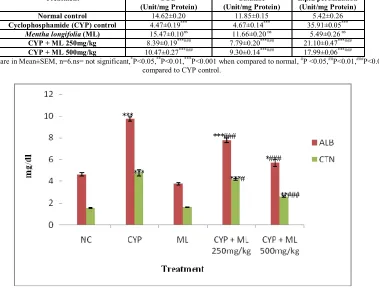
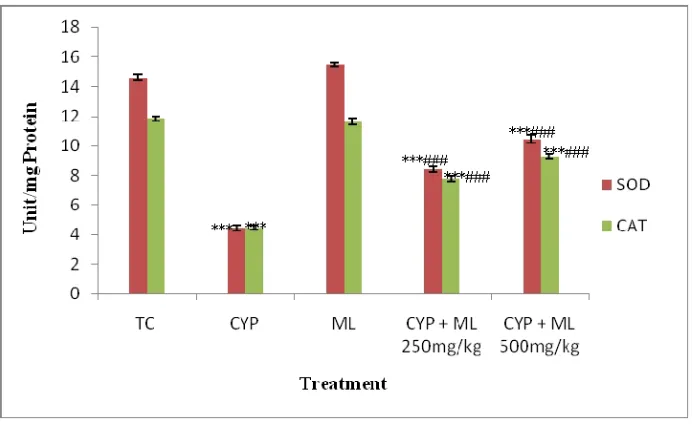
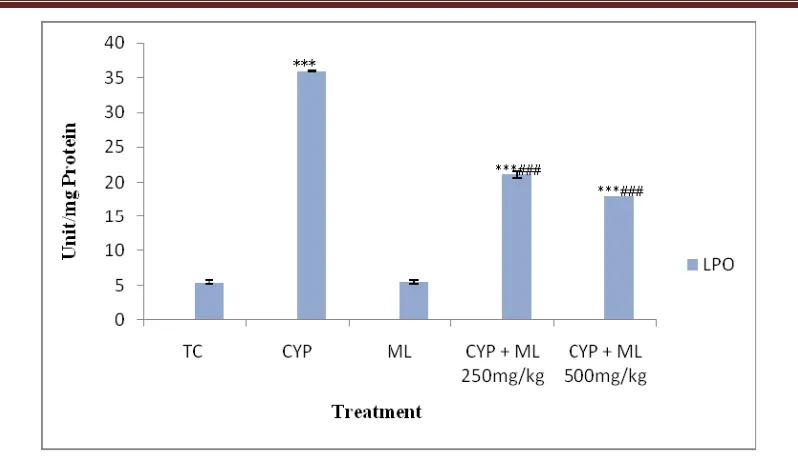
(2) Ayshath Afroos Shahana A.R et al. Int. Res. J. Pharm. 2016, 7 (6) MATERIALS AND METHODS. microscope.22. Preparation of Mentha longifolia Extract. Statistical Analysis. The plant of Mentha longifolia was collected from Riyad, KSA in the month of September 2015. The material was procured and identified by Dr. Shanavaskhan AE, scientist, king abdulaziz city for science and technology, Riyad, KSA. The leaves were cut in to small pieces and shade dried. It was then coarsely powdered and extracted using ethanol (80%) by maceration process. The obtained ethanolic extracts were filtered and evaporated by using a rotary evaporator and freeze dryer, respectively to give the crude dried extract8. The yield was found to be 15.38% (W/W). Extract was freshly dissolved in tween 80% before giving each dose to animals.. Results are expressed as mean ± SEM. Statistical significance was assessed using one‑way analysis of variance (ANOVA) followed by Tukey‑Karmer multiple comparison tests. P <0.05 was considered significant.. Experimental Animals Healthy adult Wistar albino rats of either sex weighing 175-250 g were procured from Animal House, Shree Devi College of Pharmacy, Mangaluru. Rats were housed in polypropylene cages, maintained under standardized condition (12 h L: D cycles, 25° ± 5°C) with paddy husk bedding at the Central Animal House, Shree Devi College of Pharmacy, Mangaluru. Animals were provided with standard pellet food and had free access to purified drinking water. The guidelines of Committee for the Purpose of Control and Supervision of Experiments on Animals (CPCSEA), Ministry of Social Justice and Empowerment, Government of India were followed and prior permission was sought from the Institutional Animal Ethics Committee for conducting the study (SDCP/IAEC‑01/2014‑15). Experimental Protocol Animals divided into five groups of six animals each. Group 1 served as normal control and administered 1 ml per kg body weight (p.o.) of 0.5 % carboxymethyl cellulose (CMC) daily for 10 days. Group 2 served as cyclophosphamide control where animals were administered with a single dose of CYP (200 mg/kg, i.p.) on the first day of experimental period. Group 3 animals were treated with ethanol extract of Mentha longifolia at (500 mg/kg p.o.) alone for 10 days. Group 4 animals received single dose of CYP (200 mg/kg i.p.) on first day followed by the administration of ethanol extract (250 mg/kg) of ML continuously for 10 days. Group 5 animals were daily administered ML ethanol extract (500 mg/kg) of for 10 days immediately after a single dose of CYP (200 mg/kg i.p.) on first day.15 Oxidative Marker Enzymes Assay Twenty-four hour after the last treatment, blood was collected for the separation of serum and analyzed for Albumin (ALB),16 Creatinine (CTN)17 and Total protein (TP).18 Estimation of marker enzymes were done by using commercial kits with the help of semi‑auto analyzer (model: Prietest touch, Robonik India PVT.LTD.). Then the animals were sacrificed by mild ether anaesthesia. The heart tissue was homogenized with sucrose solution (0.25 M) for estimations of superoxide dismutase (SOD),19 catalase (CAT)20 and lipid peroxidation (LPO).21 Histopathological Evaluation The kidney tissue was dissected and fixed in 10% formalin. The paraffin sections were prepared and stained with haematoxylin and eosin for the examination using the light. RESULTS Serum Enzyme Biomarkers CYP control group demonstrated extremely significant increase in serum Albumin (ALB), Creatinine (CTN) and Total protein (TP) values compared to normal control. Mentha longifolia (ML, 250 mg/kg and 500mg/kg) treated rats significantly decreased the ALB, CTN and TP values in dose dependent fashion compared to CYP control group [Table 1, Figure 1,2]. Effect of SOD and Catalase SOD and catalase activity were reduced extremely significantly in CYP control compared to normal control. Experimental groups such as Mentha longifolia (250 mg/kg and 500mg/kg) treated groups resulted in extremely significant improvement in SOD and catalase activity compared to CYP‑treated group [Table 2, Figure 3,4]. Effect on Lipid Peroxidation CYP control group exhibited extremely significant increase in LPO levels compared to normal control. Mentha longifolia treatment in a dose dependent manner demonstrated extremely significant reduction in LPO levels compared to CYP control group [Table 2, Figure 3,4]. Histopathological Observations CYP control group showed distorted structure of rat kidney by severe necrosis of the tubules. Engorged blood vessels and areas of heamorrhage were seen, suggesting severe tubular necrosis. Thus confirming the nephrotoxic effect of CYP at the dose used. Mentha longifolia, provided dose dependant protection against CYP induced renal epithelial cells damage [Figure 5]. DISCUSSION The aim of the present study was to investigate the effect of ML leaf extract against CYP‑induced nephrotoxicity. From the documented results, it can be concluded that ML leaf extract (250 and 500 mg/kg, p.o.) showed beneficial results dose dependently. Mentha longifolia contain different flavanoids, monoterpene ketones, tannins and saponins which are responsible for different pharmacological and biological activity of these plants. Flavanoids are a class of polyphenolic substances with reported properties including free radical scavenging, inhibition of hydrolytic and oxidative enzymes and anti-inflammatory action. Nephrotoxicity is caused due to the two active metabolites of CYP, named phosphoramide mustard and acrolein. Phosphoramide produces an antineoplastic effect and acrolein produces free radicals by interacting with body’s antioxidant defense system. Lipid peroxidation is one of the main reasons of cyclophosphamide-induced toxicity, due to the production of. 78.
(3) Ayshath Afroos Shahana A.R et al. Int. Res. J. Pharm. 2016, 7 (6) acrolein. Nephrotoxicity was characterized by marked reduction in SOD and Catalase and elevated lipid peroxidation level. In our present finding, animals treated with only CYP demonstrated significant decrease in SOD, Catalase and significant increase in lipid peroxidation, which indicates the induction of renal toxicity. Prophylactic treatment with Mentha longifolia dose dependently increase SOD and Catalase activity and decrease lipid peroxidation level which justify it’s protection. Elevations in serum Albumin, Creatinine and Total protein level can serve as clinical indicators of poor kidney function. Acrolein produced during CYP metabolism is known to be nephrotoxic. In this study, the animals treated with only CYP showed remarkable increase in the levels of serum markers like. Albumin, Creatinine and Total protein. Prophylactic treatment with Mentha longifolia dose dependently decrease Albumin, Creatinine and Total protein level which justify it’s protection. Histological study in CYP induced nephrotoxicity supported the findings of other parameters analyzed in different treatment groups. For the normal kidney, occasional blood vessels were seen in both cortex and medulla. Treatment with Mentha longifolia dose dependently inhibited CYP induced renal damage by preventing the focal degenerative changes in the renal tubular epithelial cells. Mentha longifolia predominantly in higher dose (500 mg/kg) was able to retrieve the pathological changes associated with CYP in renal epithelial cell.. Table 1: Effect of M.longifolia on serum level of albumin, creatinine and total protein in CYP induced nephrotoxicity in rats Treatment. Albumin Creatinine Total Protein (mg/dl) (mg/dl) (mg/dl) Normal control 4.63±0.13 1.57±0.04 51.76±0.13 Cyclophosphamide (CYP) control 9.74±0.21*** 4.76±0.25*** 76.67±0.32*** 1.63±0.02 ns Mentha longifolia (ML) 3.74±0.12ns 51.73±0.12 ns 7.77±0.23***### 67.55±0.18***### CYP + ML 250mg/kg 4.15±0.09***# CYP + ML 500mg/kg 5.68±0.33*### 2.61±0.08**### 56.36±0.22***### * ** *** # All the values are in Mean±SEM, n=6.ns= not significant, P<0.05, P<0.01, P<0.001 when compared to normal, P <0.05,##P<0.01,###P<0.001 when compared to CYP control. Table 2: Effect of M.longifolia on antioxidants SOD, Catalase and lipid peroxidation in CYP induced nephrotoxicity in rats Treatment. SOD Catalase Lipid peroxidation (Unit/mg Protein) (Unit/mg Protein) (Unit/mg Protein) 14.62±0.20 11.85±0.15 5.42±0.26 Normal control *** *** Cyclophosphamide (CYP) control 4.67±0.14 4.47±0.19 35.91±0.05*** Mentha longifolia (ML) 15.47±0.10ns 11.66±0.20 ns 5.49±0.26 ns 8.39±0.19***### 21.10±0.47***### CYP + ML 250mg/kg 7.79±0.20***### CYP + ML 500mg/kg 10.47±0.27***### 9.30±0.14***### 17.99±0.06***### All the values are in Mean±SEM, n=6.ns= not significant,*P<0.05,**P<0.01,***P<0.001 when compared to normal, #P <0.05,##P<0.01,###P<0.001 when compared to CYP control.. Figure 1: Effect of M.longifolia on serum level of Albumin and Creatinine in CYP induced nephrotoxicity in rats All the values are in Mean±SEM, n=6.ns= not significant,*P<0.05,**P<0.01,***P<0.001 when compared to normal, #P <0.05,##P<0.01,###P<0.001 when compared to CYP control.. 79.
(4) Ayshath Afroos Shahana A.R et al. Int. Res. J. Pharm. 2016, 7 (6). Figure 2: Effect of M.longifolia on serum level of Total protein in CYP induced nephrotoxicity in rats All the values are in Mean±SEM, n=6.ns= not significant,*P<0.05,**P<0.01,***P<0.001 when compared to normal, #P <0.05,##P<0.01,###P<0.001 when compared to CYP control.. Figure 3: Effect of M.longifolia on antioxidants SOD and Catalase in CYP induced nephrotoxicity in rats All the values are in Mean±SEM, n=6.ns= not significant,*P<0.05,**P<0.01,***P<0.001 when compared to normal, #P <0.05,##P<0.01,###P<0.001 when compared to CYP control.. 80.
(5) Ayshath Afroos Shahana A.R et al. Int. Res. J. Pharm. 2016, 7 (6). Figure 4: Effect of M.longifolia on antioxidant of Lipid peroxidation in CYP induced nephrotoxicity in rats All the values are in Mean±SEM, n=6.ns= not significant,*P<0.05,**P<0.01,***P<0.001 when compared to normal, #P <0.05,##P<0.01,###P<0.001 when compared to CYP control.. 5(a). 5(b). 5(c). 5(d). Figure 5: Histopathological evaluation of kidney tissue in (a) normal (b) CYP treated (c) CYP+ML (250mg/kg) treated and (d) CYP+ML (500mg/ kg) treated rats. CONCLUSION. ACKNOWLEDGEMENT. It can be concluded from the present study that CYP treatment causes pronounced oxidative stress and tissue damage in the kidney. Administration of ML extract protects the CYP induced nephrotoxicity in dose dependent manner. Biochemical and histopathological studies confirm the nephroprotective role of Mentha longifolia. Future studies can be carried out to establish the fact clinically.. Authors would like to thank Dr. Shanavaskhan AE, scientist, king abdulaziz city for science and technology, Riyad, KSA for identification of plant Mentha longifolia. The authors are also thankful to management of Shree Devi College of Pharmacy, Mangaluru, India for their constant encouragement and support and providing all the necessary facilities for carrying out this study.. 81.
(6) Ayshath Afroos Shahana A.R et al. Int. Res. J. Pharm. 2016, 7 (6) REFERENCES 1. Ashry NA, Gameil NM, Suddek GM. Mitigating role of quercetin against cyclophosphamide-induced lung injury in rats. Journal of Food and Pharmaceutical Science 2014;2:3945. 2. Estakhri R, Hajipour B, Majidi H, Soleimani H. Vitamin E ameliorates cyclophosphamide induced nephrotoxicity. Life Science Journal 2013;10(6):308-13. 3. Todorova V, Vanderpool D, Blossom S, Nwokedi E, Hennings L, Mrak R, et al. Oral glutamine protects against cyclophosphamide‑induced cardiotoxicity in experimental rats through increase of cardiac glutathione. Nutrition 2009;25:812‑7. 4. Angie MAM, Paka GD, Ntentie FR, Dimodi H, Ngondi JL, Enyong JO. Protective effect of hydroethanolic extract of Solanum scabrum and Cola verticillata against cyclophosphamide induced toxicity in female rats. Journal of Food Research 2014;3(3):18-30. 5. Dzamic AM, Sokovic MD, Ristic MS, Novakovic M, Grujic-Jovanovic S, Tesevic V, et al. Antifungal and antioxidant activity of Mentha longifolia (L.) Hudson (Lamiaceae) essential oil. Botanica SERBICA 2010;34(1):57-61. 6. Al-Ali K, Abdelrazik M, Alghaithy A, Diab A, ElBeshbishy H, Baghdadi H. Antimutagenic and anticancer activity of Al Madina Alhasawy mint (Mentha longifolia) leaves extract. Pakistan Journal of Biological Sciences 2014;1-6. 7. Alamgeer, Akhtar MS, Jabeen Q, Bashir S, Malik MNH, Khan HU, et al. Antihypertensive and toxicity studies of aqueous methanolic extract of Mentha longifolia L. The Journal of Animal and Plant Sciences 2013;23(6):1622-7. 8. Dragana M, Stojicevic SS, Zlatkovic BP, Velickovic DT, Karabegovic IT, Lazic ML, et al. Antioxidant activity, the content of total phenols and flavanoids in the ethanol extracts of Mentha longifolia (L.)Hudson dried by the use of different techniques. Chemical Industry and Chemical Engineering Quarterly 2012;18(3):411-20. 9. Khan RA, Khan F, Ahmed M, Shah AS, Khan NA, Khan MR, et al. Phytotoxic and antibacterial assays of crude methanolic extract of Mentha longifolia (Linn.). African Journal of Pharmacy and Pharmacology 2011 Sep 29;5(12):1530-3. 10. Ruwali Pushpa, Rai Nishant, Kumar Navin, Gautam Pankaj. Antiviral potential of medicinal plants: An overview. Int. Res. J. Pharm. 2013; 4(6):8-16 DOI: 10.7897/2230-8407.04603. 11. Bhrigu Kumar Das, Mandeep Kumar Singh, Jayamma M Kulkarni. Potential gastroprotective medicinal plants: An overview. Int. Res. J. Pharm. 2016;7(2):8-14 http://dx.doi.org/10.7897/2230-8407.07213 12. Ertas A, Goren AC, Hasimi N, Tolan V, Kolak U. Evaluation of antioxidant, cholinesterase Inhibitory and antimicrobial properties of Mentha longifolia subsp. noeana. 13.. 14.. 15.. 16.. 17.. 18. 19.. 20.. 21.. 22.. and it’s secondary metabolites. Records of Natural Products 2015;9(1):105-15. Akroum S, Bendjeddou D, Satta D, Lalaoui K. Antibacterial activity and acute toxicity effect of flavanoids extracted from Mentha longifolia . American-Eurasian Journal of Scientific Research 2009;4(2):93-6. Sharopov F, Sulaimonova VA, Setzer WN. Essential oil composition of Mentha longifolia from wild populations growing in Tajikistan. Journal of Medicinally Active Plants 2012 Jun;1(2):76-84. Viswanathaswamy AHM, Patel UM, Koti BC, Gadad PC, Patel NL, Thippeswamy AHM. Cardioprotective effect of Saraca indica against cyclophosphamide induced cardiotoxicity in rats: a biochemical electrocardiographic and histopathological study. Indian Journal of Pharmacology 2013 Feb;45(1):44- 8. Johnson AM, Rohfs EM, Silverman LM. Proteins. In: Burtis CA, Ashwood ER. Editors Tietz text book for clinical chemistry. 3rd ed. Philadelphia: W.B Saunders Company; 1999. p. 477-540. Reddy C, Amulya V, Lakshmi CH, Reddy PK, Prathima D, Thirupathi A, Kumar PK et al. Effect of simvastatin in Gentamicin induced Nephrotoxicity in Albino Rats. Asian Journal of Pharmaceutical and Clinical Research 2011;5(1):36-40. Young DS. Effects of drugs on clinical lab. Tests, 4th ed. AACC Press, 1995. Oyedemi SO, Brandley G, Alfolayan J. In–vitro and In–vivo antioxidant activities of aqueous extract of Strychnoshenningsii Gilg. African Journal of Pharmacy and Pharmacology 2010;4(2): 70-8. Rajasekaran A, Kalaivani M. Antioxidant activity of aqueous extract of Monascus fermented Indian variety of rice in high cholesterol diet fed-Streptozotocin diabetic rats, an in vivo study. International Journal of Current Scientific Research 2011;1(2): 35-8. Rukmini MS, Dsouza B, Dsouza V. Sopper oxide dismutase and catalase activities and their correlation with molonaldehyde in schizophrenic patients. Indian Journal of Clinical Biochemistry 2004;19(2): 114-8. Chakraborty M, Asdaq SM. Interaction of Semecarpus anacardium L. with propranolol against isoproterenol induced myocardial damage in rats. Indian Journal of Experimental Biology 2011;49:200-6.. Cite this article as: Ayshath Afroos Shahana A.R, Sanjiv Karale, Jagadish V. Kamath. Nephroprotective effect of Mentha longifolia against cyclophosphamide induced nephrotoxicity in rats: A biochemical and histopathological study. Int. Res. J. Pharm. 2016;7(6):77-82 http://dx.doi.org/10.7897/2230-8407.07668. Source of support: Nil, Conflict of interest: None Declared Disclaimer: IRJP is solely owned by Moksha Publishing House - A non-profit publishing house, dedicated to publish quality research, while every effort has been taken to verify the accuracy of the content published in our Journal. IRJP cannot accept any responsibility or liability for the site content and articles published. The views expressed in articles by our contributing authors are not necessarily those of IRJP editor or editorial board members.. 82.
(7)
Figure
Related documents
We now see the development of a na tional telephone service from which, at any time of the day or night, the subscribing physician, or hospital, is at once given whatever
Our study shows that while we cannot obtain the true vote shares until election day, we can still fine-tune the model parameters by using up-to-date time series signal data for
This thesis explores the socio-religious environment of the Basques and the confrontation and miscommunication of the accused witches and the Inquisitors through linguist Mary
The question may now be raised whether the rather striking eye color changes which take place during the development of the flies are due to changes in the proportions of
BP: Blood pressure; DWI: Diffusion weighted image; FLAIR: Fluid attenuated inversion recovery; MRA: Magnetic resonance angiography; MRS: Magnetic resonance spectroscopy; NAA:
Organizational commitment to turnover intention has NEGATIVE influence with original sample value of -0.472 which means that lower organizational commitment then
In situations where anticoagulation is indicated and offered, there is no room for ambiguity in explaining to patients the certain benefit of anticoagulation and lack of known
Specifically, this research approach would help readers understand how elementary teachers within one school make sense of the role that race, gender, social class, and power play
